物理化学学报 >> 2025, Vol. 41 >> Issue (3): 100027.doi: 10.3866/PKU.WHXB202406007
氰基修饰的苝二酰亚胺衍生物作为膜厚不敏感型阴极界面材料用于高效有机太阳能电池
王毅锴1, 蒋晓林2, 宋浩鸣1, 魏楠1, 王逸凡2, 徐新军1, 李翠红1,*( ), 路皓2,*(), 刘亚辉2,*, 薄志山1,*()
- 1 北京师范大学化学学院, 能量转换与存储材料北京市重点实验室, 北京 100875
2 青岛大学纺织服装学院, 省部共建生物多糖纤维成形与生态纺织国家重点实验室, 青岛 266071
-
收稿日期:2024-06-06修回日期:2024-07-10录用日期:2024-07-11发布日期:2024-12-14 -
通讯作者:Email: licuihong@bnu.edu.cn (李翠红)luhao@qdu.edu.cn (路皓)liuyh@qdu.edu.cn (刘亚辉)zsbo@bnu.edu.cn (薄志山) -
基金资助:国家自然科学基金(22375024); 国家自然科学基金(21975031); 国家自然科学基金(51933001); 国家自然科学基金(21734009)
Thickness-Insensitive, Cyano-Modified Perylene Diimide Derivative as a Cathode Interlayer Material for High-Efficiency Organic Solar Cells
Yikai Wang1, Xiaolin Jiang2, Haoming Song1, Nan Wei1, Yifan Wang2, Xinjun Xu1, Cuihong Li1,*(), Hao Lu2,*(), Yahui Liu2,*, Zhishan Bo1,*()
- 1 Beijing Key Laboratory of Energy Conversion and Storage Materials, College of Chemistry, Beijing Normal University, Beijing 100875, China
2 College of Textiles & Clothing, State Key Laboratory of Bio-fibers and Eco-textiles, Qingdao University, Qingdao 266071, Shandong Province, China
-
Received:2024-06-06Revised:2024-07-10Accepted:2024-07-11Published:2024-12-14 -
Contact:Email: licuihong@bnu.edu.cn (Cuihong Li)luhao@qdu.edu.cn (Hao Lu)liuyh@qdu.edu.cn (Yahui Liu)zsbo@bnu.edu.cn (Zhishan Bo) -
Supported by:the National Natural Science Foundation of China(22375024); the National Natural Science Foundation of China(21975031); the National Natural Science Foundation of China(51933001); the National Natural Science Foundation of China(21734009)

摘要:
开发膜厚不敏感型阴极界面材料是当前有机太阳能电池(OSCs)研究的重点和难点之一。在本研究中,我们设计并合成了一种低成本的氰基修饰的苝二酰亚胺衍生物PDINBrCN作为阴极界面层材料,PDINBrCN表现出良好的加工性和调节电极功函数的能力,当用作D18:L8-BO器件中的阴极界面层时,PDINBrCN在10 nm的膜厚度下实现了18.83%的光电转换效率(PCE),即使当膜厚度增加到50 nm时,器件仍然保持17.90%的PCE。因此,PDINBrCN有望成为一种高效、低成本的阴极界面层材料。
引用本文
王毅锴, 蒋晓林, 宋浩鸣, 魏楠, 王逸凡, 徐新军, 李翠红, 路皓, 刘亚辉, 薄志山. 氰基修饰的苝二酰亚胺衍生物作为膜厚不敏感型阴极界面材料用于高效有机太阳能电池[J]. 物理化学学报, 2025, 41(3), 100027. doi: 10.3866/PKU.WHXB202406007
Yikai Wang, Xiaolin Jiang, Haoming Song, Nan Wei, Yifan Wang, Xinjun Xu, Cuihong Li, Hao Lu, Yahui Liu, Zhishan Bo. Thickness-Insensitive, Cyano-Modified Perylene Diimide Derivative as a Cathode Interlayer Material for High-Efficiency Organic Solar Cells[J]. Acta Phys. -Chim. Sin. 2025, 41(3), 100027. doi: 10.3866/PKU.WHXB202406007
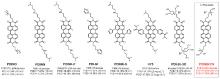
图1
Chemical structures of the PDI derivatives (including PDINBrCN, studied in this work) used as the cathode interlayer material, their film thickness tolerances, as well as the PCEs achieved across different cathode interface layer thicknesses 30–36."
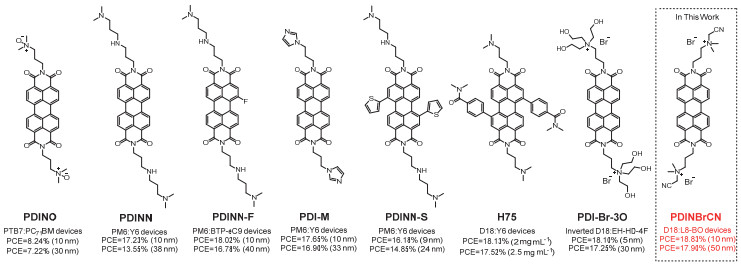
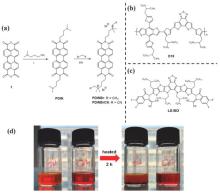
图1
(a) The synthesis procedure of PDINBrCN and PDINBr, in which the conditions are i) N, N-dimethylformamide (DMF), 130 ℃; ii) TFE, reflux; iii) DMF, 100 ℃; (b, c) chemical structures of D18 and L8-BO; (d) the photography of PDINBrCN and PDINBr in TFE solutions after heating for 2 h."
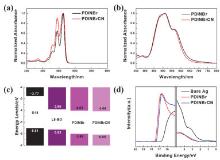
图2
(a) UV-Vis spectra of the PDINBr and PDINBrCN solutions in TFE; (b) UV-Vis spectra of the PDINBr and PDINBrCN films; (c) energy levels of active layers, PDINBr and PDINBrCN; (d) UPS spectra of bare Ag electrode, PDINBr and PDINBrCN on Ag substrates."
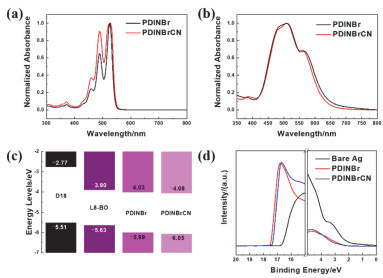
表1
Optical and electrochemical properties of PDINBr and PDINBrCN."
| ETLs | | | HOMO a/eV | LUMO b/eV | WF/eV | ||
| PDINBr | 525 | 510 | 632 | 1.96 | −5.99 | −4.03 | 3.78 |
| PDINBrCN | 529 | 509 | 628 | 1.97 | −6.05 | −4.08 | 3.90 |
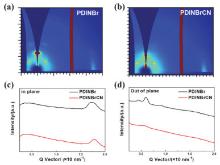
图3
GIWAXS patterns of (a) PDINBr and (b) PDINBrCN as thin films and their corresponding line-cut profiles in the (c) IP and (d) OOP direction."
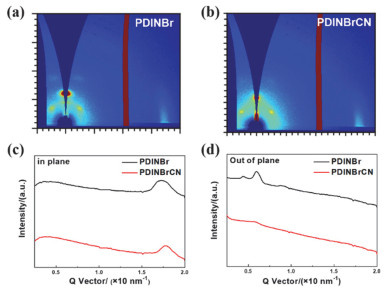
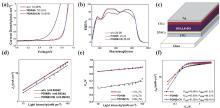
图4
(a) J–V curves and (b) EQE curves for D18:L8-BO-based devices without an interlayer, and with PDINBr or PDINBrCN interlayer at an optimized thickness of approximately 10 nm; (c) the device structure; (d) dependence of Jsc on the light intensity; (e) dependence of Voc on the light intensity; (f) Jph vs. Veff of the OSCs devices."
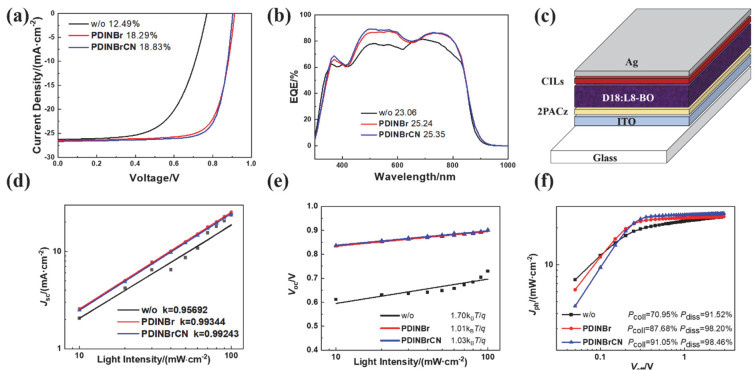
表2
Photovoltaic parameters of D18:L8-BO based devices with or without PDI-based ETLs under the illumination of AM 1.5G, 100 mW∙cm−2."
| Active Layers | ETLs | Thickness/nm | Voc/V | Jsc /(mA∙cm−2) | FF/% | PCE/% |
| D18:L8-BO | w/o | 0 | 0.769 | 26.28 | 61.39 | 12.49 |
| PDINBr | 10 | 0.913 | 26.48 (25.360 a) | 75.18 | 18.29 | |
| 50 | 0.899 | 25.42 (24.567 a) | 74.25 | 17.17 | ||
| PDINBrCN | 10 | 0.903 | 26.67 (25.351 a) | 77.68 | 18.83 | |
| 50 | 0.904 | 26.12 (25.442 a) | 75.27 | 17.90 |
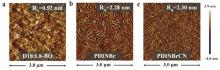
图5
The AFM height image of (a) active layer (D18:L8-BO), (b) PDINBr and (c) PDINBrCN scattering on the active layer."
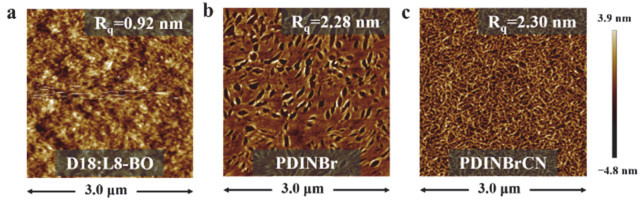
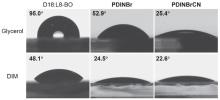
图6
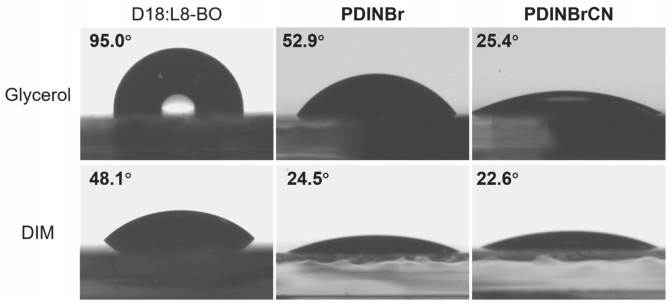
Contact angles of glycerol (the first line) and diiodomethane (DIM, the second line) dropped on D18:L8-BO, PDINBr and PDINBrCN films scattering on ITO/glass."
| 1 |
doi: 10.1038/s41563-022-01244-y |
| 2 |
doi: 10.1093/nsr/nwad085 |
| 3 |
doi: 10.1002/anie.202314420 |
| 4 |
doi: 10.31635/ccschem.024.202404023 |
| 5 |
李若男; 梁世洁; 许韵华; 张翠芬; 唐正; 刘柏侨; 李韦伟. 物理化学学报, 2024, 40(8), 2307037.
doi: 10.3866/PKU.WHXB202307037 |
|
|
|
| 6 |
doi: 10.1002/adma.201502110 |
| 7 |
doi: 10.1002/adma.201600281 |
| 8 |
doi: 10.1002/adma.201707170 |
| 9 |
doi: 10.1016/j.joule.2019.01.004 |
| 10 |
doi: 10.1016/j.scib.2020.01.001 |
| 11 |
doi: 10.1038/s41560-021-00820-x |
| 12 |
doi: 10.1002/adma.201404317 |
| 13 |
doi: 10.1007/s11426-024-2054-8 |
| 14 |
doi: 10.11777/j.issn1000-3304.2022.22055 |
| 15 |
张默淳; 冯硕; 邬赟羚; 李彦光. 物理化学学报, 2023, 39(2), 2205050.
doi: 10.3866/PKU.WHXB202205050 |
|
|
|
| 16 |
doi: 10.1002/adma.202400342 |
| 17 |
doi: 10.11777/j.issn1000-3304.2023.23020 |
| 18 |
梁秋菊; 常银霞; 梁朝伟; 祝浩雷; 郭子宾; 刘剑刚. 物理化学学报, 2023, 39(7), 2212006.
doi: 10.3866/PKU.WHXB202212006 |
|
|
|
| 19 |
赵永智; 陈晨阳; 刘文燚; 胡伟飞; 刘金平. 物理化学学报, 2023, 39(8), 2211017.
doi: 10.3866/PKU.WHXB202211017 |
|
|
|
| 20 |
郭雅雯; 李大伟; 高杨; 李翠红. 物理化学学报, 2024, 40(6), 2306050.
doi: 10.3866/PKU.WHXB202306050 |
|
|
|
| 21 |
doi: 10.1002/anie.201503933 |
| 22 |
doi: 10.1021/jacs.0c07439 |
| 23 |
doi: 10.1021/acsenergylett.3c00584 |
| 24 |
doi: 10.1126/science.1218829 |
| 25 |
doi: 10.1002/aenm.201501393 |
| 26 |
doi: 10.1038/nphoton.2012.190 |
| 27 |
doi: 10.1021/acsami.5b10211 |
| 28 |
doi: 10.1021/acsami.5b08769 |
| 29 |
doi: 10.1007/s11426-024-1948-6 |
| 30 |
doi: 10.1039/C4EE00022F |
| 31 |
doi: 10.1038/s41467-020-16509-w |
| 32 |
doi: 10.1002/adma.202203690 |
| 33 |
doi: 10.1021/acsenergylett.1c01482 |
| 34 |
doi: 10.1021/acsami.2c22069 |
| 35 |
doi: 10.1002/adfm.202303386 |
| 36 |
doi: 10.1039/d3ta07443a |
| 37 |
doi: 10.1021/cm048642z |
| 38 |
doi: 10.1038/s41598-021-95551-0 |
| 39 |
doi: 10.1126/science.1255826 |
| 40 |
doi: 10.1021/acsami.1c12790 |
| 41 |
doi: 10.1021/acsami.6b02712 |
| 42 |
doi: 10.1039/D3TA04833K |
| 43 |
doi: 10.5101/nml.v6i1.pp.24–29 |
| [1] | 王震寰, 韦炜斐, 马睿杰, 罗豆, 陈展翔, 张君, 于立扬, 李刚, 罗正辉. 苯并[a]苯嗪受体的核心氰基化实现高效(19.04%)绿色溶剂加工的二元有机太阳能[J]. 物理化学学报, 2026, 42(2): 100182 - . |
| [2] | 李若男, 梁世洁, 许韵华, 张翠芬, 唐正, 刘柏侨, 李韦伟. 氯取代近红外双缆共轭高分子材料与低能量损失单组分有机太阳能电池[J]. 物理化学学报, 2024, 40(8): 2307037 - . |
| [3] | 郭雅雯, 李大伟, 高杨, 李翠红. 非富勒烯受体有机太阳能电池稳定性研究进展[J]. 物理化学学报, 2024, 40(6): 2306050 - . |
| [4] | 梁秋菊, 常银霞, 梁朝伟, 祝浩雷, 郭子宾, 刘剑刚. 结晶动力学策略在非富勒烯体系太阳能电池形貌调控领域的应用[J]. 物理化学学报, 2023, 39(7): 2212006 -0 . |
| [5] | 徐小云, 吴宏波, 梁世洁, 唐正, 李梦阳, 王静, 王翔, 闻瑾, 周二军, 李韦伟, 马在飞. 聚3-己基噻吩:非富勒烯太阳能电池中的量子效率损失和电压损失[J]. 物理化学学报, 2022, 38(11): 2201039 - . |
| [6] | 尹媛, 郭振东, 陈高远, 张慧峰, 尹万健. 卤化钙钛矿太阳能电池的缺陷容忍及缺陷钝化研究进展[J]. 物理化学学报, 2021, 37(4): 2008048 - . |
| [7] | 刘柏侨, 许韵华, 夏冬冬, 肖承义, 杨兆凡, 李韦伟. 基于非富勒烯电子受体的半透明有机太阳能电池[J]. 物理化学学报, 2021, 37(3): 2009056 - . |
| [8] | 魏珍, 李敏杰, 陆文聪. 应用于染料敏化太阳能电池的基于染料R6的含有不同吸电子基团的有机染料的理论研究[J]. 物理化学学报, 2021, 37(10): 1905084 - . |
| [9] | 董玉杰,许晨东,王士昭,李维军,宋庆宝,张诚. 通过增强电荷转移激发态构建激发态下稳定的基于氰基二苯乙烯的E/Z构型[J]. 物理化学学报, 2019, 35(6): 637 -643 . |
| [10] | 张美琪, 马云龙, 郑庆东. 含萘并二噻吩小分子受体材料的带隙调控及其在非富勒烯太阳能电池中的应用[J]. 物理化学学报, 2019, 35(5): 503 -508 . |
| [11] | 邓祎华, 彭爱东, 吴筱曦, 陈华杰, 黄辉. 有机太阳能电池中基于苝二酰亚胺结构小分子受体进展[J]. 物理化学学报, 2019, 35(5): 461 -471 . |
| [12] | 章中强, 张书华, 刘志玺, 张志国, 李永舫, 李昌治, 陈红征. 骨架非稠合的电子受体在聚合物太阳能电池中的应用[J]. 物理化学学报, 2019, 35(4): 394 -400 . |
| [13] | 薛佩瑶,张俊祥,辛景明,RECHJeromy,李腾飞,孟凯鑫,王嘉宇,马伟,尤为,MARDER Seth R.,韩平畴,占肖卫. 第三组份端基对有机太阳能电池性能的影响[J]. 物理化学学报, 2019, 35(3): 275 -283 . |
| [14] | 刘方彬,刘俊,王利祥. 带有噻吩侧基的有机硼小分子电子受体光伏材料[J]. 物理化学学报, 2019, 35(3): 251 -256 . |
| [15] | 杨阳,蒋秀,占肖卫,陈兴国. 以绕丹宁和噻唑烷-2, 4-二酮为端基的不对称结构有机受体分子的设计合成与构性关系探讨[J]. 物理化学学报, 2019, 35(3): 257 -267 . |
|
||