物理化学学报 >> 2025, Vol. 41 >> Issue (4): 100038.doi: 10.3866/PKU.WHXB202408015
论文 上一篇
光增强CuOx/TiO2催化丙烯氧气直接环氧化反应
吕卓岩1,2, 丁杨铭1, 康磊磊1,*( ), 李林1, 刘晓艳1,*(), 王爱琴1, 张涛1
- 1 中国科学院大连化学物理研究所, 中国科学院航天催化材料重点实验室, 能源材料化学协同创新中心, 辽宁 大连 116023
2 中国科学院大学, 北京 100049
-
收稿日期:2024-08-27修回日期:2024-09-25录用日期:2024-10-02发布日期:2024-12-28 -
通讯作者:Email: xyliu2003@dicp.ac.cn; Tel.: +86-411-84379416 (刘晓艳)leikang@dicp.ac.cn (康磊磊) -
基金资助:国家自然科学基金委“单原子催化”基础科学中心项目(22388102); 中央高校基本科研业务费专项资金(20720220009); 中国科学院洁净能源创新研究院合作基金(DNL202002); 辽宁省兴辽英才计划(XLYC2007070); 中国科学院B类先导专项(XDB0540000)
Light-Enhanced Direct Epoxidation of Propylene by Molecular Oxygen over CuOx/TiO2 Catalyst
Zhuoyan Lv1,2, Yangming Ding1, Leilei Kang1,*(), Lin Li1, Xiao Yan Liu1,*(), Aiqin Wang1, Tao Zhang1
- 1 CAS Key Laboratory of Science and Technology on Applied Catalysis, iChEM, Dalian Institute of Chemical Physics, Chinese Academy of Sciences, Dalian 116023, Liaoning Province, China
2 University of Chinese Academy of Sciences, Beijing 100049, China
-
Received:2024-08-27Revised:2024-09-25Accepted:2024-10-02Published:2024-12-28 -
Contact:Email: xyliu2003@dicp.ac.cn; Tel.: +86-411-84379416 (Xiao Yan Liu)leikang@dicp.ac.cn (Leilei Kang) -
Supported by:the NSFC Center for Single-Atom Catalysis(22388102); the Fundamental Research Funds for the Central Universities(20720220009); the DNL Cooperation Fund, CAS(DNL202002); the DNL Cooperation Fund, CAS(XLYC2007070); the Strategic Priority Research Program of the Chinese Academy of Sciences(XDB0540000)

摘要:
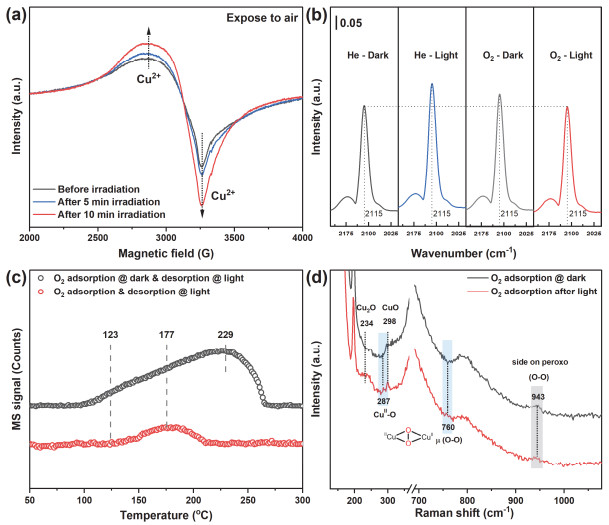
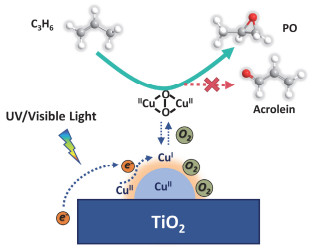
丙烯氧气直接环氧化(DEP)反应是合成环氧丙烷(PO)一种理想途径,但这一过程极具挑战性。本工作发现通过光热协同催化作用,在CuOx/TiO2催化剂上可以提升PO的生成速率和选择性。在180 ℃时,引入光照可使PO的生成速率提高20倍以上(从8.2增加到180.6 μmol·g−1·h−1),同时选择性提高了3倍以上(从8%增加到27%),打破了半导体在DEP反应中活性和选择性极低的传统认知。动力学研究结果表明,光照可显著降低PO生成的活化能(从95降至40 kJ·mol−1)。采用原位电子顺磁共振(EPR)、X射线光电子能谱(XPS)、拉曼光谱和漫反射红外傅里叶变换光谱(DRIFTS)技术,对铜氧化物物种的价态进行了动态表征,确定了氧气分子活化中间体的构型,首次捕捉到促进PO生成的活性氧物种。光生电子能够促进Cu+活性物种的形成以及μ侧过氧化二铜结构的产生,削弱O―O键,从而提高PO的生成速率和选择性。本工作为设计用于DEP反应的半导体光催化剂奠定良好的基础。
引用本文
吕卓岩, 丁杨铭, 康磊磊, 李林, 刘晓艳, 王爱琴, 张涛. 光增强CuOx/TiO2催化丙烯氧气直接环氧化反应[J]. 物理化学学报, 2025, 41(4), 100038. doi: 10.3866/PKU.WHXB202408015
Zhuoyan Lv, Yangming Ding, Leilei Kang, Lin Li, Xiao Yan Liu, Aiqin Wang, Tao Zhang. Light-Enhanced Direct Epoxidation of Propylene by Molecular Oxygen over CuOx/TiO2 Catalyst[J]. Acta Phys. -Chim. Sin. 2025, 41(4), 100038. doi: 10.3866/PKU.WHXB202408015
图1
"
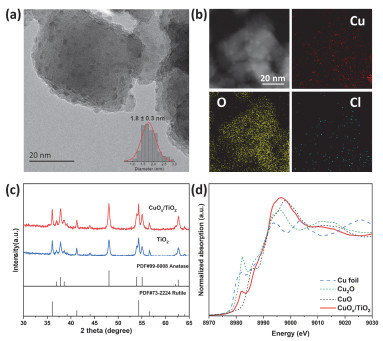
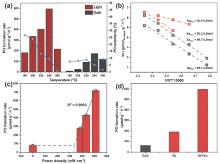
图2
"
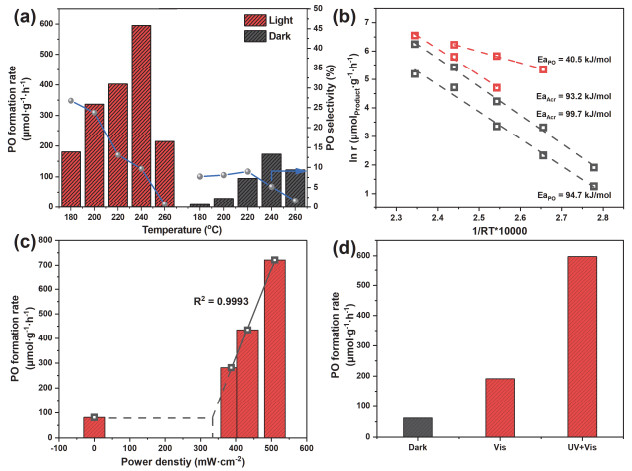
图3
"
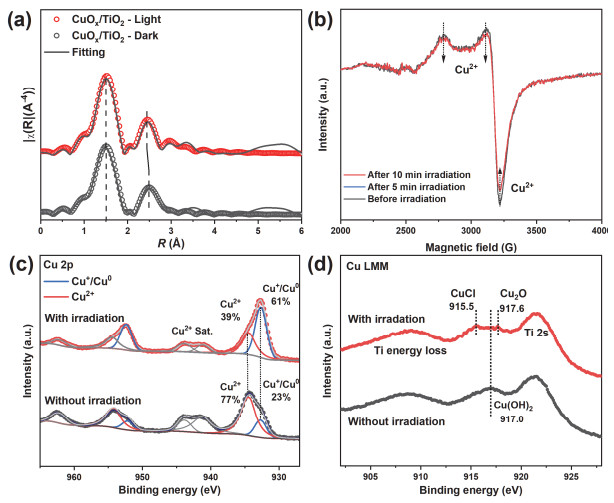
表1
"
| Sample | Shell | CN a | R (Å) | σ2 | ΔE0 (eV) | R factor (%) |
| CuOx/TiO2-Dark | Cu-O | 3.5 | 1.95 ± 0.004 | 0.005 | −0.8 | 0.2 |
| Cu-Cu1 | 2.0 | 2.92 ± 0.01 | 0.006 | |||
| Cu-Cu2 | 2.0 | 3.07 ± 0.01 | 0.005 | |||
| CuOx/TiO2-Light | Cu-O | 3.5 | 1.95 ± 0.01 | 0.006 | −0.5 | 0.4 |
| Cu-Cu1 | 1.1 | 2.85 ± 0.02 | 0.006 | |||
| Cu-Cu2 | 3.0 | 3.01 ± 0.02 | 0.013 |
图4
"
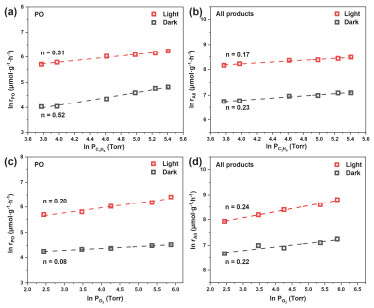
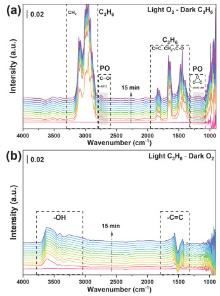
图5
"
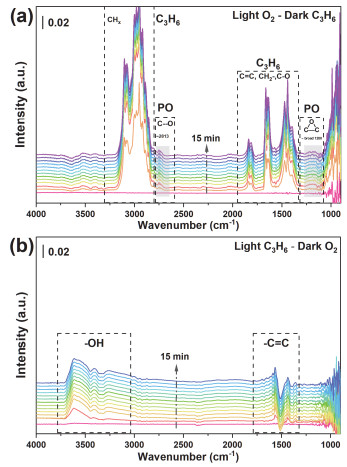
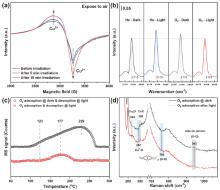
图6
"
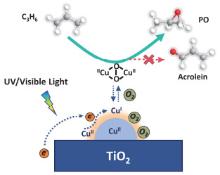
图Scheme 1
"
| 1 |
doi: 10.1080/01614940.2015.1041849 |
| 2 |
doi: 10.1021/acscatal.0c03340 |
| 3 |
doi: 10.1021/acscatal.1c05939 |
| 4 |
doi: 10.1021/acscatal.4c01566 |
| 5 |
doi: 10.1016/j.apcata.2006.10.051 |
| 6 |
|
| 7 |
doi: 10.1007/s11164-011-0424-6 |
| 8 |
doi: 10.1021/ie402416s |
| 9 |
doi: 10.1016/j.jcat.2009.09.017 |
| 10 |
doi: 10.1021/jp800927y |
| 11 |
doi: 10.1021/jacs.0c03882 |
| 12 |
doi: 10.1002/anie.202301497 |
| 13 |
doi: 10.1002/anie.201907443 |
| 14 |
doi: 10.1039/d1cs00782c |
| 15 |
doi: 10.1021/J100487A012 |
| 16 |
doi: 10.1016/0920-5861(93)80069-D |
| 17 |
doi: 10.1021/la0496439 |
| 18 |
doi: 10.1021/jp0277006 |
| 19 |
doi: 10.1016/s0021-9517(03)00292-6 |
| 20 |
doi: 10.1006/jcat.1997.1813 |
| 21 |
doi: 10.1126/science.1231631 |
| 22 |
doi: 10.1021/acscatal.4c01749 |
| 23 |
doi: 10.1002/anie.202001701 |
| 24 |
doi: 10.3866/PKU.WHXB202303003 |
| 25 |
doi: 10.1021/jacs.1c03788 |
| 26 |
doi: 10.1016/j.jcat.2010.12.016 |
| 27 |
doi: 10.1002/anie.200603803 |
| 28 |
doi: 10.1021/acscatal.7b01180 |
| 29 |
doi: 10.1002/adma.202207793 |
| 30 |
doi: 10.1039/b512113b |
| 31 |
doi: 10.1002/anie.201509115 |
| 32 |
doi: 10.1021/jacs.1c09141 |
| 33 |
doi: 10.1038/s41467-021-27698-3 |
| 34 |
doi: 10.1063/1.356160 |
| 35 |
doi: 10.1021/jacs.2c00792 |
| 36 |
doi: 10.1016/j.jcat.2012.11.032 |
| 37 |
doi: 10.1016/j.cej.2016.09.035 |
| 38 |
doi: 10.1038/s41467-021-26257-0 |
| 39 |
doi: 10.1021/jacs.3c10551 |
| 40 |
doi: 10.1021/acscatal.2c02424 |
| 41 |
doi: 10.1002/cctc.201600843 |
| 42 |
doi: 10.1016/s1872-2067(06)60009-0 |
| 43 |
doi: 10.1039/c005500j |
| 44 |
doi: 10.1021/ja020969i |
| 45 |
doi: 10.1073/pnas.0910461106 |
| 46 |
doi: 10.1002/adma.201705197 |
| 47 |
doi: 10.1038/s41560-018-0292-z |
| 48 |
doi: 10.1021/jp8017875 |
| 49 |
doi: 10.1002/ange.200290031 |
| 50 |
doi: 10.1038/s41586-020-2826-3 |
| 51 |
doi: 10.1021/acs.jpcc.8b07044 |
| 52 |
doi: 10.1021/acs.jpcc.0c0629 |
| 53 |
doi: 10.1021/acs.jpcc.4c03206 |
| [1] | 洪佳楠, 许辰宇, 刘烟, 黎昌棋, 王梦琳, 张彦威. 通过边缘活性位点调控解析光热催化中析氢与二氧化碳还原的界面竞争[J]. 物理化学学报, 2025, 41(9): 100099 - . |
| [2] | 郭李娜, 李睿哲, 孙闯, 罗小利, 石义秋, 原弘, 欧阳述昕, 张铁锐. 层状双金属氢氧化物的层间阴离子对衍生的Ni-Al2O3催化剂光热催化CO2甲烷化反应的影响[J]. 物理化学学报, 2025, 41(1): 100002 - . |
| [3] | 李亚晋, 刘会敏, 马兰, 刘佳雄, 贺德华. Au/Co3O4-ZnO催化剂上CO2-丙三醇羰基化合成丙三醇碳酸酯[J]. 物理化学学报, 2024, 40(9): 2308005 - . |
| [4] | 张城城, 吴之怡, 沈家辉, 何乐, 孙威. 硅纳米结构阵列:光热CO2催化的新兴平台[J]. 物理化学学报, 2024, 40(1): 2304004 - . |
| [5] | 何展军, 黄敏, 林铁军, 钟良枢. 光热催化甲烷干重整研究进展[J]. 物理化学学报, 2023, 39(9): 2212060 -0 . |
| [6] | 宋千伟, 何观朝, 费慧龙. 基于单原子催化剂的光热催化转化:原理和应用[J]. 物理化学学报, 2023, 39(9): 2212038 -0 . |
| [7] | 安平, 付宇, 韦丹蕾, 郭杨龙, 詹望成, 张金水. 富氮空心蠕虫状碳材料的合成及其苯甲醇非金属选择性催化氧化的高活性[J]. 物理化学学报, 2021, 37(10): 2001025 - . |
| [8] | 李建梅, 刘坚, 任立伟, 刘清龙, 赵震, 韦岳长, 段爱军, 姜桂元. 钾调变Mo/SBA-15催化剂用于乙烷选择氧化制乙醛[J]. 物理化学学报, 2014, 30(9): 1736 -1744 . |
| [9] | 陈文龙, 刘海超. 甲醇选择氧化金属氧化物催化剂的结构与其催化性能的关系[J]. 物理化学学报, 2012, 28(10): 2315 -2326 . |
| [10] | 刘坚, 赵震, 王宏宣, 段爱军, 姜桂元. 担载钒氧化物催化剂对丙烷选择氧化性能[J]. 物理化学学报, 2011, 27(11): 2659 -2664 . |
| [11] | 杨新丽, 尹安远, 戴维林, 范康年. 高效WO3掺杂MCF催化剂的合成及其在环戊烯选择氧化制戊二醛反应中的应用[J]. 物理化学学报, 2011, 27(01): 177 -185 . |
| [12] | 卢春丽, 伏再辉, 刘亚纯, 刘凤兰, 秦金纬, 何乡陵, 尹笃林. 5,7 -二溴-8-羟基喹啉锰配合物催化H2O2 选择氧化乙苯[J]. 物理化学学报, 2010, 26(10): 2705 -2710 . |
| [13] | 张胜红, 张鸿鹏, 李为臻, 张伟, 黄华, 刘海超. ZrO2晶相对MoOx/ZrO2催化剂结构及其甲醇选择氧化性能的影响[J]. 物理化学学报, 2010, 26(07): 1879 -1886 . |
| [14] | 何月, 董梅, 李俊汾, 王建国, 樊卫斌. MeAPO-5分子筛的合成及其在肉桂醇选择氧化反应中的催化性能[J]. 物理化学学报, 2010, 26(05): 1305 -1310 . |
| [15] | 张胜红, 刘海超. 低碳烷烃选择氧化金属氧化物催化剂的结构与其催化性能的关系[J]. 物理化学学报, 2010, 26(04): 895 -907 . |
|
||