物理化学学报 >> 2025, Vol. 41 >> Issue (10): 100114.doi: 10.1016/j.actphy.2025.100114
基于选择性化学刻蚀的低缺陷炭导电网络原位构筑及其对活性炭比表面积与导电性的协同增强
张晶1,†, 张苏1,*,†( ), 李齐齐1, 纪麟肯2, 李禹彤3, 任宇康1, 臧小蓓1, 曹宁1, 胡涵4,*(), 梁鹏5,*(), 范壮军1
- 1 中国石油大学(华东)材料科学与工程学院, 山东省智能能源材料重点实验室, 山东 青岛 266580
2 青岛华世洁新材料科技集团股份有限公司, 山东 青岛 266510
3 中国石油大学(华东)新能源学院, 山东 青岛 266580
4 中国石油大学(华东)化学化工学院, 山东 青岛 266580
5 山东科技大学化学与生物工程学院, 山东 青岛 266590
-
收稿日期:2025-04-10修回日期:2025-06-02录用日期:2025-06-10发布日期:2025-09-29 -
通讯作者:Email: suzhangs@163.com (张苏)hhu@upc.edu.cn (胡涵)liangpeng202@hotmail.com (梁鹏) -
作者简介:†These authors contributed equally to this work.
-
基金资助:国家自然科学基金(52062046); 国家自然科学基金(52302336); 国家自然科学基金(22179145); 山东省泰山学者项目(tsqn202306131); 山东省泰山学者项目(tsqn202312123); 山东省自然科学基金重点基础研究项目(ZR2019ZD51)
Integrating high surface area and electric conductivity in activated carbon by in situ formation of the less-defective carbon network during selective chemical etching
Jing Zhang1, Su Zhang1,*(), Qiqi Li1, Linken Ji2, Yutong Li3, Yukang Ren1, Xiaobei Zang1, Ning Cao1, Han Hu4,*(), Peng Liang5,*(), Zhuangjun Fan1
- 1 Shandong Key Laboratory of Intelligent Energy Materials, School of Materials Science and Engineering, China University of Petroleum (East China), Qingdao 266580, Shandong Province, China
2 Qingdao Huashijie Environment Technology Co., Ltd., Qingdao 266510, Shandong Province, China
3 College of New Energy, China University of Petroleum (East China), Qingdao 266580, Shandong Province, China
4 College of Chemistry and Chemical Engineering, China University of Petroleum (East China), Qingdao 266580, Shandong Province, China
5 College of Chemical and Biological Engineering, Shandong University of Science and Technology, Qingdao 266590, Shandong Province, China
-
Received:2025-04-10Revised:2025-06-02Accepted:2025-06-10Published:2025-09-29 -
Contact:Email: suzhangs@163.com (Su Zhang)hhu@upc.edu.cn (Han Hu)liangpeng202@hotmail.com (Peng Liang) -
Supported by:the National Natural Science Foundation of China(52062046); the National Natural Science Foundation of China(52302336); the National Natural Science Foundation of China(22179145); the Taishan Scholar Project of Shandong Province(tsqn202306131); the Taishan Scholar Project of Shandong Province(tsqn202312123); the Key Basic Research Projects of Natural Science Foundation of Shandong province(ZR2019ZD51)

摘要:
导电性是影响活性炭的电化学性能的重要因素,但活性炭发达的孔隙结构通常会破坏连续导电网络。本研究以沥青/聚丙烯腈(PAN)混合前驱体为原料,提出一种简单的选择性化学蚀刻策略制备兼具高比表面积与高导电性的活性炭。研究发现,PAN衍生炭包含无定形与结晶炭;在活化过程中,高反应活性的无定形炭被优先刻蚀,促使低缺陷炭骨架原位重构为连续导电网络。优化样品的比表面积达2773 m2·g−1,电导率提升了2.6倍(912 S·m−1),性能优于大多数活性炭。此外,沥青和PAN分子之间通过预氧化产生的强交联效应使制备的活性炭的产率(58%)显著高于纯沥青基活性炭(34%)。组装的对称超级电容器在10 mg·cm−2高负载量下仍表现出优异的面电容(1 A·g−1时为2.8 F·cm−2)、良好的倍率性能(50 A·g−¹时电容保持率为41%)、高的能量密度(10.9 Wh·kg−1)及卓越的循环稳定性(50000次循环后容量无衰减),本工作显示了高导电活性炭在实际应用中的巨大潜力,为先进储能器件用导电活性炭的制备提供了新思路。
引用本文
张晶, 张苏, 李齐齐, 纪麟肯, 李禹彤, 任宇康, 臧小蓓, 曹宁, 胡涵, 梁鹏, 范壮军. 基于选择性化学刻蚀的低缺陷炭导电网络原位构筑及其对活性炭比表面积与导电性的协同增强[J]. 物理化学学报, 2025, 41(10), 100114. doi: 10.1016/j.actphy.2025.100114
Jing Zhang, Su Zhang, Qiqi Li, Linken Ji, Yutong Li, Yukang Ren, Xiaobei Zang, Ning Cao, Han Hu, Peng Liang, Zhuangjun Fan. Integrating high surface area and electric conductivity in activated carbon by in situ formation of the less-defective carbon network during selective chemical etching[J]. Acta Phys. -Chim. Sin. 2025, 41(10), 100114. doi: 10.1016/j.actphy.2025.100114
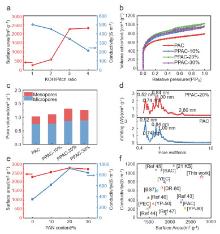
图1
"
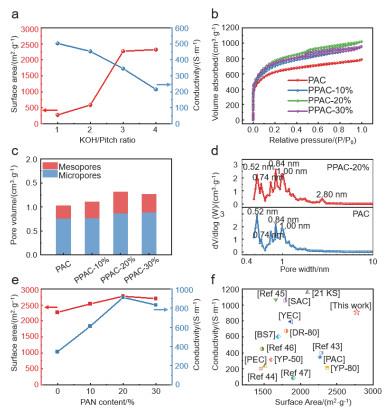
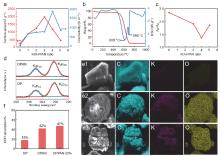
图2
"
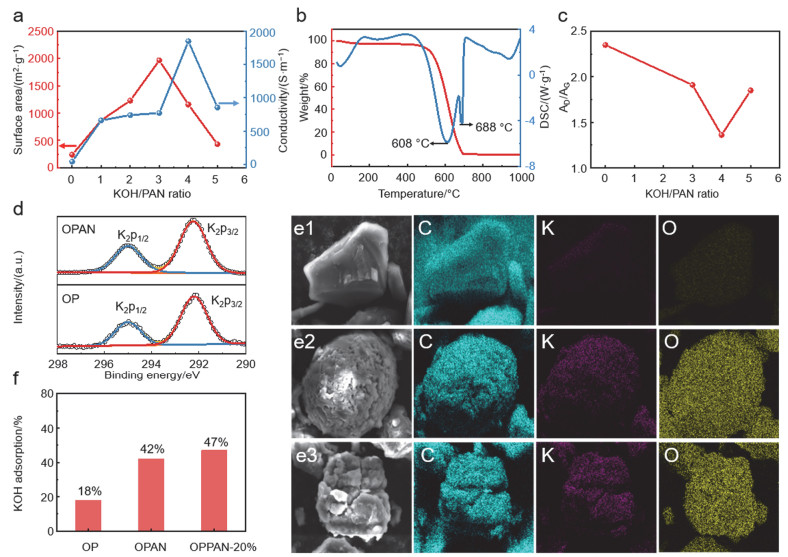
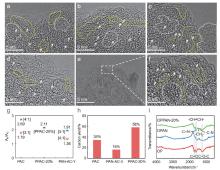
图3
"
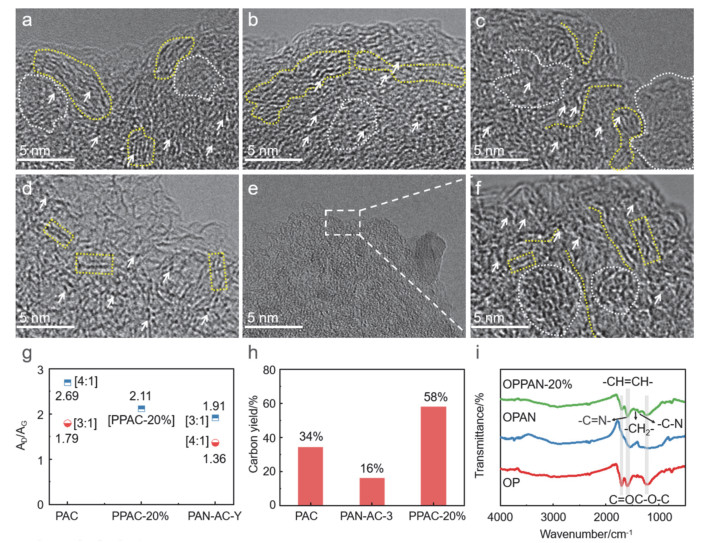
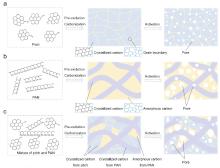
图4
"
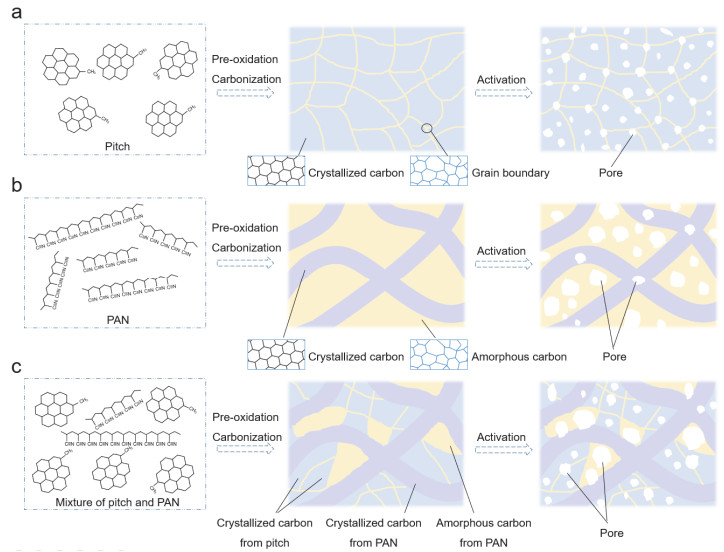
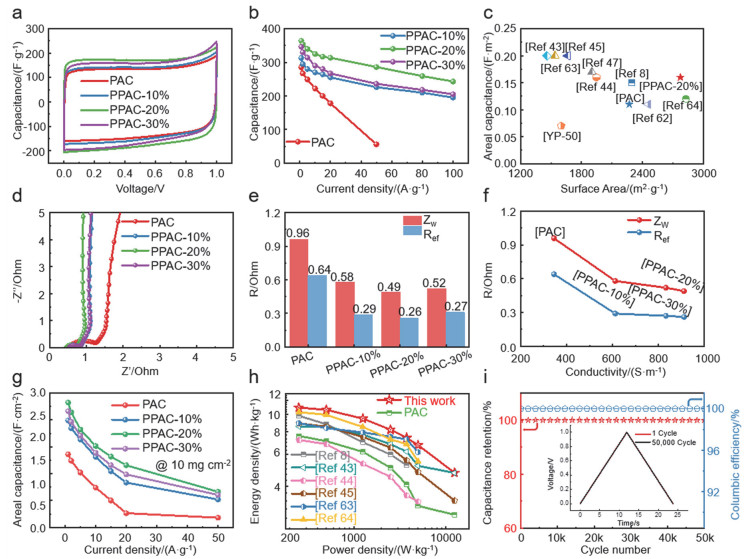
图5
"
| 1 |
Y. M. Xiao, S. Yi, Z. L. Yan, X. Y. Qiu, P. P. Ning, D. R. Yang, N. Du. Small. 2024, 20, 2404440.
doi: 10.1002/smll.202404440 |
| 2 |
H. Shao, Y. C. Wu, Z. F. Lin, P. L. Taberna, P. Simon. Chem. Soc. Rev. 2020, 49, 3005.
doi: 10.1039/D0CS00059K |
| 3 |
W. Guo, C. Yu, S. F. Li, J. S. Qiu. Energy Environ. Sci. 2021, 14, 576.
doi: 10.1039/D0EE02649B |
| 4 |
Z. F. Lin, E. Goikolea, A. Balducci, K. Naoi, P. L. Taberna, M. Salanne, G. Yushin, P. Simon. Mater. Today 2018, 21, 419.
doi: 10.1016/j.mattod.2018.01.035 |
| 5 |
Z. F. Lin, E. Goikolea, A. Balducci, K. Naoi, P. L. Taberna, M. Salanne, G. Yushin, P. Simon. Small Methods 2020, 4, 1900853.
doi: 10.1002/smtd.201900853 |
| 6 |
Y. Qing, Y. T. Jiang, H. Lin, L. X. Wang, A. J. Liu, Y. L. Cao, R. Sheng, Y. Guo, C. W. Fan, S. Zhang, D. Z. Jia, Z. J. Fan. J. Mater. Chem. A 2019, 7, 6021.
doi: 10.1039/C8TA11620B |
| 7 |
L. Y. Liu, X. H. Wang, V. Izotov, D. Havrykov, I. Koltsov, W. Han, Y. Zozulya, O. Linyucheva, V. Zahorodna, O. Gogotsi, Y. Gogotsi. Electrochim. Acta 2019, 302, 38.
doi: 10.1016/j.electacta.2019.02.004 |
| 8 |
R. Saha, C. J. Gómez García. Chem. Soc. Rev. 2024, 53, 9490.
doi: 10.1039/D4CS00141A |
| 9 |
P. Mao, Y. G. Guo, T. Wang, L. Q. He, W. J. Li, Z. Y. Liu, B. Xie, K. Guo, L. L. Shu, J. H. Gao. ACS Appl. Mater. Inter. 2024, 17, 1485.
doi: 10.1021/acsami.4c15339 |
| 10 |
Z. Wang, Q. H. Hu, S. B. Wang, Z. R. Liu, C. Y Tang, L. L. Li. J. Mater. Chem. A. 2025, 13, 2642.
doi: 10.1039/d4ta06337f |
| 11 |
S. Suman, D. K. Sharma, O. Szabo, B. Rakesh, M. Marton, M. Vojs, K. J. Sankaran, A. Kromka. Small 2024, 21, 2407514.
doi: 10.1002/smll.202407514 |
| 12 |
J. Y. Wu, X. Zhang, Z. Y. Ju, L. Wang, Z. Y. Hui, K. Mayilvahanan, K. J. Takeuchi, A. C. Marschilok, A. C. West, E. S. Takeuchi, G. H. Yu. Adv. Mater. 2021, 33, 2101275.
doi: 10.1002/adma.202101275 |
| 13 |
P. Ye, L. S. Qin, M. Y. He, F. F. Wu, Z. Y. Chen, M. X. Liang, L. B. Deng. Acta Phys. Chim. Sin. 2025, 41, 100023.
doi: 10.3866/PKU.WHXB202311032 |
| 14 |
Q. Q. Li, Y. T. Jiang, Z. M. Jiang, J. Y. Zhu, X. M. Gan, F. W. Qin, T. T. Tang, W. X. Luo, N. N. Guo, Z. Liu, L. X. Wang, S. Zhang, D. Z. Jia, Z. J. Fan. Carbon 2022, 191, 19.
doi: 10.1016/j.carbon.2022.01.042 |
| 15 |
M. Yu, X. H. Ning. Chem. Eng. J. 2025, 503, 158554.
doi: 10.1016/j.cej.2024.158554 |
| 16 |
X. X. Yang, G. X. Sun, F. Wang, X. Li, Z. Z. Zhang, Y. Z. Zhen, D. J. Wang, X. M. Gao, F. Fu, R. A. Chi. J. Colloid Interface Sci. 2023, 646, 228.
doi: 10.1016/j.jcis.2023.04.179 |
| 17 |
J. X. Cheng, Z. J. Lu, X. F. Zhao, X. X. Chen, Y. H. Liu. J. Power Sources. 2021, 494, 229770.
doi: 10.1016/j.jpowsour.2021.229770 |
| 18 |
Y. Xiao, D. Dong, J. W. Wang, J. N. Liu, T. Wang, Y. S. Zhang. Chem. Eng. J. 2024, 500, 157084.
doi: 10.1016/j.cej.2024.157084 |
| 19 |
G. L. Zhang, T. T. Guan, N. Wang, J. C. Wu, J. L. Wang, J. L Qiao, K. X. Li. Chem. Eng. J. 2020, 399, 125818.
|
| 20 |
X. Y. Liu, D. Lyu, C. Merlet, M. J. A. Leesmith, X. Hua, Z. Xu, Grey C. P., Forse A. C.. Science 2024, 384, 321.
doi: 10.1126/science.adn6242 |
| 21 |
W. H. Chi, G. W. Wang, Z. P. Qiu, Q. Q. Li, Z. Xu, Z. Y. Li, B. Qi, K. Cao, C. L. Chi, T. Wei, Z. J. Fan. Batteries. 2024, 10, 5.
doi: 10.3390/batteries10010005 |
| 22 |
M. Majumder, R. B. Choudhary, S. P. Koiry, A. K. Thakur, U. Kumar. Electrochim. Acta 2017, 248, 98.
doi: 10.1016/j.electacta.2017.07.107 |
| 23 |
S. J. Zhu, M. H. Sun, J. Y. Jiang, X. F. Zhan, C. Y. Du, C. Ding, D. H. Wei, X. C. Huang. ACS Appl. Nano Mater. 2024, 7, 28593.
doi: 10.1021/acsanm.4c05742 |
| 24 |
T. D. Silva, C. Damery, R. Alkhaldi, R. Karunanithy, D. H. Gallaba, P. D. Patil, M. Wasala, P. Sivakumar, A. Migone, S. Talapatra. ACS Appl. Mater. Interfaces 2021, 13, 56004.
doi: 10.1021/acsami.1c12551 |
| 25 |
S. Zhu, J. F. Ni, Y. Li. Nano Res. 2020, 13, 1825.
doi: 10.1007/s12274-020-2729-5 |
| 26 |
J. Tian, S. Wu, X. L. Yin, W. Wu. Appl. Surf. Sci. 2019, 496, 143696.
doi: 10.1016/j.apsusc.2019.143696 |
| 27 |
S. Y. Lu, M. Jin, Y. Zhang, Y. B. Niu, J. C. Gao, C. M. Li. Adv. Energy Mater. 2018, 8, 1702545.
doi: 10.1002/aenm.201702545 |
| 28 |
J. Y. Zhu, L. X. Wang, X. M. Gan, T. T. Tang, F. W. Qin, W. X. Luo, Q. Q. Li, N. N. Guo, S. Zhang, D. Z. Jia, H. H. Song. Energy Storage Mater. 2022, 47, 158.
doi: 10.1016/j.ensm.2022.02.015 |
| 29 |
J. Zhao, J. Y. Zhu, Y. Li, L. X. Wang, Y. Dong, Z. M. Jiang, C. W. Fan, Y. L. Cao, R. Sheng, A. J. Liu, S. Zhang, H. H. Song, D. Z. Jia, Z. J. Fan. ACS Appl. Mater. Interfaces. 2020, 12, 11669.
doi: 10.1021/acsami.9b22408 |
| 30 |
K. H. Lee, H. Park, W. Eom, D. J. Kang, S. H. Noh, T. H. Han. J. Mater. Chem. A 2019, 7, 23727.
doi: 10.1039/C9TA05242A |
| 31 |
C. Shi, L. T. Hu, J. X. Hou, K. Guo, T. Y. Zhai, H. Q. Li. Energy Storage Mater. 2018, 15, 82.
doi: 10.1016/j.ensm.2018.03.010 |
| 32 |
F. Herold, S. Prosch, N. Oefner, K. Brunnengräber, O. Leubner, Y. Hermans, K. Hofmann, A. Drochner, J. P. Hofmann, W. Qi, B. J. M. Etzold. Angew. Chem. Int. Ed. 2021, 133, 5962.
doi: 10.1002/anie.202014862 |
| 33 |
G. H. Choi, M. G. Nam, S. J. Kwak, S. H. Kim, H. Chang, C. Shin, W. B. Lee, P. J. Yoo. Energy Environ. Sci. 2021, 14, 3203.
doi: 10.1039/D1EE00402F |
| 34 |
Z. L. Yu, S. Xin, Y. You, L. Yu, Y. Lin, D. W. Xu, C. Qiao, Z. H. Huang, N. Yang, S. H. Yu, J. B. Goodenough. J. Am. Chem. Soc. 2016, 138, 14915.
doi: 10.1021/jacs.6b06673 |
| 35 |
Z. W. Li, S. Gao, H. Y. Mi, C. C. Lei, C. C. Ji, Z. L. Xie, C. Yu, J. S. Qiu. Carbon. 2019, 149, 273.
doi: 10.1016/j.carbon.2019.04.056 |
| 36 |
C. F. Liu, C. K. Zhang, H. Y. Fu, X. H. Nan, G. Z. Cao. Adv. Energy Mater. 2017, 7, 1601127.
doi: 10.1002/aenm.201601127 |
| 37 |
Q. Wang, Y. X. Qu, J. Bai, Z. Y. Chen, Q. T. Luo, H. J. Li, J. Li, W. Q. Yang. Nano Energy. 2024, 120, 109147.
doi: 10.1016/j.nanoen.2023.109147 |
| 38 |
X. Y. Li, C. C. Cai, P. Hu, B. Zhang, P. J. Wu, H. Fan, Z. Chen, L. Zhou, L. Q. Mai, H. J. Fan. Adv. Mater. 2024, 36, 2400184.
doi: 10.1002/adma.202400184 |
| 39 |
Q. F. Peng, K. Wang, Y. Gong, X. D. Zhang, Y. N. Xu, Y. B. Ma, X. Zhang, X. Z. Sun, Y. W. Ma. Adv. Funct. Mater. 2023, 33, 2308284.
doi: 10.1002/adfm.202308284 |
| 40 |
X. Y. Li, C. C. Cai, L. Zhou, L. Q. Mai, H. J. Fan. Adv. Mater. 2024, 36, 2404393.
doi: 10.1002/adma.202404393 |
| 41 |
M. Yuan, C. Y. Meng, A. Li, B. Cao, Y. Dong, D. K. Wang, X. W. Liu, X. H. Chen, H. H. Song. Small 2022, 18, 2105738.
doi: 10.1002/smll.202105738 |
| 42 |
P. Li, H. Li, D. L. Han, T. X. Shang, Y. Q. Deng, Y. Tao, W. Lv, Q. H. Yang. Adv. Sci. 2019, 6, 1802355.
doi: 10.1002/advs.201802355 |
| 43 |
T. Lv, X. M. Yang, Y. Zhang, X. F. Wang, J. S. Qiu. Small 2024, 20, 2310645.
doi: 10.1002/smll.202310645 |
| 44 |
G. Z. Wang, D. B. Ji, H. J. Wu, X. L. Ma. Adv. Powder Tech. 2021, 32, 4677.
doi: 10.1016/j.apt.2021.10.013 |
| 45 |
H. Wu, W. Y. Yuan, X. W. Yuan, L. F. Cheng. Energy Storage Mater. 2022, 50, 514.
doi: 10.1016/j.ensm.2022.05.046 |
| 46 |
W. Q. Tian, Q. M. Gao, Y. L. Tan, K. Yang, L. H. Zhu, C. X. Yang, H. Zhang. J. Mater. Chem. A 2015, 3, 5656.
doi: 10.1039/C4TA06620K |
| 47 |
W. H. Tian, J. Y. Zhu, Y. Dong, J. Zhao, J. Li, N. N. Guo, H. Lin, S. Zhang, D. Z. Jia. Carbon 2020, 161, 89.
doi: 10.1016/j.carbon.2020.01.044 |
| 48 |
C. W. Fan, Y. Dong, Y. F. Liu, L. H. Zhang, D. K. Wang, X. J. Lin, Y. Lv, S. Zhang, H. H. Song, D. Z. Jia. Carbon 2020, 160, 328.
doi: 10.1016/j.carbon.2020.01.034 |
| 49 |
E. B. Barros, N. S. Demir, A. G. Souza Filho, J. Mendes Filho, A. Jorio, G. Dresselhaus, M. S. Dresselhaus. Phys. Rev. B 2005, 71, 165422.
doi: 10.1103/PhysRevB.71.165422 |
| 50 |
Y. Dong, S. Zhang, X. Du, S. Hong, S. N. Zhao, Y. X. Chen, X. H. Chen, H. H. Song. Adv. Funct. Mater. 2019, 29, 1901127.
doi: 10.1002/adfm.201901127 |
| 51 |
H. F. Tian, Y. H. Ma, Z. J. Li, M. Y. Cheng, S. C. Ning, E. X. Han, M. Q. Xu, P. F. Zhang, K. X. Zhao, R. J. Li, Y. T. Zou, P. C. Liao, S. L. Yu, X. M. Li, J. L. Wang, S. Z. Liu, Y. F. Li, X. Y. Huang, Z. X. Yao, D. D. Ding, J. J. Guo, Y. Huang, J. M. Lu, Y. Y. Han, Z. S. Wang, Z. G. Cheng, J. X. Liu, Z. Xu, K. H. Liu, P. Gao, Y. Jiang, L. Lin, X. X. Zhao, L. F. Wang, X. D. Bai, W. Y. Fu, J. Y. Wang, M. Z. Li, T. Lei, Y. F. Zhang, Y. L. Hou, J. Pei, S. J. Pennycook, E. Wang, J. Chen, W. Zhou, L. Liu. Nature 2023, 615, 56.
doi: 10.1038/s41586-022-05617-w |
| 52 |
S. Li, E. T. Kang, K. G. Neoh, Z. H. Ma, K. L. Tan, W. Huang. Appl. Surf. Sci. 2001, 181, 201.
doi: 10.1016/S0169-4332(01)00397-X |
| 53 |
J. Y. Zhu, Y. Dong, S. Zhang, Z. J. Fan. Acta Phys. Chim. Sin. 2020, 36, 1903052.
doi: 10.3866/pku.whxb201903052 |
| 54 |
Q. Q. Li, S. Zhang, Y. T. Jiang, L. N. Zhu, N. N. Guo, J. Zhang, Y. T. Li, T. Wei, Z. J. Fan. Acta Phys. Chim. Sin. 2025, 41, 100028.
doi: 10.3866/PKU.WHXB202406009 |
| 55 |
Y. X. Lu, C. L. Zhao, X. G. Qi, Y. Qi, H. Li, X. J. Huang, L. Q. Chen, Y. S. Hu. Adv. Energy Mater. 2018, 8, 1800108.
doi: 10.1002/aenm.201800108 |
| 56 |
H. Y. Mao, J. Tang, J. Chen, J. Y. Wan, K. Hou, Y. Peng, D. M. Halat, L. G. Xiao, R. F. Zhang, X. D. Lv, A. K. Yang, Y. Cui, J. A. Reimer. Sci. Adv. 2020, 6, eabb0694.
doi: 10.1126/sciadv.abb0694 |
| 57 |
S. Zhang, Y. T. Li, Y. Kang, Y. Dong, S. Hong, X. X. Chen, J. S. Zhou, Y. V. Fedoseeva, I. P. Asanov, L. G. Bulusheva, H. Song, A. V. Okotrub. Carbon 2016, 108, 461.
doi: 10.1016/j.carbon.2016.07.046 |
| 58 |
Y. P. Huang, F. L. Lai, L. S. Zhang, H. Y. Lu, Y. Miao, T. X. Liu. T. Sci. Rep. 2016, 6, 31541.
doi: 10.1038/srep31541 |
| 59 |
D. D. Zhang, C. He, Y. Z. Wang, J. H. Zhao, J. L. Wang, K. X. Li. J. Colloid Interface Sci. 2019, 540, 439.
doi: 10.1016/j.jcis.2019.01.038 |
| 60 |
E. Ismar, A. S. Sarac. Polym. Bull. 2018, 75, 485.
doi: 10.1007/s00289-017-2043-x |
| 61 |
S. Y. Li, Q. Y. Zhang, L. N. Liu, J. G. Wang, L. Zhang, M. J. Shi, X. C. Chen. J. Alloy. Compd. 2023, 941, 168963.
doi: 10.1016/j.jallcom.2023.168963 |
| 62 |
B. Zhang, F. Sun, Y. Li, D. Wu, C. Yang, Z. Wang, J. Gao, G. Zhao, S. Sun. Carbon 2024, 219, 118812.
doi: 10.1016/j.carbon.2024.118812 |
| 63 |
Z. Tian, G. Duan, F. Wang, Y. Wang, H. Hou, C. Zhang, S. He, J. Han, X. Han, S. Jiang. Chem. Eng. J. 2024, 484, 149615.
doi: 10.1016/j.cej.2024.149615 |
| 64 |
H. Liu, S. Zhu, Y. Zhang, H. Song, Y. Zhang, Y. Chang, W. Hou. G. Han Small 2023, 19, 2204119.
doi: 10.1002/smll.202204119 |
| [1] | 刘华艳, 陈逸飞, 杨梦召, 顾佳俊. 二维材料基超级电容器的容量与倍率性能提升策略[J]. 物理化学学报, 2025, 41(6): 100063 - . |
| [2] | 李齐齐, 张苏, 江娱婷, 朱琳娜, 郭楠楠, 张晶, 李禹彤, 魏彤, 范壮军. 前驱体机械压实制备高密度活性炭及其致密电容储能性能[J]. 物理化学学报, 2025, 41(3): 100028 - . |
| [3] | 王梦茵, 黄若贝, 熊剑峰, 田景华, 李剑锋, 田中群. 锌-空气电池隔膜的关键作用及其最新研究进展[J]. 物理化学学报, 2024, 40(6): 2307017 - . |
| [4] | 姜美慧, 盛利志, 王超, 江丽丽, 范壮军. 超级电容器用石墨烯薄膜:制备、基元结构及表面调控[J]. 物理化学学报, 2022, 38(2): 2012085 - . |
| [5] | 樊润林, 彭宇航, 田豪, 郑俊生, 明平文, 张存满. 燃料电池复合石墨双极板基材的研究进展:材料、结构与性能[J]. 物理化学学报, 2021, 37(9): 2009095 - . |
| [6] | 叶耀坤, 胡宗祥, 刘佳华, 林伟成, 陈涛文, 郑家新, 潘锋. 锂离子电池正极材料中的极化子现象理论计算研究进展[J]. 物理化学学报, 2021, 37(11): 2011003 - . |
| [7] | 孙建川, 王旭辉, 陈帅奇, 廖艳清, 郜阿旺, 胡雨昊, 杨涛, 徐向宇, 王颖霞, 宋家庆. 由单层薄水铝石制备的活性氧化铝处理水中氟离子[J]. 物理化学学报, 2021, 37(10): 1911009 - . |
| [8] | 王玖,吴南石,刘涛,曹少文,余家国. 用于超级电容器的锰钴氧化物/碳纤维材料[J]. 物理化学学报, 2020, 36(7): 1907072 - . |
| [9] | 佟永丽, 戴美珍, 邢磊, 刘恒岐, 孙婉婷, 武祥. 基于NiCo2O4纳米片电极的非对称混合电容器[J]. 物理化学学报, 2020, 36(7): 1903046 - . |
| [10] | 朱家瑶, 董玥, 张苏, 范壮军. 炭-/石墨烯量子点在超级电容器中的应用[J]. 物理化学学报, 2020, 36(2): 1903052 - . |
| [11] | 王易,霍旺晨,袁小亚,张育新. 二氧化锰与二维材料复合应用于超级电容器[J]. 物理化学学报, 2020, 36(2): 1904007 - . |
| [12] | 魏风,毕宏晖,焦帅,何孝军. 超级电容器用相互连接的类石墨烯纳米片[J]. 物理化学学报, 2020, 36(2): 1903043 - . |
| [13] | 赵攀,杨兵军,陈江涛,郎俊伟,张天芸,阎兴斌. 基于三维多孔活性炭构筑安全、高性能以及长循环寿命的锌离子混合电容器[J]. 物理化学学报, 2020, 36(2): 1904050 - . |
| [14] | 田地,卢晓峰,李闱墨,李悦,王策. 静电纺纳米纤维基超级电容器无粘合剂电极材料的研究进展[J]. 物理化学学报, 2020, 36(2): 1904056 - . |
| [15] | 郭楠楠,张苏,王鲁香,贾殿赠. 植物基多孔炭材料在超级电容器中的应用[J]. 物理化学学报, 2020, 36(2): 1903055 - . |
|
||