Acta Phys. -Chim. Sin. ›› 2026, Vol. 42 ›› Issue (2): 100134.doi: 10.1016/j.actphy.2025.100134
• ARTICLE • Previous Articles Next Articles
Red-emitting carbon dots prepared from Epipremnum Aureum leaves extract for biological imaging
Renyi Shao1, Khurram Abbas2, Vladimir Yu. Osipov3, Haimei Zhu1, Yuan Li1, Usama1,*( ), Hong Bi1,*()
- 1 School of Materials Science and Engineering, Anhui University, Hefei 230601, Anhui Province, China
2 School of Chemistry and Chemical Engineering, Anhui University, Hefei 230601, Anhui Province, China
3 Ioffe Institute, St. Petersburg 194021, Russian Federation
-
Received:2025-06-06Revised:2025-07-17Accepted:2025-07-22Published:2025-12-03 -
Contact:Email: bihong@ahu.edu.cn (Hong Bi)24743@ahu.edu.cn (Usama)

Cite this article
Renyi Shao, Khurram Abbas, Vladimir Yu. Osipov, Haimei Zhu, Yuan Li, Usama, Hong Bi. Red-emitting carbon dots prepared from Epipremnum Aureum leaves extract for biological imaging[J]. Acta Phys. -Chim. Sin. 2026, 42(2), 100134. doi: 10.1016/j.actphy.2025.100134
share this article
Scheme 1
The synthesis process of EA-CDs and bioimaging experiments."
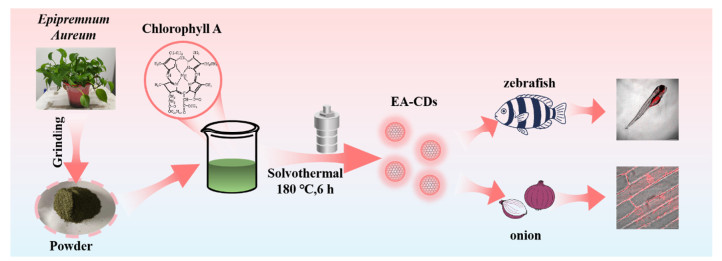
Fig 1
(a) TEM, HRTEM images and size statistical distribution diagram of EA-CDs in aqueous solution; (b) Raman spectrum (λex = 532 nm), (c) FT-IR transmission spectrum of EA-CDs; (d) Cu Kα XRD pattern, (e) XPS survey spectrum of EA-CDs; High-resolution (f) C 1s, (g) N 1s, and (h) O 1s XPS peaks of EA-CDs."
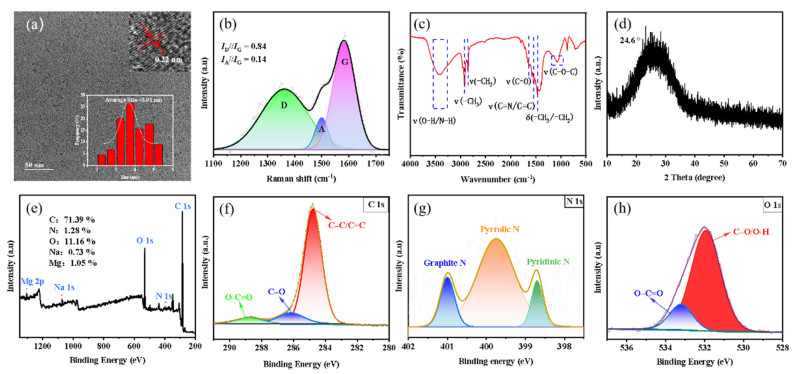
Fig 2
(a) UV-Vis absorption (red), Photoluminescence Excitation Spectroscopy (PLE) (black), and Photoluminescence Spectroscopy (PL) (blue) spectra of EA-CDs; (b) the fluorescence emission spectra of EA-CDs excited at various wavelengths; Fluorescence variation of the EA-CDs as a function of (c) pH; (d) thermal; (e) irradiation time; and (f) concentration of NaCl."
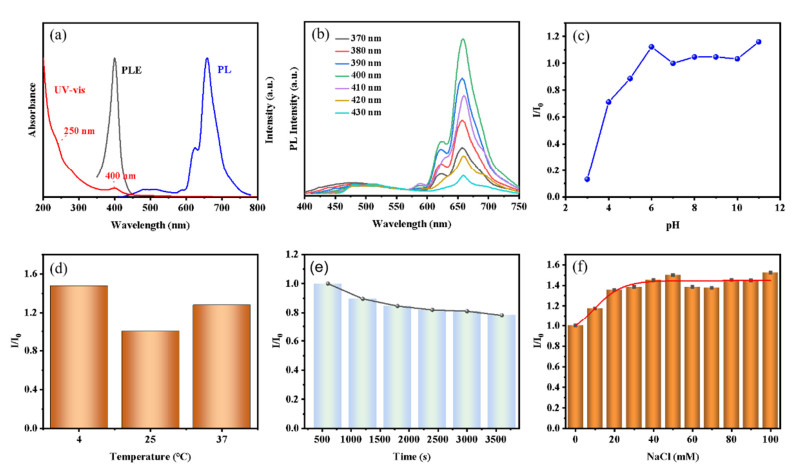
Fig 3
CLSM images of onion epidermal tissues treated with EA-CDs at different concentrations and incubation times. These vertical panels show optical images of onion epidermal cells at different incubation time (30, 60, and 120 min) under the same EA-CDs concentration; while the horizontal panels show the optical images treated with different concentrations (0, 25, and 50 μg·mL−1) of EA-CDs at the same incubation time. Red channel parameters: λex = 561 nm; λem = 600−800 nm. Scale bar, 100 μm."
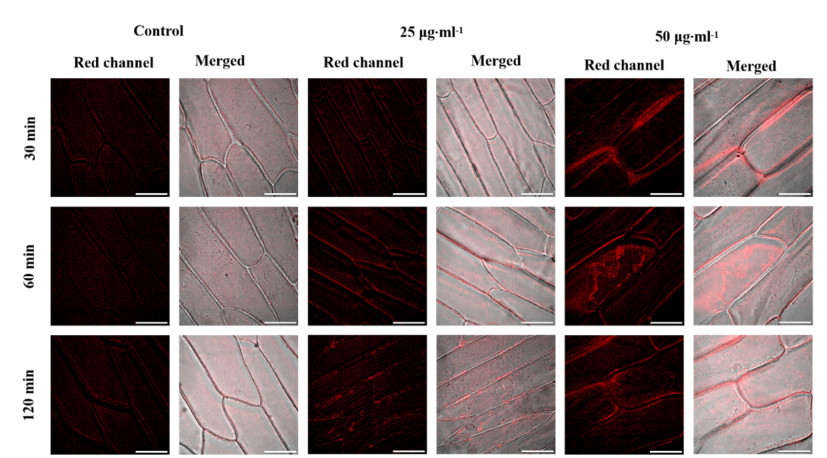
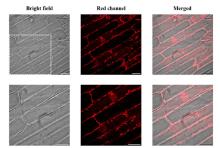
Fig 4
CLSM images of onion epidermal tissues treated with 25 μg mL−1 EA-CDs for 240 min. The following picture is an enlarged view of the white area in the above picture. Red channel parameters: λex = 561 nm; λem = 600−800 nm. Scale bar, 100 μm."
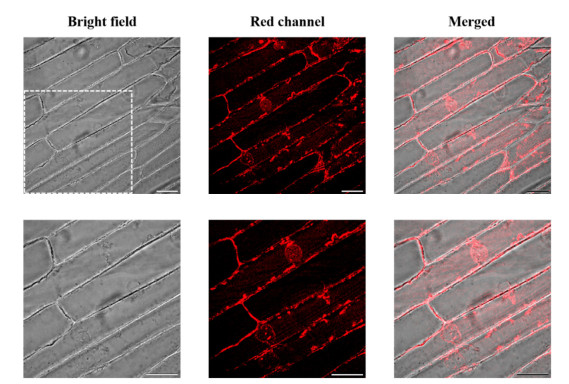
Fig 5
Bioimaging of Saccharomyces cerevisiae using EA-CDs (10 μg mL−1). EA-CDs display successful microbial labeling with red fluorescence. Scale bar, 40 μm."
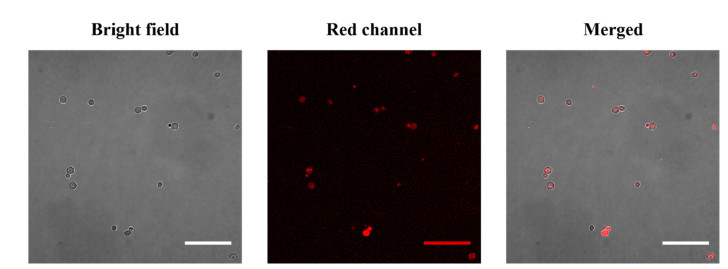
Fig 6
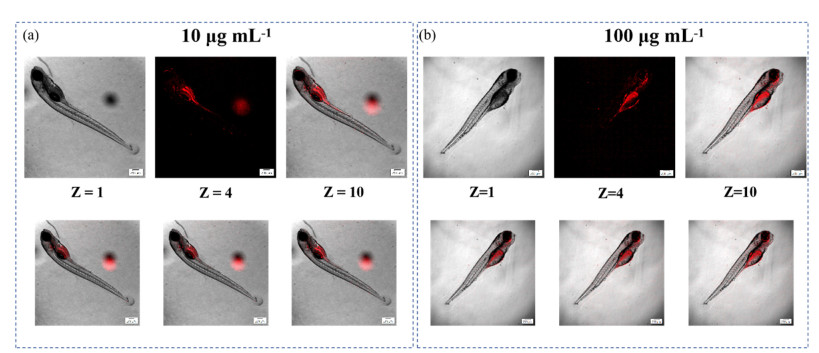
In vivo bioimaging of zebrafish larvae treated with EA-CDs. (a) Zebrafish larvae were incubated with 10 μg mL−1 (left panel) and (b) 100 μg mL−1 (right panel) EA-CDs, followed by Z-stack confocal imaging across multiple focal planes (Z = 1 to Z = 10), Scale bar, 200 μm."
| 1 |
W. X. Meng, X. Bai, B. Y. Wang, Z. Y. Liu, S. Y. Lu, B. Yang. Energy Environ. Mater. 2019, 2, 172.
doi: 10.1002/eem2.12038 |
| 2 |
Y. F. Hu, J. F. Li, X. F. Li. Anal. Bioanal. Chem. 2019, 411, 7879.
doi: 10.1007/s00216-019-02192-4 |
| 3 |
P. Singh, V. Bhankar, S. Kumar, K. Kumar. Adv. Colloid Interface Sci. 2024, 328, 103182.
doi: 10.1016/j.cis.2024.103182 |
| 4 |
D. Cai, X. Zhong, L. Xu, Y. Xiong, W. Deng, G. Zou, H. Hou, X. Ji. Chem. Sci. 2025, 16, 4937.
doi: 10.1039/D4SC08659G |
| 5 |
C. Z. Liang, X. B. Xie, D. D. Zhang, J. Feng, S. Y. Lu, Q. S. Shi. J. Mater. Chem. B 2021, 9, 5670.
doi: 10.1039/D0TB02979C |
| 6 |
H. K. Kohli, D. Parab. Next Mater. 2025, 8, 100527.
doi: 10.1016/j.nxmate.2025.100527 |
| 7 |
X. Y. Kou, Y. G. Cong, W. F. Dong, L. Li. Mater. Des. 2024, 240, 112855.
doi: 10.1016/j.matdes.2024.112855 |
| 8 |
B. Unnikrishnan, A. Anand, C. J. Lin, C. Y. Lee, A. Nain, P. Srivastava, R. S. Wu, H. W. Chu, C. Y. Wang, R. H. Shi, et al.. Coord. Chem. Rev. 2025, 534, 216552.
doi: 10.1016/j.ccr.2025.216552 |
| 9 |
F. Qin, J. L. Bai, Y. Q. Zhu, P. Y. He, X. Y. Wang, S. Wu, X. Yu, L. L. Ren. Phys. Chem. Chem. Phys. 2023, 25, 2762.
doi: 10.1039/d2cp05130c |
| 10 |
L. J. Yang, Y. B. An, D. Z. Xu, F. Dai, S. L. Shao, Z. X. Lu, G. Liu. Small 2024, 20, 2309293.
doi: 10.1002/smll.202309293 |
| 11 |
M. H. Usman, S. Cheng. Engineering 2024, 5, 2223.
doi: 10.3390/eng5030116 |
| 12 |
J. J. Lin, W. Y. Huang, H. R. Zhang, X. J. Zhang, Y. L. Liu, W. Li, B. F. Lei. J. Mater. Chem. C 2024, 12, 5480.
doi: 10.1039/d4tc00107a |
| 13 |
F. H. Wang, X. Z. Dong, Y. J. Zuo, Z. Xie, R. F. Guan. Mater. Today Phys. 2024, 41, 101332.
doi: 10.1016/j.mtphys.2024.101332 |
| 14 |
Y. P. Liu, J. H. Lei, G. Wang, Z. M. Zhang, J. Wu, B. H. Zhang, H. Q. Zhang, E. S. Liu, L. M. Wang, T. M. Liu, et al.. Adv. Sci. 2022, 9, 2202283.
doi: 10.1002/advs.202202283 |
| 15 |
Y. P. Liu, H. Wang, S. N. Qu. Chin. Chem. Lett. 2025, 36, 110618.
doi: 10.1016/j.cclet.2024.110618 |
| 16 |
X. Wu, Y. P. Liu, B. Z. Wang, L. Y. Li, Z. J. Li, Q. C. Wang, Q. S. Cheng, G. C. Xing, S. N. Qu. Acta Phys. -Chim. Sin. 2025, 41, 100109.
doi: 10.1016/j.actphy.2025.100109 |
| 17 |
J. J. Liu, Y. J. Geng, D. W. Li, H. Yao, Z. P. Huo, Y. F. Li, K. Zhang, S. J. Zhu, H. T. Wei, W. Q. Xu, J. L. Jiang, B. Yang. Adv. Mater. 2020, 32, 1906641.
doi: 10.1002/adma.201906641 |
| 18 |
H. L. Yang, L. F. Bai, Z. R. Geng, H. Chen, L. T. Xu, Y. C. Xie, D. J. Wang, H. W. Gu, X. M. Wang. Mater. Today Adv. 2023, 18, 100376.
doi: 10.1016/j.mtadv.2023.100376 |
| 19 |
J. Liu, T. Y. Kong, H. M. Xiong. Adv. Mater. 2022, 34, 2200152.
doi: 10.1002/adma.202200152 |
| 20 |
L. Jiang, H. Cai, W. W. Zhou, Z. J. Li, L. Zhang, H. Bi. Adv. Mater. 2023, 35, 2210776.
doi: 10.1002/adma.202210776 |
| 21 |
R. J. Chen, Z. B. Wang, T. Pang, Q. Teng, C. H. Li, N. Z. Jiang, S. Zheng, R. D. Zhang, Y. H. Zheng, D. Q. Chen, F. L. Yuan. Adv. Mater. 2023, 35, 2302275.
doi: 10.1002/adma.202302275 |
| 22 |
Q. Fu, K. L. Zhang, K. Z. Lu, N. Li, S. H. Sun, Z. H. Dong. J. Alloys Compd. 2024, 971, 172688.
doi: 10.1016/j.jallcom.2023.172688 |
| 23 |
W. X. Qin, M. Y. Wang, Y. Li, L. C. Li, K. Abbas, Z. J. Li, A. C. Tedesco, H. Bi. Mater. Chem. Front. 2024, 8, 930.
doi: 10.1039/d3qm00968h |
| 24 |
H. Cai, Y. Li, X. Y. Wu, Y. X. Yang, A. C. Tedesco, Z. J Li, H. Bi. Adv. Funct. Mater. 2024, 34, 2406096.
doi: 10.1002/adfm.202406096 |
| 25 |
J. Chen, T. Li, C. Z. Lin, Y. X. Hou, S. H. Cheng, B. M. Gao. Spectrochim. Acta 2025, 328, 125458.
doi: 10.1016/j.saa.2024.125458 |
| 26 |
C. Hu, S. Sedghi, A. S. Albero, G. G. Andersson, A. Sharma, P. Pendleton, F. R. Reinoso, K. Kaneko, M. J. Biggs. Carbon 2015, 85, 147.
doi: 10.1016/j.carbon.2014.12.098 |
| 27 |
V. Y. Osipov, A. V. Baranov, V. A. Ermakov, T. L. Makarova, L. F. Chungong, A. I. Shames, K. Takai, T. Enoki, Y. Kaburagi, M. Endo, et al.. Diam. Relat. Mater. 2011, 20, 205.
doi: 10.1016/j.diamond.2010.12.006 |
| 28 |
B. Y. Wang, J. Li, Z. Y. Tang, B. Yang, S. Y. Lu. Sci. Bull. 2019, 64, 1285.
doi: 10.1016/j.scib.2019.07.021 |
| 29 |
J. L. Pu, C. Liu, B. Wang, P. Liu, Y. Z. Jin, J. C. Chen. Analyst 2021, 146, 1032.
doi: 10.1039/d0an02075c |
| 30 |
M. L. Liu, B. B. Chen, C. M. Li, C. Z. Huang. Green Chem. 2019, 21, 449.
doi: 10.1039/c8gc02736f |
| 31 |
B. Krushna, S. Sharma, A. Srinivasan, S. Sahu, K. Ponnazhagan, A. George, K. Rathla, M. Manjula, V. Shivakumar, S. Devaraja, et al.. Colloids Surf. 2024, 703, 135135.
doi: 10.1016/j.colsurfa.2024.135135 |
| 32 |
J. K Yu, X. Yong, Z. Y. Tang, B. Yang, S. Y. Lu. J. Phys. Chem. Lett. 2021, 12, 7671.
doi: 10.1021/acs.jpclett.1c01856 |
| 33 |
H. Ding, X. X. Zhou, J. S. Wei, X. B. Li, B. T. Qin, X. B. Chen, H. M. Xiong. Carbon 2020, 167, 322.
doi: 10.1016/j.carbon.2020.06.024 |
| 34 |
D. Benner, P. K. Yadav, D. Bhatia. Nanoscale Adv. 2023, 5, 4337.
doi: 10.1039/d3na00469d |
| 35 |
H. X. Li, D. D. Su, H. Gao, X. Yan, D. S. Kong, R. Jin, X. M. Liu, C. G. Wang, G. Y. Lu. Anal. Chem. 2020, 92, 3198.
doi: 10.1021/acs.analchem.9b04917 |
| 36 |
Q. Xu, T. R. Kuang, Y. Liu, L. L. Cai, X. F. Peng, T. S. Sreeprasad, P. Zhao, Z. Q. Yu, N. Li. J. Mater. Chem. B 2016, 4, 7204.
doi: 10.1039/c6tb02131j |
| 37 |
K. Abbas, Usama, W. X. Qin, H. M. Zhu, Y. Li, Z. J. Li, M. Imran, H. Bi. CBMI 2025,
doi: 10.1021/cbmi.4c00109 |
| 38 |
A. Maholiya, P. Ranjan, R. Khan, S. Murali, R. C. Nainwal, P. S. Chauhan, N. Sathish, J. P. Chaurasia, A. K. Srivastava. Environ. Sci. Nano 2023, 10, 959.
doi: 10.1039/d2en00954d |
| 39 |
Y. Liu, W. D. Li, H. Wu, S. Y. Lu. Acta Phys. -Chim. Sin. 2021, 37, 2009082.
doi: 10.3866/PKU.WHXB202009082 |
| 40 |
Z. Q. Zhang, H. M. Zhu, N. N. Peng, J. Song, R. J. Sun, J. M. Wang, F. F. Zhu, Y. Z. Wang. Mater. Lett. 2023, 341, 134233.
doi: 10.1016/j.matlet.2023.134233 |
| 41 |
J. Q. Chang, H. M. Xu, W. J. Xie, Y. Zhang, L. Qi, L. Z. Fan, Y. Li. Acta Phys. -Chim. Sin. 2023, 39, 2301034.
doi: 10.3866/PKU.WHXB202301034 |
| 42 |
N. K. Dal, M. Speth, K. Johann, M. Barz, C. Beauvineau, J. Wohlmann, F. Fenaroli, B. Gicquel, G. Griffiths, N. A. Rodriguez. Dis. Model. Mech. 2022, 15, dmm049147.
doi: 10.1242/dmm.049147 |
| [1] | Qingwen Xu, Zhigang Xie, Min Zheng. Construction of pH-responsive Lycium barbarum-derived carbon dots nanovaccines for enhanced anti-tumor immunotherapy [J]. Acta Phys. -Chim. Sin., 2026, 42(6): 100203-. |
| [2] | Li Ting, Zeng Xiao, Yang Yuzhuo, Wen Xinyi, Ding Shurong, Shi Linlin, Zhang Yongqiang, Lu Siyu. Towards practical circularly polarized luminescence: carbon dots-based circularly polarized lasers [J]. Acta Phys. -Chim. Sin., 2026, 42(4): 100191-. |
| [3] | Yinghao Zhang, Huaxin Liu, Hanrui Ding, Zhi Zheng, Wentao Deng, Guoqiang Zou, Laiqiang Xu, Hongshuai Hou, Xiaobo Ji. The application of carbon dots in electrolytes of advanced batteries [J]. Acta Phys. -Chim. Sin., 2026, 42(3): 100170-. |
| [4] | Yu Liu, Pengfei Li, Yize Liu, Zaicheng Sun. Recent advances in carbon dots as a single photocatalyst [J]. Acta Phys. -Chim. Sin., 2026, 42(2): 100167-. |
| [5] | Zihan Cheng, Kai Jiang, Jun Jiang, Henggang Wang, Hengwei Lin. Achieving thermal-stimulus-responsive dynamic afterglow from carbon dots by singlet-triplet energy gap engineering through covalent fixation [J]. Acta Phys. -Chim. Sin., 2026, 42(2): 100169-. |
| [6] | Chunyuan Kang, Xiaoyu Li, Fan Yang, Bai Yang. Ionic-bond crosslinked carbonized polymer dots for tunable and enhanced room temperature phosphorescence [J]. Acta Phys. -Chim. Sin., 2026, 42(1): 100156-. |
| [7] | Wenlong Wang, Wentao Hao, Lang He, Jia Qiao, Ning Li, Chaoqiu Chen, Yong Qin. Bandgap and adsorption engineering of carbon dots/TiO2 S-scheme heterojunctions for enhanced photocatalytic CO2 methanation [J]. Acta Phys. -Chim. Sin., 2025, 41(9): 100116-. |
| [8] | Xue Wu, Yupeng Liu, Bingzhe Wang, Lingyun Li, Zhenjian Li, Qingcheng Wang, Quansheng Cheng, Guichuan Xing, Songnan Qu. Rationally assembling different surface functionalized carbon dots for enhanced near-infrared tumor photothermal therapy [J]. Acta Phys. -Chim. Sin., 2025, 41(9): 100109-. |
| [9] | Tiejin Chen, Xiaokuang Xue, Jian Li, Minhui Cui, Yongliang Hao, Mianqi Xue, Haihua Xiao, Jiechao Ge, Pengfei Wang. Membrane-anchoring nanoengineered carbon dots as a pyroptosis amplifier for robust tumor photodynamic-immunotherapy [J]. Acta Phys. -Chim. Sin., 2025, 41(10): 100113-. |
| [10] | Jianqiao Chang, Huimin Xu, Wenjing Xie, Yang Zhang, Ling Qi, Louzhen Fan, Yong Li. Fluorescent Carbon Dots for Rapid and Highly Sensitive Detection of Nucleic Acids [J]. Acta Phys. -Chim. Sin., 2023, 39(12): 2301034-. |
| [11] | Yuan Liu, Weidong Li, Han Wu, Siyu Lu. Carbon Dots Enhance Ruthenium Nanoparticles for Efficient Hydrogen Production in Alkaline [J]. Acta Phys. -Chim. Sin., 2021, 37(7): 2009082-. |
| [12] | Yanjie HUANG, Chao LIAN, Jinyan ZHOU, Zichen HUANG, Xiaohong KANG, Zhenyu HUANG, Xiaojing LI, Lin CHEN, Yan GUAN. Investigation of Excitation-, pH-, Metal Ion-, Temperature-, and Polarity-Dependent Fluorescence of Carbon Dots Derived from Silkworm Excrement [J]. Acta Physico-Chimica Sinica, 2019, 35(11): 1267-1275. |
| [13] | Jin-Long LIU,Liang-Zhen LIN,Jin-Feng HU,Ming-Jie BAI,Liang-Xian CHEN,Jun-Jun WEI,Li-Fu HEI,Cheng-Ming LI. Reaction Process and Luminescence Mechanism of Carbon Nanodots Prepared by Microwave Synthesis [J]. Acta Phys. -Chim. Sin., 2018, 34(1): 92-98. |
| [14] | Li-Xia SANG,Jia LIN,Hao GE,Lei LEI. Dynamic Analysis of Carbon Dots/KOH Electrolyte Interface by IMPS/IMVS [J]. Acta Phys. -Chim. Sin., 2017, 33(12): 2454-2462. |
| [15] | JI Min, ZHEN Jun-Feng, ZHANG Qun, CHEN Yang. Photodissociation Dynamics of tert-Butyl Nitrite Investigated by Time-Resolved Fourier TransformInfrared Emission Spectroscopy [J]. Acta Phys. -Chim. Sin., 2009, 25(08): 1641-1644. |
|
||