Acta Phys. -Chim. Sin. ›› 2025, Vol. 41 ›› Issue (11): 100147.doi: 10.1016/j.actphy.2025.100147
• ARTICLE • Previous Articles Next Articles
Lignin derived carbon quantum dots and oxygen vacancies coregulated S-scheme LCQDs/Bi2WO6 heterojunction for photocatalytic H2O2 production
Qishen Wang1, Changzhao Chen1,*( ), Mengqing Li1, Lingmin Wu2,*(), Kai Dai3,*()
- 1 School of Mechanics and Photoelectric Physics, Anhui University of Science and Technology, Huainan 232001, Anhui Province, China
2 Guangdong Provincial Key Laboratory of Fuel Cell Technology School of Chemistry and Chemical Engineering, South China University of Technology, Guangzhou 510640, Guangdong Province, China
3 Key Laboratory of Green and Precise Synthetic Chemistry and Applications, Ministry of Education, Anhui Province Key Laboratory of Pollutant Sensitive Materials and Environmental Remediation, Huaibei Normal University, Huaibei 235000, Anhui Province, China
-
Received:2025-07-06Revised:2025-07-30Accepted:2025-08-03Published:2025-09-29 -
Contact:Email: chzhchen@aust.edu.cn (Changzhao Chen)202110184982@mail.scut.edu.cn (Lingmin Wu)daikai940@chnu.edu.cn (Kai Dai) -
Supported by:the National Natural Science Foundation of China(22278169); the National Natural Science Foundation of China(12304134); the Excellent Scientific Research and Innovation Team of Education Department of Anhui Province(2022AH010028); the Natural Science Foundation of Anhui Province(2108085ME148)

Cite this article
Qishen Wang, Changzhao Chen, Mengqing Li, Lingmin Wu, Kai Dai. Lignin derived carbon quantum dots and oxygen vacancies coregulated S-scheme LCQDs/Bi2WO6 heterojunction for photocatalytic H2O2 production[J]. Acta Phys. -Chim. Sin. 2025, 41(11), 100147. doi: 10.1016/j.actphy.2025.100147
share this article
Fig 1
(a) XRD patterns, (b) Raman, and (c) FT-IR spectra of BWO, BWO-A, LCD/BWO, LCD/BWO-A, and LCQDs; (d) SAED pattern of LCD/BWO."
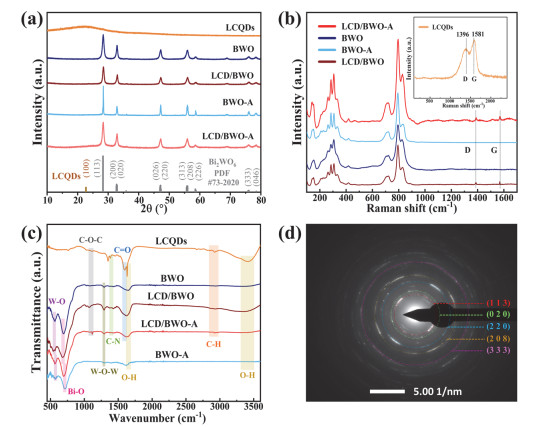
Fig 2
(a) Evolutionary process and SEM images of (b) BWO, (c) LCD/BWO, and (d) LCD/BWO-A, (e) high magnification of LCD/BWO−A; (f) TEM, HRTEM images, and particle size distribution of LCQDs; (g) HRTEM images, (h) OVs range in HRTEM, and (i) elemental mapping of LCD/BWO."
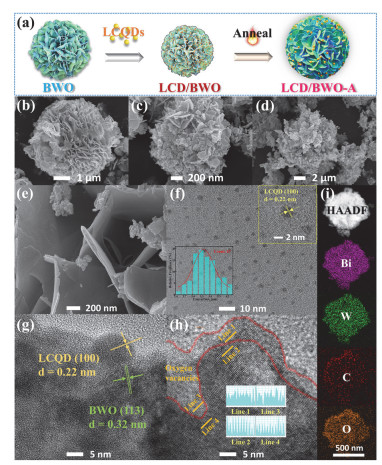
Fig 3
(a) EPR spectra and high resolution XPS spectra of (b) W 4f, (c) Bi 4f, and (d) C 1s for BWO, BWO-A, LCD/BWO, and LCD/BWO-A, (e) C 1s and O 1s for LCQDs."
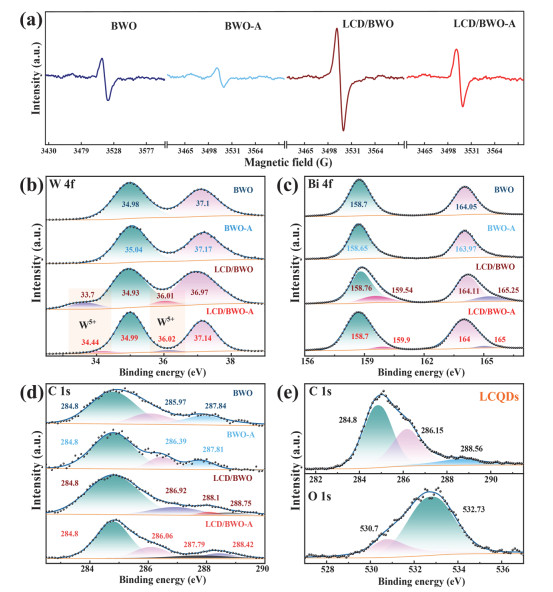
Fig 4
(a) Up-converted PL spectra of LCQDs under 800 nm excitation; (b) Room temperature conventional PL spectroscopy analysis of BWO, BWO-A, LCD/BWO, and LCD/BWO-A under 350 nm excitation; (c) TRPL and fluorescence attenuation fit curves of BWO and LCD/BWO; (d) EIS, impedance fitting circuit model, (e) transient photocurrent response, (f) LSV curve of BWO, BWO-A, LCD/BWO, and LCD/BWO-A."
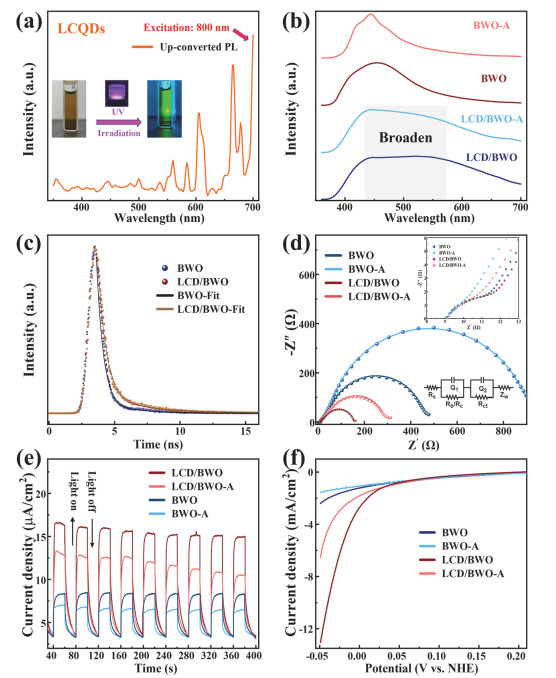
Fig 5
Photocatalytic H2O2 time-dependent yields under (a) simulated visible light and (b) sunlight radiation, (c) evolution rates of BWO, BWO-A, LCD/BWO, LCD/BWO-A, and LCQDs; (d) 5 sets of cyclic test results for LCD10/BWO under simulated sunlight radiation."
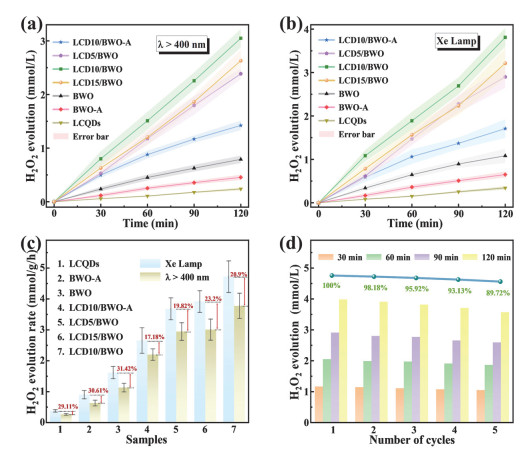
Fig 6
(a, b) UV-DRS and (c) Tauc plots of BWO, BWO-A, LCD/BWO, LCD/BWO-A, and LCQDs; (d) XPS valence band spectra of BWO and LCQDs."
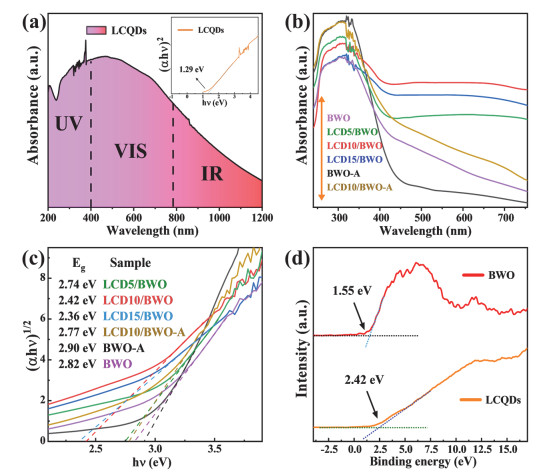
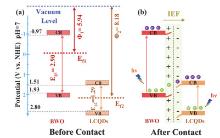
Fig 7
The formation of LCD/BWO S-scheme heterojunction: sketches of energy band for BWO and LCQDs (a) before, and (b) after contact under sunlight."
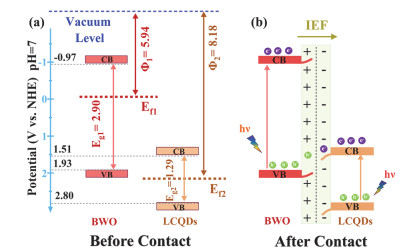
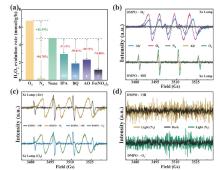
Fig 8
(a) Photocatalytic H2O2 rates of LCD10/BWO with different sacrificial agents and atmospheres under simulated sunlight radiation; (b−d) In situ EPR signals plots of ⋅O2– and ⋅OH for LCD10/BWO under different radiation conditions and atmospheres."
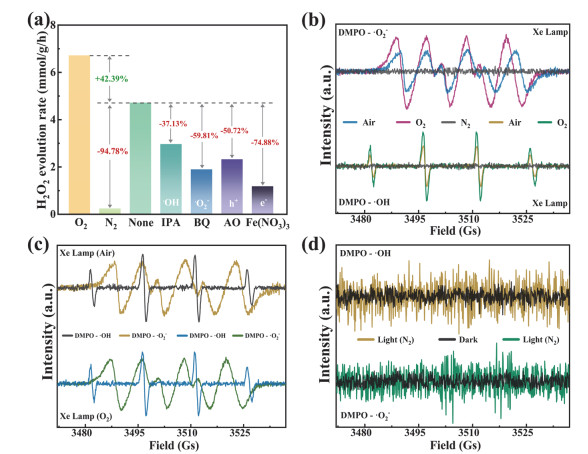
Fig 9
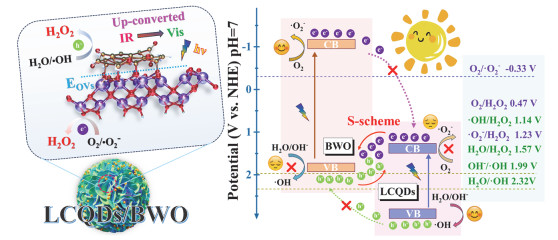
Proposed schematic diagram of the enhanced photocatalytic H2O2 production mechanism over LCD/BWO."
| 1 |
doi: 10.1039/D5EE01295C |
| 2 |
doi: 10.1016/j.actphy.2025.100093 |
| 3 |
doi: 10.1016/j.jmat.2024.100978 |
| 4 |
doi: 10.1016/j.jmst.2025.03.005 |
| 5 |
doi: 10.1016/S1872−2067(24)60121−X |
| 6 |
doi: 10.1002/adfm.202315426 |
| 7 |
doi: 10.1016/j.actphy.2025.100117 |
| 8 |
doi: 10.1016/j.jmst.2024.12.060 |
| 9 |
doi: 10.1016/S1872-2067(23)64645-5 |
| 10 |
doi: 10.1002/anie.202313914 |
| 11 |
doi: 10.1016/j.cclet.2025.111272 |
| 12 |
doi: 10.1016/j.jmat.2024.100970 |
| 13 |
doi: 10.1016/j.actphy.2025.100104 |
| 14 |
doi: 10.1016/j.jmat.2024.100985 |
| 15 |
doi: 10.1016/j.actphy.2025.100064 |
| 16 |
doi: 10.1002/anie.202406310 |
| 17 |
doi: 10.3866/PKU.WHXB202405016 |
| 18 |
doi: 10.1038/s41467−024−47624−7 |
| 19 |
doi: 10.1002/adfm.202007073 |
| 20 |
doi: 10.1002/anie.202313836 |
| 21 |
doi: 10.1021/acsami.3c07489 |
| 22 |
doi: 10.1021/acsnano.1c08136 |
| 23 |
doi: 10.1002/anie.202301909 |
| 24 |
doi: 10.1002/adma.202504445 |
| 25 |
doi: 10.1021/acsnano.2c04750 |
| 26 |
doi: 10.1002/adfm.202423751 |
| 27 |
doi: 10.1021/acsnano.0c10387 |
| 28 |
doi: 10.1016/S1872−2067(24)60072−0 |
| 29 |
doi: 10.1021/acssuschemeng.2c03229 |
| 30 |
doi: 10.1016/j.jcis.2022.08.172 |
| 31 |
doi: 10.1016/j.carbon.2023.118768 |
| 32 |
doi: 10.1016/j.cej.2020.126352 |
| 33 |
doi: 10.1002/anie.202506448 |
| 34 |
doi: 10.1021/jacs.1c10636 |
| 35 |
doi: 10.1002/anie.202412341 |
| 36 |
doi: 10.1021/acsnano.1c03886 |
| 37 |
doi: 10.1021/jacs.3c04448 |
| 38 |
doi: 10.1016/j.ijbiomac.2024.131919 |
| 39 |
doi: 10.1021/jacs.5c01367 |
| 40 |
doi: 10.1002/anie.202425038 |
| 41 |
doi: 10.1007/s40843-023-2747-6 |
| 42 |
doi: 10.1016/j.jmst.2024.12.094 |
| 43 |
doi: 10.1016/j.jmat.2024.100975 |
| 44 |
doi: 10.1021/acsnano.4c06954 |
| 45 |
doi: 10.1016/j.cclet.2025.111118 |
| 46 |
doi: 10.3866/PKU.WHXB202407020 |
| 47 |
doi: 10.63823/20250103 |
| 48 |
doi: 10.1016/j.jmst.2024.12.076 |
| 49 |
doi: 10.1016/S1872-2067(24)60003-3 |
| 50 |
doi: 10.1002/adma.202405060 |
| 51 |
doi: 10.1016/j.cclet.2025.111162 |
| 52 |
doi: 10.1038/s41570-025-00698-3 |
| 53 |
doi: 10.1002/anie.202414229 |
| 54 |
doi: 10.1002/adma.202305397 |
| 55 |
doi: 10.1016/j.cclet.2024.110288 |
| 56 |
doi: 10.1016/j.seppur.2025.131717 |
| 57 |
doi: 10.1002/anie.202508932 |
| 58 |
doi: 10.1016/j.jmst.2024.12.071 |
| 59 |
doi: 10.1016/j.actphy.2025.100051 |
| 60 |
doi: 10.1016/j.jmat.2024.100998 |
| 61 |
doi: 10.1016/S1872-2067(24)60184-1 |
| 62 |
doi: 10.1002/anie.202505456 |
| 63 |
doi: 10.1016/j.jmst.2024.12.047 |
| 64 |
doi: 10.1016/j.actphy.2025.100074 |
| 65 |
doi: 10.1002/anie.202422667 |
| 66 |
doi: 10.1016/j.apcatb.2023.122587 |
| 67 |
doi: 10.1038/s41467-025-56306-x |
| 68 |
doi: 10.1016/j.apcatb.2024.124747 |
| 69 |
doi: 10.1002/adma.202303649 |
| 70 |
doi: 10.1016/j.actphy.2025.100065 |
| 71 |
doi: 10.1016/j.jmst.2025.01.050 |
| 72 |
doi: 10.1016/S1872-2067(23)64610-8 |
| 73 |
doi: 10.1002/anie.202407975 |
| 74 |
doi: 10.1038/s41467-024-49004-7 |
| 75 |
doi: 10.1016/j.jmst.2025.05.016 |
| 76 |
doi: 10.1002/anie.202414672 |
| 77 |
doi: 10.1016/j.actphy.2025.100084 |
| 78 |
doi: 10.1016/S1872-2067(23)64607-8 |
| 79 |
doi: 10.1016/j.jmst.2024.12.001 |
| 80 |
doi: 10.1016/j.apcatb.2023.123374 |
| 81 |
doi: 10.1002/adma.202414803 |
| 82 |
doi: 10.1016/j.jmst.2022.10.040 |
| 83 |
doi: 10.1016/j.jmat.2024.100996 |
| 84 |
doi: 10.1016/j.jmst.2024.01.048 |
| 85 |
doi: 10.1016/S1872-2067(23)64507-3 |
|
||