Acta Phys. -Chim. Sin. ›› 2026, Vol. 42 ›› Issue (9): 100328.doi: 10.1016/j.actphy.2026.100328
• ARTICLE • Previous Articles Next Articles
Melamine-assisted topotactic transformation of MOFs into needle-like α-MoC/β-Mo2C for high-performance electromagnetic wave absorption and corrosion resistance
Jing Yan1,*( ), Zenan Zhang1, Dongwei Ma2, Xinyi Zhang1, Zhuodong Ye1, Xuefang Chen3,*()
- 1 School of Materials and Chemical Engineering, Xi'an Technological University, Xi'an 710021, Shaanxi Province, China
2 School of Automotive Materials, Hubei University of Automotive Technology, Shiyan 442002, Hubei Province, China
3 Chemical Defence Institute, Academy of Military Science, Beijing 102205, China
-
Received:2026-04-12Revised:2026-05-17Accepted:2026-05-20Published:2026-07-03 -
Contact:Email: yanjingyan212@163.com (Jing Yan)chenxfzns@163.com (Xuefang Chen)

Cite this article
Jing Yan, Zenan Zhang, Dongwei Ma, Xinyi Zhang, Zhuodong Ye, Xuefang Chen. Melamine-assisted topotactic transformation of MOFs into needle-like α-MoC/β-Mo2C for high-performance electromagnetic wave absorption and corrosion resistance[J]. Acta Phys. -Chim. Sin. 2026, 42(9), 100328. doi: 10.1016/j.actphy.2026.100328
share this article
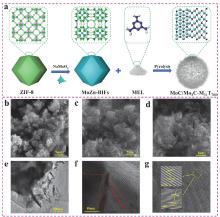
Fig 1
(a) Schematic diagram of the preparation process, (b–d) SEM images, (e) TEM images and (f–g) HRTEM image of MoC/Mo2C-M11T700."
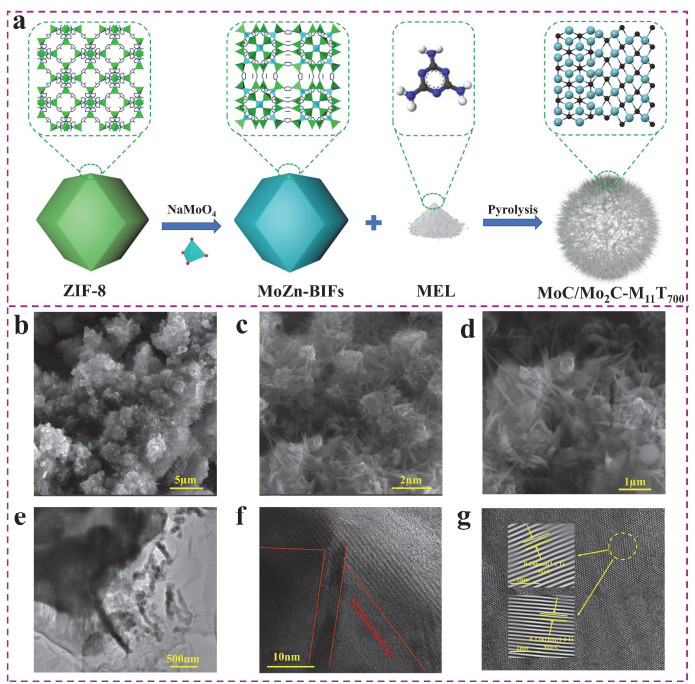
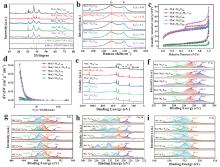
Fig 2
(a) XRD curves, (b) Raman curves, (c) Nitrogen adsorption-desorption isotherms, (d) Pore size distributions, (e) XPS survey, (f) C 1s spectra, (g) N 1s spectra, (h) Mo 3d spectra, and (i) O 1s spectra of MoC-M21T700, MoC/Mo2C-M11T700, MoC-M12T700, MoC-M11T600, and MoC-M11T800."
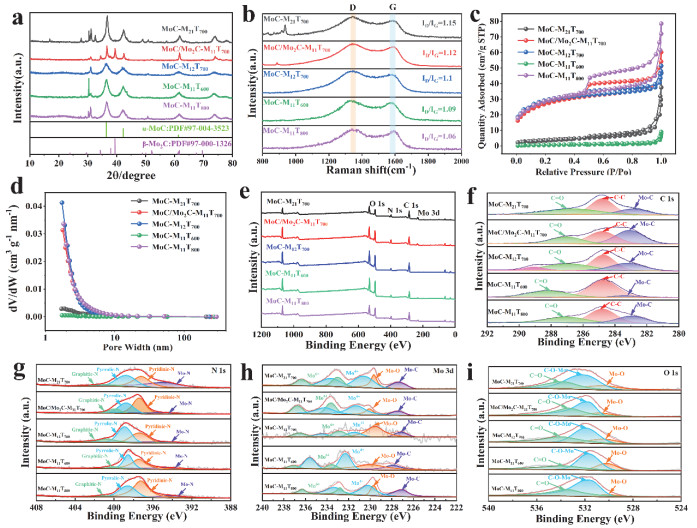
Fig 3
SEM images of (a, b) MoC-M21T700, (c, d) MoC-M12T700, (e, f) MoC-M11T600, (g, h) MoC-M11T800, (i) Element mapping and (j) EDS of MoC/Mo2C-M11T700."
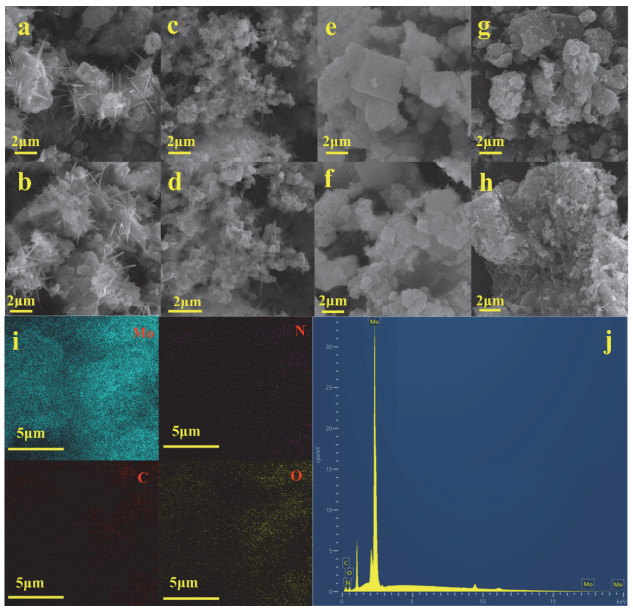
Fig 4
3D RL and the corresponding 2D contour projection maps of (a, d) MoC-M21T700, (b, e) MoC/Mo2C-M11T700, (c, f) MoC-M12T700, (g, j) MoC-M11T600, (h, k) MoC-M11T800, comparison of EWA performance of samples with (i) different precursor ratios and (l) different pyrolysis temperatures."
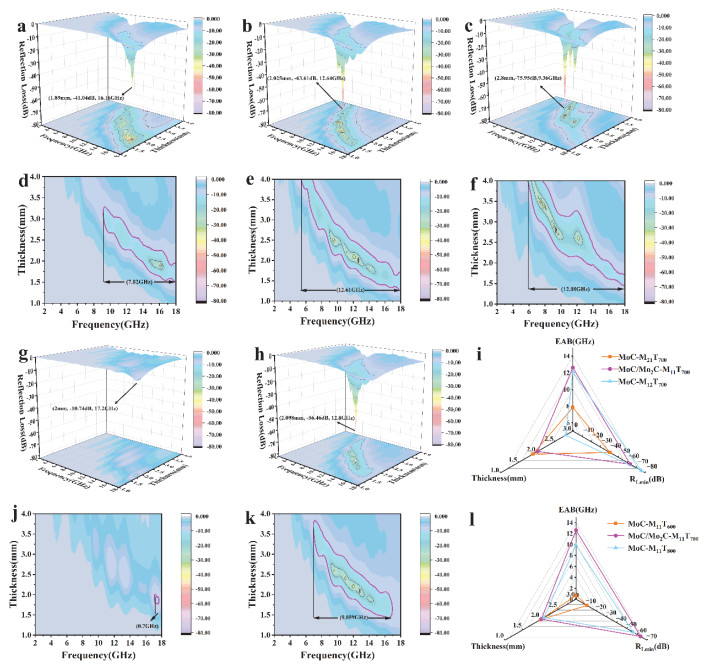
Fig 5
(a) ε′, (b) ε″, (c) tanδε, (d) μ′, (e) μ″, (f) tanδμ, (g–k) comparison of tmfit and tmexp at different frequencies, (l) attenuation constant curve of MoC-M21T700, MoC/Mo2C-M11T700, MoC-M12T700, MoC-M11T600 and MoC-M11T800."
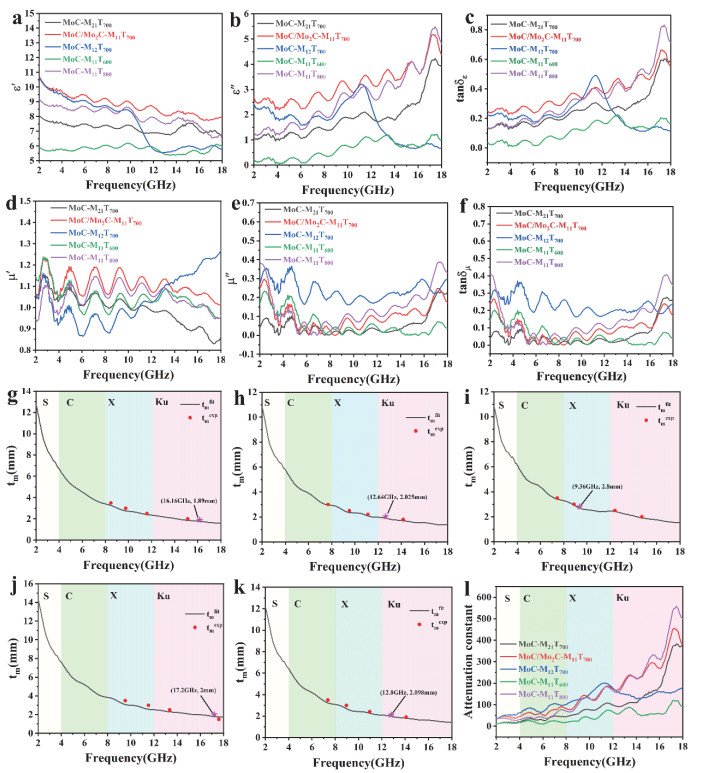
Fig 6
3D impedance (Z) values for samples with 30 wt% loading: (a) MoC-M21T700, (b) MoC/Mo2C-M11T700, (c) MoC-M12T700, (d) MoC-M11T600, (e) MoC-M11T800, (f) Potentiodynamic polarization curves (Tafel plots), (g) Nyquist plots, (h) Bode modulus plots, (i) Bode phase angle plots of five samples."
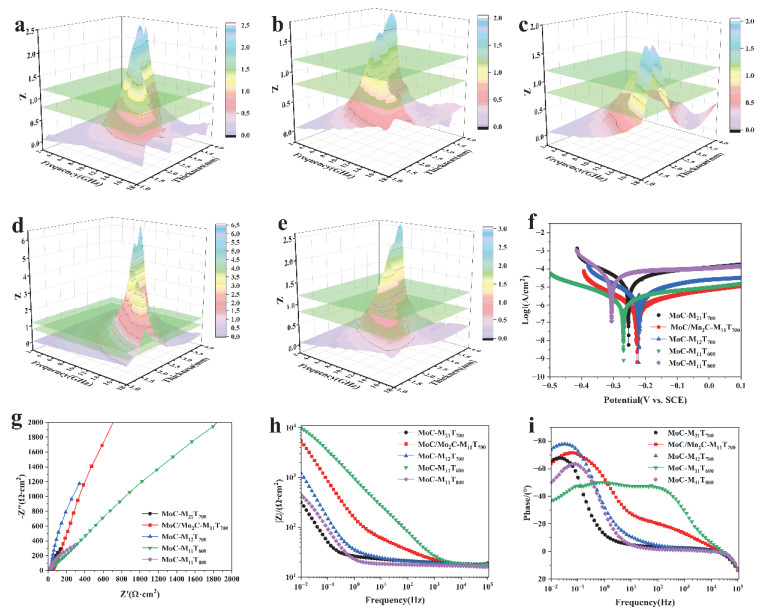
Fig 7
(a, b) RCS simulation curves, (c–g) 3D RCS patterns at normal incidence of MoC-M21T700, MoC/Mo2C-M11T700, MoC-M12T700, MoC-M11T600 and MoC-M11T800."
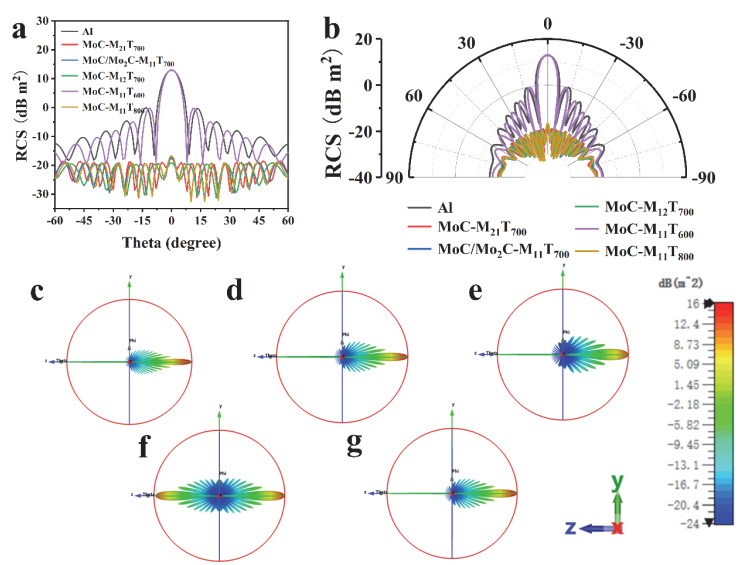
Fig 8
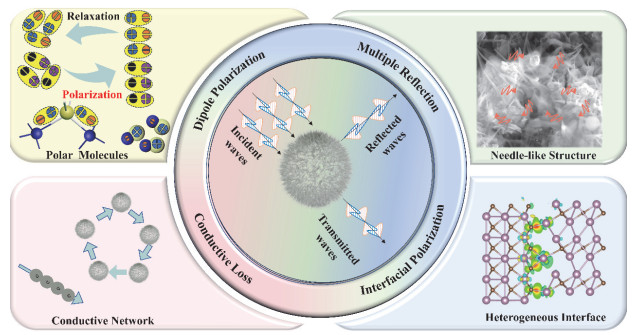
Detailed EWA mechanism diagram of the MoC/Mo2C-M11T700."
| 1 |
B. Quan, Y. Chen, L. Li, X. Lu, Z. Lou, H. Zhu, X. Zhu, G. Shao, T. Guo, L. Lin, et al., Adv. Mater. (2026) e20176, https://doi.org/10.1002/adma.202520176.
|
| 2 |
P. Liu, Z. He, X. Li, L. Ding, S. Liu, J. Kong. Adv. Mater. 2025, 37(35), 2500646.
doi: 10.1002/adma.202500646 |
| 3 |
X. Ren, Z. Jia, Z. Gao, S. Zhang, Y. Zhang, D. Lan, G. Wu. Adv. Funct. Mater. 2026, 36(29), e24264.
doi: 10.1002/adfm.202524264 |
| 4 |
Y. Han, Y. Yang, T. Li, Y. Zhang, H. Guo, M. He, K. Han, H. Qiu, J. Gu. Adv. Funct. Mater. 2025, 36(24), e25719.
doi: 10.1002/adfm.202525719 |
| 5 |
J. Xiao, B. Zhan, M. He, X. Qi, Y. Zhang, H. Guo, Y. Qu, W. Zhong, J. Gu. Adv. Funct. Mater. 2025, 35(14), 2419266.
doi: 10.1002/adfm.202419266 |
| 6 |
J. Qi, C. Liang, K. Ruan, M. Li, H. Guo, M. He, H. Qiu, Y. Guo, J. Gu. Natl. Sci. Rev. 2025, 12(11), nwaf394.
doi: 10.1093/nsr/nwaf394 |
| 7 |
X. Ren, D. Lan, Z. Gao, S. Zhang, Y. Zhang, M. He, Z. Jia, G. Wu. J. Mater. Sci. & Technol. 2025, 255, 236.
doi: 10.1016/j.jmst.2025.09.001 |
| 8 |
S. Zhang, J. Zheng, Z. Zhao, S. Du, D. Lan, Z. Gao, G. Wu. Adv. Funct. Mater. 2026, 36(1), e13762.
doi: 10.1002/adfm.202513762 |
| 9 |
Q. Li, Z. Gao, W. Zhou, S. Yang, Z. Jia, G. Wu. Nano Res. 2026, 19, 94908525.
doi: 10.26599/NR.2026.94908525 |
| 10 |
Y. Cheng, X. Liu, J. Ren, X. Xu, D. Lan, G. Wu, S. Zhang, Z. Gao, Z. Jia, G. Wu. Carbon 2025, 239, 120325.
doi: 10.1016/j.carbon.2025.120325 |
| 11 |
J. Yan, Z. Ye, D. Lan, W. Chen, Z. Jia, G. Wu. Compos. Commun. 2024, 48, 101954.
doi: 10.1016/j.coco.2024.101954 |
| 12 |
T. Liu, Y. Zhang, C. Wang, Y. Kang, M. Wang, F. Wu, W. Huang. Small 2024, 20(31), 2308378.
doi: 10.1002/smll.202308378 |
| 13 |
A. Liu, H. Qiu, X. Lu, H. Guo, J. Hu, C. Liang, M. He, Z. Yu, Y. Zhang, J. Kong, et al.. Adv. Mater. 2025, 37(5), 2414085.
doi: 10.1002/adma.202414085 |
| 14 |
T. Zhao, X. Guo, Z. Gao, Z. Jia, D. Lan, G. Wu. Carbon 2026, 254, 121509.
doi: 10.1016/j.carbon.2026.121509 |
| 15 |
Z. Wang, Z. Gao, Z. Jia, D. Lan, G. Wu. Carbon 2026, 255, 121535.
doi: 10.1016/j.carbon.2026.121535 |
| 16 |
Y. Zhang, Y. Tian, N. Xu, P. Cui, L. Guo, J. Ma, Y. Kang, L. Qin, F. Wu, L. Zhang, et al.. Adv. Funct. Mater. 2025, 35(6), 2414910.
doi: 10.1002/adfm.202414910 |
| 17 |
S. Yu, L. Gai, C. Tian, L. Zhu, W. Song, B. Hu, X. Han, Y. Du. Carbon 2024, 228, 119390.
doi: 10.1016/j.carbon.2024.119390 |
| 18 |
Y. Liu, M. Zhang, D. Liu, L. Gai, Y. Wang, P. Wang, X. Han, Y. Du. Small Methods 2025, 9(1), 2400734.
doi: 10.1002/smtd.202400734 |
| 19 |
S. Mao, R. Miao, D. Lan, S. Zhang, J. Zhou, X. Liu, S. Du, Z. Zhao, G. Wu. Acta Phys.-Chim. Sin. 2026, 42(6), 100279.
doi: 10.1016/j.actphy.2026.100279 |
| 20 |
S. Zhang, H. Li, S. Zhang, S. Wang, S. Du, Z. Zhao, X. Zhao, X. Liang, Acta Phys.-Chim. Sin. (2026) 100305, https://doi.org/10.1016/j.actphy.2026.100305.
|
| 21 |
X. Di, M. Yuan, J. Lu, S. Yang, C. Zhou, Y. Chen, H. Zou, Acta Phys.-Chim. Sin. (2026) 100270, https://doi.org/10.1016/j.actphy.2026.100270.
|
| 22 |
M. Shi, Z. Jia, D. Lan, Z. Gao, S. Zhang, G. Wu. Adv. Funct. Mater. 2025, 36(30), e28665.
doi: 10.1002/adfm.202528665 |
| 23 |
J. Wang, B. Cai, B. Sun, Z. Hou, S. Yang, Q. Yang, P. Zhao, W. Li, Y. Zhang, G. Wang, Acta Phys.-Chim. Sin. (2026) 100271, https://doi.org/10.1016/j.actphy.2026.100271.
|
| 24 |
T. Liu, C. Wang, X. Zhang, H. Huo, H. Li, W. Zhang, M. Ren, C. Yan, H. Huang, W. Huang. Adv. Funct. Mater. 2024, 34(51), 2410194.
doi: 10.1002/adfm.202410194 |
| 25 |
J. Yan, Z. Ye, T. Liu, X. Zhang, Z. Zhang, C. Wang, Y. Huang. Carbon 2026, 254, 121478.
doi: 10.1016/j.carbon.2026.121478 |
| 26 |
P. Zhu, Y. Kang, X. Li, H. Yu, T. Liu, M. Song, Y. Zhang, L. Zhou, P. Zhao, W. Huang. Nanoscale 2024, 16(12), 6249.
doi: 10.1039/D3NR05917K |
| 27 |
W. Wang, H. Qin, H. Li, D. Lan, Y. Wang, Y. Han, D. Liu, R. Liu, G. Wu. Sci. China Mater. 2025, 68(10), 3757.
doi: 10.1007/s40843-025-3624-y |
| 28 |
X. Liu, J. Wang, W. Wang, Y. Liu, J. Sun, H. Wang, Q. Zhao, W. Liu, Q. Huang, S. Wang, et al.. Small 2024, 20(12), 2307902.
doi: 10.1002/smll.202307902 |
| 29 |
Z. He, H. Xu, L. Shi, X. Ren, J. Kong, P. Liu. Small 2024, 20(6), 2306253.
doi: 10.1002/smll.202306253 |
| 30 |
X. Di, J. Lu, M. Yuan, M. Liang, Z. Zeng, H. Liu, Y. Chen, H. Zou. Compos. Part A Appl. Sci. Manuf. 2025, 199, 109211.
doi: 10.1016/j.compositesa.2025.109211 |
| 31 |
F. Lv, Y. Wang, Q. He, D. Lan, G. Wu, Adv. Funct. Mater. (2026) e75416, https://doi.org/10.1002/adfm.75416.
|
| 32 |
W. Gu, Z. Luo, J. Wang, X. Tan, Z. Tao, P. Zhou, H. Zhang, D. Lan, A. Xia. J. Mater. Sci. & Technol. 2026, 243, 102.
doi: 10.1016/j.jmst.2025.04.024 |
| 33 |
M. Shi, Z. Jia, S. Xu, Z. Gao, G. Wu, Adv. Funct. Mater. (2026) e74648, https://doi.org/10.1002/adfm.74648.
|
| 34 |
M. Yuan, H. Zhang, Y. Fei, J. Lu, J. He, B. Qiu, Z. Zeng, H. Liu, W. Chen, M. Liang, et al.. Carbon 2024, 216, 118504.
doi: 10.1016/j.carbon.2023.118504 |
| 35 |
W. Geng, P. Liu. Soft Sci. 2026, 6(1), 2.
doi: 10.20517/ss.2025.113 |
| 36 |
Y. Li, Y. Lu, Z. Liu, D. Lei, M. Yang, D. Yang, Y. Jin, J. Liu, D. Lan. Rare Met. 2025, 44(9), 6531.
doi: 10.1007/s12598-025-03429-1 |
| 37 |
Z. Jia, J. Li, D. Lan, S. Zhang, Z. Gao, X. Shi, G. Wu. J. Mater. Sci. & Technol. 2025, 256, 246.
doi: 10.1016/j.jmst.2025.08.044 |
| 38 |
Q. Wu, Z. Ma, C. Wang, Y. Tao, S. Wang, Z. Jin, T. Gao, C. Li, P. Liu. J. Adv. Ceram. 2025, 14(12), 9221210.
doi: 10.26599/JAC.2025.9221210 |
| 39 |
W. Zhao, Z. Guo, D. Lan, Z. Jia, S. Zhang, G. Wu. Small 2025, 21(45), e09339.
doi: 10.1002/smll.202509339 |
| 40 |
S. Xiong, L. Cai, Y. Zhang, Y. Ma, D. Lan, G. Chen, C. Dong, H. Guan. Rare Met. 2025, 44(10), 7720.
doi: 10.1007/s12598-025-03439-z |
| 41 |
T. Liu, D. Lan, S. Zhang, P. Wang, S. Zhang, X. Zhao, X. Liang, Z. Zhao, Acta Phys.-Chim. Sin. (2026) 100289, https://doi.org/10.1016/j.actphy.2026.100289.
|
| 42 |
R. Feng, C. Fan, D. Lan, L. Liu, Q. He, Y. Wang, Acta Phys.-Chim. Sin. (2026) 100301, https://doi.org/10.1016/j.actphy.2026.100301.
|
| 43 |
P. Yin, D. Lan, Z. Yuan, R. Wang, Y. Zhang, X. Sun. J. Alloys Compd. 2025, 1037, 182260.
doi: 10.1016/j.jallcom.2025.182260 |
| 44 |
X. Dai, D. Lan, X. Chen, X. Wang, G. Ji, Acta Phys.-Chim. Sin. (2026) 100302, https://doi.org/10.1016/j.actphy.2026.100302.
|
| 45 |
S. Xu, Z. Jia, D. Lan, M. Shi, Z. Gao, G. Wu, Adv. Funct. Mater. (2026) e75567, https://doi.org/10.1002/adfm.75567.
|
| 46 |
X. Liu, Y. Zhao, Y. Zhang, X. Cui, Y. Xue, X. Lu, J. Gu. Nano-Micro Lett. 2026, 18, 344.
doi: 10.1007/s40820-026-02202-y |
| 47 |
X. Zhao, Q. Niu, Y. Huang, H. Jiang, H. Huang, M. Zong, C. Chen. J. Energy Chem. 2025, 108, 246.
doi: 10.1016/j.jechem.2025.03.091 |
| 48 |
Y. Chen, H. Peng, B. Cai, C. Liang, Y. Zhang, P. Zhao, P. Hu, W. Li, G. Wang. J. Adv. Ceram. 2026, 15(2), 9221225.
doi: 10.26599/JAC.2025.9221225 |
| [1] | Jun Wang, Yibo Wang, Jiran Wu, Dashuang Wang, Cheng Liu, Haiming Huang, Youyong Wang, Chuankun Zhang. Synergizing magnetic exchange resonance and hierarchical dielectric relaxation in multiphase core-shell heterojunctions for efficient microwave dissipation [J]. Acta Phys. -Chim. Sin., 2026, 42(9): 100336-. |
| [2] | Shihao Yang, Zhiqiang Guo, Zirui Jia, Yi Liu, Dingshuo Wang, Zengchao Li, Haifeng Li, Hua Qiu, Guanglei Wu. Precisely engineered heterointerfaces in bimetallic MOFs enable multiscale polarization synergy for efficient electromagnetic attenuation [J]. Acta Phys. -Chim. Sin., 2026, 42(9): 100348-. |
| [3] | Renwei Feng, Congmin Fan, Di Lan, Lanxiang Liu, Qinchuan He, Yiqun Wang. Anchoring strategy-induced conductive loss in Ni-MOF@expanded graphite composites to achieve broadband microwave absorption [J]. Acta Phys. -Chim. Sin., 2026, 42(8): 100301-. |
| [4] | Shuai Zhang, Haifeng Li, Shijie Zhang, Shun Wang, Suxuan Du, Zhiwei Zhao, Xiaomiao Zhao, Xiaowei Liang. Microwave assisted construction of Ta2CTx MXene/CuInS2 heterostructures toward enhanced dielectric loss and broadband electromagnetic wave absorption [J]. Acta Phys. -Chim. Sin., 2026, 42(8): 100305-. |
| [5] | Zhiqing Jia, Xinju Gong, Di Lan, Huanhuan Sun, Yu Liu, Yuping Gao, Siyao Guo. Electrostatically induced dual-coupled interfaces of defect polarization enhanced PBA/MXene heterostructures for boosting electromagnetic wave absorption [J]. Acta Phys. -Chim. Sin., 2026, 42(8): 100312-. |
| [6] | Zirui Jia, Zehua Zhou, Shuang Xu, Yuan Wang, Mengjia Shi, Mengting He, Chuankun Zhang, Di Lan. Two birds with one stone: phosphorus doping to enhance conduction loss and dipole polarization for electromagnetic wave absorber [J]. Acta Phys. -Chim. Sin., 2026, 42(8): 100310-. |
| [7] | Weiheng Liu, Juhua Luo, Jiahuan Shi, Di Lan, Shuangshuang Mao, Yu Xie. Honeycomb-like BiCo@NC composites derived from bimetallic organic frameworks for high-efficiency electromagnetic wave absorption [J]. Acta Phys. -Chim. Sin., 2026, 42(8): 100313-. |
| [8] | Guangrong Wu, Jiahui Zhu, Xiaomeng Guo, Changmiao Zhang, Mengting He, Hua Qiu, Dongwei Ma. Construction of Schottky barrier and the enhanced interface polarization effect of C@ZnO/Sn@GaN for high performance electromagnetic wave absorption [J]. Acta Phys. -Chim. Sin., 2026, 42(8): 100324-. |
| [9] | Shuangshuang Mao, Juhua Luo, Bingjie Han, Jiahuan Shi, Yujia Gu. Covalent organic framework-derived Fe3C/NC/TiO2 heterostructures for high-performance electromagnetic wave absorption [J]. Acta Phys. -Chim. Sin., 2026, 42(7): 100290-. |
| [10] | Bo Hu, Yanyi Chen, Yongzheng Chen, Xuan Wang, Xijiang Han, Yunchen Du. Theoretical guidance for the rational design of FeCo foams toward efficient electromagnetic wave absorption in 2.0–8.0 GHz range [J]. Acta Phys. -Chim. Sin., 2026, 42(6): 100269-. |
| [11] | Yuqi Zhai, Mengzhu Liu, Junhao Hu, Yongpeng Wang. Strengthening of Fe3O4/Ti3C2Tx MXene/CF@PANI composites with 'reinforced concrete' structure and high electromagnetic wave absorption performance [J]. Acta Phys. -Chim. Sin., 2026, 42(10): 100248-. |
| [12] | CHEN Zhi-Lei, ZHANG Yong-Bin, HU Yin, LUO Li-Zhu, LIU Ke-Zhao. Influence on Surface Morphology of Uranium by Modification of Pulsed Laser Nitriding [J]. Acta Phys. -Chim. Sin., 2015, 31(Suppl): 111-116. |
| [13] | QIAN Yang, XU Jiang. Properties of Zr Nanocrystalline Coating on Ti Alloy Bipolar Plates in Simulated PEMFC Environments [J]. Acta Phys. -Chim. Sin., 2015, 31(2): 291-301. |
| [14] | ZHONG Xiao-Cong, GUI Jun-Feng, YU Xiao-Ying, LIU Fang-Yang, JIANG Liang-Xing, LAI Yan-Qing, LI Jie, LIU Ye-Xiang. Influence of Alloying Element Nd on the Electrochemical Behavior of Pb-Ag Anode in H2SO4 Solution [J]. Acta Phys. -Chim. Sin., 2014, 30(3): 492-499. |
| [15] | LUO Bing, XIA Da-Hai. Characterization of pH Effect on Corrosion Resistance of Nuclear Steam Generator Tubing Alloy by In-situ Scanning Electrochemical Microscopy [J]. Acta Phys. -Chim. Sin., 2014, 30(1): 59-66. |
|
||