Acta Phys. -Chim. Sin. ›› 2025, Vol. 41 ›› Issue (1): 100002.doi: 10.3866/PKU.WHXB202309002
Special Issue: Energy Chemistry
• ARTICLE • Previous Articles Next Articles
Effect of Interlayer Anions in Layered Double Hydroxides on the Photothermocatalytic CO2 Methanation of Derived Ni-Al2O3 Catalysts
Lina Guo1, Ruizhe Li1, Chuang Sun1, Xiaoli Luo1, Yiqiu Shi1, Hong Yuan1,*( ), Shuxin Ouyang1,*(), Tierui Zhang2,*()
- 1 Engineering Research Center of Photoenergy Utilization for Pollution Control and Carbon Reduction, Ministry of Education; Key Laboratory of Pesticide and Chemical Biology of Ministry of Education, College of Chemistry, Central China Normal University, Wuhan 430079, China
2 Key Laboratory of Photochemical Conversion and Optoelectronic Materials, Technical Institute of Physics and Chemistry, Chinese Academy of Sciences, Beijing 100190, China
-
Received:2023-09-01Revised:2023-10-06Accepted:2023-10-19Published:2023-12-20 -
Contact:Email: yuanhong@mail.ccnu.edu.cn (Hong Yuan)oysx@mail.ccnu.edu.cn (Shuxin Ouyang)tierui@mail.ipc.ac.cn (Tierui Zhang) -
Supported by:the National Natural Science Foundation of China(21972052); the National Natural Science Foundation of China(22272061); Foundation Project of Hubei Key Laboratory of Radiation Chemistry and Functional Materials(2021KF01)

Cite this article
Lina Guo, Ruizhe Li, Chuang Sun, Xiaoli Luo, Yiqiu Shi, Hong Yuan, Shuxin Ouyang, Tierui Zhang. Effect of Interlayer Anions in Layered Double Hydroxides on the Photothermocatalytic CO2 Methanation of Derived Ni-Al2O3 Catalysts[J]. Acta Phys. -Chim. Sin. 2025, 41(1), 100002. doi: 10.3866/PKU.WHXB202309002
share this article
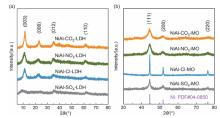
Fig 1
XRD patterns of (a) NiAl-x-LDH precursors and (b) NiAl-x-MO catalysts."
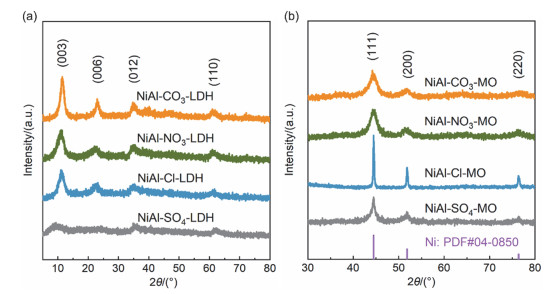
Fig 2
TEM and HRTEM images of the NiAl-x-MO catalysts: (a, b) NiAl-CO3-MO, (c, d) NiAl-NO3-MO, (e, f) NiAl-Cl-MO, and (g, h) NiAl-SO4-MO."
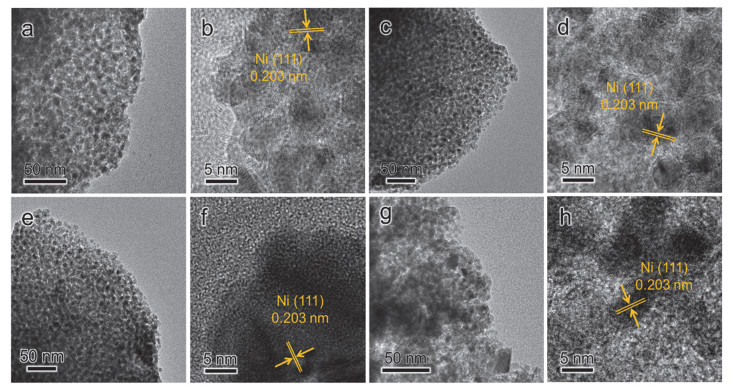
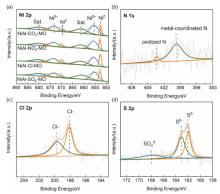
Fig 3
(a) Ni 2p XPS spectra of the NiAl-x-MO catalysts, (b) N 1s XPS spectrum of the NiAl-NO3-MO catalyst, (c) Cl 2p XPS spectrum of the NiAl-Cl-MO catalyst, and (d) S 2p XPS spectrum of the NiAl-SO4-MO catalyst."
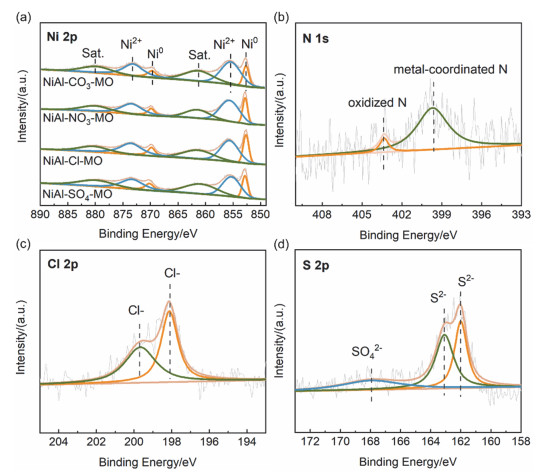
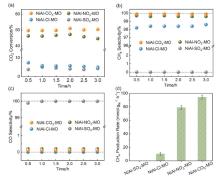
Fig 4
(a) CO2 conversion, (b) CH4 selectivity, (c) CO selectivity, and (d) CH4 yield over the NiAl-x-MO catalysts. Reaction conditions: 0.3 g catalyst, 250 ℃, and 1 atm."
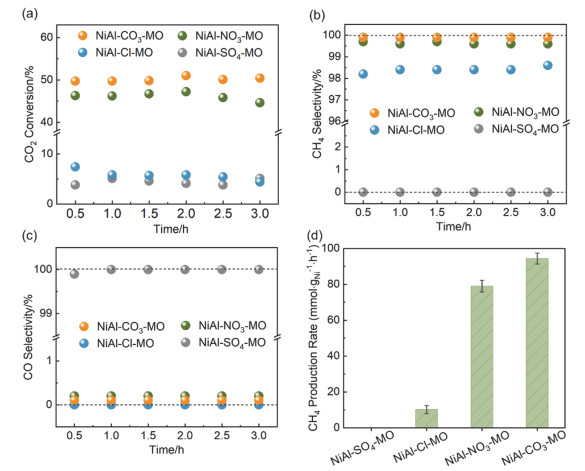
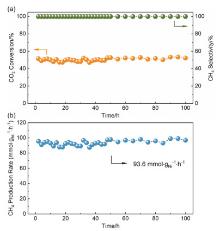
Fig 5
100 h long-term stability over the NiAl-CO3-MO catalysts: (a) CO2 conversion and CH4 selectivity, (b) CH4 yield. Reaction conditions: 0.3 g catalyst, 250 ℃ and 1 atm."
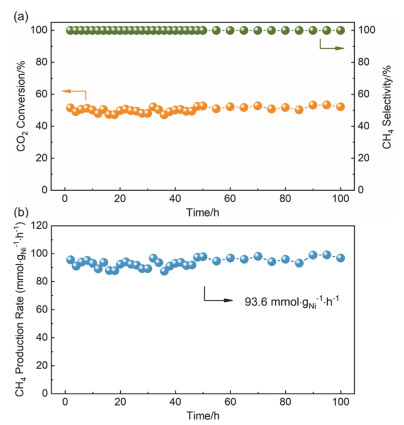
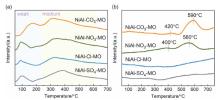
Fig 6
(a) CO2-TPD profiles and (b) H2-TPD profiles of the NiAl-x-MO catalysts."
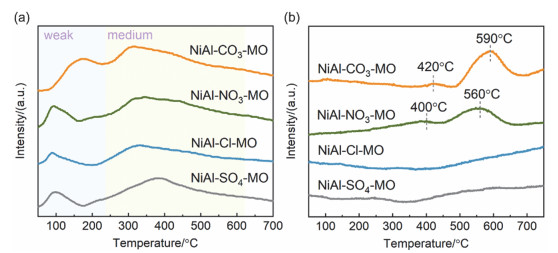
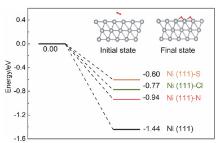
Fig 7
The adsorption-dissociation energies of H2 on the Ni(111), Ni(111)-N, Ni(111)-Cl, and Ni(111)-S models."

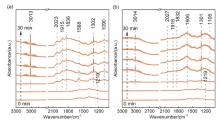
Fig 8
The in situ DRIFTS profiles of the NiAl-x-MO catalysts: (a) NiAl-CO3-MO, (b) NiAl-NO3-MO (From bottom to top, reaction time: 0, 5, 10, 15, 20, 25, 30 min)."
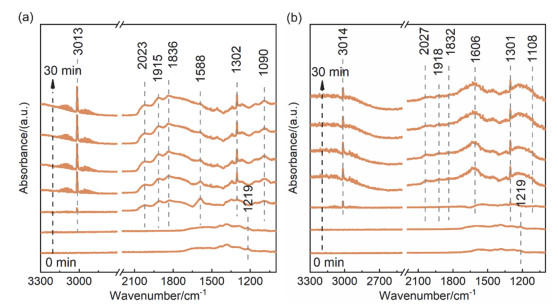
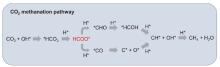
Fig 9
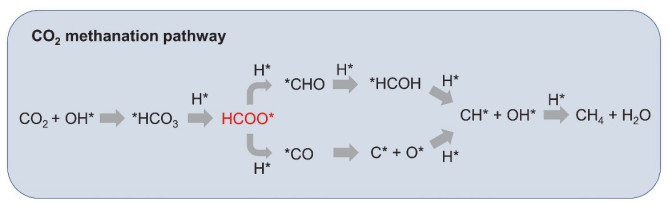
Reaction pathway of CO2 methanation on the NiAl-CO3-MO and NiAl-NO3-MO catalysts."
| 1 |
doi: 10.1126/science.aau5153 |
| 2 |
doi: 10.1038/nature18307 |
| 3 |
doi: 10.1039/c9cs00821g |
| 4 |
|
|
高云楠; 刘世桢; 赵振清; 陶亨聪; 孙振宇. 物理化学学报, 2018, 34, 858.
doi: 10.3866/PKU.WHXB201802061 |
|
| 5 |
|
|
张继宏; 钟地长; 鲁统部. 物理化学学报, 2021, 37, 2008068.
doi: 10.3866/PKU.WHXB202008068 |
|
| 6 |
doi: 10.1007/s12598-020-01431-3 |
| 7 |
doi: 10.1038/nature23016 |
| 8 |
doi: 10.1007/s10311-022-01483-0 |
| 9 |
doi: 10.1021/acscatal.9b02197 |
| 10 |
doi: 10.1021/acsnano.2c09025 |
| 11 |
doi: 10.1002/solr.202200493 |
| 12 |
doi: 10.1002/advs.202302568 |
| 13 |
doi: 10.1007/s12209-022-00333-y |
| 14 |
doi: 10.1002/aenm.201601657 |
| 15 |
doi: 10.1021/acsami.9b18665 |
| 16 |
doi: 10.1021/acscatal.5b01464 |
| 17 |
doi: 10.1016/j.apcatb.2020.119561 |
| 18 |
doi: 10.1038/s41560-021-00867-w |
| 19 |
doi: 10.1021/acscatal.9b04963 |
| 20 |
doi: 10.1016/j.apcatb.2021.119922 |
| 21 |
doi: 10.1002/adma.201704663 |
| 22 |
doi: 10.1007/s12274-021-3436-6 |
| 23 |
doi: 10.1002/asia.202101084 |
| 24 |
doi: 10.1016/j.cej.2019.123682 |
| 25 |
doi: 10.1021/jacs.2c01153 |
| 26 |
doi: 10.1016/j.jhazmat.2017.12.062 |
| 27 |
doi: 10.1016/j.porgcoat.2019.105218 |
| 28 |
doi: 10.1016/j.jtice.2019.04.051 |
| 29 |
doi: 10.1021/acscatal.8b00584 |
| 30 |
doi: 10.1021/acscatal.6b02203 |
| 31 |
doi: 10.1038/s41467-020-18969-6 |
| 32 |
doi: 10.1021/acsnano.2c11013 |
| 33 |
doi: 10.1021/acsami.7b04919 |
| 34 |
doi: 10.1038/s41598-017-10632-3 |
| 35 |
doi: 10.1016/j.apcatb.2020.119869 |
| 36 |
doi: 10.1016/j.nanoen.2015.02.035 |
| 37 |
doi: 10.1016/j.cej.2018.11.143 |
| 38 |
doi: 10.1016/j.apcatb.2019.04.093 |
| 39 |
doi: 10.1016/j.apcatb.2019.118494 |
| 40 |
doi: 10.1016/j.jece.2021.105173 |
| 41 |
doi: 10.1016/j.jcou.2022.102381 |
| 42 |
doi: 10.3390/catal11040443 |
| 43 |
doi: 10.1016/j.fuel.2022.127241 |
| 44 |
doi: 10.1016/j.jcat.2020.10.018 |
| 45 |
doi: 10.1016/j.apcatb.2019.117791 |
| 46 |
doi: 10.1038/s41560-019-0431-1 |
| 47 |
doi: 10.1016/j.apcatb.2021.120454 |
| 48 |
doi: 10.1016/j.cej.2022.137217 |
| [1] | Wenlong Wang, Wentao Hao, Lang He, Jia Qiao, Ning Li, Chaoqiu Chen, Yong Qin. Bandgap and adsorption engineering of carbon dots/TiO2 S-scheme heterojunctions for enhanced photocatalytic CO2 methanation [J]. Acta Phys. -Chim. Sin., 2025, 41(9): 100116-. |
| [2] | Tian Li, Xiaojie Hao, Sha Bai, Yufei Zhao, Yu-Fei Song. Controllable Synthesis and Scale-up Production Prospect of Monolayer Layered Double Hydroxide Nanosheets [J]. Acta Phys. -Chim. Sin., 2020, 36(9): 1912005-. |
| [3] | SHI Wei, HU Jun, NI Zhe-Ming, LI Yuan, LIU Jiao. Influence of Interlayer Water Content on Supermolecular Interaction of Copper-Iron Layered Double Hydroxides [J]. Acta Phys. -Chim. Sin., 2012, 28(08): 1869-1876. |
| [4] | NI Zhe-Ming, LIU Jiao, XUE Ji-Long, LI Yuan, SHI Wei. Effect of Divalent Metal Ions on the Stability of Cu-Containing Layered Double Hydroxides [J]. Acta Phys. -Chim. Sin., 2012, 28(07): 1714-1720. |
| [5] | YAO Ping, NI Zhe-Ming, XU Qian, MAO Jiang-Hong, LIU Xiao-Ming, WANG Qiao-Qiao. Supermolecular Interactions in Magnesium-Tin Layered Double Hydroxides [J]. Acta Phys. -Chim. Sin., 2010, 26(01): 175-182. |
| [6] | XU Qian; NI Zhe-Ming; PAN Guo-Xiang; CHEN Li-Tao; LIU Ting. Super-Molecular Interaction between Cl- and H2O within the Restricted Space of Layered Double Hydroxides [J]. Acta Phys. -Chim. Sin., 2008, 24(04): 601-606. |
| [7] | PAN Guo-Xiang; NI Zhe-Ming; LI Xiao-Nian. Supra-molecular Interaction between Host Layer and Guest CO2-3, H2O of Layered Double Hydroxides [J]. Acta Phys. -Chim. Sin., 2007, 23(08): 1195-1200. |
| [8] | NI Zhe-Ming;PAN Guo-Xiang;WANG Li-Geng;CHEN Li-Tao . Theoretical Studies on Super-molecule Interaction between Host Layer and Halide Anion of Layered Double Hydroxides [J]. Acta Phys. -Chim. Sin., 2006, 22(11): 1321-1324. |
| [9] | Gou Guo-Jing;Ma Pei-Hua;Chu Min-Xiong. Kinetics of Synthetic of Cl- Type Hydrotalcitelike with Coprecipitation Reaction [J]. Acta Phys. -Chim. Sin., 2004, 20(11): 1357-1363. |
|
||