Acta Phys. -Chim. Sin. ›› 2024, Vol. 40 ›› Issue (12): 2407020.doi: 10.3866/PKU.WHXB202407020
• ARTICLE • Previous Articles Next Articles
Constructing Covalent Triazine Frameworks/N-Doped Carbon-Coated Cu2O S-Scheme Heterojunctions for Boosting Photocatalytic Hydrogen Production
Kaihui Huang1,2, Dejun Chen2, Xin Zhang3,*( ), Rongchen Shen1,2,*(), Peng Zhang4,*(), Difa Xu5, Xin Li1,2,*()
- 1 Institute of Biomass Engineering, Key Laboratory of Energy Plants Resource and Utilization, Ministry of Agriculture and Rural Affairs, South China Agricultural University, Guangzhou 510642, China
2 Key Laboratory for Biobased Materials and Energy of Ministry of Education, College of Materials and Energy, South China Agricultural University, Guangzhou 510642, China
3 Hubei Key Lab Low Dimens Optoelect Mat 2 Devices, Hubei University of Arts and Science, Xiangyang 441053, Hubei Province, China
4 State Centre for International Cooperation on Designer Low-Carbon 2 Environmental Materials (CDLCEM), School of Materials Science and Engineering, Zhengzhou University, Zhengzhou 450001, China
5 Hunan Key Laboratory of Applied Environmental Photocatalysis, Changsha University, Changsha 410022, China
-
Received:2024-07-21Revised:2024-09-18Accepted:2024-09-19Published:2024-11-09 -
Contact:Email: xinli@scau.edu.cn (Xin Li)xinzhang@hbuas.edu.cn (Xin Zhang)shenrongchenscau@163.com (Rongchen Shen)zhangp@zzu.edu.cn (Peng Zhang) -
About author:†These authors contributed equally to this work.
-
Supported by:The project was supported from the National Natural Science Foundation of China(22378148); The project was supported from the National Natural Science Foundation of China(21975084); The project was supported from the National Natural Science Foundation of China(2230082074); Natural Science Foundation of Guangdong Province(2024A1515012433)

Cite this article
Kaihui Huang, Dejun Chen, Xin Zhang, Rongchen Shen, Peng Zhang, Difa Xu, Xin Li. Constructing Covalent Triazine Frameworks/N-Doped Carbon-Coated Cu2O S-Scheme Heterojunctions for Boosting Photocatalytic Hydrogen Production[J]. Acta Phys. -Chim. Sin. 2024, 40(12), 2407020. doi: 10.3866/PKU.WHXB202407020
share this article
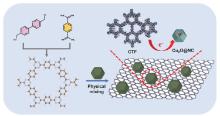
Scheme1
Schematic diagram of the synthesis of CTF-Cu2O@NC composites."
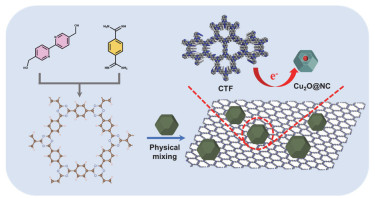
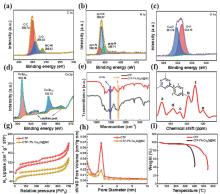
Fig 1
XPS spectra of CTF-7% Cu2O@NC in the region of (a) C 1s, (b) N 1s, (c) O 1s, (d) Cu 2p, (e) FTIR spectra of CTF and CTF-Cu2O@NC. (f) Solid-state 13C NMR spectra of CTF. (g) The isotherms of N2 adsorption and desorption for CTF and CTF-7% Cu2O@NC. (h) The distribution of pore sizes of CTF and CTF-7% Cu2O@NC. (i) TGA of CTF and CTF-7% Cu2O@NC under N2."
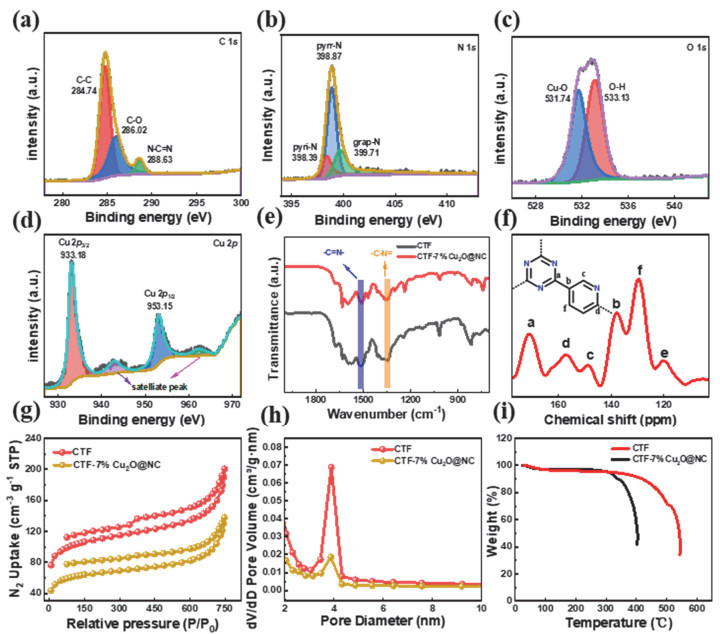
Fig 2
TEM images of (a) CTF; (b) Cu2O@NC; (e) CTF-7% Cu2O@NC; (c) live profile of CTF and Cu2O@NC; HRTEM images of CTF-7% Cu2O@NC (d) and (f); Elemental mapping of CTF-7% Cu2O@NC (g–j)."
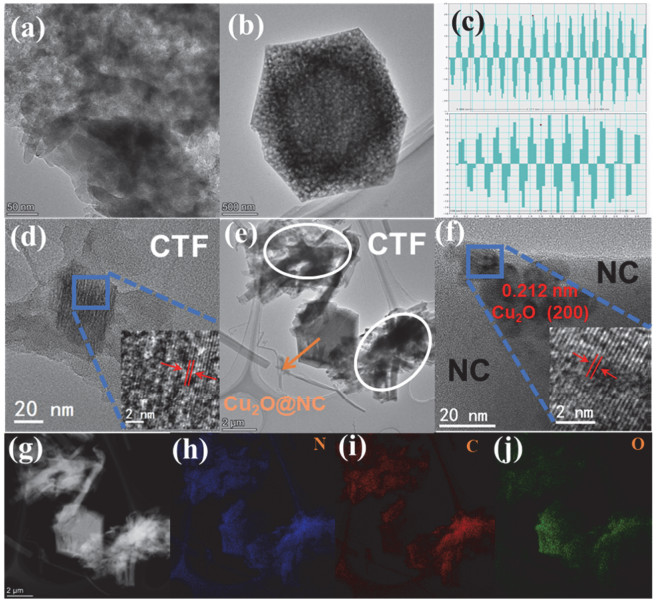
Fig 3
(a) UV-Vis absorption spectra of CTF, Cu2O, Cu2O@NC and CTF-7% Cu2O@NC; (b) Photocatalytic H2 evolution performance of CTF-7% Cu2O@NC compared to CTF and Cu2O@NC; (c) H2 evolution rate of CTF-X% Cu2O@NC using different ratios of Cu2O@NC (d) H2 evolution rates for CTF-7% Cu2O@NC with different types of sacrificial agents. (e) Cycling stability for CTF-7% Cu2O@NC and CTF in photocatalytic H2 evolution. (f) Wavelength-dependent AQY of photocatalytic H2 evolution for CTF-7% Cu2O@NC; (g) Comparison of the photocatalytic H2-evolution activities on CTF-based photocatalysts."
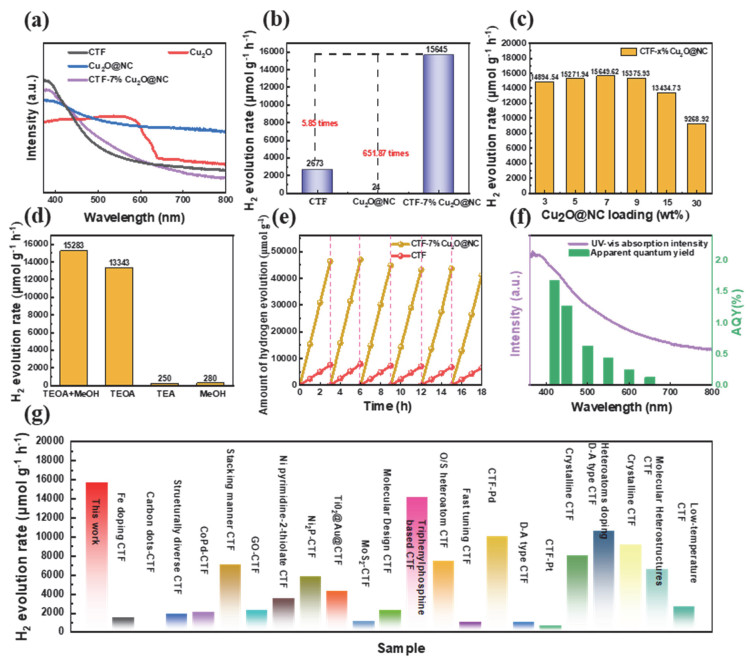
Fig 4
The MottSchottky plot of CTF (a) and Cu2O@NC (b); (c) Kubelka-Munk function vs. the energy of incident light plots; The valence-band XPS profile of CTF (d) and Cu2O@NC (e); (f) Band structures of CTF and Cu2O@NC."
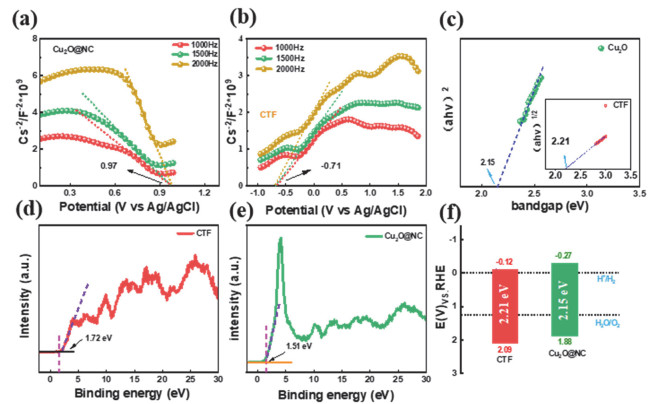
Fig 5
(a, b) Band structures of CTF and Cu2O; (c) The electrostatic potential of CTF; (d) Work function of Cu2O@NC and CTF; High-resolution XPS spectra of (e) Cu 2p and (f) O 1s in the samples under the irradiation of 365 nm UV light or in the dark; (g) Photocurrent profile of CTF-7% Cu2O@NC, CTF and Cu2O@NC; PL spectra (h) and fluorescence lifetime (i) spectrum of CTF-7% Cu2O@NC CTF and Cu2O@NC composites."
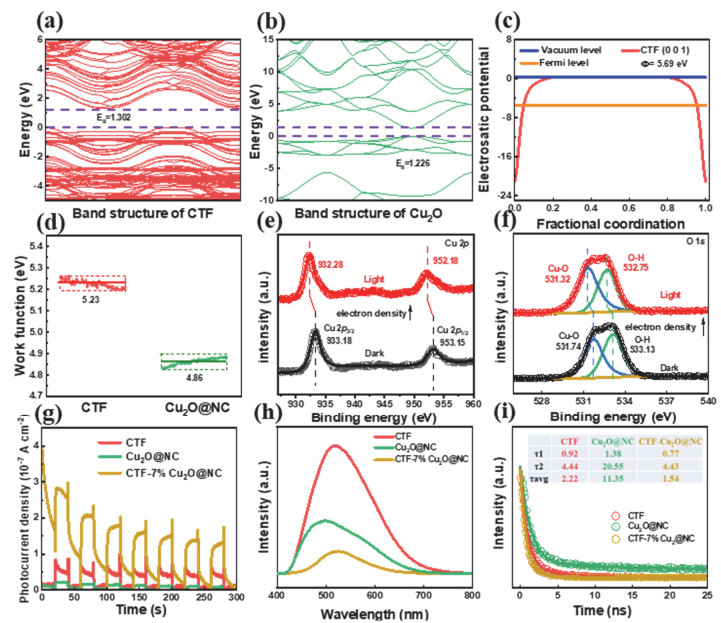
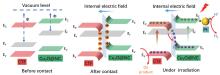
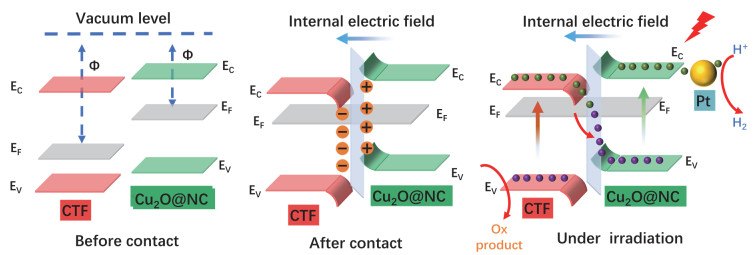
Fig 6
Schematic representation of interfacial electron transfer, migration and EF equilibrium of CTF, Cu2O @NC before contact, after contact, and under light irradiation."
| 1 |
doi: 10.1038/s41929-019-0242-6 |
| 2 |
doi: 10.1016/j.mtphys.2022.100767 |
| 3 |
doi: 10.1021/acsaem.1c03967 |
| 4 |
doi: 10.1007/s40242-023-3124-z |
| 5 |
doi: 10.1007/s40843-023-2755-2 |
| 6 |
doi: 10.1002/eem2.12414 |
| 7 |
doi: 10.1016/j.jallcom.2022.165607 |
| 8 |
doi: 10.1002/adsu.202200139 |
| 9 |
doi: 10.1007/s40242-022-2254-z |
| 10 |
doi: 10.1002/ece2.16 |
| 11 |
doi: 10.1002/adma.202303649 |
| 12 |
doi: 10.1016/j.jallcom.2022.164041 |
| 13 |
doi: 10.1016/j.jmst.2023.03.067 |
| 14 |
doi: 10.1016/j.chempr.2020.06.010 |
| 15 |
doi: 10.3866/pku.Whxb202212016 |
| 16 |
doi: 10.1002/anie.202218688 |
| 17 |
doi: 10.1016/j.jmst.2024.02.012 |
| 18 |
doi: 10.1016/j.apmt.2022.101637 |
| 19 |
doi: 10.1016/j.jmst.2023.03.003 |
| 20 |
doi: 10.1016/S1872-2067(23)64420-1 |
| 21 |
doi: 10.1016/j.surfin.2023.103160 |
| 22 |
doi: 10.1002/eem2.12643 |
| 23 |
doi: 10.1002/anie.201806664 |
| 24 |
doi: 10.1016/s1872-2067(21)63936-0 |
| 25 |
doi: 10.1002/adfm.202308553 |
| 26 |
doi: 10.1002/adfm.202400065 |
| 27 |
doi: 10.1002/anie.202304173 |
| 28 |
doi: 10.1016/j.cjsc.2024.100332 |
| 29 |
doi: 10.1007/s40242-022-1504-4 |
| 30 |
doi: 10.1016/j.cjsc.2023.100204 |
| 31 |
doi: 10.1038/s41929-019-0338-z |
| 32 |
doi: 10.1021/acscatal.7b04219 |
| 33 |
doi: 10.1021/am500131b |
| 34 |
doi: 10.1002/anie.201708548 |
| 35 |
doi: 10.1021/ja508693y |
| 36 |
doi: 10.1016/j.cjsc.2023.100202 |
| 37 |
doi: 10.1002/adfm.202301463 |
| 38 |
doi: 10.1016/j.apcatb.2019.01.042 |
| 39 |
doi: 10.1016/j.apcatb.2023.122581 |
| 40 |
doi: 10.1007/s40242-024-4055-z |
| 41 |
doi: 10.1016/j.apcatb.2021.120104 |
| 42 |
doi: 10.1002/ece2.20 |
| 43 |
doi: 10.1021/acsaem.0c02102 |
| 44 |
doi: 10.1002/anie.202116875 |
| 45 |
doi: 10.1002/cssc.202101308 |
| 46 |
doi: 10.1002/cctc.202001631 |
| 47 |
doi: 10.1016/j.apsusc.2018.11.036 |
| 48 |
doi: 10.1016/j.apcatb.2019.117935 |
| 49 |
doi: 10.1039/C8TA07391K |
| 50 |
doi: 10.1002/anie.202114071 |
| 51 |
doi: 10.1039/C7CC01827D |
| 52 |
doi: 10.1002/chem.202101956 |
| 53 |
doi: 10.1002/smll.202200129 |
| 54 |
doi: 10.1002/ange.201900046 |
| 55 |
doi: 10.1002/cssc.201702220 |
| 56 |
doi: 10.1016/j.jallcom.2021.159565 |
| 57 |
doi: 10.1039/d1cc05619k |
| 58 |
doi: 10.1021/acsami.9b21903 |
| 59 |
doi: 10.1002/anie.201914424 |
| 60 |
doi: 10.1021/acs.chemmater.9b02825 |
| 61 |
doi: 10.1007/s10853-020-05637-9 |
| 62 |
doi: 10.1039/D0TA10165F |
| 63 |
doi: 10.1016/j.ijhydene.2021.12.220 |
| 64 |
doi: 10.1002/eem2.12404 |
| 65 |
doi: 10.1007/s40242-023-3182-2 |
| 66 |
doi: 10.1002/sus2.229 |
| 67 |
doi: 10.1021/acs.jpcc.3c04031 |
| 68 |
doi: 10.1016/j.cjsc.2024.100375 |
| 69 |
doi: 10.1007/s40843-023-2599-9 |
| 70 |
doi: 10.3866/PKU.WHXB202309031 |
| 71 |
doi: 10.1002/adfm.202315426 |
| 72 |
doi: 10.1016/S1872-2067(23)64444-4 |
| 73 |
doi: 10.1016/S1872-2067(23)64607-8 |
| 74 |
doi: 10.1016/j.jmst.2023.11.081 |
| 75 |
doi: 10.1007/s40242-022-2274-8 |
| 76 |
doi: 10.1002/ece2.8 |
| 77 |
doi: 10.1007/s40843-024-2900-5 |
| 78 |
doi: 10.1002/smtd.202000214 |
|
||