Acta Phys. -Chim. Sin. ›› 2024, Vol. 40 ›› Issue (12): 2407021.doi: 10.3866/PKU.WHXB202407021
Special Issue: Solar fuel preparation
• ARTICLE • Previous Articles Next Articles
Revealing Photoinduced Charge Transfer Mechanism of SnO2/BiOBr S-Scheme Heterostructure for CO2 Photoreduction
Yuejiao An1, Wenxuan Liu2, Yanfeng Zhang1,*( ), Jianjun Zhang3,*(), Zhansheng Lu4,2,*()
- 1 National Demonstration Center for Experimental Chemistry Education, Hebei Key Laboratory of Inorganic Nano-materials, College of Chemistry and Materials Science, Hebei Normal University, Shijiazhuang 050024, China
2 School of Physics, Henan Key Laboratory of Advanced Semiconductor & Functional Device Integration, Henan Normal University, Xinxiang 453007, Henan Province, China
3 Laboratory of Solar Fuel, Faculty of Materials Science and Chemistry, China University of Geosciences, Wuhan 430078, China
4 School of Mathematics and Physics, Beijing University of Chemical Technology, Beijing 100029, China
-
Received:2024-07-23Revised:2024-08-21Accepted:2024-08-22Published:2024-09-02 -
Contact:Email: zhangyanfeng@hebtu.edu.cn (Yanfeng Zhang)zslu@buct.edu.cn (Zhansheng Lu)zhangjianjun@cug.edu.cn (Jianjun Zhang) -
Supported by:National Natural Science Foundation of China(12274118); National Natural Science Foundation of China(52202375); Natural Science Foundation of Hebei of China(B2020205013); Natural Science Foundation of Hebei of China(B2022205008); Science and Technology Project of Hebei Normal University of China(L2021K01); Innovation Capability Improvement Plan Project of Hebei Province(22567604H); Henan Center for Outstanding Overseas Scientists(GZS2023007); Special Project for Fundamental Research in University of Henan Province(22ZX013)

Cite this article
Yuejiao An, Wenxuan Liu, Yanfeng Zhang, Jianjun Zhang, Zhansheng Lu. Revealing Photoinduced Charge Transfer Mechanism of SnO2/BiOBr S-Scheme Heterostructure for CO2 Photoreduction[J]. Acta Phys. -Chim. Sin. 2024, 40(12), 2407021. doi: 10.3866/PKU.WHXB202407021
share this article
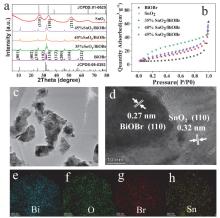
Fig 1
(a) XRD patterns (b) N2 physisorption desorption isotherms of BiOBr, SnO2, and SnO2/BiOBr heterojunctions with different molar ratios; (c) TEM image, (d) HRTEM image, (e–h) elemental mapping images of 40%SnO2/BiOBr."
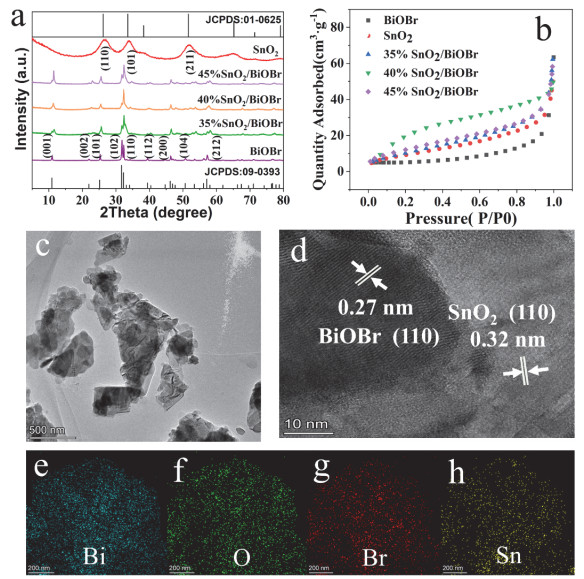
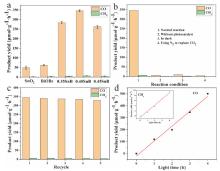
Fig 2
(a) Yields for CO and CH4 on BiOBr, SnO2, 0.35SnB, 0.40SnB, 0.45SnB (35%SnO2/BiOBr, 40%SnO2/BiOBr, 45%SnO2/BiOBr) exposed to simulated solar irradiation; (b) Yields of CO and CH4 on 40%SnO2/BiOBr at various conditions; (c) Photocatalytic cycling performance; (d) Variation of yield with light duration of 40%SnO2/BiOBr."
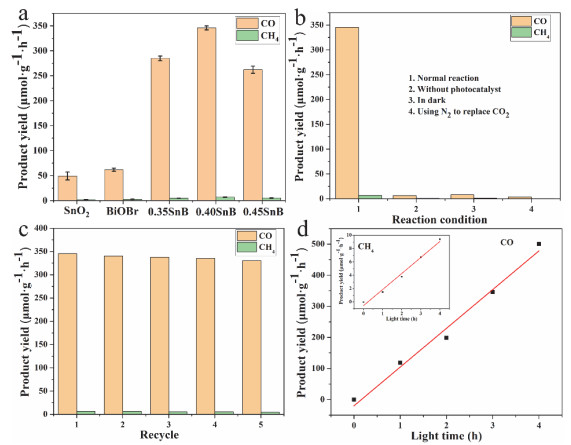
Fig 3
High-resolution XPS spectra of pristine BiOBr, SnO2 and 40%SnO2/BiOBr: (a) Bi 4f; (b) O 1s; (c) Br 3d; (d) Sn 3d."
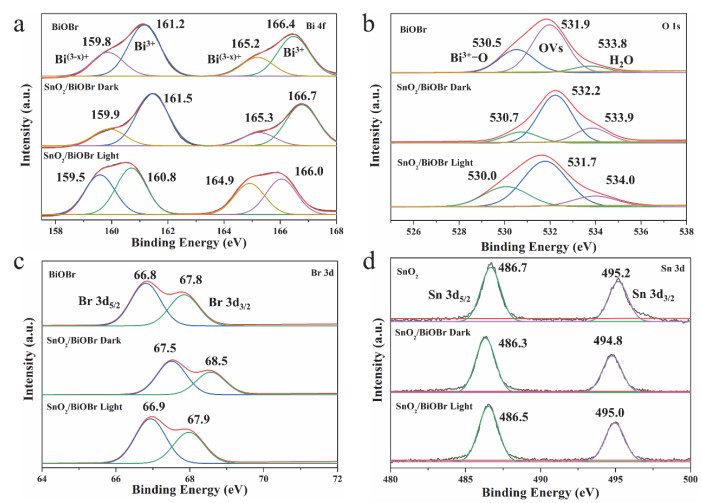
Fig 4
(a) UV-Vis DRS of BiOBr, SnO2 and SnO2/BiOBr with different ratios; (b) band gap energy; (c) Mott-Schottky curves and VBXPS; (d) band structure of BiOBr and SnO2."
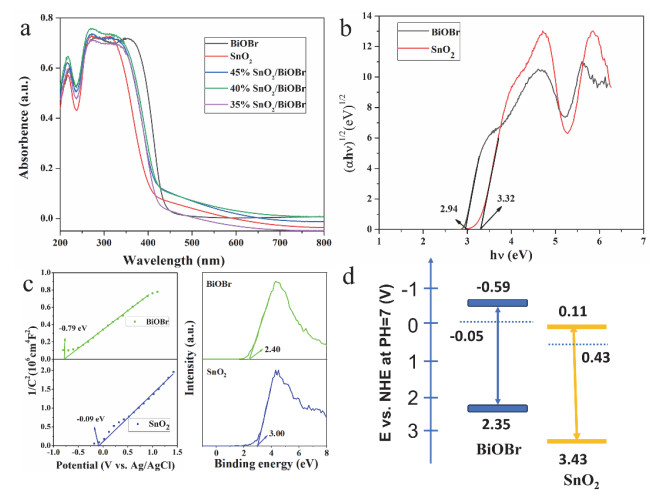
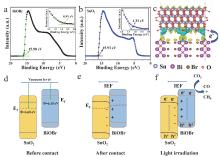
Fig 5
(a, b) UPS spectra of BiOBr and SnO2; (c) charge density difference of the SnO2/ BiOBr heterojunction; (d–f) mechanism of electron transfer in SnO2/BiOBr heterojunction."
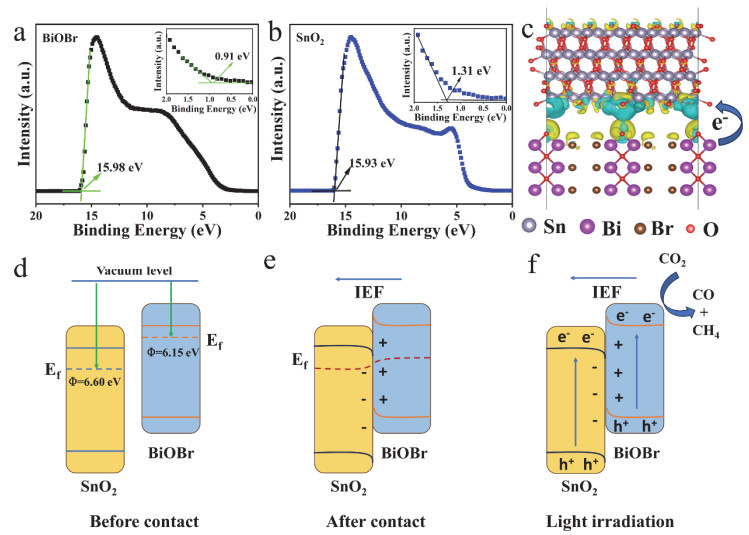
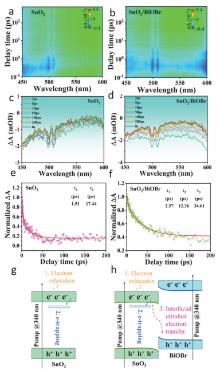
Fig 6
Pseudocolor fs-TA plots of (a) SnO2 and (b) SnO2/BiOBr using 340 nm pump pulse. fs-TA spectra of (c) SnO2 and (d) SnO2/BiOBr at indicated delay time. fs-TA decay kinetics of (e) SnO2 and (f) SnO2/BiOBr probed at 500 nm. Schematic for the quenching pathways of photogenerated electrons in (g) SnO2 and (h) SnO2/BiOBr."
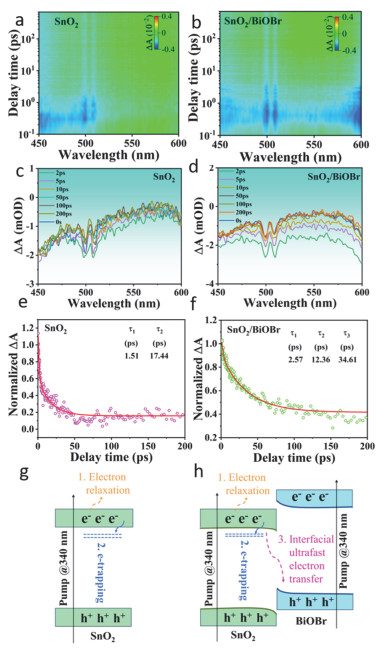
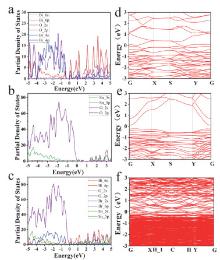
Fig 7
Partial density of states (PDOS) of (a) BiOBr, (b) SnO2, (c) SnO2/BiOBr. band structure of (d) BiOBr, (e) SnO2, (f) SnO2/BiOBr."
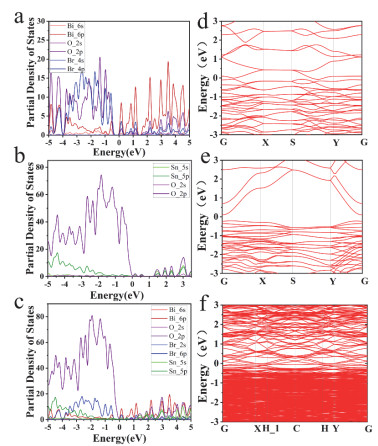
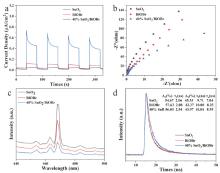
Fig 8
(a) Transient photocurrent response curves, (b) electrochemical impedance curves, (c) photoluminescence emission spectra and (d) time-resolved PL attenuation of pristine SnO2, pristine BiOBr and 40%SnO2/BiOBr."
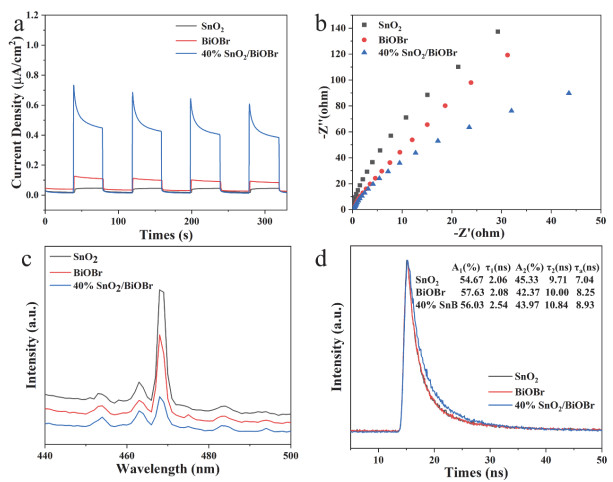
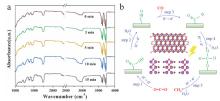
Fig 9
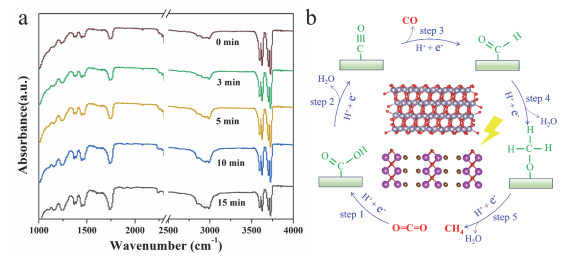
(a) In situ FTIR of 40%SnO2/BiOBr at light conditions with different reaction times; (b) pathway for photocatalytic conversion of CO2 to CO."
| 1 |
doi: 10.1016/j.cej.2024.150098 |
| 2 |
doi: 10.1007/s12274-023-5444-1 |
| 3 |
doi: 10.3866/PKU.WHXB202212026 |
| 4 |
doi: 10.1007/s40843-023-2698-5 |
| 5 |
doi: 10.1016/j.jcis.2023.12.173 |
| 6 |
doi: 10.1016/j.jcis.2024.06.176 |
| 7 |
doi: 10.1007/s40843-023-2703-0 |
| 8 |
doi: 10.3866/PKU.WHXB202211009 |
| 9 |
doi: 10.1016/j.apcatb.2021.119923 |
| 10 |
doi: 10.1002/solr.202100587 |
| 11 |
doi: 10.1002/adma.201400087 |
| 12 |
doi: 10.1002/anie.201710509 |
| 13 |
doi: 10.1002/er.7563 |
| 14 |
doi: 10.1016/j.jmst.2023.11.081 |
| 15 |
doi: 10.1002/adma.202300643 |
| 16 |
doi: 10.1002/adma.202310600 |
| 17 |
doi: 10.1016/j.matt.2022.09.009 |
| 18 |
doi: 10.3866/PKU.WHXB202312024 |
| 19 |
doi: 10.3866/PKU.WHXB202307022 |
| 20 |
doi: 10.1016/j.apcatb.2021.120802 |
| 21 |
doi: 10.1016/j.apsusc.2021.149767 |
| 22 |
doi: 10.1002/smll.202311504 |
| 23 |
doi: 10.1007/s40843-023-2725-y |
| 24 |
doi: 10.3866/PKU.WHXB202309031 |
| 25 |
doi: 10.1002/crat.201400076 |
| 26 |
doi: 10.1016/j.matlet.2019.126681 |
| 27 |
doi: 10.1016/j.jmst.2023.04.053 |
| 28 |
doi: 10.1002/solr.202200279 |
| 29 |
doi: 10.1016/j.seppur.2022.123054 |
| 30 |
doi: 10.1016/j.jallcom.2022.164372 |
| 31 |
doi: 10.1016/j.jcis.2019.06.053 |
| 32 |
doi: 10.1016/j.snb.2021.130733 |
| 33 |
doi: 10.1016/S1872-2067(23)64607-8 |
| 34 |
doi: 10.1016/j.jallcom.2024.174595 |
| 35 |
doi: 10.1039/c4ra14187c |
| 36 |
doi: 10.1016/j.cej.2023.142536 |
| 37 |
doi: 10.1016/j.cej.2021.129286 |
| 38 |
doi: 10.1016/j.apcatb.2018.09.089 |
| 39 |
doi: 10.1038/s41467-021-25007-6 |
| 40 |
doi: 10.1021/acscatal.3c03095 |
| 41 |
doi: 10.1016/j.jcis.2024.04.226 |
| 42 |
doi: 10.1002/jccs.202200016 |
| 43 |
doi: 10.1016/j.seppur.2018.12.003 |
| 44 |
doi: 10.1021/ie102310a |
| 45 |
doi: 10.1038/s41467-020-18350-7 |
| 46 |
doi: 10.1016/j.cej.2024.152473 |
| 47 |
doi: 10.1038/s41467-021-21435-6 |
| 48 |
doi: 10.1002/eem2.12218 |
| 49 |
doi: 10.1016/j.apsusc.2022.154246 |
| 50 |
doi: 10.1016/S1872-2067(23)64480-8 |
| 51 |
doi: 10.1002/anie.202218688 |
| 52 |
doi: 10.1039/d2ta09777j |
| 53 |
doi: 10.1002/adma.202400288 |
| 54 |
doi: 10.1016/S1872-2067(23)64466-3 |
| 55 |
doi: 10.1038/s41467-024-49004-7 |
| 56 |
doi: 10.1021/acscatal.4c00026 |
| 57 |
doi: 10.1016/j.apcatb.2021.120618 |
| 58 |
doi: 10.1002/chem.201706164 |
| 59 |
doi: 10.1002/jcc.21055 |
| 60 |
doi: 10.1021/acsnano.4c00217 |
| 61 |
doi: 10.1016/S1872-2067(23)64478-X |
| 62 |
doi: 10.1016/S1872-2067(23)64420-1 |
| 63 |
doi: 10.1002/smll.202207581 |
| 64 |
doi: 10.1021/acscatal.7b02952 |
| 65 |
doi: 10.1016/j.jcis.2021.08.116 |
| 66 |
doi: 10.1002/adma.202406460 |
| 67 |
doi: 10.1002/anie.202017041 |
| 68 |
doi: 10.1021/jacs.3c08571 |
| 69 |
doi: 10.1021/jacs.0c02973 |
| 70 |
doi: 10.1016/j.apcatb.2024.124167 |
| 71 |
doi: 10.1016/j.jcat.2004.06.012 |
|
||