Acta Phys. -Chim. Sin. ›› 2024, Vol. 40 ›› Issue (10): 2312010.doi: 10.3866/PKU.WHXB202312010
Special Issue: Solar Fuel Photocatalyst
• ARTICLE • Previous Articles Next Articles
Synergistic Effect of Cu-Graphdiyne/Transition Bimetallic Tungstate Formed S-Scheme Heterojunction for Enhanced Photocatalytic Hydrogen Evolution
Zhengyu Zhou1, Huiqin Yao2,*( ), Youlin Wu1, Teng Li1,3, Noritatsu Tsubaki3,*(), Zhiliang Jin1,*()
- 1 School of Chemistry and Chemical Engineering, North Minzu University, Yinchuan 750021, China
2 Department of Chemistry, College of Basic Medicine, Ningxia Medical University, Yinchuan 750004, China
3 Department of Applied Chemistry, Graduate School of Engineering, University of Toyama, Gofuku 3190, Toyama 930-8555, Japan
-
Received:2023-12-08Revised:2024-01-08Accepted:2024-01-08Published:2024-03-13 -
Contact:Email: yaohq@nxmu.edu.cn (Huiqin Yao)tsubaki@eng.u-toyama.ac.jp (Noritatsu Tsubaki)zl-jin@nun.edu.cn (Zhiliang Jin) -
Supported by:the Ningxia Hui Autonomous Region Natural Science Foundation Project(2023AAC02046)

Cite this article
Zhengyu Zhou, Huiqin Yao, Youlin Wu, Teng Li, Noritatsu Tsubaki, Zhiliang Jin. Synergistic Effect of Cu-Graphdiyne/Transition Bimetallic Tungstate Formed S-Scheme Heterojunction for Enhanced Photocatalytic Hydrogen Evolution[J]. Acta Phys. -Chim. Sin. 2024, 40(10), 2312010. doi: 10.3866/PKU.WHXB202312010
share this article
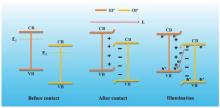
Scheme 1
Diagram of S-scheme heterojunction before and after contact and under light."
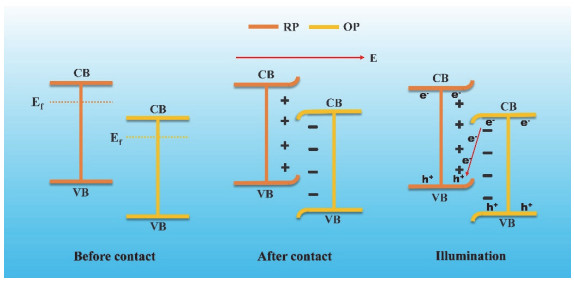
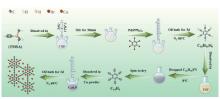
Scheme 2
The flow chart for CGDY preparation."
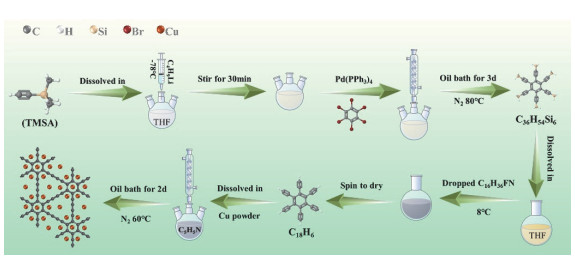
Scheme 3
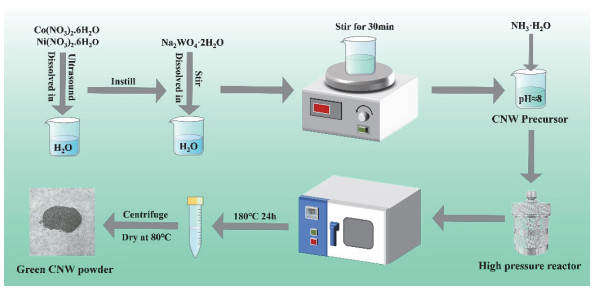
The preparation process diagram of CNW."
Scheme 4
The preparation process diagram of GCNW10."
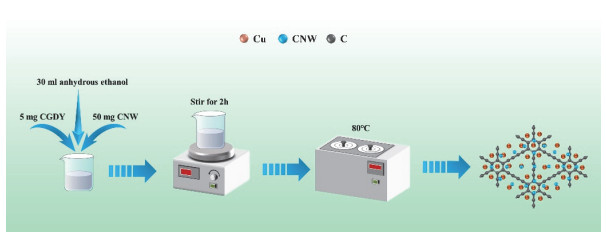
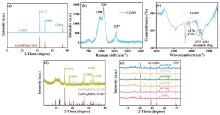
Fig 1
(a) XRD patterns of CGDY; (b) Raman spectra of CGDY; (c) FT-IR spectra of CGDY; (d, e) XRD patterns of CNW and GCNWX."
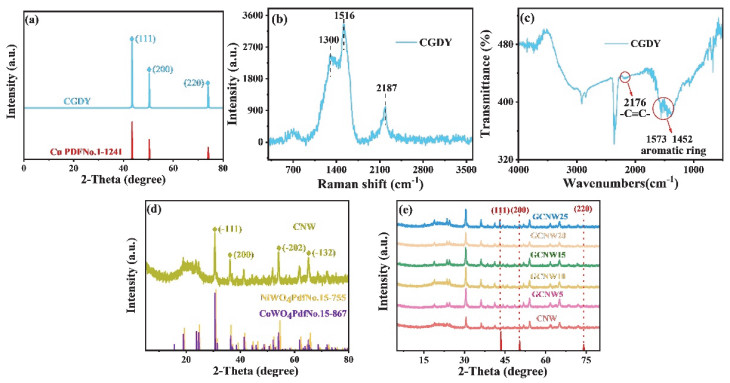
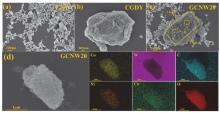
Fig 2
(a–c) SEM images of CNW, CGDY and GCNW20, (d) EDX elemental mapping images of GCNW20.0."
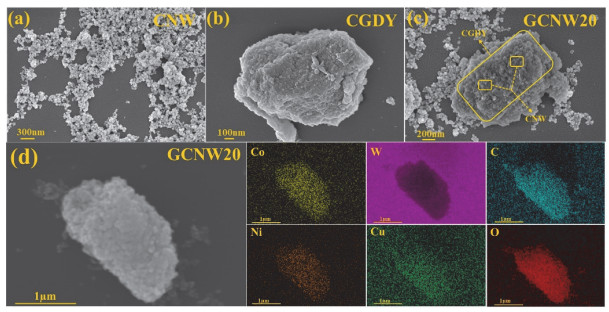
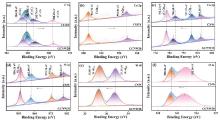
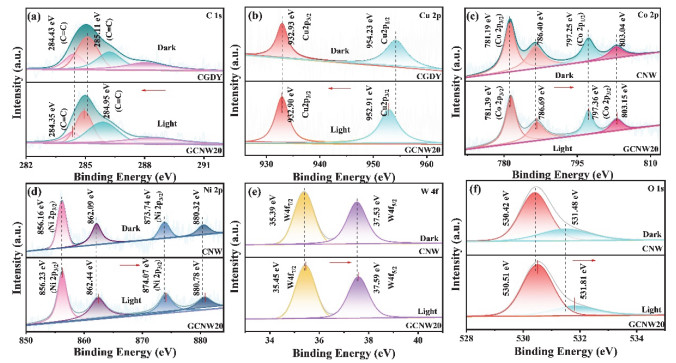
Fig 3
(a–f) The XPS spectra of C 1s, Cu 2p, Co 2p, Ni 2p, W 4f and O 1s."
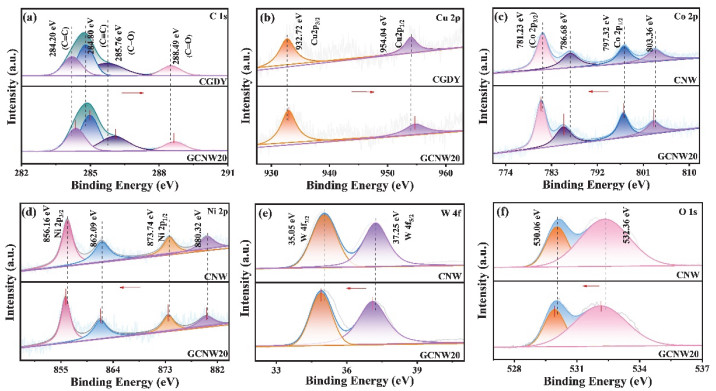
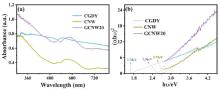
Fig 4
(a) UV-Vis absorption spectra of CGDY, CNW and GCNW20; (b) Kubelka-Munk plot of CGDY, CNW and GCNW20."
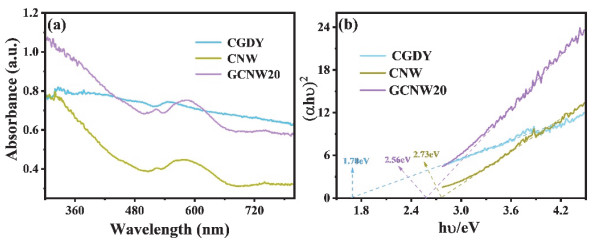
Fig 5
(a) Hydrogen evolution in CGDY, CNW, and GCNW20; (b) Hydrogen evolution of x% CGDY/CNW (where x = 5, 10, 15, 20, 25); (c) Hydrogen evolution of GCNW20 at different pH values; (d) Hydrogen evolution plots of CGDY, CNW and GCNW20 within 5 h; (e) Hydrogen production of GCNW20 under different sacrificial reagents; (f) Hydrogen production diagram of GCNW20 at different EY quantities; (g) Hydrogen evolution cycle of GCNW20; (h) The XRD comparison pre- and post-hydrogen evolution; (i) AQE at different radiation wavelengths."
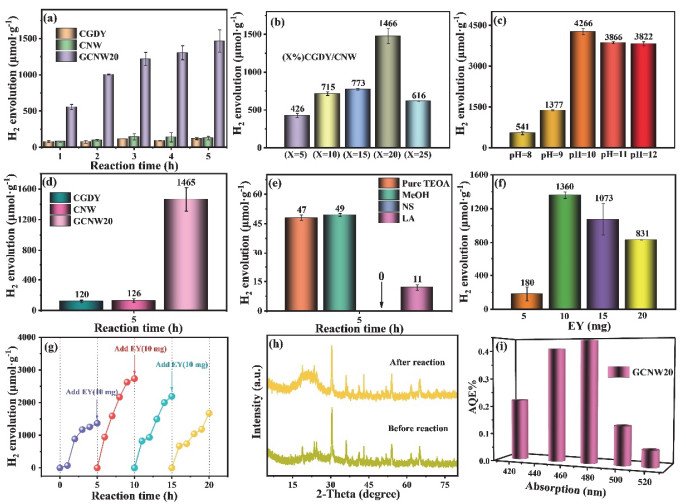
Table 1
Comparison of hydrogen production of GDY-based composite photocatalysts."
| Photocatalyst | Optical source | Sacrificial reagent | Hydrogen production in 5 h | Reference |
| GCNW20 | LED 5 W | TEOA (15%) | 4266 μmol∙g−1 | This work |
| NiS/GDY | LED 5 W | TEOA (15%) | 4105 μmol∙g−1 | |
| Co3O4/GDY | LED 5 W | TEOA (15%) | 3070 μmol∙g−1 | |
| GDY@g-C3N4/Pt | Solar 100 W | TEOA (15%) | 3990 μmol∙g−1 | |
| CdS/GD | LED | TEOA (0.3 mol∙L−1) | 2050 μmol∙g−1 | |
| GD-CuI-NiTiO3 | LED 5 W | TEOA (15%) | 2545 μmol∙g−1 |
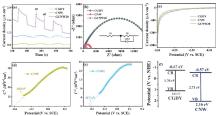
Fig 6
(a) The transient photocurrent response curve of the sample; (b) Electrochemical impedance spectroscopy; (c) Linear sweep voltammetry; (d, e) Mott-Schottky plots of CNW and CGDY. (f) Band gap structure diagram of CGDY and CNW."
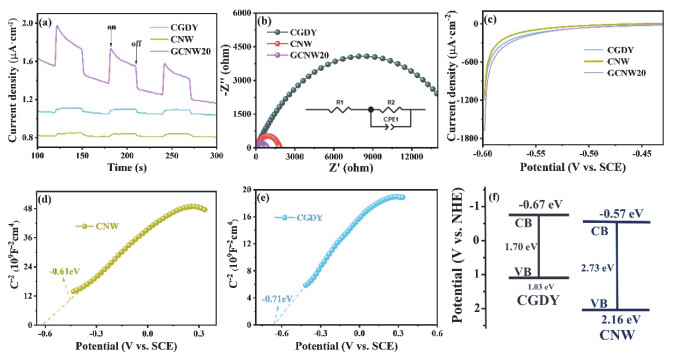
Fig 7
(a, b) PL and TRPL spectrum of EY, CNW, CGDY, and GCNW20."
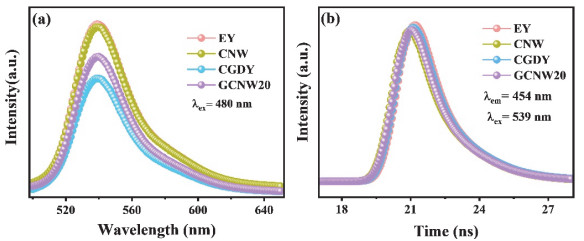
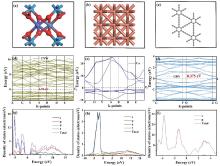
Fig 8
(a–c) DFT calculation model diagram of CNW, Cu and GDY; (d–f) Energy band structure diagram of CNW, Cu and GDY; (g–i) The total state density diagram of CNW, Cu and GDY."
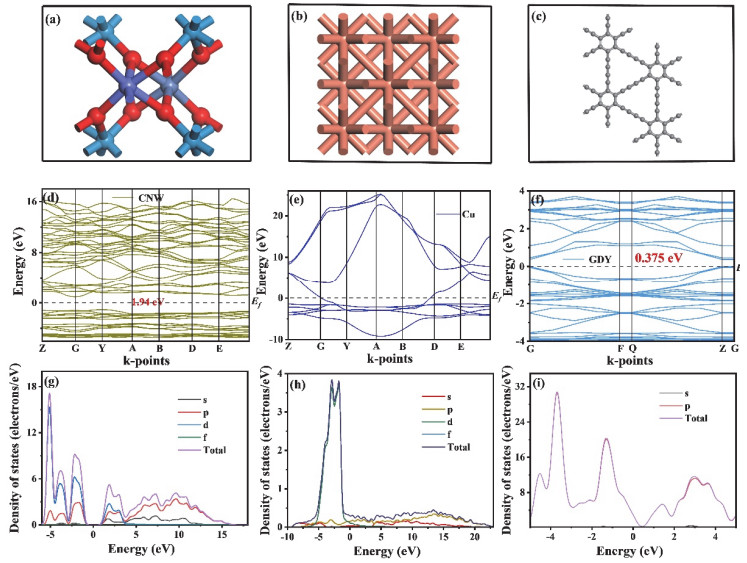
Fig 9
(a, b) The work function of GDY (002) and Cu (111)."
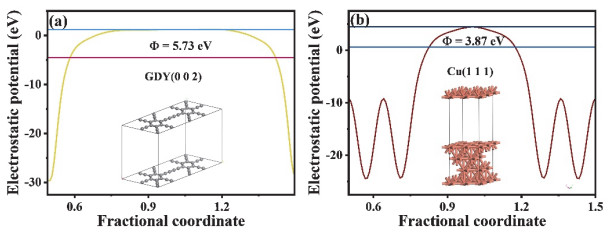
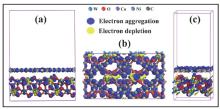
Fig 10
(a–c) The main view, top view and side view of electron density difference diagram of GDY/CNW."
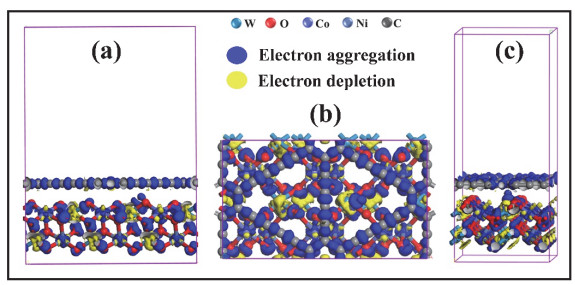
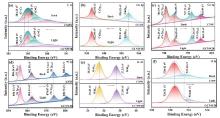
Fig 11
The in situ XPS spectra of C 1s, Cu 2p, Co 2p, Ni 2p, W 4f and O 1s."
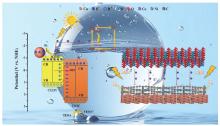
Scheme 5
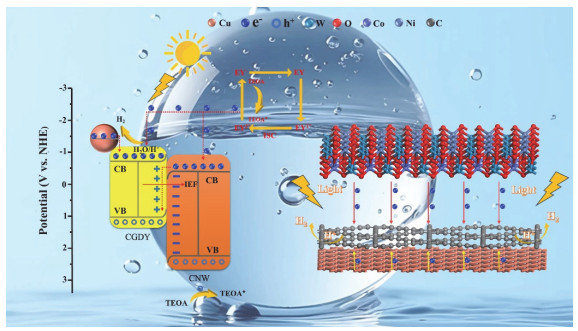
The hydrogen evolution mechanism diagram and model diagram of GCNW20."
| 1 |
doi: 10.3866/PKU.WHXB202302051 |
|
张利君; 吴有林; TsubakiNoritatsu; 靳治良. 物理化学学报, 2023, 39, 2302051.
doi: 10.3866/PKU.WHXB202302051 |
|
| 2 |
doi: 10.1016/j.apcatb.2018.11.011 |
| 3 |
doi: 10.1002/adma.202310600 |
| 4 |
doi: 10.3866/PKU.WHXB202212009 |
|
孙涛; 李晨曦; 鲍钰鹏; 樊君; 刘恩周. 物理化学学报, 2023, 39, 2212009.
doi: 10.3866/PKU.WHXB202212009 |
|
| 5 |
doi: 10.3866/PKU.WHXB202209037 |
|
王中辽; 汪静; 张金锋; 代凯. 物理化学学报, 2023, 39, 2209037.
doi: 10.3866/PKU.WHXB202209037 |
|
| 6 |
doi: 10.1016/j.trechm.2022.08.008 |
| 7 |
doi: 10.1016/s1872-2067(19)63382-6 |
| 8 |
doi: 10.1063/5.0009858 |
| 9 |
doi: 10.1039/d2gc01684b |
| 10 |
doi: 10.1016/s1872-2067(23)64420-1 |
| 11 |
doi: 10.1016/j.jmst.2023.03.067 |
| 12 |
doi: 10.1016/s1872-2067(23)64444-4 |
| 13 |
doi: 10.14102/j.cnki.0254-5861.2021-0057 |
| 14 |
doi: 10.1016/j.jmst.2023.05.046 |
| 15 |
doi: 10.14102/j.cnki.0254-5861.2022-0108 |
| 16 |
doi: 10.1002/agt2.364 |
| 17 |
doi: 10.1016/s1872-2067(21)63818-4 |
| 18 |
doi: 10.1016/s1872-2067(22)64096-8 |
| 19 |
doi: 10.1016/j.apsusc.2022.154174 |
| 20 |
doi: 10.1038/s41598-023-37053-9 |
| 21 |
doi: 10.1002/slct.202104548 |
| 22 |
doi: 10.1021/acsaem.0c00353 |
| 23 |
doi: 10.1016/j.ensm.2020.07.014 |
| 24 |
doi: 10.1016/j.cej.2019.04.100 |
| 25 |
doi: 10.1016/j.jallcom.2021.160066 |
| 26 |
doi: 10.1016/j.optmat.2021.111680 |
| 27 |
doi: 10.1002/smll.202001440 |
| 28 |
doi: 10.1002/anie.202301384 |
| 29 |
doi: 10.1039/d1cs00592h |
| 30 |
doi: 10.1039/b922733d |
| 31 |
doi: 10.1016/j.jmst.2022.02.016 |
| 32 |
doi: 10.3866/PKU.WHXB202212010 |
|
张珂瑜; 李云锋; 袁仕丹; 张洛红; 王倩. 物理化学学报, 2023, 39, 2212010.
doi: 10.3866/PKU.WHXB202212010 |
|
| 33 |
doi: 10.1016/j.chempr.2020.06.010 |
| 34 |
doi: 10.1016/s1872-2067(20)63705-6 |
| 35 |
doi: 10.3866/PKU.WHXB202212016 |
|
吴新鹤; 陈郭强; 王娟; 李金懋; 王国宏. 物理化学学报, 2023, 39, 2212016.
doi: 10.3866/PKU.WHXB202212016 |
|
| 36 |
doi: 10.1007/s12598-023-02403-z |
| 37 |
doi: 10.1016/s1872-2067(23)64507-3 |
| 38 |
doi: 10.1016/j.cej.2021.133639 |
| 39 |
doi: 10.1039/d3ta02598e |
| 40 |
doi: 10.1016/j.jmst.2023.03.002 |
| 41 |
doi: 10.1016/j.colsurfa.2021.127606 |
| 42 |
doi: 10.1016/s1872-2067(19)63454-6 |
| 43 |
doi: 10.1016/j.jmst.2021.11.073 |
| 44 |
doi: 10.1007/s11249-023-01728-1 |
| 45 |
doi: 10.1016/j.apcatb.2023.122461 |
| 46 |
doi: 10.14102/j.cnki.0254-5861.2022-0096 |
| 47 |
doi: 10.1016/j.apcatb.2016.10.086 |
| 48 |
doi: 10.1016/j.corsci.2020.109082 |
| 49 |
doi: 10.1016/j.cej.2023.144898 |
| 50 |
doi: 10.1016/j.jmst.2023.05.066 |
| 51 |
doi: 10.1007/s12598-022-02183-y |
| 52 |
doi: 10.1016/s1872-2067(17)62981-4A |
| 53 |
doi: 10.1016/s1872-2067(23)64462-6 |
| 54 |
doi: 10.1016/j.apsusc.2015.12.238 |
| 55 |
doi: 10.1016/j.apsusc.2022.154641 |
| 56 |
doi: 10.1016/j.cej.2022.136334 |
| 57 |
doi: 10.1016/j.jcis.2023.01.055 |
| 58 |
doi: 10.1016/j.apcata.2023.119421 |
| 59 |
doi: 10.1016/j.jcis.2019.01.101 |
| 60 |
doi: 10.1002/smll.202302859 |
| 61 |
doi: 10.1016/j.renene.2022.11.004 |
| 62 |
doi: 10.1039/d2ta06752h |
| 63 |
doi: 10.1039/d2ta09918g |
| 64 |
doi: 10.1021/acsami.8b03326 |
| 65 |
doi: 10.1021/acsami.1c04874 |
| 66 |
doi: 10.14102/j.cnki.0254-5861.2022-0042 |
| 67 |
doi: 10.1016/j.jcis.2022.11.084 |
| 68 |
doi: 10.1016/j.jallcom.2023.172218 |
| 69 |
doi: 10.1016/j.ijhydene.2021.11.171 |
| 70 |
doi: 10.1039/d3tc02869k |
| 71 |
doi: 10.1021/acs.jpcc.6b02802 |
|
||