Acta Phys. -Chim. Sin. ›› 2024, Vol. 40 ›› Issue (11): 2311026.doi: 10.3866/PKU.WHXB202311026
Special Issue: Electrochemical Separation and Recycling
• REVIEW • Previous Articles Next Articles
Cutting-Edge Applications of Multi-Angle Numerical Simulations for Capacitive Deionization
Xiaochen Zhang1,2, Fei Yu3, Jie Ma1,2,*( )
)
- 1 Research Center for Environmentally Functional Materials, College of Environmental Science and Engineering, Tongji University, Shanghai 200092, China
2 School of Civil Engineering, Kashi University, Kashi 844000, the Xinjiang Uygur Autonomous Region, China
3 College of Oceanography and Ecological Science, Shanghai Ocean University, Shanghai 201306, China
-
Received:2023-11-21Revised:2023-12-25Accepted:2023-12-26Published:2024-02-26 -
Contact:Email: jma@tongji.edu.cn (Jie Ma) -
Supported by:the National Natural Science Foundation of China(22276137); the National Natural Science Foundation of China(52170087)

Cite this article
Xiaochen Zhang, Fei Yu, Jie Ma. Cutting-Edge Applications of Multi-Angle Numerical Simulations for Capacitive Deionization[J]. Acta Phys. -Chim. Sin. 2024, 40(11), 2311026. doi: 10.3866/PKU.WHXB202311026
share this article
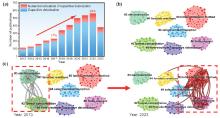
Fig 1
(a) The number of publications in the field of capacitive deionization and the proportion of them involving mathematical simulation studies, 2013–2023; (b) Co-occurrence network analysis of keywords in the literature in the field of capacitive deionization and highly cited papers, 2013–2023; (c) Co-occurrence network analysis of the literature in the field of capacitive deionization in 2013 and 2023 (in the red dashed box). (Source of the above data: Web of Science database, visualization software: CiteSpace)."
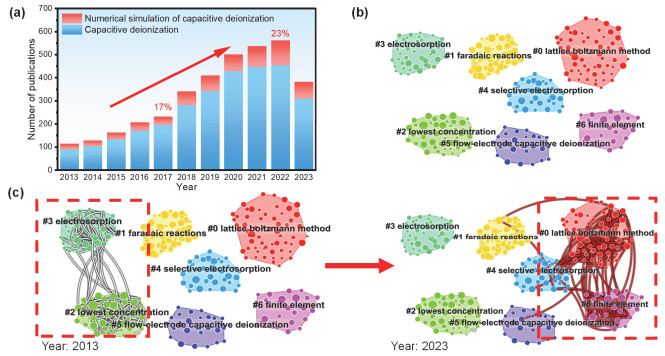
Table 1
Advantages and disadvantages of different numerical simulation methods in CDI studies."
| Numerical simulation method | Advantage | Disadvantage |
| Continuous-scale model | Allows effective characterization of the ionodynamic processes of CDI and identification of the conditions that limit its rate and course. | The material microstructure is drastically simplified, requiring the use of semi-empirical formulas to describe reaction kinetics. |
| Pore-scale model | The microscopic porous structure of the porous medium is clearly resolved, eliminating the need for empirical formulas to preset transport parameters. | The number of working groups conducting related research is still small, and the applicability of different electrode materials remains to be examined. |
| Molecular dynamics | Can be used to explain the coupling between ion dynamics, charge compensation mechanisms and CDI performance and ion selectivity. | Empirical parameters are needed to calculate pairing potentials and forces that do not explicitly capture electron degrees of freedom. |
| Density functional theory | It can be used to explain the CDI mechanism of various electrode materials, and at the same time can provide information reference for material design. | Are computationally intensive tasks that take up a lot of computational resources. |
| Finite element analysis | A powerful tool for revealing the relationship between structural properties of electrode materials during ion removal and optimizing CDI process parameters. | Models are approximations of real objects, so accuracy is limited. |
| Computational fluid dynamics | A spatio-temporal quantitative portrayal of the three-dimensional flow field using a combination of computerized numerical calculations and graphical presentations. | Mathematical models are often complex nonlinear partial differential equations that require higher performance computer processors with limited modeling accuracy. |
| Machine learning | Data-driven machine learning has particular strengths in handling nonlinear data and revealing complex mechanisms of water treatment processes. | “Catastrophic forgetting” effect could crash machine learning models. |
| Techno-economic analysis | It is possible to derive the optimal combination of technical and economic aspects of CDI to achieve the best technical and economic results. | Relevant research is still quite scarce and there is a lack of a harmonized and standardized institutional framework. |
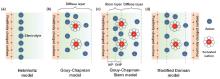
Fig 2
Models for describing the structure of an electrical double layer at a positively charged surface: (a) the Helmholtz model, (b) the Gouy-Chapman model, (c) the Gouy-Chapman-Stern model, and (d) the modified Donna model."
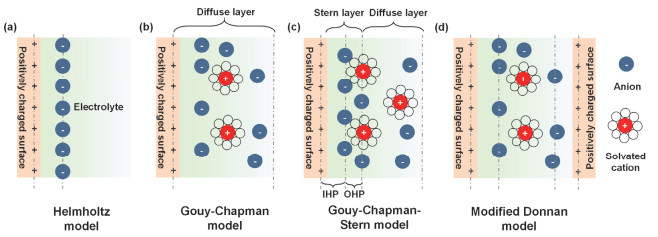
Fig 3
(a) Surface boundary treatment method 121; (b) Change in desalination capacity of CDI with time (arrows indicate direction of time) 121; (c) Ion concentration distribution inside electrodes with different porosities (ε) 124. (a–c) Adapted from Elsevier publisher."
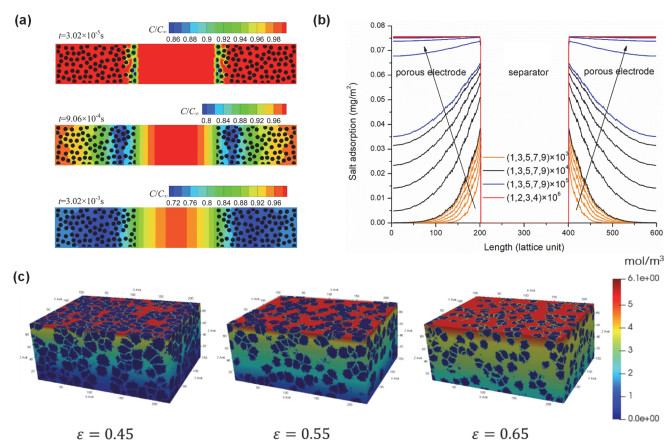
Fig 4
(a) Molecular dynamics simulation system of carbon nanotubes 135; (b) Simulation system of slit pores filled with water as well as sodium and chloride ions 136; (c) Electrochemical quartz crystal microbalance test results with molecular dynamics simulation of ionic diffusion of graphene (RGO) films 137; (d) Molecular dynamics modeling of supercapacitors and ionic liquids 138. (a–c) Adapted from Elsevier publisher; (d) Adapted from Springer Nature publisher."
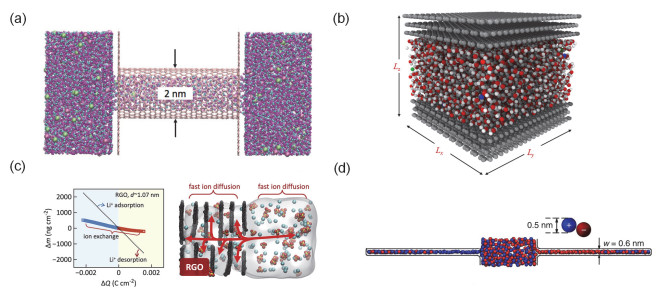
Fig 5
(a) Na atom absorbed on the carbons with different defects 140; (b) Top and side views of the charge density difference induced by Na adsorption for different carbon-based material 141; (c) charge density difference for TiO2/Ti3C2, DOS analysis of TiO2/Ti3C2, and theoretically calculated work function of Ti3C2 and TiO2 143. (a) Adapted from Royal Society of Chemistry publisher; (b, c) Adapted from Wiley publisher."
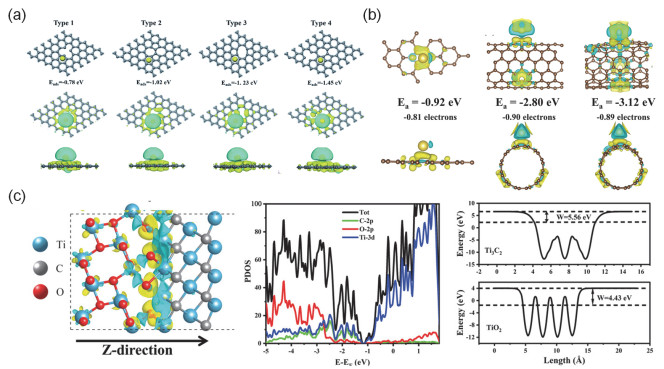
Fig 6
(a) Finite element simulation results of stress and deformation displacement distribution in a hollow cube and solid cube 152; (b) Finite element simulation results for the constant concentration vacations in 2D models with time 153; (c) The 3D electric field and computational fluid dynamics simulations of 3D foam current collector 163. (a) Adapted from American Association for the Advancement of Science publisher. (b) Adapted from American Chemical Society publisher. (c) Adapted from Elsevier publisher."
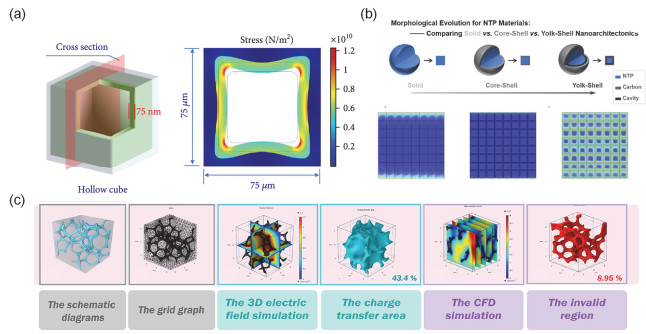
Fig 7
Simplified topology of the established (a) artificial neural network model 167 and (b) random forest model 167; (c) Illustration of the deep reinforcement learning with a representative membrane capacitive deionization system 176. (a, b) Adapted from Royal Society of Chemistry publisher; (c) Adapted from Elsevier publisher."
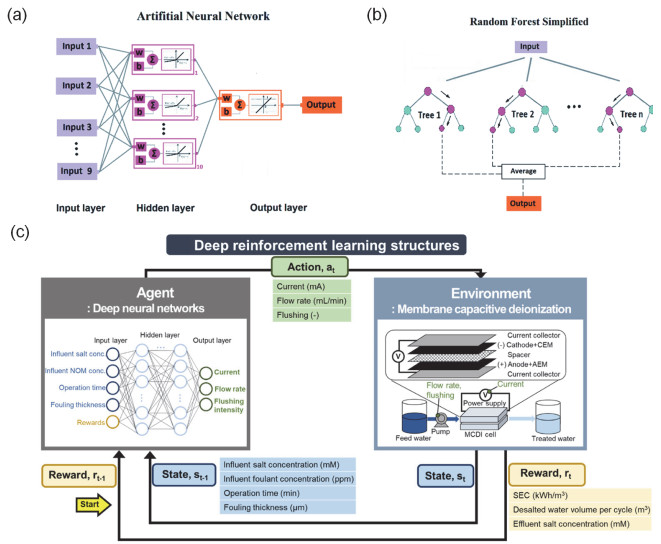
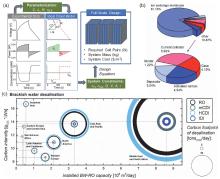
Fig 8
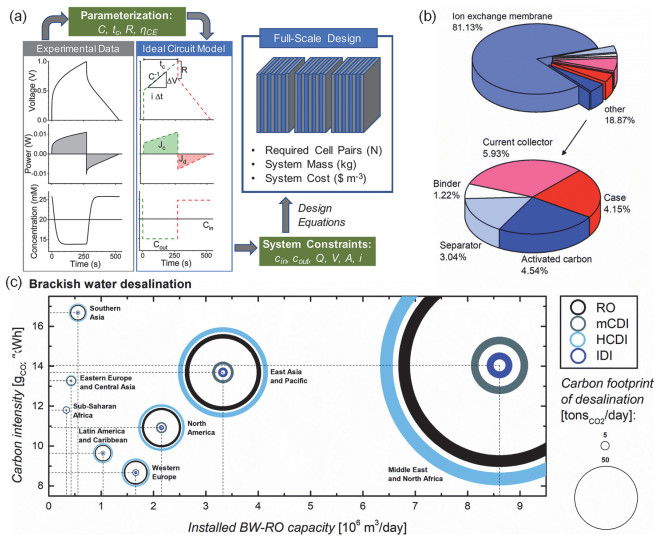
(a) Schematic diagram of economic analysis of capacitive deionization technology 182; (b) Cost breakdown of individual module components for membrane capacitive deionization cell 72; (c) Carbon footprint comparison of reverse osmosis and capacitive deionization technologies under different conditions 72. (a) Adapted from American Chemical Society publisher; (b, c) Adapted from Royal Society of Chemistry publisher."
| 1 |
doi: 10.1038/s41586-018-0123-1 |
| 2 |
doi: 10.1016/j.desal.2014.02.031 |
| 3 |
doi: 10.1038/nature06599 |
| 4 |
doi: 10.1126/science.1200488 |
| 5 |
doi: 10.3866/PKU.WHXB202009022 |
|
李艳; 胡星盛; 黄静伟; 王磊; 佘厚德; 王其召. 物理化学学报, 2021, 37(8), 2009022.
doi: 10.3866/PKU.WHXB202009022 |
|
| 6 |
doi: 10.3866/PKU.WHXB202201008 |
|
王文亮; 张灏纯; 陈义钢; 史海峰. 物理化学学报, 2022, 38(7), 2201008.
doi: 10.3866/PKU.WHXB202201008 |
|
| 7 |
doi: 10.3866/PKU.WHXB202112027 |
|
周亮; 李云锋; 张永康; 秋列维; 邢艳. 物理化学学报, 2022, 38(7), 2112027.
doi: 10.3866/PKU.WHXB202112027 |
|
| 8 |
doi: 10.3866/PKU.WHXB202101020 |
|
陈清; 赵健; 程虎虎; 曲良体. 物理化学学报, 2022, 38(1), 2101020.
doi: 10.3866/PKU.WHXB202101020 |
|
| 9 |
doi: 10.3866/PKU.WHXB202003031 |
|
常明凯; 胡娜; 李遥; 鲜东帆; 周万强; 王静一; 时燕琳; 刘春立. 物理化学学报, 2022, 38(3), 2003031.
doi: 10.3866/PKU.WHXB202003031 |
|
| 10 |
doi: 10.3866/PKU.WHXB202211019 |
|
刘振中; 万思文; 吴阳; 王波延; 季宏亮. 物理化学学报, 2023, 39(5), 2211019.
|
|
| 11 |
doi: 10.1039/C5EE00519A |
| 12 |
doi: 10.1039/C7EE00855D |
| 13 |
doi: 10.1002/anie.202302180 |
| 14 |
doi: 10.1016/j.watres.2022.118290 |
| 15 |
doi: 10.1039/C3EE24443A |
| 16 |
doi: 10.1016/j.watres.2023.120436 |
| 17 |
doi: 10.1016/j.watres.2023.119831 |
| 18 |
doi: 10.3866/PKU.WHXB201410141 |
|
卢淼; 刘建允; 程健; 王世平; 杨健茂. 物理化学学报, 2014, 30(12), 2263.
doi: 10.3866/PKU.WHXB201410141 |
|
| 19 |
doi: 10.3866/PKU.WHXB201704113 |
|
王雷; 于飞; 马杰. 物理化学学报, 2017, 33(7), 1338.
doi: 10.3866/PKU.WHXB201704113 |
|
| 20 |
doi: 10.3866/PKU.WHXB20111116 |
|
王喜文; 姜芳婷; 索全伶; 方玉珠; 路勇. 物理化学学报, 2011, 27(11), 2605.
doi: 10.3866/PKU.WHXB20111116 |
|
| 21 |
doi: 10.1021/acs.est.9b00655 |
| 22 |
doi: 10.1016/j.watres.2009.10.020 |
| 23 |
doi: 10.1016/j.watres.2021.117959 |
| 24 |
doi: 10.1016/j.desal.2016.03.019 |
| 25 |
doi: 10.1016/j.desal.2023.116798 |
| 26 |
doi: 10.1002/smll.202205619 |
| 27 |
doi: 10.1016/j.watres.2022.119441 |
| 28 |
doi: 10.1021/acs.est.1c03228 |
| 29 |
doi: 10.1016/j.desal.2023.116409 |
| 30 |
doi: 10.1039/D0EN00826E |
| 31 |
doi: 10.1016/j.cej.2022.135381 |
| 32 |
doi: 10.1016/j.cej.2021.133578 |
| 33 |
doi: 10.1039/D1EN00350J |
| 34 |
doi: 10.3866/PKU.WHXB202006037 |
|
熊岳城; 于飞; 马杰. 物理化学学报, 2022, 38(5), 2006037.
doi: 10.3866/PKU.WHXB202006037 |
|
| 35 |
doi: 10.1016/j.jhazmat.2021.127084 |
| 36 |
doi: 10.1016/j.jhazmat.2016.03.055 |
| 37 |
doi: 10.1039/C9EN00730J |
| 38 |
doi: 10.1039/C7TA03515B |
| 39 |
doi: 10.1016/j.scitotenv.2019.07.069 |
| 40 |
doi: 10.1016/j.cej.2017.12.120 |
| 41 |
doi: 10.1016/j.jhazmat.2020.123568 |
| 42 |
doi: 10.1016/j.jhazmat.2023.131785 |
| 43 |
doi: 10.1002/advs.202203189 |
| 44 |
doi: 10.1016/j.watres.2023.119645 |
| 45 |
doi: 10.1016/j.watres.2021.117423 |
| 46 |
doi: 10.1021/acs.est.0c01836 |
| 47 |
doi: 10.1021/acs.est.3c03922 |
| 48 |
doi: 10.1016/j.watres.2022.118351 |
| 49 |
doi: 10.1016/j.jhazmat.2022.128591 |
| 50 |
doi: 10.1021/acs.est.2c00982 |
| 51 |
doi: 10.1016/j.cej.2022.134967 |
| 52 |
doi: 10.1021/acsnano.5b03763 |
| 53 |
doi: 10.1016/j.pmatsci.2013.03.005 |
| 54 |
doi: 10.1149/1.3193709 |
| 55 |
doi: 10.1016/j.electacta.2016.12.060 |
| 56 |
doi: 10.1016/j.desal.2006.01.011 |
| 57 |
doi: 10.1016/j.watres.2021.117222 |
| 58 |
doi: 10.1016/j.watres.2018.11.064 |
| 59 |
doi: 10.1039/C6CS00776G |
| 60 |
doi: 10.1021/cr500232y |
| 61 |
doi: 10.1021/nl203889e |
| 62 |
doi: 10.1016/j.nanoen.2017.12.015 |
| 63 |
doi: 10.1002/advs.201400018 |
| 64 |
doi: 10.1038/ncomms7544 |
| 65 |
doi: 10.1016/j.joule.2018.02.018 |
| 66 |
doi: 10.1039/C4EE01034E |
| 67 |
doi: 10.1021/jacs.7b01119 |
| 68 |
doi: 10.1016/j.desal.2019.114098 |
| 69 |
doi: 10.1002/aenm.201700278 |
| 70 |
doi: 10.1038/s41467-018-07159-0 |
| 71 |
doi: 10.1002/advs.202002213 |
| 72 |
doi: 10.1039/D0EE00725K |
| 73 |
doi: 10.1016/j.coelec.2020.05.003 |
| 74 |
doi: 10.1002/adfm.202213578 |
| 75 |
doi: 10.1002/adfm.202304790 |
| 76 |
doi: 10.1038/s41578-023-00564-y |
| 77 |
doi: 10.1002/smll.202300253 |
| 78 |
doi: 10.1016/0013-4686(67)80079-3 |
| 79 |
doi: 10.1149/1.2408094 |
| 80 |
doi: 10.1016/0013-4686(63)80042-0 |
| 81 |
doi: 10.1002/andp.18792430702 |
| 82 |
doi: 10.1051/jphystap:019100090045700.Ajp |
| 83 |
doi: 10.1080/14786440408634187 |
| 84 |
doi: 10.1039/C2EE21737F |
| 85 |
doi: 10.1016/j.jcis.2011.04.049 |
| 86 |
doi: 10.1021/es403682n |
| 87 |
doi: 10.1016/j.watres.2015.08.012 |
| 88 |
doi: 10.1016/j.watres.2016.01.048 |
| 89 |
doi: 10.1016/j.colcom.2015.12.001 |
| 90 |
doi: 10.1021/acs.est.8b06954 |
| 91 |
doi: 10.1016/j.watres.2017.05.036 |
| 92 |
doi: 10.1021/acs.est.9b04749 |
| 93 |
doi: 10.1016/j.watres.2022.119517 |
| 94 |
doi: 10.1039/C3EE42209G |
| 95 |
doi: 10.1021/acs.est.9b07482 |
| 96 |
doi: 10.1021/acs.jpca.9b05503 |
| 97 |
doi: 10.1021/acs.langmuir.9b03571 |
| 98 |
doi: 10.1021/acs.langmuir.1c02806 |
| 99 |
doi: 10.1149/2.0761603jes |
| 100 |
doi: 10.1016/j.electacta.2017.02.006 |
| 101 |
doi: 10.1016/j.electacta.2018.03.065 |
| 102 |
doi: 10.1016/j.watres.2019.114995 |
| 103 |
doi: 10.1103/PhysRevApplied.9.064036 |
| 104 |
doi: 10.1016/j.watres.2017.12.073 |
| 105 |
doi: 10.1149/1945-7111/abfefd |
| 106 |
doi: 10.1016/j.jcis.2014.05.015 |
| 107 |
doi: 10.1016/j.cej.2018.11.236 |
| 108 |
doi: 10.1016/j.watres.2007.12.022 |
| 109 |
doi: 10.1021/es201551e |
| 110 |
doi: 10.1016/j.carbon.2008.11.012 |
| 111 |
doi: 10.1039/C0JM01911A |
| 112 |
doi: 10.1021/am201683j |
| 113 |
doi: 10.1016/j.est.2022.104744 |
| 114 |
doi: 10.1016/j.cej.2019.122099 |
| 115 |
doi: 10.1016/j.cherd.2022.10.046 |
| 116 |
doi: 10.1016/j.cnsns.2014.03.005 |
| 117 |
doi: 10.1002/2014JB011812 |
| 118 |
doi: 10.1016/j.cemconcomp.2017.09.014 |
| 119 |
doi: 10.1016/j.jcis.2017.12.047 |
| 120 |
doi: 10.1016/j.ijheatmasstransfer.2019.01.149 |
| 121 |
doi: 10.1016/j.molliq.2021.115863 |
| 122 |
doi: 10.1016/j.desal.2022.115718 |
| 123 |
doi: 10.1016/j.desal.2021.115520 |
| 124 |
doi: 10.1016/j.seppur.2022.121626 |
| 125 |
doi: 10.1021/acs.chemrev.1c00904 |
| 126 |
doi: 10.1021/acs.est.9b01374 |
| 127 |
doi: 10.1016/j.joule.2020.06.020 |
| 128 |
doi: 10.1021/acsami.0c11233 |
| 129 |
doi: 10.1016/j.desal.2015.02.040 |
| 130 |
doi: 10.1016/j.desal.2021.115325 |
| 131 |
doi: 10.1039/D2TA06006J |
| 132 |
doi: 10.1021/jp811283b |
| 133 |
doi: 10.1021/jp310090u |
| 134 |
doi: 10.1021/acsami.0c07903 |
| 135 |
doi: 10.1016/j.cej.2021.128920 |
| 136 |
doi: 10.1016/j.cej.2022.134750 |
| 137 |
doi: 10.1016/j.ensm.2020.06.001 |
| 138 |
doi: 10.1038/s41467-020-19903-6 |
| 139 |
doi: 10.1016/j.watres.2022.118927 |
| 140 |
doi: 10.1039/D0TA07014A |
| 141 |
doi: 10.1002/adfm.202209741 |
| 142 |
doi: 10.1016/j.cej.2022.137438 |
| 143 |
doi: 10.1002/advs.202204041 |
| 144 |
doi: 10.1002/adfm.202105203 |
| 145 |
doi: 10.1002/eem2.12255 |
| 146 |
doi: 10.1021/acsnano.2c11430 |
| 147 |
doi: 10.1039/C9TA08663C |
| 148 |
doi: 10.1016/j.elecom.2013.12.020 |
| 149 |
doi: 10.1021/acsami.9b12744 |
| 150 |
doi: 10.1021/acsami.8b08232 |
| 151 |
doi: 10.1039/D2TA00611A |
| 152 |
doi: 10.34133/2021/9754145 |
| 153 |
doi: 10.1021/jacs.3c01755 |
| 154 |
doi: 10.1016/j.desal.2021.115493 |
| 155 |
doi: 10.1016/j.softx.2022.101234 |
| 156 |
doi: 10.1016/j.desal.2023.116899 |
| 157 |
doi: 10.1016/j.desal.2023.116865 |
| 158 |
doi: 10.1016/j.desal.2018.10.021 |
| 159 |
doi: 10.1016/j.chemosphere.2020.126781 |
| 160 |
doi: 10.1021/acsestwater.3c00242 |
| 161 |
doi: 10.1016/j.watres.2021.117498 |
| 162 |
doi: 10.1016/j.desal.2020.114912 |
| 163 |
doi: 10.1016/j.watres.2022.118642 |
| 164 |
doi: 10.1016/j.desal.2023.116676 |
| 165 |
doi: 10.1016/j.watres.2019.03.030 |
| 166 |
doi: 10.1126/science.aaa8415 |
| 167 |
doi: 10.1039/D0TA09531A |
| 168 |
doi: 10.1016/j.desal.2021.115197 |
| 169 |
doi: 10.1016/j.watres.2017.04.039 |
| 170 |
doi: 10.1016/j.desal.2021.115233 |
| 171 |
doi: 10.1016/j.desal.2022.115826 |
| 172 |
doi: 10.1016/j.scitotenv.2022.159158 |
| 173 |
doi: 10.1016/j.desal.2022.115992 |
| 174 |
doi: 10.1016/j.neunet.2014.09.003 |
| 175 |
doi: 10.1016/j.conengprac.2020.104331 |
| 176 |
doi: 10.1016/j.watres.2022.119337 |
| 177 |
doi: 10.1016/j.desal.2023.116614 |
| 178 |
doi: 10.1016/j.watres.2022.119349 |
| 179 |
doi: 10.1016/j.jii.2022.100383 |
| 180 |
doi: 10.1016/j.desal.2021.115482 |
| 181 |
doi: 10.1039/C9EW00797K |
| 182 |
doi: 10.1021/acs.est.9b04347 |
| 183 |
doi: 10.1016/j.watres.2020.116034 |
| 184 |
doi: 10.1016/j.desal.2022.116350 |
| 185 |
doi: 10.1038/s41524-023-01049-w |
| 186 |
doi: 10.1038/s41524-018-0070-2 |
| 187 |
doi: 10.1016/j.neunet.2023.01.014 |
| [1] | Ying Liang, Yuheng Deng, Shilv Yu, Jiahao Cheng, Jiawei Song, Jun Yao, Yichen Yang, Wanlei Zhang, Wenjing Zhou, Xin Zhang, Wenjian Shen, Guijie Liang, Bin Li, Yong Peng, Run Hu, Wangnan Li. Machine learning-guided antireflection coatings architectures and interface modification for synergistically optimizing efficient and stable perovskite solar cells [J]. Acta Phys. -Chim. Sin., 2025, 41(9): 100098-. |
| [2] | Shuhong Xiang, Lv Yang, Yingsheng Xu, Guoxin Cao, Hongjian Zhou. Selective electrosorption of Cs(Ⅰ) from high-salinity radioactive wastewater using CNT-interspersed potassium zinc ferrocyanide electrodes [J]. Acta Phys. -Chim. Sin., 2025, 41(9): 100097-. |
| [3] | Zeqiu Chen, Limiao Cai, Jie Guan, Zhanyang Li, Hao Wang, Yaoguang Guo, Xingtao Xu, Likun Pan. Advanced electrode materials in capacitive deionization for efficient lithium extraction [J]. Acta Phys. -Chim. Sin., 2025, 41(8): 100089-. |
| [4] | Jun Huang, Pengfei Nie, Yongchao Lu, Jiayang Li, Yiwen Wang, Jianyun Liu. Efficient adsorption of hardness ions by a mordenite-loaded, nitrogen-doped porous carbon nanofiber cathode in capacitive deionization [J]. Acta Phys. -Chim. Sin., 2025, 41(7): 100066-. |
| [5] | Guoze Yan, Bin Zuo, Shaoqing Liu, Tao Wang, Ruoyu Wang, Jinyang Bao, Zhongzhou Zhao, Feifei Chu, Zhengtong Li, Yamauchi Yusuke, Melhi Saad, Xingtao Xu. Opportunities and Challenges of Capacitive Deionization for Uranium Extraction from Seawater [J]. Acta Phys. -Chim. Sin., 2025, 41(4): 100032-. |
| [6] | Zhuo Wang, Xue Bai, Kexin Zhang, Hongzhi Wang, Jiabao Dong, Yuan Gao, Bin Zhao. MOF-Templated Synthesis of Nitrogen-Doped Carbon for Enhanced Electrochemical Sodium Ion Storage and Removal [J]. Acta Phys. -Chim. Sin., 2025, 41(3): 100026-. |
| [7] | Ping Ye, Lingshuang Qin, Mengyao He, Fangfang Wu, Zengye Chen, Mingxing Liang, Libo Deng. Potential of Zero Charge-Mediated Electrochemical Capture of Cadmium Ions from Wastewater by Lotus Leaf-Derived Porous Carbons [J]. Acta Phys. -Chim. Sin., 2025, 41(3): 100023-. |
| [8] | Xinghai Li, Zhisen Wu, Lijing Zhang, Shengyang Tao. Machine Learning Enables the Prediction of Amide Bond Synthesis Based on Small Datasets [J]. Acta Phys. -Chim. Sin., 2025, 41(2): 100010-. |
| [9] | Zehao Zhang, Zheng Wang, Haibo Li. Preparation of 2D V2O3@Pourous Carbon Nanosheets Derived from V2CFx MXene for Capacitive Desalination [J]. Acta Phys. -Chim. Sin., 2024, 40(8): 2308020-. |
| [10] | Wei Sun, Yongjing Wang, Kun Xiang, Saishuai Bai, Haitao Wang, Jing Zou, Arramel, Jizhou Jiang. CoP Decorated on Ti3C2Tx MXene Nanocomposites as Robust Electrocatalyst for Hydrogen Evolution Reaction [J]. Acta Phys. -Chim. Sin., 2024, 40(8): 2308015-. |
| [11] | Weikaixin Kong, Jingjing Lian, Chao Peng, Jie Zhu, Yulin Zheng, Weiran Huang, Bowen Zhang, Guifang Duan, Lin Ma, Xiaodong Peng, Weining Ma, Sujie Zhu, Zhuo Huang. Identification of Novel GABAA Receptor Positive Allosteric Modulators with Novel Scaffolds via Multistep Virtual Screening [J]. Acta Phys. -Chim. Sin., 2024, 40(1): 2302044-. |
| [12] | Hanyu Xu, Xuedan Song, Qing Zhang, Chang Yu, Jieshan Qiu. Mechanistic Insights into Water-Mediated CO2 Electrochemical Reduction Reactions on Cu@C2N Catalysts: A Theoretical Study [J]. Acta Phys. -Chim. Sin., 2024, 40(1): 2303040-. |
| [13] | Heran Wang, Kai Chen, Shuo Fu, Haoxuan Wang, Jiaxuan Yuan, Xingyi Hu, Wenjuan Xu, Baoxiu Mi. Isomeric Bisbenzophenothiazines: Synthesis, Theoretical Calculations, and Photophysical Properties [J]. Acta Phys. -Chim. Sin., 2024, 40(1): 2303047-. |
| [14] | Cheng Luo, Qing Long, Bei Cheng, Bicheng Zhu, Linxi Wang. A DFT Study on S-Scheme Heterojunction Consisting of Pt Single Atom Loaded G-C3N4 and BiOCl for Photocatalytic CO2 Reduction [J]. Acta Phys. -Chim. Sin., 2023, 39(6): 2212026-. |
| [15] | Ruoning Li, Xue Zhang, Na Xue, Jie Li, Tianhao Wu, Zhen Xu, Yifan Wang, Na Li, Hao Tang, Shimin Hou, Yongfeng Wang. Hierarchical Self-Assembly of Ag-Coordinated Motifs on Ag(111) [J]. Acta Phys. -Chim. Sin., 2022, 38(8): 2011060-. |
|
||