Acta Phys. -Chim. Sin. ›› 2024, Vol. 40 ›› Issue (12): 2406029.doi: 10.3866/PKU.WHXB202406029
Special Issue: Solar fuel preparation
• REVIEW • Previous Articles Next Articles
Insights into the Development of Copper-Based Photocatalysts for CO2 Conversion
Zhiquan Zhang1, Baker Rhimi1, Zheyang Liu1, Min Zhou1, Guowei Deng2, Wei Wei1,*( ), Liang Mao3,*(), Huaming Li1, Zhifeng Jiang1,*()
- 1 Institute for Energy Research, School of Chemistry and Chemical Engineering, Jiangsu University, Zhenjiang 212013, Jiangsu Province, China
2 Sichuan Province Key Laboratory for Structure Optimization and Application of Functional Molecules, College of Chemistry and Life Sciences, Chengdu Normal University, Chengdu 611130, China
3 School of Materials Science and Physics, China University of Mining and Technology, Xuzhou 221116, Jiangsu Province, China
-
Received:2024-06-24Revised:2024-08-10Accepted:2024-08-11Published:2024-11-09 -
Contact:Email: weiwei@ujs.edu.cn (Wei Wei)maoliang@cumt.edu.cn (Liang Mao)jiangzf@ujs.edu.cn (Zhifeng Jiang) -
Supported by:the National Natural Science Foundation of China(22178149); Jiangsu Distinguished Professor Program; Natural Science Foundation of Jiangsu Province for Outstanding Youth Scientists(BK20211599); China Postdoctoral Science Foundation(2023M731421); Key R&D Project of Zhenjiang City(CQ2022001); Opening Project of Structural Optimization and Application of Functional Molecules Key Laboratory of Sichuan Province(2023GNFZ-01)

Cite this article
Zhiquan Zhang, Baker Rhimi, Zheyang Liu, Min Zhou, Guowei Deng, Wei Wei, Liang Mao, Huaming Li, Zhifeng Jiang. Insights into the Development of Copper-Based Photocatalysts for CO2 Conversion[J]. Acta Phys. -Chim. Sin. 2024, 40(12), 2406029. doi: 10.3866/PKU.WHXB202406029
share this article
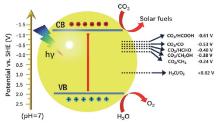
Fig 1
Schematic diagram of photocatalytic CO2 reduction. Reproduced with permission 24. Copyright 2020, Elsevier."
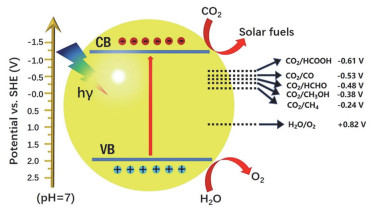
Table 1
Potential values for partial CO2 reduction reactions."
| Reaction | E0 (V) vs. NHE (pH = 7) |
| CO2 + e− → CO2•− | −1.90 |
| CO2 + 8H+ + 8e− → CH4 + 2H2O | −0.24 |
| CO2 + 2H+ + 2e− → CO + H2O | −0.53 |
| CO2 + 2H+ + 2e− → HCOOH | −0.61 |
| CO2 + 4H+ + 4e− → HCHO + H2O | −0.48 |
| CO2 + 6H+ + 6e− → CH3OH + H2O | −0.38 |
| 2CO2 + 8H+ + 8e− → CH3COOH + 2H2O | −0.30 |
| 2CO2 + 12H+ + 12e− → C2H4 + 4H2O | −0.34 |
| 2CO2 + 14H+ + 14e− → C2H6 + 4H2O | −0.27 |
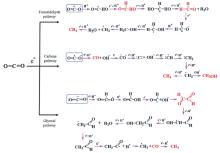
Fig 2
Reaction pathways for CO2RR. Reproduced with permission 26. Copyright 2022, Royal Society of Chemistry."
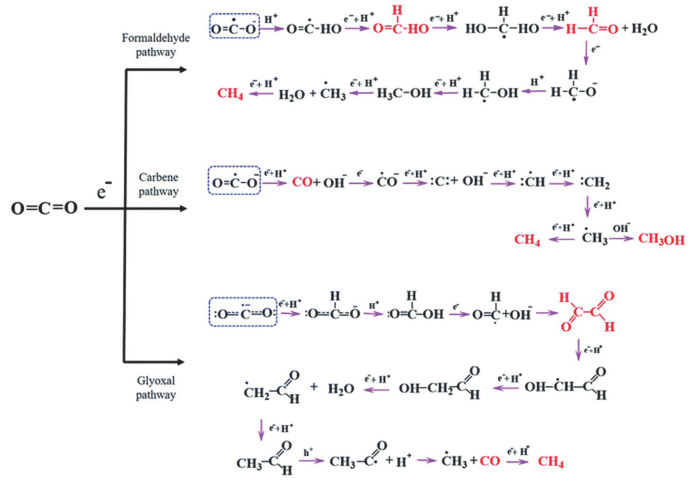
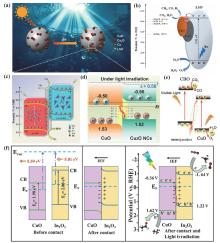
Fig 3
(a) Schematic illustration of the formation of CuO/Cu2O/Cu clusters during the reaction. (b) The energy band structure of CuxO/LSO and potential mechanism for photocatalytic CO2 reduction by CuxO/LSO composites. Reproduced with permission. 31 Copyright 2021, Elsevier. (c) Schematic diagram of photocatalytic CO2 reduction mechanism on CCB/CuO heterojunction. Reproduced with permission 36. Copyright 2024, Elsevier. (d) Illustration of the CuO/Cu2O-2 heterojunction. Reproduced with permission 37. Copyright 2024, Elsevier. (e) S-scheme charge transfer modes in CBO/CuO heterojunctions. Reproduced with permission 38. Copyright 2024, MDPI. (f) Possible mechanism of CO production by photocatalytic reduction of CO2 with CuO@In2O3. Reproduced with permission 39. Copyright 2024, Elsevier."
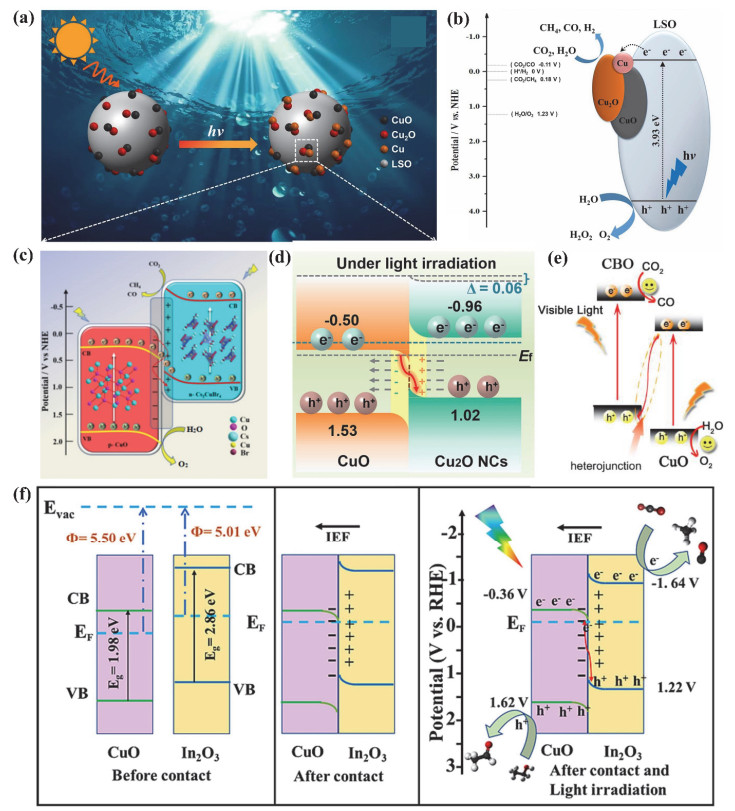
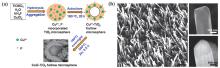
Fig 4
(a) Illustration of the preparation process of CuO-TiO2 hollow microspheres. Reproduced with permission 42. Copyright 2015, American Chemistry Society. (b) Analysis of typical CuO and ZnO-CuO nanowires. FE-SEM image of ZnO-CuO nanowire arrays with magnified original CuO nanowire (top right) and CuO nanowire coated with 63 cycles of ALD ZnO (bottom right). Reproduced with permission 43. Copyright 2015, American Chemistry Society."
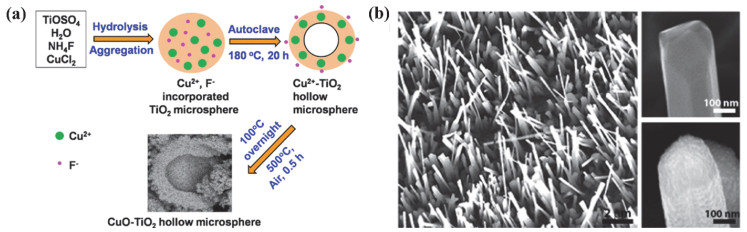
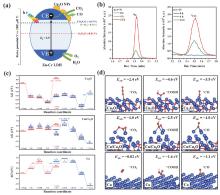
Fig 5
(a) Possible modes of electron transfer from Zn-Cr LDH to Cu2O. (b) Mass chromatography spectra of 18O2 (m/z = 36) and 13CO (m/z = 29) generated on 0.1 Cu2O@Zn 1.8 Cr LDH impregnated with H218O under 13CO2 atmosphere. Reproduced with permission 44. Copyright 2018, Elsevier. (c) Gibbs free energy diagrams of CO2 reduction pathways in primary Cu2O, Cu/Cu2O, and primary Cu. The red line indicates the CO formation path, and the blue line indicates the CH4 generation path. (d) Adsorption energy of *CO2, *COOH and *CO as CO2 RR intermediates for primary Cu2O, Cu/Cu2O and primary Cu. Reproduced with permission 45. Copyright 2022, Springer Nature."
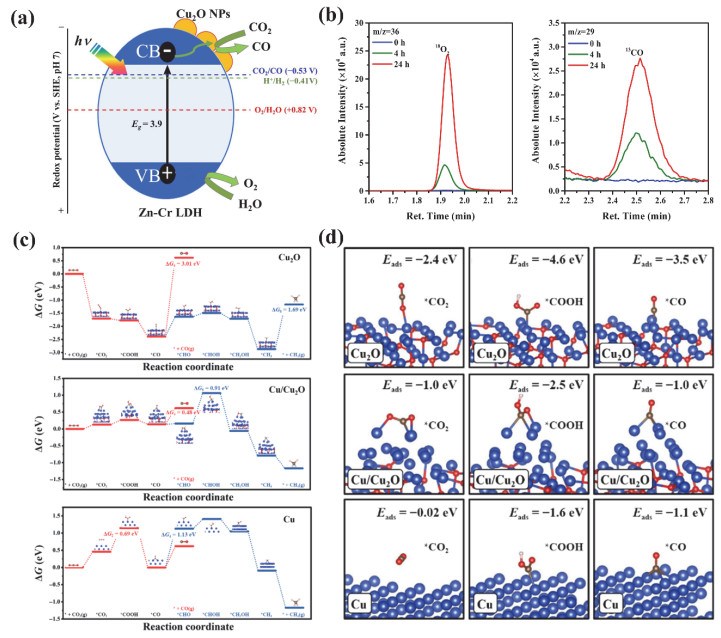
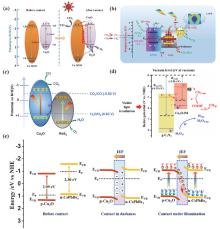
Fig 6
(a) Schematic representation of electron transfer dynamics in Co-MOF/Cu2O catalysts. Reproduced with permission 46. Copyright 2022, Elsevier. (b) The potential photocatalysis improvement mechanism of the S-scheme g-C3N4/Cu2O@Cu plasmonic heterojunction photocatalyst. Reproduced with permission 49. Copyright 2022, Elsevier. (c) Representation of energy band diagram and S-scheme of photocatalytic CO2 reduction by ReS2@Cu2O heterostructure. Reproduced with permission 50. Copyright 2022, Springer Nature. (d) Depiction of charge flows of the g-C3N4/Cu2O-Pd heterojunctions. Reproduced with permission 51. Copyright 2023, American Chemistry Society. (e) Representation of the S-scheme charge transfer mechanism over the CPB/Cu2O heterostructure. Reproduced with permission 52. Copyright 2022, American Chemistry Society."
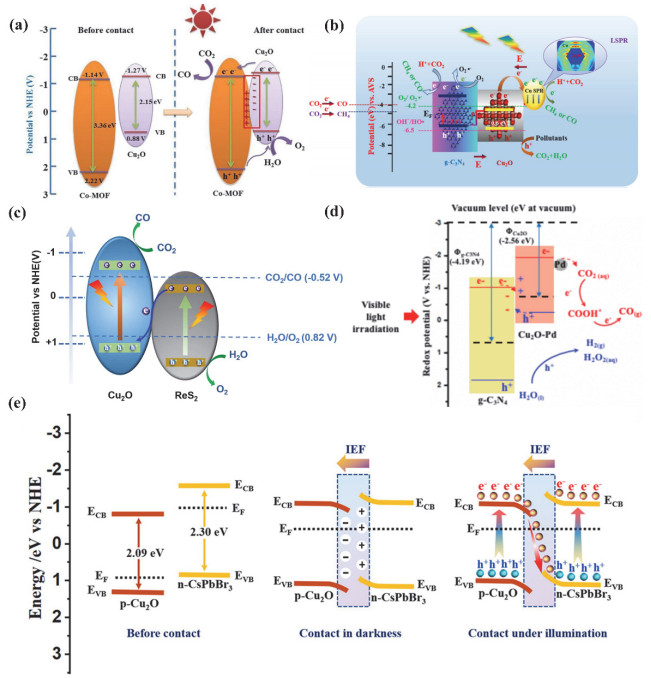
Fig 7
(a) The SEM image and (b) Representation of CO2 reduction mechanism of 3D porous Cu2O photocatalysts. Reproduced with permission 53. Copyright 2022, Elsevier. (c) Schematic diagram of the photocatalytic CO2 reduction mechanism of g-C3N4 foam/Cu2O QDs. Reproduced with permission 54. Copyright 2019, Elsevier. (d) The band structure of xCu2O and gCN. Reproduced with permission 55. Copyright 2018, Elsevier."
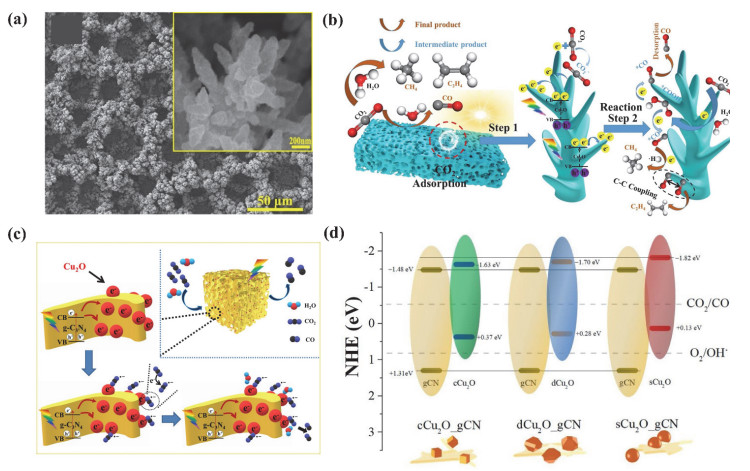
Fig 8
(a) Depiction of the synthesis process of Cu-Ti3C2Tx/g-C3N4 composite. Reproduced with permission 56. Copyright 2022, Elsevier. (b) Photocatalytic CO2 yield activity and (c) product selectivity of TiO2 and Cu/TiO2 samples. (d) GC-MS analysis of 13CO products for photocatalytic 13CO2 reduction on Cu/TiO2-3. Reproduced with permission 57. Copyright 2022, Wiley-VCH. (e) Photoreduction of CO2 to CO and H2 on BIF-29 (10 mg). (f) Calculation of free energy for photocatalytic CO2 reduction. (g) Density of states of BIF-29 and BIF-33. Reproduced with permission 58. Copyright 2019, Wiley-VCH. (h) Yield of CO2 photocatalytic reduction of CO by different photocatalysts. (i) Energy diagram of two steps in the CO formation process. Reproduced with permission 59. Copyright 2020, American Chemistry Society."
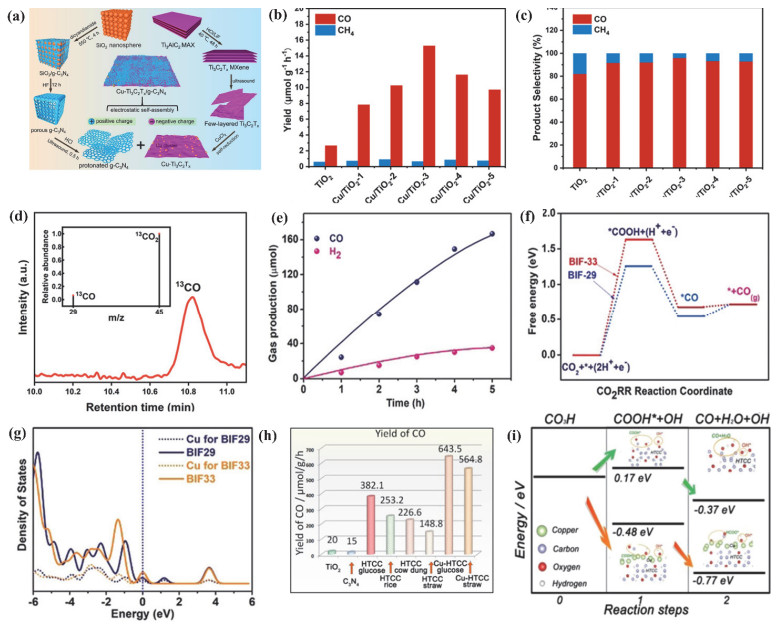
Fig 9
(a) Performance of CuCdS-x (x = 0, 2, 5, 10) catalysts in CO2 reduction. Energy profiles for CO2 dissociative adsorption on (b) CdS and (c) CuCdS-5 surfaces: DFT results. Reproduced with permission 60. Copyright 2021, Royal Society of Chemistry. (d) Evolution of CO over time at CeO2, CeO2−x, and Cu/CeO2−x. (e) Time-resolved fluorescence spectra at 420 nm excitation. (f) Possible mechanistic schemes for CO2 reduction at Cu/CeO2−x. Reproduced with permission 61. Copyright 2019, American Chemistry Society. Gibbs free energy diagram of the (g) CO2 reduction to CO and (h) dissociation process of H2O on TiO2, COCT-1 and COCT-3. (i) Mechanistic pathway for CO2 reduction to CO catalyzed by Cu NCs and OVs (* denoted the adsorption site on the catalyst surface). Reproduced with permission 62. Copyright 2022, Elsevier."
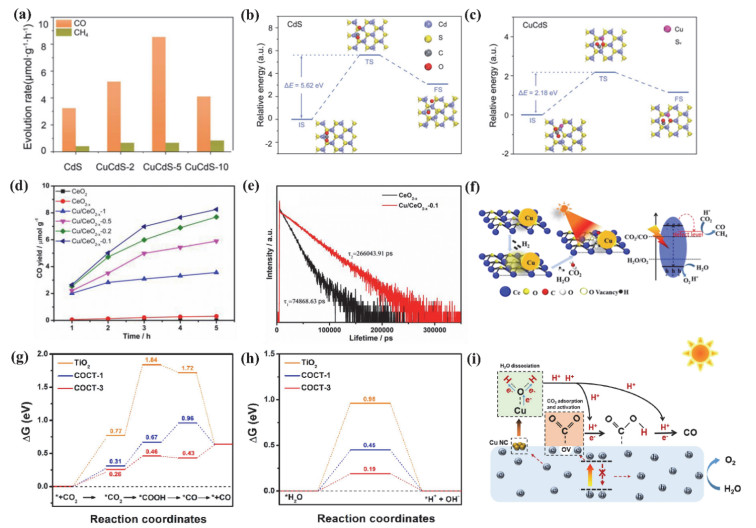
Fig 10
(a) Photocatalytic CO2 reduction activity of the TPB-Cu sample modified with varying mass ratios of Cu NPs. (b) Potential mechanism for the photocatalytic CO2 reduction in TPB-Cu system. Reproduced with permission 63. Copyright 2021, Elsevier. (c) Average CO yield of bulk g-C3N4, g-C3N4 foam and Cu/CF photocatalysts. (d) Schematic representation of the synergistic mechanism in CO2 photoreduction for Cu-NPs/g-C3N4 Foam. Reproduced with permission 64. Copyright 2020, Elsevier. (e) Product evolution of all samples over time. (f) Representaion of the CO2RR over Cu/C3N4 samples. Reproduced with permission 65. Copyright 2018, Elsevier."
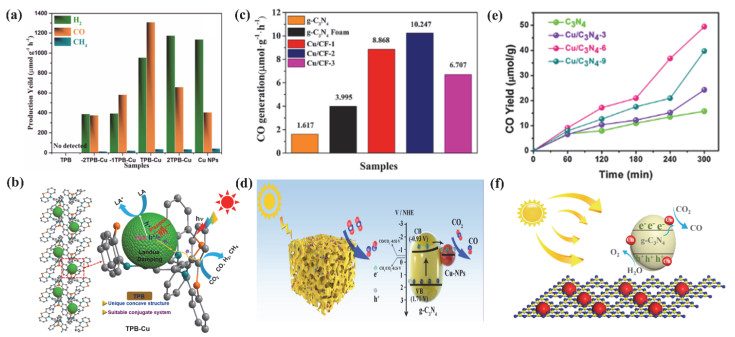
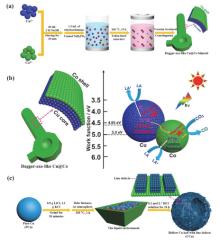
Fig 11
(a) Illustration of the synthesis process for dagger-axe-like Cu@Co core–shell bimetal. (b) Potential mechanism for the photocatalytic CO2 reduction in Cu@Co catalyst. Reproduced with permission 66. Copyright 2021, Elsevier. (c) Description of preparation approach of hollow Cu ball with line defects (CCu). Reproduced with permission 67. Copyright 2021, Elsevier."
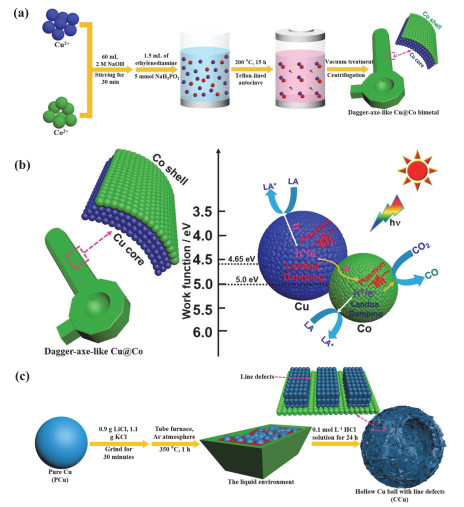
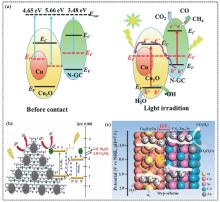
Fig 12
(a) The work functions of Cu, Cu2O, and N-GC prior to contact, and the proposed photocatalytic pathway of Cu@Cu2O/N-GC samples under visible light. Reproduced with permission 68. Copyright 2022, Royal Society of Chemistry. (b) Depiction of CO2 reduction mechanism. Reproduced with permission 69. Copyright 2023, Elsevier. (c) Possible S-scheme photocatalytic mechanism for the CZS/CC5 sample. Reproduced with permission 70. Copyright 2022, Elsevier."
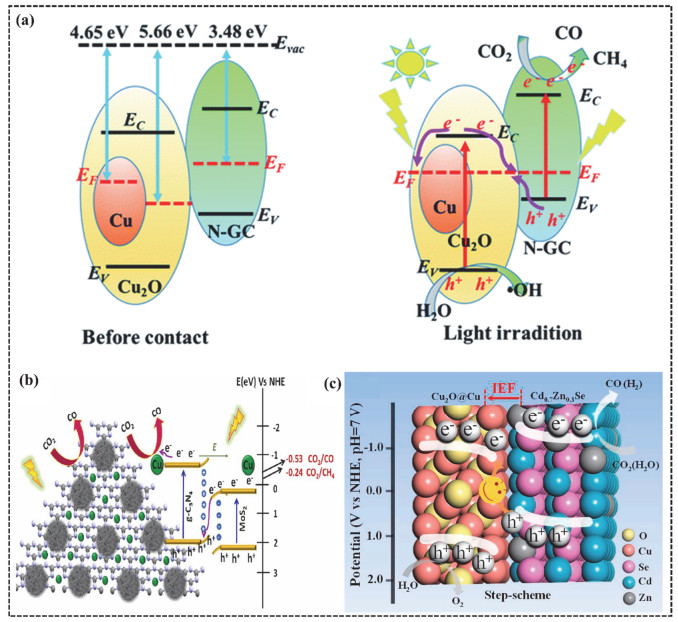
Fig 13
(a) Illustration of the sequential template method for transforming Cu3N nanocubes into TiO2@Cu3N hybrid nanocubes and CuO-TiO2−xNx hollow nanocubes. (b) Solar irradiation methane production rates (ppm∙g−1∙h−1) for CuO-TiO2−xNx hollow nanocubes in CO2/H2O vs. Ar/H2O, with comparative data from control samples. Reproduced with permission 71. Copyright 2012, Wiley-VCH. (c) Low-magnification and high-magnification TEM images of the CCS-3/CuO/CM sample. (d) Comparison of CH3OH yields for CM, CuO, and CuO/CM with various CdxCu1−xS loadings after 4-hour light exposure. Reproduced with permission 72. Copyright 2021, Elsevier."
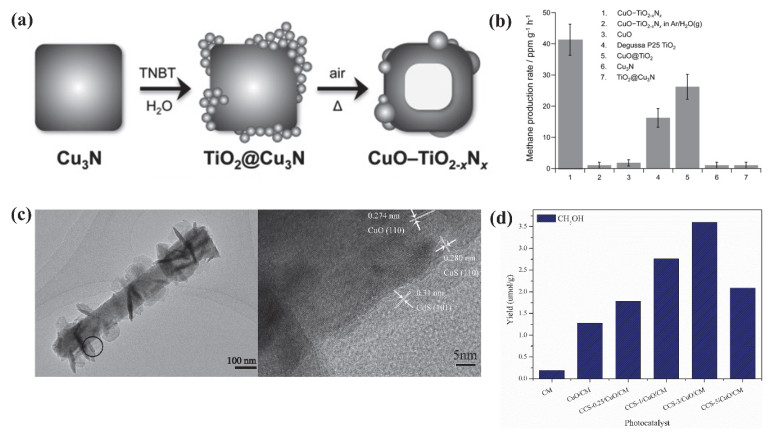
Fig 14
(a) TEM and HRTEM images of 5 wt% CNTO. (b) Morphology of CNTO and CNTO-L and schematic diagram of CO2 photoreduction. Reproduced with permission 73. Copyright 2018, Elsevier. (c) Synthesis pathway of g-C3N4/CuO@MIL-125(Ti) sample. (d) HRTEM image of 2.5% g-C3N4/1% CuO@MIL-125(Ti) sample. Reproduced with permission 74. Copyright 2020, Elsevier."
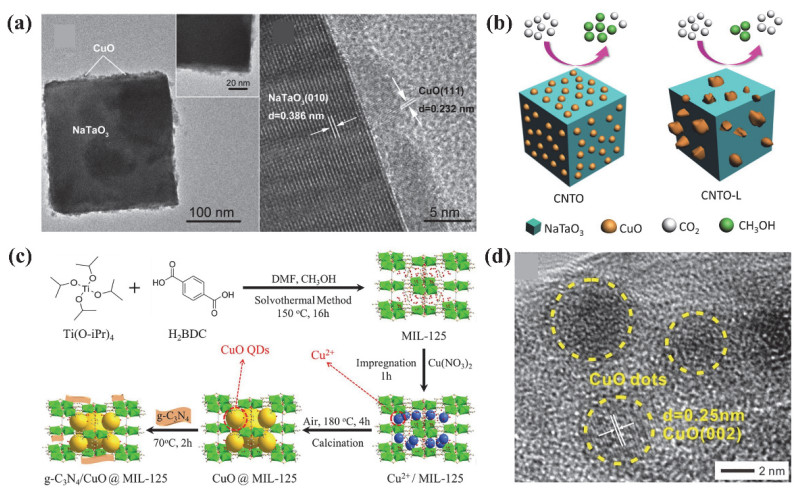
Fig 15
(a) Energy level diagram illustrating the construction of a heterojunction and Z-scheme between CuO and Nb2O5 under UV radiation. Reproduced with permission 75. Copyright 2020, American Chemistry Society. (b) Illustration of charge transfer pathway between p-type CuO and n-type WO3: before contact and after formation of the p–n junction. Reproduced with permission 76. Copyright 2020, Royal Society of Chemistry. (c) Possible charge transfer mechanisms of CO2RR reduction on the CuO/BiOCl composites. Reproduced with permission 77. Copyright 2022, Elsevier. (d) Possible mechanism of CO2 reduction using p-CuO/n-ZnO. Reproduced with permission 78. Copyright 2019, Elsevier. (e) Photocatalytic mechanism of ACZ. Reproduced with permission 79. Copyright 2024, Elsevier. (f) Diagram illustrating the CO2 to methanol photoreduction mechanism over rGO-Bi2S3/CuO S-scheme heterojunction photocatalyst under visible light. Reproduced with permission 80. Copyright 2024, Springer Nature. (g) Synthesis strategy of Cu2O/S-TiO2/CuO. Reproduced with permission 81. Copyright 2017, Elsevier."
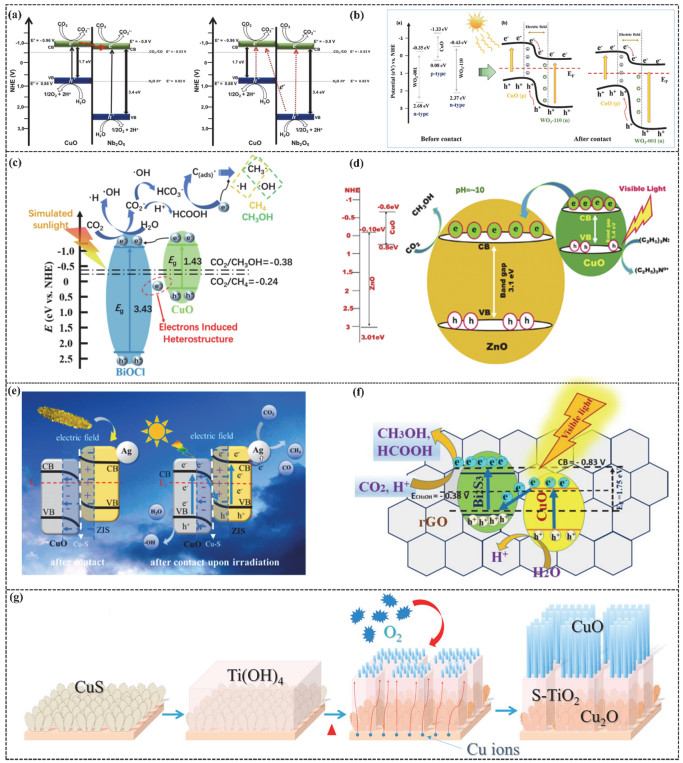
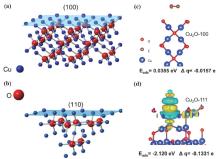
Fig 16
(a) The atomic model of Cu terminated by the (100) surface of Cu2O was utilized for DFT calculations. (b) The atomic model of Cu terminated by the (110) surface of Cu2O was utilized for DFT calculations. Reproduced with permission 82. Copyright 2019, Springer Nature. Electron density variation on (c) (100) and (d) (111) surfaces of Cu2O following CO Adsorption (0.0006 Electrons·Å−³): Yellow for electron depletion, blue for electron accumulation. Reproduced with permission 83. Copyright 2024, American Chemistry Society."
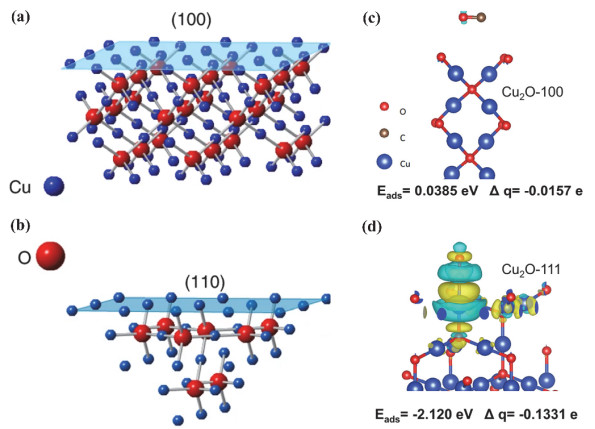
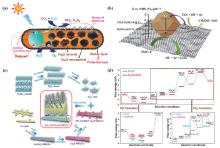
Fig 17
(a) Illustration of the possible process of CO2RR over CCMNRs. Reproduced with permission 84. Copyright 2016, American Chemistry Society. (b) Illustrated mechanism of CO2 reduction via rhombic dodecahedral Cu2O/rGO. Reproduced with permission 85. Copyright 2019, Elsevier. (c) Representation of the synthesis process for Ti3C2 QDs and Ti3C2 QDs/Cu2O NWs/Cu. Reproduced with permission 86. Copyright 2018, Wiley-VCH. (d) Free energy diagram illustrating the CO2 RR to CO and CH4, including enlarged diagrams for the CO and subsequent CH4 generation processes on pure Cu2O and Cl-doped Cu2O samples. Reproduced with permission 87. Copyright 2019, Elsevier."
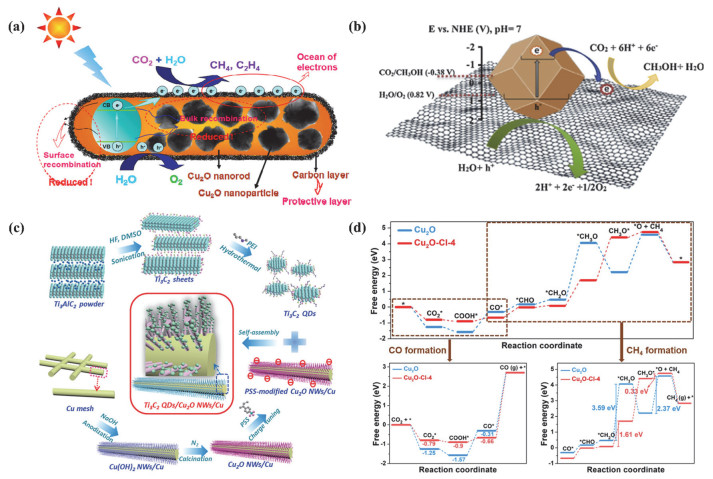
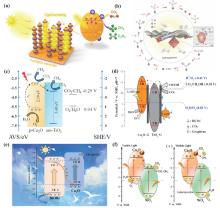
Fig 18
(a) Diagram depicting the CO2 reduction mechanism on Cu2O@Cu nanorod arrays. Reproduced with permission 88. Copyright 2020, Elsevier. (b) Schematic illustrating the mechanism of CO2 photoreduction into CH4 using the Ag/Cu2O@rGO catalyst. Reproduced with permission 89. Copyright 2022, Elsevier. (c) Band alignment of Cu2O and TiO2, and redox potentials for CO2 photoreduction and H2O oxidation referenced against the absolute vacuum scale (AVS) and the standard hydrogen electrode (SHE) at pH = 5. Reproduced with permission 90. Copyright 2014, Wiley-VCH. (d) Illustration depicting the possible mechanism for CO2RR using the ternary Cu2O/graphene/TNA catalyst under visible light irradiation. Reproduced with permission 91. Copyright 2016, Elsevier. (e) Diagram illustrating the electron transfer pathway involved in the CO2 reduction in S-scheme BiOBr/Cu2O composites under sunlight irradiation. Reproduced with permission 92. Copyright 2023, Elsevier. (f) Photocatalytic S-scheme charge transfer mode in Cu/Cu2O/WO3 composites. Reproduced with permission 93. Copyright 2022, MDPI."
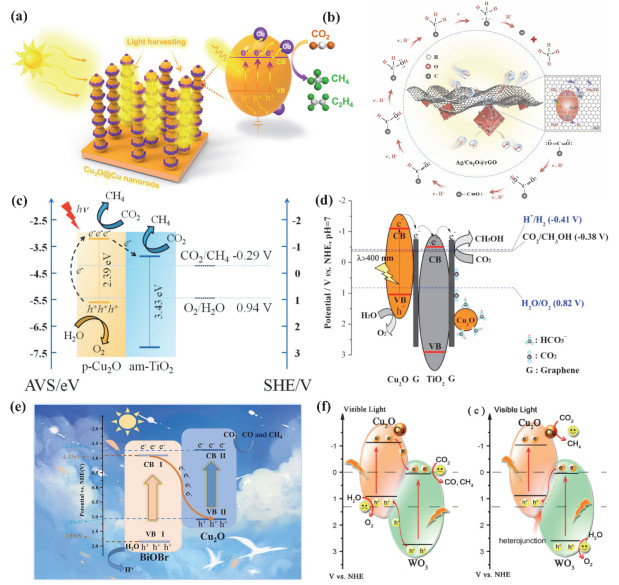
Fig 19
(a) The solar fuel formation rates of GO, Cu/GO-1, Cu/GO-2, and Cu/GO-3 after 2 h of light illumination. Reproduced with permission 94. Copyright 2014, American Chemical Society. (b) CH4 production yields on Cu/CsPbBr3-Cs4PbBr6 NCs with varying amounts of copper. Reproduced with permission 95. Copyright 2022, Elsevier. (c) Photoreduction activity for converting CO2 into CH4 over TiO2 and TiO2-Cu samples under simulated solar light for 4 h. Reproduced with permission 96. Copyright 2022, Elsevier. (d) The CH3OH evolution rate from photocatalytic reduction of CO2 under UV and visible light irradiation for 3 h. Reproduced with permission 97. Copyright 2015, Elsevier."
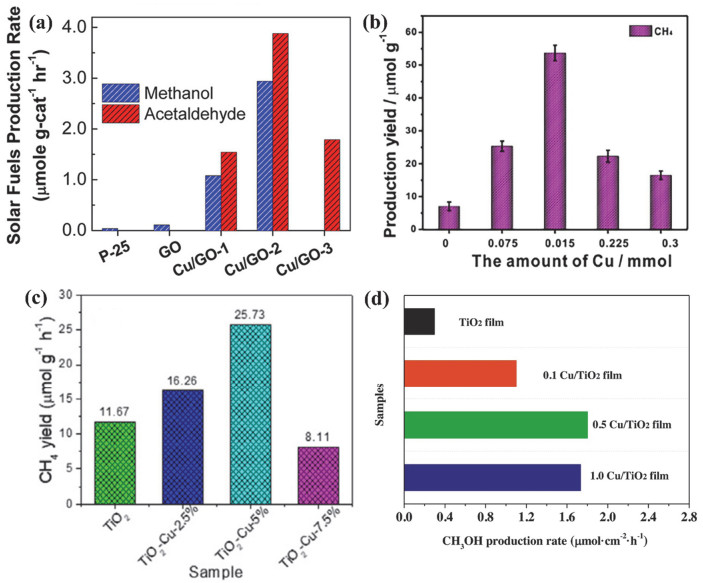
Fig 20
(a) Photocatalytic performance of BiYO3 doped with varying Cu amounts. Reproduced with permission 98. Copyright 2017, Elsevier. (b) The influence of Cu content in Cu-TiO2 on the catalytic methane yield under solar simulator irradiation. Reproduced with permission 99. Copyright 2017, Wiley-VCH. (c) Yield of HCOOH for UV and visible light vs. irradiation time. Reproduced with permission 100. Copyright 2017, Elsevier. (d) Rate of CO/CH4 formation by CO2 photoreduction over original BTN and Cu-BTN with varying copper load content. Reproduced with permission 101. Copyright 2017, Wiley-VCH."
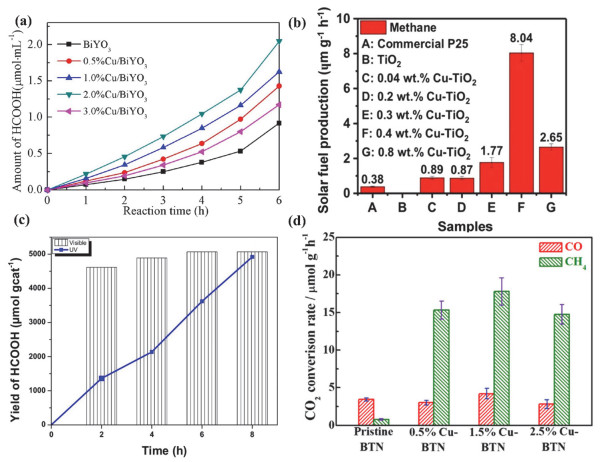
Fig 21
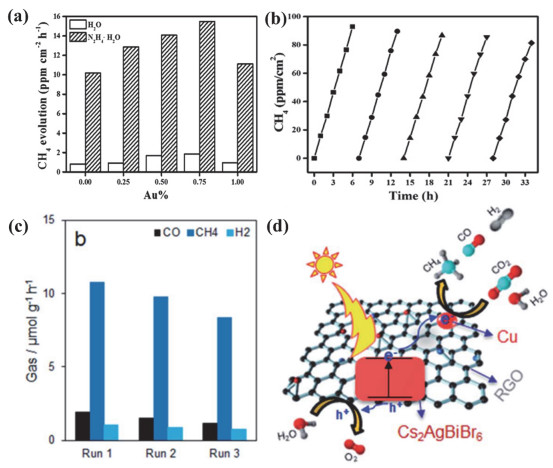
(a) The quantity of CH4 generated in the photoreduction of CO2 on Au-Cu@STO/TiO2 nanotube arrays correlates with the Au fraction in bimetallic alloy NPs. (b) Cycling measurements of CH4 generation on Au-Cu@STO/TiO2 nanotube arrays. Reproduced with permission 102. Copyright 2014, Wiley-VCH. (c) Repeatability test of DP-Cu-RGO in three consecutive runs. (d) Schematic illustrating the mechanism of charge separation and transfer during CO2 reduction on DP-Cu-RGO nanocomposites under simulated sunlight. Reproduced with permission 103. Copyright 2021, Royal Society of Chemistry."
| 1 |
doi: 10.1021/jacs.0c02973 |
| 2 |
doi: 10.3866/pku.Whxb202009030 |
| 3 |
doi: 10.3866/pku.Whxb202309031 |
| 4 |
doi: 10.1002/anie.202407468 |
| 5 |
doi: 10.1016/j.ces.2023.119546 |
| 6 |
doi: 10.1021/jacs.1c05839 |
| 7 |
doi: 10.1007/s40820-023-01276-2 |
| 8 |
doi: 10.1016/j.cej.2023.147560 |
| 9 |
doi: 10.1021/acscatal.2c03970 |
| 10 |
doi: 10.1002/adma.202300643 |
| 11 |
doi: 10.3866/PKU.WHXB202212011 |
| 12 |
doi: 10.3866/PKU.WHXB202306041 |
| 13 |
doi: 10.1002/adfm.202214470 |
| 14 |
doi: 10.1016/j.cej.2020.128397 |
| 15 |
doi: 10.1016/j.apcatb.2019.118331 |
| 16 |
doi: 10.1007/s12274-017-1552-0 |
| 17 |
doi: 10.1002/adma.202008145 |
| 18 |
doi: 10.1021/acs.chemrev.5b00482 |
| 19 |
doi: 10.1016/j.jcou.2022.102056 |
| 20 |
doi: 10.1016/j.apcatb.2022.122079 |
| 21 |
doi: 10.1002/smll.202310677 |
| 22 |
doi: 10.1002/smll.202206314 |
| 23 |
doi: 10.1002/adma.201704649 |
| 24 |
doi: 10.1016/j.mattod.2019.06.009 |
| 25 |
doi: 10.1016/j.rser.2019.109246 |
| 26 |
doi: 10.1039/d1ee02714j |
| 27 |
doi: 10.1021/acscatal.5b02694 |
| 28 |
doi: 10.1021/acsami.0c21067 |
| 29 |
doi: 10.1021/jacs.2c09424 |
| 30 |
doi: 10.1016/j.cej.2021.131579 |
| 31 |
doi: 10.1016/j.apsusc.2021.150985 |
| 32 |
doi: 10.1038/s41467-024-49004-7 |
| 33 |
doi: 10.1016/j.chempr.2020.06.010 |
| 34 |
doi: 10.1002/adma.202310600 |
| 35 |
doi: 10.1002/anie.202218688 |
| 36 |
doi: 10.1016/j.cclet.2024.109700 |
| 37 |
doi: 10.1016/j.apsusc.2023.159220 |
| 38 |
doi: 10.3390/nano12183247 |
| 39 |
doi: 10.1016/j.cej.2024.149855 |
| 40 |
doi: 10.1016/j.apcatb.2023.122621 |
| 41 |
doi: 10.1002/adfm.202301785 |
| 42 |
doi: 10.1021/acssuschemeng.5b00724 |
| 43 |
doi: 10.1021/am508590j |
| 44 |
doi: 10.1016/j.apcatb.2017.11.011 |
| 45 |
doi: 10.1007/s12274-022-4397-0 |
| 46 |
doi: 10.1016/j.cej.2022.135622 |
| 47 |
doi: 10.1002/adma.201601694 |
| 48 |
doi: 10.3390/ma15030967 |
| 49 |
doi: 10.1016/j.carbon.2022.03.038 |
| 50 |
doi: 10.1007/s10853-022-07591-0 |
| 51 |
doi: 10.1021/acsami.3c02383 |
| 52 |
doi: 10.1021/acsaem.2c01760 |
| 53 |
doi: 10.1016/j.apsusc.2021.152343 |
| 54 |
doi: 10.1016/j.envint.2019.06.008 |
| 55 |
doi: 10.1016/j.jcou.2018.06.009 |
| 56 |
doi: 10.1016/j.cej.2022.137028 |
| 57 |
doi: 10.1002/anie.202207600 |
| 58 |
doi: 10.1002/anie.201905869 |
| 59 |
doi: 10.1021/acsami.0c13323 |
| 60 |
doi: 10.1039/d1ta03615g |
| 61 |
doi: 10.1021/acscatal.8b03975 |
| 62 |
doi: 10.1016/j.cej.2022.136718 |
| 63 |
doi: 10.1016/j.apsusc.2021.149361 |
| 64 |
doi: 10.1016/j.apsusc.2019.144347 |
| 65 |
doi: 10.1016/j.apsusc.2017.08.148 |
| 66 |
doi: 10.1016/j.cej.2021.129295 |
| 67 |
doi: 10.1016/j.jcis.2021.06.127 |
| 68 |
doi: 10.1039/d1ta10514k |
| 69 |
doi: 10.1016/j.jece.2023.109545 |
| 70 |
doi: 10.1016/j.mtphys.2022.100729 |
| 71 |
doi: 10.1002/anie.201108936 |
| 72 |
doi: 10.1016/j.optmat.2021.111016 |
| 73 |
doi: 10.1016/j.jcis.2018.01.109 |
| 74 |
doi: 10.1016/j.cej.2020.125782 |
| 75 |
doi: 10.1021/acsaem.0c01047 |
| 76 |
doi: 10.1039/d0se00034e |
| 77 |
doi: 10.1016/j.apsusc.2022.152463 |
| 78 |
doi: 10.1016/j.jcou.2019.03.012 |
| 79 |
doi: 10.1016/j.apcatb.2023.123449 |
| 80 |
doi: 10.1557/s43578-024-01352-2 |
| 81 |
doi: 10.1016/j.jcou.2017.05.008 |
| 82 |
doi: 10.1038/s41560-019-0490-3 |
| 83 |
doi: 10.1021/acscatal.2c00167 |
| 84 |
doi: 10.1021/acscatal.6b01455 |
| 85 |
doi: 10.1016/j.jcou.2019.05.020 |
| 86 |
doi: 10.1002/adfm.201806500 |
| 87 |
doi: 10.1016/j.nanoen.2019.03.083 |
| 88 |
doi: 10.1016/j.cej.2019.123940 |
| 89 |
doi: 10.1016/j.apcatb.2022.121371 |
| 90 |
doi: 10.1002/cjoc.201400476 |
| 91 |
doi: 10.1016/j.nanoen.2016.06.056 |
| 92 |
doi: 10.1016/j.jece.2023.111479 |
| 93 |
doi: 10.3390/nano12132284 |
| 94 |
doi: 10.1021/nl503609v |
| 95 |
doi: 10.1016/j.cej.2022.134811 |
| 96 |
doi: 10.1016/j.cclet.2021.07.052 |
| 97 |
doi: 10.1016/j.materresbull.2015.03.064 |
| 98 |
doi: 10.1016/j.apcatb.2016.09.035 |
| 99 |
doi: 10.1002/cctc.201700512 |
| 100 |
doi: 10.1016/j.jcou.2017.02.004 |
| 101 |
doi: 10.1002/cphc.201700563 |
| 102 |
doi: 10.1002/anie.201409183 |
| 103 |
doi: 10.1039/d1ta01281a |
| [1] | Fan Fan, Hao Xiu, Yuting Wang, Yongpeng Cui, Yajun Wang. Construction of NH2-MIL-125/Na-doped g-C3N4 composite S-scheme heterojunction and its performance in photocatalytic hydrogen peroxide production [J]. Acta Phys. -Chim. Sin., 2026, 42(2): 100143-. |
| [2] | Yu Liu, Pengfei Li, Yize Liu, Zaicheng Sun. Recent advances in carbon dots as a single photocatalyst [J]. Acta Phys. -Chim. Sin., 2026, 42(2): 100167-. |
| [3] | Yuhang Zhang, Yi Li, Yuehan Cao, Yingjie Shuai, Yu Zhou, Ying Zhou. Regulating the formation type by Ir of intermediates to suppress product overoxidation in photocatalytic methane conversion [J]. Acta Phys. -Chim. Sin., 2026, 42(2): 100173-. |
| [4] | Shiyi Chen, Jialong Fu, Jianping Qiu, Guoju Chang, Shiyou Hao. Waste medical mask-derived carbon quantum dots enhance the photocatalytic degradation of polyethylene terephthalate (PET) over BiOBr/g-C3N4 S-scheme heterojunction [J]. Acta Phys. -Chim. Sin., 2026, 42(1): 100135-. |
| [5] | Chengxiao Zhao, Zhaolin Li, Dongfang Wu, Xiaofei Yang. SBA-15 templated covalent triazine frameworks for boosted photocatalytic hydrogen production [J]. Acta Phys. -Chim. Sin., 2026, 42(1): 100149-. |
| [6] | Chengyan Ge, Jiawei Hu, Xingyu Liu, Yuxi Song, Chao Liu, Zhigang Zou. Self-integrated black NiO clusters with ZnIn2S4 microspheres for photothermal-assisted hydrogen evolution by S-scheme electron transfer mechanism [J]. Acta Phys. -Chim. Sin., 2026, 42(1): 100154-. |
| [7] | Jianan Hong, Chenyu Xu, Yan Liu, Changqi Li, Menglin Wang, Yanwei Zhang. Decoding the interfacial competition between hydrogen evolution and CO2 reduction via edge-active-site modulation in photothermal catalysis [J]. Acta Phys. -Chim. Sin., 2025, 41(9): 100099-. |
| [8] | Menglan Wei, Xiaoxia Ou, Yimeng Wang, Mengyuan Zhang, Fei Teng, Kaixuan Wang. S-scheme heterojunction g-C3N4/Bi2WO6 highly efficient degradation of levofloxacin: performance, mechanism and degradation pathway [J]. Acta Phys. -Chim. Sin., 2025, 41(9): 100105-. |
| [9] | Jingping Li, Suding Yan, Jiaxi Wu, Qiang Cheng, Kai Wang. Improving hydrogen peroxide photosynthesis over inorganic/organic S-scheme photocatalyst with LiFePO4 [J]. Acta Phys. -Chim. Sin., 2025, 41(9): 100104-. |
| [10] | Fengying Zhang, Yanglin Mei, Yuman Jiang, Shenshen Zheng, Kaibo Zheng, Ying Zhou. Research progress of transient absorption spectroscopy in solar energy conversion and utilization [J]. Acta Phys. -Chim. Sin., 2025, 41(9): 100118-. |
| [11] | Wenlong Wang, Wentao Hao, Lang He, Jia Qiao, Ning Li, Chaoqiu Chen, Yong Qin. Bandgap and adsorption engineering of carbon dots/TiO2 S-scheme heterojunctions for enhanced photocatalytic CO2 methanation [J]. Acta Phys. -Chim. Sin., 2025, 41(9): 100116-. |
| [12] | Lewang Yuan, Yaoyao Peng, Zong-Jie Guan, Yu Fang. Insights into the development of 2D covalent organic frameworks as photocatalysts in organic synthesis [J]. Acta Phys. -Chim. Sin., 2025, 41(8): 100086-. |
| [13] | Fanpeng Meng, Fei Zhao, Jingkai Lin, Jinsheng Zhao, Huayang Zhang, Shaobin Wang. Optimizing interfacial electric fields in carbon nitride nanosheet/spherical conjugated polymer S-scheme heterojunction for hydrogen evolution [J]. Acta Phys. -Chim. Sin., 2025, 41(8): 100095-. |
| [14] | Weikang Wang, Yadong Wu, Jianjun Zhang, Kai Meng, Jinhe Li, Lele Wang, Qinqin Liu. Green H2O2 synthesis via melamine-foam supported S-scheme Cd0.5Zn0.5In2S4/S-doped carbon nitride heterojunction: synergistic interfacial charge transfer and local photothermal effect [J]. Acta Phys. -Chim. Sin., 2025, 41(8): 100093-. |
| [15] | Liangliang Song, Haoyan Liang, Shunqing Li, Bao Qiu, Zhaoping Liu. Challenges and strategies on high-manganese Li-rich layered oxide cathodes for ultrahigh-energy-density batteries [J]. Acta Phys. -Chim. Sin., 2025, 41(8): 100085-. |
|
||