Acta Phys. -Chim. Sin. ›› 2024, Vol. 40 ›› Issue (2): 2303059.doi: 10.3866/PKU.WHXB202303059
Special Issue: Energy and Environmental Catalysis
• REVIEW • Previous Articles Next Articles
Use of NiFe Layered Double Hydroxide as Electrocatalyst in Oxygen Evolution Reaction: Catalytic Mechanisms, Electrode Design, and Durability
Wang Wang1, Yucheng Liu2, Shengli Chen1,*( )
)
- 1 Electrochemical Power Sources Key Laboratory, College of Chemistry and Molecular Sciences, Wuhan University, Wuhan 430072, China
2 Core Facility of Wuhan University, Wuhan 430072, China
-
Received:2023-03-31Revised:2023-04-28Accepted:2023-05-08Published:2023-05-19 -
Contact:Email: slchen@whu.edu.cn; Tel.: +86-27-68754693 (Shengli Chen) -
Supported by:the National Natural Science Foundation of China(22102121); the National Natural Science Foundation of China(21832004); the China National Postdoctoral Program for Innovative Talents(BX20200253)

Cite this article
Wang Wang, Yucheng Liu, Shengli Chen. Use of NiFe Layered Double Hydroxide as Electrocatalyst in Oxygen Evolution Reaction: Catalytic Mechanisms, Electrode Design, and Durability[J]. Acta Phys. -Chim. Sin. 2024, 40(2), 2303059. doi: 10.3866/PKU.WHXB202303059
share this article
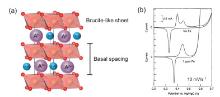
Fig 1
(a) The schematic structure of layered double hydroxides40, adapted from Molecular Diversity Preservation International publisher. (b) Effect of iron in the electrolyte on nickel electrode voltammograms, 10 mV∙s−141, adapted from the Electrochemical Society."
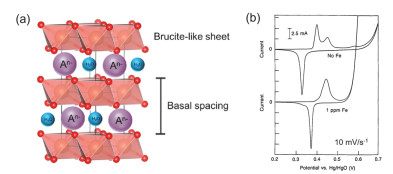
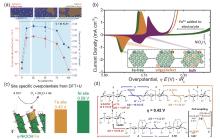
Fig 2
(a) OER activity of mixed Ni-Fe catalysts varies with Fe content in 0.1 mol·L−1 KOH. Top: illustration of the influence of Fe ratio on the phases of the catalysts66, adapted from American Chemical Society publisher. (b) CV of NiOxHy cycled in Fe-free aq. 1 mol∙L−1 KOH, and then cycled in 1 mol∙L−1 KOH solution with 1 mmol·L−1 Fe (NO3)3. The inset is possible illustration of Fe incorporation into a NiOxHy platelet with different cycling numbers65, adapted from American Chemical Society publisher. (c) Left: the edged Fe site catalyzes the OER, right: the calculated overpotential on Fe and Ni sites66, adapted from American Chemical Society publisher. (d) The mechanism of OER on γ-(Ni, Fe)OOH catalysts75, adapted from Proceedings of the National Academy of Sciences publisher."
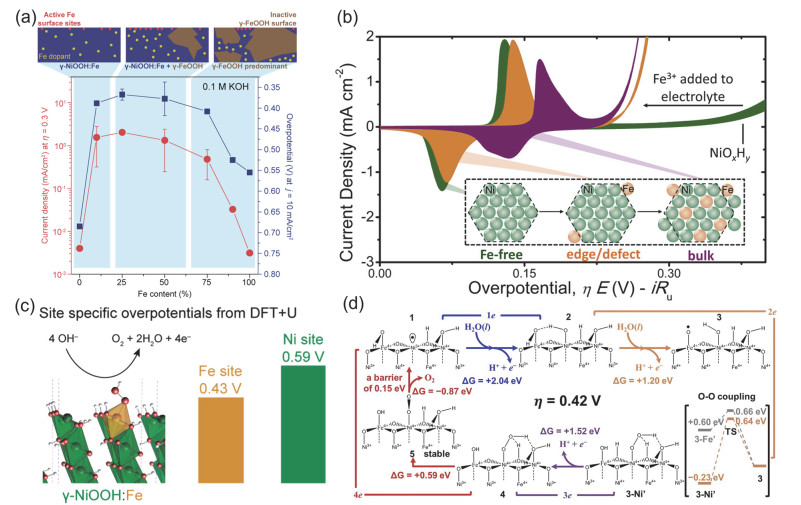
Fig 3
(a) The onset potentials and Tafel slopes after metal atoms doped in NiFe-LDH, adapted from John Wiley & Sons, Inc. publisher. (b) The Tafel slope and the bandgap width after metal atoms doped in NiFe-LDH78, adapted from John Wiley & Sons, Inc. publisher. (c) The illustration of the impact of interlayer Co2+ on the local structure of NiFe LDH79, adapted from American Chemical Society publisher."
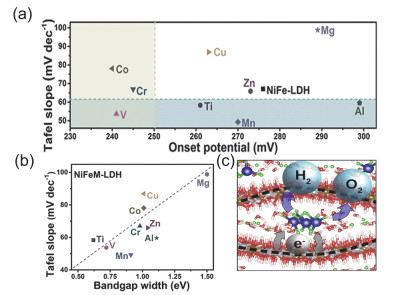
Fig 4
(a) Illustration of the electronic interaction among Ni, Fe, Ce, and O in NiFe-LDH, CeNiFe-LDH81, adapted from John Wiley & Sons, Inc. publisher. (b) Illustration of d band change upon Mn2+ doping on NiFe-LDH11, adapted from Royal Society of Chemistry publisher."
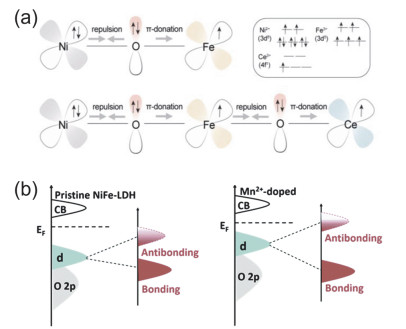
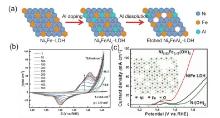
Fig 5
(a) Al doping and partial dissolution in NiFeAl LDH85, adapted from Elsevier publisher. (b) The 500 CV cycles for F-NiFe LDH51, adapted from American Chemical Society publisher. (c) Nanoporous and defective NiFe LDH with better OER activity49, adapted from American Chemical Society publisher."

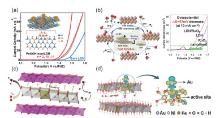
Fig 6
(a) Interfacial interplay between FeOOH and NiFe LDH to enhance OER electrocatalysis86, adapted from American Chemical Society publisher. (b) Exfoliated NiFe LDH-RuO2 hybrid nanosheets kinetically control the RDS to improve the OER89, adapted from Nature publisher. (c) A 2D MnO2-2D NiFe LDH hybrid catalyst91, adapted from John Wiley & Sons, Inc. publisher. (d) Differential charge densities of NiFe LDH with Au atom when O is adsorbed on the Fe site, blue and yellow contours represent electron depletion and accumulation, respectively92, adapted from American Chemical Society publisher."
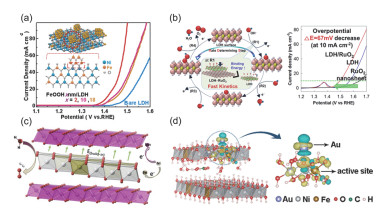
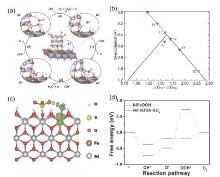
Fig 7
(a) Illustration of the OER process at S1 site (NiO/NiFe LDH intersection). (b) Activity volcano of the theoretical overpotential for different sites. The triangles are the overpotentials for different NiO/NiFe LDH models and the green square for Fe site (L1) at LDH edge. T1, T2, T1', and T2' are Fe sites at the edge of LDH with the NiO cluster nearby and the other edge sites of LDH being adsorbed by *OH or H2O. The red star is the position for the ideal catalyst without overpotential94, adapted from John Wiley & Sons, Inc. publisher. (c) Differential charge densities of NiFeOOH-SO4 upon OOH* adsorbtion on the Fe site. Blue and yellow contours represent electron depletion and accumulation, respectively. (d) The reaction diagrams of OER over NiFeOOH and NiFeOOH-SO495, adapted from John Wiley & Sons, Inc. publisher."
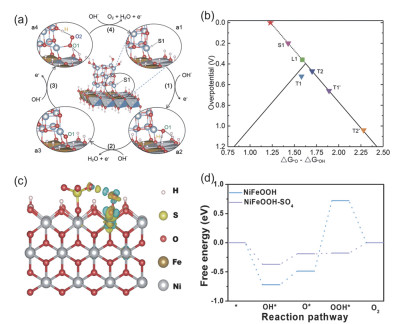
Fig 8
(a) Illustration of the anion exchange reaction of LDH with increasing basal distance, adapted from American Chemical Society publisher. (b) The polarization curves of various intercalated LDHs, the insets are the relation between the basal space and the anions, and the relation between the catalytic activity and the electrochemical surface area96, adapted from American Chemical Society publisher. (c) Schematic illustration of the synthesis of NiFe LDH with CO32−, Cl−, SO42−, and dodecyl sulfate anions in the interlayer gallery, which eventually transform to CO32−-intercalated LDH97, adapted from American Chemical Society publisher. (d) Overpotentials of NiFe LDH with various interlayer anions as a function of anion basicity98, adapted from Royal Society of Chemistry publisher."
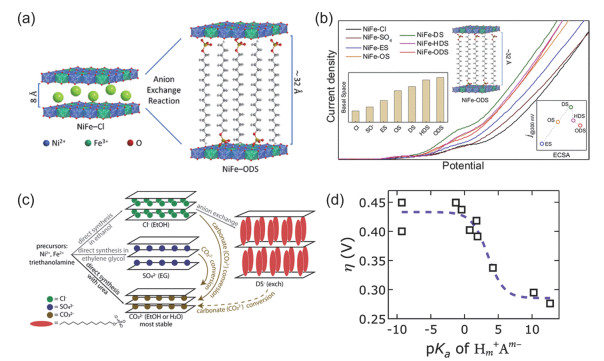
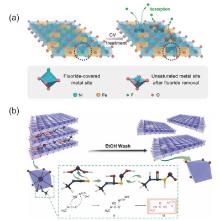
Fig 9
(a) Illustration of the creation of vacancies by fluorine102, adapted from American Chemical Society publisher. (b) The mechanism of introduction of CH3NCS to create multivacancies103, adapted from Elsevier publisher."
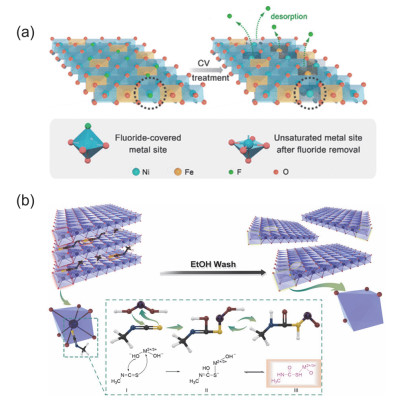
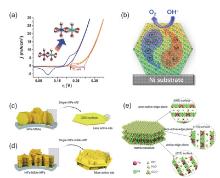
Fig 10
(a) The polarization curves of the NiFe LDH with and without lattice tensile strain108, adapted from John Wiley & Sons, Inc. publisher. (b) Gradient in NiFe LDH nanoarrays for efficient oxygen evolution109, adapted from Elsevier publisher. The microstructures of traditional NiFe LDH (c) with (003) dominated facets and the synthesized NiFe LDH (d) with (012) dominated facets, adapted from Royal Society of Chemistry publisher. (e) The various crystalline planes of NiFe LDHs: the (003) crystal plane, the (110) and (012) edge planes110, adapted from Royal Society of Chemistry publisher."
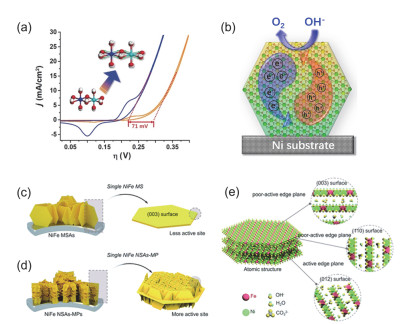
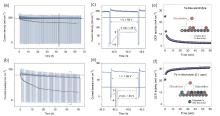
Fig 11
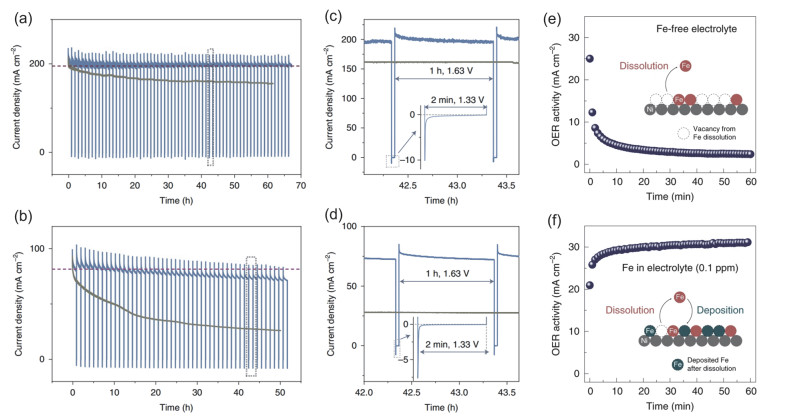
(a) Long-term stability test of thin NiFe LDH for the OER. Two techniques were applied to study the stability change. Green line is continuous CA treatment, and the blue line is the CA treatment with holding at 1.33 V for 2 min between every 1 h of CA treatment, adapted from Nature publisher. (b) Enlargement of a measurement period in (a), adapted from Nature publisher. (c) Long-term stability test of bulk NiFe LDH for the OER. The stability test follows the same techniques as used for the thin NiFe LDH, adapted from Nature publisher. (d) Enlargement of a measurement period in (c)54, adapted from Nature publisher. The OER activity of Fe-NiOxHy during the CA treatments at 1.7 V in purified KOH (e) and KOH with 0.1 ppm Fe (f), adapted from Nature publisher. The diagram in (e) illustrates the dissolution process, the diagram in (f) shows both the Fe dissolution and redeposition processes, with balanced rates by the Fe in the electrolyte116, adapted from Nature publisher."
| 1 |
doi: 10.1126/science.aad4998 |
| 2 |
doi: 10.1126/science.1103197 |
| 3 |
doi: 10.1038/nature11475 |
| 4 |
doi: 10.1016/j.apcatb.2022.122072 |
| 5 |
doi: 10.1016/j.esci.2023.100111 |
| 6 |
doi: 10.1016/j.chempr.2022.02.003 |
| 7 |
doi: 10.1002/adma.201704609 |
| 8 |
doi: 10.1021/acsami.7b04665 |
| 9 |
doi: 10.1002/aenm.201700467 |
| 10 |
doi: 10.1038/ncomms9625 |
| 11 |
doi: 10.1039/c8nh00121a |
| 12 |
doi: 10.1038/s41467-023-37007-9 |
| 13 |
doi: 10.1002/anie.202008031 |
| 14 |
doi: 10.1016/j.cclet.2021.04.004 |
| 15 |
doi: 10.1002/anie.202103888 |
| 16 |
doi: 10.1021/cs501739e |
| 17 |
doi: 10.1002/anie.202011388 |
| 18 |
doi: 10.1021/acscatal.0c03801 |
| 19 |
doi: 10.1002/aenm.201701686 |
| 20 |
doi: 10.1002/anie.202015060 |
| 21 |
doi: 10.1016/j.esci.2022.04.004 |
| 22 |
doi: 10.1038/s41929-020-00550-5 |
| 23 |
doi: 10.1016/j.chempr.2019.06.016 |
| 24 |
doi: 10.1016/j.chempr.2019.01.002 |
| 25 |
doi: 10.1002/adma.201707522 |
| 26 |
doi: 10.1021/acsami.9b13580 |
| 27 |
doi: 10.1038/s41929-020-00525-6 |
| 28 |
doi: 10.1021/acscatal.0c03523 |
| 29 |
doi: 10.1016/j.jcat.2018.08.020 |
| 30 |
doi: 10.1039/d0ee01609h |
| 31 |
doi: 10.1038/s41560-018-0308-8 |
| 32 |
doi: 10.1021/acs.jpcb.7b06935 |
| 33 |
doi: 10.1016/j.nanoen.2017.06.027 |
| 34 |
doi: 10.1021/acscatal.6b03497 |
| 35 |
doi: 10.1021/acs.chemmater.5b03404 |
| 36 |
doi: 10.1016/j.carbon.2020.07.048 |
| 37 |
doi: 10.1021/jp506946b |
| 38 |
doi: 10.1021/ja310246r |
| 39 |
doi: 10.1002/aenm.201600621 |
| 40 |
doi: 10.3390/chemengineering3030068 |
| 41 |
doi: 10.1149/1.2100463 |
| 42 |
doi: 10.1021/j100303a024 |
| 43 |
doi: 10.1002/anie.201802923 |
| 44 |
doi: 10.1016/j.cej.2021.129690 |
| 45 |
doi: 10.1039/c9ee02388g |
| 46 |
doi: 10.1016/j.cej.2020.125738 |
| 47 |
doi: 10.1039/c8ta05295f |
| 48 |
doi: 10.1021/acscatal.9b01935 |
| 49 |
doi: 10.1021/acscatal.8b01332 |
| 50 |
doi: 10.1016/j.jcat.2020.06.022 |
| 51 |
doi: 10.1021/acs.nanolett.8b04466 |
| 52 |
doi: 10.1021/ja307507a |
| 53 |
doi: 10.1002/adma.201903909 |
| 54 |
doi: 10.1038/s41929-020-0496-z |
| 55 |
doi: 10.1002/smll.202003916 |
| 56 |
doi: 10.1039/d0ta10712c |
| 57 |
doi: 10.1002/aenm.201803358 |
| 58 |
doi: 10.1021/ja405351s |
| 59 |
doi: 10.1016/0920-5861(91)80068-K |
| 60 |
doi: 10.1021/ja502379c |
| 61 |
doi: 10.1016/j.joule.2018.01.008 |
| 62 |
doi: 10.1021/jacs.5b10699 |
| 63 |
doi: 10.1021/acs.jpcc.5b02685 |
| 64 |
doi: 10.1021/jp3007415 |
| 65 |
doi: 10.1021/jacs.7b07117 |
| 66 |
doi: 10.1021/ja511559d |
| 67 |
doi: 10.1021/jacs.5b10977 |
| 68 |
doi: 10.1073/pnas.1620787114 |
| 69 |
doi: 10.1016/j.elecom.2013.03.040 |
| 70 |
doi: 10.1021/acs.jpcc.5b00105 |
| 71 |
doi: 10.1002/anie.201903200 |
| 72 |
doi: 10.1002/anie.201915803 |
| 73 |
doi: 10.1021/jacs.0c11307 |
| 74 |
doi: 10.1038/s41467-020-16237-1 |
| 75 |
doi: 10.1073/pnas.1722034115 |
| 76 |
doi: 10.1002/aenm.201703341 |
| 77 |
doi: 10.1021/acscatal.0c03272 |
| 78 |
doi: 10.1002/adfm.202009743 |
| 79 |
doi: 10.1021/acs.jpcc.9b01671 |
| 80 |
doi: 10.1039/d0ta06353c |
| 81 |
doi: 10.1002/aenm.202101281 |
| 82 |
doi: 10.1002/smll.201700610 |
| 83 |
doi: 10.1021/acs.nanolett.9b03460 |
| 84 |
doi: 10.1021/acsami.1c01815 |
| 85 |
doi: 10.1016/j.nanoen.2017.04.011 |
| 86 |
doi: 10.1021/acscatal.8b03489 |
| 87 |
doi: 10.1002/smll.202007334 |
| 88 |
doi: 10.1016/j.apcatb.2021.120453 |
| 89 |
doi: 10.1038/s41427-018-0060-3 |
| 90 |
doi: 10.1002/adma.201700017 |
| 91 |
doi: 10.1002/anie.202016064 |
| 92 |
doi: 10.1021/jacs.8b00752 |
| 93 |
doi: 10.1016/S1872-2067(21)63926-8 |
| 94 |
doi: 10.1002/adma.201804769 |
| 95 |
doi: 10.1002/adfm.202102772 |
| 96 |
doi: 10.1021/acs.chemmater.9b01263 |
| 97 |
doi: 10.1021/acs.chemmater.8b01334 |
| 98 |
doi: 10.1039/c6ee00377j |
| 99 |
doi: 10.1021/acsenergylett.8b00696 |
| 100 |
doi: 10.1002/aenm.201900881 |
| 101 |
doi: 10.1002/anie.202109938 |
| 102 |
doi: 10.1021/acscatal.0c02501 |
| 103 |
doi: 10.1016/j.nanoen.2020.105606 |
| 104 |
doi: 10.1002/smll.201800136 |
| 105 |
doi: 10.1021/acscatal.2c05783 |
| 106 |
doi: 10.1039/c9nr07465a |
| 107 |
doi: 10.1002/adma.201900883 |
| 108 |
doi: 10.1002/anie.201809689 |
| 109 |
doi: 10.1016/j.nanoen.2019.04.014 |
| 110 |
doi: 10.1039/d0sc04196c |
| 111 |
doi: 10.1016/j.apcatb.2020.118627 |
| 112 |
doi: 10.1002/adfm.201706847 |
| 113 |
doi: 10.1039/c7ee01571b |
| 114 |
doi: 10.1002/adma.201906432 |
| 115 |
doi: 10.1039/d0ta08815c |
| 116 |
doi: 10.1038/s41560-020-0576-y |
| 117 |
doi: 10.1021/jacs.0c08959 |
| 118 |
doi: 10.1038/srep12167 |
| [1] | Yihan Xue, Xue Han, Jie Zhang, Xiaoru Wen. Efficient capacitive desalination over NCQDs decorated FeOOH composite [J]. Acta Phys. -Chim. Sin., 2025, 41(7): 100072-. |
| [2] | Chunling Qin, Shuang Chen, Hassanien Gomaa, Mohamed A. Shenashen, Sherif A. El-Safty, Qian Liu, Cuihua An, Xijun Liu, Qibo Deng, Ning Hu. Regulating HER and OER Performances of 2D Materials by the External Physical Fields [J]. Acta Phys. -Chim. Sin., 2024, 40(9): 2307059-. |
| [3] | Jingyi Xie, Qianxi Lü, Weizhen Qiao, Chenyu Bu, Yusheng Zhang, Xuejun Zhai, Renqing Lü, Yongming Chai, Bin Dong. Enhancing Cobalt―Oxygen Bond to Stabilize Defective Co2MnO4 in Acidic Oxygen Evolution [J]. Acta Phys. -Chim. Sin., 2024, 40(3): 2305021-. |
| [4] | Heng Chen, Longhui Nie, Kai Xu, Yiqiong Yang, Caihong Fang. Remarkable Photocatalytic H2O2 Production Efficiency over Ultrathin g-C3N4 Nanosheet with Large Surface Area and Enhanced Crystallinity by Two-Step Calcination [J]. Acta Phys. -Chim. Sin., 2024, 40(11): 2406019-. |
| [5] | Liliang Tian, Weiqi Zhang, Zheng Xie, Kai Peng, Qiang Ma, Qian Xu, Sivakumar Pasupathi, Huaneng Su. Enhanced Performance and Durability of High-Temperature Polymer Electrolyte Membrane Fuel Cell by Incorporating Covalent Organic Framework into Catalyst Layer [J]. Acta Phys. -Chim. Sin., 2021, 37(9): 2009049-. |
| [6] | Yan Yang,Yun Zhang,Jin-Song Hu,Li-Jun Wan. Progress in the Mechanisms and Materials for CO2 Electroreduction toward C2+ Products [J]. Acta Physico-Chimica Sinica, 2020, 36(1): 1906085-. |
| [7] | Yang Lü,Yu-Jiang SONG,Hui-Yuan LIU,Huan-Qiao LI. Pd-Containing Core/Pt-Based Shell Structured Electrocatalysts [J]. Acta Phys. -Chim. Sin., 2017, 33(2): 283-294. |
| [8] | Xiao-Ru ZHANG,Yue-Feng XU,Shou-Yu SHEN,Yuan CHEN,Ling HUANG,Jun-Tao LI,Shi-Gang SUN. Reduced Graphene Oxide-LaFeO3 Composite Nanomaterials as Bifunctional Catalyst for Rechargeable Lithium-Oxygen Batteries [J]. Acta Phys. -Chim. Sin., 2017, 33(11): 2237-2244. |
| [9] | Yang LI,Jia-Dao WANG,Li-Ning FAN,Da-Rong CHEN. Feasible Fabrication of a Durable Superhydrophobic Coating on Polyester Fabrics for Oil-Water Separation [J]. Acta Phys. -Chim. Sin., 2016, 32(4): 990-996. |
| [10] | ZHANG Jun-Wei, ZHOU Jun-Gang, Lü Hong, HUANG Qiang. Molecular Dynamics Simulation of Active-Sites of Retaining and Inverting β-Xylosidases [J]. Acta Phys. -Chim. Sin., 2015, 31(6): 1169-1178. |
| [11] | YANG Bing-Jian, WANG Hong, Li Lei, HUANG Bo-Wen, LIAO Xiao-Zhen, HE Yu-Shi, MA Zi-Feng. Influence of Calcination Temperature on Performances of Co-N/C Electrocatalysts for Li/O2 Cells [J]. Acta Phys. -Chim. Sin., 2014, 30(1): 150-156. |
| [12] | CAO Chun-Hui, LIN Rui, ZHAO Tian-Tian, HUANG Zhen, MA Jian-Xin. Preparation and Characterization of Core-Shell Co@Pt/C Catalysts for Fuel Cell [J]. Acta Phys. -Chim. Sin., 2013, 29(01): 95-101. |
| [13] | ZHENG Ning, ZHU Chun-Mei, SUN Bin, SHI Zu-Jin, LIU Yan, WANG Yuan. Nanocomposite Cathode Catalyst with High Methanol Tolerance and Durability [J]. Acta Phys. -Chim. Sin., 2012, 28(10): 2263-2268. |
| [14] | ZHENG Hua-Rong, WANG Xiao-Wei, LIN Xia-Hui, GENG Qiang, CHEN Xun, DAI Wen-Xin, WANG Xu-Xu. Promoted Effect of Polyethylene Glycol on the Photo-Induced Hydrophilicity of TiO2 Films [J]. Acta Phys. -Chim. Sin., 2012, 28(07): 1764-1770. |
| [15] | MA Liang; MA Jie; LIU Hui. Composite Electrodeposition of CoNiP-BaFe12O19Magnetic Thin Film [J]. Acta Phys. -Chim. Sin., 2007, 23(04): 590-594. |
|
||