Acta Phys. -Chim. Sin. ›› 2024, Vol. 40 ›› Issue (11): 2406019.doi: 10.3866/PKU.WHXB202406019
Special Issue: Solar fuel preparation
• ARTICLE • Previous Articles Next Articles
Remarkable Photocatalytic H2O2 Production Efficiency over Ultrathin g-C3N4 Nanosheet with Large Surface Area and Enhanced Crystallinity by Two-Step Calcination
Heng Chen, Longhui Nie*( ), Kai Xu, Yiqiong Yang, Caihong Fang
- School of Materials and Chemical Engineering, Hubei University of Technology, Wuhan 430068, China
-
Received:2024-06-17Revised:2024-07-18Accepted:2024-07-18Published:2024-10-14 -
Contact:Email: nielonghui@mail.hbut.edu.cn; Tel.: +86-27-87280460 (Longhui Nie) -
Supported by:the Natural Science Foundation of China(51572074); Open Fund of Key Laboratory of Drug Analysis and Anti-drug Technology of the Ministry of Public Security(YNPL-B2021002)

Cite this article
Heng Chen, Longhui Nie, Kai Xu, Yiqiong Yang, Caihong Fang. Remarkable Photocatalytic H2O2 Production Efficiency over Ultrathin g-C3N4 Nanosheet with Large Surface Area and Enhanced Crystallinity by Two-Step Calcination[J]. Acta Phys. -Chim. Sin. 2024, 40(11), 2406019. doi: 10.3866/PKU.WHXB202406019
share this article
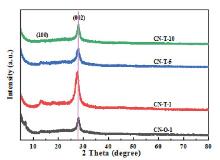
Fig 1
X-ray diffraction patterns of CN-O-1, CN-T-1, CN-T-5, CN-T-10."
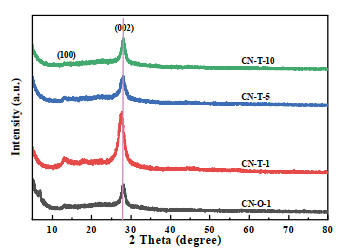
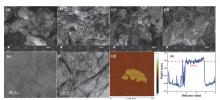
Fig 2
SEM images of CN-O-1 (a), CN-T-1 (b), CN-T-5 (c), and CN-T-10 (d), TEM images of CN-T-1 (e, f), AFM image of CN-T-1 (g) and its height curve (h)."
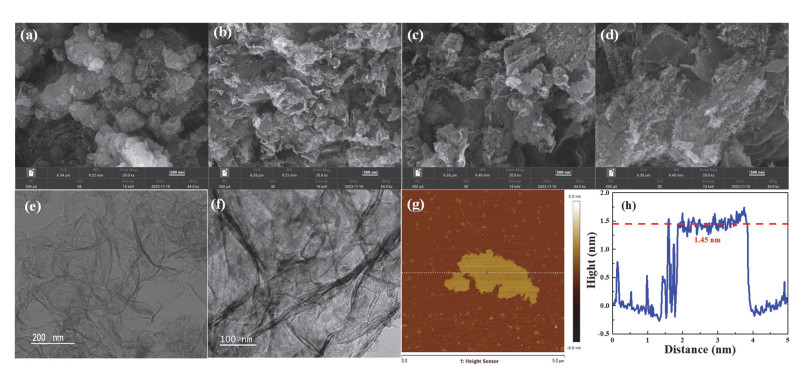
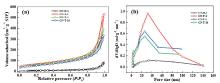
Fig 3
N2 adsorption and desorption isotherms of CN-O-1, CN-T-1, CN-T-5, CN-T-10 (a), and the corresponding pore size distribution of CN-O-1, CN-T-1, CN-T-5, CN-T-10 (b)."
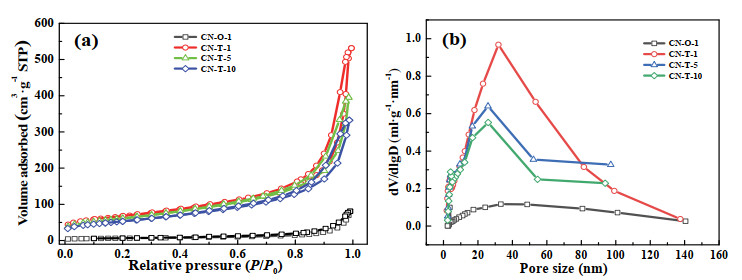
Table 1
BET surface area and pore size distribution."
| Sample | SBET/(m2·g−1) | d/(nm) | V/(cm3·g−1) |
| CN-O-1 | 22.8 | 17.7 | 0.13 |
| CN-T-1 | 237.9 | 13.2 | 0.82 |
| CN-T-5 | 218.7 | 11.9 | 0.61 |
| CN-T-10 | 190.4 | 11.3 | 0.52 |
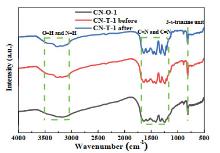
Fig 4
FT-IR profiles of CN-O-1, and CN-T-I before and after the reaction."
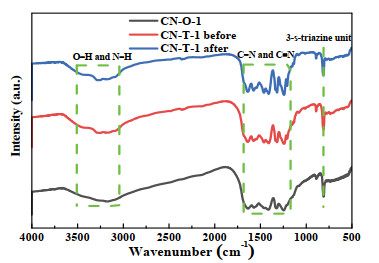
Fig 5
XPS survey spectra (a), the high-resolution XPS spectra of C 1s (b), N 1s (c), O 1s (d) of CN-O-1 and CN-T-1 before and after the reaction."
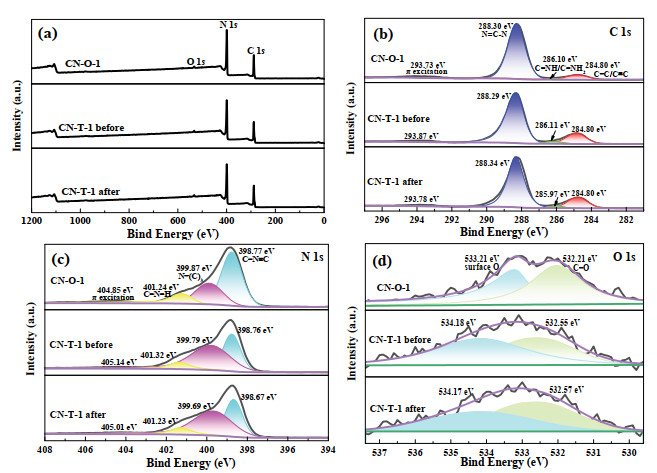
Fig 6
UV-Vis curves of CN-O-1, CN-T-1, CN-T-5 and CN-T-10 (a), Tuac plots (b), Mott-Schottky curves (c), and band gap energy levels of CN-O-1 and CN-T-1 (d)."
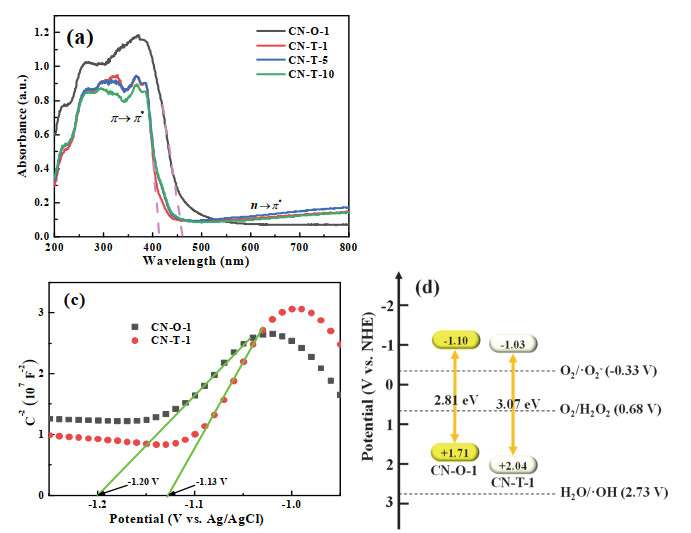
Fig 7
Time-resolved PL decay spectra (a), photocurrent-time curves (b), and EIS Nyquist plots of CN-O-1 and CN-T-1 (c)."
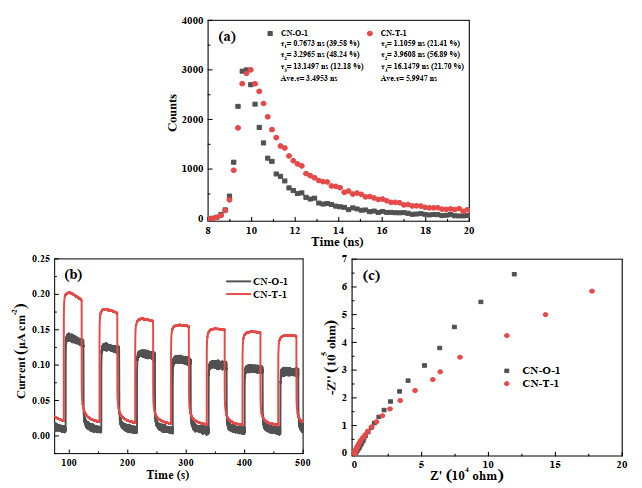
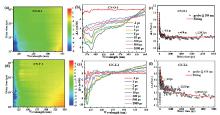
Fig 8
Pseudocolor fs-TA plots (a, d) fs-TA spectra (b, e), and normalized fs-TA decay kinetics (c, f) of CN-O-1 and CN-T-1 using 325 nm laser pulse."
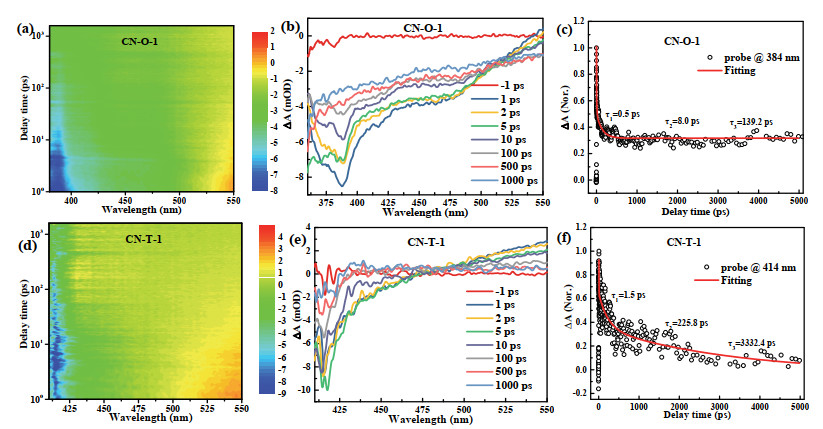
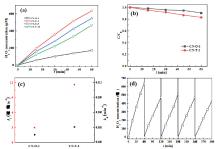
Fig 9
Performance of photocatalytic H2O2 production of CN-O-1, CN-T-1, CN-T-5 and CN-T-10 (a), photocatalytic H2O2 (1 mmol·L−1) degradation on CN-O-1 and CN-T-1 (b), contrast of H2O2 generation rate constants (Kf) and decomposition rate constants (Kd) for CN-O-1 and CN-T-1 (c), and stability test of CN-T-1 for H2O2 production (d)."
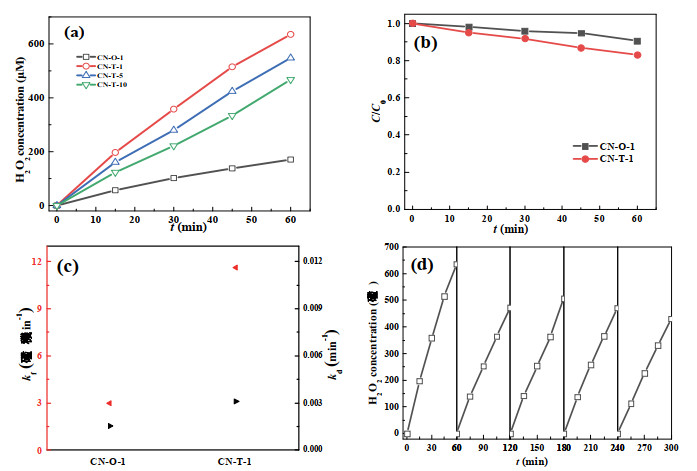
Table 2
Contrast of catalytic performance for H2O2 production over the catalysts reported in the literature and this work in the presence of sacrificial agents."
| Catalyst | Sacrificial agent | Catalyst dosage | Light source | H2O2 yield | Ref. |
| CN-T-1 | ethanol | 0.2 mg·mL−1 | 150 W high-pressure sodium lamp | 635.4 µmol·L−1 (1 h) or 3177.0 µmol·g−1·h−1 | This work |
| g-C3N4 | ethanol | 0.4 mg·mL−1 | 300 W Xe lamp λ > 420 nm | 30.59 µmol·L−1 (1 h) | 1 |
| g-C3N4 | glucose | 0.25 mg·mL−1 | λ = 385 nm LED 80 mW cm−2 | 66 µmol·L−1 (1 h) | 15 |
| CN | isopropyl alcohol | 0.5 mg·mL−1 | 300 W Xe lamp λ ≥ 420 nm | 50.5 µmol·L−1 (1 h) | 17 |
| CN-HP | isopropyl alcohol | 0.5 mg·mL−1 | 300 W Xe lamp λ > 420 nm | 81.6 µmol·L−1 (40 min) | 27 |
| m-CNNP | isopropyl alcohol | 1 mg·mL−1 | 400 nm ≤ λ ≤ 700 nm | 43.07 µmol·L−1 (4 h) | 28 |
| BCN | isopropyl alcohol | 1 mg·mL−1 | 300 W Xe lamp λ > 420 nm | 223.76 µmol·g−1·h−1 | 29 |
| CN | isopropyl alcohol | 0.2 mg·mL−1 | 300 W Xe lamp 76 mW cm−2 | 1520 µmol·g−1·h−1 | 31 |
| CN | ethanol | 0.6 mg·mL−1 | 300 W Xe lamp | 171.6 µmol·L−1 (1.5 h) | 33 |
| CN | ethanol | 0.4 mg·mL−1 | 300 W Xe lamp λ > 370 nm | 403 µmol·L−1 (1 h) | 37 |
| CN | isopropyl alcohol | 0.5 mg·mL−1 | 300 W Xe lamp λ > 420 nm | 54 µmol·g−1·h−1 | 38 |
| CN | ethanol | 1 mg·mL−1 | 300 W Xe lamp λ > 420 nm | 998 µmol·L−1 (4 h) | 39 |
| Bulk CN | ethanol | 1 mg·mL−1 | 300 W Xe lamp λ > 420 nm | 49.79 µmol·L−1 (1 h) | 48 |
| CN | ethanol | 1 mg·mL−1 | Blue LED light | 83.76 µmol·L−1 (1 h) | 53 |
| CN1 | ethanol | 1 mg·mL−1 | 300 W Xe arc lamp λ > 420 nm | 310 µmol·L−1 (1 h) | 56 |
| CN2 | ethanol | 1 mg·mL−1 | 300 W Xe arc lamp λ > 420 nm | 470 µmol·L−1 (1 h) | 56 |
| g-C3N4 | isopropyl alcohol | 1 mg·mL−1 | 300 W Xe lamp | 485 µmol·L−1 (3 h) | 58 |
| CNNP | isopropyl alcohol | 0.5 mg·mL−1 | 400 nm ≤ λ ≤ 700 nm 43.2 mW cm−2 | 34 µmol·L−1 (1 h) | 62 |
| g-C3N4 | isopropyl alcohol | 0.4 mg·mL−1 | 300 W Xe arc lamp AM 1.5 | 99 µmol·g−1·h−1 | 67 |
| g-C3N4 | isopropyl alcohol | 1 mg·mL−1 | 300 W Xe lamp λ > 420 nm | 22.21 µmol·L−1 (1 h) | 69 |
| CN | isopropyl alcohol | 1 mg·mL−1 | 300 W Xe lamp λ > 420 nm | 102 µmol·L−1 (1 h) | 75 |
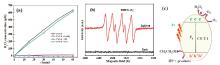
Fig 10
(a) Effect of different sacrificial agents on the yields of H2O2 over CN-T-1, (b) ESR signals of ·O2− over CN-T-1 in the dark and with light, (c) photocatalytic mechanism for H2O2 production on CN-T-1."
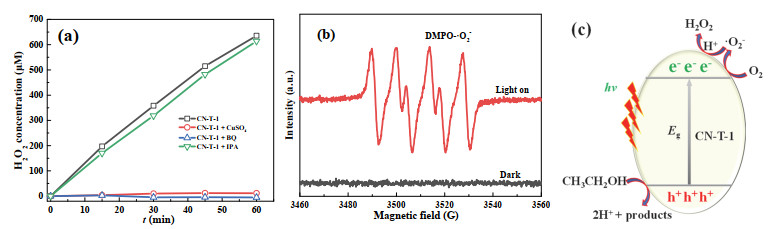
Fig 11
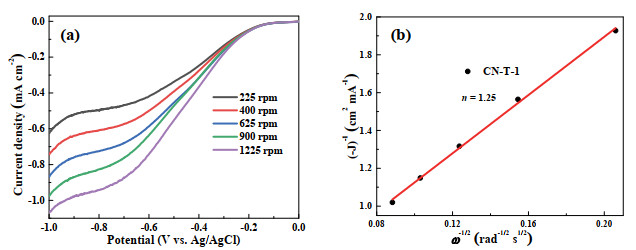
(a) LSV curves of CN-T-1 measured on a rotating disk electrode at different rotating speeds and (b) Koutecky-Levich plots detected at the constant electrode potential (−0.9 V vs. Ag/AgCl)."
| 1 |
doi: 10.1016/j.apcatb.2022.121941 |
| 2 |
doi: 10.1039/d3gc00963g |
| 3 |
doi: 10.1016/j.jece.2023.110594 |
| 4 |
doi: 10.1016/j.apsusc.2023.157463 |
| 5 |
doi: 10.1016/j.cej.2022.135999 |
| 6 |
doi: 10.1016/j.ultsonch.2023.106582 |
| 7 |
doi: 10.1016/j.xcrp.2022.100874 |
| 8 |
doi: 10.1016/j.seppur.2023.123791 |
| 9 |
doi: 10.1016/j.apcatb.2023.122780 |
| 10 |
doi: 10.1016/S1872-2067(23)64645-5 |
| 11 |
doi: 10.3866/PKU.WHXB202112037 |
| 12 |
doi: 10.3866/PKU.WHXB202312007 |
| 13 |
doi: 10.1016/j.cej.2022.139956 |
| 14 |
doi: 10.1016/j.apcatb.2021.120414 |
| 15 |
doi: 10.1021/acsami.1c23960 |
| 16 |
doi: 10.3866/PKU.WHXB202212062 |
| 17 |
doi: 10.1016/j.cej.2021.132531 |
| 18 |
doi: 10.1016/j.apt.2022.103777 |
| 19 |
doi: 10.1016/j.apcatb.2023.123340 |
| 20 |
doi: 10.3866/PKU.WHXB202209016 |
| 21 |
doi: 10.1016/j.jcis.2020.02.100 |
| 22 |
doi: 10.1016/j.jece.2023.111108 |
| 23 |
doi: 10.11862/CJIC.2023.175 |
| 24 |
doi: 10.1002/adfm.202302824 |
| 25 |
doi: 10.3866/PKU.WHXB202010073 |
| 26 |
doi: 10.1016/j.cej.2023.146163 |
| 27 |
doi: 10.1016/j.jtice.2021.09.036 |
| 28 |
doi: 10.1016/j.cej.2021.130615 |
| 29 |
doi: 10.1016/j.jallcom.2022.164028 |
| 30 |
doi: 10.1016/j.jcis.2022.07.137 |
| 31 |
doi: 10.1016/j.cej.2022.137379 |
| 32 |
doi: 10.1021/acs.inorgchem.4c00075 |
| 33 |
doi: 10.1016/j.cej.2023.143528 |
| 34 |
doi: 10.1039/d2dt01748b |
| 35 |
doi: 10.1016/j.matlet.2022.132912 |
| 36 |
doi: 10.1016/j.jcis.2023.07.075 |
| 37 |
doi: 10.1021/acs.langmuir.1c02360 |
| 38 |
doi: 10.1016/j.cej.2023.143379 |
| 39 |
doi: 10.1016/j.apcatb.2023.122933 |
| 40 |
doi: 10.1016/j.apsusc.2023.157637 |
| 41 |
doi: 10.1007/s12274-022-4976-0 |
| 42 |
doi: 10.1021/acssuschemeng.1c01012 |
| 43 |
doi: 10.1016/j.jece.2021.107116 |
| 44 |
doi: 10.1016/j.jcis.2021.12.120 |
| 45 |
doi: 10.1016/j.jcis.2023.05.204 |
| 46 |
doi: 10.1016/j.apsusc.2021.151305 |
| 47 |
doi: 10.1016/j.jcat.2022.06.042 |
| 48 |
doi: 10.1016/j.jece.2023.110138 |
| 49 |
doi: 10.3390/nano12183089 |
| 50 |
doi: 10.1016/j.cej.2021.134020 |
| 51 |
doi: 10.1016/j.jcis.2022.09.131 |
| 52 |
doi: 10.1016/j.jcis.2022.07.077 |
| 53 |
doi: 10.1016/j.apcatb.2022.121099 |
| 54 |
doi: 10.1016/j.apcatb.2022.121749 |
| 55 |
doi: 10.1016/j.seppur.2021.120291 |
| 56 |
doi: 10.1016/j.jcis.2021.04.111 |
| 57 |
doi: 10.1021/acsanm.3c00092 |
| 58 |
doi: 10.1016/j.apsusc.2022.153586 |
| 59 |
doi: 10.1016/j.apsusc.2023.157359 |
| 60 |
doi: 10.1016/j.cej.2017.10.016 |
| 61 |
doi: 10.1016/j.chemosphere.2019.124927 |
| 62 |
doi: 10.1016/j.ijhydene.2022.03.106 |
| 63 |
doi: 10.1016/j.apcatb.2022.121723 |
| 64 |
doi: 10.1016/j.colsurfa.2021.127710 |
| 65 |
doi: 10.1016/j.apsusc.2018.06.134 |
| 66 |
doi: 10.1016/j.seppur.2022.121688 |
| 67 |
doi: 10.1016/j.cej.2022.141146 |
| 68 |
doi: 10.1016/j.apsusc.2022.155242 |
| 69 |
doi: 10.1016/j.jallcom.2022.168500 |
| 70 |
doi: 10.1021/acs.inorgchem.2c03491 |
| 71 |
doi: 10.1002/smll.202308952 |
| 72 |
doi: 10.1002/adma.202400288 |
| 73 |
doi: 10.1038/s41467-024-45604-5 |
| 74 |
doi: 10.1038/s41467-024-47624-7 |
| 75 |
doi: 10.1016/j.apcatb.2020.118970 |
|
||