Acta Phys. -Chim. Sin. ›› 2024, Vol. 40 ›› Issue (3): 2304044.doi: 10.3866/PKU.WHXB202304044
Special Issue: Electrocatalysis in Energy Conversion
• ARTICLE • Previous Articles Next Articles
P-Doped Carbon-Supported ZnxPyOz for Efficient Ammonia Electrosynthesis under Ambient Conditions
Jia Wang, Qing Qin*( ), Zhe Wang, Xuhao Zhao, Yunfei Chen, Liqiang Hou, Shangguo Liu, Xien Liu*()
- College of Chemical Engineering, Qingdao University of Science and Technology, Qingdao 266042, Shandong Province, China
-
Received:2023-04-24Revised:2023-06-13Accepted:2023-06-14Published:2023-06-27 -
Contact:Email: liuxien@qust.edu.cn (Xien Liu)qinqing@qust.edu.cn (Qing Qin) -
Supported by:the Taishan Scholar Program of Shandong Province(ts201712045); the Taishan Scholar Program of Shandong Province(tsqn202211162); the National Natural Science Foundation of China(22102079); the Natural Science Foundation of Shandong Province(ZR2021YQ10)

Cite this article
Jia Wang, Qing Qin, Zhe Wang, Xuhao Zhao, Yunfei Chen, Liqiang Hou, Shangguo Liu, Xien Liu. P-Doped Carbon-Supported ZnxPyOz for Efficient Ammonia Electrosynthesis under Ambient Conditions[J]. Acta Phys. -Chim. Sin. 2024, 40(3), 2304044. doi: 10.3866/PKU.WHXB202304044
share this article
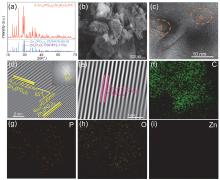
Fig 1
(a) XRD pattern, (b) SEM image, (c) TEM image, (d, e) HRTEM images of h-PC/Zn3(PO4)2/Zn2P2O7. (f–i) STEM-EDS elemental mappings of h-PC/Zn3(PO4)2/Zn2P2O7."
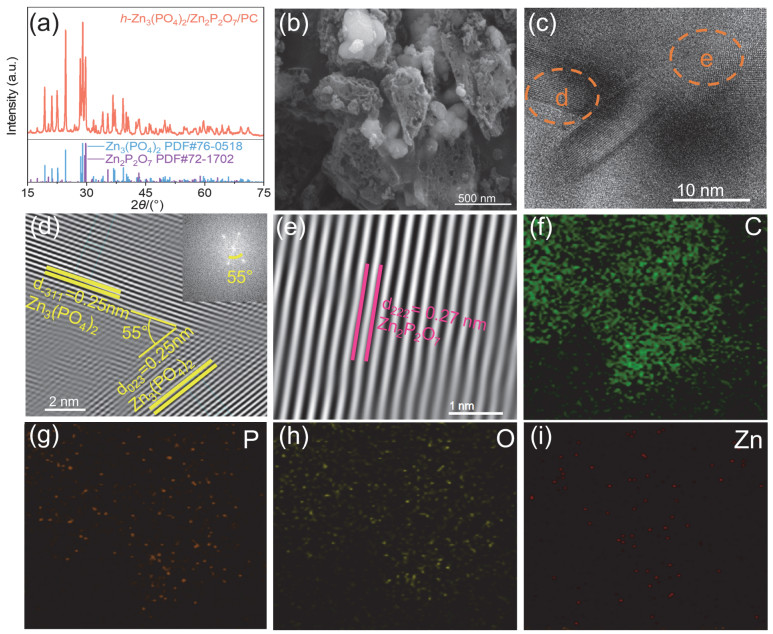
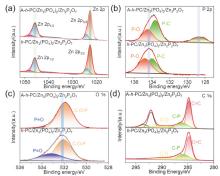
Fig 2
High-resolution XPS spectra of (a) Zn 2p, (b) P 2p, (c) O 1s, and (d) C 1s of h-PC/Zn3(PO4)2/Zn2P2O7 and A–h-PC/Zn3(PO4)2/Zn2P2O7."
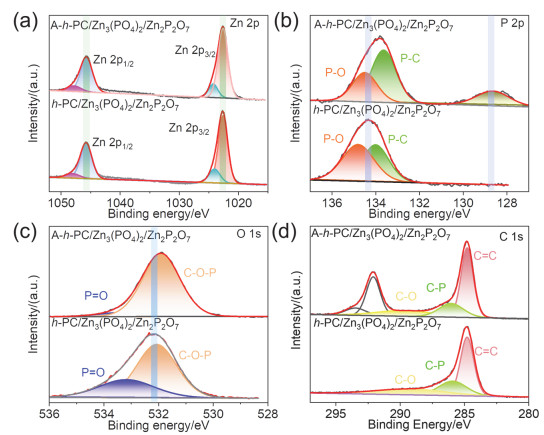
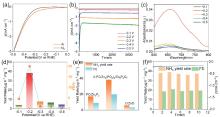
Fig 3
(a) LSV curves of h–PC/Zn3(PO4)2/Zn2P2O7 in Ar- and N2-saturated 0.1 mol∙L−1 HCl. (b) I–t curves of h-PC/Zn3(PO4)2/Zn2P2O7 at series of potentials. (c) UV-Vis absorption spectra of the electrolyte after electrolysis for 1 h under N2 atomphere at various potentials. (d) NH3 yields and FEs of h-PC/Zn3(PO4)2/Zn2P2O7 at different potential. (e) NH3 yields and FEs of h-PC/Zn3(PO4)2/Zn2P2O7, PC/Zn3P2, and C/ZnO electrodes at −0.2 V vs. RHE after electrolysis under ambient conditions. (f) Stability testing of h-PC/Zn3(PO4)2/Zn2P2O7 at constant potential of −0.2 V vs. RHE."
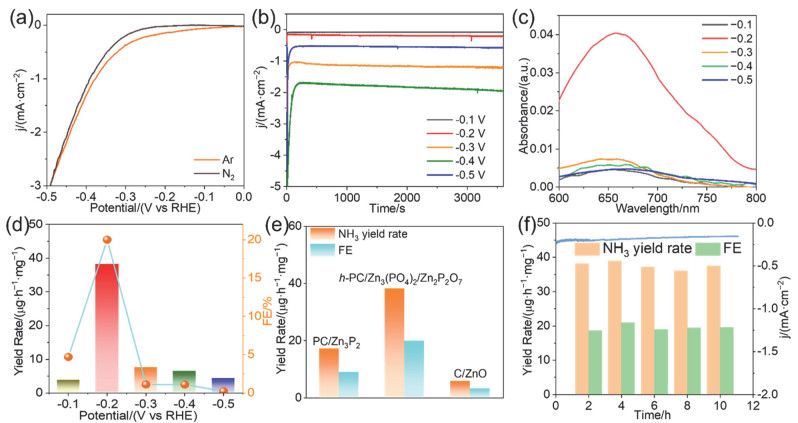
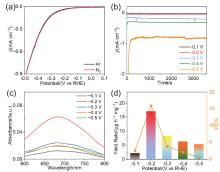
Fig 4
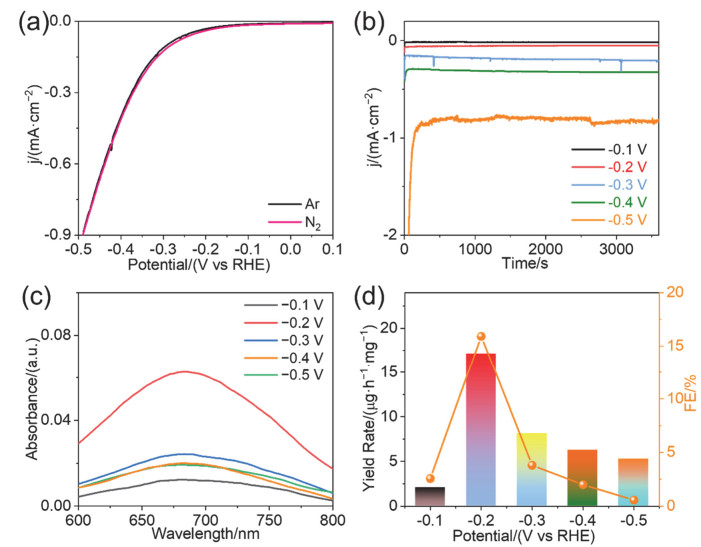
(a) LSV curves of h-PC/Zn3(PO4)2/Zn2P2O7 in N2- and Ar-saturated 0.1 mol∙L−1 Na2SO4 with a scan rate of 5 mV∙s−1. (b) Chronoamperometry curves of h-PC/Zn3(PO4)2/Zn2P2O7 at various potentials. (c) UV-Vis absorption spectra of the electrolyte after electrolysis for 1 h under N2 atomphere at various potentials. (d) NH3 yields and FEs of h-PC/Zn3(PO4)2/Zn2P2O7 at different potential."
| 1 |
doi: 10.1016/j.ces.2022.117735 |
| 2 |
doi: 10.1002/anie.202212196 |
| 3 |
doi: 10.1002/aenm.202202695 |
| 4 |
doi: 10.3866/PKU.WHXB202208033 |
|
唐甜蜜; 王振旅; 管景奇. 物理化学学报, 2023, 39, 2208033.
doi: 10.3866/PKU.WHXB202208033 |
|
| 5 |
doi: 10.3866/PKU.WHXB202301023 |
|
王奥琦; 陈军; 张鹏飞; 唐珊; 冯兆池; 姚婷婷; 李灿. 物理化学学报, 2023, 39, 2301023.
doi: 10.3866/PKU.WHXB202301023 |
|
| 6 |
doi: 10.3866/PKU.WHXB202208030 |
|
李直; 刘雯; 陈春旭; 马婷婷; 张金峰; 王正华. 物理化学学报, 2023, 39, 2208030.
doi: 10.3866/PKU.WHXB202208030 |
|
| 7 |
doi: 10.1016/j.mtnano.2022.100202 |
| 8 |
doi: 10.1038/s41467-021026256-1 |
| 9 |
doi: 10.1021/acs.chemrev.0c00594 |
| 10 |
doi: 10.1016/j.jmst.2022.07.063 |
| 11 |
doi: 10.3866/PKU.WHXB202212053 |
|
陈瑶; 陈存; 曹雪松; 王震宇; 张楠; 刘天西. 物理化学学报, 2023, 39, 2210053.
doi: 10.3866/PKU.WHXB202212053 |
|
| 12 |
doi: 10.1002/adma.201800191 |
| 13 |
doi: 10.1016/S1872-067(22)64148-2 |
| 14 |
doi: 10.1039/d0nr07885a |
| 15 |
doi: 10.1016/j.cej.2021.130745 |
| 16 |
doi: 10.1038/s41929-019-0241-7 |
| 17 |
doi: 10.1016/j.apcatb.2021.119956 |
| 18 |
doi: 10.1126/science.aaw7515 |
| 19 |
doi: 10.1038/s41929-018-0092-7 |
| 20 |
doi: 10.1038/NCHEM.1620 |
| 21 |
doi: 10.1002/adma.202007650 |
| 22 |
doi: 10.1016/j.apcatb.2021.120808 |
| 23 |
doi: 10.1016/S1872-2067(22)64128-7 |
| 24 |
doi: 10.1021/acscatal.2c00188 |
| 25 |
doi: 10.1002/aenm.202001289 |
| 26 |
doi: 10.1002/cey2.305 |
| 27 |
doi: 10.1002/adfm.202010052 |
| 28 |
doi: 10.1016/j.mattod.2019.03.002 |
| 29 |
doi: 10.1021/acsami.2c19911 |
| 30 |
doi: 10.1002/adfm.202210759 |
| 31 |
doi: 10.1039/d2ta00765g |
| 32 |
doi: 10.1039/c9cc00936a |
| 33 |
doi: 10.1002/adma.201902709 |
| 34 |
doi: 10.1002/anie.201906521 |
| 35 |
doi: 10.1002/anie.201915001 |
| 36 |
doi: 10.1021/jacs.1c01525 |
| 37 |
doi: 10.1039/D2CC03630D |
| 38 |
doi: 10.1016/j.cej.2021.132199 |
| 39 |
doi: 10.1002/cssc.201802909 |
| 40 |
doi: 10.1021/jacs.1c08050 |
| 41 |
doi: 10.1002/anie.201914967 |
| [1] | Xian-Wei Lv, Xinyuan Ding, Jiaxing Gong, Xuhuan Yan, Dayong Huang, Jianxin Geng, Zhong-Yong Yuan. Research progress on orbital hybridization in photocatalysis and electrocatalysis [J]. Acta Phys. -Chim. Sin., 2026, 42(2): 100151-. |
| [2] | Chengxiao Zhao, Zhaolin Li, Dongfang Wu, Xiaofei Yang. SBA-15 templated covalent triazine frameworks for boosted photocatalytic hydrogen production [J]. Acta Phys. -Chim. Sin., 2026, 42(1): 100149-. |
| [3] | Sumiya Akter Dristy, Md Ahasan Habib, Shusen Lin, Mehedi Hasan Joni, Rutuja Mandavkar, Young-Uk Chung, Md Najibullah, Jihoon Lee. Exploring Zn doped NiBP microspheres as efficient and stable electrocatalyst for industrial-scale water splitting [J]. Acta Phys. -Chim. Sin., 2025, 41(7): 100079-. |
| [4] | Qi Wang, Yuqing Liu, Jiefei Wang, Yuan-Yuan Ma, Jing Du, Zhan-Gang Han. Catalysts for electrocatalytic dechlorination of chlorinated aromatic hydrocarbons: synthetic strategies, applications, and challenges [J]. Acta Phys. -Chim. Sin., 2025, 41(10): 100120-. |
| [5] | Lutian Zhao, Yangge Guo, Liuxuan Luo, Xiaohui Yan, Shuiyun Shen, Junliang Zhang. Electrochemical Synthesis for Metallic Nanocrystal Electrocatalysts: Principle, Application and Challenge [J]. Acta Phys. -Chim. Sin., 2024, 40(7): 2306029-. |
| [6] | Bizhu Shao, Huijun Dong, Yunnan Gong, Jianhua Mei, Fengshi Cai, Jinbiao Liu, Dichang Zhong, Tongbu Lu. Metal-Organic Framework-Derived Nickel Nanoparticles for Efficient CO2 Electroreduction in Wide Potential Windows [J]. Acta Phys. -Chim. Sin., 2024, 40(4): 2305026-. |
| [7] | Yinjie Xu, Suiqin Li, Lihao Liu, Jiahui He, Kai Li, Mengxin Wang, Shuying Zhao, Chun Li, Zhengbin Zhang, Xing Zhong, Jianguo Wang. Enhanced Electrocatalytic Oxidation of Sterols using the Synergistic Effect of NiFe-MOF and Aminoxyl Radicals [J]. Acta Phys. -Chim. Sin., 2024, 40(3): 2305012-. |
| [8] | Chen Pu, Daijie Deng, Henan Li, Li Xu. Fe0.64Ni0.36@Fe3NiN Core-Shell Nanostructure Encapsulated in N-Doped Carbon Nanotubes for Rechargeable Zinc-Air Batteries with Ultralong Cycle Stability [J]. Acta Phys. -Chim. Sin., 2024, 40(2): 2304021-. |
| [9] | Shijie Li, Ke Rong, Xiaoqin Wang, Chuqi Shen, Fang Yang, Qinghong Zhang. Design of Carbon Quantum Dots/CdS/Ta3N5 S-scheme Heterojunction Nanofibers for Efficient Photocatalytic Antibiotic Removal [J]. Acta Phys. -Chim. Sin., 2024, 40(12): 2403005-. |
| [10] | Kexin Dong, Chuqi Shen, Ruyu Yan, Yanping Liu, Chunqiang Zhuang, Shijie Li. Integration of Plasmonic Effect and S-Scheme Heterojunction into Ag/Ag3PO4/C3N5 Photocatalyst for Boosted Photocatalytic Levofloxacin Degradation [J]. Acta Phys. -Chim. Sin., 2024, 40(10): 2310013-. |
| [11] | Fengyu Gao, Hengheng Liu, Xiaolong Yao, Zaharaddeen Sani, Xiaolong Tang, Ning Luo, Honghong Yi, Shunzheng Zhao, Qingjun Yu, Yuansong Zhou. Spherical MnxCo3−xO4−ƞ Spinel with Mn-Enriched Surface as High-Efficiency Catalysts for Low-Temperature Selective Catalytic Reduction of NOx by NH3 [J]. Acta Phys. -Chim. Sin., 2023, 39(9): 2212003-0. |
| [12] | Yanhui Yu, Peng Rao, Suyang Feng, Min Chen, Peilin Deng, Jing Li, Zhengpei Miao, Zhenye Kang, Yijun Shen, Xinlong Tian. Atomic Co Clusters for Efficient Oxygen Reduction Reaction [J]. Acta Phys. -Chim. Sin., 2023, 39(8): 2210039-0. |
| [13] | Zhongliao Wang, Jing Wang, Jinfeng Zhang, Kai Dai. Overall Utilization of Photoexcited Charges for Simultaneous Photocatalytic Redox Reactions [J]. Acta Phys. -Chim. Sin., 2023, 39(6): 2209037-. |
| [14] | Yang Hu, Bin Liu, Luyao Xu, Ziqiang Dong, Yating Wu, Jie Liu, Cheng Zhong, Wenbin Hu. High-Throughput Synthesis and Screening of Pt-Based Ternary Electrocatalysts Using a Microfluidic-Based Platform [J]. Acta Phys. -Chim. Sin., 2023, 39(3): 2209004-0. |
| [15] | Haoliang Lv, Xuejie Wang, Yu Yang, Tao Liu, Liuyang Zhang. RGO-Coated MOF-Derived In2Se3 as a High-Performance Anode for Sodium-Ion Batteries [J]. Acta Phys. -Chim. Sin., 2023, 39(3): 2210014-0. |
|
||