Acta Phys. -Chim. Sin. ›› 2024, Vol. 40 ›› Issue (8): 2308036.doi: 10.3866/PKU.WHXB202308036
Special Issue: Solar Fuel Photocatalyst
• ARTICLE • Previous Articles
Enhancing Photocatalytic Hydrogen Evolution through Electronic Structure and Wettability Adjustment of ZnIn2S4/Bi2O3 S-Scheme Heterojunction
Linfeng Xiao1, Wanlu Ren1, Shishi Shen3, Mengshan Chen2, Runhua Liao1,*( ), Yingtang Zhou2,*(), Xibao Li3,*()
- 1 School of Materials Science and Engineering, Jingdezhen Ceramic University, Jingdezhen 333403, Jiangxi Province, China
2 Zhejiang Key Laboratory of Petrochemical Environmental Pollution Control, National Engineering Research Center for Marine Aquaculture, Marine Science and Technology College, Zhejiang Ocean University, Zhoushan 316022, Zhejiang Province, China
3 School of Materials Science and Engineering, Nanchang Hangkong University, Nanchang 330063, Jiangxi Province, China
-
Received:2023-08-21Revised:2023-09-28Accepted:2023-09-28Published:2023-10-13 -
Contact:Email: 001072@jcu.edu.cn (Runhua Liao)zhouyingtang@zjou.edu.cn (Yingtang Zhou)lixibao@nchu.edu.cn (Xibao Li) -
Supported by:the Zhejiang Province Key Research and Development Project(2023 C01191); National Natural Science Foundation of China(22262024); National Natural Science Foundation of China(51962023); National Natural Science Foundation of China(51468024); Jiangxi Academic and Technical Leader of Major Disciplines(20232BCJ22008); Natural Science Foundation of Jiangxi Province(20232ACB204007); Natural Science Foundation of Jiangxi Province(20202BABL203037); Jingdezhen Science and Technology Bureau Project(20192GYZD008-33)

Cite this article
Linfeng Xiao, Wanlu Ren, Shishi Shen, Mengshan Chen, Runhua Liao, Yingtang Zhou, Xibao Li. Enhancing Photocatalytic Hydrogen Evolution through Electronic Structure and Wettability Adjustment of ZnIn2S4/Bi2O3 S-Scheme Heterojunction[J]. Acta Phys. -Chim. Sin. 2024, 40(8), 2308036. doi: 10.3866/PKU.WHXB202308036
share this article
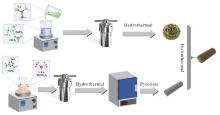
Scheme 1
Synthetic procedure employed for creating a heterostructure composed of ZIS and BO."
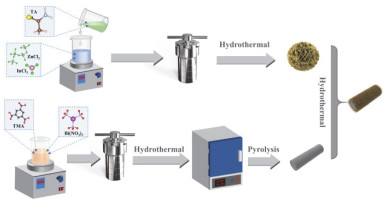
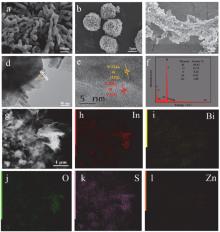
Fig 1
SEM images: (a) bare BO, (b) pure ZIS, (c) 15%ZIS/BO, TEM images of (d) 15%ZIS/BO, (e) HRTEM image of 15%ZIS/BO, (f) EDS of 15%ZIS/BO and (g–l) TEM EDS mapping of 15%ZIS/BO."
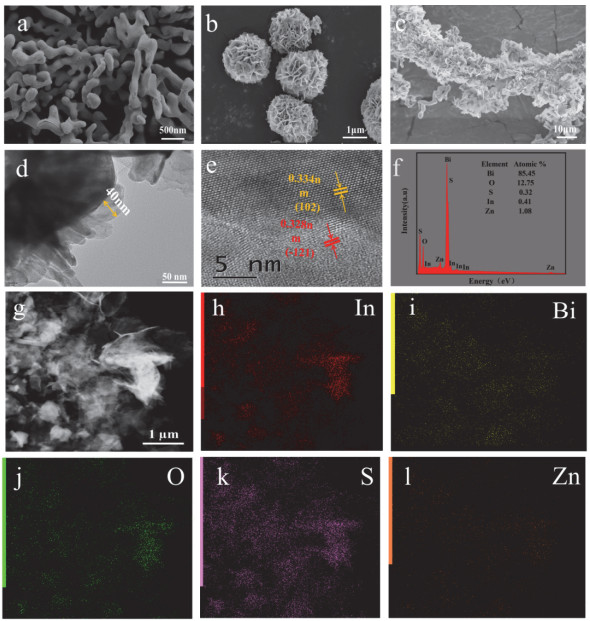
Fig 2
(a) XRD patterns of bare BO, ZIS and ZIS/BO and (b) magnified XRD patterns of BO and ZIS/BO samples. (c) TG-DSC curve of the CAU-17. (d) BET of BO, ZIS and 15%ZIS/BO, and pore size distribution curves (the inset) of BO and 15%ZIS/BO. The XPS spectra of bare BO and 15%ZIS/BO nanocomposite: (e) survey scan, (f) Bi 4f, (g) O 1s, (h) Zn 2p, (i) In 3d."
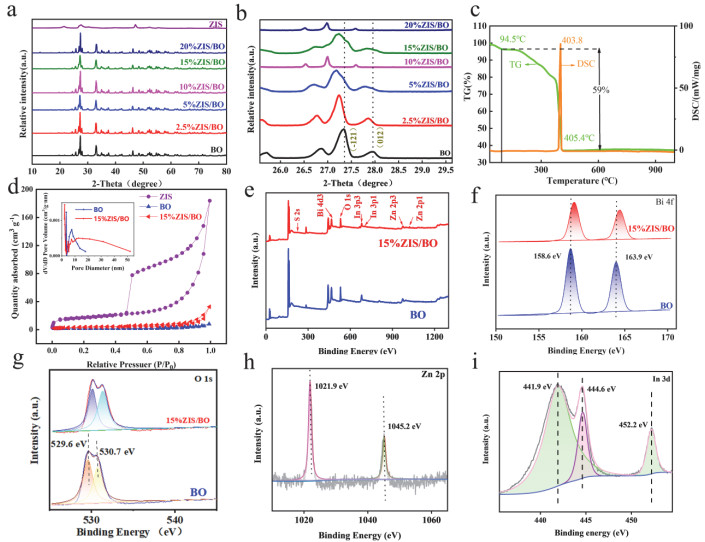
Fig 3
(a) Photocatalytic hydrogen evolution performance of BO and ZIS/BO samples. (b) Recycle H2 generation property of 15%ZIS/BO, (c) UV-Vis spectrum and AQE of 15%ZIS/BO, (d) g value of bare BO and 15%ZIS/BO, (e) UV-Vis DRS spectra of BO and ZIS/BO samples. (f) Photocurrent response and (g) EIS spectra of BO and 15%ZIS/BO samples. (h) PL spectra of BO and 15%ZIS/BO hybrids. (i) TRPL spectra of BO and 15%ZIS/BO."
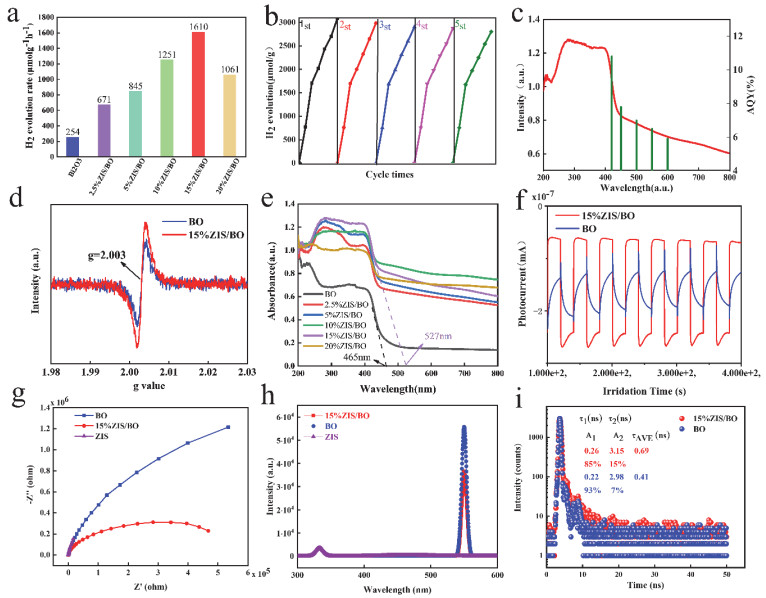
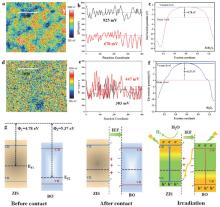
Fig 4
(a, b) Surface potential mapping using KPFM under illuminated and dark conditions for ZIS. (c) Calculated work function of ZIS. (d, e) Surface potential mapping using KPFM under illuminated and dark conditions for BO. (f) Calculated work function of BO. (g) Formation of IEF and electron transfer mechanism in the ZIS/BO catalyst."
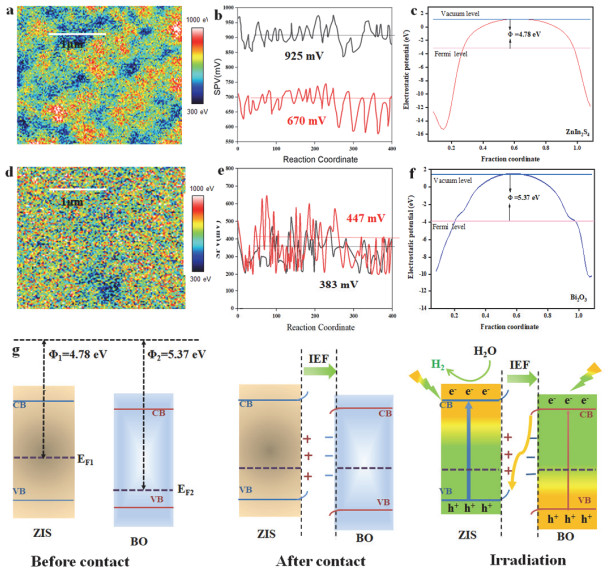
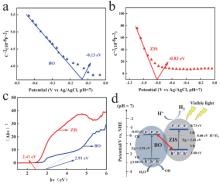
Fig 5
Mott-Schottky curves (a, b) of bare BO and ZIS. (c) Graphs depicting the relationship between (ahv)1/2 and hv for determining the band gap energies of ZIS and BO. (d) Schematic illustration of energy band structure over ZIS/BO hybrids."
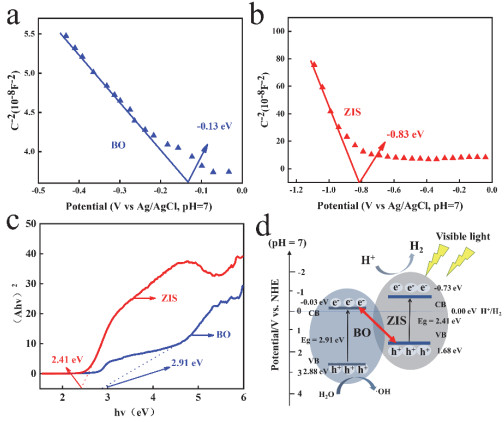
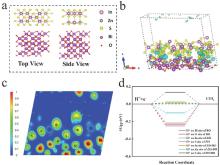
Fig 6
(a) Side view of BO (−121) and top view of ZIS (102). (b) The charge density difference of ZIS/BO, (c) ELF slices of the ZIS/BO heterojunction system (the in-plane atoms are labeled), (d) Calculated free energy diagram for HER."
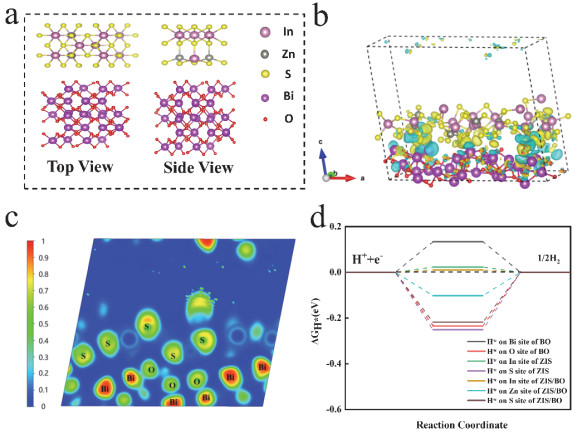
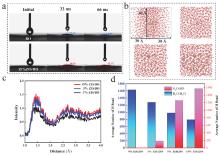
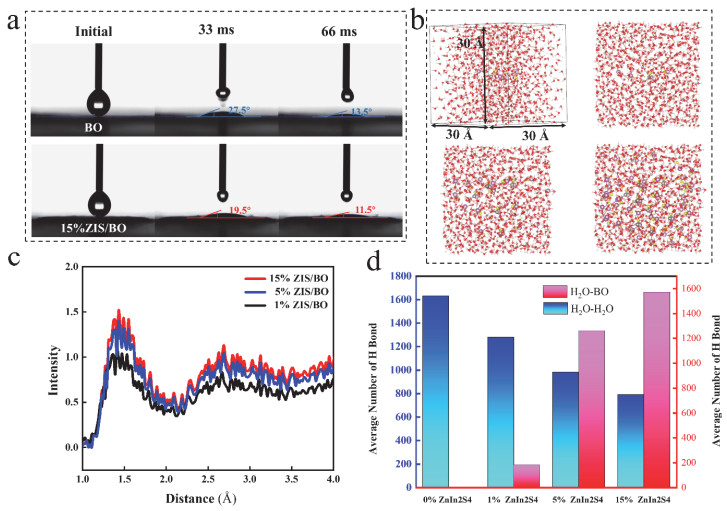
Fig 7
(a) Contact angle measurements of BO and 15%ZIS/BO. (b) Schematic diagram of three simulation models: 1%, 5%, and 15%ZIS/BO. (c) RDF calculation for varying ZIS concentrations in Owater-Owater. (d) Mean quantities of hydrogen bonds formed between water-BO molecules."
| 1 |
doi: 10.1002/adma.202107668 |
| 2 |
doi: 10.14102/j.cnki.0254-5861 |
| 3 |
doi: 10.1016/j.cclet.2023.108328 |
| 4 |
doi: 10.1016/S1872-2067(22)64185-8 |
| 5 |
doi: 10.1016/S1872-2067(20)63695-6 |
| 6 |
doi: 10.1002/adma.202306103 |
| 7 |
doi: 10.1016/j.xcrp.2020.100081 |
| 8 |
doi: 10.1002/adfm.202205985 |
| 9 |
doi: 10.1016/j.ijhydene.2022.03.259 |
| 10 |
doi: 10.1016/S1872-2067(22)64109-3 |
| 11 |
doi: 10.1016/j.apmate.2023.100140 |
| 12 |
doi: 10.1016/j.apcatb.2022.122341 |
| 13 |
doi: 10.1016/j.cclet.2022.01.058 |
| 14 |
doi: 10.1002/cey2.217 |
| 15 |
doi: 10.1016/j.cclet.2022.04.066 |
| 16 |
doi: 10.1016/S1872-2067(22)64106-8 |
| 17 |
doi: 10.1016/j.nanoen.2021.106913 |
| 18 |
|
|
王文亮; 张灏纯; 陈义钢; 史海峰. 物理化学学报, 2022, 38 (7), 2201008.
doi: 10.3866/PKU.WHXB202201008 |
|
| 19 |
doi: 10.1016/j.apcatb.2023.122763 |
| 20 |
|
|
韩高伟; 徐飞燕; 程蓓; 李佑稷; 余家国; 张留洋.. 物理化学学报, 2022, 38 (7), 2112037.
doi: 10.3866/PKU.WHXB202112037 |
|
| 21 |
|
|
何科林; 沈荣晨; 郝磊; 李佑稷; 张鹏; 江吉周; 李鑫. 物理化学学报, 2022, 38 (11), 2201021.
doi: 10.3866/PKU.WHXB202201021 |
|
| 22 |
|
|
李喜宝; 刘积有; 黄军同; 何朝政; 冯志军; 陈智; 万里鹰; 邓芳. 物理化学学报, 2021, 37 (6), 22010030.
doi: 10.3866/PKU.WHXB202010030 |
|
| 23 |
doi: 10.1016/j.apcatb.2022.121888 |
| 24 |
doi: 10.1016/j.ceramint.2021.10.027 |
| 25 |
doi: 10.1016/j.cclet.2022.01.018 |
| 26 |
doi: 10.1016/S1872-2067(20)63784-6 |
| 27 |
doi: 10.1016/j.apcatb.2016.09.068 |
| 28 |
doi: 10.1016/j.apsusc.2022.153422 |
| 29 |
doi: 10.1016/j.seppur.2022.123004 |
| 30 |
doi: 10.1016/j.jmst.2023.03.003 |
| 31 |
doi: 10.1016/S1872-2067(23)64420-1 |
| 32 |
doi: 10.1002/adma.202300643 |
| 33 |
doi: 10.1002/adsu.202100498 |
| 34 |
doi: 10.1002/adfm.202214470 |
| 35 |
|
|
王中辽; 汪静; 张金锋; 代凯. 物理化学学报, 2023, 39 (6), 2209037.
doi: 10.3866/PKU.WHXB202209037 |
|
| 36 |
doi: 10.14102/j.cnki.0254-5861.2022-0108 |
| 37 |
doi: 10.1016/s1872-2067(20)63753-6 |
| 38 |
doi: 10.1016/j.jtice.2023.104679 |
| 39 |
doi: 10.1016/j.jcis.2021.02.053 |
| 40 |
doi: 10.1002/ange.202218688 |
| 41 |
doi: 10.1002/adma.202209141 |
| 42 |
doi: 10.1002/adma.202100317 |
| 43 |
doi: 10.1016/j.cej.2023.142313 |
| 44 |
doi: 10.1016/S1872-2067(21)63883-4 |
| 45 |
doi: 10.1016/j.jechem.2022.06.027 |
| 46 |
|
|
黄悦; 梅飞飞; 张金锋; 代凯; DawsonG.. 物理化学学报, 2022, 38 (7), 2108028.
doi: 10.3866/PKU.WHXB202108028 |
|
| 47 |
doi: 10.1039/C9EE00524B |
| 48 |
doi: 10.26599/NRE.2023.9120063 |
| 49 |
doi: 10.1021/acsnano.2c09880 |
| 50 |
doi: 10.1039/C9TA06219J |
| 51 |
doi: 10.1016/j.jmst.2021.02.062 |
| 52 |
doi: 10.1016/j.ccr.2022.214664 |
| 53 |
doi: 10.1016/j.apsusc.2021.151183 |
| 54 |
doi: 10.1021/acsestengg.1c00479 |
| 55 |
doi: 10.1002/advs.202205889 |
| 56 |
doi: 10.1016/j.apcatb.2020.119602 |
| 57 |
doi: 10.1016/j.apcatb.2021.120905 |
| 58 |
doi: 10.3390/catal13030634 |
| 59 |
doi: 10.3390/nano13020305 |
| 60 |
doi: 10.1016/j.jhazmat.2021.126280 |
| 61 |
doi: 10.1002/smll.200500382 |
| 62 |
doi: 10.1016/j.esci.2023.100092 |
| 63 |
doi: 10.1016/j.compositesb.2021.108765 |
| 64 |
doi: 10.1016/j.apsusc.2019.05.163 |
| 65 |
doi: 10.1016/j.ijhydene.2012.08.038 |
| 66 |
doi: 10.1016/j.jmst.2021.11.003 |
| 67 |
doi: 10.1039/D2TA09698F |
| 68 |
doi: 10.1039/B306813G |
| 69 |
doi: 10.1007/s10853-020-05004-8 |
| 70 |
doi: 10.1016/j.apcatb.2021.120127 |
| 71 |
doi: 10.1016/j.cej.2022.14124 |
| 72 |
doi: 10.1016/j.jhazmat.2020.123017 |
| 73 |
|
|
昝忠奇; 李喜宝; 高晓明; 黄军同; 罗一丹; 韩露. 物理化学学报, 2023, 39 (6), 2209016.
doi: 10.3866/PKU.WHXB202209016 |
|
| 74 |
doi: 10.1016/j.jmst.2023.03.006 |
| [1] | Fan Fan, Hao Xiu, Yuting Wang, Yongpeng Cui, Yajun Wang. Construction of NH2-MIL-125/Na-doped g-C3N4 composite S-scheme heterojunction and its performance in photocatalytic hydrogen peroxide production [J]. Acta Phys. -Chim. Sin., 2026, 42(2): 100143-. |
| [2] | Yu Liu, Pengfei Li, Yize Liu, Zaicheng Sun. Recent advances in carbon dots as a single photocatalyst [J]. Acta Phys. -Chim. Sin., 2026, 42(2): 100167-. |
| [3] | Yuhang Zhang, Yi Li, Yuehan Cao, Yingjie Shuai, Yu Zhou, Ying Zhou. Regulating the formation type by Ir of intermediates to suppress product overoxidation in photocatalytic methane conversion [J]. Acta Phys. -Chim. Sin., 2026, 42(2): 100173-. |
| [4] | Chengxiao Zhao, Zhaolin Li, Dongfang Wu, Xiaofei Yang. SBA-15 templated covalent triazine frameworks for boosted photocatalytic hydrogen production [J]. Acta Phys. -Chim. Sin., 2026, 42(1): 100149-. |
| [5] | Chengyan Ge, Jiawei Hu, Xingyu Liu, Yuxi Song, Chao Liu, Zhigang Zou. Self-integrated black NiO clusters with ZnIn2S4 microspheres for photothermal-assisted hydrogen evolution by S-scheme electron transfer mechanism [J]. Acta Phys. -Chim. Sin., 2026, 42(1): 100154-. |
| [6] | Huoshuai Huang, Zhidong Wei, Jiawei Yan, Jiasheng Chi, Qianxiang Su, Mingxia Chen, Zhi Jiang, Yangzhou Sun, Wenfeng Shangguan. Unveiling the mechanism of direct-to-indirect bandgap transition in the photocatalytic hydrogen evolution of ZnxCd1−xS solid solution [J]. Acta Phys. -Chim. Sin., 2026, 42(1): 100141-. |
| [7] | Shiyi Chen, Jialong Fu, Jianping Qiu, Guoju Chang, Shiyou Hao. Waste medical mask-derived carbon quantum dots enhance the photocatalytic degradation of polyethylene terephthalate (PET) over BiOBr/g-C3N4 S-scheme heterojunction [J]. Acta Phys. -Chim. Sin., 2026, 42(1): 100135-. |
| [8] | Fengying Zhang, Yanglin Mei, Yuman Jiang, Shenshen Zheng, Kaibo Zheng, Ying Zhou. Research progress of transient absorption spectroscopy in solar energy conversion and utilization [J]. Acta Phys. -Chim. Sin., 2025, 41(9): 100118-. |
| [9] | Wenlong Wang, Wentao Hao, Lang He, Jia Qiao, Ning Li, Chaoqiu Chen, Yong Qin. Bandgap and adsorption engineering of carbon dots/TiO2 S-scheme heterojunctions for enhanced photocatalytic CO2 methanation [J]. Acta Phys. -Chim. Sin., 2025, 41(9): 100116-. |
| [10] | Jianan Hong, Chenyu Xu, Yan Liu, Changqi Li, Menglin Wang, Yanwei Zhang. Decoding the interfacial competition between hydrogen evolution and CO2 reduction via edge-active-site modulation in photothermal catalysis [J]. Acta Phys. -Chim. Sin., 2025, 41(9): 100099-. |
| [11] | Menglan Wei, Xiaoxia Ou, Yimeng Wang, Mengyuan Zhang, Fei Teng, Kaixuan Wang. S-scheme heterojunction g-C3N4/Bi2WO6 highly efficient degradation of levofloxacin: performance, mechanism and degradation pathway [J]. Acta Phys. -Chim. Sin., 2025, 41(9): 100105-. |
| [12] | Jingping Li, Suding Yan, Jiaxi Wu, Qiang Cheng, Kai Wang. Improving hydrogen peroxide photosynthesis over inorganic/organic S-scheme photocatalyst with LiFePO4 [J]. Acta Phys. -Chim. Sin., 2025, 41(9): 100104-. |
| [13] | Jiajie Cai, Chang Cheng, Bowen Liu, Jianjun Zhang, Chuanjia Jiang, Bei Cheng. CdS/DBTSO-BDTO S-scheme photocatalyst for H2 production and its charge transfer dynamics [J]. Acta Phys. -Chim. Sin., 2025, 41(8): 100084-. |
| [14] | Lewang Yuan, Yaoyao Peng, Zong-Jie Guan, Yu Fang. Insights into the development of 2D covalent organic frameworks as photocatalysts in organic synthesis [J]. Acta Phys. -Chim. Sin., 2025, 41(8): 100086-. |
| [15] | Fanpeng Meng, Fei Zhao, Jingkai Lin, Jinsheng Zhao, Huayang Zhang, Shaobin Wang. Optimizing interfacial electric fields in carbon nitride nanosheet/spherical conjugated polymer S-scheme heterojunction for hydrogen evolution [J]. Acta Phys. -Chim. Sin., 2025, 41(8): 100095-. |
|
||