Acta Phys. -Chim. Sin. ›› 2024, Vol. 40 ›› Issue (8): 2308027.doi: 10.3866/PKU.WHXB202308027
• ARTICLE • Previous Articles Next Articles
Amine-Functionalized Copper Catalysts: Hydrogen Bonding Mediated Electrochemical CO2 Reduction to C2 Products and Superior Rechargeable Zn-CO2 Battery Performance
Dong Xiang1, Kunzhen Li1, Kanghua Miao1, Ran Long2, Yujie Xiong2,*( ), Xiongwu Kang1,*()
- 1 New Energy Research Institute, School of Environment and Energy, South China University of Technology, Guangzhou 510006, China
2 Hefei National Laboratory for Physical Sciences at the Microscale, School of Chemistry and Materials Science, University of Science and Technology of China, Hefei 230026, China
-
Received:2023-08-15Revised:2023-09-20Accepted:2023-09-28Published:2023-10-09 -
Contact:esxkang@scut.edu.cn (Xiongwu Kang)Email: yjxiong@ustc.edu.cn (Yujie Xiong) -
Supported by:the National Natural Science Foundation of China(U2032151); the National Natural Science Foundation of China(21725102); the National Natural Science Foundation of China(91961106)

Cite this article
Dong Xiang, Kunzhen Li, Kanghua Miao, Ran Long, Yujie Xiong, Xiongwu Kang. Amine-Functionalized Copper Catalysts: Hydrogen Bonding Mediated Electrochemical CO2 Reduction to C2 Products and Superior Rechargeable Zn-CO2 Battery Performance[J]. Acta Phys. -Chim. Sin. 2024, 40(8), 2308027. doi: 10.3866/PKU.WHXB202308027
share this article
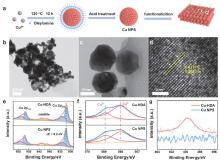
Fig 1
(a) Schematic illustration of the synthetic procedure of Cu-HDA. (b, c) TEM and (d) HRTEM images of Cu-HDA. (e) Cu 2p high-resolution XPS, (f) Cu Auger LMM spectra and (g) N 1s high-resolution XPS spectra of Cu NPs and Cu-HDA."
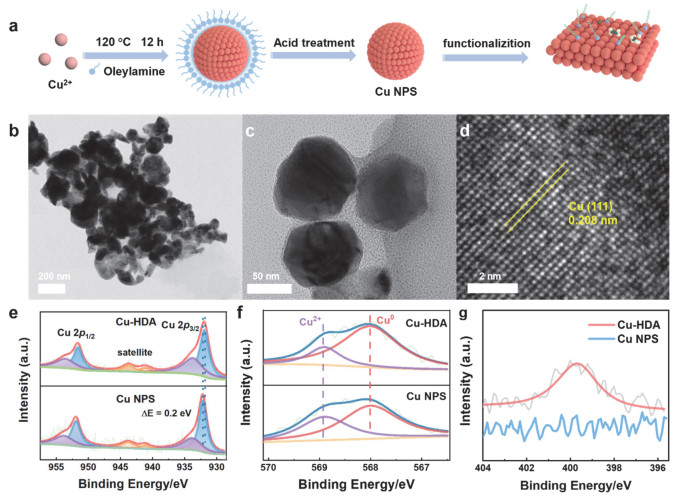
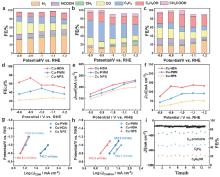
Fig 2
FE of eCO2RR on (a) Cu NPs, (b) Cu-HDA and (c) Cu-PMM in 1.0 mol∙L−1 KOH at an applied potential of −0.8 to −1.2 Ⅴ (vs. RHE). (d) FE of C2 products of Cu NPs, Cu-PMM and Cu-HDA. (e) Total current densities and (f) C2 partial current densities of Cu-HDA, Cu-PMM and Cu NPs. Tafel plots of eCO2RR towards (a) C2H4 and (b) C2H5OH products on Cu NPs, Cu-PMM and Cu-HDA. (i) Stability measurement of Cu-HDA at −0.9 Ⅴ (vs. RHE) in 1.0 mol∙L−1 KOH."
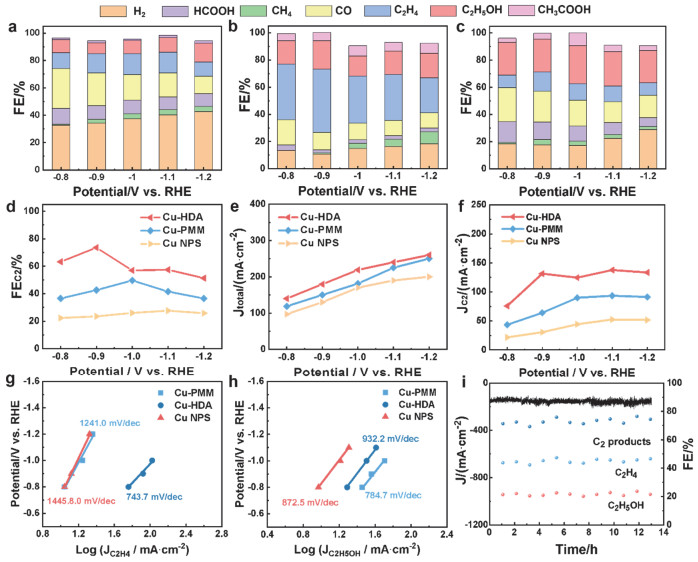
Fig 3
(a) Free energy diagrams from CO2 to CO via *COOH, (b) transition state of the dimerization of *CO and *CHO and (c) free energy diagrams of the conversion from *CHCOH to C2H4 on Cu (111) and Cu (111)-HDA. The configurations for (d, i) *CO2, (e, j) *COOH, (f, k) *CO, (g, l) *CO/CHO, and (h, m) *OCCHO on Cu (111)-HDA and Cu (111) (top panel: top view; lower panel: side view). The dashed green lines represent hydrogen bonds."
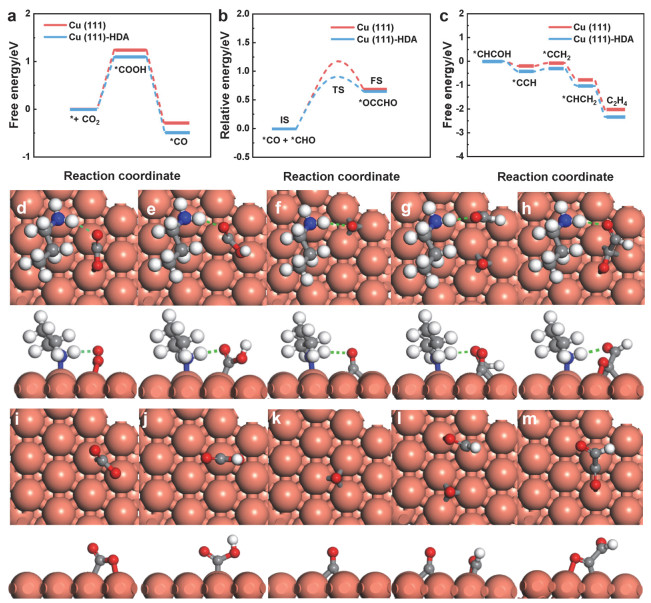
Fig 4
In situ Raman spectra of (a) Cu NPs, (b) Cu-PMM and (c) Cu-HDA at different applied potentials and open-circuit potential (OCP) in 1.0 mol∙L−1 KOH electrolyte."
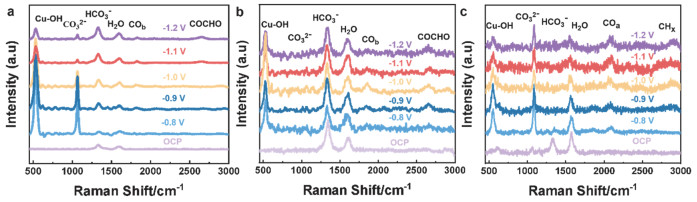
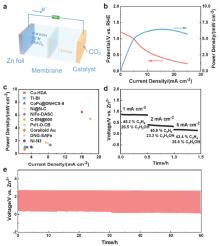
Fig 5
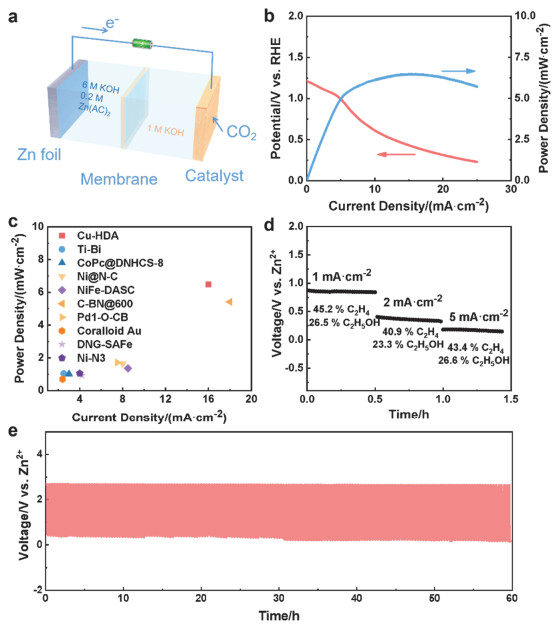
(a) Schematic representation of the reversible aqueous Zn-CO2 battery. (b) Discharge polarization curves of Cu-HDA with a scanning rate of 10 mV∙s−1 and corresponding power density curves of the assembled Zn-CO2 battery. (c) Maximum power density of Cu-HDA compared to that of other Zn-CO2 batteries 49–57. (d) Galvano static discharge curves at several current densities. (e) Discharge-charge cycling curves at 5.0 mA∙cm−2."
| 1 |
doi: 10.1038/s41586-019-1681-6 |
| 2 |
doi: 10.1016/j.joule.2020.01.002 |
| 3 |
doi: 10.1039/c9ta11140a |
| 4 |
doi: 10.1016/j.apcatb.2022.121093 |
| 5 |
doi: 10.1002/adfm.202111322 |
| 6 |
doi: 10.1002/adma.202204476 |
| 7 |
doi: 10.1016/j.mtphys.2023.101045 |
| 8 |
doi: 10.1007/s12274-021-3984-9 |
| 9 |
doi: 10.1007/s12274-022-4698-3 |
| 10 |
doi: 10.1038/s41467-022-33692-0 |
| 11 |
doi: 10.1002/anie.202206233 |
| 12 |
doi: 10.1016/j.apcatb.2021.119979 |
| 13 |
doi: 10.1002/smm2.1082 |
| 14 |
doi: 10.1002/anie.202109329 |
| 15 |
doi: 10.1002/adma.202005798 |
| 16 |
doi: 10.1002/smm2.1102 |
| 17 |
doi: 10.1038/s41557-018-0092-x |
| 18 |
doi: 10.1021/jacs.9b02945 |
| 19 |
doi: 10.1007/s12274-021-3532-7 |
| 20 |
doi: 10.1016/j.joule.2018.09.021 |
| 21 |
doi: 10.1073/pnas.1618935114 |
| 22 |
doi: 10.1016/j.jechem.2022.02.027 |
| 23 |
doi: 10.1021/acs.nanolett.1c04653 |
| 24 |
doi: 10.1021/jacs.1c11253 |
| 25 |
doi: 10.1038/s41586-019-1782-2 |
| 26 |
doi: 10.1038/s41929-020-00547-0 |
| 27 |
doi: 10.1016/j.jechem.2022.08.014 |
| 28 |
doi: 10.1038/s41929-019-0383-7 |
| 29 |
doi: 10.1021/nl9042246 |
| 30 |
doi: 10.1038/s41563-019-0445-x |
| 31 |
doi: 10.1039/c5ee03694a |
| 32 |
|
|
赵会玲.; 胡军.; 汪建军.; 周丽绘.; 刘洪来.. 物理化学学报, 2007, 23, 801.
doi: 10.1016/S1872-1508(07)60046-1 |
|
| 33 |
doi: 10.1002/aenm.201801400 |
| 34 |
doi: 10.1021/acscatal.0c00049 |
| 35 |
doi: 10.1002/anie.202011956 |
| 36 |
doi: 10.1007/s10853-021-05920-3 |
| 37 |
doi: 10.1021/acs.chemrev.8b00705 |
| 38 |
doi: 10.1038/s41467-021-24105-9 |
| 39 |
doi: 10.1021/acscatal.9b04746 |
| 40 |
doi: 10.1021/ja508649p |
| 41 |
doi: 10.1021/acs.nanolett.2c00945 |
| 42 |
doi: 10.1021/jacs.9b07415 |
| 43 |
doi: 10.1021/acscatal.9b05115 |
| 44 |
doi: 10.1002/celc.202001598 |
| 45 |
doi: 10.1038/s41467-021-26053-w |
| 46 |
doi: 10.1021/acsenergylett.0c01606 |
| 47 |
doi: 10.1021/jacs.7b10462 |
| 48 |
doi: 10.1063/1.5054109 |
| 49 |
doi: 10.1016/j.nanoen.2023.108242 |
| 50 |
doi: 10.1002/adfm.202110649 |
| 51 |
doi: 10.1002/adma.202003238 |
| 52 |
doi: 10.1002/smll.202301128 |
| 53 |
doi: 10.1038/s41467-021-24052-5 |
| 54 |
doi: 10.1002/adfm.202008146 |
| 55 |
doi: 10.1016/j.cej.2023.141865 |
| 56 |
doi: 10.1002/smll.202302253 |
| 57 |
doi: 10.1039/D1TA04360A |
| [1] | Jianan Hong, Chenyu Xu, Yan Liu, Changqi Li, Menglin Wang, Yanwei Zhang. Decoding the interfacial competition between hydrogen evolution and CO2 reduction via edge-active-site modulation in photothermal catalysis [J]. Acta Phys. -Chim. Sin., 2025, 41(9): 100099-. |
| [2] | Xianghai Song, Xiaoying Liu, Zhixiang Ren, Xiang Liu, Mei Wang, Yuanfeng Wu, Weiqiang Zhou, Zhi Zhu, Pengwei Huo. Insights into the greatly improved catalytic performance of N-doped BiOBr for CO2 photoreduction [J]. Acta Phys. -Chim. Sin., 2025, 41(6): 100055-. |
| [3] | Runhua Chen, Qiong Wu, Jingchen Luo, Xiaolong Zu, Shan Zhu, Yongfu Sun. Defective Ultrathin Two-Dimensional Materials for Photo-/Electrocatalytic CO2 Reduction: Fundamentals and Perspectives [J]. Acta Phys. -Chim. Sin., 2025, 41(3): 100019-. |
| [4] | Xue Dong, Xiaofu Sun, Shuaiqiang Jia, Shitao Han, Dawei Zhou, Ting Yao, Min Wang, Minghui Fang, Haihong Wu, Buxing Han. Electrochemical CO2 Reduction to C2+ Products with Ampere-Level Current on Carbon-Modified Copper Catalysts [J]. Acta Phys. -Chim. Sin., 2025, 41(3): 100024-. |
| [5] | Rohit Kumar, Anita Sudhaik, Aftab Asalam Pawaz Khan, Van Huy Neguyen, Archana Singh, Pardeep Singh, Sourbh Thakur, Pankaj Raizada. Designing tandem S-scheme photo-catalytic systems: Mechanistic insights, characterization techniques, and applications [J]. Acta Phys. -Chim. Sin., 2025, 41(11): 100150-. |
| [6] | Yan Kong, Wei Wei, Lekai Xu, Chen Chen. Electrochemical Synthesis of Organonitrogen Compounds from N-integrated CO2 Reduction Reaction [J]. Acta Phys. -Chim. Sin., 2024, 40(8): 2307049-. |
| [7] | Xudong Lv, Tao Shao, Junyan Liu, Meng Ye, Shengwei Liu. Paired Electrochemical CO2 Reduction and HCHO Oxidation for the Cost-Effective Production of Value-Added Chemicals [J]. Acta Phys. -Chim. Sin., 2024, 40(5): 2305028-. |
| [8] | Bizhu Shao, Huijun Dong, Yunnan Gong, Jianhua Mei, Fengshi Cai, Jinbiao Liu, Dichang Zhong, Tongbu Lu. Metal-Organic Framework-Derived Nickel Nanoparticles for Efficient CO2 Electroreduction in Wide Potential Windows [J]. Acta Phys. -Chim. Sin., 2024, 40(4): 2305026-. |
| [9] | Xueting Feng, Ziang Shang, Rong Qin, Yunhu Han. Advances in Single-Atom Catalysts for Electrocatalytic CO2 Reduction [J]. Acta Phys. -Chim. Sin., 2024, 40(4): 2305005-. |
| [10] | Xuejiao Wang, Suiying Dong, Kezhen Qi, Vadim Popkov, Xianglin Xiang. Photocatalytic CO2 Reduction by Modified g-C3N4 [J]. Acta Phys. -Chim. Sin., 2024, 40(12): 2408005-. |
| [11] | Zhiquan Zhang, Baker Rhimi, Zheyang Liu, Min Zhou, Guowei Deng, Wei Wei, Liang Mao, Huaming Li, Zhifeng Jiang. Insights into the Development of Copper-Based Photocatalysts for CO2 Conversion [J]. Acta Phys. -Chim. Sin., 2024, 40(12): 2406029-. |
| [12] | Hanyu Xu, Xuedan Song, Qing Zhang, Chang Yu, Jieshan Qiu. Mechanistic Insights into Water-Mediated CO2 Electrochemical Reduction Reactions on Cu@C2N Catalysts: A Theoretical Study [J]. Acta Phys. -Chim. Sin., 2024, 40(1): 2303040-. |
| [13] | Yao Chen, Cun Chen, Xuesong Cao, Zhenyu Wang, Nan Zhang, Tianxi Liu. Recent Advances in Defect and Interface Engineering for Electroreduction of CO2 and N2 [J]. Acta Phys. -Chim. Sin., 2023, 39(8): 2212053-0. |
| [14] | Yining Zhang, Ming Gao, Songtao Chen, Huiqin Wang, Pengwei Huo. Fabricating Ag/CN/ZnIn2S4 S-Scheme Heterojunctions with Plasmonic Effect for Enhanced Light-Driven Photocatalytic CO2 Reduction [J]. Acta Phys. -Chim. Sin., 2023, 39(6): 2211051-. |
| [15] | Ji-Chao Wang, Xiu Qiao, Weina Shi, Jing He, Jun Chen, Wanqing Zhang. S-Scheme Heterojunction of Cu2O Polytope-Modified BiOI Sheet for Efficient Visible-Light-Driven CO2 Conversion under Water Vapor [J]. Acta Phys. -Chim. Sin., 2023, 39(6): 2210003-. |
|
||