Acta Phys. -Chim. Sin. ›› 2025, Vol. 41 ›› Issue (4): 100031.doi: 10.3866/PKU.WHXB202402016
• ARTICLE • Previous Articles Next Articles
In situ Growth of Cd0.5Zn0.5S Nanorods on Ti3C2 MXene Nanosheet for Efficient Visible-Light-Driven Photocatalytic Hydrogen Evolution
Qin Li1, Huihui Zhang1, Huajun Gu1, Yuanyuan Cui3, Ruihua Gao2,*, Wei-Lin Dai1,*( )
)
- 1 Department of Chemistry and Shanghai Key Laboratory of Molecular Catalysis and Innovative Materials, Fudan University, Shanghai 200433, China
2 State Key Laboratory of Molecular Engineering of Polymers, Department of Macromolecular Science, Fudan University, Shanghai 200433, China
3 Shimadzu China Co LTD, Shanghai 200436, China
-
Received:2024-02-19Revised:2024-04-03Accepted:2024-04-03Published:2024-12-28 -
Contact:Email: ruihuagao@fudan.edu.cn (Ruihua Gao)wldai@fudan.edu.cn (Wei-Lin Dai) -
Supported by:the National Key Research and Development Program of China(2021YFA1501404); Natural Science Foundation of Shanghai(22ZR1404200); National Natural Science Foundation of China(21373054); Natural Science Foundation of Shanghai Science and Technology Committee(19DZ2270100)

Cite this article
Qin Li, Huihui Zhang, Huajun Gu, Yuanyuan Cui, Ruihua Gao, Wei-Lin Dai. In situ Growth of Cd0.5Zn0.5S Nanorods on Ti3C2 MXene Nanosheet for Efficient Visible-Light-Driven Photocatalytic Hydrogen Evolution[J]. Acta Phys. -Chim. Sin. 2025, 41(4), 100031. doi: 10.3866/PKU.WHXB202402016
share this article
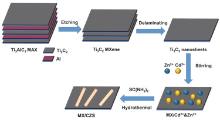
Scheme 1
Schematic synthesis route of MX/C1−xZxS."
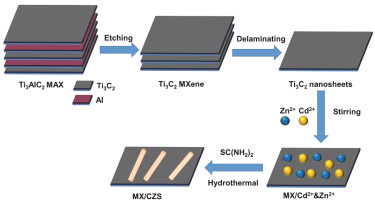
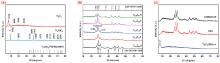
Fig 1
XRD patterns of (a) Ti3AlC2, Ti3C2, (b) C1−xZxS (x = 0.1, 0.3, 0.5, 0.7, 0.9) and (c) Ti3C2, CZS, 0.5MX/CZS."
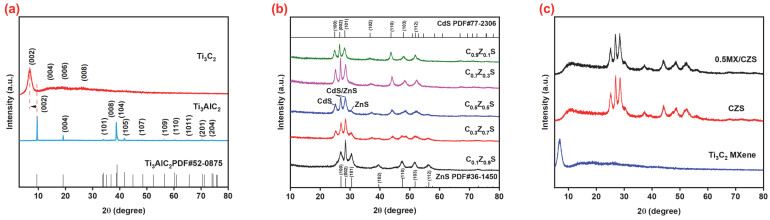
Fig 2
SEM, TEM and HRTEM images of (a) CZS, (b) MXene, (c–f) 0.5MX/CZS, (g) HAADF-STEM image and the corresponding EDS element C, Ti, Zn, Cd, S mappings of the MX/CZS."
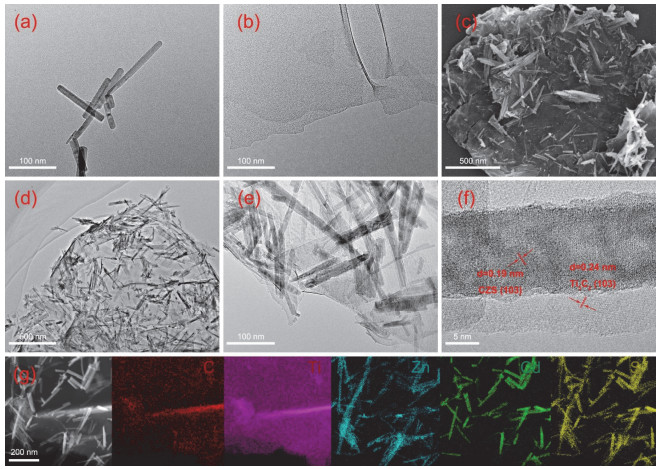
Fig 3
High resolution XPS spectra of (a) Zn 2p, (b) Cd 3d, (c) S 2p, (d) Ti 2p, (e) C 1s."
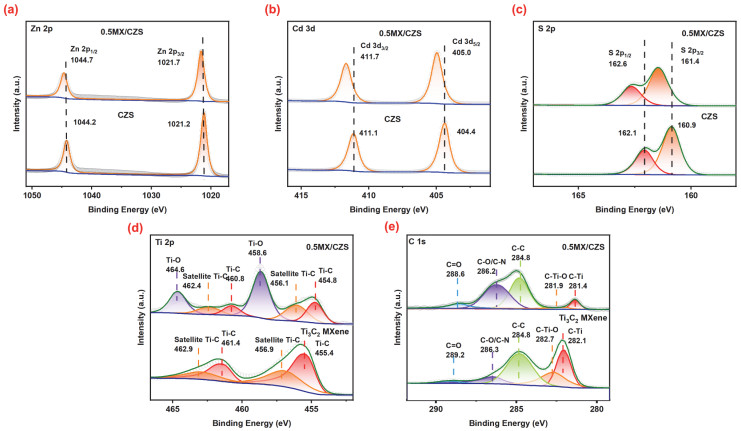
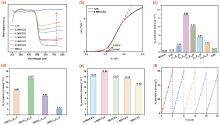
Fig 4
(a) UV-Vis DRS spectra of CZS, MXene and MX/CZS, (b) Tauc plots for CZS and 0.5MX/CZS, (c) photocatalytic activity of H2 production over MXene and C1−xZxS (x = 0, 0.1, 0.3, 0.5, 0.7, 0.9, 1.0) solid solutions, (d) photocatalytic activity of H2 production over C1−xZxS with 1% mass fraction of MXene, (e) H2 generation rates for CZS with different loading amounts of MXene, (f) recycling photocatalytic H2 production tests over 0.5MX/CZS composite."
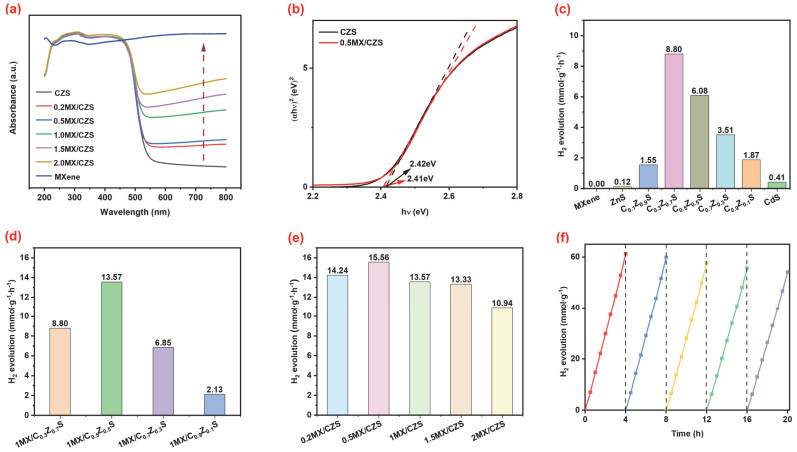
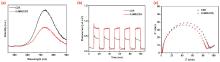
Fig 5
(a) PL spectra, (b) EIS Nyquist plots and (c) photoluminescence of CZS and 0.5MX/CZS."
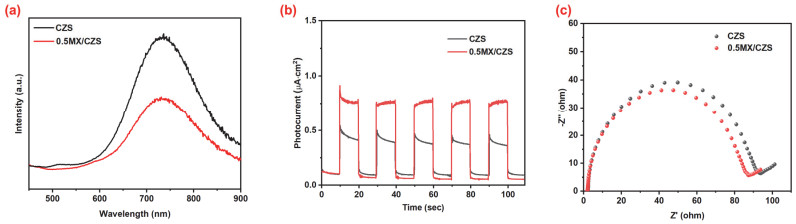
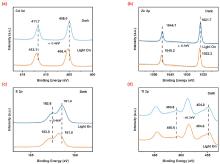
Fig 6
High-resolution in situ XPS spectra of Cd 3d (a), Zn 2p (b) S 2p (c), and Ti 2p (d) of MX/CZS."
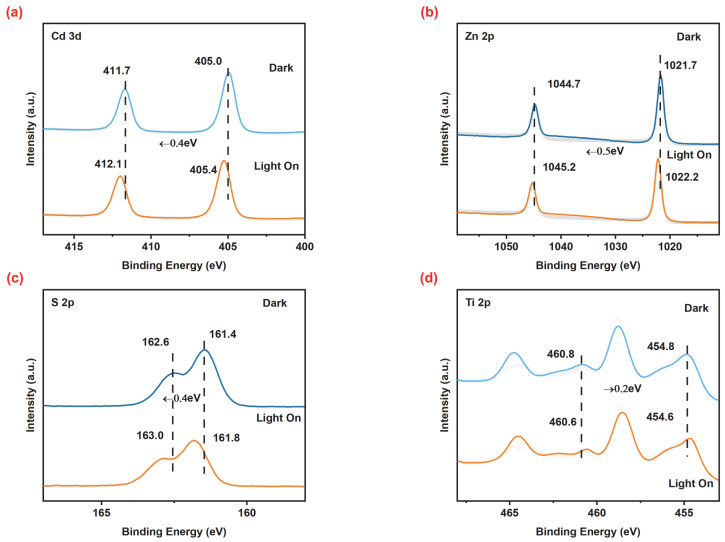
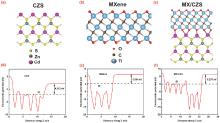
Fig 7
Structure models (a–c), electrostatic potentials (d–f) of CZS, MXene and MX/CZS."
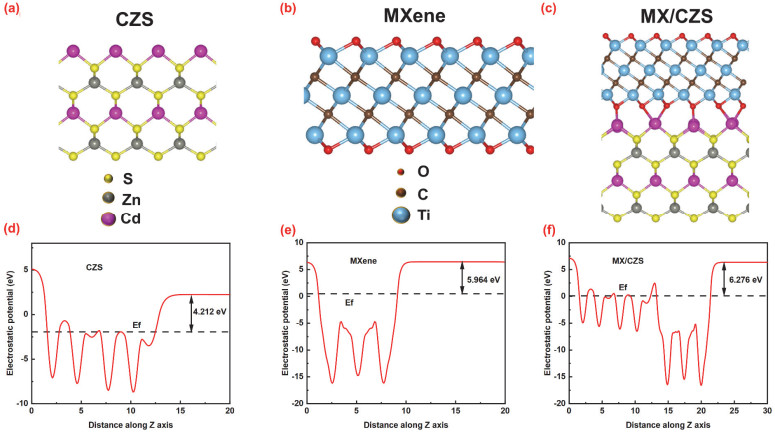
Fig 8
Planar-averaged electron density difference along with Z-axis (a), ΔGH* diagrams of CZS, MXene and MX/CZS (b)."
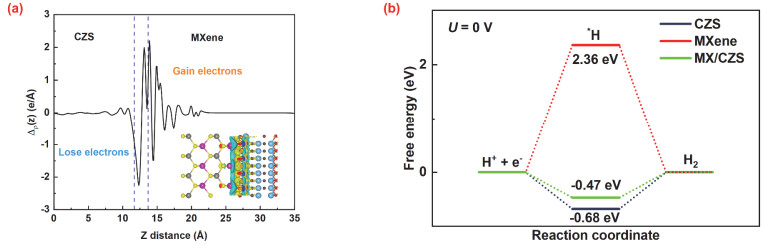
Fig 9
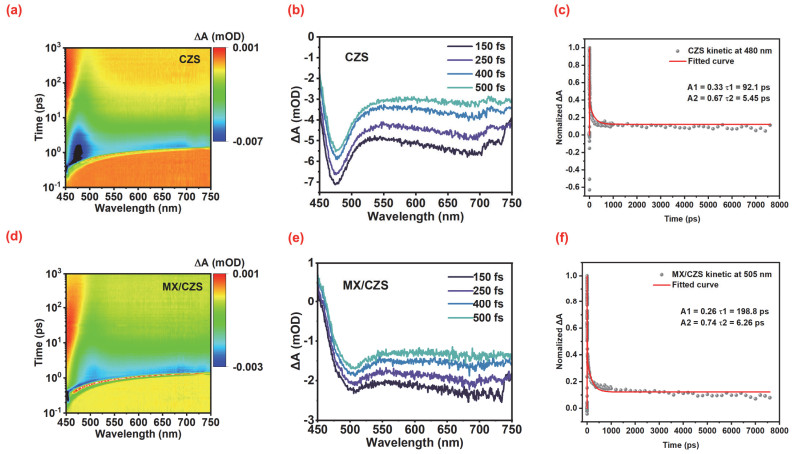
2D mapping transient absorption (TA) spectra of (a) CZS and (d) MX/CZS, TA spectra of (b) CZS and (e) MX/CZS on the fs-ns timescales, normalized kinetic profile probing at 480 nm for (c) CZS and 505 nm for (f) MX/CZS."
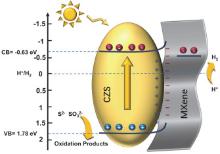
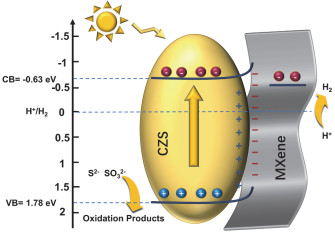
Scheme 2
Schematic illustration of the photocatalytic H2 production mechanism of MX/CZS."
| 1 |
doi: 10.1039/C8CS00542G |
| 2 |
doi: 10.1021/cr1001645 |
| 3 |
doi: 10.1038/238037a0 |
| 4 |
doi: 10.1038/nmat2317 |
| 5 |
doi: 10.1126/science.aaa3145 |
| 6 |
doi: 10.1021/jacs.9b05964 |
| 7 |
doi: 10.1016/j.apcatb.2017.04.065 |
| 8 |
doi: 10.1016/j.jcis.2021.01.083 |
| 9 |
doi: 10.1002/adfm.201806774 |
| 10 |
doi: 10.1016/j.jmst.2019.11.020 |
| 11 |
doi: 10.1016/j.apcatb.2020.118885 |
| 12 |
doi: 10.1016/j.apsusc.2018.08.250 |
| 13 |
doi: 10.1002/anie.202000158 |
| 14 |
doi: 10.1002/adma.v32.1610.1002/adma.201906368 |
| 15 |
doi: 10.1002/adma.201904249 |
| 16 |
doi: 10.1016/j.apcatb.2019.118541 |
| 17 |
doi: 10.1016/j.apcatb.2019.118029 |
| 18 |
doi: 10.1016/j.apcatb.2017.10.010 |
| 19 |
doi: 10.1016/j.apcata.2019.117115 |
| 20 |
doi: 10.1039/C9TA13836F |
| 21 |
doi: 10.1021/cs4000975 |
| 22 |
doi: 10.1002/anie.201210294 |
| 23 |
doi: 10.1002/adma.201102306 |
| 24 |
doi: 10.1021/acsnano.0c10671 |
| 25 |
doi: 10.1002/advs.202202748 |
| 26 |
doi: 10.1016/j.apcatb.2022.122009 |
| 27 |
doi: 10.1002/adma.201906739 |
| 28 |
doi: 10.1016/j.cej.2021.132950 |
| 29 |
doi: 10.1021/acsnano.9b10066 |
| 30 |
doi: 10.1016/j.apcatb.2019.01.051 |
| 31 |
doi: 10.1016/j.cej.2020.124519 |
| 32 |
doi: 10.1016/j.apcatb.2019.118379 |
| 33 |
doi: 10.1039/C7TA04122E |
| 34 |
doi: 10.1016/j.apcatb.2020.119191 |
| 35 |
doi: 10.3866/PKU.WHXB202108028 |
| 36 |
doi: 10.1016/S1872-2067(22)64096-8 |
| 37 |
doi: 10.3866/PKU.WHXB202209037 |
| 38 |
doi: 10.1016/j.jmst.2023.03.003 |
| 39 |
doi: 10.1002/adfm.202214470 |
| 40 |
doi: 10.1016/S1872-2067(23)64444-4 |
| 41 |
doi: 10.1039/c9gc03332g |
| 42 |
doi: 10.1021/acscatal.1c02018 |
| 43 |
doi: 10.1016/j.apcatb.2023.122537 |
| 44 |
doi: 10.1016/j.cej.2020.127177 |
| 45 |
doi: 10.1016/j.apcatb.2019.118382 |
| 46 |
doi: 10.1021/acsanm.2c01639 |
| 47 |
doi: 10.1016/j.jcat.2021.09.001 |
| 48 |
doi: 10.1039/D2TA02755K |
| 49 |
doi: 10.1016/j.apcatb.2020.119006 |
| 50 |
doi: 10.1016/j.jmst.2021.12.028 |
| 51 |
doi: 10.1007/s12598-022-02058-2 |
| 52 |
doi: 10.1016/S1872-2067(21)63915-3 |
| 53 |
doi: 10.1016/S1872-2067(22)64102-0 |
| 54 |
doi: 10.1039/D1NR02224E |
| 55 |
doi: 10.1002/advs.202103715 |
| 56 |
doi: 10.1039/c0gc00236d |
| 57 |
doi: 10.1002/anie.202200872 |
| 58 |
doi: 10.1016/S1872-2067(23)64438-9 |
| 59 |
doi: 10.1002/anie.202218688 |
| [1] | Fan Fan, Hao Xiu, Yuting Wang, Yongpeng Cui, Yajun Wang. Construction of NH2-MIL-125/Na-doped g-C3N4 composite S-scheme heterojunction and its performance in photocatalytic hydrogen peroxide production [J]. Acta Phys. -Chim. Sin., 2026, 42(2): 100143-. |
| [2] | Yu Liu, Pengfei Li, Yize Liu, Zaicheng Sun. Recent advances in carbon dots as a single photocatalyst [J]. Acta Phys. -Chim. Sin., 2026, 42(2): 100167-. |
| [3] | Yuhang Zhang, Yi Li, Yuehan Cao, Yingjie Shuai, Yu Zhou, Ying Zhou. Regulating the formation type by Ir of intermediates to suppress product overoxidation in photocatalytic methane conversion [J]. Acta Phys. -Chim. Sin., 2026, 42(2): 100173-. |
| [4] | Chengxiao Zhao, Zhaolin Li, Dongfang Wu, Xiaofei Yang. SBA-15 templated covalent triazine frameworks for boosted photocatalytic hydrogen production [J]. Acta Phys. -Chim. Sin., 2026, 42(1): 100149-. |
| [5] | Chengyan Ge, Jiawei Hu, Xingyu Liu, Yuxi Song, Chao Liu, Zhigang Zou. Self-integrated black NiO clusters with ZnIn2S4 microspheres for photothermal-assisted hydrogen evolution by S-scheme electron transfer mechanism [J]. Acta Phys. -Chim. Sin., 2026, 42(1): 100154-. |
| [6] | Huoshuai Huang, Zhidong Wei, Jiawei Yan, Jiasheng Chi, Qianxiang Su, Mingxia Chen, Zhi Jiang, Yangzhou Sun, Wenfeng Shangguan. Unveiling the mechanism of direct-to-indirect bandgap transition in the photocatalytic hydrogen evolution of ZnxCd1−xS solid solution [J]. Acta Phys. -Chim. Sin., 2026, 42(1): 100141-. |
| [7] | Shiyi Chen, Jialong Fu, Jianping Qiu, Guoju Chang, Shiyou Hao. Waste medical mask-derived carbon quantum dots enhance the photocatalytic degradation of polyethylene terephthalate (PET) over BiOBr/g-C3N4 S-scheme heterojunction [J]. Acta Phys. -Chim. Sin., 2026, 42(1): 100135-. |
| [8] | Fengying Zhang, Yanglin Mei, Yuman Jiang, Shenshen Zheng, Kaibo Zheng, Ying Zhou. Research progress of transient absorption spectroscopy in solar energy conversion and utilization [J]. Acta Phys. -Chim. Sin., 2025, 41(9): 100118-. |
| [9] | Wenlong Wang, Wentao Hao, Lang He, Jia Qiao, Ning Li, Chaoqiu Chen, Yong Qin. Bandgap and adsorption engineering of carbon dots/TiO2 S-scheme heterojunctions for enhanced photocatalytic CO2 methanation [J]. Acta Phys. -Chim. Sin., 2025, 41(9): 100116-. |
| [10] | Jianan Hong, Chenyu Xu, Yan Liu, Changqi Li, Menglin Wang, Yanwei Zhang. Decoding the interfacial competition between hydrogen evolution and CO2 reduction via edge-active-site modulation in photothermal catalysis [J]. Acta Phys. -Chim. Sin., 2025, 41(9): 100099-. |
| [11] | Menglan Wei, Xiaoxia Ou, Yimeng Wang, Mengyuan Zhang, Fei Teng, Kaixuan Wang. S-scheme heterojunction g-C3N4/Bi2WO6 highly efficient degradation of levofloxacin: performance, mechanism and degradation pathway [J]. Acta Phys. -Chim. Sin., 2025, 41(9): 100105-. |
| [12] | Jingping Li, Suding Yan, Jiaxi Wu, Qiang Cheng, Kai Wang. Improving hydrogen peroxide photosynthesis over inorganic/organic S-scheme photocatalyst with LiFePO4 [J]. Acta Phys. -Chim. Sin., 2025, 41(9): 100104-. |
| [13] | Qi Wu, Changhua Wang, Yingying Li, Xintong Zhang. Enhanced photocatalytic synthesis of H2O2 by triplet electron transfer at g-C3N4@BN van der Waals heterojunction interface [J]. Acta Phys. -Chim. Sin., 2025, 41(9): 100107-. |
| [14] | Jiajie Cai, Chang Cheng, Bowen Liu, Jianjun Zhang, Chuanjia Jiang, Bei Cheng. CdS/DBTSO-BDTO S-scheme photocatalyst for H2 production and its charge transfer dynamics [J]. Acta Phys. -Chim. Sin., 2025, 41(8): 100084-. |
| [15] | Lewang Yuan, Yaoyao Peng, Zong-Jie Guan, Yu Fang. Insights into the development of 2D covalent organic frameworks as photocatalysts in organic synthesis [J]. Acta Phys. -Chim. Sin., 2025, 41(8): 100086-. |
|
||