Acta Phys. -Chim. Sin. ›› 2025, Vol. 41 ›› Issue (8): 100095.doi: 10.1016/j.actphy.2025.100095
Special Issue: S-scheme heterojunction in photocatalysis
• ARTICLE • Previous Articles
Optimizing interfacial electric fields in carbon nitride nanosheet/spherical conjugated polymer S-scheme heterojunction for hydrogen evolution
Fanpeng Meng1, Fei Zhao2, Jingkai Lin3, Jinsheng Zhao1,*( ), Huayang Zhang3,*(), Shaobin Wang3
- 1 Shandong Key Laboratory of Chemical Energy Storage and Novel Cell Technology, College of Chemistry and Chemical Engineering, Liaocheng University, Liaocheng 252059, Shandong Province, China
2 College of Chemistry and Chemical Engineering, Taishan University, Taian 271000, Shandong Province, China
3 School of Chemical Engineering, The University of Adelaide, Adelaide SA 5005, Australia
-
Received:2025-03-18Revised:2025-04-02Accepted:2025-04-15Published:2025-06-07 -
Contact:Email: j.s.zhao@163.com (Jinsheng Zhao)huayang.zhang@adelaide.edu.au (Huayang Zhang) -
Supported by:the National Natural Science Foundation of China(22302085); the National Natural Science Foundation of China(22172069); the Natural Science Foundation of Shandong Province(ZR2024QB046); the Natural Science Foundation of Shandong Province(ZR2021ME071); the Research Projects of Liaocheng University(318052272); H. Zhang and S. Wang acknowledges the support from Discovery Project(DP230102406); H. Zhang and S. Wang acknowledges the support from Discovery Project(DP240102787); Australian Laureate Fellowships from the Australian Research Council(FL230100178)

Cite this article
Fanpeng Meng, Fei Zhao, Jingkai Lin, Jinsheng Zhao, Huayang Zhang, Shaobin Wang. Optimizing interfacial electric fields in carbon nitride nanosheet/spherical conjugated polymer S-scheme heterojunction for hydrogen evolution[J]. Acta Phys. -Chim. Sin. 2025, 41(8), 100095. doi: 10.1016/j.actphy.2025.100095
share this article
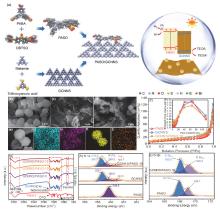
Fig 1
(a) The preparation of all-organic S-scheme heterojunction for H2 evolution, (b–d) SEM of PASO, GCNNS and GCNNS/PASO-10, (e) the element mapping images of GCNNS/PASO-10, (f) N2 adsorption-desorption isotherms and inset of pore-size distribution curves, (g) FTIR spectra, and the high-resolution XPS spectra of (h) N 1s and (i) S 2p of the photocatalysts."
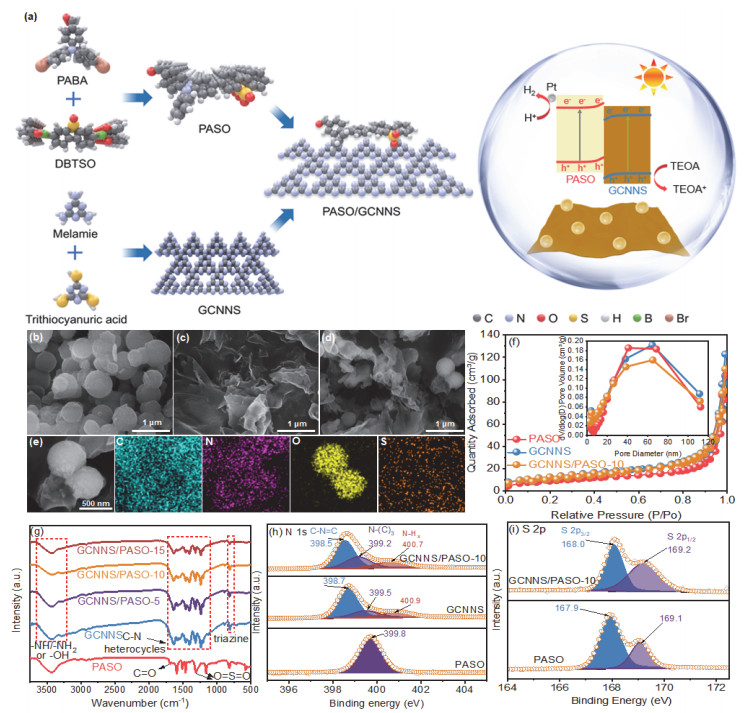
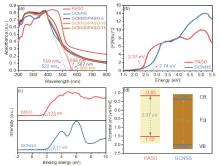
Fig 2
(a) UV-Vis diffuse reflectance spectra, (b) Tauc curves, (c) the VB-XPS spectra and (d) the band structure diagram of as-prepared samples."
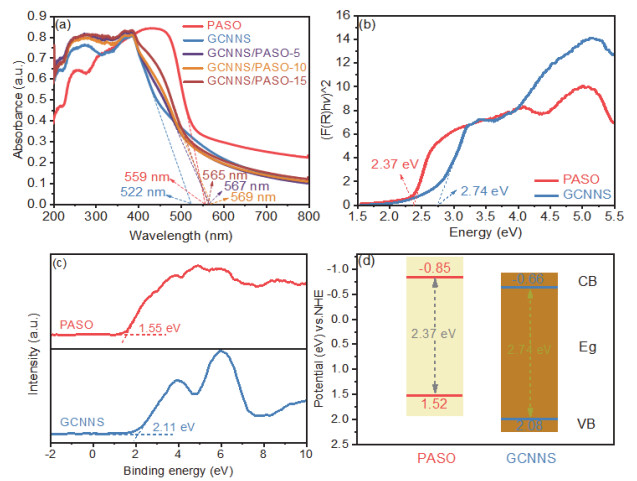
Fig 3
(a) PL spectra, (b) time-resolved photo-luminescence spectra, (c) EIS plots and (d) transient photo-current of PASO, GCNNS and GCNNS/PASO-10 samples."
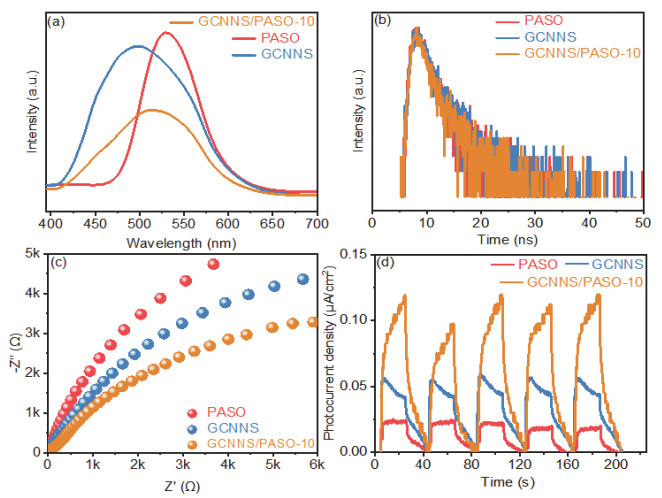
Fig 4
(a) Dependence of H2 generation rate and amount of H2 generation on photocatalyst mass (Sample: GCNNS/PASO-10, Time: 3 h), (b) the amount of H2 evolution, (c) the average amount of H2 evolution and (d) cycling stability test of samples under visible light (λ ≥ 420 nm) irradiation, (e) dependence of AQY values on the catalyst mass of GCNNS/PASO-10 at 420 nm, (f) AQY of GCNNS/PASO-10 at various wavelengths."
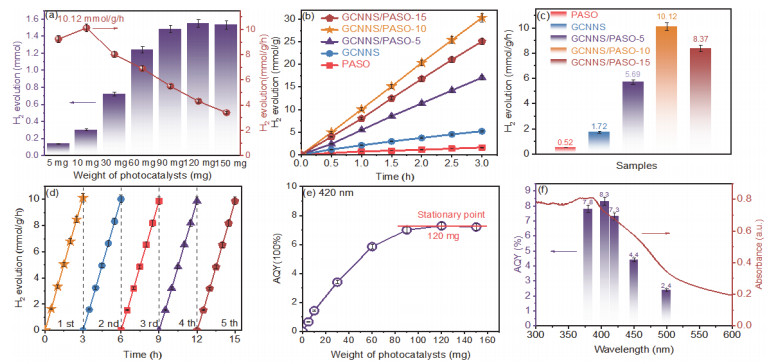
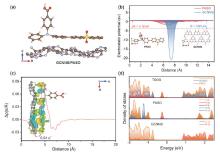
Fig 5
(a) The constructed GCNNS/PASO heterojunction after geometry optimization (brown, blue, red, yellow, and pink representing C, N, O, S, and H, respectively); (b) The electrostatic potential of GCNNS surface and PASO surface along the c-axis direction; (c) Charge density differences of GCNNS/PASO. The cyan and yellow region indicates charge accumulation and depletion, respectively. The solid red curves represent the planar-averaged charge density; (d) Total density of states (TDOS) of GCNNS/PASO, and the elemental PDOS of GCNNS and PASO."
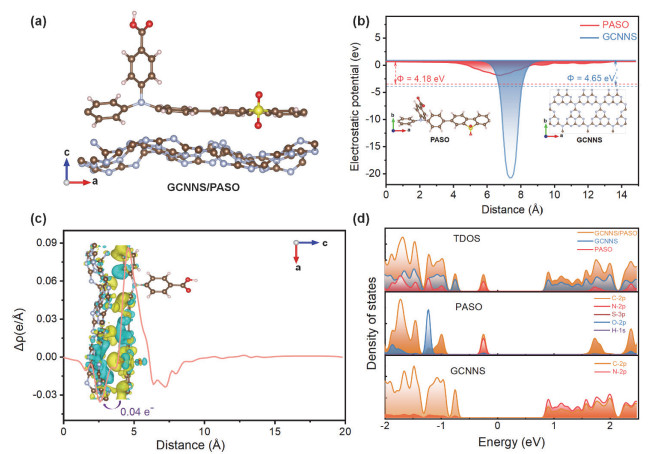
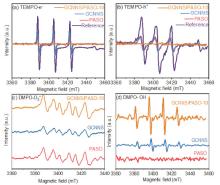
Fig 6
ESR signals of (a) TEMPO-e− adducts in water, (b) TEMPO-h+ adducts in an acetonitrile solution, (c) DMPO-O2•− adducts in methanol and (d) DMPO-•OH adducts in water under irradiation."
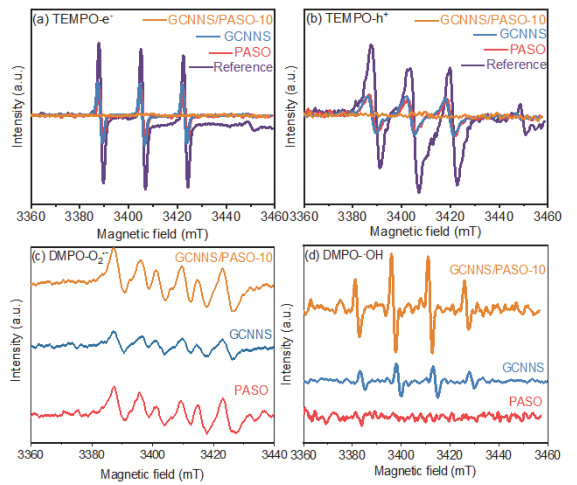
Fig 7
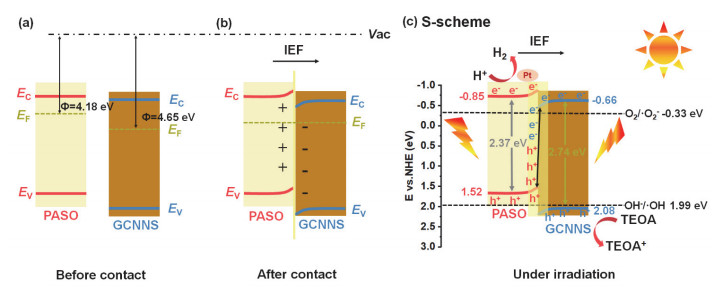
Diagrammatic sketch of GCNNS/PASO-10 (a) before contact and (b) after contact, (c) schematic diagram of photocatalytic mechanism driven by the charge transfer and separation in S-scheme mode."
| 1 |
doi: 10.1007/s40843-023-2755-2 |
| 2 |
doi: 10.3866/PKU.WHXB202212016 |
| 3 |
doi: 10.1038/s41467-024-53951-6 |
| 4 |
doi: 10.1002/anie.201607375 |
| 5 |
doi: 10.1016/j.apcatb.2018.04.050 |
| 6 |
doi: 10.1016/j.apcatb.2018.05.045 |
| 7 |
doi: 10.1016/j.apcatb.2013.05.077 |
| 8 |
doi: 10.1002/adma.202414803 |
| 9 |
doi: 10.1016/j.chempr.2020.06.010 |
| 10 |
doi: 10.1038/s41570-025-00698-3 |
| 11 |
doi: 10.3866/PKU.WHXB202307022 |
| 12 |
doi: 10.1016/j.jmst.2024.02.012 |
| 13 |
doi: 10.3866/PKU.WHXB202406026 |
| 14 |
doi: 10.1016/S1872-2067(24)60102-6 |
| 15 |
doi: 10.3866/PKU.WHXB202312024 |
| 16 |
doi: 10.1016/S1872-2067(23)64610-8 |
| 17 |
doi: 10.1016/j.jmst.2024.02.048 |
| 18 |
doi: 10.3866/PKU.WHXB202307016 |
| 19 |
doi: 10.1016/j.actphy.2025.100065 |
| 20 |
doi: 10.1002/adfm.202315426 |
| 21 |
doi: 10.3866/PKU.WHXB202403009 |
| 22 |
doi: 10.1016/S1872-2067(23)64607-8 |
| 23 |
doi: 10.1016/j.jmst.2024.12.094 |
| 24 |
doi: 10.1016/j.ccr.2021.214338 |
| 25 |
doi: 10.1039/C7CS00071E |
| 26 |
doi: 10.1016/S1872-2067(24)60011-2 |
| 27 |
doi: 10.1021/ja511552k |
| 28 |
doi: 10.1002/adma.202101466 |
| 29 |
doi: 10.1016/j.apsusc.2023.156414 |
| 30 |
doi: 10.1021/acscatal.0c03652 |
| 31 |
doi: 10.1016/j.cjsc.2023.100194 |
| 32 |
doi: 10.1016/j.scitotenv.2022.158360 |
| 33 |
doi: 10.1016/S1872-2067(20)63634-8 |
| 34 |
doi: 10.1039/D0TA00901F |
| 35 |
doi: 10.1021/acs.langmuir.3c03910 |
| 36 |
doi: 10.1002/adfm.201804512 |
| 37 |
doi: 10.1016/j.electacta.2014.03.172 |
| 38 |
doi: 10.1016/j.apcatb.2022.121144 |
| 39 |
doi: 10.1039/C9CC05415D |
| 40 |
doi: 10.1016/j.apcatb.2019.118067 |
| 41 |
doi: 10.1016/j.cej.2022.136115 |
| 42 |
doi: 10.1016/j.apcatb.2021.120819 |
| 43 |
doi: 10.1002/smll.201703599 |
| 44 |
doi: 10.1016/j.seppur.2021.120207 |
| 45 |
doi: 10.1039/D2TA00328G |
| 46 |
doi: 10.1016/j.matchemphys.2021.125299 |
| 47 |
doi: 10.1016/j.apsusc.2022.154425 |
| 48 |
doi: 10.1016/j.cjche.2021.09.026 |
| 49 |
doi: 10.1021/acsnano.1c03056 |
| 50 |
doi: 10.1021/acsami.2c03230 |
| 51 |
doi: 10.1016/S1872-2067(22)64094-4 |
| 52 |
doi: 10.1002/adfm.202111740 |
| 53 |
doi: 10.1016/j.apcatb.2022.121261 |
| 54 |
doi: 10.1021/acs.chemmater.6b02907 |
| 55 |
doi: 10.1002/anie.202009633 |
| 56 |
doi: 10.1103/PhysRevB.54.11169 |
| 57 |
doi: 10.1016/j.ijhydene.2021.10.261 |
| 58 |
doi: 10.1016/j.cclet.2021.07.056 |
| 59 |
doi: 10.1002/adma.202100317 |
| 60 |
doi: 10.1016/j.jcis.2020.10.028 |
|
||