Acta Phys. -Chim. Sin. ›› 2026, Vol. 42 ›› Issue (2): 100169.doi: 10.1016/j.actphy.2025.100169
• ARTICLE • Previous Articles Next Articles
Achieving thermal-stimulus-responsive dynamic afterglow from carbon dots by singlet-triplet energy gap engineering through covalent fixation
Zihan Cheng1, Kai Jiang1,*( ), Jun Jiang1, Henggang Wang1,2,*(), Hengwei Lin1,*()
- 1 International Joint Research Center for Photo-responsive Molecules and Materials, School of Chemical and Material Engineering, Jiangnan University, Wuxi 214122, Jiangsu Province, China
2 Chemistry Postdoctoral Research Station at Hebei Normal University, College of Chemistry and Materials Science, Hebei Normal University, Shijiazhuang 050024, Hebei Province, China
-
Received:2025-06-20Revised:2025-08-11Accepted:2025-08-19Published:2025-12-03 -
Contact:Email: jiangkai@jiangnan.edu.cn (Kai Jiang)wanghenggang11@163.com (Henggang Wang)linhengwei@jiangnan.edu.cn. Tel.: +86-510-8591-0225 (Hengwei Lin)

Cite this article
Zihan Cheng, Kai Jiang, Jun Jiang, Henggang Wang, Hengwei Lin. Achieving thermal-stimulus-responsive dynamic afterglow from carbon dots by singlet-triplet energy gap engineering through covalent fixation[J]. Acta Phys. -Chim. Sin. 2026, 42(2), 100169. doi: 10.1016/j.actphy.2025.100169
share this article
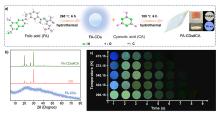
Fig 1
a) Schematic illustration of the preparation process for FA-CDs and FA-CDs#CA, and photographs of the FA-CDs#CA powder under both daylight and ultraviolet (UV) light (365 nm). b) The X-ray diffraction patterns of FA-CDs, pristine CA, and FA-CDs#CA. c) Photographs of the FA-CDs#CA powder, captured at various time after removal of the irradiation source under different temperatures (excitation wavelength (λexc.), 365 nm)."
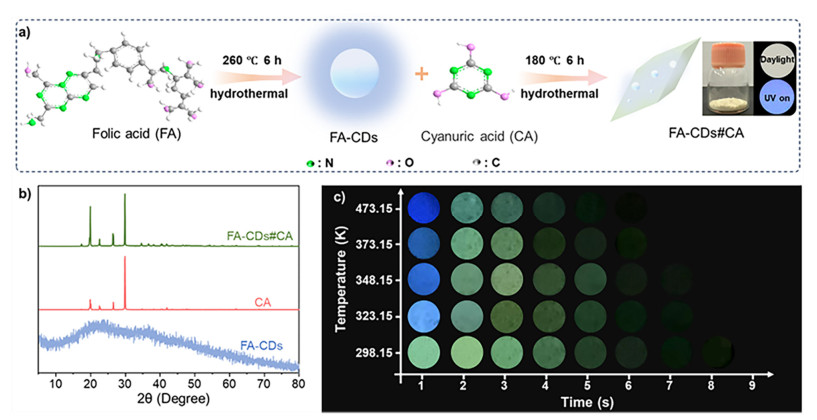
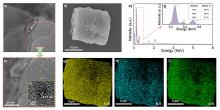
Fig 2
(a–c) TEM images of FA-CDs#CA composite, (b) is a magnified TEM image region of (a) marked in red, (c) is a magnified high-resolution TEM image region of (b) marked in green. d–f) The dark-field SEM image (d) and the energy-dispersive spectra (e–f) of FA-CDs#CA. g–i) The energy-dispersive elemental mappings of C K (g), N K (h), and O K (i) corresponding to the SEM image in (d)."
Fig 3
a) The excitation-afterglow mapping of the FA-CDs#CA powder at ambient conditions. b) The afterglow emission spectra of FA-CDs#CA (powder) at different temperatures (λexc. = 365 nm). c) The afterglow color of FA-CDs#CA in the CIE-1931 color coordinates at different temperatures. d) The temperature-dependent DF decay spectra of FA-CDs#CA at different temperatures (λexc. = 365 nm, λem = 470 nm). e-h) Time-resolved afterglow emission spectra of FA-CDs#CA at e) 77 K, f) 298.15 K, g) 323.15 K and h) 473.15 K (λexc. = 365 nm). i) DF decay rates of FA-CDs#CA as a function of temperature and fitting curve based on Eq. (2)."
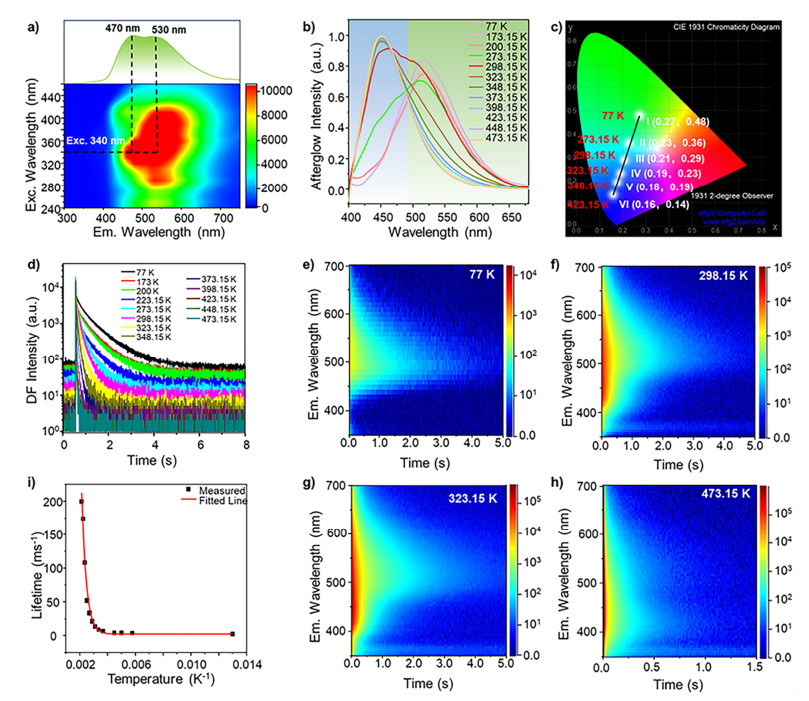
Fig 4
a) Schematic illustration of the formation of FA-CDs#CA through covalently fixation and co-crystallization processes. b) Proposed emission mechanism for the decrease in ΔEST and the activation of dual-mode emission (DF and Phos) from FA-CDs#CA. Abbreviations of excitation (EX), intersystem crossing (ISC), reversed ISC (RISC), delayed fluorescence (DF), and phosphorescence (Phos) are used."
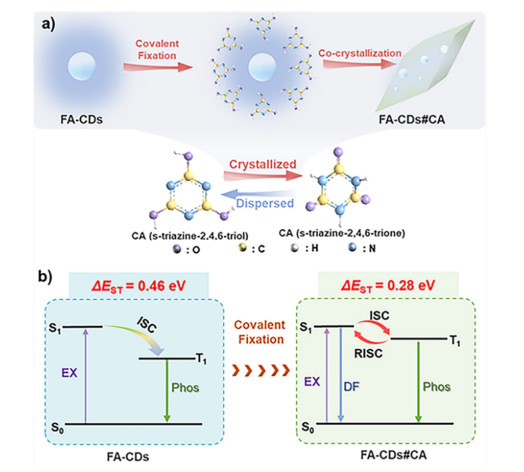
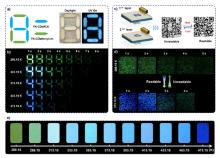
Fig 5
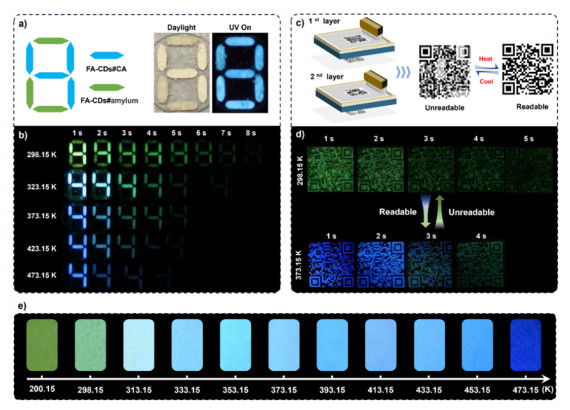
a–d) Demonstration of stimulation-response TRA anti-counterfeiting and information encryption systems utilizing FA-CDs#CA and FA-CDs#amylum phosphors. e) The variation in afterglow colour of FA-CDs#CA within the temperature range of 298.15 to 473.15 K (with a variation of 20 K)."
| 1 |
R. Gao, X. Fang, D. Yan. J. Mater. Chem. C 2019, 7(12), 3399.
doi: 10.1039/C9TC00348G |
| 2 |
Q. Cheng, A. Hao, P. Xing. P. Adv. Colloid Interface Sci. 2020, 286, 102301.
doi: 10.1016/j.cis.2020.102301 |
| 3 |
G. Guan, M. Wu, M.-Y. Han. Adv. Funct. Mater. 2020, 30(2), 1903439.
doi: 10.1002/adfm.201903439 |
| 4 |
J. Zhang, B. He, Y. Hu, P. Alam, H. Zhang, J. W. Y. Lam, B. Z. Tang. Adv. Mater. 2021, 33(32), 2008071.
doi: 10.1002/adma.202008071 |
| 5 |
H. Zhou, J. Han, J. Cuan, Y. Zhou. Chem. Eng. J. 2022, 431, 134170.
doi: 10.1016/j.cej.2021.134170 |
| 6 |
B. Yan. TrAC Trends Anal. Chem. 2024, 170, 117430.
doi: 10.1016/j.trac.2023.117430 |
| 7 |
L. Liang, N. Chen, Y. Jia, Q. Ma, J. Wang, Q. Yuan, W. Tan. Nano Res. 2019, 12(6), 1279.
doi: 10.1007/s12274-019-2343-6 |
| 8 |
Q. Ma, J. Wang, Z. Li, X. Lv, L. Liang, Q. Yuan. Small 2019, 15(32), 1804969.
doi: 10.1002/smll.201804969 |
| 9 |
B. Zhou, G. Xiao, D. Yan. Adv. Mater. 2021, 33(16), 2007571.
doi: 10.1002/adma.202007571 |
| 10 |
G. Zhou, Y. Mao, J. Zhang, Q. Ren, M. S. Molokeev, Z. Xia, X.-M. Zhang. Adv. Funct. Mater. 2025, 35(3), 2413524.
doi: 10.1002/adfm.202413524 |
| 11 |
Z. Xu, W. Chen, K. Chen, S. Lin, Z. Wu, G. Deng, J. Chen, M. Tayyab, Y. Xiong, M.-D. Li, D. Wang, Z. An, B. Z. Tang. Adv. Mater. 2025, 37(20), 2418778.
doi: 10.1002/adma.202418778 |
| 12 |
Z. Wang, Z. Ding, Y. Yang, L. Hu, W. Wu, Y. Gao, Y. Wei, X. Zhang, G. Jiang. Chem. Eng. J. 2023, 457, 141293.
doi: 10.1016/j.cej.2023.141293 |
| 13 |
Y. Xie, X. Zhao, H. Wang, Y. Tian, C. Liu, J. Wu, J. Cui, Z. Zhou, J. Chen, X. Chen. Angew. Chem. Int. Ed. 2025, 64(2), e202414846.
doi: 10.1002/anie.202414846 |
| 14 |
W. Zhao, Z. He, J. W. Y. Lam, Q. Peng, H. Ma, Z. Shuai, G. Bai, J. Hao, B. Z. Tang. Chem 2016, 1(4), 592.
doi: 10.1016/j.chempr.2016.08.010 |
| 15 |
W. Zhao, Z. He, B. Z. Tang. Nat. Rev. Mater. 2020, 5(12), 869.
doi: 10.1038/s41578-020-0223-z |
| 16 |
C. M. Marian. WIREs Comput. Mol. Sci. 2012, 2(2), 187.
doi: 10.1002/wcms.83 |
| 17 |
Z. Yang, Z. Mao, Z. Xie, Y. Zhang, S. Liu, J. Zhao, J. Xu, Z. Chi, M. P. Aldred. Chem. Soc. Rev. 2017, 46(3), 915.
doi: 10.1039/C6CS00368K |
| 18 |
D. Sasikumar, A. T. John, J. Sunny, M. Hariharan. Chem. Soc. Rev. 2020, 49(17), 6122.
doi: 10.1039/D0CS00484G |
| 19 |
S. Xu, R. Chen, C. Zheng, W. Huang. Adv. Mater. 2016, 28(45), 9920.
doi: 10.1002/adma.201602604 |
| 20 |
S. Hirata. Adv. Opt. Mater. 2017, 5(17), 1700116.
doi: 10.1002/adom.201700116 |
| 21 |
F. Ni, Z. Zhu, X. Tong, M. Xie, Q. Zhao, C. Zhong, Y. Zou, C. Yang. Chem. Sci. 2018, 9(28), 6150.
doi: 10.1039/C8SC01485J |
| 22 |
L. Huang, L. Liu, X. Li, H. Hu, M. Chen, Q. Yang, Z. Ma, X. Jia. Angew. Chem. Int. Ed. 2019, 58(46), 16445.
doi: 10.1002/anie.201908567 |
| 23 |
C. A. M. Salla, G. Farias, M. Rouzières, P. Dechambenoit, F. Durola, H. Bock, B. de Souza. Angew. Chem. Int. Ed. 2019, 58(21), 6982.
doi: 10.1002/anie.201901672 |
| 24 |
X. Zhang, K. C. Chong, Z. Xie, B. Liu. Angew. Chem. Int. Ed. 2023, 62(45), e202310335.
doi: 10.1002/anie.202310335 |
| 25 |
S. Zong, B. Wang, J. Zhang, X. Yu, Y. Zhou, Y. Chen, T. Zhang, J. Li. Angew. Chem. Int. Ed. 2025, 64(7), e202420156.
doi: 10.1002/anie.202420156 |
| 26 |
J. Sun, Y. Liu, Y. Han, W. Li, N. Wang, L. Zhang, Y. Zhang, F. Deng, D. Wang, X. Zhang. Angew. Chem. Int. Ed. 2025, 64(2), e202415042.
doi: 10.1002/anie.202415042 |
| 27 |
J. Sun, Z. Sun, Z. Wang, N. Wang, Y. Han, L. Zhang, B. Zhang, X. Zhang. Adv. Opt. Mater. 2024, 12(12), 2302542.
doi: 10.1002/adom.202302542 |
| 28 |
J. Tan, Q. Li, S. Meng, Y. Li, J. Yang, Y. Ye, Z. Tang, S. Qu, X. Ren. Adv. Mater. 2021, 33(16), 2006781.
doi: 10.1002/adma.202006781 |
| 29 |
X. Ran, Y. Pan, L. Qiao, L. Cai, Y. Jia, Z. Liu, L. Guo. Carbon 2025, 234, 119980.
doi: 10.1016/j.carbon.2024.119980 |
| 30 |
Y. Wu, Z. Li, Z. Zhou, Z. Zhang, D. Zhu, X. Dong, F. Xiu, W. Huang, J. Liu. Adv. Opt. Mater. 2025, 13(12), 2403274.
doi: 10.1002/adom.202403274 |
| 31 |
Z. Ran, H. Jia, Z. Zhong, H. Yang, Y. Zhu, Y. Li, J. Liu, X. Zhang, J. Zhuang, B. Lei, C. Hu. Nano Lett. 2025, 25(17), 6993.
doi: 10.1021/acs.nanolett.5c00723 |
| 32 |
Y. Liu, D. Cheng, B. Wang, J. Yang, Y. Hao, J. Tan, Q. Li, S. Qu. Adv. Mater. 2024, 36(31), 2403775.
doi: 10.1002/adma.202403775 |
| 33 |
L. Ai, W. Xiang, J. Xiao, H. Liu, J. Yu, L. Zhang, X. Wu, X. Qu, S. Lu. Adv. Mater. 2024, 36(27), 2401220.
doi: 10.1002/adma.202401220 |
| 34 |
Q. Lou, N. Chen, J. Zhu, K. Liu, C. Li, Y. Zhu, W. Xu, X. Chen, Z. Song, C. Liang, C.-X. Shan, J. Hu. Adv. Mater. 2023, 35(20), 2211858.
doi: 10.1002/adma.202211858 |
| 35 |
Y. Sun, J. Liu, X. Pang, X. Zhang, J. Zhuang, H. Zhang, C. Hu, M. Zheng, B. Lei, Y. Liu. J. Mater. Chem. C 2020, 8(17), 5744.
doi: 10.1039/D0TC00507J |
| 36 |
K. Jiang, Y. Wang, C. Cai, H. Lin. Chem. Mater. 2017, 29(11), 4866.
doi: 10.1021/acs.chemmater.7b00831 |
| 37 |
Y. Wang, K. Jiang, J. Du, L. Zheng, Y. Li, Z. Li, H. Lin. Nano-Micro Lett. 2021, 13(1), 198.
doi: 10.1007/s40820-021-00718-z |
| 38 |
Q. Li, M. Zhou, Q. Yang, Q. Wu, J. Shi, A. Gong, M. Yang. Chem. Mater. 2016, 28(22), 8221.
doi: 10.1021/acs.chemmater.6b03049 |
| 39 |
Z. Zhou, E. V. Ushakova, E. Liu, X. Bao, D. Li, D. Zhou, Z. Tan, S. Qu, A. L. Rogach. Nanoscale 2020, 12(20), 10987.
doi: 10.1039/D0NR02639E |
| 40 |
Q. Li, M. Zhou, M. Yang, Q. Yang, Z. Zhang, J. Shi. Nat. Commun. 2018, 9(1), 734.
doi: 10.1038/s41467-018-03144-9 |
| 41 |
K. Jiang, S. Sun, L. Zhang, Y. Lu, A. Wu, C. Cai, H. Lin. Angew. Chem. Int. Ed. 2015, 54(18), 5360.
doi: 10.1002/anie.201501193 |
| 42 |
I. Reva. Spectrochim. Acta Part A: Mol. Biomol. Spectrosc. 2015, 151, 232.
doi: 10.1016/j.saa.2015.06.070 |
| 43 |
T.-E. Chien, K.-L. Li, P.-Y. Lin, J.-L. Lin. Langmuir 2016, 32(21), 5306.
doi: 10.1021/acs.langmuir.6b01334 |
| 44 |
Y. Deng, D. Zhao, X. Chen, F. Wang, H. Song, D. Shen. Chem. Commun. 2013, 49(51), 5751.
doi: 10.1039/C3CC42600A |
| 45 |
Y. Tao, K. Yuan, T. Chen, P. Xu, H. Li, R. Chen, C. Zheng, L. Zhang, W. Huang. Adv. Mater. 2014, 26(47), 7931.
doi: 10.1002/adma.201402532 |
| 46 |
X. Xiong, F. Song, J. Wang, Y. Zhang, Y. Xue, L. Sun, N. Jiang, P. Gao, L. Tian, X. Peng. J. Am. Chem. Soc. 2014, 136(27), 9590.
doi: 10.1021/ja502292p |
| 47 |
T.-Y. Li, S.-J. Zheng, P. I. Djurovich, M. E. Thompson. Chem. Rev. 2024, 124(7), 4332.
doi: 10.1021/acs.chemrev.3c00761 |
| 48 |
H. Uoyama, K. Goushi, K. Shizu, H. Nomura, C. Adachi. Nature 7428, 492(2012), 234.
doi: 10.1038/nature11687 |
| 49 |
Y. Wada, H. Nakagawa, S. Matsumoto, Y. Wakisaka, H. Kaji. Nat. Photon. 2020, 14(10), 643.
doi: 10.1038/s41566-020-0667-0 |
| [1] | Qingwen Xu, Zhigang Xie, Min Zheng. Construction of pH-responsive Lycium barbarum-derived carbon dots nanovaccines for enhanced anti-tumor immunotherapy [J]. Acta Phys. -Chim. Sin., 2026, 42(6): 100203-. |
| [2] | Li Ting, Zeng Xiao, Yang Yuzhuo, Wen Xinyi, Ding Shurong, Shi Linlin, Zhang Yongqiang, Lu Siyu. Towards practical circularly polarized luminescence: carbon dots-based circularly polarized lasers [J]. Acta Phys. -Chim. Sin., 2026, 42(4): 100191-. |
| [3] | Yinghao Zhang, Huaxin Liu, Hanrui Ding, Zhi Zheng, Wentao Deng, Guoqiang Zou, Laiqiang Xu, Hongshuai Hou, Xiaobo Ji. The application of carbon dots in electrolytes of advanced batteries [J]. Acta Phys. -Chim. Sin., 2026, 42(3): 100170-. |
| [4] | Yu Liu, Pengfei Li, Yize Liu, Zaicheng Sun. Recent advances in carbon dots as a single photocatalyst [J]. Acta Phys. -Chim. Sin., 2026, 42(2): 100167-. |
| [5] | Renyi Shao, Khurram Abbas, Vladimir Yu. Osipov, Haimei Zhu, Yuan Li, Usama, Hong Bi. Red-emitting carbon dots prepared from Epipremnum Aureum leaves extract for biological imaging [J]. Acta Phys. -Chim. Sin., 2026, 42(2): 100134-. |
| [6] | Chunyuan Kang, Xiaoyu Li, Fan Yang, Bai Yang. Ionic-bond crosslinked carbonized polymer dots for tunable and enhanced room temperature phosphorescence [J]. Acta Phys. -Chim. Sin., 2026, 42(1): 100156-. |
| [7] | Xue Wu, Yupeng Liu, Bingzhe Wang, Lingyun Li, Zhenjian Li, Qingcheng Wang, Quansheng Cheng, Guichuan Xing, Songnan Qu. Rationally assembling different surface functionalized carbon dots for enhanced near-infrared tumor photothermal therapy [J]. Acta Phys. -Chim. Sin., 2025, 41(9): 100109-. |
| [8] | Wenlong Wang, Wentao Hao, Lang He, Jia Qiao, Ning Li, Chaoqiu Chen, Yong Qin. Bandgap and adsorption engineering of carbon dots/TiO2 S-scheme heterojunctions for enhanced photocatalytic CO2 methanation [J]. Acta Phys. -Chim. Sin., 2025, 41(9): 100116-. |
| [9] | Tiejin Chen, Xiaokuang Xue, Jian Li, Minhui Cui, Yongliang Hao, Mianqi Xue, Haihua Xiao, Jiechao Ge, Pengfei Wang. Membrane-anchoring nanoengineered carbon dots as a pyroptosis amplifier for robust tumor photodynamic-immunotherapy [J]. Acta Phys. -Chim. Sin., 2025, 41(10): 100113-. |
| [10] | Jianqiao Chang, Huimin Xu, Wenjing Xie, Yang Zhang, Ling Qi, Louzhen Fan, Yong Li. Fluorescent Carbon Dots for Rapid and Highly Sensitive Detection of Nucleic Acids [J]. Acta Phys. -Chim. Sin., 2023, 39(12): 2301034-. |
| [11] | Yuan Liu, Weidong Li, Han Wu, Siyu Lu. Carbon Dots Enhance Ruthenium Nanoparticles for Efficient Hydrogen Production in Alkaline [J]. Acta Phys. -Chim. Sin., 2021, 37(7): 2009082-. |
| [12] | Yanjie HUANG, Chao LIAN, Jinyan ZHOU, Zichen HUANG, Xiaohong KANG, Zhenyu HUANG, Xiaojing LI, Lin CHEN, Yan GUAN. Investigation of Excitation-, pH-, Metal Ion-, Temperature-, and Polarity-Dependent Fluorescence of Carbon Dots Derived from Silkworm Excrement [J]. Acta Physico-Chimica Sinica, 2019, 35(11): 1267-1275. |
| [13] | Jin-Long LIU,Liang-Zhen LIN,Jin-Feng HU,Ming-Jie BAI,Liang-Xian CHEN,Jun-Jun WEI,Li-Fu HEI,Cheng-Ming LI. Reaction Process and Luminescence Mechanism of Carbon Nanodots Prepared by Microwave Synthesis [J]. Acta Phys. -Chim. Sin., 2018, 34(1): 92-98. |
| [14] | Li-Xia SANG,Jia LIN,Hao GE,Lei LEI. Dynamic Analysis of Carbon Dots/KOH Electrolyte Interface by IMPS/IMVS [J]. Acta Phys. -Chim. Sin., 2017, 33(12): 2454-2462. |
|
||