Acta Phys. -Chim. Sin. ›› 2024, Vol. 40 ›› Issue (10): 2310013.doi: 10.3866/PKU.WHXB202310013
• ARTICLE • Previous Articles Next Articles
Integration of Plasmonic Effect and S-Scheme Heterojunction into Ag/Ag3PO4/C3N5 Photocatalyst for Boosted Photocatalytic Levofloxacin Degradation
Kexin Dong1, Chuqi Shen1, Ruyu Yan1, Yanping Liu1, Chunqiang Zhuang2, Shijie Li1,*( )
)
- 1 Key Laboratory of Health Risk Factors for Seafood of Zhejiang Province, National Engineering Research Center for Marine Aquaculture, Zhejiang Ocean University, Zhoushan 316022, Zhejiang Province, China
2 Institute of Microstructure and Property of Advanced Materials, Faculty of Materials and Manufacturing, Beijing University of Technology, Beijing 100124, China
-
Received:2023-10-16Revised:2023-11-15Accepted:2023-11-15Published:2024-03-13 -
Contact:Email: lishijie@zjou.edu.cn (Shijie Li) -
Supported by:the National Natural Science Foundation of China(U1809214); Natural Science Foundation of Zhejiang Province of China(LY20E080014); Natural Science Foundation of Zhejiang Province of China(LTGN23E080001); Science and Technology Project of Zhoushan of China(2022C41011)

Cite this article
Kexin Dong, Chuqi Shen, Ruyu Yan, Yanping Liu, Chunqiang Zhuang, Shijie Li. Integration of Plasmonic Effect and S-Scheme Heterojunction into Ag/Ag3PO4/C3N5 Photocatalyst for Boosted Photocatalytic Levofloxacin Degradation[J]. Acta Phys. -Chim. Sin. 2024, 40(10), 2310013. doi: 10.3866/PKU.WHXB202310013
share this article
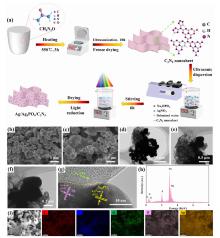
Fig 1
(a) Schematic of the synthetic steps of Ag/Ag3PO4/C3N5; (b, c) SEM images, (d–g) TEM images, (h) EDX profile and (i) element distribution mapping of Ag/Ag3PO4/C3N5."
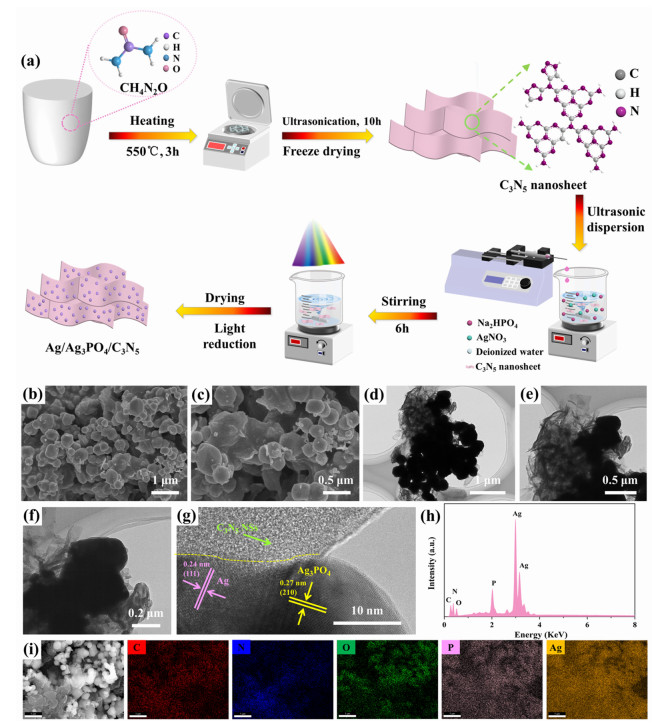
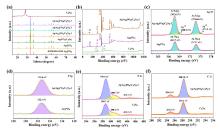
Fig 2
(a) XRD patterns; (b) XPS spectra of Ag3PO4, C3N5 and Ag/Ag3PO4/C3N5-2: (b) full spectra, (c) Ag 3d, (d) P 2p, (e) N 1s, and (f) C 1s."
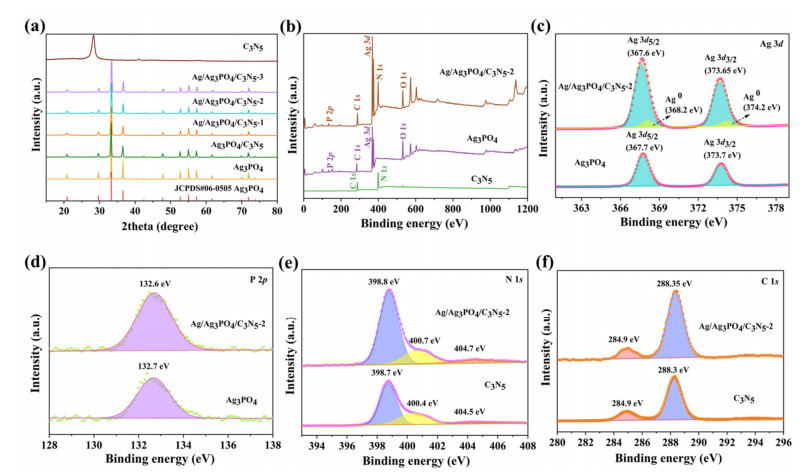
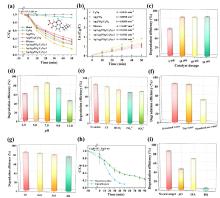
Fig 3
(a) LEV destruction performances and (b) photoreaction kinetics; (c–f) Photocatalytic LEV treatment efficacy by Ag/Ag3PO4/C3N5-2 under various conditions; (g) Cyclic photo-destruction of LEV over Ag/Ag3PO4/C3N5-2; (h) The photo-destruction curves of ciprofloxacin and oxytetracycline over Ag/Ag3PO4/C3N5-2; (i) The contributions of diverse ROS for LEV eradication."
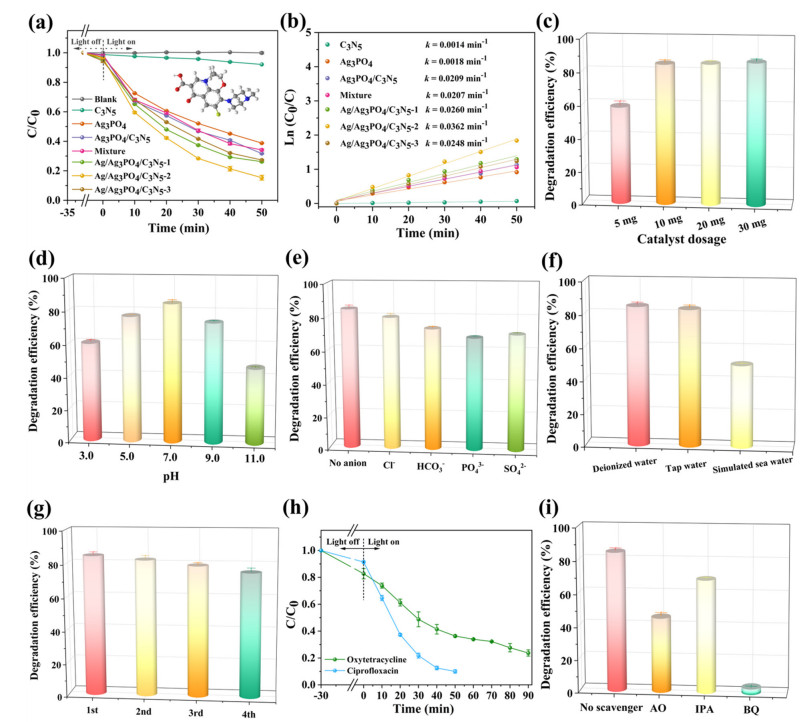
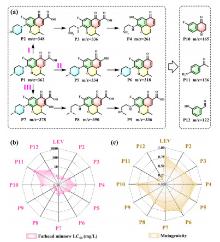
Fig 4
(a) Fragmentation process of LEV over Ag/Ag3PO4/C3N5; (b, c) Toxicity evaluation."
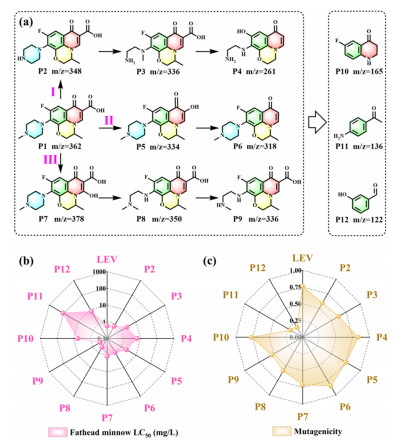
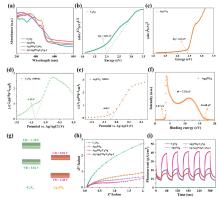
Fig 5
(a) UV-Vis DRS; (b, c) Band energies, (d, e) Mott-Schottky profiles of Ag3PO4 and C3N5, (f) UPS spectrum of Ag3PO4; (g) Band alignment of Ag3PO4 and C3N5; (h) Nyquist curves, and (i) Transient photocurrent behaviors."

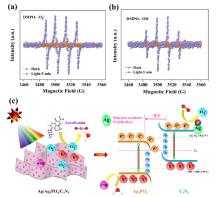
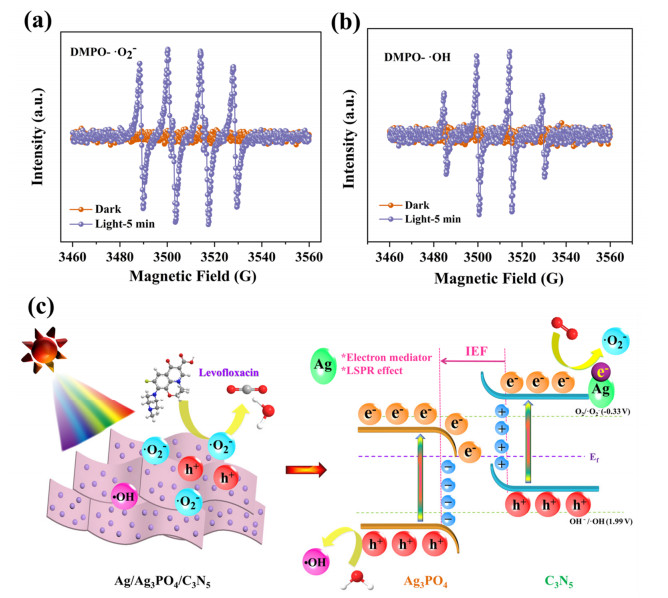
Fig 6
(a, b) ESR signals in Ag/Ag3PO4/C3N5 system; (c) The working mechanism of Ag/Ag3PO4/C3N5 for LEV destruction."
| 1 |
doi: 10.1016/j.eehl.2022.10.001 |
| 2 |
doi: 10.1016/j.eehl.2022.04.003 |
| 3 |
doi: 10.1021/acs.est.0c07609 |
| 4 |
doi: 10.1038/s41893-022-01042-z |
| 5 |
doi: 10.1038/s41893-022-00915-7 |
| 6 |
doi: 10.1016/j.envpol.2022.118922 |
| 7 |
doi: 10.1021/acs.est.2c06579 |
| 8 |
doi: 10.1007/s10311-021-01194-y |
| 9 |
doi: 10.1039/c9cs00102f |
| 10 |
doi: 10.1039/D1CS01182K |
| 11 |
doi: 10.1002/smll.202101638 |
| 12 |
doi: 10.1039/c9cs00377k |
| 13 |
doi: 10.1038/s41560-021-00919-1 |
| 14 |
doi: 10.1007/s42765-021-00122-7 |
| 15 |
doi: 10.1016/j.apmate.2021.11.011 |
| 16 |
doi: 10.1016/j.apmate.2022.100094 |
| 17 |
|
|
周文杰; 景启航; 李家馨; 陈颖芝; 郝国栋; 王鲁宁. 物理化学学报, 2023, 39, 2211010.
doi: 10.3866/PKU.WHXB202211010 |
|
| 18 |
doi: 10.1016/S1872-2067(21)63934-7 |
| 19 |
doi: 10.1016/S1872-2067(21)63876-7 |
| 20 |
doi: 10.14102/j.cnki.0254-5861.2021-0027 |
| 21 |
doi: 10.1016/S1872-2067(22)64193-7 |
| 22 |
doi: 10.1038/s41570-022-00434-1 |
| 23 |
doi: 10.1007/s42765-022-00189-w |
| 24 |
doi: 10.1016/j.jmst.2023.08.021 |
| 25 |
doi: 10.14102/j.cnki.0254-5861.2022-0188 |
| 26 |
doi: 10.1016/j.ccr.2022.214541 |
| 27 |
doi: 10.1038/s41929-021-00678-y |
| 28 |
doi: 10.1016/j.jmst.2022.08.030 |
| 29 |
doi: 10.1021/acs.chemrev.1c00473 |
| 30 |
doi: 10.1016/S1872-2067(22)64114-7 |
| 31 |
doi: 10.1016/j.jece.2021.106025 |
| 32 |
doi: 10.1016/j.eehl.2022.05.001 |
| 33 |
doi: 10.1007/s42765-022-00192-1 |
| 34 |
doi: 10.1016/j.jmst.2021.12.003 |
| 35 |
doi: 10.1016/S1872-2067(23)64417-1 |
| 36 |
doi: 10.1038/s41467-023-41522-0 |
| 37 |
doi: 10.1016/j.seppur.2022.122865 |
| 38 |
doi: 10.1016/S1872-2067(21)63813-5 |
| 39 |
doi: 10.1021/acs.langmuir.1c03127 |
| 40 |
doi: 10.1002/ange.202108605 |
| 41 |
doi: 10.1007/s42765-022-00149-4 |
| 42 |
doi: 10.1007/s42765-022-00205-z |
| 43 |
doi: 10.1021/acsami.2c03758 |
| 44 |
doi: 10.1016/j.nanoms.2023.02.003 |
| 45 |
doi: 10.1016/j.chemosphere.2022.135716 |
| 46 |
doi: 10.1021/acsami.2c04729 |
| 47 |
doi: 10.1016/j.esci.2022.06.006 |
| 48 |
doi: 10.1016/j.esci.2023.100095 |
| 49 |
doi: 10.1016/S1872-2067(20)63768-8 |
| 50 |
doi: 10.1002/adma.202200563 |
| 51 |
doi: 10.1016/j.jmst.2023.04.007 |
| 52 |
doi: 10.1016/S1872-2067(23)64444-4 |
| 53 |
doi: 10.1002/adma.202300643 |
| 54 |
doi: 10.1016/S1872-2067(21)63843-3 |
| 55 |
doi: 10.14102/j.cnki.0254-5861.2021-0046 |
| 56 |
doi: 10.14102/j.cnki.0254-5861.2021-0026 |
| 57 |
doi: 10.1016/j.compositesb.2022.109726 |
| 58 |
|
|
吴新鹤; 陈郭强; 王娟; 李金懋; 王国宏. 物理化学学报, 2023, 39, 2212016.
doi: 10.3866/PKU.WHXB202212016 |
|
| 59 |
|
|
朱弼辰; 洪小洋; 唐丽永; 刘芹芹; 唐华. 物理化学学报, 2022, 38, 2111008.
doi: 10.3866/PKU.WHXB202111008 |
|
| 60 |
doi: 10.1016/S1872-2067(21)64038-X |
| 61 |
doi: 10.14102/j.cnki.0254-5861.2022-0150 |
| 62 |
doi: 10.1016/S1872-2067(23)64479-1 |
| 63 |
|
|
王春春; 游常俊; 戎珂; 申楚琦; 杨方; 李世杰. 物理化学学报, 2024, 40, 2307045.
doi: 10.3866/PKU.WHXB202307045 |
|
| 64 |
doi: 10.1016/S1872-2067(21)64005-6 |
| 65 |
doi: 10.1016/j.trechm.2022.08.008 |
| 66 |
doi: 10.1016/S1872-2067(23)64496-1 |
| 67 |
doi: 10.1016/S1872-2067(23)64420-1 |
| 68 |
doi: 10.1002/adfm.202214470 |
| 69 |
|
|
王中辽; 汪静; 张金锋; 代凯. 物理化学学报, 2023, 39, 2209037.
doi: 10.3866/PKU.WHXB202209037 |
|
| 70 |
|
|
罗铖; 龙庆; 程蓓; 朱必成; 王临曦. 物理化学学报, 2023, 39, 2212026.
doi: 10.3866/PKU.WHXB202212026 |
|
| 71 |
doi: 10.1016/j.apmate.2022.100073 |
| 72 |
doi: 10.1002/ange.202218688 |
| 73 |
doi: 10.1016/j.jmst.2021.12.065 |
| 74 |
doi: 10.1016/j.esci.2023.100208 |
| 75 |
doi: 10.1016/j.apcatb.2020.119479 |
| 76 |
doi: 10.1016/j.apcatb.2018.03.011 |
| 77 |
doi: 10.1016/j.apcatb.2019.118327 |
| 78 |
doi: 10.1016/S1872-2067(22)64099-3 |
| 79 |
doi: 10.1021/acsami.3c01255 |
| 80 |
doi: 10.1021/acs.nanolett.0c03344 |
| 81 |
doi: 10.1021/acsami.0c08624 |
| 82 |
doi: 10.1021/acsnano.0c10945 |
| 83 |
doi: 10.1021/acsomega.8b00847 |
| 84 |
doi: 10.1016/j.apcatb.2020.118978 |
| 85 |
doi: 10.1016/j.ijhydene.2018.09.079 |
| 86 |
doi: 10.14102/j.cnki.0254-5861.2022-0108 |
| 87 |
doi: 10.1016/j.nanoms.2022.03.001 |
| 88 |
|
|
周亮; 李云锋; 张永康; 秋列维; 邢艳. 物理化学学报, 2022, 38, 2112027.
doi: 10.3866/PKU.WHXB202112027 |
|
| 89 |
doi: 10.1007/s42765-022-00253-5 |
| 90 |
doi: 10.1002/adma.202005738 |
| 91 |
|
|
刘珊池; 王凯; 杨梦雪; 靳治良. 物理化学学报, 2022, 38, 2109023.
doi: 10.3866/PKU.WHXB202109023 |
|
| 92 |
doi: 10.1039/C8CS00108A |
| 93 |
doi: 10.1002/adma.202107668 |
| 94 |
doi: 10.1016/j.cej.2022.141185 |
| 95 |
doi: 10.1016/j.jmst.2023.03.054 |
|
||