Acta Phys. -Chim. Sin. ›› 2024, Vol. 40 ›› Issue (11): 2406027.doi: 10.3866/PKU.WHXB202406027
Special Issue: Solar fuel preparation
• ARTICLE • Previous Articles Next Articles
Efficient Photocatalytic Production of H2O2 over ZnO/D-A Conjugated Polymer S-scheme Heterojunction and Charge Transfer Dynamics Investigation
You Wu1,2, Chang Cheng2, Kezhen Qi1,*( ), Bei Cheng2,*(), Jianjun Zhang3,*(), Jiaguo Yu3, Liuyang Zhang3
- 1 College of Pharmacy, Dali University, Dali 671000, Yunnan Province, China
2 State Key Laboratory of Advanced Technology for Materials Synthesis and Processing, Wuhan University of Technology, Wuhan 430070, China
3 Laboratory of Solar Fuel, Faculty of Materials Science and Chemistry, China University of Geosciences, Wuhan 430078, China
-
Received:2024-06-21Revised:2024-07-25Accepted:2024-07-26Published:2024-10-14 -
Contact:Email: qkzh2003@aliyun.com (Kezhen Qi)chengbei2013@whut.edu.cn (Bei Cheng)zhangjianjun@cug.edu.cn (Jianjun Zhang) -
Supported by:Yunnan Provincial Science and Technology Plan Project(202305AF150116); the National Natural Science Foundation of China(22238009); the National Natural Science Foundation of China(U23A20102); the National Natural Science Foundation of China(52073223); the National Natural Science Foundation of China(22278324); the National Natural Science Foundation of China(22361142704); the Natural Science Foundation of Hubei Province of China(2022CFA001); the Fundamental Research Funds for the Central Universities, China University of Geosciences (Wuhan)(CUG22061)

Cite this article
You Wu, Chang Cheng, Kezhen Qi, Bei Cheng, Jianjun Zhang, Jiaguo Yu, Liuyang Zhang. Efficient Photocatalytic Production of H2O2 over ZnO/D-A Conjugated Polymer S-scheme Heterojunction and Charge Transfer Dynamics Investigation[J]. Acta Phys. -Chim. Sin. 2024, 40(11), 2406027. doi: 10.3866/PKU.WHXB202406027
share this article
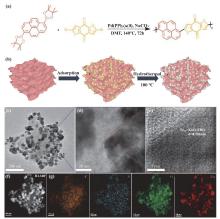
Fig 1
(a) Synthesis route of PBD; (b) Schematic diagram of ZP-x composites prepared by hydrothermal method; (c, d) TEM images of ZP-10; (e) HRTEM image of ZnO; (f, g) HAADF image of ZP-10 and elemental mapping of Zn, O, C, S."
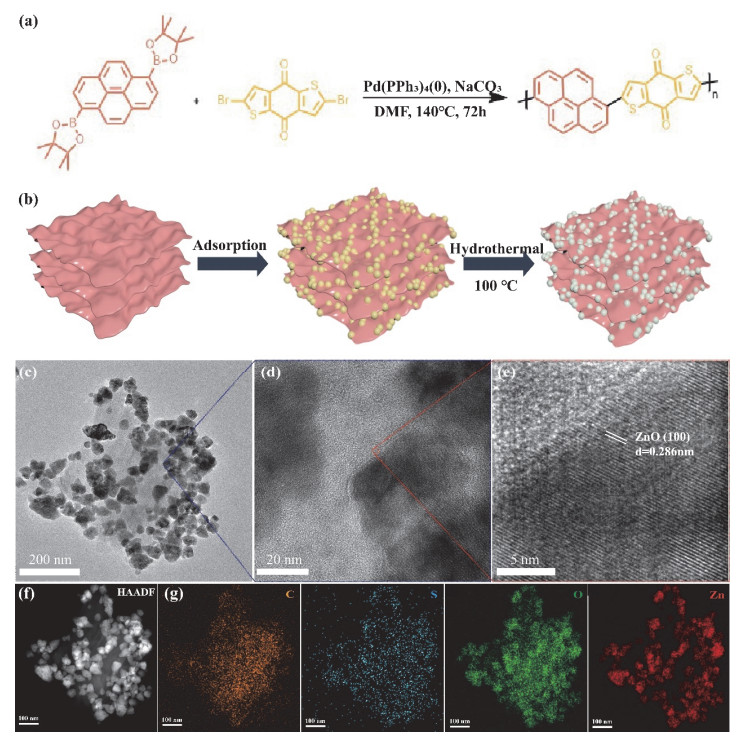
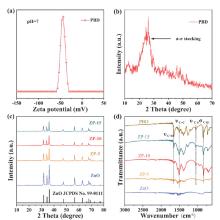
Fig 2
(a) Zeta potential of PBD at pH = 7; XRD spectra of (b) PBD, (c) ZnO and ZP-x composite; (d) FT-IR of PBD, ZnO, and ZP-x composites."
Fig 3
(a) Photocatalytic H2O2 performance of different samples; (b) Cyclic stability test of H2O2 production by ZP-10; (c) Comparison of XRD patterns before and after cycling test of ZP-10; (d) Kf and Kd values fitted to different photocatalysts."
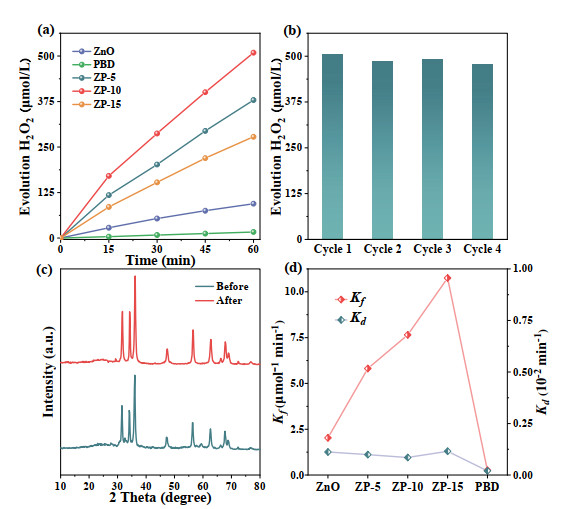
Fig 4
(a) PL spectra of ZnO, PBD, and ZP-10; (b) TRPL spectra of ZnO and ZP-10."
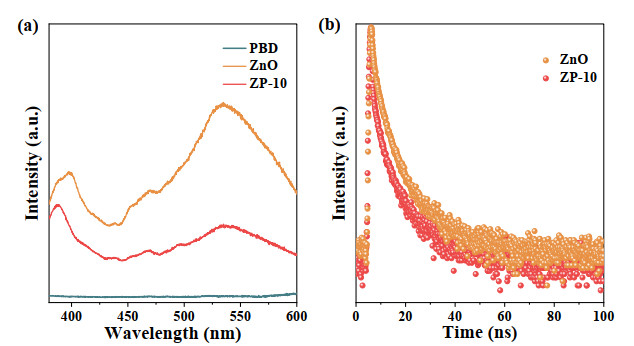
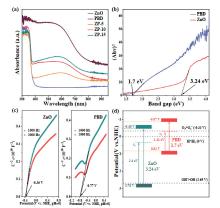
Fig 5
(a) UV-Vis DRS spectra of ZnO, PBD, and ZP-x; (b) Tauc curves of ZnO and PBD; (c) Mott-Schottky plots of ZnO and PBD; (d) Energy band structures of ZnO and PBD."
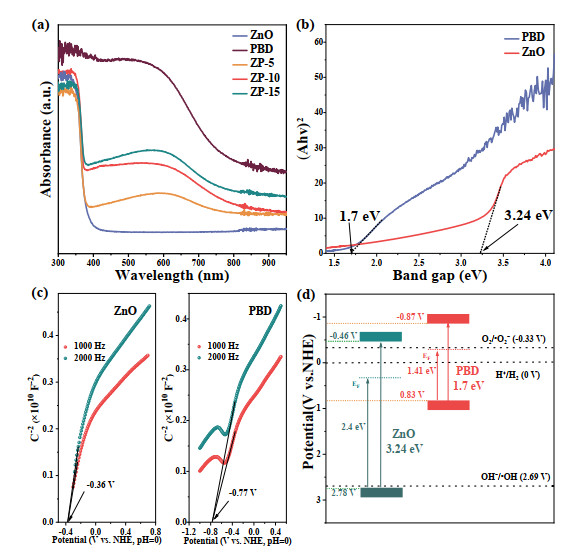
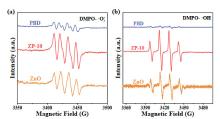
Fig 6
(a) DMPO- •signals of ZnO, PBD and ZP-10 in methanol; (b) DMPO-OH signals of ZnO, PBD and ZP-10 in water."
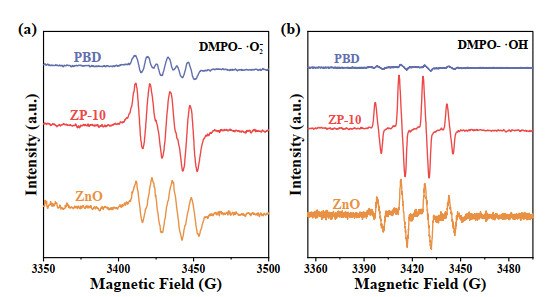
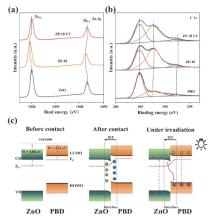
Fig 7
High resolution (a) Zn 2p spectra of ZnO and ZP-10 and (b) C 1s spectra of ZnO and ZP-10 in darkness and under photoexcitaion. (c) Schematic for the formation process and electron transfer paths in ZnO/PBD S-scheme heterojunction."
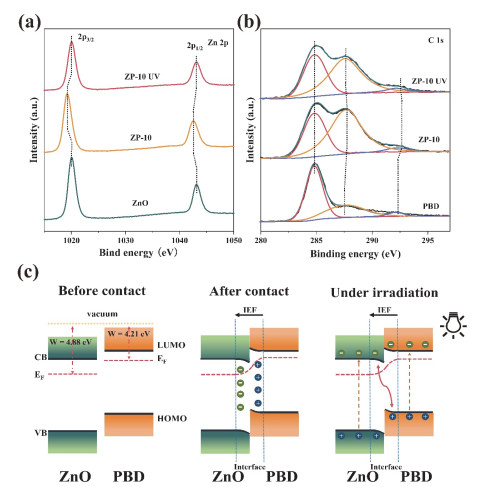
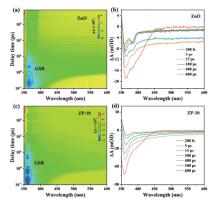
Fig 8
2D pseudocolor fs-TA plots of (a) ZnO and (c) ZP-10; fs-TA spectra of (b) ZnO and (d) ZP-10 at indicated delay time using 400 nm pump pulse in an aqueous environment."
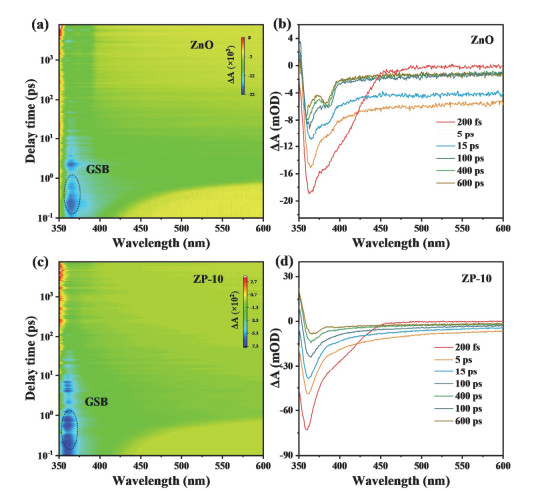
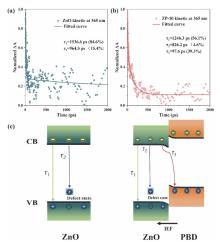
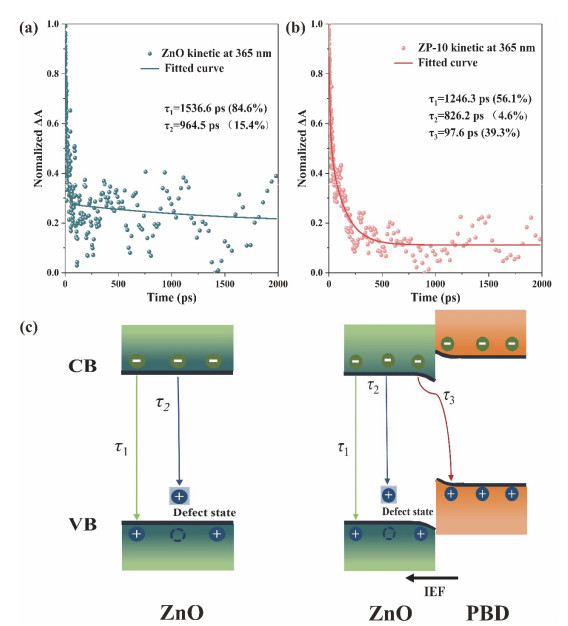
Fig 9
(a) Schematics for the electron quenching dynamics in ZnO and ZP-10; (b) Normalized GSB decay kinetics of ZnO and (c) ZP-10 probed at 365 nm."
| 1 |
doi: 10.1002/anie.202309624 |
| 2 |
doi: 10.1002/adma.202307967 |
| 3 |
doi: 10.1016/j.apcatb.2023.122780 |
| 4 |
doi: 10.1016/j.jmst.2023.03.045 |
| 5 |
doi: 10.7536/PC220718 |
| 6 |
doi: 10.1016/j.apcatb.2022.122200 |
| 7 |
doi: 10.3866/PKU.WHXB202309020 |
| 8 |
doi: 10.1021/acscatal.0c03359 |
| 9 |
doi: 10.1039/D2TA08203A |
| 10 |
doi: 10.3866/PKU.WHXB202212010 |
| 11 |
doi: 10.1016/j.apcatb.2022.121675 |
| 12 |
doi: 10.1039/D4TC01076K |
| 13 |
doi: 10.1007/s11467-019-0950-z |
| 14 |
doi: 10.1016/j.jmst.2023.05.030 |
| 15 |
doi: 10.1038/s41467-024-47624-7 |
| 16 |
doi: 10.1016/j.jmst.2022.09.002 |
| 17 |
doi: 10.1007/s40843-023-2717-0 |
| 18 |
doi: 10.1002/anie.202310476 |
| 19 |
doi: 10.1016/j.apcatb.2023.122770 |
| 20 |
doi: 10.1039/D1TA11022E |
| 21 |
doi: 10.1016/j.jhazmat.2021.127379 |
| 22 |
doi: 10.1016/S1872-2067(23)64475-4 |
| 23 |
doi: 10.1016/j.cej.2023.145067 |
| 24 |
doi: 10.1002/smll.202100132 |
| 25 |
doi: 10.1002/adma.202310600 |
| 26 |
doi: 10.3866/PKU.WHXB202209037 |
| 27 |
doi: 10.1016/j.jmat.2023.05.014 |
| 28 |
doi: 10.1021/acs.jpclett.3c00811 |
| 29 |
doi: 10.3866/PKU.WHXB202209016 |
| 30 |
doi: 10.1016/j.jmst.2023.03.054 |
| 31 |
doi: 10.1002/adma.202203225 |
| 32 |
doi: 10.1016/j.jmat.2021.06.006 |
| 33 |
doi: 10.3866/PKU.WHXB202307022 |
| 34 |
doi: 10.3866/PKU.WHXB202112037 |
| 35 |
doi: 10.1007/s40843-023-2754-8 |
| 36 |
doi: 10.1007/s40843-023-2755-2 |
| 37 |
doi: 10.1016/j.jmst.2023.12.054 |
| 38 |
doi: 10.1016/j.jmst.2022.01.029 |
| 39 |
doi: 10.1016/j.cej.2022.136584 |
| 40 |
doi: 10.1007/s12598-021-01902-1 |
| 41 |
doi: 10.1016/S1872-2067(21)63832-9 |
| 42 |
doi: 10.1038/s41467-021-25007-6 |
| 43 |
doi: 10.1016/S1872-2067(23)64502-4 |
| 44 |
doi: 10.1016/S1872-2067(23)64514-0 |
| 45 |
doi: 10.1515/ntrev-2022-0035 |
| 46 |
doi: 10.1039/C5TA05503B |
| 47 |
doi: 10.1016/j.apsusc.2017.06.176 |
| 48 |
doi: 10.1021/acssuschemeng.8b00938 |
| 49 |
doi: 10.1039/D1NR03221F |
| 50 |
doi: 10.1016/j.apcatb.2019.03.055 |
| 51 |
doi: 10.1002/smll.202205097 |
| 52 |
doi: 10.1016/j.orgel.2016.10.016 |
| 53 |
doi: 10.1016/j.optmat.2024.115241 |
| 54 |
doi: 10.1016/j.diamond.2023.110364 |
| 55 |
doi: 10.1002/advs.201902988 |
| 56 |
doi: 10.35848/1347-4065/acbd57 |
| 57 |
doi: 10.1016/S1872-2067(22)64108-1 |
| 58 |
doi: 10.1016/j.jece.2020.104097 |
| 59 |
doi: 10.1088/1361-6528/aaa530 |
| 60 |
doi: 10.1021/acsomega.7b00767 |
| 61 |
doi: 10.1016/S1872-2067(23)64466-3 |
| 62 |
doi: 10.1039/D2CC06300J |
| 63 |
doi: 10.1002/anie.202218688 |
| 64 |
doi: 10.1016/j.apcatb.2023.123196 |
| 65 |
doi: 10.1016/j.jmst.2024.02.012 |
| 66 |
doi: 10.1038/s41467-024-45604-5 |
| 67 |
doi: 10.1002/adma.202400288 |
|
||