Acta Phys. -Chim. Sin. ›› 2026, Vol. 42 ›› Issue (6): 100203.doi: 10.1016/j.actphy.2025.100203
• ARTICLE • Previous Articles Next Articles
Construction of pH-responsive Lycium barbarum-derived carbon dots nanovaccines for enhanced anti-tumor immunotherapy
Qingwen Xu1, Zhigang Xie2,*( ), Min Zheng1,*()
- 1 College of Chemistry and Life Sciences, Advanced Institute of Materials Science, Changchun University of Technology, Changchun 130012, Jilin Province, China
2 Key Laboratory of Polymer Ecomaterials, Changchun Institute of Applied Chemistry, Chinese Academy of Sciences, Changchun 130022, Jilin Province, China
-
Received:2025-09-01Revised:2025-10-19Accepted:2025-10-19Published:2026-04-21 -
Contact:Email: xiez@ciac.ac.cn (Zhigang Xie)zhengm@ciac.ac.cn (Min Zheng)

Cite this article
Qingwen Xu, Zhigang Xie, Min Zheng. Construction of pH-responsive Lycium barbarum-derived carbon dots nanovaccines for enhanced anti-tumor immunotherapy[J]. Acta Phys. -Chim. Sin. 2026, 42(6), 100203. doi: 10.1016/j.actphy.2025.100203
share this article
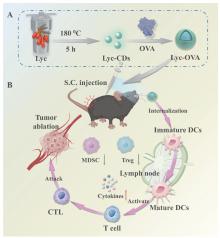
Fig 1
(A) Synthesis of Lyc-CDs and Lyc-OVA. (B) Schematic representation of the immune response triggered by Lyc-OVA in vivo."
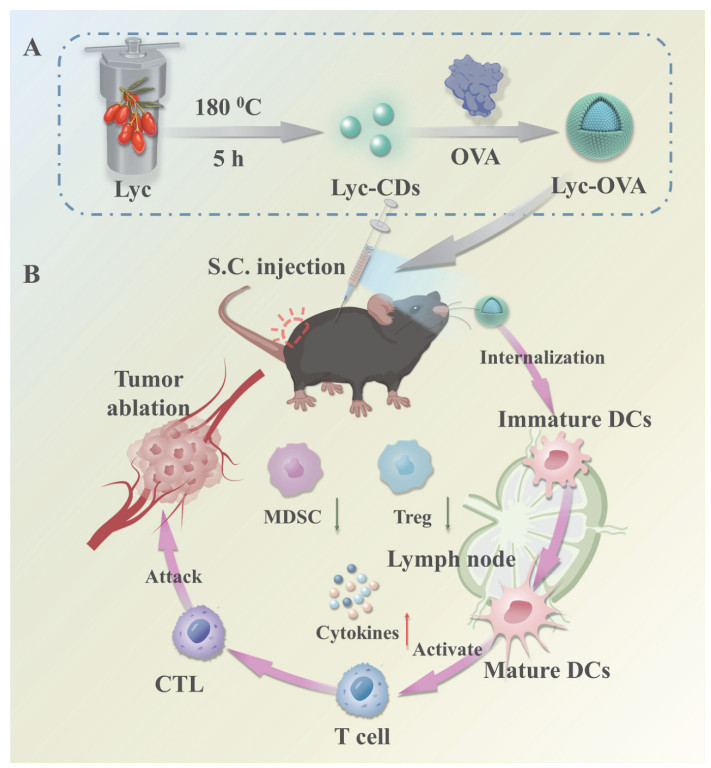
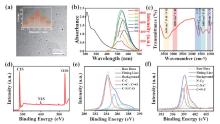
Fig 2
(a) TEM image of Lyc-CDs. (b) UV-Vis absorption and fluorescence spectra of Lyc-CDs. (c) FTIR spectrum of Lyc-CDs. (d) XPS spectrum of Lyc-CDs. High-resolution (e) C 1s, (f) N 1s XPS spectra of Lyc-CDs."
Fig 3
(a) TEM images of Lyc-OVA. (b) Size distribution of Lyc-OVA. (c) SDS-PAGE analysis of OVA, L-Arg-CDs, Lyc-CDs, L-Arg-OVA and Lyc-OVA. (d) Molecular docking diagram of rhamnose in LBP and OVA. (e) Zeta potential of OVA, L-Arg-CDs, Lyc-CDs, L-Arg-OVA and Lyc-OVA. (f) OVA release curve of Lyc-OVA in PBS (pH = 7.4, 6.5 and 5.4)"
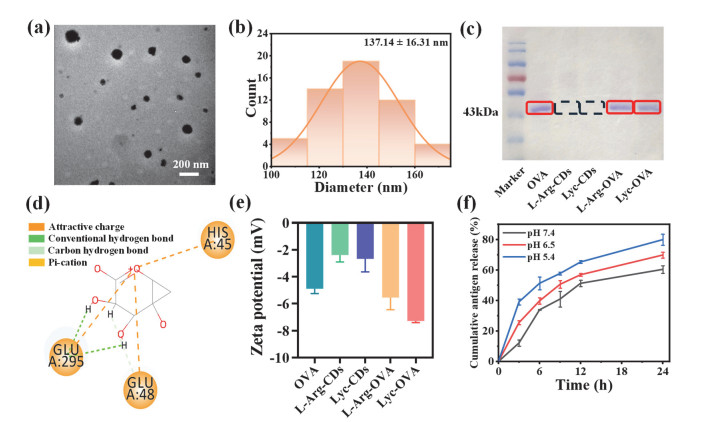
Fig 4
(a) Cell viability of DC2.4 after treatment with Lyc-CDs and Lyc-OVA for 24 h. (b) CLSTM High Content images of immature DC2.4 treated with Lyc-CDs and Lyc-OVA for 2, 4 and 6 h. (c) CD80+CD86+ in DC2.4 after treatment with PBS, OVA, L-Arg-CDs, Lyc-CDs, L-Arg-OVA, Lyc-OVA and LPS. (d) Immunofluorescence images of CD80 and CD86 expressed by DC2.4 cells after incubation with PBS, OVA, L-Arg-CDs, Lyc-CDs, L-Arg-OVA, Lyc-OVA and LPS. (Blue: DAPI; Green: Cytoskeleton). Expression levels of (e) TNF-α, (f) IFN-γ and (g) IL-6 in DC2.4 after treatment with PBS, OVA, L-Arg-CDs, Lyc-CDs, L-Arg-OVA, Lyc-OVA and LPS. Data are expressed as mean ± SD (significance analysis was performed using a two-way ANOVA or two-tailed t-test. ns: not significant, *p < 0.05, **p < 0.01, and ***p < 0.001, n = 4)."
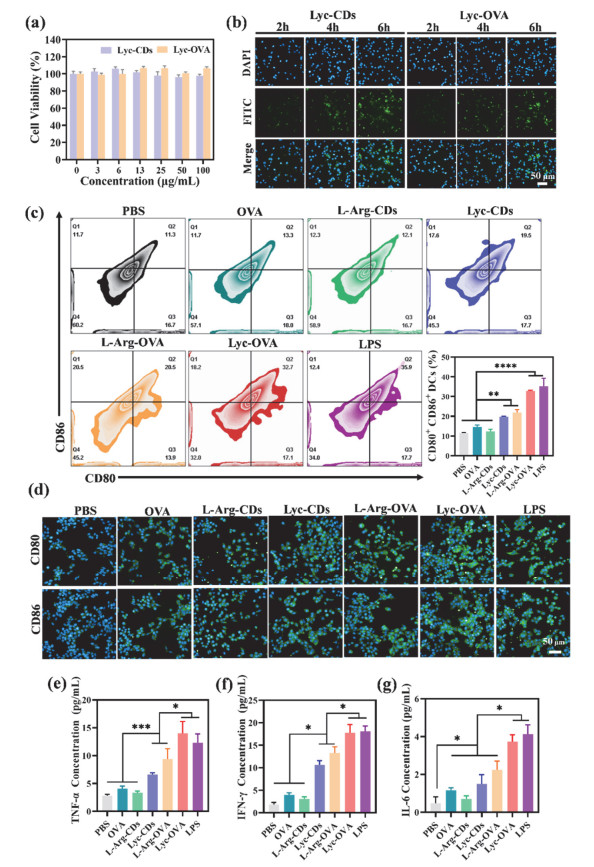
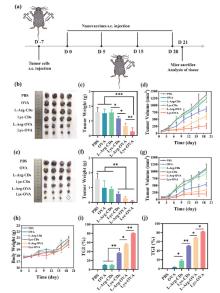
Fig 5
(a) Treatment schedule for B16-OVA tumors in C57BL/6 mice. (b) Pictures of primary tumors. (c) Mean tumor weight of primary tumors. (d) Growth curves of primary tumors (e) Pictures of distal tumors. (f) Mean tumor weight of distal tumors. (g) Growth curves of distal tumors. (h) Curve of mice body weight over time. (i) Tumor Growth Inhibition (TGI) of the primary tumors. (j) TGI of the distal tumors. Data are expressed as mean ± SD (significance analysis was performed using a two-way ANOVA or two-tailed t-test. ns: not significant, *p < 0.05, **p < 0.01, and ***p < 0.001, n = 5)."
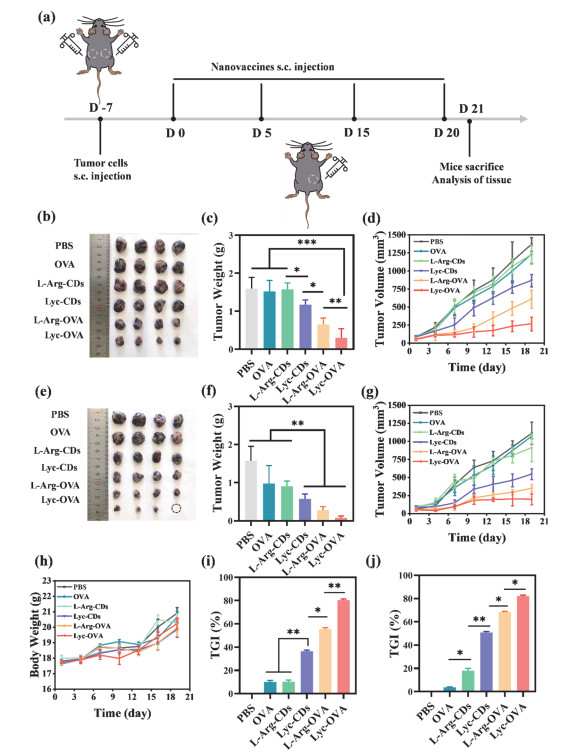
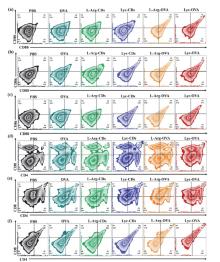
Fig 6
Percentage of mature DC cells in the (a) LNs, (b) spleens and (c) in the tumors. Percentage of CD4+CD8+ T cells in the (d) LNs, (e) spleens and (f) tumors."
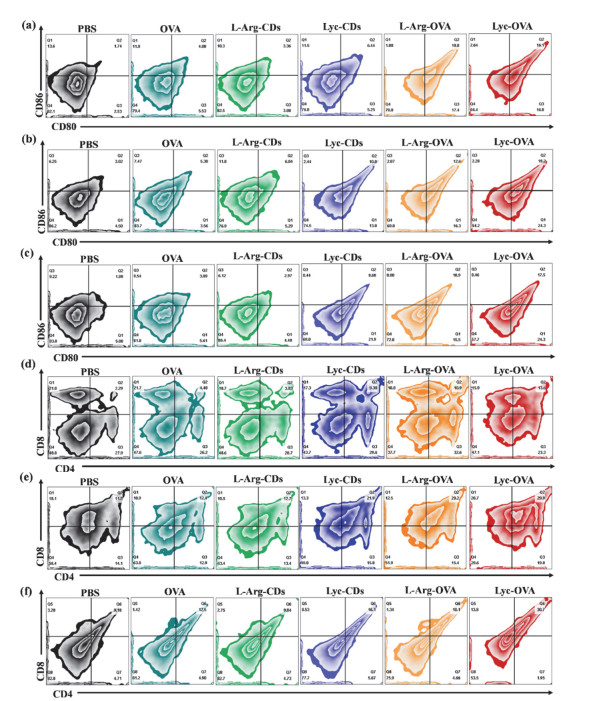
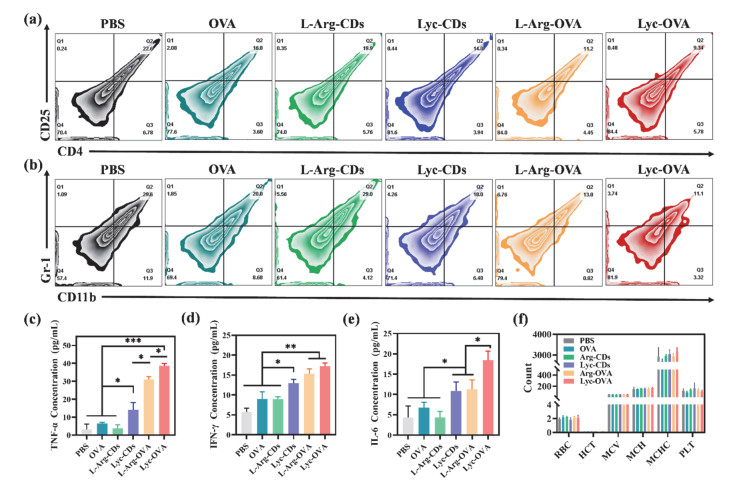
Fig 7
Percentage of (a) MDSCs and (b) Tregs in the tumors. Serum levels of cytokines including (c) TNF-α, (d) IFN-γ and (e) IL-6 in mice. (f) Blood routine analysis of the mice. Data are expressed as mean ± SD (significance analysis was performed using a two-way ANOVA or two-tailed t-test. ns: not significant, *p < 0.05, **p < 0.01, and ***p < 0.001, n = 5)."
| 1 |
H. Liu, T. Zhang, M. Zheng, Z. Xie. J. Colloid Interface Sci. 2024, 673, 594.
doi: 10.1016/j.jcis.2024.06.101 |
| 2 |
P. Guasp, C. Reiche, Z. Sethna, V. Balachandran. Cancer Cell 2024, 42, 1163.
doi: 10.1016/j.ccell.2024.05.005 |
| 3 |
W. Zhang, X. Shi, S. Huang, Q. Yu, Z. Wu, W. Xie, B. Li, Y. Xu, Z. Gao, G. Li, et al.. Cancer Immunol. Immunother. 2024, 73, 245.
doi: 10.1007/s00262-024-03830-2 |
| 4 |
A. Brandenburg, A. Heine, P. Brossart. Trends Cancer 2024, 10, 749.
doi: 10.1016/j.trecan.2024.06.003 |
| 5 |
X. Zhu, T. Wang, H. Jia, F. Wu. Adv. Funct. Mater. 2022, 32, e2207181.
doi: 10.1002/adfm.202207181 |
| 6 |
G. Jin, H. Liu, Z. Mei, Q. Jin, S. Ma, L. Wang, Y. Su, L. Lv, Z. Wang, H. Zhou, et al.. Bioact. Mater. 2025, 45, 102.
doi: 10.1016/j.bioactmat.2024.11.008 |
| 7 |
H. Liu, Z. Xie, M. Zheng. ACS Appl. Mater. Interfaces 2022, 14, 39858.
doi: 10.1021/acsami.2c11596 |
| 8 |
Z. Cui, C. Shi, R. An, Y. Tang, Y. Li, X. Cao, X. Jiang, C. Liu, M. Xiao, L. Xu. ACS Nano 2025, 19, 2099.
doi: 10.1021/acsnano.4c08898 |
| 9 |
C. Sun, S. Li, J. Ding. Adv. Healthcare Mater. 2024, 13, e2400864.
doi: 10.1002/adhm.202400864 |
| 10 |
C. Zhang, G. Shi, J. Zhang, H. Song, J. Niu, S. Shi, P. Huang, Y. Wang, W. Wang, C. Li, et al.. J. Control. Release 2017, 256, 170.
doi: 10.1016/j.jconrel.2017.04.020 |
| 11 |
W. Zhang, W. Ma, J. Zhang, X. Song, W. Sun, Y. Fan. Int. J. Biol. Macromol. 2017, 105, 852.
doi: 10.1016/j.ijbiomac.2017.07.108 |
| 12 |
L. Zhou, L. Zhao, M. Wang, X. Qi, X. Zhang, Q. Song, D. Xue, M. Mao, Z. Zhang, J. Shi, et al.. Adv. Sci. 2024, 11, e2402199.
doi: 10.1002/advs.202402199 |
| 13 |
J. Zhou, K. Tison, H. Zhou, L. Bai, R. Acharyya, D. McEachern, H. Metwally, Y. Wang, M. Pitter, J. Choi, et al.. Nature 2025, 643, 519.
doi: 10.1038/s41586-025-09000-3 |
| 14 |
H. Fang, Y. Wu, L. Chen, Z. Cao, Z. Deng, R. Zhao, L. Zhang, Y. Yang, Z. Liu, Q. Chen. ACS Nano 2023, 17, 4748.
doi: 10.1021/acsnano.2c11159 |
| 15 |
D. Han, X. Liao, Q. Huang, L. Qi, C. Xu, X. Ren, X. He, T. Guo, Y. Huang, X. Pang, et al.. ACS Nano 2025, 19, 20808.
doi: 10.1021/acsnano.5c03116 |
| 16 |
Y. Huang, J. Zou, J. Huo, M. Zhang, Y. Yang. Adv. Mater. 2024, 36, e2407914.
doi: 10.1002/adma.202407914 |
| 17 |
L. Li, J. Wu, X. Wu, Z. Li, X. Zhang, Z. Yan, Y. Liang, C. Huang, S. Qu. Adv. Mater. 2025, 37, e2420068.
doi: 10.1002/adma.202420068 |
| 18 |
S. Wu, F. Wu, X. Chen. Adv. Mater. 2022, 34, e2109210.
doi: 10.1002/adma.202109210 |
| 19 |
J. Zhang, J. Liu, H. Zhang, B. Liu, L. Li, Y. Li, J. Pei, Q. Lin, Q. Chen, J. Lin. Mater. Today Bio 2025, 31, e101559.
doi: 10.1016/j.mtbio.2025.101559 |
| 20 |
J. Sun, Z. Huangfu, J. Yang, G. Wang, K. Hu, M. Gao, Z. Zhong. Adv. Drug Deliv. Rev. 2022, 190, e114538.
doi: 10.1016/j.addr.2022.114538 |
| 21 |
M. Chen, J. Jiang, H. Chen, R. Wu, W. Xie, S. Dai, W. Zheng, G. Tan, F. Huang. J. Immunother. Cancer 2025, 13, e010150.
doi: 10.1136/jitc-2024-010150 |
| 22 |
S. Lu, B. Yang. SmartMat 2022, 3, 207.
doi: 10.1002/smm2.1132 |
| 23 |
H. Liu, Z. Xie, M. Zheng. Small 2023, 19, e2206683.
doi: 10.1002/smll.202206683 |
| 24 |
J. Liu, R. Li, B. Yang. ACS Cent. Sci. 2020, 6, 2179.
doi: 10.1021/acscentsci.0c01306 |
| 25 |
H. Feng, Y. Hong, Q. Li, S. Qu. Chem. Eng. J. 2024, 502, 157991.
doi: 10.1016/j.cej.2024.157991 |
| 26 |
Y. Zhang, J. Wang, L. Wang, R. Fu, L. Sui, H. Song, Y. Hu, S. Lu. Adv. Mater. 2023, 35, e2302536.
doi: 10.1002/adma.202302536 |
| 27 |
F. Shan, J. Zhang, C. Liao, Y. Liu, X. Li, H. Mi, W. Wang, S. Jiang, M. Li, Y. Liu, et al.. ACS Nano 2025, 19, 20205.
doi: 10.1021/acsnano.5c05934 |
| 28 |
Y. Hu, O. Seivert, Y. Tang, H. Karahan, A. Bianco. Angew. Chem. Int. Ed. 2024, 63, 202412341.
doi: 10.1002/anie.202412341 |
| 29 |
M. Gao, S. Sun, H. Lin, C. Yang. Chin. Chem. Lett. 2025, 111055.
doi: 10.1016/j.cclet.2025.111055 |
| 30 |
Y. Xu, B. Wang, M. Zhang, J. Zhang, Y. Li, P. Jia, H. Zhang, L. Duan, Y. Li, Y. Li, et al.. Adv. Mater. 2022, 34, e2200905.
doi: 10.1002/adma.202200905 |
| 31 |
J. Li, W. Fu, X. Zhang, Q. Zhang, D. Ma, Y. Wang, W. Qian, D. Zhu. Carbon 2023, 208, 208.
doi: 10.1016/j.carbon.2023.03.039 |
| 32 |
P. Liang, T. Bi, Y. Zhou, C. Wang, Y. Ma, H. Xu, H. Shen, W. Ren, S. Yang. Small 2023, 19, e2303498.
doi: 10.1002/smll.202303498 |
| 33 |
M. Li, Z. Xie, M. Zheng. Biosens. Bioelectron. 2024, 263, 116576.
doi: 10.1016/j.bios.2024.116576 |
| 34 |
Z. Li, R. Zhao, Q. Pei, Z. Xie, M. Zheng. Adv. Sci. 2025, 03883.
doi: 10.1002/advs.202503883 |
| 35 |
L. Yang, F. Dai, H. Tang, M. Li, Y. An, Y. Tan, R. Liu, X. Tan, W. Zhang, S. Rizvi, et al.. Chem. Eng. J. 2025, 513, e162637.
doi: 10.1016/j.cej.2025.162637 |
| 36 |
G. Zhang, C. Kang, H. Chen, W. Tian, H. Liu. Chem. Eng. J. 2025, 508, e160594.
doi: 10.1016/j.cej.2025.160594 |
| 37 |
M. Fang, B. Wang, X. Qu, S. Li, J. Huang, J. Li, S. Lu, N. Zhou. Chin. Chem. Lett. 2024, 35, 64.
doi: 10.1016/j.cclet.2023.108423 |
| 38 |
Y. Li, J. Yang, S. Shen, J. Ding. Nano Today 2025, 64, e102805.
doi: 10.1016/j.nantod.2025.102805 |
| 39 |
L. Gu, J. Zhang, G. Yang, Y. Tang, X. Zhang, X. Huang, W. Zhai, E. Fodjo, C. Kong. Food Chem. 2022, 376, 131898.
doi: 10.1016/j.foodchem.2021.131898 |
| 40 |
Z. Guo, Z. Wang, Y. Liu, H. Wu, Q. Zhang, J. Han, J. Liu, C. Zhang. ACS Appl. Mater. Interfaces 2023, 15, 20726.
doi: 10.1021/acsami.3c01322 |
| 41 |
D. Wu, H. Guo, S. Lin, S. Lam, L. Zhao, D. Lin, W. Qin. Trends Food Sci. Technol. 2018, 79, 171.
doi: 10.1016/j.tifs.2018.07.016 |
| 42 |
L. Sun, Y. Liu, Q. Sun, G. Wang, B. Du, B. Liu, T. Gao, P. Zhao, Y. Yang, R. Rong, et al.. Carbohydr. Polym. 2025, 357, 123416.
doi: 10.1016/j.carbpol.2025.123416 |
| 43 |
Y. Liu, L. Zhang, H. Cai, X. Qu, J. Chang, G. Waterhouse, S. Lu. Sci. Bull. 2024, 69, 3127.
doi: 10.1016/j.scib.2024.08.011 |
| 44 |
L. Sushytskyi, A. Synytsya, P. Lukac, L. Rajsiglová, P. Capek, R. Pohl, R. Bleha, L. Vannucci, D. Smrz, J. Copíková, et al.. Carbohydr. Polym. 2025, 353, 123242.
doi: 10.1016/j.carbpol.2025.123242 |
| 45 |
Y. Guo, P. Hu, J. Shi. J. Am. Chem. Soc. 2024, 146, 10217.
doi: 10.1021/jacs.3c14005 |
| 46 |
X. Qiu, Y. Qu, B. Guo, H. Zheng, F. Meng, Z. Zhong. J. Control. Release 2022, 341, 498.
doi: 10.1016/j.jconrel.2021.12.002 |
| 47 |
C. Chao, E. Zhang, D. Trinh, E. Udofa, H. Lin, C. Silvers, J. Huo, S. He, J. Zheng, X. Cai, et al.. Nat. Commun. 2025, 16, e4578.
doi: 10.1038/s41467-025-59840-w |
| 48 |
P. Chou, S. Lin, Y. Wu, C. Shen, M. Sheu, H. Ho. J. Control. Release 2022, 351, 970.
doi: 10.1016/j.jconrel.2022.10.002 |
| 49 |
P. Zhang, T. Wang, G. Cui, R. Ye, W. Wan, T. Liu, Y. Zheng, Z. Zhong. Adv. Mater. 2024, 36, e2407189.
doi: 10.1002/adma.202407189 |
| 50 |
Z. Guo, T. Huang, X. Lv, R. Yin, P. Wan, G. Li, P. Zhang, C. Xiao, X. Chen. Biomaterials 2025, 314, e122870.
doi: 10.1016/j.biomaterials.2024.122870 |
| 51 |
X. Li, F. Wu. Biosens. Bioelectron. 2025, 274, e117130.
doi: 10.1016/j.bios.2025.117130 |
| 52 |
Y. Jiang, S. Qi, C. Mao. Acta Pharm. Sin. B 2025, 15, 1796.
doi: 10.1016/j.apsb.2025.03.006 |
| [1] | Ting Li, Xiao Zeng, Yuzhuo Yang, Xinyi Wen, Shurong Ding, Linlin Shi, Yongqiang Zhang, Siyu Lu. Towards practical circularly polarized luminescence: carbon dots-based circularly polarized lasers [J]. Acta Phys. -Chim. Sin., 2026, 42(4): 100191-. |
| [2] | Yinghao Zhang, Huaxin Liu, Hanrui Ding, Zhi Zheng, Wentao Deng, Guoqiang Zou, Laiqiang Xu, Hongshuai Hou, Xiaobo Ji. The application of carbon dots in electrolytes of advanced batteries [J]. Acta Phys. -Chim. Sin., 2026, 42(3): 100170-. |
| [3] | Renyi Shao, Khurram Abbas, Vladimir Yu. Osipov, Haimei Zhu, Yuan Li, Usama, Hong Bi. Red-emitting carbon dots prepared from Epipremnum Aureum leaves extract for biological imaging [J]. Acta Phys. -Chim. Sin., 2026, 42(2): 100134-. |
| [4] | Yu Liu, Pengfei Li, Yize Liu, Zaicheng Sun. Recent advances in carbon dots as a single photocatalyst [J]. Acta Phys. -Chim. Sin., 2026, 42(2): 100167-. |
| [5] | Zihan Cheng, Kai Jiang, Jun Jiang, Henggang Wang, Hengwei Lin. Achieving thermal-stimulus-responsive dynamic afterglow from carbon dots by singlet-triplet energy gap engineering through covalent fixation [J]. Acta Phys. -Chim. Sin., 2026, 42(2): 100169-. |
| [6] | Chunyuan Kang, Xiaoyu Li, Fan Yang, Bai Yang. Ionic-bond crosslinked carbonized polymer dots for tunable and enhanced room temperature phosphorescence [J]. Acta Phys. -Chim. Sin., 2026, 42(1): 100156-. |
| [7] | Xue Wu, Yupeng Liu, Bingzhe Wang, Lingyun Li, Zhenjian Li, Qingcheng Wang, Quansheng Cheng, Guichuan Xing, Songnan Qu. Rationally assembling different surface functionalized carbon dots for enhanced near-infrared tumor photothermal therapy [J]. Acta Phys. -Chim. Sin., 2025, 41(9): 100109-. |
| [8] | Wenlong Wang, Wentao Hao, Lang He, Jia Qiao, Ning Li, Chaoqiu Chen, Yong Qin. Bandgap and adsorption engineering of carbon dots/TiO2 S-scheme heterojunctions for enhanced photocatalytic CO2 methanation [J]. Acta Phys. -Chim. Sin., 2025, 41(9): 100116-. |
| [9] | Tiejin Chen, Xiaokuang Xue, Jian Li, Minhui Cui, Yongliang Hao, Mianqi Xue, Haihua Xiao, Jiechao Ge, Pengfei Wang. Membrane-anchoring nanoengineered carbon dots as a pyroptosis amplifier for robust tumor photodynamic-immunotherapy [J]. Acta Phys. -Chim. Sin., 2025, 41(10): 100113-. |
| [10] | Jianqiao Chang, Huimin Xu, Wenjing Xie, Yang Zhang, Ling Qi, Louzhen Fan, Yong Li. Fluorescent Carbon Dots for Rapid and Highly Sensitive Detection of Nucleic Acids [J]. Acta Phys. -Chim. Sin., 2023, 39(12): 2301034-. |
| [11] | Yuan Liu, Weidong Li, Han Wu, Siyu Lu. Carbon Dots Enhance Ruthenium Nanoparticles for Efficient Hydrogen Production in Alkaline [J]. Acta Phys. -Chim. Sin., 2021, 37(7): 2009082-. |
| [12] | Yanjie HUANG, Chao LIAN, Jinyan ZHOU, Zichen HUANG, Xiaohong KANG, Zhenyu HUANG, Xiaojing LI, Lin CHEN, Yan GUAN. Investigation of Excitation-, pH-, Metal Ion-, Temperature-, and Polarity-Dependent Fluorescence of Carbon Dots Derived from Silkworm Excrement [J]. Acta Physico-Chimica Sinica, 2019, 35(11): 1267-1275. |
| [13] | Jin-Long LIU,Liang-Zhen LIN,Jin-Feng HU,Ming-Jie BAI,Liang-Xian CHEN,Jun-Jun WEI,Li-Fu HEI,Cheng-Ming LI. Reaction Process and Luminescence Mechanism of Carbon Nanodots Prepared by Microwave Synthesis [J]. Acta Phys. -Chim. Sin., 2018, 34(1): 92-98. |
| [14] | Li-Xia SANG,Jia LIN,Hao GE,Lei LEI. Dynamic Analysis of Carbon Dots/KOH Electrolyte Interface by IMPS/IMVS [J]. Acta Phys. -Chim. Sin., 2017, 33(12): 2454-2462. |
| [15] | Tan An-Min,Huang Yuan-Qing,Qu Song-Sheng. Microcalorimetric Study on the Respiratory Burst of Polymorphonuclear Leukocytes [J]. Acta Phys. -Chim. Sin., 1997, 13(01): 71-73. |
|
||