物理化学学报 >> 2026, Vol. 42 >> Issue (5): 100183.doi: 10.1016/j.actphy.2025.100183
离子极化工程调控聚合物氮化碳框架结构实现双氧水高效人工光合成
谢垚1, 李双军2, 陈超1, 樊思宇3, 陶英1,*( ), 张启涛1,*()
- 1 深圳大学微纳光电子学研究院, 二维材料光电科技国际合作联合实验室, 广东 深圳 518060
2 上海大学纳米科学与技术研究中心, 上海 200444
3 Department of Applied Chemistry, Faculty of Engineering, Kyushu Institute of Technology, Kitakyushu 804-8550, Japan
-
收稿日期:2025-08-20修回日期:2025-09-04录用日期:2025-09-04发布日期:2026-01-23 -
通讯作者:Email: taoying951223@163.com (陶英)qitao-zhang@szu.edu.cn (张启涛)
Ionic polarization engineering of polymeric carbon nitride toward efficient H2O2 photosynthesis
Yao Xie1, Shuangjun Li2, Chao Chen1, Siyu Fan3, Ying Tao1,*(), Qitao Zhang1,*()
- 1 International Collaborative Laboratory of 2D Materials for Optoelectronic Science & Technology, Institute of Microscale Optoelectronics, Shenzhen University, Shenzhen 518060, Guangdong Province, China
2 Research Center of Nano Science and Technology, Shanghai University, Shanghai 200444, China
3 Department of Applied Chemistry, Faculty of Engineering, Kyushu Institute of Technology, Kitakyushu 804-8550, Japan
-
Received:2025-08-20Revised:2025-09-04Accepted:2025-09-04Published:2026-01-23 -
Contact:Email: taoying951223@163.com (Ying Tao)qitao-zhang@szu.edu.cn (Qitao Zhang)

摘要:
熔盐极化技术利用高温熔盐中的离子相互作用,成为一种强大但尚未充分开发的结构工程策略。该技术能实现对聚合氮化碳(PCN)的精确结构调控,为提升光催化H2O2合成效率提供了新思路。本研究通过调控LiCl/KCl熔盐比例,成功构建了两种不同晶相结构:以七嗪单元为主的LKCN-0.95和七嗪-三嗪给受体(D-A)结结构的LKCN-0.2。结合实验与理论分析发现,富Li+熔盐体系促进高度有序七嗪骨架形成,而K+主导体系则有利于三嗪单元的引入。优化后的七嗪主导结构和七嗪-三嗪结结构分别展现出27倍和42倍的光合成H2O2性能提升(3.3和5.2 mmol L−1 h−1),较原始PCN(0.12 mmol L−1 h−1)显著提高,并保持五个循环的优异稳定性。机理研究表明,结构调控可增强电荷分离效率并优化氧吸附/活化过程,从而促进选择性2e−氧还原反应。该工作不仅深化了对熔盐驱动结构演变的理解,更为设计高效太阳能驱动H2O2人工光合成催化剂提供了可规模化制备的新方法。
引用本文
谢垚, 李双军, 陈超, 樊思宇, 陶英, 张启涛. 离子极化工程调控聚合物氮化碳框架结构实现双氧水高效人工光合成[J]. 物理化学学报, 2026, 42(5), 100183. doi: 10.1016/j.actphy.2025.100183
Yao Xie, Shuangjun Li, Chao Chen, Siyu Fan, Ying Tao, Qitao Zhang. Ionic polarization engineering of polymeric carbon nitride toward efficient H2O2 photosynthesis[J]. Acta Phys. -Chim. Sin. 2026, 42(5), 100183. doi: 10.1016/j.actphy.2025.100183
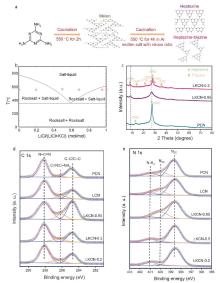
图1
"
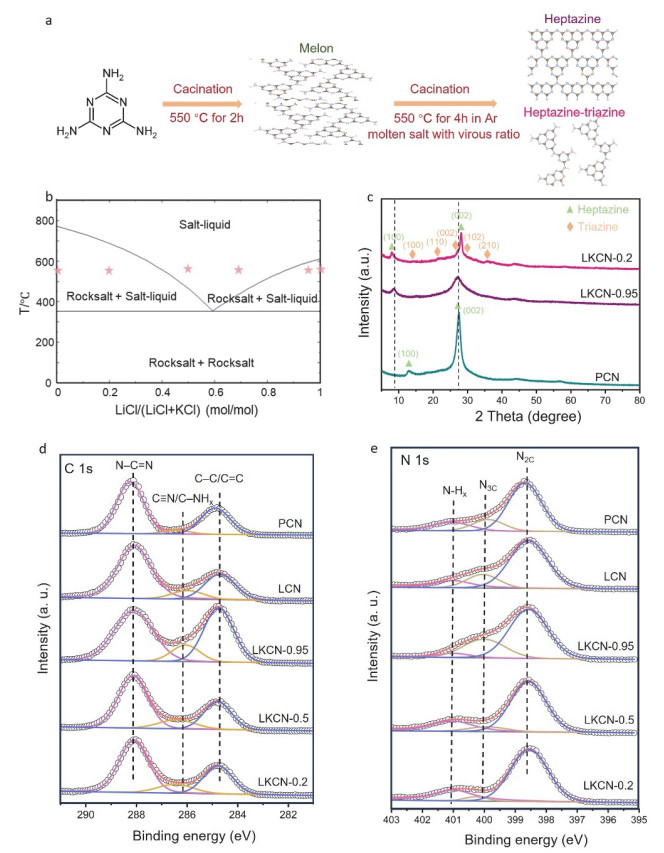
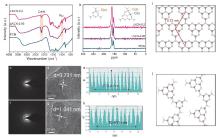
图2
"
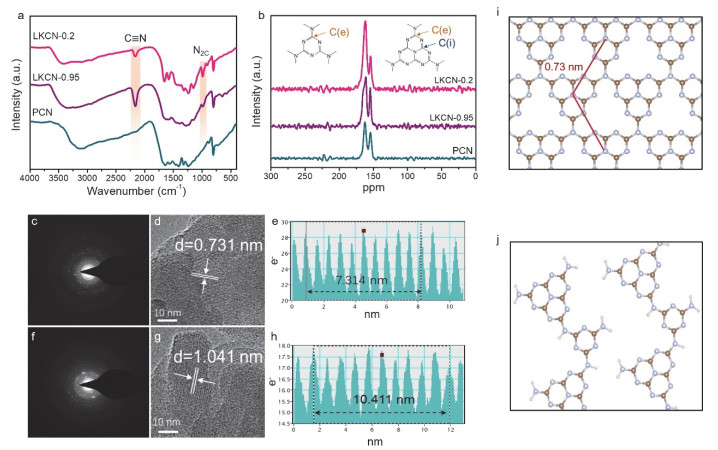
图3
"
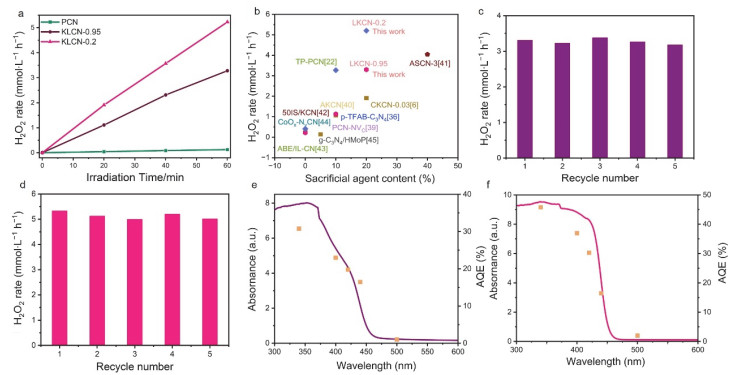
图4
"
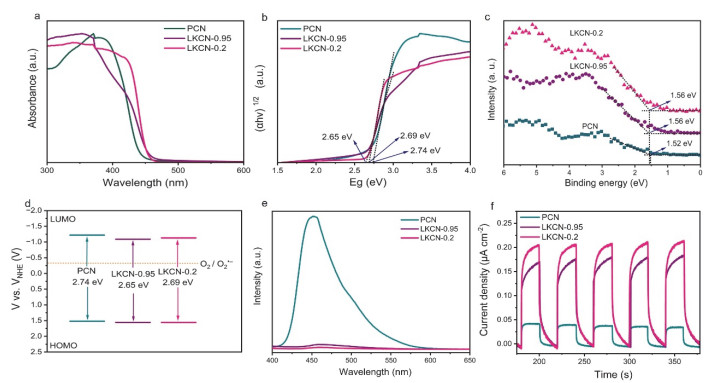
图5
"
图6
"
图7
"
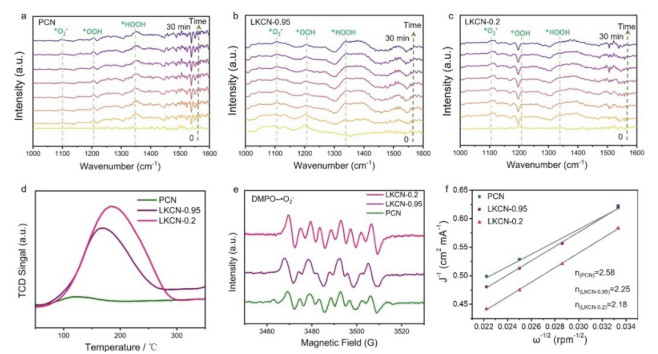
图8
"
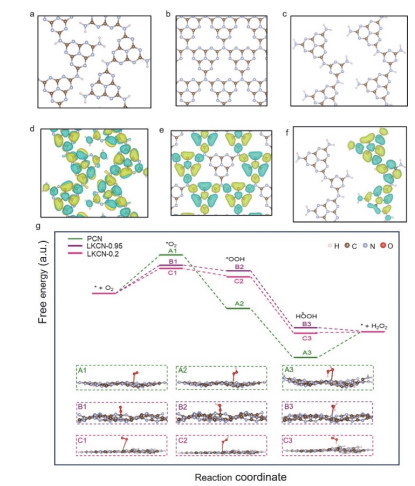
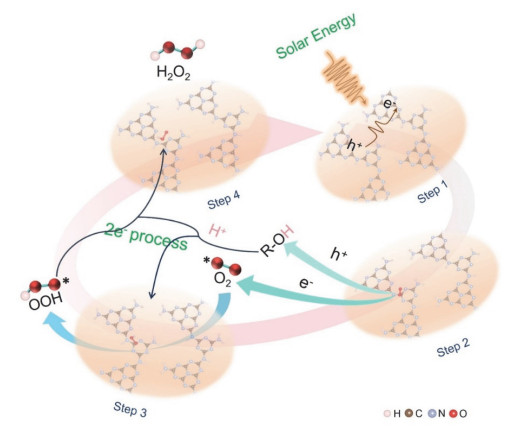
图9
"
| 1 |
Y. Liu, M. Li, T. Liu, Z. Wu, L. Zhang. J. Mater. Sci. Technol. 2025, 233, 201.
doi: 10.1016/j.jmst.2025.03.005 |
| 2 |
K. Zhang, Y. Li, S. Yuan, L. Zhang, Q. Wang. Acta Phys. -Chim. Sin. 2023, 39, 2212010.
doi: 10.3866/PKU.WHXB202212010 |
| 3 |
S. Zhou, H. Hu, H. Hu, Q. Jiang, H. Xie, C. Li, S. Gao, Y. Kong, Y. Hu. Sci. China Mater. 2023, 66, 1837.
doi: 10.1007/s40843-022-2337-7 |
| 4 |
X. Li, Z. Wang. Acta Phys. -Chim. Sin. 2025, 41, 100080.
doi: 10.1016/j.actphy.2025.100080 |
| 5 |
M. Sayed, H. Li, C. Bie. Acta Phys. -Chim. Sin. 2025, 100117.
doi: 10.1016/j.actphy.2025.100117 |
| 6 |
Y. Xie, Y. Li, Z. Huang, J. Zhang, X. Jia, X.-S. Wang, J. Ye. Appl. Catal. B 2020, 265, 118581.
doi: 10.1016/j.apcatb.2019.118581 |
| 7 |
M. Xu, Z. Li, R. Shen, X. Zhang, Z. Zhang, P. Zhang, X. Li. Chin. J. Catal. 2025, 70, 431.
doi: 10.1016/S1872-2067(24)60247-0 |
| 8 |
W. Zhong, A. Meng, Y. Su, H. Yu, P. Han, J. Yu. Angew. Chem. Int. Ed. 2025, 64, e202425038.
doi: 10.1002/anie.202425038 |
| 9 |
Y. Xie, Q. Zhang, H. Sun, Z. Teng, C. Su. Acta Phys. -Chim. Sin. 2023, 39, 2301001.
doi: 10.3866/PKU.WHXB202301001 |
| 10 |
K. Li, C. Liu, J. Li, G. Wang, K. Wang. Acta Phys. -Chim. Sin. 2024, 40, 2403009.
doi: 10.3866/PKU.WHXB202403009 |
| 11 |
B. Zhao, W. Zhong, F. Chen, P. Wang, C. Bie, H. Yu. Chin. J. Catal. 2023, 52, 127.
doi: 10.1016/S1872-2067(23)64491-2 |
| 12 |
Y. Zhao, Y. Zhang, L. Wang, C. Ai, J. Zhang. J. Mater. Sci. Technol. 2025, 229, 213.
doi: 10.1016/j.jmst.2024.12.040 |
| 13 |
R. Shen, C. Huang, L. Hao, G. Liang, P. Zhang, Q. Yue, X. Li. Nat. Commun. 2025, 16, 2457.
doi: 10.1038/s41467-025-57662-4 |
| 14 |
M. He, X. Peng, S. Wu. Inorg. Chem. Front. 2025, 12, 3237.
doi: 10.1039/D4QI03352C |
| 15 |
X. Cai, Y. Li, Y. Zhang, W. Lin. ACS Catal. 2023, 13, 15877.
doi: 10.1021/acscatal.3c05079 |
| 16 |
H. Chen, L. Nie, K. Xu, Y. Yang, C. Fang. Acta Phys. -Chim. Sin. 2024, 40, 2406019.
doi: 10.3866/PKU.WHXB202406019 |
| 17 |
J. Wang, G. Pan, N. Wang, S. Wang, Y. Zhu, Y. Li. Acta Phys. -Chim. Sin. 2025, 100168.
doi: 10.1016/j.actphy.2025.100168 |
| 18 |
N.-Y. Huang, Y.-T. Zheng, D. Chen, Z.-Y. Chen, C.-Z. Huang, Q. Xu. Chem. Soc. Rev. 2023, 52, 7949.
doi: 10.1039/D2CS00289B |
| 19 |
H. Ou, L. Lin, Y. Zheng, P. Yang, Y. Fang, X. Wang. Adv. Mater. 2017, 29, 1700008.
doi: 10.1002/adma.201700008 |
| 20 |
H. Li, B. Cheng, J. Xu, J. Yu, S. Cao. EES Catal. 2024, 2, 411.
doi: 10.1039/D3EY00302G |
| 21 |
G. Zhang, L. Lin, G. Li, Y. Zhang, A. Savateev, S. Zafeiratos, X. Wang, M. Antonietti. Angew. Chem. 2018, 130, 9516.
doi: 10.1002/ange.201804702 |
| 22 |
H. Che, X. Gao, J. Chen, J. Hou, Y. Ao, P. Wang. Angew. Chem. Int. Ed. 2021, 60, 25546.
doi: 10.1002/anie.202111769 |
| 23 |
B. Zhai, J. Zeng, Y. Wang, P. Niu, S. Wang, L. Li. Appl. Catal. 2024, 359, 124496.
doi: 10.1016/j.apcatb.2024.124496 |
| 24 |
W. Zhong, D. Zheng, Y. Ou, A. Meng, Y. Su. Acta Phys. -Chim. Sin. 2024, 40, 2406005.
doi: 10.3866/PKU.WHXB202406005 |
| 25 |
W. Freyland. Coulombic Fluids 2011, 5.
doi: 10.1007/978-3-642-17779-8_2 |
| 26 |
X. Wu, L. Tan, G. Chen, J. Kang, G. Wang. Sci. China Mater. 2024, 67, 444.
doi: 10.1007/s40843-023-2755-2 |
| 27 |
D. Hwang, C.W. Schlenker. Chem. Commun. 2021, 57, 9330.
doi: 10.1039/D1CC02745J |
| 28 |
B. Li, N. Li, Z. Guo, C. Wang, X. Wang, Z. Zhu, X. Tang, P. Huo. Chem. Eng. J. 2024, 500, 156843.
doi: 10.1016/j.cej.2024.156843 |
| 29 |
Y. Zhang, Q. Cao, A. Meng, X. Wu, Y. Xiao, C. Su, Q. Zhang. Adv. Mater. 2023, 35, 2306831.
doi: 10.1002/adma.202306831 |
| 30 |
G. Zhang, G. Li, T. Heil, S. Zafeiratos, F. Lai, A. Savateev, M. Antonietti, X. Wang. Angew. Chem. Int. Ed. 2019, 58, 3433.
doi: 10.1002/anie.201811938 |
| 31 |
P. Yang, H. Ou, Y. Fang, X. Wang. Angew. Chem. 2017, 129, 4050.
doi: 10.1002/ange.201700286 |
| 32 |
Y. Li, F. Gong, Q. Zhou, X. Feng, J. Fan, Q. Xiang. Appl. Catal. B 2020, 268, 118381.
doi: 10.1016/j.apcatb.2019.118381 |
| 33 |
Y. Ma, H. Sun, Q. Wang, L. Sun, Z. Liu, Y. Xie, Q. Zhang, C. Su, D. Fan. Appl. Catal. B 2023, 335, 122878.
doi: 10.1016/j.apcatb.2023.122878 |
| 34 |
H. Yu, R. Shi, Y. Zhao, T. Bian, Y. Zhao, C. Zhou, G.I.N. Waterhouse, L.Z. Wu, C.H. Tung, T. Zhang. Adv. Mater. 2017, 29, 1605148.
doi: 10.1002/adma.201605148 |
| 35 |
M. Yang, R. Lian, X. Zhang, C. Wang, J. Cheng, X. Wang. Nat. Commun. 2022, 13, 4900.
doi: 10.1038/s41467-022-32623-3 |
| 36 |
Q. Zhang, H. Che, H. Yang, B. Liu, Y. Ao. Angew. Chem. Int. Ed. 2024, 63, e2024093283.
doi: 10.1002/anie.202409328 |
| 37 |
W. Ruland, B. Smarsly. Appl. Crystallogr. 2002, 35, 624.
doi: 10.1107/S0021889802011007 |
| 38 |
M.J. Bojdys, J.O. Müller, M. Antonietti, A. Thomas. Chem. -Eur. J. 2008, 14, 8177.
doi: 10.1002/chem.200800190 |
| 39 |
F. Lin, T. Wang, Z. Ren, X. Cai, Y. Wang, J. Chen, J. Wang, S. Zang, F. Mao, L. Lv. J. Colloid Interface Sci. 2023, 636, 223.
doi: 10.1016/j.jcis.2023.01.036 |
| 40 |
P. Zhang, D. Sun, A. Cho, S. Weon, S. Lee, J. Lee, J.W. Han, D.-P. Kim, W. Choi. Nat. Commun. 2019, 10, 940.
doi: 10.1038/s41467-019-08731-y |
| 41 |
Q. Li, Y. Jiao, Y. Tang, J. Zhou, B. Wu, B. Jiang, H. Fu. J. Am. Chem. Soc. 2023, 145, 20837.
doi: 10.1021/jacs.3c05234 |
| 42 |
Q. Zhang, H. Miao, J. Wang, T. Sun, E. Liu. Chin. J. Catal. 2024, 63, 176.
doi: 10.1016/S1872-2067(24)60077-X |
| 43 |
Z. Yu, D. Zhang, C. Ai, J. Zhang, Q. Xiang. Chin. J. Catal. 2024, 67, 71.
doi: 10.1016/S1872-2067(24)60159-2 |
| 44 |
J. Hou, K. Wang, X. Zhang, Y. Wang, H. Su, C. Yang, X. Zhou, W. Liu, H. Hu, J. Wang. ACS Catal. 2024, 14, 10893.
doi: 10.1021/acscatal.4c00334 |
| 45 |
T. Zhang, W. Schilling, S.U. Khan, H.V. Ching, C. Lu, J. Chen, A. Jaworski, G. Barcaro, S. Monti, K. De Wael. ACS Catal. 2021, 11, 14087.
doi: 10.1021/acscatal.1c03733 |
| 46 |
X. Liu, Y. Li, K. Lin, Y. Jiang. J. Colloid Interface Sci. 2024, 654, 1228.
doi: 10.1016/j.jcis.2023.10.122 |
| 47 |
Z. Wei, M. Liu, Z. Zhang, W. Yao, H. Tan, Y. Zhu. Energy Environ. Sci. 2018, 11, 2581.
doi: 10.1039/C8EE01316K |
| 48 |
T. Zhou, X. Liu, L. Zhao, M. Qiao, W. Lei. Acta Phys. -Chim. Sin. 2024, 40, 2309020.
doi: 10.3866/PKU.WHXB202309020 |
| 49 |
W. Yu. Chin. J. Catal. 2025, 73, 8.
doi: 10.1016/S1872-2067(25)60706-1 |
| 50 |
F. Li, X. Yue, Y. Liao, L. Qiao, K. Lv, Q. Xiang. Nat. Commun. 2023, 14, 3901.
doi: 10.1038/s41467-023-39578-z |
| 51 |
F. Sun, Y. Luo, S. Kuang, M. Zhou, W.-K. Ho, H. Tang. J. Mater. Sci. Technol. 2025, 229, 287.
doi: 10.1016/j.jmst.2024.12.060 |
| 52 |
L. Zhang, R.-H. Li, X.-X. Li, S. Wang, J. Liu, X.-X. Hong, L.-Z. Dong, S.-L. Li, Y.-Q. Lan. Nat. Commun. 2024, 15, 537.
doi: 10.1038/s41467-024-44833-y |
| 53 |
K. Huang, G. Liang, S. Sun, H. Hu, X. Peng, R. Shen, X. Li. J. Mater. Sci. Technol. 2024, 193, 98.
doi: 10.1016/j.jmst.2024.01.034 |
| 54 |
C. Shao, Q. He, M. Zhang, L. Jia, Y. Ji, Y. Hu, Y. Li, W. Huang, Y. Li. Chin. J. Catal. 2023, 46, 28.
doi: 10.1016/S1872-2067(22)64205-0 |
| 55 |
L. Zhang, J. Zhang, J. Yu, H. García. Nat. Rev. Chem. 2025, 9, 328.
doi: 10.1038/s41570-025-00698-3 |
| 56 |
Q. Zhang, Y.-C. Chu, Z. Liu, M. Hong, W. Fang, X.-P. Wu, X.-Q. Gong, Z. Chen. Appl. Catal. B 2023, 331, 122688.
doi: 10.1016/j.apcatb.2023.122688 |
| 57 |
B. Qi, R. Shen, Z. Ren, Y. Teng, H. Ding, X. Zhang, Y. Zhang, L. Hao, X. Li. J. Mater. Sci. Technol. 2025, 232, 65.
doi: 10.1016/j.jmst.2025.03.003 |
| 58 |
Y. Ren, Y. Li, G. Pan, N. Wang, Y. Xing, Z. Zhang. J. Mater. Sci. Technol. 2024, 171, 162.
doi: 10.1016/j.jmst.2023.06.052 |
| 59 |
G. Zeng, G. Li, W. Yuan, J. Liu, Y. Wu, M. Li, J. Deng, X. Hu, X. Tan. Sep. Purif. Technol. 2025, 353, 128484.
doi: 10.1016/j.seppur.2024.128484 |
| 60 |
P. Zhang, Y. Tong, Y. Liu, J.J.M. Vequizo, H. Sun, C. Yang, A. Yamakata, F. Fan, W. Lin, X. Wang. Angew. Chem. Int. Ed. 2020, 132, 16343.
doi: 10.1002/ange.202006747 |
| 61 |
J. Cai, B. Liu, S. Zhang, L. Wang, Z. Wu, J. Zhang. J. Mater. Sci. Technol. 2024, 197, 183.
doi: 10.1016/j.jmst.2024.02.012 |
| 62 |
Z. Yu, X. Yue, J. Fan, Q. Xiang. ACS Catal. 2022, 12, 6345.
doi: 10.1021/acscatal.2c01563 |
| 63 |
Y. Yang, X. Zhou, M. Gu, B. Cheng, Z. Wu, J. Zhang. Acta Phys. -Chim. Sin. 2025, 41, 100064.
doi: 10.1016/j.actphy.2025.100064 |
| 64 |
K.L. Corp, C.W. Schlenker. J. Am. Chem. Soc. 2017, 139, 7904.
doi: 10.1021/jacs.7b02869 |
| 65 |
J. Zhu, S. Wageh, A.A. Al-Ghamdi. Chin. J. Catal. 2023,
doi: 10.1016/S1872-2067(23)64438-9 |
| 66 |
Y. Wu, C. Cheng, K. Qi, B. Cheng, J. Zhang, J. Yu, L. Zhang. Acta Phys. -Chim. Sin. 2024, 40, 2406027.
doi: 10.3866/PKU.WHXB202406027 |
| 67 |
A. Hayat, Z. Ajmal, A.Y.A. Alzahrani, S.B. Moussa, M. Khered, N. Almuqati, A. Alshammari, Y. Al-Hadeethi, H. Ali, Y. Orooji. Coord. Chem. Rev. 2025, 522, 216218.
doi: 10.1016/j.ccr.2024.216218 |
| 68 |
S. Nayak, I.J. McPherson, K.A. Vincent. Angew. Chem. 2018, 130, 13037.
doi: 10.1002/ange.201804978 |
| 69 |
W. Zeng, Y. Dong, X. Ye. ACS Catal. 2025, 15, 6036.
doi: 10.1021/acscatal.5c01205 |
| [1] | 杨鹤群, 饶斐, 潘德安, 陈柳, 努曼·阿巴斯, 朱刚强. 稀土镨单原子促进石墨相氮化碳管面内电荷转移以提升纯水中过氧化氢的产率[J]. 物理化学学报, 2026, 42(6): 100210 - . |
| [2] | 樊凡, 修浩, 王宇婷, 崔永朋, 王雅君. NH2-MIL-125/Na掺杂g-C3N4复合S型异质结的构建及其光催化产过氧化氢性能[J]. 物理化学学报, 2026, 42(2): 100143 - . |
| [3] | SayedMahmoud, 李瀚, 别传彪. 光催化H2O2生产的挑战与前景[J]. 物理化学学报, 2025, 41(9): 100117 - . |
| [4] | 王伟康, 吴亚栋, 张建军, 孟凯, 李金河, 王乐乐, 刘芹芹. 三聚氰胺泡沫支撑的S型硫铟锌镉/硫掺杂氮化碳异质结的绿色H2O2合成:协同界面电荷转移调控与局域光热效应[J]. 物理化学学报, 2025, 41(8): 100093 - . |
| [5] | 张淑敏, 王亚琪, 王泽林, 王立博, 安长胜, 许第发. ZIS1−x/UCN S型异质结界面的超快电子转移实现高效H2O2光合成耦合四环素降解[J]. 物理化学学报, 2025, 41(11): 100136 - . |
| [6] | 赵艳艳, 吴珍, 张勇, 朱必成, 张建军. 促进电荷分离和增强O2吸附双重策略提升金修饰含硫空位CdIn2S4的光催化产H2O2性能[J]. 物理化学学报, 2025, 41(11): 100142 - . |
| [7] | 程康娟, 刘春晓, 王友鹏, 江秋, 郑婷婷, 李旭, 夏川. 用于电合成过氧化氢的贵金属催化剂和反应器设计[J]. 物理化学学报, 2025, 41(10): 100112 - . |
| [8] | 林柳, 孙泽民, 陈华添, 赵莲, 孙明月, 杨逸涛, 廖振升, 吴鑫宇, 李欣欣, 唐城. 电催化两电子水氧化制备过氧化氢的研究进展[J]. 物理化学学报, 2024, 40(4): 2305019 - . |
| [9] | 文兆宇, 韩娜, 李彦光. 电化学二电子氧还原制备过氧化氢研究进展[J]. 物理化学学报, 2024, 40(2): 2304001 - . |
| [10] | 朱潇锋, 肖兵兵, 苏家欣, 王帅, 张清然, 王骏. 过渡金属氧化物/硫属化合物用于电化学氧还原制过氧化氢[J]. 物理化学学报, 2024, 40(12): 2407005 - . |
| [11] | 李可, 刘创, 李静萍, 王国宏, 王楷. 钛酸铋/氮化碳无机/有机复合S型异质结纯水光催化产过氧化氢[J]. 物理化学学报, 2024, 40(11): 2403009 - . |
| [12] | 陈郭强, 郑子璇, 钟威, 王国宏, 吴新鹤. 熔融中间体运输导向合成富氨基g-C3N4纳米片用于高效光催化产H2O2[J]. 物理化学学报, 2024, 40(11): 2406021 - . |
| [13] | 谢垚, 张启涛, 孙宏丽, 滕镇远, 苏陈良. 聚合物半导体光催化合成过氧化氢:光氧化还原中心的空间分离和协同利用[J]. 物理化学学报, 2023, 39(11): 2301001 - . |
| [14] | 袁明明,李迪帆,赵秀阁,马文保,孔康,倪文秀,顾青雯,侯震山. 二氧化硅包覆的杂多酸在双氧水存在条件下催化氧化甘油[J]. 物理化学学报, 2018, 34(8): 886 -895 . |
| [15] | 陈鑫,胡绍争,李萍,李薇,马宏飞,陆光. 熔盐辅助微波法制备g-C3N4包覆MgO-Al2O3-Fe2O3异质结催化剂及其光催化制过氧化氢性能[J]. 物理化学学报, 2017, 33(12): 2532 -2541 . |
|
||