物理化学学报 >> 2026, Vol. 42 >> Issue (5): 100202.doi: 10.1016/j.actphy.2025.100202
BiOCl表面掺杂石墨烯用于可见光下高效光催化胺偶联
张小菲1,†, 徐山浩1,†, 王志远1, 何龙1, 黄天成1, 徐永明2, 卞玉翠1, 李一珂1,*( ), 陈海军1,*(), 李中军1
- 1 郑州大学化学学院, 河南 郑州 450001
2 河南中烟工业有限责任公司技术中心, 河南 郑州 450000
-
收稿日期:2025-08-17修回日期:2025-10-18录用日期:2025-10-19发布日期:2026-01-23 -
通讯作者:Email: chenhaijun@zzu.edu.cn (陈海军)liyike@zzu.edu.cn (李一珂) -
作者简介:†对这项工作做出了同等贡献
Surface doping of graphene into BiOCl for efficient photocatalytic amine coupling under visible light
Xiaofei Zhang1, Shanhao Xu1, Zhiyuan Wang1, Long He1, Tiancheng Huang1, Yongming Xu2, Yucui Bian1, Yike Li1,*(), Haijun Chen1,*(), Zhongjun Li1
- 1 College of Chemistry, Zhengzhou University, Zhengzhou 450001, Henan Province, China
2 Technology Center, China Tobacco Henan Industrial Co. Ltd., Zhengzhou 450000, Henan Province, China
-
Received:2025-08-17Revised:2025-10-18Accepted:2025-10-19Published:2026-01-23 -
Contact:Email: chenhaijun@zzu.edu.cn (Haijun Chen)liyike@zzu.edu.cn (Yike Li)

摘要:
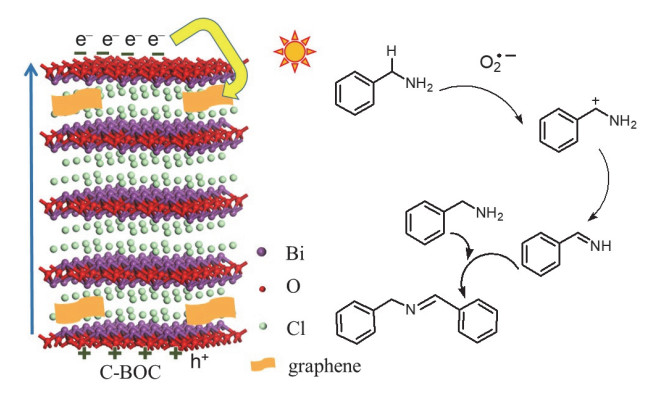
以葡萄糖为碳源制备了碳掺杂BiOCl。碳掺杂剂主要富集于晶体表面或浅层晶格中,部分与氧原子成键。在室温可见光条件下,以分子氧为绿色氧化剂,碳掺杂BiOCl催化苄胺自偶联转化率(> 99%)是纯BiOCl的12倍。该掺杂催化剂对胺类底物具有良好官能团耐受性,并表现出晶面依赖的光催化活性。综合表征证实:碳掺杂在晶体原带隙中形成掺杂能级,使BiOCl吸收范围拓宽至可见光区并降低其功函数;同时增强了BiOCl内部电场,其中单层/双层石墨烯为最有效掺杂形态,可捕获经电子-空穴分离后跃迁至高能级的导带电子,从而抑制电子-空穴复合,提高光生载流子分离效率;此外还促进了O2活化。本研究为光催化剂理性设计及实现高效定向有机转化提供了参考。
引用本文
张小菲, 徐山浩, 王志远, 何龙, 黄天成, 徐永明, 卞玉翠, 李一珂, 陈海军, 李中军. BiOCl表面掺杂石墨烯用于可见光下高效光催化胺偶联[J]. 物理化学学报, 2026, 42(5), 100202. doi: 10.1016/j.actphy.2025.100202
Xiaofei Zhang, Shanhao Xu, Zhiyuan Wang, Long He, Tiancheng Huang, Yongming Xu, Yucui Bian, Yike Li, Haijun Chen, Zhongjun Li. Surface doping of graphene into BiOCl for efficient photocatalytic amine coupling under visible light[J]. Acta Phys. -Chim. Sin. 2026, 42(5), 100202. doi: 10.1016/j.actphy.2025.100202
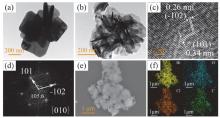
图1
"
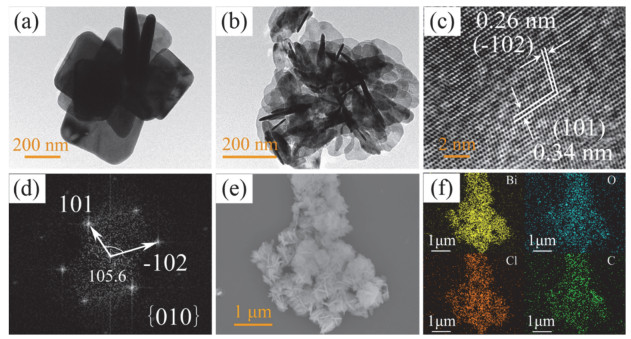
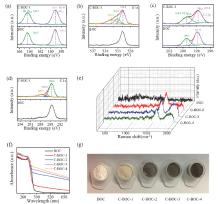
图2
"
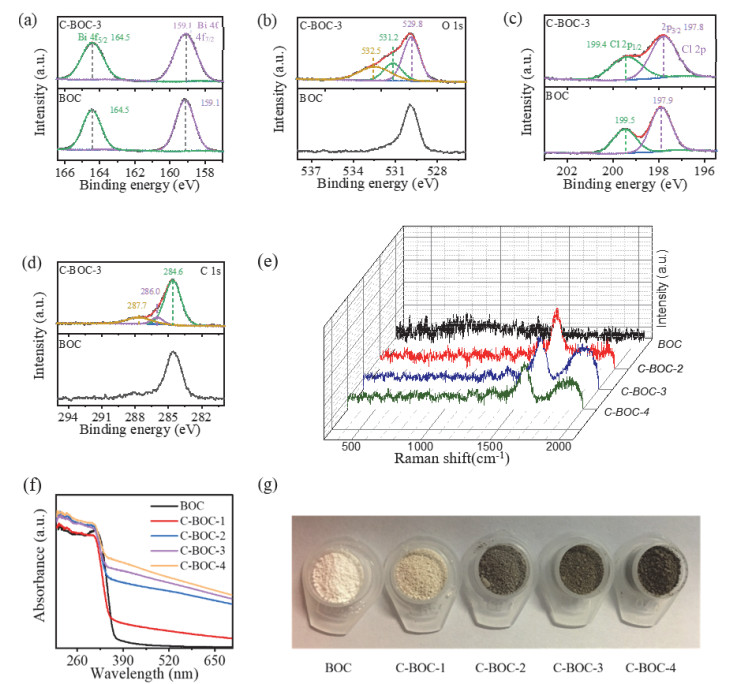
表1
"
| Entry | Catalyst | Conversion (%) | Selectivity (%) |
| 1 | No catalyst | 0 | |
| 2 b | C-BOC-3 | 2 | 99 |
| 3 c | C-BOC-3 | 17 | 99 |
| 4 d | C-BOC-3 | 88 | 99 |
| 5 | C-BOC-3 | 99 | 99 |
| 6 | BOC | 8 | 99 |
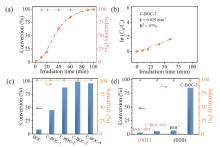
图3
"
图4
"
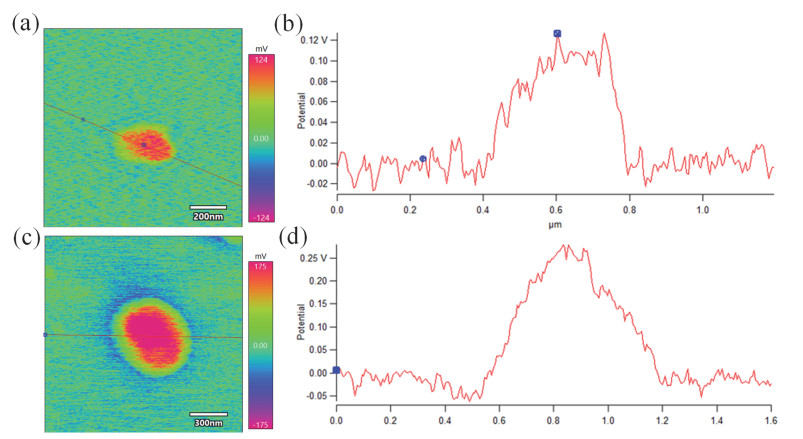
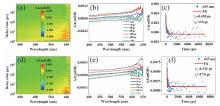
图5
"
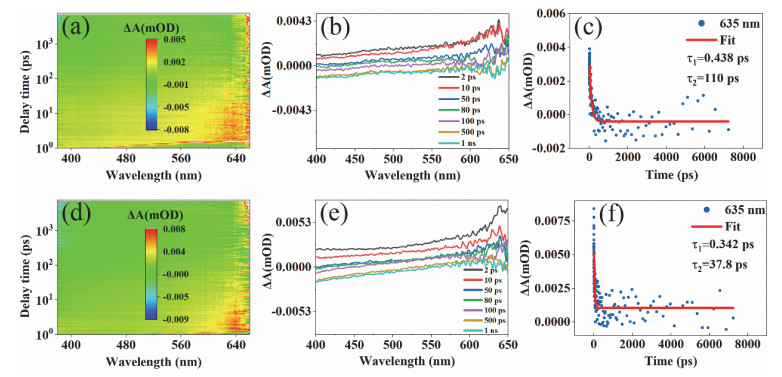
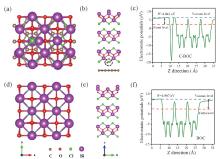
图6
"
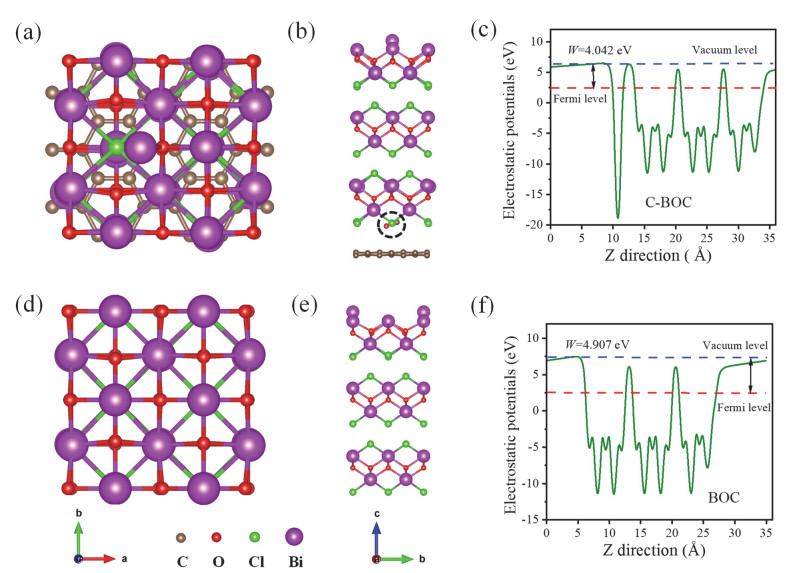
图7
"
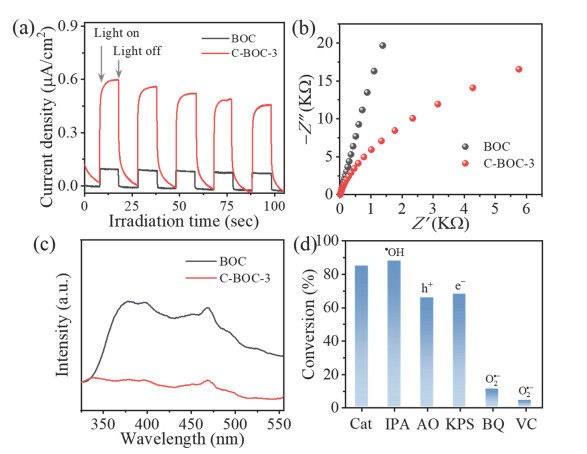
图8
"
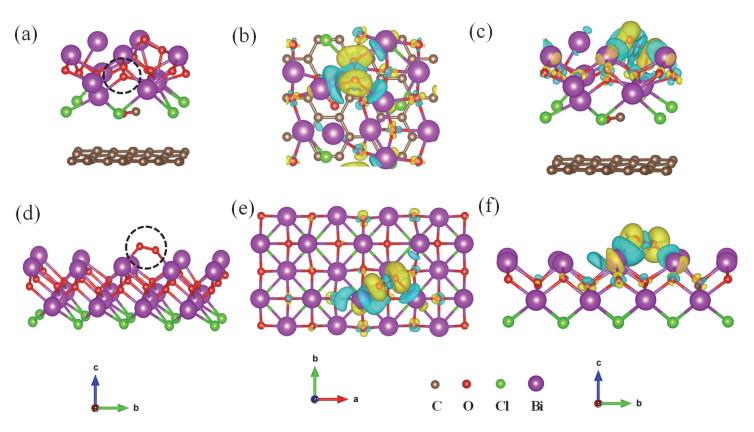
图9
"
| 1 |
M. Largeron, M.-B. Fleury. Science 2013, 339, 43.
|
| 2 |
T. Sonobe, K. Oisaki, M. Kanai. Chem. Sci. 2012, 3, 3249.
doi: 10.1039/C2SC20699D |
| 3 |
Y. X. Guo, B. Liu, J. W. Zhang, C. T. Wang, G. L. Wang, C. S. Pan, H. Zhao, Y. M. Dong, Y. F. Zhu, Appl. Catal.. B: Environ. Energy 2024, 350, 123915.
doi: 10.1016/j.apcatb.2024.123915 |
| 4 |
L. J. Yang, Z. X. Chen, Q. C. Cao, H. R. Liao, J. Gao, L. Zhang, W. Y. Wei, H. Li, J. M. Lu, Adv. Mater. 36 (2024) 2306758, https://doi.org/10.1002%2Fadma.202306758.
|
| 5 |
Y. X. Liu, H. Tan, J. Z. Sun, Y. N. Wei, M. H. Liu, J. X. Hong, S. C. Shang, X. Y. Wang, L. Li, Y. Gu, et al.. Adv. Funct. Mater. 2023, 33, 2302874.
doi: 10.1002/adfm.202302874 |
| 6 |
B. Chen, L. Y. Wang, S. Gao. ACS Catal. 2015, 5, 5851.
doi: 10.1021/acscatal.5b01479 |
| 7 |
X. Wang, C. Wang, H.-Q. Tan, T.-Y. Qiu, Y.-M. Xing, Q.-K. Shang, Y.-N. Zhao, X.-Y. Zhao, X.-Y. Zhao, Y.-G. Li. Chem. Eng. J. 2022, 431, 134051.
doi: 10.1016/j.cej.2021.134051 |
| 8 |
B. Gnanaprakasam, J. Zhang, D. Milstein. Angew. Chem. Int. Ed. 2010, 49, 1468.
doi: 10.1002/ANIE.200907018 |
| 9 |
L. Blackburn, R. J. K. Taylor. Org. Lett. 2001, 3, 1637.
doi: 10.1021/ol015819b |
| 10 |
K. C. Nicolaou, C. J. N. Mathison, T. Montagnon. J. Am. Chem. Soc. 2004, 126, 5192.
doi: 10.1021/ja0400382 |
| 11 |
T. Mukaiyama, A. Kawana, Y. Fukuda, J.-I. Matsuo. Chem. Lett. 2001, 30, 390.
doi: 10.1246/cl.2001.390 |
| 12 |
S.-I. Naya, K. Kimura, H. Tada. ACS Catal. 2013, 3, 10.
doi: 10.1021/cs300682d |
| 13 |
G. Csjernyik, A. H. Éll, L. Fadini, B. Pugin, J.-E. Bäckvall. J. Org. Chem. 2002, 67, 1657.
doi: 10.1021/jo0163750 |
| 14 |
S. Kodama, J. Yoshida, A. Nomoto, Y. Ueta, S. Yano, M. Ueshima, A. Ogawa. Tetra. Lett. 2010, 1, 2450.
doi: 10.1016/j.tetlet.2010.02.150 |
| 15 |
M. Largeron, M.-B. Fleury. Angew. Chem. Int. Ed. 2012, 51, 5409.
doi: 10.1002/anie.201200587 |
| 16 |
H. Shechter, S. S. Rawalay, M. Tubis. J. Am. Chem. Soc. 1964, 86, 1701.
doi: 10.1021/ja01063a012 |
| 17 |
R. Yamaguchi, C. Ikeda, Y. Takahashi, K.-I. Fujita. J. Am. Chem. Soc. 2009, 131, 8410.
doi: 10.1021/ja9022623 |
| 18 |
B. L. Zhu, M. Lazar, B. G. Trewyn, R. J. Angelici. J. Catal. 2008, 260, 1.
doi: 10.1016/j.jcat.2008.08.012 |
| 19 |
H. Huang, J. Huang, Y.-M. Liu, H.-Y. He, Y. Cao, K.-N. Fan. Green Chem. 2012, 14, 930.
doi: 10.1039/C2GC16681J |
| 20 |
S. Biswas, B. Dutta, K. Mullick, C.-H. Kuo, A. S. Poyraz, S. L. Suib. ACS Catal. 2015, 5, 4394.
doi: 10.1021/acscatal.5b00325 |
| 21 |
B. Dutta, S. March, L. Achola, S. Sahoo, J. K. He, A. S. Amin, Y. Wu, S. Poges, S. P. Alpay, S. L. Suib. Green Chem. 2018, 20, 3180.
doi: 10.1039/C8GC00862K |
| 22 |
B. Chen, L. Wang, W. Dai, S. Shang, Y. Lv, S. Gao. ACS Catal. 2015, 5, 2788.
doi: 10.1021/acscatal.5b00244 |
| 23 |
Z. J. Gu, Z. Shan, Y. L. Wang, J. J. Wang, T. T. Liu, X. M. Li, Z. Y. Yu, J. Su, G. Zhang. Chin. Chem. Lett. 2024, 35, 108356.
doi: 10.1016/j.cclet.2023.108356 |
| 24 |
R. Sakamoto, R. Toyoda, G. Jingyan, Y. Nishina, K. Kamiya, H. Nishihara, T. Ogoshi. Coord. Chem. Rev. 2022, 466, 214577.
doi: 10.1016/j.ccr.2022.214577 |
| 25 |
S.-L. Meng, C. Ye, X.-B. Li, C.-H. Tung, L.-Z. Wu. J. Am. Chem. Soc. 2022, 144, 16219.
doi: 10.1021/jacs.2c02341 |
| 26 |
H. J. Chen, R. H. Xu, D. Chen, T. L Lu, H. J. Li, M. Wang. ACS Catal. 2024, 14, 1977.
doi: 10.1021/acscatal.3c05263 |
| 27 |
W. J. Cao, W. J. Zhang, L. Dong, Z. Ma, J. S. Xu, X. L. Gu, Z. P. Chen. Exploration 2023, 3, 20220169.
doi: 10.1002/EXP.20220169 |
| 28 |
A. Khampuanbut, S. Santalelat, A. Pankiew, D. Channei, S. Pornsuwan, K. Faungnawakij, S. Phanichphant, B. Inceesungvorn. J. Colloid Interface Sci. 2020, 560, 213.
doi: 10.1016/j.jcis.2019.10.057 |
| 29 |
Y.-D. Sun, C. Zeng, X. Zhang, Z.-Q. Zhang, B. Yang, S.-Q. Guo. Rare Met. 2024, 43, 1488.
doi: 10.1007/s12598-023-02569-6 |
| 30 |
Q. Chen, H. Wang, C. C. Guan, R. F. Duan, R. Fang, Y. F. Hu, Xun. Appl. Catal. B Environ. 2020, 262, 118258.
doi: 10.1016/j.apcatb.2019.118258 |
| 31 |
S. Juntrapirom, S. Anuchai, O. Thongsook, S. Pornsuwan, P. Meepowpan, P. Thavornyutikarn, S. Phanichphant, D. Tantraviwat, B. Inceesungvorn. Chem. Eng. J. 2020, 394, 124934.
doi: 10.1016/j.cej.2020.124934 |
| 32 |
W. Zou, X.-H. Liu, C. Xue, X.-T. Zhou, H.-Y. Yu, P. Fan, H.-B. Ji. Appl. Catal. B. Environ. 2021, 285, 119863.
doi: 10.1016/j.apcatb.2020.119863 |
| 33 |
A. Yuan, H. Lei, Z. S. Wang, X. P. Dong. J. Colloid Interface Sci. 2020, 560, 40.
doi: 10.1016/j.jcis.2019.10.060 |
| 34 |
K.-L. Zhang, C.-M. Liu, F.-Q. Huang, C. Zheng, W.-D. Wang. Appl. Catal. B Environ. 2006, 68, 125.
doi: 10.1016/j.apcatb.2006.08.002 |
| 35 |
Y. Y. Li, J. P. Liu, J. Jiang, J. G. Yu. Dalton Trans. 2011, 40, 6632.
doi: 10.1039/C1DT10691K |
| 36 |
Y. Xu, S. C. Xu, S. Wang, Y. X. Zhang, G. H. Li. Dalton Trans. 2014, 43, 479.
doi: 10.1039/C3DT52004H |
| 37 |
J. Jiang, K. Zhao, X. Y. Xiao, L. H. Zhang. J. Am. Chem. Soc. 2012, 134, 4473.
doi: 10.1021/ja210484t |
| 38 |
C.-Y. Wang, Y.-J. Zhang, W.-K. Wang, D.-N. Pei, G.-X. Huang, J.-J. Chen, X. Zhang, H.-Q. Yu. Appl. Catal. B Environ. 2018, 221, 320.
doi: 10.1016/j.apcatb.2017.09.036 |
| 39 |
J. Shang, T. Z. Chen, X. W. Wang, L. Y. Sun, Q. Q. Su. Chem. Phys. Lett. 2018, 706, 483.
doi: 10.1016/j.cplett.2018.06.054 |
| 40 |
Y. H. Ren, J. H. Zou, K. Q. Jing, Y. Y. Liu, B. B. Guo, Y. J. Song, Y. Yu, L. Wu. J. Catal. 2019, 380, 123.
doi: 10.1016/j.jcat.2019.10.018 |
| 41 |
B. X. Zhang, J. L. Zhang, R. Duan, Q. Wan, X. N. Tan, Z. Z. S, B. X. Han, L. R. Zheng, G. Mo. Nano Energy 2020, 78, 105340.
doi: 10.1016/j.nanoen.2020.105340 |
| 42 |
H. J. Chen, L. M. Peng, Y. C. Bian, X. Q. Shen, J. Li, H.-C. Yao, S.-Q. Zang, Z. J. Li. Appl. Catal. B Environ. 2021, 284, 119704.
doi: 10.1016/j.apcatb.2020.119704 |
| 43 |
W. X. Ouyang, F. Teng, X. S. Fang. Adv. Funct. Mater. 2018, 28, 1707178.
doi: 10.1002/adfm.201707178 |
| 44 |
J. Li, K. Zhao, Y. Yu, L. Z. Zhang. Adv. Funct. Mater. 2015, 25, 2189.
doi: 10.1002/adfm.201404178 |
| 45 |
R. Rao, R. Podila, R. Tsuchikawa, J. Katoch, D. Tishler, A. M. Rao, M. Ishigami. ACS Nano 2011, 5, 1594.
doi: 10.1021/nn1031017 |
| 46 |
J. Li, L. J. Cai, J. Shang, Y. Yu, L. Z. Zhang. Adv. Mater. 2016, 28, 4059.
doi: 10.1002/adma.201600301 |
| 47 |
F. Guo, C. L. Mao, C. Liang, P. Xing, L. H. Yu, Y. B. Shi, S. Y. Cao, F. Y. Wang, X. Liu, Z. H. Ai, et al.. Angew. Chem. Int. Ed. 2023, 62, e202314243.
doi: 10.1002/anie.202314243 |
| 48 |
T. L. Lu, Z. Y. Yang, H. J. Li, H. J. Chen, J. Xu, C. C. Xu, J. S. Wang, Z. J. Li, Y. S. Zhang. J. Catal. 2022, 410, 103.
doi: 10.1016/j.jcat.2022.04.020 |
| 49 |
J. Di, W. Jiang. Mater. Today Catal. 2023, 1, 100001.
doi: 10.1016/j.mtcata.2023.100001 |
| 50 |
K. Yang, X. J. Liu, J. Xu, Y. Gong, S. L. Shen, J. C. Fan, X. J. Zhang, Y. H. Xue. Prog. Nat. Sci. -Mater. 2024, 34, 102.
doi: 10.1016/j.pnsc.2024.02.004 |
| 51 |
Q. H. Li, Y. F. Zhang, L. L. Xu, H. J. Chen, L. Zhang, M. S. Khalid, Z. W. Li, Z. J. Li, G. Li. Appl. Catal. B Environ. Energy 2025, 361, 124706.
doi: 10.1016/j.apcatb.2024.124706 |
| 52 |
J. Ning, B. H. Zhang, L. Siqin, G. H. Liu, Q. Wu, S. Q. Xue, T. T. Shao, F. C. Zhang, W. B. Zhang, X. H. Liu. Exploration 2023, 3, 20230050.
doi: 10.1002/EXP.20230050 |
| 53 |
J. H. Cho, J. Ma, S. Y. Kim. Exploration 2023, 3, 20230001.
doi: 10.1002/EXP.20230001 |
| 54 |
J. Di, C. Chen, Y. Wu, Y. Zhao, C. Zhu, Y. Zhang, C. Wang, H. Chen, J. Xiong, M. Xu, et al.. Adv. Mater. 2022, 34, e2204959.
doi: 10.1002/adma.202204959 |
| 55 |
J. Di, C. Chen, Y. Wu, H. Chen, J. Xiong, R. Long, S. Z. Li, L. Song, W. Jiang, Z. Liu. Adv. Mater. 2024, 36, e2401914.
doi: 10.1002/adma.202401914 |
| 56 |
H. J. Chen, C. Liu, M. Wang, C. F. Zhang, N. C. Luo, Y. H. Wang, H. Abroshan, G. Li, F. Wang. ACS Catal. 2017, 7, 3632.
doi: 10.1021/acscatal.6b03509 |
| [1] | 许凯强, 于佳, 夏伟, 张建军, 韩生. 范德华S型异质结赋予快速电荷转移助力光催化活性提升[J]. 物理化学学报, 2026, 42(7): 100211 - . |
| [2] | 王颖, 杨明成, 尹铸, 王英齐, 成佳佳. 无过渡金属聚庚嗪酰亚胺促进的光催化Katritzky盐C–X键构建反应研究[J]. 物理化学学报, 2026, 42(7): 100212 - . |
| [3] | 崔依琳, 李中付, 张维坤, 高禹, 董志超, 刘从华. 硫空位提升2D/2D In2.77S4/CuInS2 S型异质结光催化还原CO2为C2H4选择性[J]. 物理化学学报, 2026, 42(7): 100274 - . |
| [4] | 邓玉金, 陈怡爽, 张礼杰, 金辉乐, 杨云, 徐全龙, 王舜. 等离子体金纳米双锥强局域电场促进共价有机框架光催化析氢研究[J]. 物理化学学报, 2026, 42(6): 100193 - . |
| [5] | 孟奥运, 李振华, 熊国远, 李真, 张金锋. S型异质结Al6Si2O13/BiOBr通过增强电荷转移效应实现高效稳定光催化降解三唑磷和敌敌畏农药[J]. 物理化学学报, 2026, 42(5): 100186 - . |
| [6] | 肖子翼, 马心怡, 王林平, 胡浩斌, 刘恩周. Na2S/Na2SO3溶液促进NiS2/Mn0.5Cd0.5S肖特基/S型孪晶同质结光催化转化H2S[J]. 物理化学学报, 2026, 42(4): 100171 - . |
| [7] | 邱艳平, 张佳桐, 李林萍, 高旸钦, 李宁, 戈磊. MOF衍生的g-C3N4/ZnIn2S4 S型异质结:界面工程增强光催化NO转化[J]. 物理化学学报, 2026, 42(4): 100175 - . |
| [8] | 郭杰, 薛丽君, 宋发辉, 李程鹏, 陈卓, 温丽丽. 双内建电场驱动的D-A COFs/ZnIn2S4 S型异质结加速电荷分离实现纯水中高效光合成H2O2[J]. 物理化学学报, 2026, 42(4): 100177 - . |
| [9] | 朱文君, 艾陈斌, 许凯强, 周亚太, 张锡东, 张勇. WO3@TP无机@有机S型光催化剂用于促进产H2O2[J]. 物理化学学报, 2026, 42(3): 100184 - . |
| [10] | 骆泽, 朱玉坤, 罗雅丹, 任广敏, 王永红, 唐华. S型异质结In2O3/ZnIn2S4光催化5-羟甲基糠醛选择性氧化耦合产氢[J]. 物理化学学报, 2026, 42(3): 100166 - . |
| [11] | 刘宇, 李鹏飞, 刘翼泽, 孙再成. 碳点作为单一光催化剂的最新进展[J]. 物理化学学报, 2026, 42(2): 100167 - . |
| [12] | 彭国强, 李秀艳, 李敏, 苏志博, 胡发露, 周国伟. 高效金属-有机框架的工程设计用于光催化CO2还原[J]. 物理化学学报, 2026, 42(2): 100164 - . |
| [13] | 张宇航, 李意, 曹玥晗, 帅英杰, 周宇, 周莹. Ir调控中间体生成类型抑制光催化甲烷转化中产物过氧化[J]. 物理化学学报, 2026, 42(2): 100173 - . |
| [14] | 吕宪伟, 丁信元, 龚家兴, 闫旭焕, 黄大勇, 耿建新, 袁忠勇. 轨道杂化在光催化与电催化中的研究进展[J]. 物理化学学报, 2026, 42(2): 100151 - . |
| [15] | 陈轼逸, 付家龙, 裘建平, 常国菊, 郝仕油. 废弃医用口罩衍生的碳量子点增强BiOBr/g-C3N4 S型异质结光催化降解聚对苯二甲酸乙二醇酯(PET)[J]. 物理化学学报, 2026, 42(1): 100135 - . |
|
||