物理化学学报 >> 2026, Vol. 42 >> Issue (4): 100224.doi: 10.1016/j.actphy.2025.100224
论文 上一篇
基于机器学习势的二维Ⅲ族氮化物性质预测
曹键1,†, 刘畅1,†, 王丹棱1, 李海潮1, 徐丽娜1,*( ), 肖洪平1, 詹绍琦2, 何晓3,*(), 方国勇1,*()
- 1 温州大学化学与材料工程学院, 浙江 温州 325035
2 Department of Chemistry - ?ngstr?m Laboratory, Uppsala University, Uppsala 75120, Sweden
3 华东师范大学化学与分子工程学院, 上海分子治疗与新药创制工程技术研究中心, 上海市分子智造前沿科学研究基地, 上海 200062
-
收稿日期:2025-07-18修回日期:2025-11-20录用日期:2025-11-23发布日期:2026-01-29 -
通讯作者:Email: xulina@wzu.edu.cn (徐丽娜)xiaohe@phy.ecnu.edu.cn (何晓)fanggy@wzu.edu.cn (方国勇) -
作者简介:†这些作者对本工作做出了同等贡献
Machine learning potentials for property predictions of two-dimensional group-Ⅲ nitrides
Jian Cao1, Chang Liu1, Danling Wang1, Haichao Li1, Lina Xu1,*(), Hongping Xiao1, Shaoqi Zhan2, Xiao He3,*(), Guoyong Fang1,*()
- 1 College of Chemistry and Materials Engineering, Wenzhou University, Wenzhou 325035, Zhejiang Province, China
2 Department of Chemistry - ?ngstr?m Laboratory, Uppsala University, Uppsala 75120, Sweden
3 Shanghai Engineering Research Center of Molecular Therapeutics and New Drug Development, Shanghai Frontiers Science Center of Molecule Intelligent Syntheses, School of Chemistry and Molecular Engineering, East China Normal University, Shanghai 200062, China
-
Received:2025-07-18Revised:2025-11-20Accepted:2025-11-23Published:2026-01-29 -
Contact:Email: xulina@wzu.edu.cn (Lina Xu)xiaohe@phy.ecnu.edu.cn (Xiao He)fanggy@wzu.edu.cn (Guoyong Fang)

摘要:
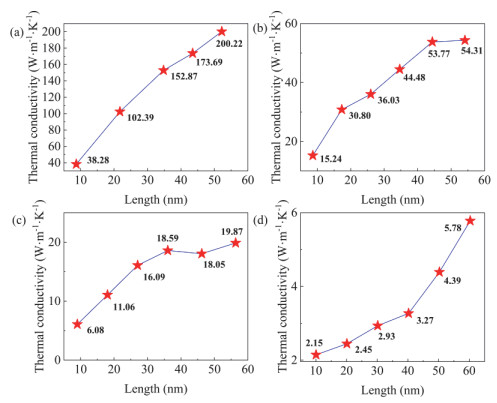
二维Ⅲ族氮化物(h-BN、h-AlN、h-GaN与h-InN)因其类石墨烯结构、热稳定性及宽禁带特性,在电子与光电器件中具有重要潜力。传统的密度泛函理论(DFT)与经典分子动力学(MD)方法分别在计算精度与尺度有优势,但也限制了其在高精度的大尺度结构与性能研究中的应用。本文引入深度势能(DP)方法,构建了高精度机器学习势函数(MLP),系统研究了二维Ⅲ族氮化物的晶格动力学、热力学、力学与热输运特性。深度势能对能量与原子力的预测接近GGA/PBE的精度,并准确重现了声子色散及0–1200 K范围内的热力学函数(自由能、热容、熵)。通过MD方法进行单轴拉伸模拟,揭示各材料的力学行为差异。h-BN刚性强且易脆断,h-AlN与h-GaN具有良好的强度和延展性,h-InN整体机械性能较弱。基于修正的非平衡分子动力学(NEMD)方法计算了材料热导率,发现h-BN与h-AlN表现出显著的长度依赖性,源于声子平均自由程较长。h-GaN与h-InN由于声子散射增强,热导率整体偏低。本研究结果表明,DP方法兼具GGA/PBE精度与大尺度模拟能力方面优势,不仅提升了对二维Ⅲ族氮化物结构性能的理解,也为其在材料设计和器件的应用提供了计算框架与理论依据。
引用本文
曹键, 刘畅, 王丹棱, 李海潮, 徐丽娜, 肖洪平, 詹绍琦, 何晓, 方国勇. 基于机器学习势的二维Ⅲ族氮化物性质预测[J]. 物理化学学报, 2026, 42(4), 100224. doi: 10.1016/j.actphy.2025.100224
Jian Cao, Chang Liu, Danling Wang, Haichao Li, Lina Xu, Hongping Xiao, Shaoqi Zhan, Xiao He, Guoyong Fang. Machine learning potentials for property predictions of two-dimensional group-Ⅲ nitrides[J]. Acta Phys. -Chim. Sin. 2026, 42(4), 100224. doi: 10.1016/j.actphy.2025.100224
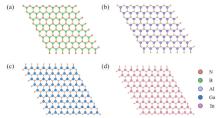
图1
"
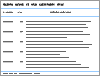
表1
"
| Compound | h-BN | h-AlN | h-GaN | h-InN | |||||||
| Parameters | Exp. | Cal. | Exp. | Cal. | Exp. | Cal. | Exp. | Cal. | |||
| Lattice parameter | 2.50–2.51 | 2.51 | 3.11–3.17 | 3.31 | 3.19 | 3.25 | 3.54 | 3.55 | |||
| Bond length | 1.44–1.45 | 1.45 | 1.80–1.83 | 1.80 | 1.82–1.85 | 1.87 | 2.15 | 2.09 | |||
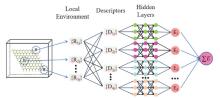
图2
"
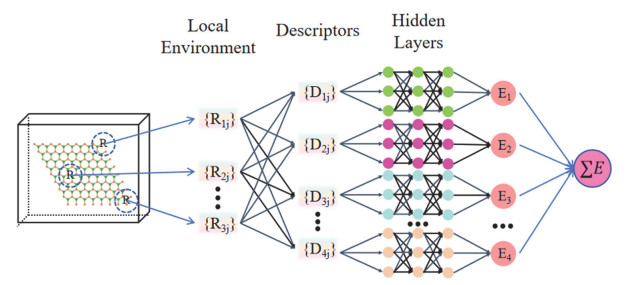
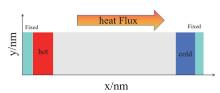
图3
"
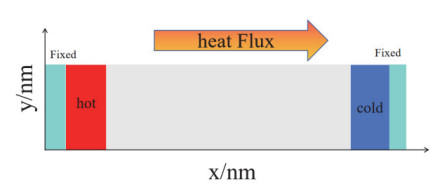
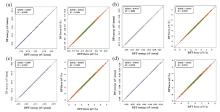
图4
"
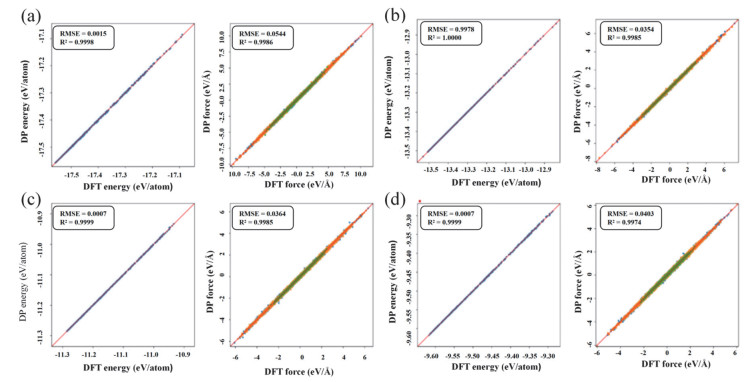
图5
"
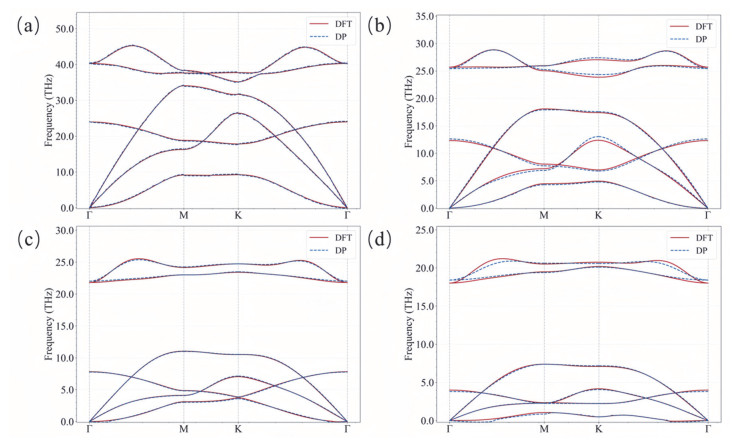
图6
"
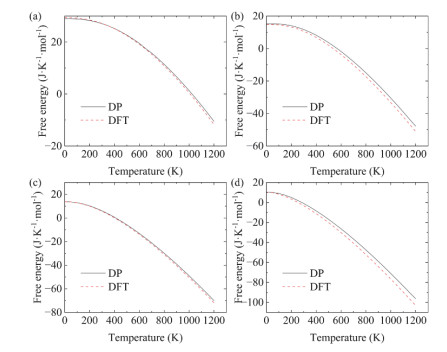
图7
"
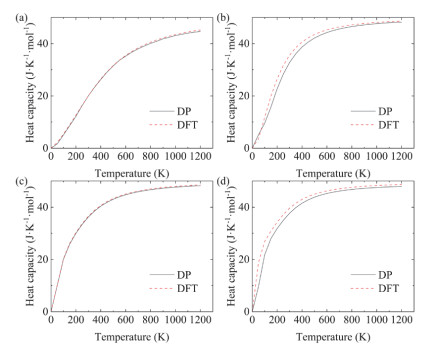
图8
"
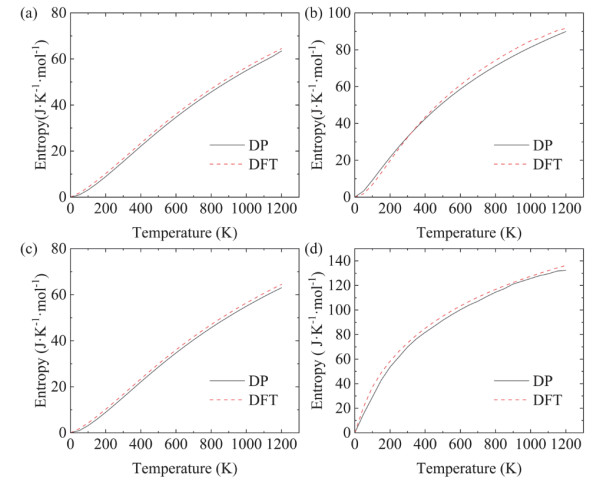
图9
"
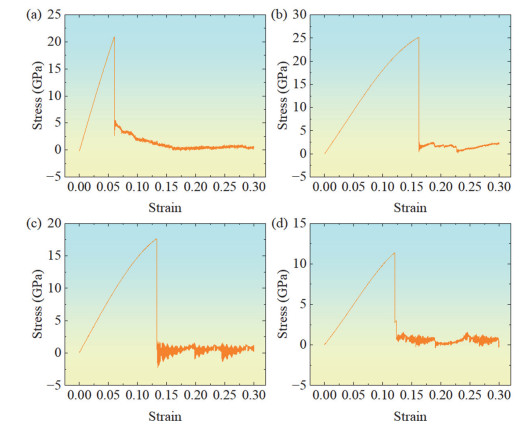
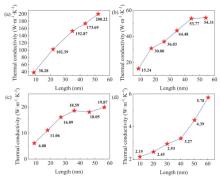
图10
"
| 1 |
F. Yang, L. Jin, L. Sun, X. Ren, X. Duan, H. Cheng. Adv. Mater. 2018, 30, 1801891.
doi: 10.1002/adma.201801891 |
| 2 |
S. Lv, S. Wang, L. Li, S. Xie, J. Yu, Y. Zhong, G. Wang, C. Liang, X. Xu, L. Zhang. Adv. Sci. 2023, 10, 2300780.
doi: 10.1002/advs.202300780 |
| 3 |
Y. Guo, H. Zhu, Q. Wang. ACS Appl. Mater. Interfaces 2018, 11, 1033.
doi: 10.1021/acsami.8b17341 |
| 4 |
S. Z. Butler, S. M. Hollen, L. Cao, Y. Cui, J. A. Gupta, H. R. Gutiérrez, T. F. Heinz, S. S. Hong, J. Huang, A. F. Ismach, et al.. ACS Nano 2013, 7, 2898.
doi: 10.1021/nn400280c |
| 5 |
A. H. Castro Neto, F. Guinea, N. M. R. Peres, K. S. Novoselov, A. K. Geim. Rev. Mod. Phys. 2009, 81, 109.
doi: 10.1002/adfm.202107499 |
| 6 |
D. Deng, K. S. Novoselov, Q. Fu, N. Zheng, Z. Tian, X. Bao. Nat. Nanotechnol. 2016, 11, 218.
doi: 10.1038/nnano.2015.340 |
| 7 |
A. Gupta, T. Sakthivel, S. Seal. Prog. Mater. Sci. 2015, 73, 44.
doi: 10.1016/j.pmatsci.2015.02.002 |
| 8 |
M. Xu, T. Liang, M. Shi, H. Chen. Chem. Rev. 2013, 113, 3766.
doi: 10.1021/cr300263a |
| 9 |
Q. Cui, G. Qin, W. Wang, K. R. Geethalakshmi, A. Du, Q. Sun. Appl. Surf. Sci. 2020, 500, 143993.
doi: 10.1016/j.apsusc.2019.143993 |
| 10 |
M. Q. Yang, N. Zhang, Y. J. Xu. ACS Appl. Mater. Interfaces 2013, 5, 1156.
doi: 10.1021/am3029798 |
| 11 |
K. Xia, V. I. Artyukhov, L. Sun, J. Zheng, L. Jiao, B. I. Yakobson, Y. Zhang. Nano Res. 2016, 9, 2182.
doi: 10.1007/s12274-016-1107-9 |
| 12 |
A. D. Oyedele, S. Yang, L. Liang, A. A. Puretzky, K. Wang, J. Zhang, P. R. Pudasaini, A. W. Ghosh, Z. Liu, C. M. Rouleau, et al.. J. Am. Chem. Soc. 2017, 139, 14090.
doi: 10.1021/jacs.7b04865 |
| 13 |
M. Corso, W. Auwa, M. Muntwiler, A. Tamai. Science 2004, 303, 217.
doi: 10.1126/science.1091979 |
| 14 |
J. Yu, L. Wang, Z. Hao, Y. Luo, C. Sun, J. Wang, Y. Han, B. Xiong, H. Li. Adv. Mater. 2020, 32, 1903407.
doi: 10.1002/adma.201903407 |
| 15 |
Z. Wang, G. Wang, X. Liu, S. Wang, T. Wang, S. Zhang, J. Yu, G. Zhao, L. Zhang. J. Mater. Chem. C 2021, 9, 17201.
doi: 10.1039/D1TC04022G |
| 16 |
B. Pécz, G. Nicotra, F. Giannazzo, R. Yakimova, A. Koos, A. Kakanakova-Georgieva. Adv. Mater. 2020, 22, 2006660.
doi: 10.1002/adma.202006660 |
| 17 |
I. A. Aleksandrov, T. V. Malin, K. S. Zhuravlev, S. V. Trubina, S. B. Erenburg, B. Pécz, Y. V. Lebiadok. Appl. Surf. Sci. 2020, 515, 146001.
doi: 10.1016/j.apsusc.2020.146001 |
| 18 |
M. E. Khan, M. Aamir, C. Ming, Y.-Y. Sun, Y.-H. Kim. FlatChem 2025, 51, 100846.
doi: 10.1016/j.flatc.2025.100846 |
| 19 |
E. Sandre, A. Pasturel. Mol. Simul. 1997, 20, 63.
doi: 10.1080/08927029708024168 |
| 20 |
R. Vink, G. Barkema, W. Van der Weg, N. Mousseau. J. Non-Cryst. Solids 2001, 282, 248.
doi: 10.1016/S0022-3093(01)00342-8 |
| 21 |
J. Tersoff. Phys. Rev. B 1988, 37, 6991.
doi: 10.1103/physrevb.37.6991 |
| 22 |
W. D. Cornell, P. Cieplak, C. I. Bayly, I. R. Gould, K. M. Merz Jr., D. M. Ferguson, D. C. Spellmeyer, T. Fox, J. W. Caldwell, P. A. Kollman. J. Am. Chem. Soc. 1995, 117, 5179.
doi: 10.1021/ja955032e |
| 23 |
L. D. Schuler, X. Daura, W. F. van Gunsteren. J. Comput. Chem. 2001, 22, 1205.
doi: 10.1002/jcc.1078 |
| 24 |
K. Wan, J. He, X. Shi. Adv. Mater. 2023, 36, 2305758.
doi: 10.1002/adma.202305758 |
| 25 |
D. Shvets, A. Gorbatov. Eur. Phys. J. Plus 2024, 139, 8685.
doi: 10.1140/epjp/s13360-024-05685-z |
| 26 |
J. Xia, Y. Zhang, B. Jiang. Chem. Soc. Rev. 2025, 54, 4790.
doi: 10.1039/d5cs00104h |
| 27 |
S. Hwang, J. Jung, C. Hong, W. Jeong, S. Kang, S. Han. J. Am. Chem. Soc. 2023, 145, 35.
doi: 10.1021/jacs.3c06210 |
| 28 |
J. Behler, M. Parrinello. Phys. Rev. Lett. 2007, 98, 146401.
doi: 10.1103/PhysRevLett.98.146401 |
| 29 |
A. P. Bartók, M. C. Payne, R. Kondor, G. Csányi. Phys. Rev. Lett. 2010, 104, 136403.
doi: 10.1103/PhysRevLett.104.136403 |
| 30 |
M. A. Caro. Phys. Rev. B 2019, 100, 024112.
doi: 10.1103/PhysRevB.100.024112 |
| 31 |
J. Byggmästar, K. Nordlund, F. Djurabekova. Phys. Rev. Mater. 2022, 6, 083801.
doi: 10.1103/PhysRevMaterials.6.083801 |
| 32 |
A. Thompson, L. Swiler, C. Trott, S. Foiles, G. Tucker. J. Comput. Phys. 2015, 285, 316.
doi: 10.1016/j.jcp.2014.12.018 |
| 33 |
I. S. Novikov, K. Gubaev, E. V. Podryabinkin, A. V. Shapeev. Mach. Learn. : Sci. Technol. 2020, 2, 025002.
doi: 10.1088/2632-2153/abc9fe |
| 34 |
L. Zhang, J. Han, H. Wang, R. Car, W. E. Phys. Rev. Lett. 2018, 120, 143001.
doi: 10.1103/physrevlett.120.143001 |
| 35 |
R. Drautz. Phys. Rev. B 2019, 23, 249901.
doi: 10.1103/PhysRevB.100.249901 |
| 36 |
H. Dong, X. Wu, Y. Shi, P. Ying, W. Zhou, K. Xu, T. Liang, S. Xiong, S. Chen, Y. Wang, et al.. J. Appl. Phys. 2024, 135, 161101.
doi: 10.1063/5.0200833 |
| 37 |
G. Kresse, J. Furthmüller. Phys. Rev. B 1996, 54, 11169.
doi: 10.1103/PhysRevB.54.11169 |
| 38 |
A. D. Becke. J. Chem. Phys. 1992, 96, 2155.
doi: 10.1063/1.462066 |
| 39 |
J. P. Perdew, K. Burke, M. Ernzerhof. Phys. Rev. Lett. 1996, 77, 3865.
doi: 10.1103/physrevlett.77.3865 |
| 40 |
J. Ben, X. Liu, C. Wang, Y. Zhang, Z. Shi, Y. Jia, S. Zhang, H. Zhang, W. Yu, D. Li, X. Sun. Adv. Mater. 2021, 32, 2006761.
doi: 10.1002/adma.202006761 |
| 41 |
M. A. Qaeed, K. Ibrahim, K. M. A. Saron, A. Salhin. Superlattices Microstruct. 2013, 64, 77.
doi: 10.1016/j.spmi.2013.08.015 |
| 42 |
A. Costales, M. A. Blanco, A. Martí. J. Am. Chem. Soc. 2002, 124, 4116.
doi: 10.1021/ja017380o |
| 43 |
K. He, X. Zhang, S. Ren, J. Sun, arXiv: 1512.03385, https://doi.org/10.48550/arXiv.1512.03385.
|
| 44 |
H. Wang, L. Zhang, J. Han, W. E. Comput. Phys. Commun. 2018, 228, 178.
doi: 10.1016/j.cpc.2018.03.016 |
| 45 |
Y. Du, C. Hao, Z. Meng, C. Wang, K. Peng, Y. Tian, W. Duan, L. Yang, P. Lin, S. Zhang. Comput. Mater. Sci. 2024, 242, 113078.
doi: 10.1016/j.commatsci.2024.113078 |
| 46 |
W. Yu, Z. Zhang, X. Wan, J. Su, Q. Gui, H. Guo, H.-x. Zhong, J. Robertson, Y. Guo. Chem. Mater. 2023, 35, 6651.
doi: 10.1021/acs.chemmater.3c00524 |
| 47 |
W. Liang, G. Lu, J. Yu. J. Mater. Sci. Technol. 2021, 75, 78.
doi: 10.1016/j.jmst.2020.09.040 |
| 48 |
D. J. Evans, B. L. Holian. J. Chem. Phys. 1985, 83, 406.
doi: 10.1063/1.449071 |
| 49 |
A. P. Thompson, H. M. Aktulga, R. Berger, D. S. Bolintineanu, W. M. Brown, P. S. Crozier, P. J. in't Veld, A. Kohlmeyer, S. G. Moore, T. D. Nguyen, et al.. Comput. Phys. Commun. 2022, 271, 108171.
doi: 10.1016/j.cpc.2021.108171 |
| 50 |
T. Gao, H. He, Y. Liu, Z. Bian, Q. Chen, Q. Xie, Y. Liang, Q. Xiao. Surf. Interfaces 2023, 39, 102983.
doi: 10.1016/j.surfin.2023.102983 |
| 51 |
K. Dey, S. Shahriar, M. A. R. Anan, P. Malakar, M. M. Rahman, M. M. Chowdhury. RSC Adv. 2024, 14, 24483.
doi: 10.1039/d4ra04814h |
| 52 |
B. Mortazavi, M. Makaremi, M. Shahrokhi, Z. Fan, T. Rabczuk. Carbon 2018, 137, 57.
doi: 10.1016/j.carbon.2018.04.090 |
| 53 |
F. Müller-Plathe. J. Chem. Phys. 1997, 106, 6082.
doi: 10.1063/1.473271 |
| 54 |
A. Chernatynskiy, S. R. Phillpot. Phys. Rev. B 2010, 82, 134301.
doi: 10.1103/physrevb.82.134301 |
| 55 |
M. Ozsipahi, S. Jean, A. Beskok, A. A. Wilson. Int. Commun. Heat Mass Transf. 2025, 163, 108658.
doi: 10.1016/j.icheatmasstransfer.2025.108658 |
| 56 |
Y. Yang, J. Ma, J. Yang, Y. Zhang. ACS Appl. Mater. Interfaces 2022, 14, 45742.
doi: 10.1021/acsami.2c14871 |
| 57 |
Z. Li, S. Xiong, C. Sievers, Y. Hu, Z. Fan, N. Wei, H. Bao, S. Chen, D. Donadio, T. Ala-Nissila. J. Chem. Phys. 2019, 151, 234105.
doi: 10.1063/1.5132543 |
| 58 |
L. Chaput, A. Togo, I. Tanaka, G. Hug. Phys. Rev. B 2011, 84, 094302.
doi: 10.1103/physrevb.84.094302 |
| 59 |
S. K. Achar, L. Zhang, J. K. Johnson. J. Phys. Chem. C 2021, 125, 14874.
doi: 10.1021/acs.jpcc.1c01411 |
| 60 |
J. Callaway. Phys. Rev. 1959, 113, 1046.
doi: 10.1103/PhysRev.113.1046 |
| 61 |
G. A. Slack. J. Phys. Chem. Solids 1973, 34, 321.
doi: 10.1016/0022-3697(73)90092-9 |
| 62 |
N. A. Sakharova, A. F. G. Pereira, J. M. Antunes. Nanomaterials 2024, 14, 1736.
doi: 10.3390/nano14211736 |
| [1] | 罗涵之, 梁琦茗, 郭子兴, 谢忻恬, 唐锦朋, 管曈, 李晔飞, 马思聪, 许颖忱, 王振雄, 商城, 刘智攀. LASPAI:人工智能驱动的未来原子模拟平台[J]. 物理化学学报, 2026, 42(6): 100235 - . |
| [2] | 张笑晨, 于飞, 马杰. 多角度数理模拟在电容去离子中的前沿应用[J]. 物理化学学报, 2024, 40(11): 2311026 - . |
| [3] | 马骋, 窦翔宇, 刘泽宇, 廖培龙, 朱志扬, 刘卡尔顿, 黄建滨. 一种新型CO2/原油助混剂CAA8-X的应用与助混机理[J]. 物理化学学报, 2022, 38(8): 2012019 - . |
| [4] | 俞宏伟, 李实, 李金龙, 朱韶华, 孙成珍. 气驱油油气混相过程的界面传质特性及其分子机制[J]. 物理化学学报, 2022, 38(5): 2006061 - . |
| [5] | 卢浩然, 魏雅清, 龙闰. 纳米孔缺陷导致单层黑磷电荷局域极大抑制非辐射电子-空穴复合的时域模拟[J]. 物理化学学报, 2022, 38(5): 2006064 - . |
| [6] | 曹冲, 张裴, 曹立冬, 刘铭鑫, 宋玉莹, 陈鹏, 黄啟良, 韩布兴. 液滴在超疏水植物叶面的沉积:实验和分子动力学模拟[J]. 物理化学学报, 2022, 38(12): 2207006 - . |
| [7] | 宋厚甫, 康飞宇. 石墨烯导热研究进展[J]. 物理化学学报, 2022, 38(1): 2101013 - . |
| [8] | 李孟婷, 郑星群, 李莉, 魏子栋. 碱性介质中氢氧化和析氢反应机理研究现状[J]. 物理化学学报, 2021, 37(9): 2007054 - . |
| [9] | 陈文琼, 关永吉, 张姣, 裴俊捷, 张晓萍, 邓友全. 外电场作用下离子液体振动光谱变化的分子动力学模拟研究[J]. 物理化学学报, 2021, 37(10): 2001004 - . |
| [10] | 孙成珍, 周润峰, 白博峰. 基于静电效应的石墨烯纳米孔选择性渗透特性[J]. 物理化学学报, 2020, 36(11): 1911044 - . |
| [11] | 陈召龙, 高鹏, 刘忠范. 新型石墨烯基LED器件:从生长机理到器件特性[J]. 物理化学学报, 2020, 36(1): 1907004 - . |
| [12] | 刘海,李毅,马兆侠,周智炫,李俊玲,何远航. 定常冲击波作用下六硝基六氮杂异伍兹烷(CL-20)/奥克托今(HMX)含能共晶初始分解机理研究[J]. 物理化学学报, 2019, 35(8): 858 -867 . |
| [13] | 张涛,仇运广,罗启超,程曦,赵丽芬,严昕,彭浡,蒋华良,阳怀宇. 钙离子和镁离子浓度变化对磷脂酰乙醇胺-磷脂酰甘油双分子层膜的影响[J]. 物理化学学报, 2019, 35(8): 840 -849 . |
| [14] | 许谢君,肖兴庆,徐首红,刘洪来. 亮氨酸拉链型脂肽对脂质体温敏性调节的分子模拟[J]. 物理化学学报, 2019, 35(6): 598 -606 . |
| [15] | 吕康杰,彭燕秋,肖丽,陆君涛,庄林. 醇/水混合溶剂中碱性聚合物电解质独特的溶解行为[J]. 物理化学学报, 2019, 35(4): 378 -384 . |
|
||