物理化学学报 >> 2026, Vol. 42 >> Issue (6): 100285.doi: 10.1016/j.actphy.2026.100285
论文 上一篇
聚酰亚胺衍生多孔碳纳米片中的协同分子组装与阻抗匹配及其微波吸收性能研究
梁博1,2, 赵禹一健1, 王思雨1, 黄诗涵1, 周方科1, 张传坤2, 王越1,2,*( ), 果小明1,2,*()
- 1 湖北汽车工业学院汽车材料学院, 湖北 十堰 442002
2 湖北汽车工业学院储能与动力电池湖北省重点实验室, 湖北 十堰 442002
-
收稿日期:2026-02-14修回日期:2026-03-10录用日期:2026-03-11发布日期:2026-04-21 -
通讯作者:Email: wangyue@huat.edu.cn (王越)gxm@huat.edu.cn (果小明)
Synergistic molecular assembly and impedance matching in polyimide-derived porous carbon nanosheets for advanced microwave absorption
Bo Liang1,2, Yuyijian Zhao1, Siyu Wang1, Shihan Huang1, Fangke Zhou1, Chuankun Zhang2, Yue Wang1,2,*(), Xiaoming Guo1,2,*()
- 1 School of Automotive Materials, Hubei University of Automotive Technology, Shiyan 442002, Hubei Province, China
2 Hubei Key Laboratory of Energy Storage and Power Battery, School of Optoelectronic Engineering, School of New Energy, Hubei University of Automotive Technology, Shiyan 442002, Hubei Province, China
-
Received:2026-02-14Revised:2026-03-10Accepted:2026-03-11Published:2026-04-21 -
Contact:Email: wangyue@huat.edu.cn (Yue Wang)gxm@huat.edu.cn (Xiaoming Guo)

摘要:
本文提出了一种通过分子结构设计协同调控介电与磁损耗来制备高性能微波吸收材料的新策略。以同时含有羧基和苯并咪唑官能团的聚酰亚胺前驱体为关键组分,通过冰模板法结合原位离子交换,将Ni2+离子均匀引入聚合物骨架。经热酰亚胺化和碳化处理后,成功制备均匀负载Ni/NiO纳米颗粒的氮掺杂二维碳纳米片复合材料(BPCN@Ni/NiO)。相较于不含苯并咪唑结构的对照样品(NPCN@Ni/NiO),该材料展现出优异的微波吸收性能:最低反射损耗(RLmin)达−69.02 dB,有效吸收带宽(EAB)为8.92 GHz (8.28–17.2 GHz)。微观结构分析证实其具有三维互联纳米片结构、高度分散的Ni/NiO组分及均匀的元素分布。吸波性能的提升归因于苯并咪唑和羧基对Ni2+的协同络合作用,实现了镍组分的高效负载与均匀分散,从而优化了阻抗匹配。此外,独特的二维导电网络、丰富的C/Ni/NiO异质界面、缺陷诱导偶极极化以及Ni与NiO间的磁耦合共同构建了协同多重损耗机制,赋予材料优异的微波衰减能力。该工作为通过精准分子工程设计轻质、宽频、高效的碳基复合吸波材料提供了新思路。
引用本文
梁博, 赵禹一健, 王思雨, 黄诗涵, 周方科, 张传坤, 王越, 果小明. 聚酰亚胺衍生多孔碳纳米片中的协同分子组装与阻抗匹配及其微波吸收性能研究[J]. 物理化学学报, 2026, 42(6), 100285. doi: 10.1016/j.actphy.2026.100285
Bo Liang, Yuyijian Zhao, Siyu Wang, Shihan Huang, Fangke Zhou, Chuankun Zhang, Yue Wang, Xiaoming Guo. Synergistic molecular assembly and impedance matching in polyimide-derived porous carbon nanosheets for advanced microwave absorption[J]. Acta Phys. -Chim. Sin. 2026, 42(6), 100285. doi: 10.1016/j.actphy.2026.100285
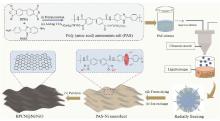
图1
"
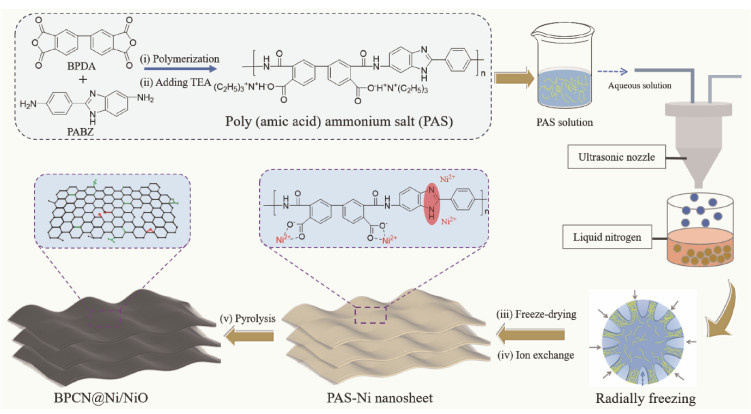
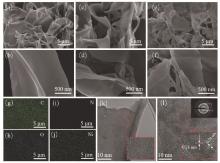
图2
"
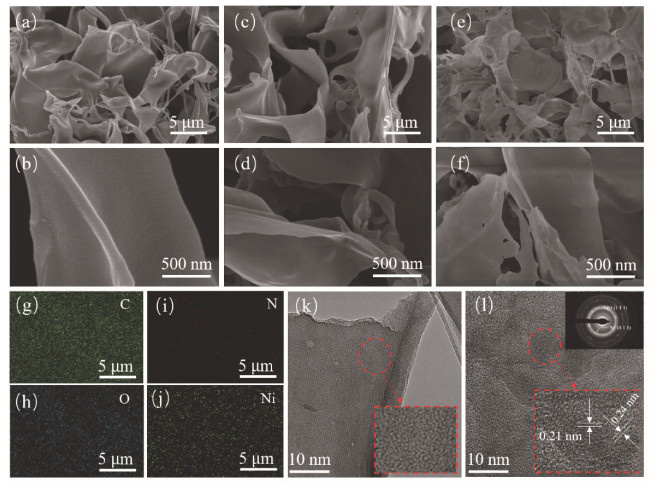
图3
"
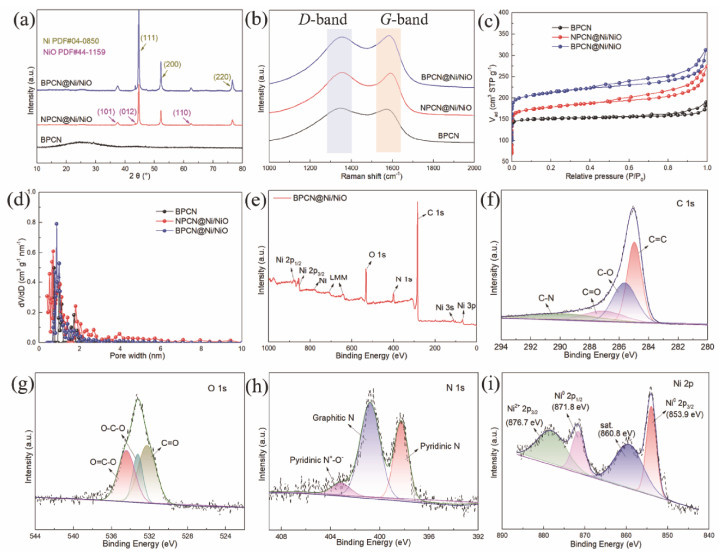
图4
"
图5
"
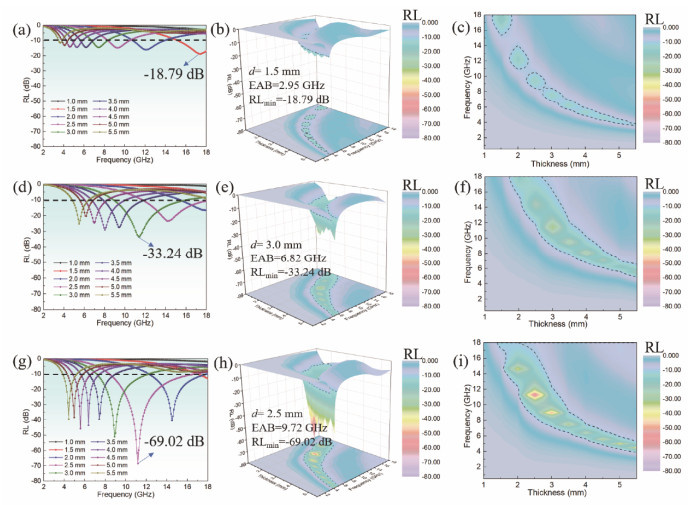
图6
"
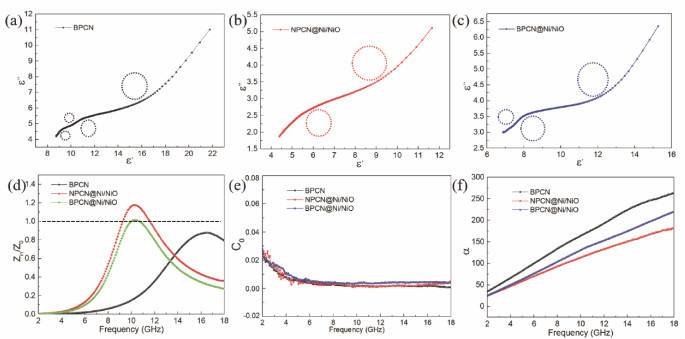
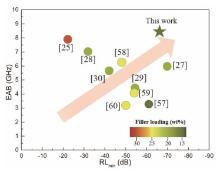
图7
"
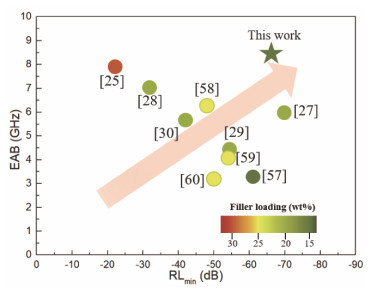
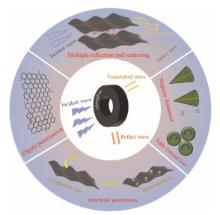
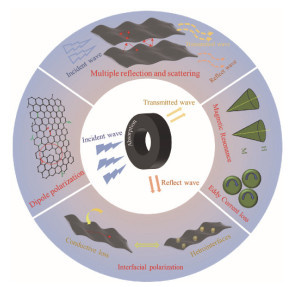
图8
"
| 1 |
H. Li, Y. Pan, B. Liang, D. Yao, X. Gao, J. Chen, C. Lu, X. Pang. Sep. Purif. Technol. 2025, 354, 128903.
doi: 10.1016/j.seppur.2024.128903 |
| 2 |
S. Zhang, R. Niu, X. Guo, Z. Jia, D. Lan, G. Wu. Carbon 2026, 252, 121371.
doi: 10.1016/j.carbon.2026.121371 |
| 3 |
C. Zhang, F. Zhou, Y. Zhao, S. Wang, S. Huang, Q. Zhao, D. Lan, X. Guo, Yijin Ren, B. Liang. New J. Chem. 2026, 50, 3256.
doi: 10.1039/d5nj04791a |
| 4 |
D. Wang, T. Ping, Z. Du, Y. Liao, H. Gao, X. Gong, J. Rao, B. Wang, S. Wei, X. Liu. Nano Res. 2025, 18, 94907226.
doi: 10.26599/NR.2025.94907226 |
| 5 |
Q. Niu, Y. Huang, H. Huang, M. Zong. Adv. Mater. 2025, 37, e10139.
doi: 10.1002/adma.202510139 |
| 6 |
J. Zhou, X. Huang, D. Lan, Z. Jia, G. Wu. Carbon 2026, 248, 121143.
doi: 10.1016/j.carbon.2025.121143 |
| 7 |
T. Hu, D. Lan, J. Wang, X. Zhong, G. Bu, P. Yin. Carbon 2025, 232, 119798.
doi: 10.1016/j.carbon.2024.119798 |
| 8 |
Y. Pan, K. Yu, D. Lan, Z. Zhang, Z. Chen. Carbon 2025, 245, 120824.
doi: 10.1016/j.carbon.2025.120824 |
| 9 |
W. Jiang, S. Xu, C. Lv, D. Lan, S. Zhang, Z. Gao, Z. Jia, G. Wu. Carbon 2025, 245, 120784.
doi: 10.1016/j.carbon.2025.120784 |
| 10 |
M. Shi, Z. Jia, D. Lan, Z. Gao, S. Zhang, G. Wu. Adv. Funct. Mater. 2026, 36, e28665.
doi: 10.1002/adfm.202528665 |
| 11 |
D. Wang, X. Zhang, Z. Du, X, Gong, Y. Zhang. J. Mater. Sci. Technol. 2025, 257, 307.
doi: 10.1016/j.jmst.2025.08.051 |
| 12 |
R. Xue, D. Lan, R. Qiang, Z. Zang, J. Ren, Y. Shao, L. Rong, J. Gu, J. Fang, G. Wu. Carbon 2025, 233, 119877.
doi: 10.1016/j.carbon.2024.119877 |
| 13 |
Y. Cheng, X. Liu, J. Ren, X. Xu, D. Lan, G. Wu, S. Zhang, Z. Gao, Z. Jia, G. Wu. Carbon 2025, 239, 120325.
doi: 10.1016/j.carbon.2025.120325 |
| 14 |
P. Yin, D. Lan, Z. Yuan, R. Wang, Y. Zhang, X. Sun. J. Alloy. Compd. 2025, 1037, 182260.
doi: 10.1016/j.jallcom.2025.182260 |
| 15 |
H. Wei, W. Li, K. Bachagha. Carbon 2024, 217, 118651.
doi: 10.1016/j.carbon.2023.118651 |
| 16 |
J. Zheng, L. Cheng, S. Zhang, D. Lan, X. Zhao, X. Liu, J. Zhou, S. Cai, L. Niu, G. Wu, et al.. J. Mater. Sci. Technol. 2026, 264, 163.
doi: 10.1016/j.jmst.2025.11.031 |
| 17 |
X. Ren, D. Lan, Z. Gao, S. Zhang, Y. Zhang, M. He, Z. Jia, G. Wu. J. Mater. Sci. Technol. 2026, 255, 236.
doi: 10.1016/j.jmst.2025.09.001 |
| 18 |
W. Zhao, Z. Guo, D. Lan, Z. Jia, S. Zhang, G. Wu. Small 2025, 21, e09339.
doi: 10.1002/smll.202509339 |
| 19 |
D. Lan, J. Wang, Y. Wang, X. Guo, D. Du, C. Zhang, G. Wu. Carbon 2026, 121416.
doi: 10.1016/j.carbon.2026.121416 |
| 20 |
Y. Y. Gu, J. Shi, D. Nematov, A. Q. Liu, Y. R. Yin, H. L. Dai, L. Bi. Mater. Sci. Eng. B 2026, 327, 119260.
doi: 10.1016/j.mseb.2026.119260 |
| 21 |
W. H. Song, X. C. Dong, Y. R. Yin, S. F. Yu, Y. Y. Gu, L. Bi. J. Adv. Ceram. 2026, 15, 9221262.
doi: 10.26599/JAC.2026.9221262 |
| 22 |
D. Tan, Q. Wang, M. Li, L. Song, F. Zhang, Z. Min, H. Wang, Y. Zhu, R. Zhang, D. Lan, et al.. Chem. Eng. J. 2024, 492, 152245.
doi: 10.1016/j.cej.2024.152245 |
| 23 |
D. Wang, T. Ping, Z. Du, X. Liu, Y. Zhang. Nano-Micro Lett. 2025, 17 (1), 100.
doi: 10.1007/s40820-024-01591-2 |
| 24 |
B. Luo, B. Liang, J. Wang, Z. Yang, X. Zhang, S. Xiong, L. Yang, Y. Xu, Y. Li. Adv. Funct. Mater. 2025, 35, 2504823.
doi: 10.1002/adfm.202504823 |
| 25 |
M. Yi, B. Liang, H. Xiao, W. Tan, W. Yang, X. He, Y. Stehle, J. Hu, K. Zeng, G. Yang. ACS Appl. Mater. Interf. 2025, 17, 9702.
doi: 10.1021/acsami.4c22824 |
| 26 |
T. Zhang, B. Liang, J. Zhang, L. Yang, J. Hu, Y. Li. Chinese J. Polym. Sci. 2025, 43, 261.
doi: 10.1007/s10118-025-3274-1 |
| 27 |
M. Chen, B. Liang, X. He, W. Tan, H. Xiao, W. Yang, J. Hu, K. Zeng, G. Yang. Carbon 2025, 232, 119804.
doi: 10.1016/j.carbon.2024.119804 |
| 28 |
C. Gao, H. Zhang, D. Zhang, F. Gao, Y. Liu, X. Chen, D. Wu, M. Terrones, Y. Wang. Chem. Eng. J. 2023, 476, 146912.
doi: 10.1016/j.cej.2023.146912 |
| 29 |
P. Liu, Y. Huang, J. Yan, Y. Yang, Y. Zhao. ACS Appl. Mater. Interf. 2016, 8, 5536.
doi: 10.1021/acsami.5b10511 |
| 30 |
L. Lyu, F. Wang, B. Li, X. Zhang, J. Qiao, Y. Yang, J. Liu. J. Colloid Interf. Sci. 2021, 586, 613.
doi: 10.1016/j.jcis.2020.10.129 |
| 31 |
B. Liang, W. Tan, M. Chen, M. Yi, J. Hu, K. Zeng, Y. Wang, Y. Li, G. Yang. J. Alloy. Compd. 2024, 976, 173030.
doi: 10.1016/j.jallcom.2023.173030 |
| 32 |
Q. Zhao, F. Zhou, J. Ma, S. Wang, S. Huang, Y. Zhao, H. Li, X. Guo, B. Liang. J. Power Source. 2026, 662, 238762.
doi: 10.1016/j.jpowsour.2025.238762 |
| 33 |
W. Tan, B. Liang, M. Chen, H. Xiao, X. He, W. Yang, J. Hu, K. Zeng, G. Yang. Chem. Eng. J. 2024, 496, 153822.
doi: 10.1016/j.cej.2024.153822 |
| 34 |
B. Liang, L. Chen, J. Lv, Y. Li, W. Tan, W. Zhu, J. Hu, K. Zeng, G. Yang. ACS Appl. Energy Mater. 2022, 5, 6163.
doi: 10.1021/acsaem.2c00568 |
| 35 |
P. Yin, L. Zhang, J. Wang, X. Feng, Y. Zhang, J. Dai, J. Liu. Ceram. Int. 2022, 48, 12979.
doi: 10.1016/j.ceramint.2022.01.171 |
| 36 |
S. Yang, Y. R. Yin, S. Boulfrad, H. L. Dai, S. F. Yu, Y. Y. Gu, L. Bi. Adv. Funct. Mater. 2026, e74539.
doi: 10.1002/adfm.74539 |
| 37 |
J. Wen, D. Lan, Y. Wang, L. Ren, A. Feng, Z. Jia, G. Wu. Int. J. Min. Met. Mater. 2024, 31, 1701.
doi: 10.1007/s12613-024-2881-0 |
| 38 |
L. Chai, Y. Wang, Z. Jia, Z. Liu, S. Zhou, Q. He, H. Du, G. Wu. Chem. Eng. J. 2022, 429, 132547.
doi: 10.1016/j.cej.2021.132547 |
| 39 |
L. Zhou, Y. R. Yin, D. Nematov, H. L. Dai, Y. Y. Gu, S. F. Yu, L. Bi. Sustain. Mater. Technol. 2026, 48, e01936.
doi: 10.1016/j.susmat.2026.e01936 |
| 40 |
S. Zhang, J. Zheng, Z. Zhao, S. Du, D. Lan, Z. Gao, G. Wu. Adv. Funct. Mater. 2026, 36, e13762.
doi: 10.1002/adfm.202513762 |
| 41 |
S. Zhang, J. Zheng, D. Lan, Z. Gao, X. Liang, Q. Tian, Z. Zhao, G. Wu. Adv. Funct. Mater. 2025, 35, 2413884.
doi: 10.1002/adfm.202413884 |
| 42 |
L. Zhou, P. Hu, M. Bai, N. Leng, B. Cai, H. Peng, P. Zhao, Y. Guo, M. He, G. Wang, et al.. Adv. Mater. 2025, 37, 2418321.
doi: 10.1002/adma.202418321 |
| 43 |
X. Ma, F. Pan, Z. Xiu, L. Li, R. Zhang, H. Gu, C. Sun, Y. Gao, W. Lu. Carbon 2024, 229, 119444.
doi: 10.1016/j.carbon.2024.119444 |
| 44 |
X. Gong, L. Xiang, X. Qi, X. Gong, Y. Chen, Q. Peng, Y. Qu, F. Wu, K. Sun, W. Zhong. Adv. Compos. Hybrid Mater. 2024, 7, 216.
doi: 10.1007/s42114-024-01043-w |
| 45 |
T. Shi, X. Li, X. Chen, M. Rao, Y. Wang, D. Huang, Q. Li, H. Zeng, J. Wang, Y. Chen. Carbon 2025, 237, 120157.
doi: 10.1016/j.carbon.2025.120157 |
| 46 |
G. Han, F. Qi, Y. Sun, J. Zhou, Y. Wang, S. Sui, B. Feng, Y. Jia, X. Tian, X. Wang, et al.. Compos. Commun. 2025, 55, 102303.
doi: 10.1016/j.coco.2025.102303 |
| 47 |
Z. Liu, Z. Chen, J. Zhou, J. Tao, Z. Cheng, Y. Liu, L. Duan, F. Wu, J. Liu, Y. Yan, et al.. Carbon 2024, 230, 119684.
doi: 10.1016/j.carbon.2024.119684 |
| 48 |
J. Qiu, H. Cao, J. Liao, R. Du, K. Dou, N. Tsidaeva, W. Wang. J. Colloid Interface Sci. 2022, 609, 12.
doi: 10.1016/j.jcis.2021.11.176 |
| 49 |
X. Wu, P. Kang, Y. Zhang, H. Guo, S. Yang, Q. Zheng, L. Wang, W. Jiang. J. Mater. Sci. Technol. 2025, 205, 258.
doi: 10.1016/j.jmst.2024.03.066 |
| 50 |
D. Wang, Y. Hu, Z. Cui, P. Yang, Z. Du, Y. Hou, P. Yang, J. Rao, C. Wang, Y. Zhang. J. Colloid Interface Sci. 2023, 646, 991.
doi: 10.1016/j.jcis.2023.05.112 |
| 51 |
D. Wang, P. Yang, Y. Hu, Z. Cui, Z. Du, P. Yang, S. Yi, J. Rao, Y. Zhang. Powder Technol. 2023, 426, 118670.
doi: 10.1016/j.powtec.2023.118670 |
| 52 |
L. Han, H. Yang, Z. Cai, Y. Lin. Carbon 2025, 232, 119817.
doi: 10.1016/j.carbon.2024.119817 |
| 53 |
B. Fan, R. Ji, Y. Yu, B. Huang, G. Tong, W. Wu. Carbon 2024, 228, 119296.
doi: 10.1016/j.carbon.2024.119296 |
| 54 |
B. Li, J. Xu, H. Xu, F. Yan, X. Zhang, C. Zhu, X. Zhang, Y. Chen. Chem. Eng. J. 2022, 435, 134846.
doi: 10.1016/j.cej.2022.134846 |
| 55 |
Z. Jia, M. Kong, B. Yu, Y. Ma, J. Pan, G. Wu. J. Mater. Sci. Technol. 2022, 127, 153.
doi: 10.1016/j.jmst.2022.04.005 |
| 56 |
M. Huang, L. Wang, K. Pei, W. You, X. Yu, Z. Wu, R. Che. Small 2020, 16, 2000158.
doi: 10.1002/smll.202000158 |
| 57 |
L. Kong, J. Qi, M. Li, X. Chen, X. Yuan, T. Wang, J. Yang, J. Huang, X. Fan. Carbon 2021, 183, 322.
doi: 10.1016/j.carbon.2021.07.018 |
| 58 |
N. Liu, Y. Dou, X. Zhang, L. Yu, X. Yan. Carbon 2022, 190, 125.
doi: 10.1016/j.carbon.2022.01.007 |
| 59 |
Y. Lu, X. Zhao, Q. Tian, Y. Lin, P. Li, Y. Tao, Z. Wang, J. Ma, H. Xu, Y. Liu. Carbon 2024, 224, 119083.
doi: 10.1016/j.carbon.2024.119083 |
| 60 |
H. Sun, Y. Yang, J. Chen, H. Ge, J. Sun. Colloid. Surf. A 2022, 644, 128826.
doi: 10.1016/j.colsurfa.2022.128826 |
| [1] | 谭世豪, 崔彩云, 马树玮, 朱良森, 刘先国. 层状FeSiBCr引入纳米晶/非晶异质结构实现同步增强吸收、拓宽吸收带宽并降低匹配厚度[J]. 物理化学学报, 2026, 42(7): 100283 - . |
| [2] | 刘亚楠, 苏晓岗, 兰笛, 刘江涌, 马卫海, 刘亚青. 双金属MOF衍生的CoZn-C/MWCNTs复合材料用于轻质宽带微波吸收[J]. 物理化学学报, 2026, 42(6): 100276 - . |
| [3] | 孟凡鹏, 赵飞, 林靖恺, 赵金生, 张华阳, 王少彬. 优化氮化碳纳米片/球形共轭聚合物S型异质结界面电场以促进析氢反应[J]. 物理化学学报, 2025, 41(8): 100095 - . |
| [4] | 李文慧, 唐亚昆, 周玉生, 张月, 张文海, 马庆涛, 刘浪, 董森, 曹余良. 通过分子内氧化提升沥青衍生硬碳的储钠性能以用于高性能钠离子电池[J]. 物理化学学报, 2025, 41(10): 100119 - . |
| [5] | 邵碧珠, 董慧君, 龚云南, 梅剑华, 蔡锋石, 刘金彪, 钟地长, 鲁统部. 金属有机框架衍生镍纳米颗粒在宽电位窗口内高效电催化二氧化碳还原[J]. 物理化学学报, 2024, 40(4): 2305026 - . |
| [6] | 陈郭强, 郑子璇, 钟威, 王国宏, 吴新鹤. 熔融中间体运输导向合成富氨基g-C3N4纳米片用于高效光催化产H2O2[J]. 物理化学学报, 2024, 40(11): 2406021 - . |
| [7] | 杨越, 朱加伟, 王鹏彦, 刘海咪, 曾炜豪, 陈磊, 陈志祥, 木士春. 镶嵌于NH2-MIL-125 (Ti)衍生氮掺多孔碳中的花状超细纳米TiO2作为高活性和稳定性的锂离子电池负极材料[J]. 物理化学学报, 2022, 38(6): 2106002 - . |
| [8] | 黄小雄, 马英杰, 智林杰. 超薄氮掺杂碳纳米片负载单原子镍用于高效电催化还原二氧化碳[J]. 物理化学学报, 2022, 38(2): 2011050 - . |
| [9] | 吕琳, 张立阳, 何雪冰, 原弘, 欧阳述昕, 张铁锐. 双功能型嵌入镍纳米颗粒的碳棱柱状微米棒电极用于电化学甲醇氧化助力的节能产氢[J]. 物理化学学报, 2021, 37(7): 2007079 - . |
| [10] | 陈星, 田鹤, 张泽. PbTiO3/SrTiO3(010)异质界面上的周期性失配位错及电子富集[J]. 物理化学学报, 2020, 36(11): 1906019 - . |
| [11] | 力国民,朱保顺,梁丽萍,田玉明,吕宝亮,王连成. 基于核壳结构Co3Fe7@C的高效微波吸收材料[J]. 物理化学学报, 2017, 33(8): 1715 -1720 . |
| [12] | 夏娟, 宋乐新, 党政, 邵志成. 聚乙二醇-四氧化三铁纳米粒子复合材料的结构、物理性质及应用[J]. 物理化学学报, 2013, 29(07): 1524 -1533 . |
| [13] | 李松梅, 王博, 刘建华, 于美, 安军伟. 不同形貌镍纳米粒子-石墨烯复合材料的制备及微波吸收性能[J]. 物理化学学报, 2012, 28(11): 2754 -2760 . |
| [14] | 陶小军;李志伟;陈洪杰;张平余;张治军;吴志申;党鸿辛. 一种制备镍纳米颗粒的新方法[J]. 物理化学学报, 2005, 21(05): 569 -572 . |
| [15] | 阮圣平;吴凤清;王永为;张力乌日娜;宣丽. 钡铁氧体纳米复合材料的制备及其微波吸收性能[J]. 物理化学学报, 2003, 19(03): 275 -277 . |
|
||