物理化学学报 >> 2026, Vol. 42 >> Issue (9): 100348.doi: 10.1016/j.actphy.2026.100348
所属专题: 2026年度《物理化学学报》“新锐科学家”专刊
论文 上一篇
双金属MOFs中精确设计的异质界面实现多尺度极化协同效应用于高效电磁衰减
杨世豪1,†, 郭志强1,*,†( ), 贾梓睿1,*(), 刘翌1, 王丁硕1, 李增超1, 李海丰2, 邱华3, 吴广磊1,*()
- 1 青岛大学材料科学与工程学院, 山东省低维材料与聚合物复合材料重点实验室, 山东 青岛 266071
2 湖北汽车工业学院汽车材料学院, 湖北 十堰 442002
3 西北工业大学化学与化工学院, 陕西 西安 710072
-
收稿日期:2026-04-02修回日期:2026-06-11录用日期:2026-06-11发布日期:2026-07-03 -
通讯作者:Email: guozq2022@163.com (郭志强)jiazirui@qdu.edu.cn (贾梓睿)wuguanglei@mail.xjtu.edu.cn/wuguanglei@qdu.edu.cn (吴广磊) -
作者简介:†这些作者对本工作做出了同等贡献
Precisely engineered heterointerfaces in bimetallic MOFs enable multiscale polarization synergy for efficient electromagnetic attenuation
Shihao Yang1, Zhiqiang Guo1,*(), Zirui Jia1,*(), Yi Liu1, Dingshuo Wang1, Zengchao Li1, Haifeng Li2, Hua Qiu3, Guanglei Wu1,*()
- 1 College of Materials Science and Engineering, Shandong Key Laboratory of Low Dimensional Materials and Polymer Composites, Qingdao University, Qingdao 266071, Shandong Province, China
2 School of Automotive Materials, Hubei University of Automotive Technology, Shiyan 442002, Hubei Province, China
3 School of Chemistry and Chemical Engineering, Northwestern Polytechnical University, Xi'an 710072, Shaanxi Province, China
-
Received:2026-04-02Revised:2026-06-11Accepted:2026-06-11Published:2026-07-03 -
Contact:Email: guozq2022@163.com (Zhiqiang Guo)jiazirui@qdu.edu.cn (Zirui Jia)wuguanglei@mail.xjtu.edu.cn/wuguanglei@qdu.edu.cn (Guanglei Wu)

摘要:
基于金属有机框架(MOF)衍生物的多组分界面工程在实现高性能电磁波(EMW)吸收方面具有巨大潜力。然而,精确控制异质界面构型及其相关极化机制仍是一个重大科技难题。本研究开发了一种基于双金属MOF前驱体的可控热解-硒化策略,用于制备ZnSe/Cu2Se多相复合材料。通过前驱体结构设计和硒化程度的精准调控,实现了形貌与异质界面的双重精确控制。多尺度表征、有限元模拟和密度泛函理论(DFT)计算共同表明:Cu2Se在碳骨架内形成了高效导电网络,产生显著传导损耗;同时两种金属硒化物的共存构建了大量异质界面,极大增强了界面极化损耗。此外,缺陷诱导极化和偶极子极化产生了活性位点,实现多尺度极化协同耗散电磁波。最终优化后的复合材料展现出卓越的电磁波吸收性能,其最小反射损耗(RLmin)达−52.63 dB,最大有效吸收带宽(EABmax)为8.64 GHz。本研究提出了一种精确调控基于MOF衍生的双金属硒化物异质界面的策略,为理解高效衰减电磁波所需的多尺度极化协同机制提供了理论基础。
引用本文
杨世豪, 郭志强, 贾梓睿, 刘翌, 王丁硕, 李增超, 李海丰, 邱华, 吴广磊. 双金属MOFs中精确设计的异质界面实现多尺度极化协同效应用于高效电磁衰减[J]. 物理化学学报, 2026, 42(9), 100348. doi: 10.1016/j.actphy.2026.100348
Shihao Yang, Zhiqiang Guo, Zirui Jia, Yi Liu, Dingshuo Wang, Zengchao Li, Haifeng Li, Hua Qiu, Guanglei Wu. Precisely engineered heterointerfaces in bimetallic MOFs enable multiscale polarization synergy for efficient electromagnetic attenuation[J]. Acta Phys. -Chim. Sin. 2026, 42(9), 100348. doi: 10.1016/j.actphy.2026.100348
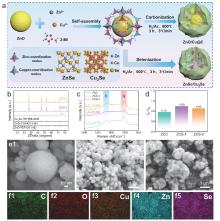
图1
"
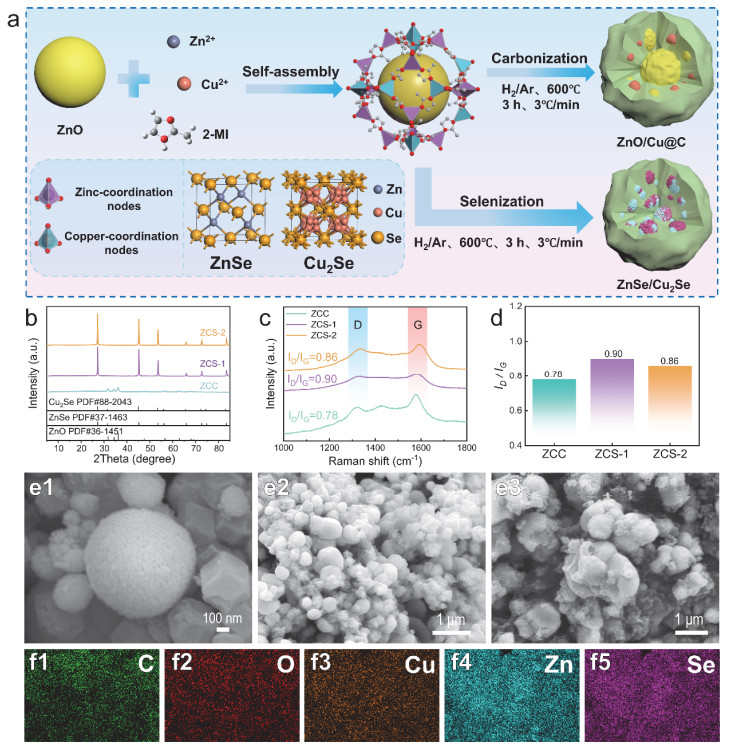
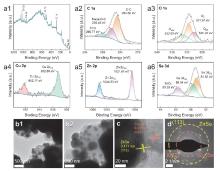
图2
"
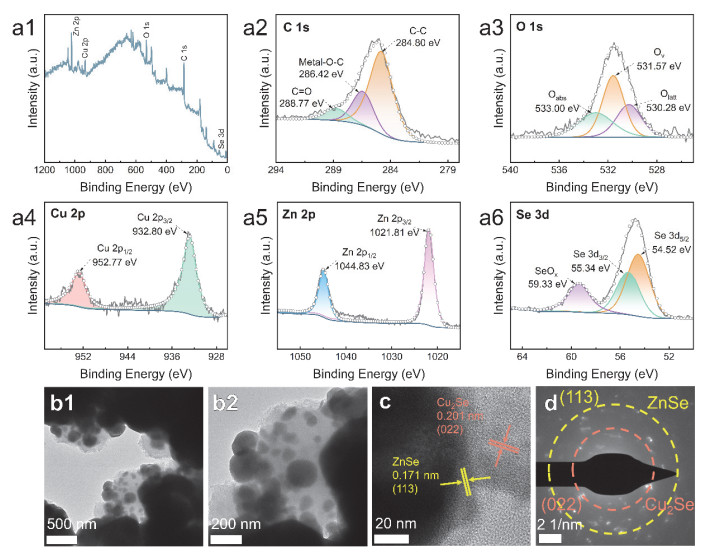
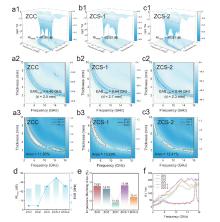
图3
"
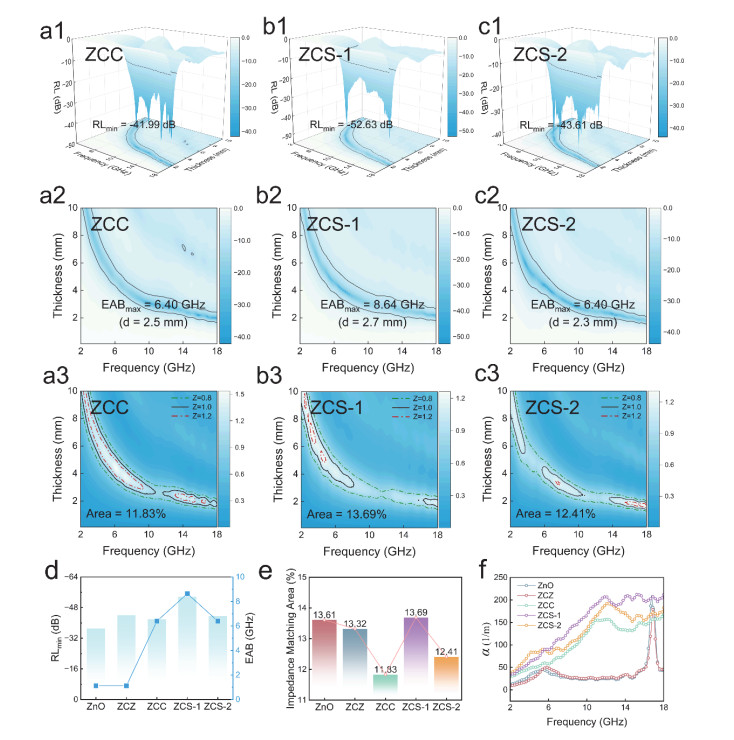
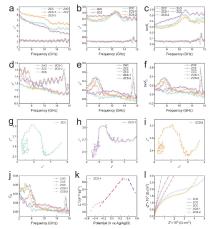
图4
"
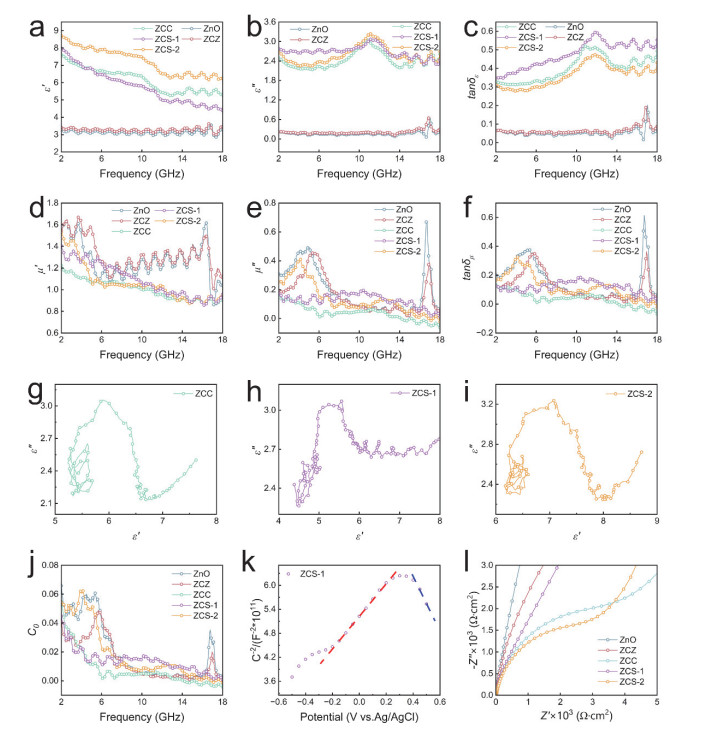
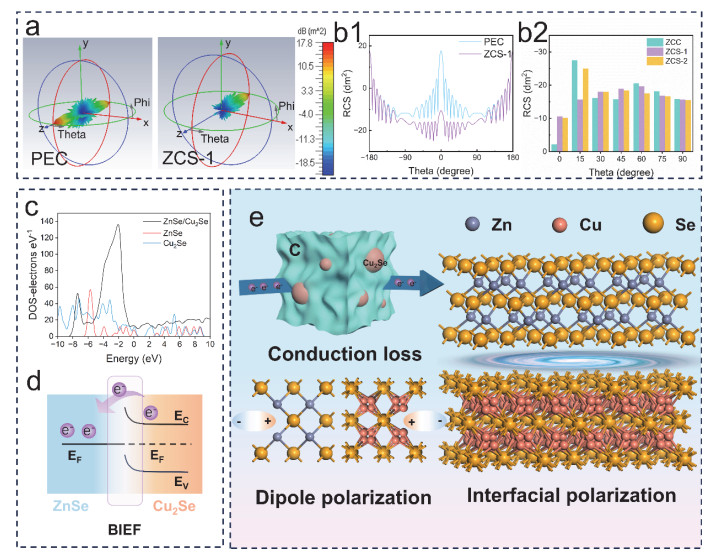
图5
"
| 1 |
B. Fan, X. Zeng, X. Fan, X. Huang. J. Adv. Ceram. 2025, 14(12), 9221215.
doi: 10.26599/JAC.2025.9221215 |
| 2 |
X. Liu, Y. Zhao, Y. Zhang, X. Cui, Y. Xue, X. Lu, J. Gu. Nano-Micro Lett. 2026, 18(1), 344.
doi: 10.1007/s40820-026-02202-y |
| 3 |
S. Mao, R. Miao, D. Lan, S. Zhang, J. Zhou, X. Liu, S. Du, Z. Zhao, G. Wu. Acta Phys.-Chim. Sin. 2026, 42(6), 100279.
doi: 10.1016/j.actphy.2026.100279 |
| 4 |
L. Liang, W. Gu, Y. Wu, B. Zhang, G. Wang, Y. Yang, G. Ji. Adv. Mater. 2022, 34(4), 2106195.
doi: 10.1002/adma.202106195 |
| 5 |
B. Fan, L. Xing, K. Yang, F. Zhou, Q. He, G. Tong, W. Wu. Chem. Eng. J. 2023, 451, 138492.
doi: 10.1016/j.cej.2022.138492 |
| 6 |
Y. Jiao, Z. Dai, M. Feng, J. Luo, Y. Xu. Mater. Today Phys. 2023, 33, 101058.
doi: 10.1016/j.mtphys.2023.101058 |
| 7 |
B. Zhao, Y. Du, Z. Yan, L. Rao, G. Chen, M. Yuan, L. Yang, J. Zhang, R. Che. Adv. Funct. Mater. 2023, 33(1), 2209924.
doi: 10.1002/adfm.202209924 |
| 8 |
X. Zhang, J. Qiao, Y. Jiang, F. Wang, X. Tian, Z. Wang, L. Wu, W. Liu, J. Liu. Nano-Micro Lett. 2021, 13(1), 135.
doi: 10.1007/s40820-021-00658-8 |
| 9 |
B. Zeng, F. Zhang, K. Zhao, M. Ahmad, J. Wu, L. Zhang, D. Lan, B. Zhang. J. Mater. Sci. Technol. 2026, 251, 193- 202.
doi: 10.1016/j.jmst.2025.07.008 |
| 10 |
J. Zheng, D. Lan, S. Zhang, F. Wei, T. Liu, Z. Gao, G. Wu. J. Alloy. Compd. 2025, 1010, 177092.
doi: 10.1016/j.jallcom.2024.177092 |
| 11 |
Z. Shan, S. Cheng, F. Wu, X. Pan, W. Li, W. Dong, A. Xie, G. Zhang. Chem. Eng. J. 2022, 446, 137409.
doi: 10.1016/j.cej.2022.137409 |
| 12 |
K. Wei, Y. Shi, X. Tan, M. Shalash, J. Ren, A.A. Faheim, C. Jia, R. Huang, Y. Sheng, Z. Guo, et al.. Adv. Colloid Interface Sci. 2024, 332, 103271.
doi: 10.1016/j.cis.2024.103271 |
| 13 |
M.Z Hussain, M. Bahri, W.R. Heinz, Q. Jia, O. Ersen, T. Kratky, R.A. Fischer, Y. Zhu, Y. Xia. Microporous Mesoporous Mat. 2021, 316, 110957.
doi: 10.1016/j.micromeso.2021.110957 |
| 14 |
Y. Dong, D. Lan, S. Xu, J. Gu, Z. Jia, G. Wu. Carbon. 2024, 228, 119339.
doi: 10.1016/j.carbon.2024.119339 |
| 15 |
M. Shi, Z. Jia, D. Lan, Z. Gao, S. Zhang, G. Wu. Adv. Funct. Mater. 2025, 35(49), e02261.
doi: 10.1002/adfm.202502261 |
| 16 |
Y. Pan, K. Yu, D. Lan, Z. Zhang, Z. Chen. Carbon. 2025, 245, 120824.
doi: 10.1016/j.carbon.2025.120824 |
| 17 |
H. Hou, D. Ma, Z. Zhang, Z. Jia. Acta Phys.-Chim. Sin. 2026, 42(8), 100325.
doi: 10.1016/j.actphy.2026.100325 |
| 18 |
Y. Dong, G. Wu, Z. Gao, D. Lan, H. Qiu, Z. Jia, G. Wu. Nano Res. 2026,
doi: 10.26599/NR.2026.94908868 |
| 19 |
Y. Cheng, Y. Zhao, H. Zhao, H. Lv, X. Qi, J. Cao, G. Ji, Y. Du. Chem. Eng. J. 2019, 372, 390- 398.
doi: 10.1016/j.cej.2019.04.174 |
| 20 |
R.A. Hussain. Next Mater. 2025, 8, 100746.
doi: 10.1016/j.nxmate.2025.100746 |
| 21 |
Q. Zhang, H. Li, Y. Ma, T. Zhai. Prog. Mater Sci. 2016, 83, 472- 535.
doi: 10.1016/j.pmatsci.2016.07.005 |
| 22 |
W. Liu, L. Yang, Z. Chen. Nano Today. 2020, 35, 100938.
doi: 10.1016/j.nantod.2020.100938 |
| 23 |
G. Wu, J. Zhu, X. Guo, C. Zhang, M. He, H. Qiu, D. Ma. Acta Phys.-Chim. Sin. 2026, 42(8), 100324.
doi: 10.1016/j.actphy.2026.100324 |
| 24 |
S. Gao, C. Zhu, Y. Zhang. Ceram. Int. 2024, 50(24), 52761- 52769.
doi: 10.1016/j.ceramint.2024.10.129 |
| 25 |
W. Zhang, S. Xu, X. Li, Y. Yin, C. Sun, Z. Yu, C. Zhao, D. Lan, Z. Jia, G. Wu, et al.. Rare Metals. 2026, 45(2), e70051.
doi: 10.1002/rar2.70051 |
| 26 |
D. Liu, D. Lan, Y. Yin, J. Kong, Y. Meng, Y. Liu, Y. Qiu, G. Xia, D. Liu. Acta Phys.-Chim. Sin. 2026, 42(7), 100275.
doi: 10.1016/j.actphy.2026.100275 |
| 27 |
Q. Gao, P. Li, S. Ding, H. He, M. Cai, X. Ning, Y. Cai, M. Zhang. Ionics. 2020, 26(11), 5525- 5533.
doi: 10.1007/s11581-020-03686-3 |
| 28 |
K. Zhao, X. Nie, H. Wang, S. Chen, X. Quan, H. Yu, W. Choi, G. Zhang, B. Kim, J.G. Chen. Nat. Commun. 2020, 11(1), 2455.
doi: 10.1038/s41467-020-16381-8 |
| 29 |
K. Liu, Q. Gao, H. Li, L. Diao, X. Chen, D. Li, G. Wu. Acta Phys.-Chim. Sin. 2026, 42(8), 100315.
doi: 10.1016/j.actphy.2026.100315 |
| 30 |
Q. Wei, Y. Qiu, T. Yang, Y. Jiang, S. Zhu, J. Zhou, C. Liu, W. Hou, Y. Wang, D. Liu. Acta Phys.-Chim. Sin. 2026, 100320.
doi: 10.1016/j.actphy.2026.100320 |
| 31 |
T. Hu, D. Lan, J. Wang, X. Zhong, G. Bu, P. Yin. Carbon. 2025, 232, 119798.
doi: 10.1016/j.carbon.2024.119798 |
| 32 |
S. Wu, Y. Wang, J. Jiang, Y. Li, D. Liu. Chem. Eng. J. 2025, 506, 160372.
doi: 10.1016/j.cej.2025.160372 |
| 33 |
X. Ma, Y. Huang, X. Zhao, M. Yu, Y. Gao, B. Gao, S. Xiang. React. Chem. Eng. 2024, 9(12), 3299- 3310.
doi: 10.1039/D4RE00353E |
| 34 |
X. Cheng, C. Wang, D. Lan, Z. Tang, S. Chen, W. Zhang, X. Zhou, L. Zhang, G. Wu. Nano Res. 2026, 19, 90908433.
doi: 10.26599/NR.2026.94908433 |
| 35 |
S. Xu, Z. Jia, D. Lan, M. Shi, Z. Gao, G. Wu. Adv. Funct. Mater. 2026, e76265.
doi: 10.1002/adfm.76265 |
| 36 |
M. Li, Y. Wang, F. Sun, G. He, R. Zhang, H. Wang, Y. Zhu, P. Liang, Mitian, W. Li, et al.. Adv. Powder Mater. 2026, 5(5), 100410.
doi: 10.1016/j.apmate.2026.100410 |
| 37 |
X. Zhao, Q. Niu, Y. Huang, H. Jiang, H. Huang, M. Zong, C. Chen. J. Energy Chem. 2025, 108, 246- 253.
doi: 10.1016/j.jechem.2025.03.091 |
| 38 |
Y. Ma, L. Yang, Y. Li, H. Li, Y. Huang, J. Chen. Small. 2024, 20(20), 2308650.
doi: 10.1002/smll.202308650 |
| 39 |
Y. Xiao, Y. Miao, S. Wan, Y.K. Sun, S. Chen. Small. 2022, 18(28), 2202582.
doi: 10.1002/smll.202202582 |
| 40 |
S. Song, B. Zheng, L. Chen, H. Shu, D. Gao, D. Lan, T. Li, X. Liu, Y. Ma. J. Energy Storage. 2025, 134, 118282.
doi: 10.1016/j.est.2025.118282 |
| 41 |
Y. Sun, Y. Wang, Y. Li, S. Dai, B. Ding, J. Guo, Y. Yuan, D. Zhang, D. Liu. Diamond Relat. Mater. 2025, 159, 112842.
doi: 10.1016/j.diamond.2025.112842 |
| 42 |
Z. Jia, Z. Zhou, S. Xu, Y. Wang, M. Shi, M. He, C. Zhang, D. Lan. Acta Phys.-Chim. Sin. 2026, 42(8), 100310.
doi: 10.1016/j.actphy.2026.100310 |
| 43 |
S. Zhang, H. Li, S. Zhang, S. Wang, S. Du, Z. Zhao, X. Zhao, X. Liang. Acta Phys.-Chim. Sin. 2026, 42(8), 100305.
doi: 10.1016/j.actphy.2026.100305 |
| 44 |
R. Feng, C. Fan, D. Lan, L. Liu, Q. He, Y. Wang. Acta Phys.-Chim. Sin. 2026, 42(8), 100301.
doi: 10.1016/j.actphy.2026.100301 |
| 45 |
Z. Niu, Y. Wang, Q. Tian, J. Wang, Z. Gao, D. Lan, G. Wu. Carbon. 2025, 233, 119848.
doi: 10.1016/j.carbon.2024.119848 |
| 46 |
R. Xue, D. Lan, R. Qiang, Z. Zang, J. Ren, Y. Shao, L. Rong, J. Gu, J. Fang, G. Wu. Carbon. 2025, 233, 119877.
doi: 10.1016/j.carbon.2024.119877 |
| 47 |
S. Zhang, J. Zheng, X. Liang, D. Lan, L. Niu, X. Zhao, Z. Zhao, S. Zhang, G. Wu, X. Li. Small. 2025, 21(45), e09237.
doi: 10.1002/smll.202509237 |
| 48 |
B. Liang, Y. Zhao, S. Wang, S. Huang, F. Zhou, C. Zhang, Y. Wang, X. Guo. Acta Phys.-Chim. Sin. 2026, 42(6), 100285.
doi: 10.1016/j.actphy.2026.100285 |
| 49 |
M. Han, Z. Jia, D. Lan, Z. Gao, G. Wu. Chin. J. Chem. 2026, 44(10), 1525- 1538.
doi: 10.1002/cjoc.70494 |
| 50 |
Z. Jia, X. Gong, D. Lan, H. Sun, Y. Liu, Y. Gao, S. Guo. Acta Phys.-Chim. Sin. 2026, 42(8), 100312.
doi: 10.1016/j.actphy.2026.100312 |
| 51 |
M. He, X. Zhong, X. Lu, J. Hu, K. Ruan, H. Guo, Y. Zhang, Y. Guo, J. Gu. Adv. Mater. 2024, 36(48), 2410186.
doi: 10.1002/adma.202410186 |
| 52 |
P. Xie, H. Wu, Z. Cheng, M. Liu, Y. Liu, W. Pang, R. Fan, Y. Liu. Adv. Mater. 2026, 38(13), e16951.
doi: 10.1002/adma.202516951 |
| 53 |
F. Lv, Y. Wang, Q. He, D. Lan, G. Wu. Funct. Mater. 2026, e75416.
doi: 10.1002/adfm.75416 |
| 54 |
Q. Ban, Y. Song, L. Li, H. Zhang, X. Wu, J. Liu, Y. Qin, D. Lan, T. Zhang, J. Kong. Small. 2025, 21(41), e08008.
doi: 10.1002/smll.202508008 |
| 55 |
W. Liu, J. Luo, J. Shi, D. Lan, S. Mao, Y. Xie. Acta Phys.-Chim. Sin. 2026, 42(8), 100313.
doi: 10.1016/j.actphy.2026.100313 |
| 56 |
M. He, J. Hu, H. Yan, X. Zhong, Y. Zhang, P. Liu, J. Kong, J. Gu. Adv. Funct. Mater. 2025, 35(18), 2316691.
doi: 10.1002/adfm.202316691 |
| 57 |
X. Dai, D. Lan, X. Chen, X. Wang, G. Ji. Acta Phys.-Chim. Sin. 2026, 42(8), 100302.
doi: 10.1016/j.actphy.2026.100302 |
| 58 |
J. Qi, C. Liang, K. Ruan, M. Li, H. Guo, M. He, H. Qiu, Y. Guo, J. Gu. Natl. Sci. Rev. 2025, 12(11)
doi: 10.1093/nsr/nwaf394 |
| 59 |
Z. Tian, J. Liu, M. Zhang, Q. Jia, M. Liu, Z. Li, T. Wang, W. Zhao, D. Ma, X. Qi. Acta Phys.-Chim. Sin. 2026, 42(8), 100323.
doi: 10.1016/j.actphy.2026.100323 |
| 60 |
M. He, J. Gu. Eng. Transform. Mater. 2026,
doi: 10.2738/ENGTM.2026.0001 |
| 61 |
M.R. Tariq, M. Ahmad, M.U.D. Naik, I. Khan, B. Zhang. Coord. Chem. Rev. 2025, 533, 216535.
doi: 10.1016/j.ccr.2025.216535 |
| 62 |
Y. Zhao, L. Song, L. Wang, X. Guo, H. Wang, R. Zhang, P. Liang, X. Wang, Y. Yuan, Y. Zhu, et al.. Def. Technol. 2025,
doi: 10.1016/j.dt.2025.10.014 |
| 63 |
M. Caretti, L. Lazouni, M. Xia, R.A. Wells, S. Nussbaum, D. Ren, M. Grätzel, K. Sivula. ACS Energy Lett. 2022, 7(5), 1618- 1625.
doi: 10.1021/acsenergylett.2c00474 |
| 64 |
C. Meng, M. Zhang, Q. Xu, Y. Zhang, X. Li, L. Fan, Y. Li. Nano Res. 2025, 18(6), 94907434.
doi: 10.26599/NR.2025.94907434 |
| 65 |
M. Shi, Z. Jia, D. Lan, Z. Gao, S. Zhang, G. Wu. Adv. Funct. Mater. 2026, 36(30), e28665.
doi: 10.1002/adfm.202528665 |
| 66 |
Y. Cai, Z. Jia, Z. Wu, W. Zhou, X. Xu, Y. Wang, Z. Gao, H. Qiu, G. Wu. J. Mater. Sci. Technol. 2027, 277, 66- 75.
doi: 10.1016/j.jmst.2026.05.009 |
| 67 |
J. Yan, Z. Zhang, D. Ma, X. Zhang, Z. Ye, X. Chen. Acta Phys.-Chim. Sin. 2026, 100328.
doi: 10.1016/j.actphy.2026.100328 |
| 68 |
P. Huang, Z. Wang, Y. He, W. Li, Y. Chen, H. Wang, R. Zhang, Y. Zhu, F. Zhang, B. Fan. Sci. China-Mater. 2026,
doi: 10.1007/s40843-025-3974-1 |
| 69 |
Z. Lu, X. Wang, H. Zong, D. Lan, Y. Sun, K. Zhao, B. Wang, J. Liu. Chem. Eng. J. 2024, 500, 157183.
doi: 10.1016/j.cej.2024.157183 |
| 70 |
B. Ramezanzadeh, Z. Haeri, M. Ramezanzadeh. Chem. Eng. J. 2016, 303, 511- 528.
doi: 10.1016/j.cej.2016.06.028 |
| 71 |
T. Chen, Y. Tian, Z. Guo, Y. Chen, Q. Qi, F. Meng. Nano Res. 2024, 17(3), 913- 926.
doi: 10.1007/s12274-023-6168-y |
| 72 |
W. Zhang, C. Zhao, D. Lan, X. Xu, Z. Jia, X. Xu. Carbon. 2026, 257, 121698.
doi: 10.1016/j.carbon.2026.121698 |
| 73 |
X. Meng, J. Li, S. Zhang, D. Lan, M. Yu, T. Long, C. Wang. Adv. Fiber Mater. 2025, 7(3), 736- 747.
doi: 10.1007/s42765-024-00501-w |
| 74 |
S. Xu, Z. Jia, D. Lan, M. Shi, Z. Gao, G. Wu. Adv. Funct. Mater. 2026, e75567.
doi: 10.1002/adfm.75567 |
| 75 |
X. Zhang, H. Wang, Y. Hao, Y. Qu, X. Wang, W. Jiang, H. Li, C. Deng, X. Qi. Acta Phys.-Chim. Sin. 2026, 100326.
doi: 10.1016/j.actphy.2026.100326 |
| 76 |
Z. Gao, A. Iqbal, T. Hassan, S. Hui, H. Wu, C.M. Koo. Adv. Mater. 2024, 36(19), 2311411.
doi: 10.1002/adma.202311411 |
| 77 |
X. Zhou, X. Wang, X. Chen, D. Lan, Y. Gao, X. Wang, D. Li, S. Zhang, L. Zhang, G. Wu. Acta Phys.-Chim. Sin. 2026, 42(7), 100287.
doi: 10.1016/j.actphy.2026.100287 |
| 78 |
M. Li, K. Zhao, B. Fan, Y. Li, D. Tan, H. Wang, Q. Gao, W. Li, H. Zhang, Y. Zhu, et al.. Adv. Sci. 2026, 13(1), e16938.
doi: 10.1002/advs.202516938 |
| 79 |
Q. Li, Z. Gao, W. Zhou, S. Yang, Z. Jia, G. Wu. Nano Res. 2026,
doi: 10.26599/NR.2026.94908525 |
| 80 |
J. Wang, Y. Wang, J. Wu, D. Wang, C. Liu, H. Huang, Y. Wang, C. Zhang. Acta Phys.-Chim. Sin. 2026, 100336.
doi: 10.1016/j.actphy.2026.100336 |
| 81 |
X. Zhao, M. Liu, Y. Wang, Y. Xiong, P. Yang, J. Qin, X. Xiong, Y. Lei. ACS Nano. 2022, 16(12), 19959- 19979.
doi: 10.1021/acsnano.2c09888 |
| 82 |
M. Shi, Z. Jia, S. Xu, Z. Gao, G. Wu. Adv. Funct. Mater. 2026, 36(39), e74648.
doi: 10.1002/adfm.74648 |
| 83 |
B. Quan, W. Shi, S.J.H. Ong, X. Lu, P.L. Wang, G. Ji, Y. Guo, L. Zheng, Z.J. Xu. Adv. Funct. Mater. 2019, 29(28), 1901236.
doi: 10.1002/adfm.201901236 |
| [1] | 魏祺, 仇亚茹, 杨腾飞, 蒋艺玲, 朱韶涵, 周杰, 刘聪聪, 侯文杰, 王越, 刘冬. 金属@碳纳米片异质界面的协同工程用于双功能电磁波吸收与电化学储能[J]. 物理化学学报, 2026, 42(9): 100320 - . |
| [2] | 闫婧, 张泽楠, 马东威, 张昕怡, 叶卓栋, 陈雪芳. 三聚氰胺辅助MOFs拓扑定向转化为针状α-MoC/β-Mo2C用于高性能电磁波吸收与耐腐蚀性研究[J]. 物理化学学报, 2026, 42(9): 100328 - . |
| [3] | 王骏, 王奕博, 吴吉然, 王大双, 刘成, 黄海铭, 王友勇, 张传坤. 在多相核壳异质结中协同磁交换共振与多级介电弛豫以实现高效微波耗散[J]. 物理化学学报, 2026, 42(9): 100336 - . |
| [4] | 冯仁威, 范聪敏, 兰笛, 刘澜翔, 何秦川, 王益群. 锚定策略诱导Ni-MOF@膨胀石墨复合材料的导电损耗以实现宽带微波吸收[J]. 物理化学学报, 2026, 42(8): 100301 - . |
| [5] | 戴鑫鑫, 兰笛, 陈星亮, 王行伟, 姬广斌. 二氧化锰@氮掺杂碳@镍铁氧体杂化材料的一锅法绿色合成及吸波性能研究[J]. 物理化学学报, 2026, 42(8): 100302 - . |
| [6] | 张帅, 李海丰, 张世杰, 王顺, 杜苏轩, 赵志伟, 赵小苗, 梁笑微. 微波辅助构筑Ta2CTx MXene/CuInS2异质结构增强介电损耗和宽频电磁波吸收性能[J]. 物理化学学报, 2026, 42(8): 100305 - . |
| [7] | 贾志卿, 宫新菊, 兰笛, 孙环环, 刘雨, 高玉萍, 郭思瑶. 静电诱导缺陷极化增强型PBA/MXene异质结构的双耦合界面以提升电磁波吸收性能[J]. 物理化学学报, 2026, 42(8): 100312 - . |
| [8] | 贾梓睿, 周泽华, 徐爽, 王远, 石梦佳, 何梦婷, 张传坤, 兰笛. 一石二鸟:磷掺杂以增强导电损耗和偶极极化用于电磁波吸收[J]. 物理化学学报, 2026, 42(8): 100310 - . |
| [9] | 刘伟恒, 罗驹华, 时家欢, 兰笛, 毛双双, 谢宇. 双金属有机框架衍生蜂窝状BiCo@NC用于高效电磁波吸收[J]. 物理化学学报, 2026, 42(8): 100313 - . |
| [10] | 吴广荣, 朱佳慧, 郭小萌, 张昌淼, 何梦婷, 邱华, 马冬威. 构建肖特基势垒并增强C@ZnO/Sn@GaN界面极化效应以实现高性能电磁波吸收[J]. 物理化学学报, 2026, 42(8): 100324 - . |
| [11] | 毛双双, 罗驹华, 韩冰洁, 时家欢, 谷俞稼. 共价有机框架衍生的Fe3C/NC/TiO2异质结构用于高性能电磁波吸收[J]. 物理化学学报, 2026, 42(7): 100290 - . |
| [12] | 胡波, 陈言轶, 陈永政, 王璇, 韩喜江, 杜耘辰. 基于理论计算指导的FeCo合金泡沫设计合成及其在2.0–8.0 GHz范围内的吸波性能研究[J]. 物理化学学报, 2026, 42(6): 100269 - . |
| [13] | 翟钰琦, 刘梦竹, 胡峻豪, 王永鹏. 具有“钢筋混凝土”结构和优异电磁波吸收性能的Fe3O4/Ti3C2Tx MXene/CF@PANI复合材料[J]. 物理化学学报, 2026, 42(10): 100248 - . |
| [14] | 张增富;罗国华;范壮军;项荣;周丽;魏飞. 不同结构碳纳米管的电磁波吸收性能研究[J]. 物理化学学报, 2006, 22(03): 296 -300 . |
|
||