物理化学学报 >> 2025, Vol. 41 >> Issue (2): 100015.doi: 10.3866/PKU.WHXB202310024
所属专题: 电化学前沿
稳定导电网络结构的C-SnO2/MWCNTs复合材料用于锂浆料电池
杨博文1, 王瑞2, 辛本舰1, 刘丽丽1,*( ), 牛志强2,*()
- 1 天津理工大学材料科学与工程学院, 天津市光电显示材料与器件重点实验室, 天津 300384
2 南开大学化学学院, 先进能源材料化学教育部重点实验室, 物质绿色创造与制造海河实验室, 天津 300071
-
收稿日期:2023-10-19修回日期:2023-11-09录用日期:2023-11-09发布日期:2024-01-04 -
通讯作者:Email: lililiuhappy@163.com (刘丽丽)zqniu@nankai.edu.cn (牛志强) -
基金资助:国家重点研发计划(2019YFA0705601); 国家自然科学基金(51972231)
C-SnO2/MWCNTs Composite with Stable Conductive Network for Lithium-based Semi-Solid Flow Batteries
Bowen Yang1, Rui Wang2, Benjian Xin1, Lili Liu1,*(), Zhiqiang Niu2,*()
- 1 Tianjin Key Laboratory for Photoelectric Materials and Devices, School of Materials Science and Engineering, Tianjin University of Technology, Tianjin 300384, China
2 Key Laboratory of Advanced Energy Materials Chemistry (Ministry of Education), Haihe Laboratory of Sustainable Chemical Transformations, College of Chemistry, Nankai University, Tianjin 300071, China
-
Received:2023-10-19Revised:2023-11-09Accepted:2023-11-09Published:2024-01-04 -
Contact:Email: lililiuhappy@163.com (Lili Liu)zqniu@nankai.edu.cn (Zhiqiang Niu) -
Supported by:the National Key Research and Development Program of China(2019YFA0705601); the National Natural Science Foundation of China(51972231)

摘要:
锂浆料电池(LSSFBs)具有应用于大规模储能系统的潜力。然而,LSSFBs的电化学性能受限于活性材料本征导电性差以及活性材料与导电添加剂之间的不稳定接触。本文设计了碳包覆的二氧化锡/多壁碳纳米管(C-SnO2/MWCNTs)复合材料作为LSSFBs负极材料。在该复合材料中,SnO2纳米颗粒均匀分布在(MWCNTs)表面,同时SnO2颗粒外表进行碳包覆。纳米尺寸赋予SnO2更多反应活性位点。此外,碳纳米管和碳包覆层共同构建稳定的导电网络。这种导电网络有效改善SnO2的电子转移动力学,并抑制其在充/放电过程中的体积膨胀,从而提高倍率和循环性能。此外,MWCNTs增强浆料电极的悬浮稳定性。这些优势赋予LSSFBs良好的倍率和循环性能。这项工作为优化LSSFBs的浆料电极提供了一种具有前景的策略。
引用本文
杨博文, 王瑞, 辛本舰, 刘丽丽, 牛志强. 稳定导电网络结构的C-SnO2/MWCNTs复合材料用于锂浆料电池[J]. 物理化学学报, 2025, 41(2), 100015. doi: 10.3866/PKU.WHXB202310024
Bowen Yang, Rui Wang, Benjian Xin, Lili Liu, Zhiqiang Niu. C-SnO2/MWCNTs Composite with Stable Conductive Network for Lithium-based Semi-Solid Flow Batteries[J]. Acta Phys. -Chim. Sin. 2025, 41(2), 100015. doi: 10.3866/PKU.WHXB202310024
图1
"
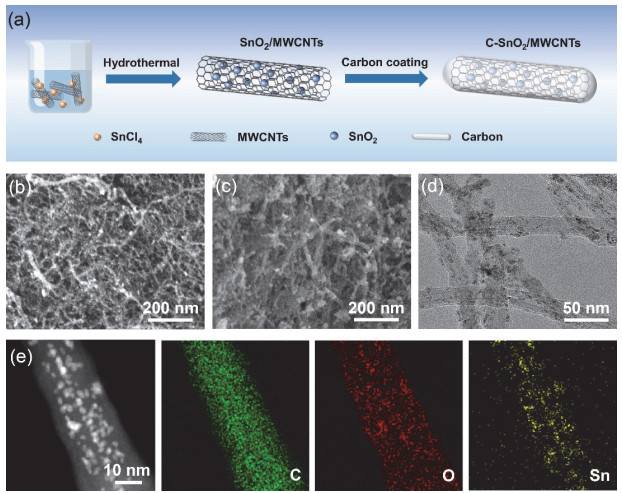
图2
"
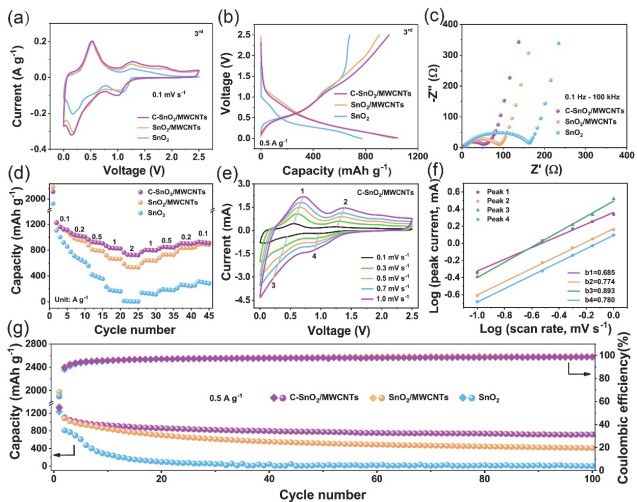
图3
"
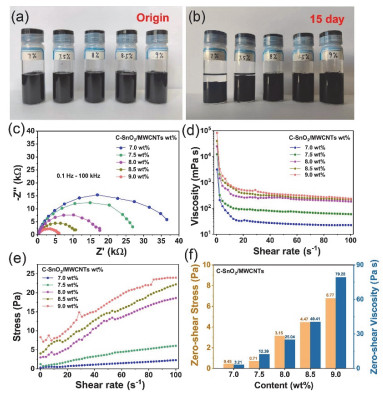
图4
"
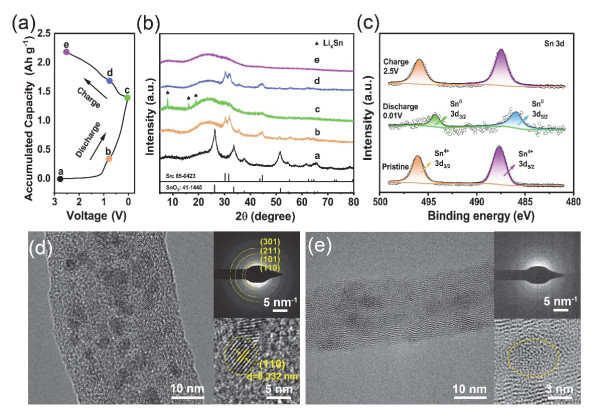
图5
"
| 1 |
doi: 10.1038/s41560-020-00772-8 |
| 2 |
doi: 10.1038/s41467-022-28880-x |
| 3 |
doi: 10.3866/PKU.WHXB201905011 |
|
杨晓兵; 赵磊; 隋旭磊; 孟令辉; 王振波. 物理化学学报, 2019, 35(12), 1372.
doi: 10.3866/PKU.WHXB201905011 |
|
| 4 |
doi: 10.34133/2022/9795675 |
| 5 |
doi: 10.34133/2022/9863679 |
| 6 |
doi: 10.1007/s12209-019-00231-w |
| 7 |
doi: 10.1016/j.scib.2020.12.019 |
| 8 |
doi: 10.1016/j.esci.2022.07.002 |
| 9 |
doi: 10.1016/j.esci.2022.02.008 |
| 10 |
doi: 10.34133/2021/9798460 |
| 11 |
doi: 10.1002/smm2.1115 |
| 12 |
doi: 10.1007/s12209-020-00236-w |
| 13 |
doi: 10.1016/j.energy.2018.11.130 |
| 14 |
doi: 10.3866/PKU.WHXB202106008 |
|
从广涛; 卢怡君. 物理化学学报, 2022, 38(6), 2106008.
doi: 10.3866/PKU.WHXB202106008 |
|
| 15 |
doi: 10.1016/j.nanoms.2020.06.003 |
| 16 |
doi: 10.1016/j.coche.2022.100834 |
| 17 |
doi: 10.1039/C2CP44466F |
| 18 |
doi: 10.1016/j.gee.2020.09.012 |
| 19 |
doi: 10.1021/acs.langmuir.6b04322 |
| 20 |
doi: 10.7503/cjcu20220731 |
|
辛本舰; 王瑞; 刘丽丽; 牛志强. 高等学校化学学报, 2023, 43(5), 20220731.
doi: 10.7503/cjcu20220731 |
|
| 21 |
doi: 10.1002/aenm.201100152 |
| 22 |
doi: 10.1093/nsr/nww098 |
| 23 |
doi: 10.1021/acsenergylett.2c00032 |
| 24 |
doi: 10.1016/S0013-4686(99)00195-4 |
| 25 |
doi: 10.1021/am501650q |
| 26 |
doi: 10.3866/PKU.WHXB20101212 |
|
周晓玲; 黄瑞安; 吴肇聪; 杨斌; 戴永年. 物理化学学报, 2010, 26(12), 3187.
doi: 10.3866/PKU.WHXB20101212 |
|
| 27 |
doi: 10.1002/aenm.201500535 |
| 28 |
doi: 10.34133/2021/1205324 |
| 29 |
doi: 10.1039/D1TA10883B |
| 30 |
doi: 10.1039/c7cs00863e |
| 31 |
doi: 10.1021/cr500232y |
| 32 |
doi: 10.1002/adma.201301051 |
| 33 |
doi: 10.1002/smll.201801606 |
| 34 |
doi: 10.1126/science.1195628 |
| 35 |
doi: 10.1360/ssc-2021-0127 |
|
王刘彬; 赵东东; 李俊礼; 王红强; 张宁. 中国科学: 化学, 2021, 51(9), 1124.
doi: 10.1360/ssc-2021-0127 |
|
| 36 |
doi: 10.1016/j.ensm.2018.08.002 |
| 37 |
doi: 10.14062/j.issn.0454-5648.20210691 |
|
钱晨亮; 古飞蛟; 金双玲; 王晓瑞; 张睿; 金鸣林. 硅酸盐学报, 2022, 50(5), 1215.
doi: 10.14062/j.issn.0454-5648.20210691 |
|
| 38 |
doi: 10.1002/aenm.201902657 |
| 39 |
doi: 10.1002/smm2.1061 |
| 40 |
doi: 10.1021/acs.nanolett.2c03699 |
| 41 |
doi: 10.1002/smll.202201110 |
| 42 |
doi: 10.1002/batt.201800152 |
| 43 |
doi: 10.1038/ncomms6877 |
| 44 |
doi: 10.1002/smll.202202139 |
| 45 |
doi: 10.1360/ssc-2022-0102 |
|
辛本舰; 王瑞; 胡阳; 刘丽丽; 牛志强. 中国科学: 化学, 2022, 52(7), 1148.
doi: 10.1360/ssc-2022-0102 |
|
| 46 |
doi: 10.1007/s11426-022-1292-0 |
| 47 |
doi: 10.1002/smll.201700656 |
| 48 |
doi: 10.14062/j.issn.0454-5648.20210759 |
|
朱超; 涂健; 丁元力. 硅酸盐学报, 2022, 50(2), 364.
doi: 10.14062/j.issn.0454-5648.20210759 |
|
| 49 |
doi: 10.1021/acssuschemeng.8b05869 |
| 50 |
doi: 10.1007/s11434-015-0767-2 |
| 51 |
doi: 10.1016/j.esci.2021.12.004 |
| 52 |
doi: 10.1002/anie.202115877 |
| 53 |
doi: 10.1016/j.jpowsour.2021.230341 |
| 54 |
doi: 10.1016/j.carbon.2017.04.014 |
| 55 |
doi: 10.1016/j.jpowsour.2020.229319 |
| 56 |
doi: 10.1039/C8SE00424B |
| 57 |
doi: 10.1039/C5EE03367E |
| 58 |
doi: 10.1016/j.jelechem.2018.02.031 |
| 59 |
doi: 10.3866/PKU.WHXB20090308 |
|
马若彪; 付延鲍; 马晓华. 物理化学学报, 2009, 25(3), 441.
doi: 10.3866/PKU.WHXB20090308 |
|
| 60 |
doi: 10.1002/chem.201406029 |
| 61 |
doi: 10.1039/D2TA07435D |
| 62 |
doi: 10.1016/j.jelechem.2017.10.040 |
| 63 |
doi: 10.1021/acs.langmuir.7b02538 |
| 64 |
doi: 10.1002/cey2.181 |
| [1] | 吴昆杰, 张永毅, 勇振中, 李清文. 碳纳米管纤维的连续制备及高性能化[J]. 物理化学学报, 2022, 38(9): 2106034 - . |
| [2] | 贺文娅, 程虎虎, 曲良体. 烯碳纤维基能源器件的研究进展[J]. 物理化学学报, 2022, 38(9): 2203004 - . |
| [3] | 张则尧, 姚艺希, 李彦. FeCo/MgO催化生长体相单壁碳纳米管的直径调控[J]. 物理化学学报, 2022, 38(8): 2101055 - . |
| [4] | 邹菁云, 高冰, 张小品, 唐磊, 冯思敏, 金赫华, 刘碧录, 成会明. 一维碳纳米管/二维二硫化钼混合维度异质结的原位制备及其电荷转移性能[J]. 物理化学学报, 2022, 38(5): 2008037 - . |
| [5] | 沈晓帆, 王晓娜, 俞能晟, 杨薇, 周雨融, 石艳红, 王玉莲, 董立忠, 邸江涛, 李清文. 聚吡咯@二氧化锰/碳纳米管薄膜电极的制备及在高性能锌离子电池中的应用[J]. 物理化学学报, 2022, 38(5): 2006059 - . |
| [6] | 刘亚, 郑磊, 谷巍, 沈炎宾, 陈立桅. 原位聚合表面修饰的金属锂负极[J]. 物理化学学报, 2021, 37(1): 2004058 - . |
| [7] | 熊辉, 谢歆雯, 王苗, 侯雅琦, 侯旭. 网状骨架CVD生长碳纳米管用于重盐水脱盐[J]. 物理化学学报, 2020, 36(9): 1912008 - . |
| [8] | 安惠芳, 姜莉, 李峰, 吴平, 朱晓舒, 魏少华, 周益明. 基于水凝胶衍生的硅/碳纳米管/石墨烯纳米复合材料及储锂性能[J]. 物理化学学报, 2020, 36(7): 1905034 - . |
| [9] | 卢晓霞,董升阳,陈志杰,吴朗源,张校刚. 碳包覆Ti2Nb2O9纳米片的制备及其储钠性能[J]. 物理化学学报, 2020, 36(5): 1906024 - . |
| [10] | 许可, 王晋芬. 基于一维和二维纳米材料的神经界面构筑[J]. 物理化学学报, 2020, 36(12): 2003050 - . |
| [11] | 刘杨, 段小洁. 基于碳纳米材料的神经电极技术[J]. 物理化学学报, 2020, 36(12): 2007066 - . |
| [12] | 张树辰,张娜,张锦. 碳纳米管可控制备的过去、现在和未来[J]. 物理化学学报, 2020, 36(1): 1907021 - . |
| [13] | 李路路,姚路,段力. 基于共价有机框架复合材料的锂硒电池应用[J]. 物理化学学报, 2019, 35(7): 734 -739 . |
| [14] | 王灏珉,何茂帅,张莹莹. 碳纳米管薄膜的制备及其在柔性电子器件中的应用[J]. 物理化学学报, 2019, 35(11): 1207 -1223 . |
| [15] | 相欣然,万晓梅,索红波,胡燚. 功能化离子液体修饰多壁碳纳米管固定化Candida antarctic lipase B[J]. 物理化学学报, 2018, 34(1): 99 -107 . |
|
||