

物理化学学报 >> 2024, Vol. 40 >> Issue (12): 2408012.doi: 10.3866/PKU.WHXB202408012
论文 上一篇
苏加鑫1, 张佳琪1, 柴姝名1, 王衍坤1, 汪思波1,2,*( ), 方元行1,2,*()
收稿日期:2024-08-20
修回日期:2024-09-19
录用日期:2024-09-19
发布日期:2024-11-09
通讯作者:
Email: sibowang@fzu.edu.cn (汪思波)yxfang@fzu.edu.cn (方元行)
基金资助:
Jiaxin Su1, Jiaqi Zhang1, Shuming Chai1, Yankun Wang1, Sibo Wang1,2,*(), Yuanxing Fang1,2,*()
Received:2024-08-20
Revised:2024-09-19
Accepted:2024-09-19
Published:2024-11-09
Contact:
Email: sibowang@fzu.edu.cn (Sibo Wang)yxfang@fzu.edu.cn (Yuanxing Fang)
Supported by:摘要:
开发用于水氧化反应的聚合物薄膜光阳极引起了学术界的关注,其中碳化氮类半导体材料因其卓越的性能而尤为瞩目。本研究聚焦于一种高结晶度的氮化碳材料制备与调控,即聚七嗪亚胺薄膜光阳极,发展了二元熔盐体系用于开展聚七嗪亚胺薄膜光阳极的制备及其水氧化性能研究。优化后的电极能够在相对于可逆氢电极的1.23 V的偏置电压下,在模拟太阳光照射下,其最佳光电流密度达到了365 μA·cm−2,约为无定形PCN光阳极的18倍。双熔岩体系中,NH4SCN保证了SnS2种子层的生长,而K2CO3增强了氮化碳薄膜的结晶性。原位电化学分析表明,这种盐的组合提高了光激发电荷转移效率,并将SnS2层的厚度限制在一定范围内,使得电极电阻较小。这项研究阐明了盐在合成聚七嗪亚胺光阳极中的作用,并为设计基于高结晶碳化氮的功能性薄膜提供了研究基础。
苏加鑫, 张佳琪, 柴姝名, 王衍坤, 汪思波, 方元行. 发展二元熔盐体系用于聚七嗪亚胺薄膜光阳极的制备与水氧化性能研究[J]. 物理化学学报, 2024, 40(12), 2408012. doi: 10.3866/PKU.WHXB202408012
Jiaxin Su, Jiaqi Zhang, Shuming Chai, Yankun Wang, Sibo Wang, Yuanxing Fang. Optimizing Poly(heptazine imide) Photoanodes Using Binary Molten Salt Synthesis for Water Oxidation Reaction[J]. Acta Phys. -Chim. Sin. 2024, 40(12), 2408012. doi: 10.3866/PKU.WHXB202408012
图1
"
图2
"
图3
"
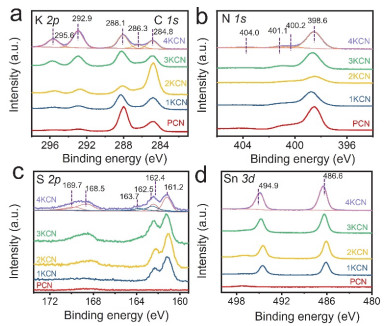
图4
"
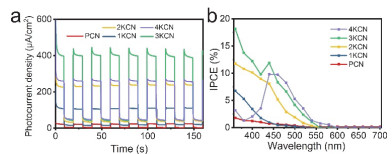
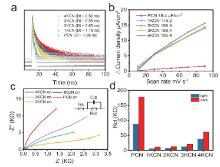
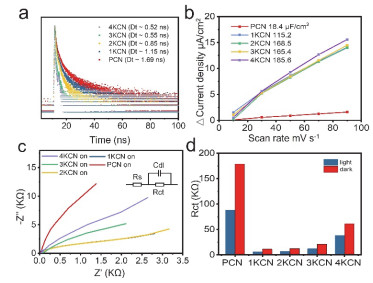
图5
"
| 1 |
doi: 10.1021/acs.chemrev.1c00686 |
| 2 |
doi: 10.3866/PKU.WHXB202212038 |
|
宋千伟; 何观朝; 费慧龙. 物理化学学报, 2023, 39, 2212038.
doi: 10.3866/PKU.WHXB202212038 |
|
| 3 |
doi: 10.3866/PKU.WHXB202212016 |
|
吴新鹤; 陈郭强; 王娟; 李金懋; 王国宏. 物理化学学报, 2023, 39, 2212016.
doi: 10.3866/PKU.WHXB202212016 |
|
| 4 |
doi: 10.3866/PKU.WHXB202112037 |
|
韩高伟; 徐飞燕; 程蓓; 李佑稷; 余家国; 张留洋. 物理化学学报, 2022, 38, 2112037.
doi: 10.3866/PKU.WHXB202112037 |
|
| 5 |
doi: 10.1016/j.jmst.2022.01.029 |
| 6 |
doi: 10.1002/anie.202218688 |
| 7 |
doi: 10.1038/nmat2317 |
| 8 |
doi: 10.3866/PKU.WHXB201905080 |
|
王亦清; 沈少华. 物理化学学报, 2020, 36, 1905080.
doi: 10.3866/PKU.WHXB201905080 |
|
| 9 |
doi: 10.1002/cssc.202101346 |
| 10 |
doi: 10.1002/adma.201602581 |
| 11 |
doi: 10.1021/jacs.5b05724 |
| 12 |
doi: 10.1002/anie.202008000 |
| 13 |
doi: 10.1002/anie.201711155 |
| 14 |
doi: 10.1039/D4SC03512G |
| 15 |
doi: 10.1039/D2EN00135G |
| 16 |
doi: 10.1016/j.checat.2022.05.002 |
| 17 |
doi: 10.1002/adfm.202002021 |
| 18 |
doi: 10.1002/adma.201702428 |
| 19 |
doi: 10.3866/PKU.WHXB202209037 |
|
王中辽; 汪静; 张金锋; 代凯. 物理化学学报, 2023, 39, 2209037.
doi: 10.3866/PKU.WHXB202209037 |
|
| 20 |
doi: 10.1002/adfm.202105369 |
| 21 |
doi: 10.1021/acscatal.8b02549 |
| 22 |
doi: 10.1002/cssc.202200330 |
| 23 |
doi: 10.1016/j.apcatb.2016.03.062 |
| 24 |
doi: 10.1021/accountsmr.1c00148 |
| 25 |
doi: 10.1016/j.jmst.2022.09.024 |
| 26 |
doi: 10.1002/anie.201711669 |
| 27 |
doi: 10.1016/j.jmst.2023.03.038 |
| 28 |
doi: 10.1002/cssc.202100313 |
| 29 |
doi: 10.1039/D2SC02043B |
| 30 |
doi: 10.1039/D2QI00715K |
| 31 |
doi: 10.1002/chem.202200705 |
| 32 |
doi: 10.1021/acscentsci.5b00402 |
| 33 |
doi: 10.1021/acsami.1c00958 |
| 34 |
doi: 10.1016/j.apcatb.2019.02.016 |
| 35 |
doi: 10.1021/acs.nanolett.0c01484 |
| 36 |
doi: 10.1002/cssc.202202255 |
| 37 |
doi: 10.1016/j.apcatb.2022.121719 |
| 38 |
doi: 10.1021/acscatal.1c03687 |
| 39 |
doi: 10.1002/anie.201706870 |
| 40 |
doi: 10.1002/adma.202101466 |
| 41 |
doi: 10.1002/anie.202210849 |
| 42 |
doi: 10.1021/acscatal.1c03669 |
| 43 |
doi: 10.1002/sstr.202400123 |
| 44 |
doi: 10.1016/j.apcatb.2018.09.084 |
| 45 |
doi: 10.1016/j.ijhydene.2020.01.200 |
| 46 |
doi: 10.1007/s00214-010-0821-8 |
| 47 |
doi: 10.1021/acssuschemeng.8b01934 |
| 48 |
doi: 10.1016/j.jcat.2021.08.025 |
| 49 |
doi: 10.1149/2.0251910jes |
| 50 |
doi: 10.1002/smll.202303602 |
| 51 |
doi: 10.1002/anie.202211587 |
| 52 |
doi: 10.1016/j.jmst.2023.03.039 |
| 53 |
doi: 10.1016/j.jmst.2023.02.049 |
| 54 |
doi: 10.1007/s40843-023-2725-y |
| 55 |
doi: 10.1021/acsaem.7b00305 |
| 56 |
doi: 10.1021/jp412501j |
| 57 |
doi: 10.1021/jacs.9b10476 |
| 58 |
doi: 10.1016/S1872-2067(22)64108-1 |
| 59 |
doi: 10.1007/s11664-024-11056-2 |
| 60 |
doi: 10.1016/S1872-2067(23)64607-8 |
| [1] | 林柳, 孙泽民, 陈华添, 赵莲, 孙明月, 杨逸涛, 廖振升, 吴鑫宇, 李欣欣, 唐城. 电催化两电子水氧化制备过氧化氢的研究进展[J]. 物理化学学报, 2024, 40(4): 2305019 - . |
| [2] | 张珹博, 陶晓萍, 蒋文超, 郭俊雪, 张鹏飞, 李灿, 李仁贵. 微波辅助合成促进铬酸铋晶体的光生电荷分离[J]. 物理化学学报, 2024, 40(1): 2303034 - . |
| [3] | 高学庆, 杨树姣, 张伟, 曹睿. 胺和水插层磷酸锰仿生模拟氢键网络用于电催化水氧化[J]. 物理化学学报, 2021, 37(7): 2007031 - . |
| [4] | 孙万军,林军奇,梁向明,杨峻懿,马宝春,丁勇. 基于立方烷结构的分子催化剂在光催化水氧化中的研究进展[J]. 物理化学学报, 2020, 36(3): 1905025 - . |
| [5] | 邱伟涛,黄勇潮,王子龙,肖爽,纪红兵,童叶翔. 光电催化分解水的光阳极改性策略[J]. 物理化学学报, 2017, 33(1): 80 -102 . |
| [6] | 周丽,刘欢欢,杨玉林,强亮生. SILAR法制备TiO2/CdS/Co-Pi水氧化光阳极及其性能[J]. 物理化学学报, 2016, 32(11): 2731 -2736 . |
| [7] | 王时茂, 董伟伟, 方晓东, 邓赞红, 邵景珍, 胡林华, 朱俊. 单晶二氧化钛纳米棒阵列的修饰及其在量子点敏化太阳电池中的应用[J]. 物理化学学报, 2014, 30(5): 873 -880 . |
| [8] | 高素雯, 兰章, 吴晚霞, 阙兰芳, 吴季怀, 林建明, 黄妙良. 基于TiO2纳米管阵列的高效正面透光型染料敏化太阳能电池的制备及其光电性能[J]. 物理化学学报, 2014, 30(3): 446 -452 . |
| [9] | 李景哲, 孔凡太, 武国华, 黄阳, 陈汪超, 戴松元. 染料敏化太阳电池中TiO2/染料/电解质界面的修饰[J]. 物理化学学报, 2013, 29(09): 1851 -1864 . |
| [10] | 郭薇, 王开, 沈艺花, 张贺, 翁韬, 马廷丽. 简易模板剂法制备多级介孔TiO2微球及其在染料敏化太阳能电池中的性能[J]. 物理化学学报, 2013, 29(01): 82 -88 . |
| [11] | 肖尧明, 吴季怀, 岳根田, 林建明, 黄妙良, 范乐庆, 兰章. 单晶二氧化钛纳米线的制备及其在柔性染料敏化太阳能电池中的应用[J]. 物理化学学报, 2012, 28(03): 578 -584 . |
| [12] | 周健, 陆小华, 王延儒, 时钧. 超临界水的分子动力学模拟[J]. 物理化学学报, 1999, 15(11): 1017 -1022 . |
|
||
