

物理化学学报 >> 2024, Vol. 40 >> Issue (9): 2308005.doi: 10.3866/PKU.WHXB202308005
李亚晋1, 刘会敏2,*( ), 马兰3, 刘佳雄1, 贺德华1,*()
收稿日期:2023-08-03
修回日期:2023-10-06
录用日期:2023-10-10
发布日期:2023-10-16
通讯作者:
Email: hedeh@mail.tsinghua.edu.cn (贺德华)liuhuimin08@tsinghua.org.cn; Tel.: +86-13522893188 (刘会敏)
基金资助:
Yajin Li1, Huimin Liu2,*(), Lan Ma3, Jiaxiong Liu1, Dehua He1,*()
Received:2023-08-03
Revised:2023-10-06
Accepted:2023-10-10
Published:2023-10-16
Contact:
Email: hedeh@mail.tsinghua.edu.cn (Dehua He)liuhuimin08@tsinghua.org.cn; Tel.: +86-13522893188 (Huimin Liu)
Supported by:摘要:
CO2与丙三醇羰基化合成丙三醇碳酸酯是一项前景广阔的CO2利用途径。尽管该反应可以通过热驱动的催化途径实现,但受热力学平衡的限制。在本研究中,我们开发了xAu/20Co3O4-ZnO系列催化剂,并引入太阳光辐射能量来实现光热协同催化反应,以突破热力学限制。由p型半导体Co3O4和n型半导体ZnO复合而成的Co3O4-ZnO氧化物具有异质结构,而负载于Co3O4-ZnO表面的Au纳米粒子具有局域表面等离子体共振(LSPR)效应。我们研究了xAu/20Co3O4-ZnO的可见光吸收性能、光生电子-空穴对分离效率以及Au添加对xAu/20Co3O4-ZnO催化剂光热协同催化性能的影响。此外,我们还研究了Au掺杂对xAu/20Co3O4-ZnO的体相和表面性质(晶相结构、形貌、比表面积、元素结合能、表面酸碱性、还原行为)的影响。研究结果显示,Au/20Co3O4-ZnO的异质结构有助于吸收可见光并提高电子-空穴对的分离效率。负载于Co3O4-ZnO表面的Au纳米颗粒约为50 nm,Au的加入改变了Zn和Co的电子密度,增强了Co物种的还原性,并增加了Co3O4-ZnO表面的氧空位。此外,Au纳米粒子的LSPR进一步提高了Au/20Co3O4-ZnO的可见光吸收能力,并改善了光生电子-空穴对的分离,从而提高了光热协同催化性能。在优化的条件下(150 ℃、5 MPa、6 h、25 W可见光照射),2%Au/20Co3O4-ZnO表现出良好的光热协同催化性能,丙三醇碳酸酯的产率为6.5%。这项工作有望为合理设计更好的CO2-丙三醇羰基化制丙三醇碳酸酯光热催化剂提供参考。
李亚晋, 刘会敏, 马兰, 刘佳雄, 贺德华. Au/Co3O4-ZnO催化剂上CO2-丙三醇羰基化合成丙三醇碳酸酯[J]. 物理化学学报, 2024, 40(9), 2308005. doi: 10.3866/PKU.WHXB202308005
Yajin Li, Huimin Liu, Lan Ma, Jiaxiong Liu, Dehua He. Photothermal Synthesis of Glycerol Carbonate via Glycerol Carbonylation with CO2 over Au/Co3O4-ZnO Catalyst[J]. Acta Phys. -Chim. Sin. 2024, 40(9), 2308005. doi: 10.3866/PKU.WHXB202308005
图1
"
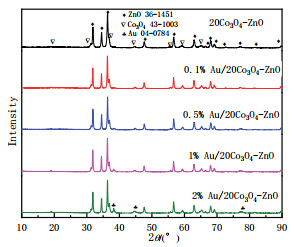
图2
"
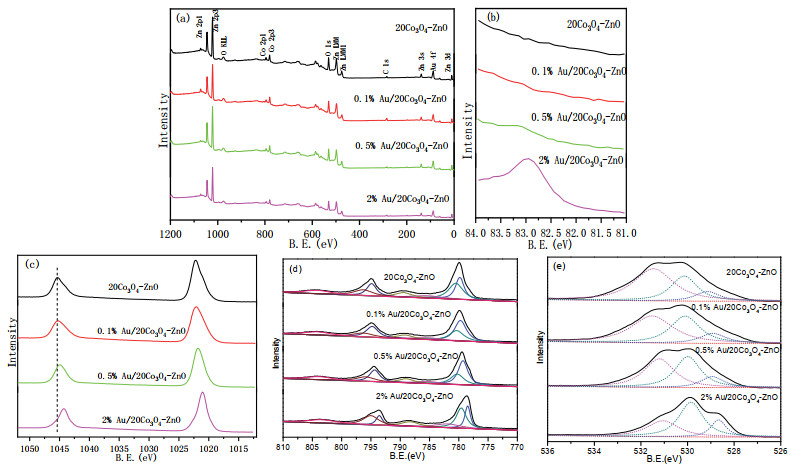
表1
"
| Catalyst | Lattice oxygen (OL) a | Adsorbed oxygen (OS) b | Hydroxyl group (OH) c |
| 20Co3O4-ZnO | 10.8% | 30.3% | 58.9% |
| 0.1%Au/20Co3O4-ZnO | 11.7% | 36.4% | 51.9% |
| 0.5%Au/20Co3O4-ZnO | 13.4% | 41.3% | 45.3% |
| 2%Au/20Co3O4-ZnO | 16.3% | 52.3% | 31.4% |
图3
"
图4
"
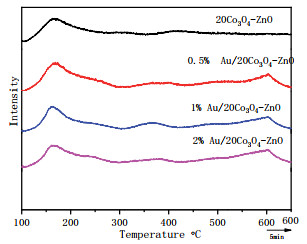
表2
"
| Catalyst | Base sites (μmolCO2∙g−1) | Total base sites (μmol CO2∙g−1) | ||
| Weak (< 250 ºC) | Medium (250–450 ºC) | Strong (> 450 ºC) | ||
| 20Co3O4-ZnO | 33.08 (74% a) | 10.49 (23%) | 1.27 (3%) | 44.84 |
| 0.5%Au/20Co3O4-ZnO | 22.68 (55%) | 3.94 (10%) | 14.25 (35%) | 40.87 |
| 1%Au/20Co3O4-ZnO | 18.12 (54%) | 2.28 (7%) | 12.86 (39%) | 33.26 |
| 2%Au/20Co3O4-ZnO | 17.86 (53%) | 2.06 (6%) | 13.40 (40%) | 33.32 |
图5
"
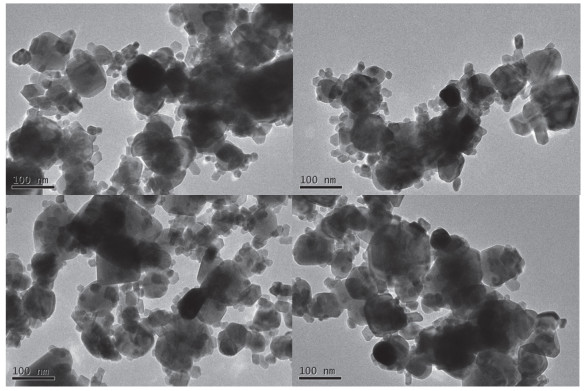
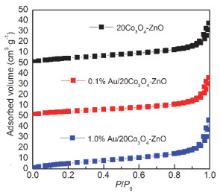
图6
"
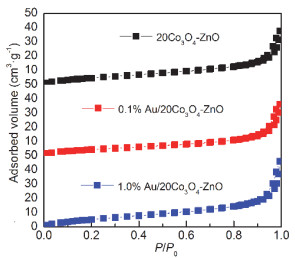
表3
"
| Support/catalyst | Specific surface area/(m2∙g−1) |
| 20Co3O4-ZnO | 20.2 |
| 0.1%Au/20Co3O4-ZnO | 19.9 |
| 1.0%Au/20Co3O4-ZnO | 20.9 |
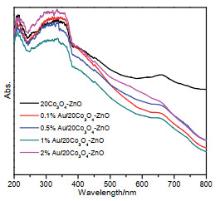
图7
"
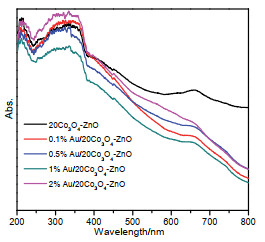
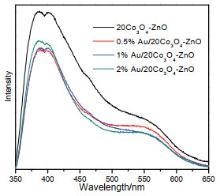
图8
"
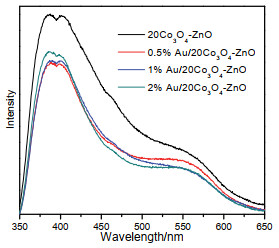
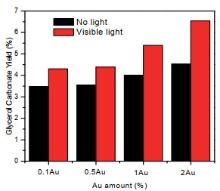
图9
"
表4
"
| Recycle number | Glycerol carbonate yield (%) |
| 1 | 6.5 |
| 2 | 6.3 |
| 3 | 6.2 |
表5
"
| Catalyst | Reaction conditions | Performance | Reference |
| Au/Co3O4-ZnO | 100 mL stainless steel autoclave, 10 mmol glycerol, 0.50 g catalyst, 20 mL dimethyl fumarate, 150 ℃, 5 MPa CO2, 6 h and 225 W visible light irradiation. | 6.5% glycerol carbonate yield. | This work |
| Zn-doped CeO2 | 50 mL high-pressure reactor, 0.92 g glycerol (10 mmol), 0.17 g catalyst, 3.12 g 2-cyanopyridine, 10 mL dimethylformamide, 150 ℃, 40 bar (1 bar = 0.1 MPa) CO2 pressure, and 5 h. | 19.1% glycerol conversion and 18.9% glycerol carbonate yield. | |
| La/ZIF-8 | 100 mL stainless steel autoclave, 0.1 g catalyst, 7 bar CO2, 150 ℃, in the presence of MgCO3 as the dehydrating agent. | 46.5% glycerol conversion and 35.3% glycerol carbonate yield. | |
| CeO2 | 100 mL stainless steel autoclave, 10 mmol glycerol, 0.34 g CeO2, 30 mmol 2-cyanopyridine, 10 mL dimethyl formamide, 150 ℃, 4 MPa and reaction time 5 h. | 20.8% glycerol carbonate yield. | |
| Cu/La2O3 | 100 mL stainless steel autoclave, glycerol 50 mmol, acetonitrile 10 mL, catalyst 0.08 g, 150 ℃, CO2 7 MPa, 3 h. | 8.9% glycerol conversion and 29.3% selectivity towards glycerol carbonate. | |
| Zn/Al/La/X (X = F, Cl, Br) | 50 mL stainless-steel autoclave, 4.60 g glycerol, 0.14 g catalyst and 5.0 mL acetonitrile, CO2 4.0 MPa, 170 ℃ for 12 h. | 35.5% glycerol conversion and 16.0% glycerol carbonate yield. | |
| La2O2CO3-ZnO | 100 mL stainless steel autoclave, 0.92 g glycerol, 0.50 g catalyst, 20 mL of N, N-dimethylformamide, 150 ℃, 5.5 MPa CO2, and reaction time of 6 h, visible light irradiation. | 6.9% glycerol conversion and 6.1% glycerol carbonate yield. | |
| Au/ZnWO4-ZnO | 100 mL stainless steel autoclave, 10 mmol glycerol, 1.0 g catalyst, 20 mL N, N-dimethylformamide, 5.0 MPa CO2, 150 ℃, 6 h, with 250 W visible light irradiation. | 8.4% glycerol carbonate yield. |
表6
"
| Catalyst | Reaction condition | Glycerol carbonate yield (%) |
| 2%Au/20Co3O4-ZnO | Thermal | 4.5 |
| 2%Au/20Co3O4-ZnO | Photo-thermal | 6.5 |
| 20Co3O4-ZnO | Thermal | 3.1 |
| 20Co3O4-ZnO | Photo-thermal | 5.3 |
| 2%Au/Co3O4 | Thermal | 2.6 |
| 2%Au/Co3O4 | Photo-thermal | 3.2 |
| 2%Au/ZnO | Thermal | 1.3 |
| 2%Au/ZnO | Photo-thermal | 1.8 |
图10
"
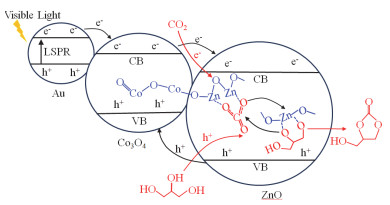
图11
"
| 1 |
doi: 10.1038/s41586-019-1681-6 |
| 2 |
doi: 10.1021/acs.chemrev.9b00723 |
| 3 |
doi: 10.1016/j.apcatb.2018.09.073 |
| 4 |
doi: 10.1016/j.renene.2018.07.047 |
| 5 |
doi: 10.1016/j.scitotenv.2018.12.104 |
| 6 |
doi: 10.1002/adma.201807166 |
| 7 |
doi: 10.1039/c8cs00607e |
| 8 |
doi: 10.1021/jacs.8b07615 |
| 9 |
doi: 10.1016/j.jcat.2018.03.014 |
| 10 |
doi: 10.1021/acscatal.8b05060 |
| 11 |
doi: 10.1021/acscatal.7b04150 |
| 12 |
doi: 10.1016/j.cattod.2015.04.012 |
| 13 |
doi: 10.1002/ente.201900493 |
| 14 |
doi: 10.1039/d0gc02717k |
| 15 |
doi: 10.1016/j.jcou.2020.101252 |
| 16 |
doi: 10.1016/j.apcata.2015.12.030 |
| 17 |
doi: 10.1039/c4cy01237b |
| 18 |
doi: 10.1039/c7gc00260b |
| 19 |
doi: 10.1016/j.jcis.2013.12.049 |
| 20 |
doi: 10.1038/nnano.2010.235 |
| 21 |
doi: 10.1002/adma.201603730 |
| 22 |
doi: 10.1039/c3gc40790j |
| 23 |
doi: 10.1016/j.mcat.2017.03.025 |
| 24 |
doi: 10.1039/d0cy01821j |
| 25 |
doi: 10.1016/j.fuel.2022.123294 |
| 26 |
doi: 10.1021/acs.chemrev.9b00187 |
| 27 |
doi: 10.1002/adom.201801433 |
| 28 |
doi: 10.1002/advs.201900471 |
| 29 |
doi: 10.1016/j.jpcs.2018.12.005 |
| 30 |
doi: 10.1016/j.jascer.2017.06.008 |
| 31 |
doi: 10.1016/j.jcis.2021.02.066 |
| 32 |
doi: 10.1021/acscatal.8b01237 |
| 33 |
doi: 10.1016/j.jallcom.2018.01.205 |
| 34 |
doi: 10.1016/j.cej.2019.122596 |
| 35 |
doi: 10.1016/j.cej.2019.122511 |
| 36 |
doi: 10.1021/am300835p |
| 37 |
doi: 10.1021/jp8027275 |
| 38 |
doi: 10.1016/j.apcatb.2017.06.071 |
| 39 |
doi: 10.1016/j.cej.2017.10.040 |
| 40 |
doi: 10.1016/j.susc.2009.12.009 |
| 41 |
doi: 10.1002/anie.201504933 |
| 42 |
doi: 10.1016/j.nanoen.2016.05.045 |
| 43 |
doi: 10.1016/j.jmmm.2014.08.023 |
| 44 |
doi: 10.1021/acsanm.0c03166 |
| 45 |
doi: 10.1039/d0ta12413c |
| 46 |
doi: 10.1002/jctb.4414 |
| 47 |
doi: 10.1016/j.molcata.2015.03.012 |
| 48 |
doi: 10.1016/j.apcatb.2018.12.018 |
| 49 |
doi: 10.1021/cs200320h |
| 50 |
doi: 10.1039/c9dt04243a |
| 51 |
doi: 10.1021/cm100703e |
| 52 |
doi: 10.1021/ef800209a |
| 53 |
doi: 10.1016/j.apcatb.2013.07.026 |
| 54 |
doi: 10.1039/c5ra07799k |
| [1] | 洪佳楠, 许辰宇, 刘烟, 黎昌棋, 王梦琳, 张彦威. 通过边缘活性位点调控解析光热催化中析氢与二氧化碳还原的界面竞争[J]. 物理化学学报, 2025, 41(9): 100099 - . |
| [2] | 吕卓岩, 丁杨铭, 康磊磊, 李林, 刘晓艳, 王爱琴, 张涛. 光增强CuOx/TiO2催化丙烯氧气直接环氧化反应[J]. 物理化学学报, 2025, 41(4): 100038 - . |
| [3] | 郭李娜, 李睿哲, 孙闯, 罗小利, 石义秋, 原弘, 欧阳述昕, 张铁锐. 层状双金属氢氧化物的层间阴离子对衍生的Ni-Al2O3催化剂光热催化CO2甲烷化反应的影响[J]. 物理化学学报, 2025, 41(1): 100002 - . |
| [4] | 张城城, 吴之怡, 沈家辉, 何乐, 孙威. 硅纳米结构阵列:光热CO2催化的新兴平台[J]. 物理化学学报, 2024, 40(1): 2304004 - . |
| [5] | 何展军, 黄敏, 林铁军, 钟良枢. 光热催化甲烷干重整研究进展[J]. 物理化学学报, 2023, 39(9): 2212060 -0 . |
| [6] | 宋千伟, 何观朝, 费慧龙. 基于单原子催化剂的光热催化转化:原理和应用[J]. 物理化学学报, 2023, 39(9): 2212038 -0 . |
| [7] | 焦卓浩, 赵心远, 赵健, 谢瑶, 侯胜利, 赵斌. [Co3]簇基金属有机框架材料实现“一石二鸟”高效催化CO2转化为噁唑烷酮[J]. 物理化学学报, 2023, 39(11): 2301018 - . |
| [8] | 刘志成, 伊晓东, 高飞雪, 谢在库, 韩布兴, 孙予罕, 何鸣元, 杨俊林. 绿色碳科学:双碳目标下的科学基础——第292期“双清论坛”学术综述[J]. 物理化学学报, 2023, 39(1): 2112029 -0 . |
| [9] | 任玉美,许群. 构筑先进二维异质结构Ag/WO3−x用于提升光电转化效率[J]. 物理化学学报, 2019, 35(10): 1157 -1164 . |
|
||
