物理化学学报 >> 2025, Vol. 41 >> Issue (10): 100126.doi: 10.1016/j.actphy.2025.100126
Ga掺杂Cu/γ-Al2O3双功能界面位点促进CO2加氢直接合成二甲醚
陈晓睿1, 罗轩1, 苏通明1, 谢新玲1, 陈柳云1, 宾月景2, 秦祖赠1,*( ), 纪红兵1,3
- 1 广西大学化学化工学院, 广西 南宁 530004
2 广西科技大学生物与化学工程学院, 广西 柳州 545005
3 浙江工业大学浙江绿色石化与轻烃转化研究院, 浙江 杭州 310014
-
收稿日期:2025-05-05修回日期:2025-06-21录用日期:2025-06-24发布日期:2025-09-29 -
通讯作者:Email: qinzuzeng@gxu.edu.cn (秦祖赠) -
基金资助:国家自然科学基金(22078074); 广西重大专项计划(桂科AB25069513)
Ga-doped Cu/γ-Al2O3 bifunctional interface sites promote the direct hydrogenation of CO2 to DME
Xiaorui Chen1, Xuan Luo1, Tongming Su1, Xinling Xie1, Liuyun Chen1, Yuejing Bin2, Zuzeng Qin1,*(), Hongbing Ji1,3
- 1 School of Chemistry and Chemical Engineering, Guangxi University, Nanning 530004, Guangxi Zhuang Autonomous Region, China
2 College of Biological and Chemical Engineering, Guangxi University of Science and Technology, Liuzhou 545005, Guangxi Zhuang Autonomous Region, China
3 Zhejiang Green Petrochemical and Light Hydrocarbon Transformation Research Institute, Zhejiang University of Technology, Hangzhou 310014, Zhejiang Province, China
-
Received:2025-05-05Revised:2025-06-21Accepted:2025-06-24Published:2025-09-29 -
Contact:Email: qinzuzeng@gxu.edu.cn (Zuzeng Qin) -
Supported by:the National Natural Science Foundation of China(22078074); the Guangxi Key Research and Development Program(桂科AB25069513)

摘要:
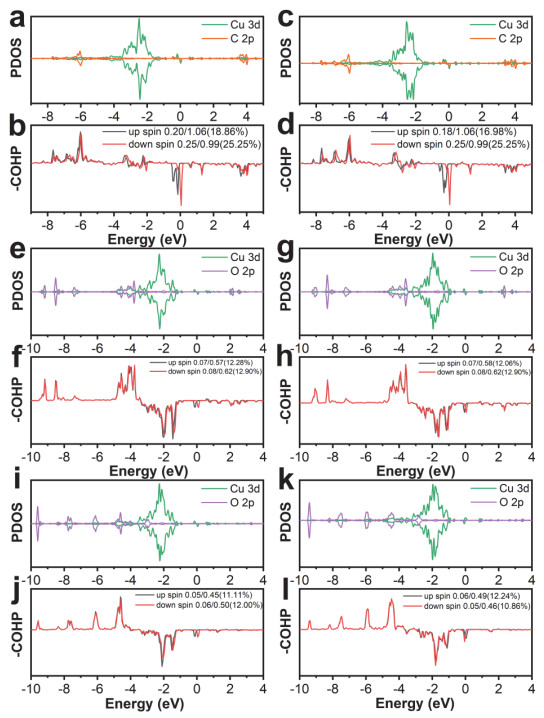
二氧化碳催化加氢制二甲醚(DME)通常依赖于含铜金属氧化物/分子筛体系;然而,在反应过程中,铜物种向分子筛的迁移难以避免,这会导致Cu0位点和酸性位点的损失。在本工作中,通过共沉淀法合成了Cu/x%Ga-γ-Al2O3双功能催化剂。Ga以低浓度掺杂到γ-Al2O3晶格中,与表面Cu0物种形成界面活性位点,从而实现CO2加氢制DME。实验研究与DFT计算表明,该催化剂在180 h内保持稳定,且Ga掺杂Cu/γ-Al2O3界面位点对CO2加氢制甲醇和甲醇脱水制DME均表现出催化作用。Ga的掺杂增大了催化剂的比表面积,减小了金属Cu0的粒径,增加了催化剂上的酸性和碱性位点数量,并促进了H2和CO2的吸附。此外,还提出了一种新的DME合成反应路径。本工作去除了传统铜基双功能催化剂中的脱水组分,使两个反应能够在同一活性位点上发生,为新型二甲醚合成双功能催化剂的设计提供了新策略。
引用本文
陈晓睿, 罗轩, 苏通明, 谢新玲, 陈柳云, 宾月景, 秦祖赠, 纪红兵. Ga掺杂Cu/γ-Al2O3双功能界面位点促进CO2加氢直接合成二甲醚[J]. 物理化学学报, 2025, 41(10), 100126. doi: 10.1016/j.actphy.2025.100126
Xiaorui Chen, Xuan Luo, Tongming Su, Xinling Xie, Liuyun Chen, Yuejing Bin, Zuzeng Qin, Hongbing Ji. Ga-doped Cu/γ-Al2O3 bifunctional interface sites promote the direct hydrogenation of CO2 to DME[J]. Acta Phys. -Chim. Sin. 2025, 41(10), 100126. doi: 10.1016/j.actphy.2025.100126
图1
"
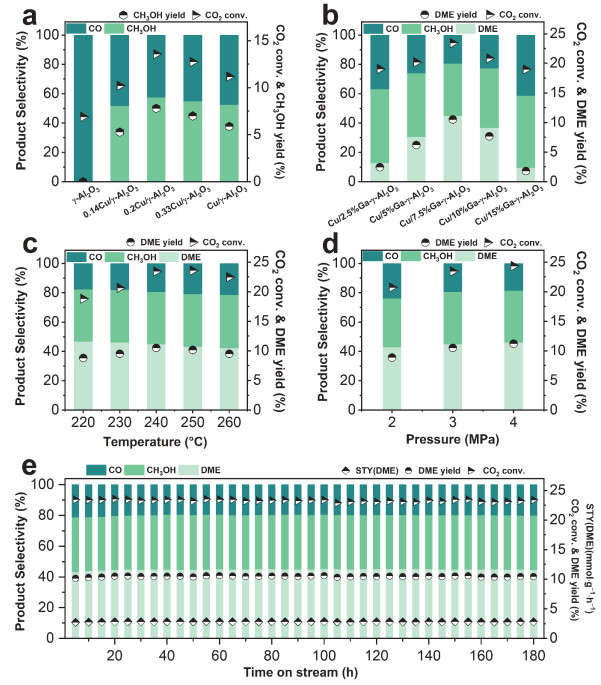
图2
"
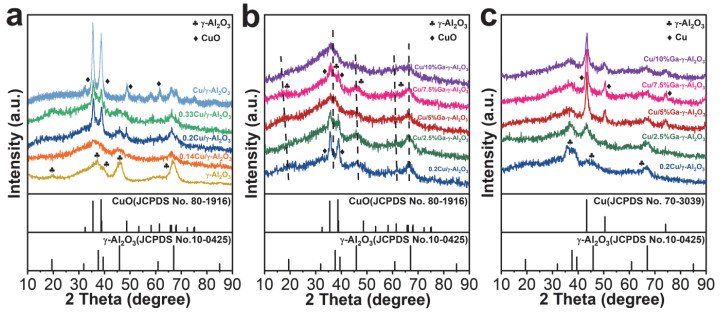
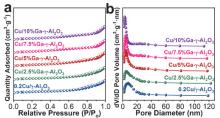
图3
"
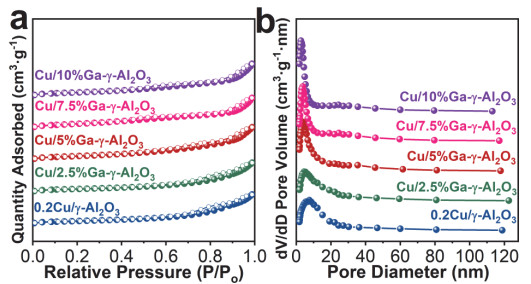
表1
"
| Catalysts | BET surface area (m2∙g−1) | Average pore diameter (nm) | Pore volume (cm3∙g−1) |
| Cu/γ-Al2O3 | 99.2 | 10.5 | 0.30 |
| Cu/2.5%Ga-γ-Al2O3 | 104.5 | 10.6 | 0.29 |
| Cu/5%Ga-γ-Al2O3 | 132.4 | 8.9 | 0.33 |
| Cu/7.5%Ga-γ-Al2O3 | 149.7 | 9.2 | 0.33 |
| Cu/10%Ga-γ-Al2O3 | 132.9 | 7.6 | 0.30 |
图4
"
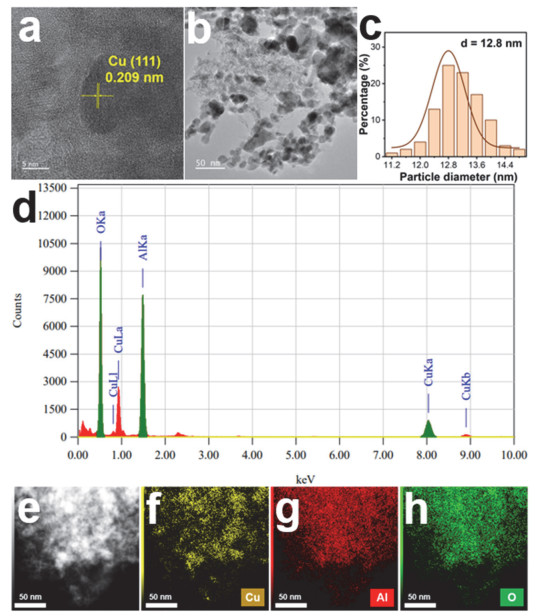
图5
"
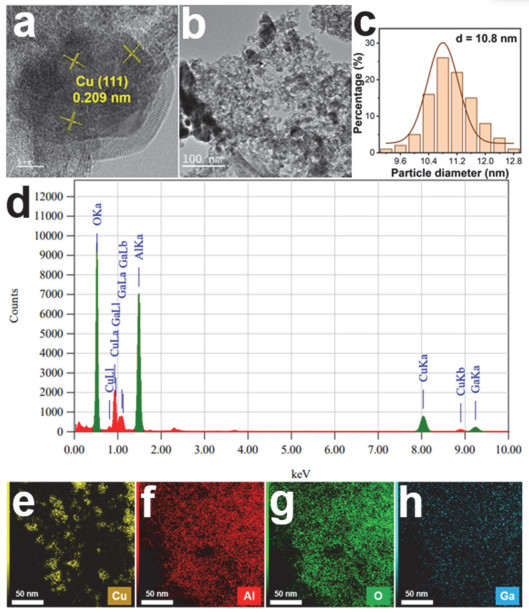
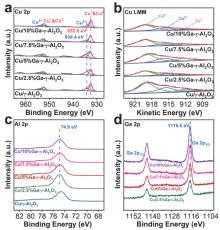
图6
"
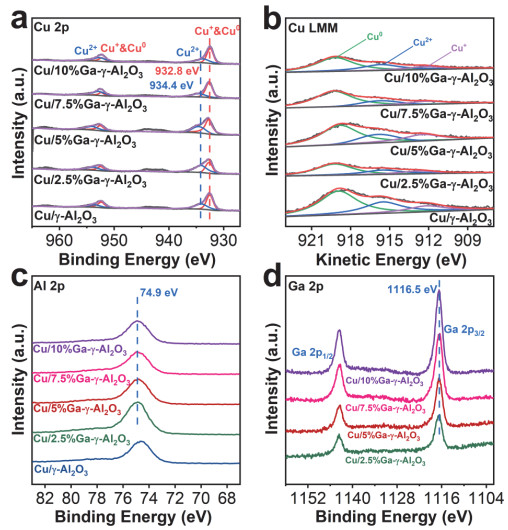
表2
"
| Catalysts | Cu LMM peak area (%) | Molar ratio Cu0/(Cu+ + Cu2+) | ||
| Cu2+ | Cu+ | Cu0 | ||
| Cu/γ-Al2O3 | 29.34 | 14.98 | 55.68 | 1.26 |
| Cu/2.5%Ga-γ-Al2O3 | 26.23 | 16.52 | 57.25 | 1.34 |
| Cu/5%Ga-γ-Al2O3 | 21.21 | 20.70 | 58.09 | 1.39 |
| Cu/7.5%Ga-γ-Al2O3 | 17.56 | 14.68 | 67.76 | 2.10 |
| Cu/10%Ga-γ-Al2O3 | 28.33 | 13.85 | 57.82 | 1.37 |
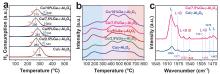
图7
"
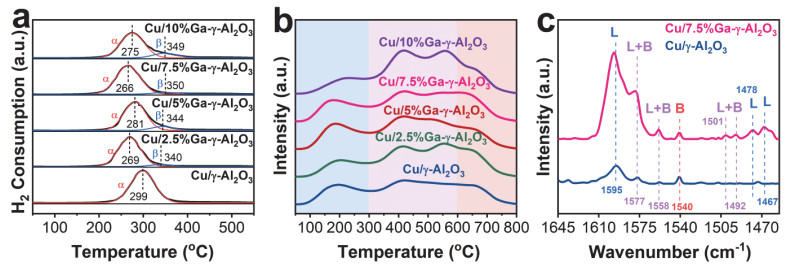
表3
"
| Catalysts | Amount of H2 consumptions (μmol∙g−1) | Total amount of H2 consumptions (μmol∙g−1) | |
| α | β | ||
| Cu/γ-Al2O3 | 3267.4 | – | 3267.4 |
| Cu/2.5%Ga-γ-Al2O3 | 2673.8 | 174.6 | 2848.4 |
| Cu/5%Ga-γ-Al2O3 | 2581.5 | 349.4 | 2930.9 |
| Cu/7.5%Ga-γ-Al2O3 | 2772.0 | 163.2 | 2935.2 |
| Cu/10%Ga-γ-Al2O3 | 2439.0 | 457.3 | 2896.3 |
表4
"
| Catalysts | Total acid content (mmol∙g−1) |
| Cu/γ-Al2O3 | 1.32 |
| Cu/2.5%Ga-γ-Al2O3 | 1.56 |
| Cu/5%Ga-γ-Al2O3 | 1.62 |
| Cu/7.5%Ga-γ-Al2O3 | 1.85 |
| Cu/10%Ga-γ-Al2O3 | 1.65 |
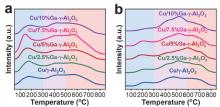
图8
"
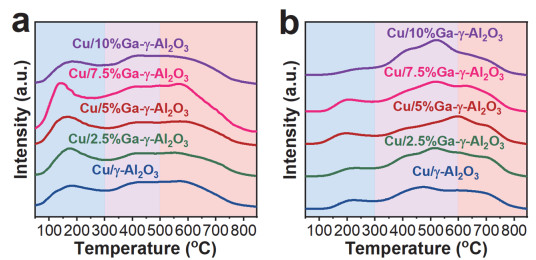
表5
"
| Catalysts | H2 total content (mmol∙g−1) | CO2 total content (mmol∙g−1) |
| Cu/γ-Al2O3 | 0.07 | 0.83 |
| Cu/2.5%Ga-γ-Al2O3 | 0.08 | 0.95 |
| Cu/5%Ga-γ-Al2O3 | 0.10 | 1.01 |
| Cu/7.5%Ga-γ-Al2O3 | 0.14 | 1.09 |
| Cu/10%Ga-γ-Al2O3 | 0.09 | 1.00 |
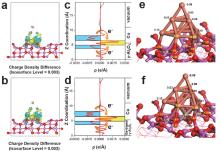
图9
"
图10
"
图11
"
图12
"
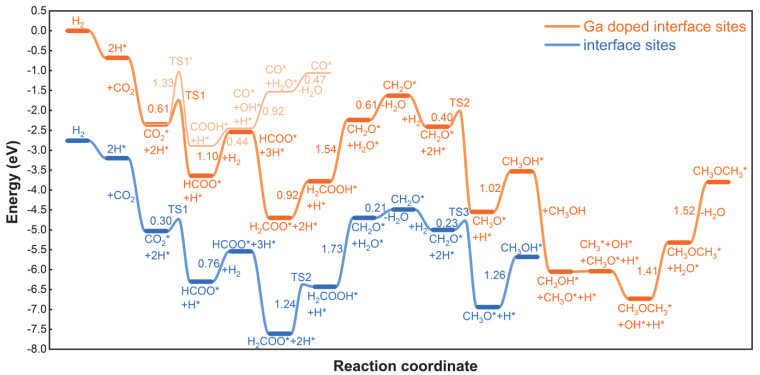
图13
"
| 1 |
A. Álvarez, A. Bansode, A. Urakawa, A. V. Bavykina, T. A. Wezendonk, M. Makkee, J. Gascon, F. Kapteijn. Chem. Rev. 2017, 117 (14), 9804.
doi: 10.1021/acs.chemrev.6b00816 |
| 2 |
A. Modak, P. Bhanja, S. Dutta, B. Chowdhury, A. Bhaumik. Green Chem. 2020, 22 (13), 4002.
doi: 10.1039/D0GC01092H |
| 3 |
J. Wang, R. Fu, S. Wen, P. Ning, M. H. Helal, M. A. Salem, B. B. Xu, Z. M. El-Bahy, M. Huang, Z. Guo, L. Huang, Q. Wang. Adv. Compos. Hybrid Mater. 2022, 5 (4), 2721.
doi: 10.1007/s42114-022-00567-3 |
| 4 |
X. Guo, J. Yin, S. Xia, J. Gong, J. He, F. Tang, C. Zuo, P. Liu. Fuel 2024, 364, 131057.
doi: 10.1016/j.fuel.2024.131057 |
| 5 |
Y. Song, K. Serikawa, K. Imamura, H. Imai, X. Li. Ind. Eng. Chem. Res. 2020, 59 (26), 11962.
doi: 10.1021/acs.iecr.0c01015 |
| 6 |
X. Chen, T. Su, X. Luo, X. Xie, Z. Qin, H. Ji. Surf. Interfaces 2024, 48, 104346.
doi: 10.1016/j.surfin.2024.104346 |
| 7 |
N. Nintao, P. Chadawong, W. Sangthong, W. Donphai, A. Seubsai, C. Niamnuy. Top. Catal. 2023, 66 (19), 1478.
doi: 10.1007/s11244-023-01844-1 |
| 8 |
H. Li, S. Ren, S. Zhang, S. Padinjarekutt, B. Sengupta, X. Liang, S. Li, M. Yu. J. Mater. Chem. A 2021, 9 (5), 2678.
doi: 10.1039/D0TA10417E |
| 9 |
U. Mondal, G. D. Yadav. Reaction Chemistry & Engineering 2022, 7 (6), 1391.
doi: 10.1039/D2RE00025C |
| 10 |
X. Cui, W. Yan, H. Yang, Y. Shi, Y. Xue, H. Zhang, Y. Niu, W. Fan, T. Deng. ACS Sustain. Chem. Eng. 2021, 9 (7), 2661.
doi: 10.1021/acssuschemeng.0c07258 |
| 11 |
P. Rodriguez-Vega, A. Ateka, I. Kumakiri, H. Vicente, J. Ereña, A. T. Aguayo, J. Bilbao. Chem. Eng. Sci. 2021, 234, 116396.
doi: 10.1016/j.ces.2020.116396 |
| 12 |
M. Sánchez-Contador, A. Ateka, P. Rodriguez-Vega, J. Bilbao, A. T. Aguayo. Ind. Eng. Chem. Res. 2018, 57 (4), 1169.
doi: 10.1021/acs.iecr.7b04345 |
| 13 |
D. Kubas, M. Semmel, O. Salem, I. Krossing. ACS Catal. 2023, 13 (6), 3960.
doi: 10.1021/acscatal.2c06207 |
| 14 |
C. Sun, Y. Xia, X. Ye, W. Xu, H. Shi, X. Gao, J. Yu, L. Guo, J. Li. Ind. Eng. Chem. Res. 2024, 63 (5), 2113.
doi: 10.1021/acs.iecr.3c03606 |
| 15 |
J. Du, Y. Zhang, K. Wang, F. Ding, S. Jia, G. Liu, L. Tan. RSC Adv. 2021, 11 (24), 14426.
doi: 10.1039/D0RA10849A |
| 16 |
W. Yue, Z. Wan, Y. Li, X. He, J. Caro, A. Huang. J. Membr. Sci. 2022, 660, 120845.
doi: 10.1016/j.memsci.2022.120845 |
| 17 |
X. Fan, B. Jin, S. Ren, S. Li, M. Yu, X. Liang. AlChE J. 2021, 67 (11), e17353.
doi: 10.1002/aic.17353 |
| 18 |
R.-W. Liu, Z.-Z. Qin, H.-B. Ji, T.-M. Su. Ind. Eng. Chem. Res. 2013, 52 (47), 16648.
doi: 10.1021/ie401763g |
| 19 |
Z.-Z. Qin, X.-H. Zhou, T.-M. Su, Y.-X. Jiang, H.-B. Ji. Catal. Commun. 2016, 75, 78.
doi: 10.1016/j.catcom.2015.12.010 |
| 20 |
X. Zhou, T. Su, Y. Jiang, Z. Qin, H. Ji, Z. Guo. Chem. Eng. Sci. 2016, 153, 10.
doi: 10.1016/j.ces.2016.07.007 |
| 21 |
L. Yao, X. Shen, Y. Pan, Z. Peng. Energy Fuels 2020, 34 (7), 8635.
doi: 10.1021/acs.energyfuels.0c01256 |
| 22 |
G. Bonura, S. Todaro, L. Frusteri, I. Majchrzak-Kucęba, D. Wawrzyńczak, Z. Pászti, E. Tálas, A. Tompos, L. Ferenc, H. Solt, C. Cannilla, F. Frusteri, Appl. Catal.. B 2021, 294, 120255.
doi: 10.1016/j.apcatb.2021.120255 |
| 23 |
H. H. Koybasi, A. K. Avci. Ind. Eng. Chem. Res. 2022, 61 (30), 10846.
doi: 10.1021/acs.iecr.2c01764 |
| 24 |
H. R. Godini, S. R. Kumar, N. Tadikamalla, F. Gallucci. Int. J. Hydrog. Energy 2022, 47 (21), 11341.
doi: 10.1016/j.ijhydene.2021.11.073 |
| 25 |
R. Dalebout, L. Barberis, N. L. Visser, J. E. S. van der Hoeven, A. M. J. van der Eerden, J. A. Stewart, F. Meirer, K. P. de Jong, P. E. de Jongh. ChemCatChem 2022, 14 (19), e202200451.
doi: 10.1002/cctc.202200451 |
| 26 |
H. Guo, S. Ding, H. Zhang, C. Wang, F. Peng, S. Yao, L. Xiong, X. Chen. Mol. Catal. 2021, 513, 111820.
doi: 10.1016/j.mcat.2021.111820 |
| 27 |
C. Fritsch, J. Dornseiffer, J. Blankenstein, M. Noyong, C. Groteklaes, U. Simon. ChemCatChem 2024, 16, e202400731.
doi: 10.1002/cctc.202400731 |
| 28 |
Q. He, Z. Li, D. Li, F. Ning, Q. Wang, W. Liu, W. Zhang, Y. Cui, J. Zhang, C. Liu. Mol. Catal. 2024, 558, 114008.
doi: 10.1016/j.mcat.2024.114008 |
| 29 |
V. K. Shrivastaw, J. Kaishyop, T. S. Khan, D. Khurana, G. Singh, S. Paul, B. Chowdhury, A. Bordoloi. ChemCatChem 2024, 16, e202400534.
doi: 10.1002/cctc.202400534 |
| 30 |
J. Wang, Y. Song, J. Li, F. Liu, J. Wang, J. Lv, S. Wang, M. Li, X. Bao, X. Ma. Appl. Catal. A 2024, 674, 119618.
doi: 10.1016/j.apcata.2024.119618 |
| 31 |
H. Zhou, Z. Chen, A. V. López, E. D. López, E. Lam, A. Tsoukalou, E. Willinger, D. A. Kuznetsov, D. Mance, A. Kierzkowska, F. Donat, P. M. Abdala, A. Comas-Vives, C. Copéret, A. Fedorov, C. R. Müller. Nat. Catal. 2021, 4 (10), 860.
doi: 10.1038/s41929-021-00684-0 |
| 32 |
F. C. Meunier, I. Dansette, A. Paredes-Nunez, Y. Schuurman. Angew. Chem. Int. Ed. 2023, 62 (29), e202303939.
doi: 10.1002/anie.202303939 |
| 33 |
W. Wu, Y. Wang, L. Luo, M. Wang, Z. Li, Y. Chen, Z. Wang, J. Chai, Z. Cen, Y. Shi, J. Zhao, J. Zeng, H. Li. Angew. Chem. Int. Ed. 2022, 61 (48), e202213024.
doi: 10.1002/anie.202213024 |
| 34 |
A. Feng, T. He, W. Jin, D. Li, B. Qu, R. Zhou. Mol. Catal. 2024, 563, 114259.
doi: 10.1016/j.mcat.2024.114259 |
| 35 |
H. Zhang, J. Yang, S. Wang, N. Zhao, F. Xiao, Y. Wang. Catal. Sci. Technol. 2024, 14 (8), 2153.
doi: 10.1039/D3CY01753B |
| 36 |
A. Ghorbanpour, J. D. Rimer, L. C. Grabow. ACS Catal. 2016, 6 (4), 2287.
doi: 10.1021/acscatal.5b02367 |
| 37 |
A. Das, S. C. Mandal, S. Das, B. Pathak. J. Phys. Chem. C 2022, 126 (51), 21628.
doi: 10.1021/acs.jpcc.2c07240 |
| 38 |
A. Lotfollahzade Moghaddam, M. Ghavipour, J. Kopyscinski, M. J. Hazlett, Appl. Catal.. A 2024, 672, 119594.
doi: 10.1016/j.apcata.2024.119594 |
| 39 |
G. Kresse, J. Furthmüller. Physical Review B 1996, 54 (16), 11169.
doi: 10.1103/PhysRevB.54.11169 |
| 40 |
J. P. Perdew, K. Burke, M. Ernzerhof. Phys. Rev. Lett. 1996, 77 (18), 3865.
doi: 10.1103/PhysRevLett.77.3865 |
| 41 |
M.-C. Silaghi, A. Comas-Vives, C. Copéret. ACS Catal. 2016, 6 (7), 4501.
doi: 10.1021/acscatal.6b00822 |
| 42 |
Z. Cui, S. Meng, Y. Yi, A. Jafarzadeh, S. Li, E. C. Neyts, Y. Hao, L. Li, X. Zhang, X. Wang, A. Bogaerts. ACS Catal. 2022, 12 (2), 1326.
doi: 10.1021/acscatal.1c04678 |
| 43 |
Q. Wang, Z. Yu, J. Feng, P. Fornasiero, Y. He, D. Li. ACS Sustain. Chem. Eng. 2020, 8 (40), 15288.
doi: 10.1021/acssuschemeng.0c05235 |
| 44 |
S. Lu, J. Zhang, H. Meng, X. Qin, J. Huang, Y. Liang, F.-S. Xiao. Appl. Catal. B 2023, 325, 122329.
doi: 10.1016/j.apcatb.2022.122329 |
| 45 |
S. Poulston, P. M. Parlett, P. Stone, M. Bowker, Surf. Interface Anal. 24 (12) (1996) 811, https://doi.org/10.1002/ (SICI)1096-9918(199611)24: 12<811: : AID-SIA191>3.0.CO;2-Z.
|
| 46 |
C. Wang, T. Su, Z. Qin, H. Ji. Catal. Sci. Technol. 2022, 12 (15), 4826.
doi: 10.1039/D2CY00582D |
| 47 |
A. Beck, M. Zabilskiy, M. A. Newton, O. Safonova, M. G. Willinger, J. A. van Bokhoven. Nat. Catal. 2021, 4 (6), 488.
doi: 10.1038/s41929-021-00625-x |
| 48 |
K. Chen, B. Chu, Q. Qin, X. Ou, R. Zhao, X. Wei, H. Wu, B. Li, L. Dong. Appl. Surf. Sci. 2022, 589, 153052.
doi: 10.1016/j.apsusc.2022.153052 |
| 49 |
C. V. Hidalgo, H. Itoh, T. Hattori, M. Niwa, Y. Murakami. J. Catal. 1984, 85 (2), 362.
doi: 10.1016/0021-9517(84)90225-2 |
| 50 |
L. J. Lobree, I.-C. Hwang, J. A. Reimer, A. T. Bell. J. Catal. 1999, 186 (2), 242.
doi: 10.1006/jcat.1999.2548 |
| 51 |
N. Katada, H. Igi, J.-H. Kim. J. Phys. Chem. B 1997, 101 (31), 5969.
doi: 10.1021/jp9639152 |
| 52 |
Y. Yang, T. Su, X. Xie, X. Luo, H. Ji, J.-C. Sin, S.-M. Lam, Z. Qin. Catal. Lett. 2024, 154 (12), 6454.
doi: 10.1007/s10562-024-04828-2 |
| 53 |
L. Chen, W. Wang, T. Lu, X. Luo, X. Xie, K. Huang, S. Qin, T. Su, Z. Qin, H. Ji. Acta Phys. -Chim. Sin. 2025, 41 (6), 100054.
doi: 10.1016/j.actphy.2025.100054 |
| 54 |
H. Li, S. Zhao, W. Zhang, H. Du, X. Yang, Y. Peng, D. Han, B. Wang, Z. Li. Fuel 2023, 342, 127786.
doi: 10.1016/j.fuel.2023.127786 |
| 55 |
G. Xie, R. Jin, P. Ren, Y. Fang, R. Zhang, Z.-j. Wang, Appl. Catal.. B 2023, 324, 122233.
doi: 10.1016/j.apcatb.2022.122233 |
| 56 |
Y. Xiao, C. Men, B. Chu, Z. Qin, H. Ji, J. Chen, T. Su. Chem. Eng. J. 2022, 446, 137028.
doi: 10.1016/j.cej.2022.137028 |
| 57 |
X.-L. Zhang, X. Su, Y.-R. Zheng, S.-J. Hu, L. Shi, F.-Y. Gao, P.-P. Yang, Z.-Z. Niu, Z.-Z. Wu, S. Qin, R. Wu, Y. Duan, C. Gu, X.-S. Zheng, J.-F. Zhu, M.-R. Gao. Angew. Chem. Int. Ed. 2021, 60 (52), 26922.
doi: 10.1002/anie.202111075 |
| 58 |
Y. Yang, F.-Y. Gao, X.-L. Zhang, S. Qin, L.-R. Zheng, Y.-H. Wang, J. Liao, Q. Yang, M.-R. Gao. Angew. Chem. Int. Ed. 2022, 61 (42), e202208040.
doi: 10.1002/anie.202208040 |
| 59 |
H. Zhao, R. Yu, S. Ma, K. Xu, Y. Chen, K. Jiang, Y. Fang, C. Zhu, X. Liu, Y. Tang, L. Wu, Y. Wu, Q. Jiang, P. He, Z. Liu, L. Tan. Nat. Catal. 2022, 5 (9), 818.
doi: 10.1038/s41929-022-00840-0 |
| 60 |
R. Zou, M. Liu, C. Shen, K. Sun, C.-j. Liu. Chem. Commun. 2024, 60 (14), 1872.
doi: 10.1039/D3CC05973A |
| [1] | 邱江源, 于涛, 陈均鑫, 李文轩, 张晓萱, 李金生, 郭瑞, 黄在银, 刘宣文. FeOOH调节Bi12O17Cl2@FeOOH异质结中Bi12O17Cl2的表面势阱深度以增强压电电荷转移和压电自芬顿催化[J]. 物理化学学报, 2026, 42(1): 100157 - . |
| [2] | 梁英, 邓羽恒, 余士律, 程家豪, 宋嘉伟, 姚俊, 杨亦辰, 张万雷, 周文靖, 张欣, 沈文剑, 梁桂杰, 李彬, 彭勇, 胡润, 李望南. 机器学习辅助减反膜结构设计与界面修饰协同优化的高效稳定钙钛矿太阳能电池[J]. 物理化学学报, 2025, 41(9): 100098 - . |
| [3] | 祝鑫彤, 曹斌, 闫崇, 唐城, 陈爱兵, 张强. 锂离子电池石墨负极包覆研究进展[J]. 物理化学学报, 2025, 41(9): 100096 - . |
| [4] | 洪佳楠, 许辰宇, 刘烟, 黎昌棋, 王梦琳, 张彦威. 通过边缘活性位点调控解析光热催化中析氢与二氧化碳还原的界面竞争[J]. 物理化学学报, 2025, 41(9): 100099 - . |
| [5] | 吴琦, 王长华, 李莹莹, 张昕彤. 增强g-C3N4@BN范德华异质结界面上的三重态电子转移增强光催化合成H2O2[J]. 物理化学学报, 2025, 41(9): 100107 - . |
| [6] | 彭羽, 陈嘉威, 殷悦, 曹永杰, 廖莫愁, 王丛笑, 董晓丽, 夏永姚. 无碳酸乙烯酯电解液定向构筑正极电解质界面相实现高电压钴酸锂的宽温域稳定运行[J]. 物理化学学报, 2025, 41(8): 100087 - . |
| [7] | 陈柳云, 王文举, 陆泰榕, 罗轩, 谢新玲, 黄科林, 覃善丽, 苏通明, 秦祖赠, 纪红兵. 软模板法诱导Cu/Al2O3深孔道结构促进等离子催化CO2加氢制二甲醚[J]. 物理化学学报, 2025, 41(6): 100054 - . |
| [8] | 曹雪婷, 察爽爽, 龚鸣. 电催化反应中的界面双电层:理论、表征与应用[J]. 物理化学学报, 2025, 41(5): 100041 - . |
| [9] | 黄奥羽, 许君, 黄玉, 储圭, 王卯, 王黎丽, 孙永奇, 蒋臻, 朱晓波. 通过简单的浆料添加剂调整电极-电解液界面以实现稳定的高电压锂离子电池[J]. 物理化学学报, 2025, 41(4): 100037 - . |
| [10] | 王毅锴, 蒋晓林, 宋浩鸣, 魏楠, 王逸凡, 徐新军, 李翠红, 路皓, 刘亚辉, 薄志山. 氰基修饰的苝二酰亚胺衍生物作为膜厚不敏感型阴极界面材料用于高效有机太阳能电池[J]. 物理化学学报, 2025, 41(3): 100027 - . |
| [11] | 刘建东, 张志佳, MikhailKamenskii, FilippVolkov, SvetlanaEliseeva, 马建民. 高压锂电池正极电解质界面研究进展[J]. 物理化学学报, 2025, 41(2): 100011 - . |
| [12] | 刘崇静, 夏雨健, 张鹏军, 魏世强, 曹登丰, 圣蓓蓓, 褚勇衡, 陈双明, 宋礼, 刘啸嵩. 近常压X射线光电子能谱研究固-气和固-液界面[J]. 物理化学学报, 2025, 41(2): 100013 - . |
| [13] | 陈成鑫, 石洪飞, 蔡晓燕, 毛梁, 陈哲. 增强型双功能S型CoWO4/CdIn2S4异质结用于H2生成和甲醛降解[J]. 物理化学学报, 2025, 41(12): 100155 - . |
| [14] | 马浩桐, 衡明宇, 许杨, 毕炜, 缪应纯, 肖舒宁. 微波合成铜负载的碳掺杂氮化硼光催化材料及其大气浓度下CO2还原性能研究[J]. 物理化学学报, 2025, 41(11): 100132 - . |
| [15] | 管勤辉, 郭昱昊, 李娜, 李敬, 颜廷江. 分子筛介导的氧化铟催化剂用于增强光催化CO2加氢[J]. 物理化学学报, 2025, 41(11): 100133 - . |
|
||