物理化学学报 >> 2026, Vol. 42 >> Issue (7): 100274.doi: 10.1016/j.actphy.2026.100274
硫空位提升2D/2D In2.77S4/CuInS2 S型异质结光催化还原CO2为C2H4选择性
崔依琳1,2,3, 李中付1,2,3,*( ), 张维坤1,2,3, 高禹4, 董志超1,2,3,*(), 刘从华1,2,3,*()
- 1 山东理工大学材料科学与工程学院, 山东 淄博 255000
2 山东高校稀土催化新材料工程技术研究中心(CREC), 山东 淄博 255000
3 高温功能陶瓷材料学科与技术中心, 山东 淄博 255000
4 宜宾学院数学与物理学院, 四川 宜宾 644000
-
收稿日期:2026-01-30修回日期:2026-02-28录用日期:2026-03-01发布日期:2026-05-22 -
通讯作者:Email: lzf1632008@126.com (李中付)lch4138@163.com (刘从华)zc339580@126.com (董志超)
Sulfur vacancies boosting C2H4 selectivity of 2D/2D In2.77S4/CuInS2 S-scheme heterojunction for CO2 photoreduction
Yilin Cui1,2,3, Zhongfu Li1,2,3,*(), Weikun Zhang1,2,3, Yu Gao4, Zhichao Dong1,2,3,*(), Conghua Liu1,2,3,*()
- 1 School of Materials Science and Engineering, Shandong University of Technology, Zibo 255000, Shandong Province, China
2 Shandong Collegial Engineering Research Center of Novel Rare Earth Catalysis Materials (CREC), Zibo 255000, Shandong Province, China
3 Discipline and Technology Center for High Temperature Functional Ceramics, Zibo 255000, Shandong Province, China
4 School of Mathematics and Physics, Yibin University, Yibin 644000, Sichuan Province, China
-
Received:2026-01-30Revised:2026-02-28Accepted:2026-03-01Published:2026-05-22 -
Contact:Email: lzf1632008@126.com (Zhongfu Li)lch4138@163.com (Conghua Liu)zc339580@126.com (Zhichao Dong)

摘要:
由于碳碳耦合动力学迟缓和多电子过程复杂,通过人工光合作用将二氧化碳转化为多碳烃仍具挑战性。本研究采用一步水热法合成了具有丰富硫空位(SV)的超薄In2.77S4/CuInS2异质结。通过原位X射线光电子能谱(XPS)、飞秒瞬态吸收光谱(fs-TAS)和光电化学表征,证实了由内建电场驱动的S型电荷转移机制。该S型异质结不仅提高了光生载流子的分离效率,同时保持了优异的还原能力,实现了二氧化碳光还原生成C2烃类。实验数据与密度泛函理论(DFT)计算表明,硫空位缩短了铜-铟活性位点距离,优化了局部电荷密度,并降低了关键二聚体(*CHOCO)形成的能垒,从而加速了碳碳耦合动力学。最终,In2.77S4/CuInS2-4催化剂展现出优异的C2H4产率(47.2 μmol g−1 h−1)和选择性(99.1%),这归因于S型异质结的高效载流子调控与硫空位促进的碳碳耦合动力学的协同效应。同位素标记实验进一步证实二氧化碳是该反应的唯一碳源。总体而言,这种"硫空位-异质结"策略为二氧化碳光还原制乙烯提供了优异的电子选择性,为二氧化碳资源化利用开辟了新视角。
引用本文
崔依琳, 李中付, 张维坤, 高禹, 董志超, 刘从华. 硫空位提升2D/2D In2.77S4/CuInS2 S型异质结光催化还原CO2为C2H4选择性[J]. 物理化学学报, 2026, 42(7), 100274. doi: 10.1016/j.actphy.2026.100274
Yilin Cui, Zhongfu Li, Weikun Zhang, Yu Gao, Zhichao Dong, Conghua Liu. Sulfur vacancies boosting C2H4 selectivity of 2D/2D In2.77S4/CuInS2 S-scheme heterojunction for CO2 photoreduction[J]. Acta Phys. -Chim. Sin. 2026, 42(7), 100274. doi: 10.1016/j.actphy.2026.100274
图1
"
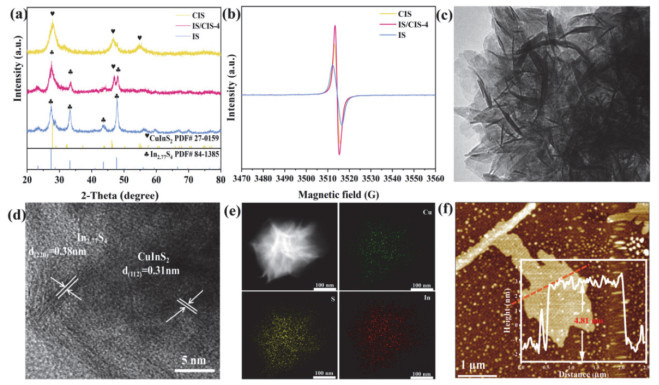
图2
"
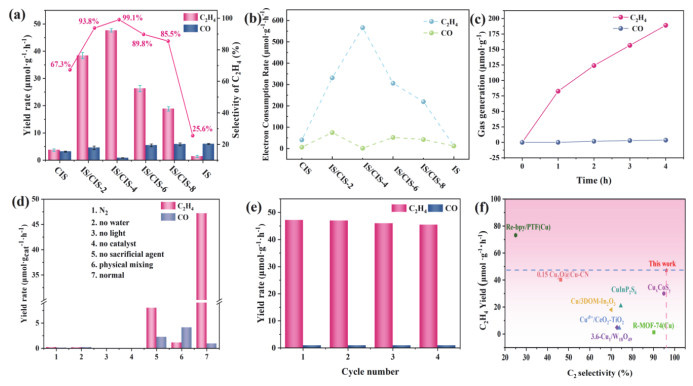
图3
"
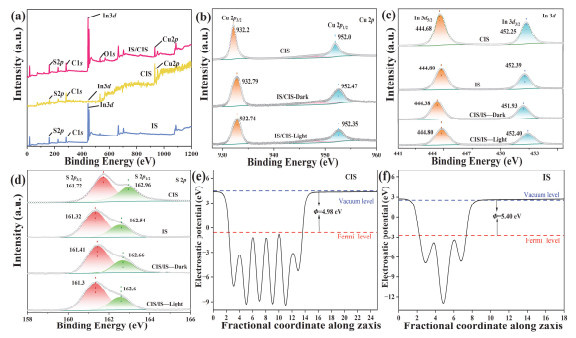
图4
"
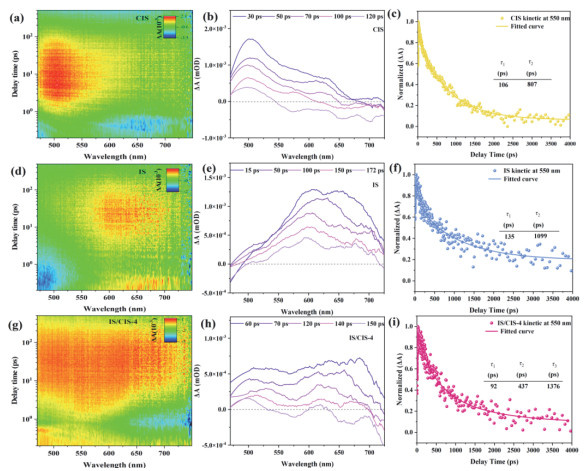
图5
"
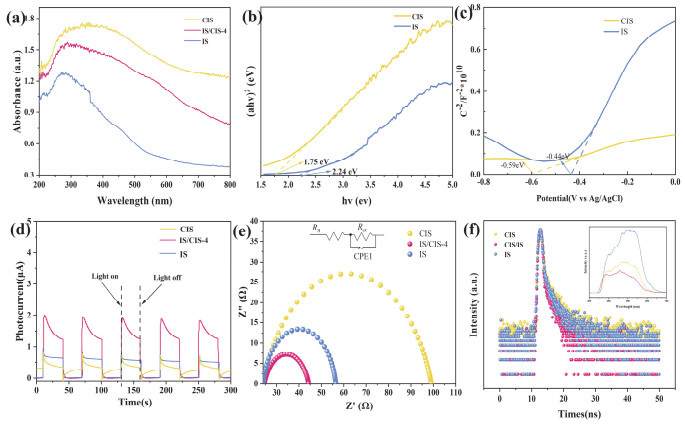
图6
"
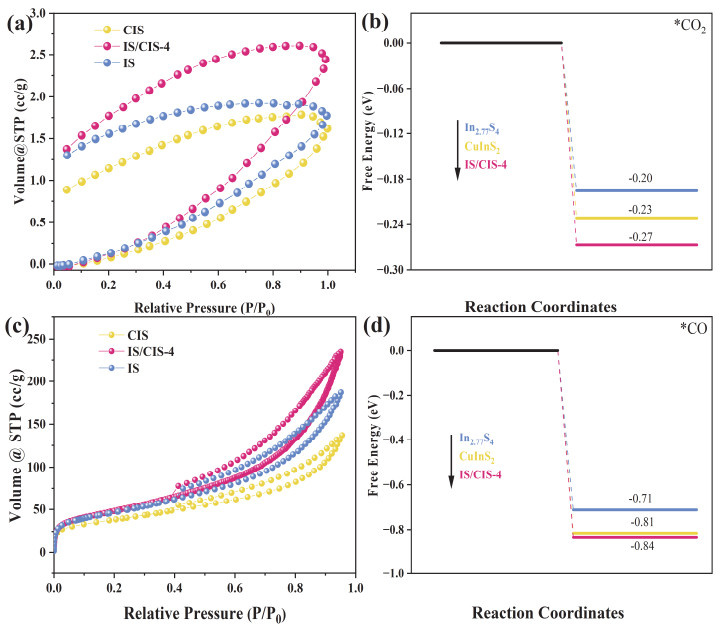
图7
"
图8
"
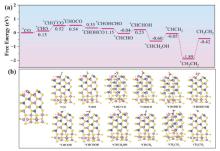
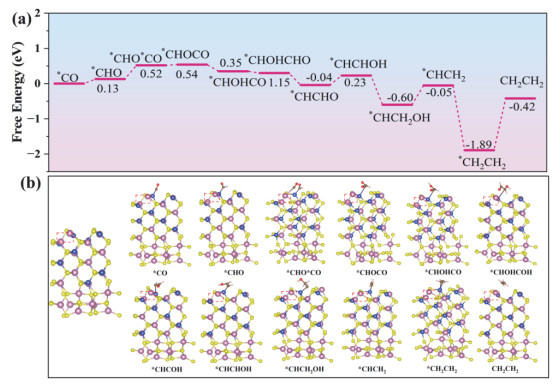
图9
"
| 1 |
M. Cai, Z. Wu, Z. Li, L. Wang, W. Sun, A. A. Tountas, C. Li, S. Wang, K. Feng, A. B. Xu, et al.. Nat. Energy 2021, 6, 807.
|
| 2 |
F. Kolahdouzan, N. Goodarzi, M. Setayeshmehr, D. S. Mousavi, A. Z. Moshfegh. Chin. J. Catal. 2025, 70, 230.
doi: 10.1021/acscatal.5c09349 |
| 3 |
D. D. Kruger, M. C. Antonino, S. Osella, F. Xu, J. Yu, A. Primo, He. Garcia. Angew. Chem. Int. Ed. 2026, 65, e23341.
doi: 10.1002/anie.8425918 |
| 4 |
Y. Chai, Y. Kong, M. Lin, W. Lin, J. Shen, J. Long, R. Yuan, W. Dai, X. Wang, Z. Zhang. Nat. Commun. 2023, 14, 6168.
doi: 10.1038/s41467-023-41943-x |
| 5 |
F. Wang, X. Li, K. Lu, M. Zhou, C. Yu, K. Yang. Chin. J. Catal. 2024, 63, 190.
doi: 10.1016/S1872-2067(24)60066-5 |
| 6 |
J. Kim, J. Y. Do, N. K. Park, S. J. Lee, J. P. Hong, M. Kang. Korean J. Chem. Eng. 2018, 35, 1089.
doi: 10.1007/s11814-018-0007-y |
| 7 |
R. Wang, M. Zhang, S. Zhang, J. Zheng, Y. Zeng, Y. Yang, J. Ding, X. Wu, Q. Zhong. ACS Nano 2023, 17, 24363.
doi: 10.1021/acsnano.3c10352 |
| 8 |
Y. Wei, J. Li, D. Zhao, Y. Zhao, Q. Zhang, L. Gu, J. Wan, D. Wang. CCS Chem. 2024, 6, 3065.
doi: 10.31635/ccschem.024.202303604 |
| 9 |
F. Fu, Y. Li. Chin. J. Catal. 2025, 78, 4.
doi: 10.1016/S1872-2067(25)64809-1 |
| 10 |
L. Zhang, J. Zhang, J. Yu. Chem 2026, 12, 102719.
doi: 10.1016/j.chempr.2025.102719 |
| 11 |
F. Xu, L. Zheng, J. Zhang, Y. He, H. Cao, X. Zheng, H. García, J. Yu. Nat. Catal. 2026, 9, 73.
doi: 10.1038/s41929-025-01471-x |
| 12 |
Y. Wu, Z. Li, Q. Chen, Z. Lou, G. Wang, J. Mao. ACS Catal. 2025, 15, 3558.
doi: 10.1021/acscatal.4c07797 |
| 13 |
Y. Yan, C. Yang, H. Wang, C. Hu, P. Yuan, L. Zhang, G. Zheng. Small 2025, 21, 2503710.
doi: 10.1002/smll.202503710 |
| 14 |
H. Yu, C. Sun, Y. Xuan, K. Zhang, K. Chang. Chem. Eng. J. 2022, 430, 132940.
doi: 10.1016/j.cej.2021.132940 |
| 15 |
R. Zhang, H. Wang, S. Tang, C. Liu, F. Dong, H. Yue, B. Liang. ACS Catal. 2018, 8, 9280.
doi: 10.1021/acscatal.8b02441 |
| 16 |
B. Rhimi, M. Zhou, Z. Yan, X. Cai, Z. Jiang. Nano-Micro Lett. 2024, 16, 64.
doi: 10.1007/s40820-023-01276-2 |
| 17 |
M. Sayed, K. Qi, X. Wu, L. Zhang, H. García, J. Yu. Chem. Soc. Rev. 2025, 54, 4874.
doi: 10.1039/D4CS01091D |
| 18 |
Y. Li, Y. Chen, Q. Wang, Y. Ye, J. Zeng, Z. Liu. Adv. Mater. 2025, 37, 2414994.
doi: 10.1002/adma.202414994 |
| 19 |
Z. Zhang, Q. Hu, J. Xie, W. Yan, J. Hu, J. Zhu, Y. Pan, W. Liu, H. Liu, X. Jiao. ACS Catal. 2025, 15, 14021.
doi: 10.1021/acscatal.5c04257 |
| 20 |
J. Wang, C. Yang, L. Mao, X. Cai, Z. Geng, H. Zhang, J. Zhang, X. Tan, J. Ye, T. Yu. Adv. Funct. Mater. 2023, 33, 2213901.
doi: 10.1002/adfm.202213901 |
| 21 |
T. Wang, L. Chen, C. Chen, M. Huang, Y. Huang, S. Liu, B. Li. ACS Nano. 2022, 16, 2306- 2318.
|
| 22 |
Y. Zhang, T. Wei, D. Ding, K. Wang, J. Di, J. C. Tseng, Y. She, M. M. J. Li, J. Xia, H. Li. ACS Catal. 2025, 15, 5614.
doi: 10.1021/acscatal.4c07545 |
| 23 |
Q. Zhou, Y. Guo, Y. Zhu. Nat. Catal. 2025, 8, 728.
doi: 10.1038/s41929-025-01369-8 |
| 24 |
X. Zhang, S. He, M. Chen, J. Li, H. J, Y. Liu. Chem. Eng. J. 2025, 525, 170555.
doi: 10.1016/j.cej.2025.170555 |
| 25 |
R. Kavitha, C. Manjunatha, J. Yu, S. G. Kumar. EnergyChem 2025, 7, 100159.
doi: 10.1016/j.enchem.2025.100159 |
| 26 |
L. Dai, H. Wang, L. Cui, Y. Liu. Renew. Energy 2025, 247, 123093.
doi: 10.1016/j.renene.2025.123093 |
| 27 |
S. He, X. Zhang, M. Chen, H. Jiang, Y. Qiu, Y. Liu, J. Jiang. Compos. Funct. Mater. 2025, 1, 20250203.
doi: 10.63823/20250203 |
| 28 |
B. Chang, X. Liu, X. Song, Y. Yang, J. Zhang, W. Zhou, P. Huo. Catalysts 2025, 15, 782.
doi: 10.3390/catal15080782 |
| 29 |
K. Lai, Y. Sun, N. Li, Y. Gao, H. Li, L. Ge, T. Ma. Adv. Funct. Mater. 2024, 34, 2409031.
doi: 10.1002/adfm.202409031 |
| 30 |
X. Zhang, W. Ni, X. Yue, Z. Wang, Z. Zhang, K. Wang, W. Dai, Xi. Fu. J. Colloid Interface Sci. 2025, 678, 233.
doi: 10.1016/j.jcis.2024.09.023 |
| 31 |
G. Tang, J. Zhang, C. Bie, X. Zheng, C. Jiang, J. Yu. Adv. Mater. 2025, 37, e14576.
doi: 10.1002/adma.202514576 |
| 32 |
B. Zhu, C. Jiang, J. Xu, Z. Zhang, J. Fu, J. Yu. Mater. Today 2025, 82, 251.
doi: 10.1016/j.mattod.2024.11.012 |
| 33 |
H. Li, Q. Shen, Z. Sun, W. Wang, J. Xue, J. Yu. ACS Catal. 2025, 5, 9717.
doi: 10.1021/acscatal.5c01732 |
| 34 |
X. Li, Y. Sun, J. Xu, Y. Shao, J. Wu, X. Xu, Y. Pan, H. Ju, J. Zhu, Y. Xie. Nat. Energy 2019, 4, 690.
doi: 10.1038/s41560-019-0431-1 |
| 35 |
Y. Nie, Y. Li, C. An, X. Tan, Z. Hu, J. Ye, T. Yu. Appl. Catal. B Environ. 2024, 345, 123704.
doi: 10.1016/j.apcatb.2024.123704 |
| 36 |
D. Xu, R. He, Z. Jiang. J. Mater. Sci. Technol. 2025, 236, 280.
doi: 10.1016/j.jmst.2025.02.040 |
| 37 |
X. Liu, Z. Jiang. Chin. J. Catal. 2025, 70, 5.
doi: 10.1016/S1872-2067(24)60223-8 |
| 38 |
K. Zhang, M. Zhou, C. Yu, K. Yang, X. Li, W. Dai, J. Guan, Q. Shu, W. Huang. Dyes Pigments 2020, 180, 108525.
doi: 10.1016/j.dyepig.2020.108525 |
| 39 |
R. Banyal, A. sudhaik, R. kumar, Sonu, P. Raizada, T. Ahamad, S. Kaya, M. M. Maslov, V. Chaudhary, C. M. Hussain, P. Singh. J. Phys. Chem. Solids 2024, 195, 112132.
doi: 10.1016/j.jpcs.2024.112132 |
| 40 |
H. Cui, J. Cao, Y. Zhao, J. Wang, S. Li, K. Ge, J. Chen, Y. Yang. Chem. Eng. J. 2024, 479, 147618.
doi: 10.1016/j.cej.2023.147618 |
| 41 |
M. A. Mahadadalkar, G. Dhakal, S. Sahoo, D. Ranjith Kumar, M. L. Baynosa, V. Q. Nguyen, M. S. Sayed, A. M. Rabie, W. K. Kim, J. J. Shim. J. Ind. Eng. Chem. 2023, 124, 402.
doi: 10.1016/j.jiec.2023.04.034 |
| 42 |
X. Deng, J. Zhang, K. Qi, G. Liang, F. Xu, J. Yu. Nat. Commun. 2024, 15, 4807.
doi: 10.1038/s41467-024-49004-7 |
| 43 |
B. Liu, J. Zhang, H. Li, B. Cheng, C. Bie. Acta Phys. Chim. Sin. 2025, 41, 100121.
doi: 10.1016/j.actphy.2025.100121 |
| 44 |
Q. Xu, L. Zhang, B. Cheng, J. Fan, J. Yu. Chem 2020, 6, 1543.
doi: 10.1016/j.chempr.2020.06.010 |
| 45 |
X. Wu, M. Sayed, G. Wang, W. Yu, B. Zhu. Adv. Mater. 2026, 38, e11322.
doi: 10.1002/adma.202511322 |
| 46 |
K. Qi, B. Cheng, M. Setayeshmehr, A. Z. Moshfegh. Chin. J. Catal. 2026, 81, 1.
doi: 10.1016/S1872-2067(25)64902-3 |
| 47 |
R. He, Di. Xu, M. Sayed. J. Materiomics 2025, 11, 100989.
doi: 10.1016/j.jmat.2024.100989 |
| 48 |
Y. Ma, S. Wang, Y. Zhang, B. Cheng, L. Zhang. J. Materiomics 2025, 11, 100978.
doi: 10.1016/j.jmat.2024.100978 |
| 49 |
J. Sun, H. Liu, S. Wang, Y. Zhang, C. Bie, L. Zhang. J. Materiomics 2025, 11, 100975.
doi: 10.1016/j.jmat.2024.100975 |
| 50 |
F. Xu, W. Mei, P. Hu, L. Zheng, J. Zhang, H. Cao, H. García, J. Yu. Angew. Chem. Int. Ed. 2025, 64, e202513364.
doi: 10.1002/anie.202513364 |
| 51 |
P. Hu, G. Liang, B. Zhu, W. Macyk, J. Yu, F. Xu. ACS Catal. 2023, 13, 12623.
doi: 10.1021/acscatal.3c03095 |
| 52 |
W. Yu. Chinese J. Catal. 2025, 73, 8.
doi: 10.1016/S1872-2067(25)60706-1 |
| 53 |
M. Li, X. Li, J. B. Ghasemi. Chin. J. Catal. 2025, 73, 12.
doi: 10.1016/S1872-2067(25)64709-7 |
| 54 |
Y. K. Zhang, L. Zhao, A. O. Terent'ev, L. N. He. J. Mater. Chem. A 2025, 13, 1407.
doi: 10.1039/D4TA07403C |
| 55 |
Y. Yang, X. Zhou, M. Gu, B. Cheng, Z. Wu, J. Zhang. Acta Phys. Chim. Sin. 2025, 41, 100064.
doi: 10.1016/j.actphy.2025.100064 |
| 56 |
S. Wang, K. Qi. J. Mater. Sci. Technol. 2025, 226, 317.
doi: 10.1016/j.jmst.2024.11.056 |
| 57 |
M. Gu, J. Zhang, I. V. Kurganskii, A. S. Poryvaev, M. V. Fedin, B. Cheng, J. Yu, L. Zhang. Adv. Mater. 2025, 37, 2414803.
doi: 10.1002/adma.202414803 |
| 58 |
C. Cheng, J. Zhang, B. Zhu, G. Liang, L. Zhang, J. Yu. Angew. Chem. Int. Ed. 2023, 62, e202218688.
doi: 10.1002/anie.202218688 |
| 59 |
R. Gao, R. Shen, C. Huang, K. Huang, G. Liang, P. Zhang, X. Li. Angew. Chem. Int. Ed. 2025, 64, e202414229.
doi: 10.1002/anie.202414229 |
| 60 |
J. Cai, B. Liu, S. Zhang, L. Wang, Z. Wu, J. Zhang, B. Cheng. J. Mater. Sci. Technol. 2024, 197, 183.
doi: 10.1016/j.jmst.2024.02.012 |
| 61 |
X. Chu, S. Liu, B. B. Luan, Y. Zhang, Y. Xi, L. H. Shao, F. M. Zhang, Y. Q. Lan. Angew. Chem. Int. Ed. 2025, 64, e202422940.
doi: 10.1002/anie.202422940 |
| 62 |
Y. Zhao, D. Wang, G. Sun, L. Wang, J. Zhang, B. Zhu. Chem. Eng. J. 2025, 518, 164759.
doi: 10.1016/j.cej.2025.164759 |
| 63 |
Y. Huo, X. Zhou, F. Zhao, C. Ai, Z. Wu, Z. Chang, B. Zhu. Acta Phys. Chim. Sin. 2025, 41, 100148.
doi: 10.1016/j.actphy.2025.100148 |
| 64 |
B. Zhu, Ji. Sun, Y. Zhao, L. Zhang, J. Yu. Adv. Mater. 2024, 36, 2310600.
doi: 10.1002/adma.202310600 |
| 65 |
F. Huang, Z. Jiao, F. Wang, Y. Liu, L. Guo. Chem. Eng. J. 2024, 495, 153560.
doi: 10.1016/j.cej.2024.153560 |
| 66 |
M. Li, Y. Liu, S. Yang, Y. Zhang, L. Wei, B. Zhu. J. Mater. Sci. Technol. 2025, 224, 245.
doi: 10.1016/j.jmst.2024.12.001 |
| 67 |
Y. Liu, M. Li, T. Liu, Z. Wu, L. Zhang. J. Mater. Sci. Technol. 2025, 233, 201.
doi: 10.1016/j.jmst.2025.03.005 |
| 68 |
K. Yan, D. Wu, T. Wang, C. Chen, S. Liu, Y. Hu, C. Gao, H. Chen, B. Li. ACS Catal. 2023, 13, 2302.
doi: 10.1021/acscatal.2c05741 |
| 69 |
J. Ding, Y. Bu, M. Ou, Y. Yu, Q. Zhong, M. Fan. Appl. Catal. B Environ. 2017, 202, 314.
doi: 10.1016/j.apcatb.2016.09.038 |
| 70 |
Z. Li, H. Dong, Z. Wu, J. Shen, D. Xu, R. He, L. Wan, S. Zhang. Appl. Surf. Sci. 2020, 529, 147162.
doi: 10.1016/j.apsusc.2020.147162 |
| 71 |
Z. Chen, A. Savateev, S. Pronkin, V. Papaefthimiou, C. Wolff, M. G. Willinger, E. Willinger, D. Neher, M. Antonietti, D. Dontsova. Adv. Mater. 2017, 29, 1700555.
doi: 10.1002/adma.201700555 |
| 72 |
Z. Li, Z. Wu, R. He, L. Wan, S. Zhang. J. Mater. Sci. Technol. 2020, 56, 151.
doi: 10.1016/j.jmst.2020.02.061 |
| 73 |
F. Xu, F. Zhao, X. Deng, J. Zhang, J. Zhang, C. Ai, J. Yu, H. García. Nat. Commun. 2025, 16, 6882.
doi: 10.1038/s41467-025-60961-5 |
| 74 |
F. Xu, Y. He, J. Zhang, G. Liang, C. Liu, J. Yu. Angew. Chem. Int. Ed. 2025, 64, e202414672.
doi: 10.1002/anie.202414672 |
| 75 |
K. Wang, R. Zhang, B. Zhou, Q. Li, M. Zhou, H. M. Shen, Q. Wang, J. Xia, H. Li, Q. Yi, Y. She. J. Colloid Interface Sci. 2025, 677, 872.
doi: 10.1016/j.jcis.2024.08.114 |
| 76 |
W. Xie, K. Li, X. H. Liu, X. Zhang, H. Huang. Adv. Mater. 2023, 35, 2208132.
doi: 10.1002/adma.202208132 |
| 77 |
W. Gao, L. Shi, W. Hou, C. Ding, Q. Liu, R. Long, H. Chi, Y. Zhang, X. Xu, X. Ma, et al.. Angew. Chem. Int. Ed. 2024, 63, e202317852.
doi: 10.1002/anie.202317852 |
| 78 |
P. Fu, C. Chen, C. Wu, B. Meng, Q. Yue, T. Chen, W. Yin, X. Chi, X. Yu, R. Li, et al.. Angew. Chem. Int. Ed. 2025, 64, e202415202.
doi: 10.1002/anie.202415202 |
| [1] | 陈丽珊, 李雪梅, 徐向菊, 董幼青, 徐全龙. MA3Bi2Br9/g-C3N4 0D/2D S型异质结用于选择性光催化氧化甲苯[J]. 物理化学学报, 2026, 42(9): 100258 - . |
| [2] | 殷鸿飞, 洪梦玲, 张锦阳, 王文涛, 陈伟, 吴国志. 氧空位介导的2D/2D Bi2MoO6/Bi2O2S S型异质结用于高效CO2光还原[J]. 物理化学学报, 2026, 42(9): 100332 - . |
| [3] | 许凯强, 于佳, 夏伟, 张建军, 韩生. 范德华S型异质结赋予快速电荷转移助力光催化活性提升[J]. 物理化学学报, 2026, 42(7): 100211 - . |
| [4] | 袁成成, 夏伟, 王骏, 朱潇锋, 张勇, 朱必成, 余家国. 双功能单原子修饰SnS2/CdS S型光催化剂用于协同产氢与乳酸氧化的DFT研究[J]. 物理化学学报, 2026, 42(6): 100244 - . |
| [5] | 程强, 李静萍, 柯振东, 李嘉明, 王楷. 无机/有机S型异质结构建及高级氧化技术协同光热降解抗生素研究[J]. 物理化学学报, 2026, 42(5): 100187 - . |
| [6] | 孟奥运, 李振华, 熊国远, 李真, 张金锋. S型异质结Al6Si2O13/BiOBr通过增强电荷转移效应实现高效稳定光催化降解三唑磷和敌敌畏农药[J]. 物理化学学报, 2026, 42(5): 100186 - . |
| [7] | 邱艳平, 张佳桐, 李林萍, 高旸钦, 李宁, 戈磊. MOF衍生的g-C3N4/ZnIn2S4 S型异质结:界面工程增强光催化NO转化[J]. 物理化学学报, 2026, 42(4): 100175 - . |
| [8] | 郭杰, 薛丽君, 宋发辉, 李程鹏, 陈卓, 温丽丽. 双内建电场驱动的D-A COFs/ZnIn2S4 S型异质结加速电荷分离实现纯水中高效光合成H2O2[J]. 物理化学学报, 2026, 42(4): 100177 - . |
| [9] | 李振, 张素娟, 王中辽, 张金锋, 陈高礼, 陈士夫. S型CdS/MnO2异质结的合理构建用于高附加值甲苯光热协同催化选择性氧化[J]. 物理化学学报, 2026, 42(4): 100179 - . |
| [10] | 朱文君, 艾陈斌, 许凯强, 周亚太, 张锡东, 张勇. WO3@TP无机@有机S型光催化剂用于促进产H2O2[J]. 物理化学学报, 2026, 42(3): 100184 - . |
| [11] | 周玲, 李龙, 黄礼文, 吴艳. 通过间接两电子还原的HOF/BiVO4 (010) S型光催化剂增强H2O2生产性能[J]. 物理化学学报, 2026, 42(3): 100172 - . |
| [12] | 骆泽, 朱玉坤, 罗雅丹, 任广敏, 王永红, 唐华. S型异质结In2O3/ZnIn2S4光催化5-羟甲基糠醛选择性氧化耦合产氢[J]. 物理化学学报, 2026, 42(3): 100166 - . |
| [13] | 吕宪伟, 丁信元, 龚家兴, 闫旭焕, 黄大勇, 耿建新, 袁忠勇. 轨道杂化在光催化与电催化中的研究进展[J]. 物理化学学报, 2026, 42(2): 100151 - . |
| [14] | 樊凡, 修浩, 王宇婷, 崔永朋, 王雅君. NH2-MIL-125/Na掺杂g-C3N4复合S型异质结的构建及其光催化产过氧化氢性能[J]. 物理化学学报, 2026, 42(2): 100143 - . |
| [15] | 葛成艳, 胡佳伟, 刘星雨, 宋玉玺, 刘超, 邹志刚. 自集成黑色NiO团簇与ZnIn2S4微球实现S型电子转移机制下光热辅助制氢[J]. 物理化学学报, 2026, 42(1): 100154 - . |
|
||