物理化学学报 >> 2026, Vol. 42 >> Issue (7): 100225.doi: 10.1016/j.actphy.2025.100225
金属有机框架(2014–2024):追求卓越性能的十年
彭日1,†, 谢雨欣1,†, 袁帅2, 沈如伟1, 朱敦如1,2,*( )
)
- 1 南京工业大学化工学院, 材料化学工程全国重点实验室, 江苏 南京 211816
2 南京大学, 配位化学全国重点实验室, 江苏 南京 210023
-
收稿日期:2025-09-22修回日期:2025-11-23录用日期:2025-11-26发布日期:2026-05-22 -
通讯作者:Email: zhudr@njtech.edu.cn (朱敦如) -
作者简介:†这些作者对这项工作做出了同等贡献
Metal-Organic Frameworks (2014–2024): A decade pursuit for top performance
Ri Peng1, Yuxin Xie1, Shuai Yuan2, Ruwei Shen1, Dunru Zhu1,2,*()
- 1 State Key Laboratory of Materials-Oriented Chemical Engineering, College of Chemical Engineering, Nanjing Tech University, Nanjing 211816, Jiangsu Province, China
2 State Key Laboratory of Coordination Chemistry, Nanjing University, Nanjing 210023, Jiangsu Province, China
-
Received:2025-09-22Revised:2025-11-23Accepted:2025-11-26Published:2026-05-22 -
Contact:Email: zhudr@njtech.edu.cn (Dunru Zhu)

摘要:
2025年诺贝尔化学奖授予S. Kitagawa、R. Robson和O. M. Yaghi,以表彰他们在金属有机框架(Metal-Organic Frameworks,MOFs)开发方面的成就。作为21世纪的明星材料,MOFs因其巨大的比表面积、纳米级孔道以及多样的拓扑结构,在众多领域得以应用。作为最先进的多孔材料,MOFs的应用不再局限于气体吸附、分离和催化等传统领域,在大气集水、病原体检测和海水提铀等新兴领域也展现出广阔的应用前景。2013年,Yaghi在Science上发表了一篇有关MOFs最佳性能的重要综述。但从那以后,MOFs的性能又取得了重大突破。通过网状化学原理指导无机阳离子(节点)与有机配体(连接体)的组装,可以构筑混合组分的MOFs,使单组分MOFs优异性能的协同组合得以实现。将人工智能技术引入MOFs领域,能够为科学家们提供更多的机会,以快速设计和制造具有定制性能的新型MOFs。此外,基于反向MOFs设计策略(带负电荷的节点和带正电荷的配体)合成的新型多孔等网状non-MOFs材料将为MOFs材料开辟一个新的研究热点。
引用本文
彭日, 谢雨欣, 袁帅, 沈如伟, 朱敦如. 金属有机框架(2014–2024):追求卓越性能的十年[J]. 物理化学学报, 2026, 42(7), 100225. doi: 10.1016/j.actphy.2025.100225
Ri Peng, Yuxin Xie, Shuai Yuan, Ruwei Shen, Dunru Zhu. Metal-Organic Frameworks (2014–2024): A decade pursuit for top performance[J]. Acta Phys. -Chim. Sin. 2026, 42(7), 100225. doi: 10.1016/j.actphy.2025.100225
图1
"
图2
"
表1
"
| Property or application | MOF | Achieved value | Refs. |
| Highest reported value | |||
| BET surface area a | NU-1501-Al b | 7310 m2 g−1 | [ |
| Cage size | MOF-939 | 11.4 nm | [ |
| Unit cell volume | NU-1301 | 5201294 Å3 | [ |
| Unit cell length | SC-MOF-6 c | 266.21 Å | [ |
| Thermal stability | MAF-stu-1 d | 680 ℃ | [ |
| Chemical stability | Cr-btec-tpt e | pH: −1.1~15 | [ |
| Volumetric H2 uptake (298 K/100 bar) | [Ni2(4,6-m-DOT)] | 11.9 g L−1 | [ |
| Usable H2 capacity (298 K/100 bar) | [Ni2(4,6-m-DOT)] | 11.0 g L−1 | [ |
| Gravimetric H2 uptake (296 K/100 bar) | NU-1501-Al | 2.9 wt% | [ |
| Usable CH4 capacity (298 K/65 bar) | [Co(bdp)] f | 197 cm3 cm−3 | [ |
| Gravimetric CH4 uptake (296 K/100 bar) | NU-1501-Al | 0.54 g g−1 | [ |
| Gravimetric NH3 uptake (298 K/1 bar) | LiCl@MIL-53-(OH)2 g | 0.58 g g−1 | [ |
| Volumetric NH3 uptake (298 K/1 bar) | LiCl@MIL-53-(OH)2 | 0.80 g cm−3 | [ |
| Gravimetric CO2 uptake (273 K/1 bar) | CPM-231 h | 0.46 g g−1 | [ |
| Proton conductivity (−40 ℃) | H2SO4@MIL-101-SO3H | 9.2 × 10⁻³ S cm−1 | [ |
| Proton conductivity (90 ℃/90% RH) i | LiCl@UiO-66-F2-(SO3H)2 j | 2.86 S cm−1 | [ |
| Gravimetric water uptake (RT/70% RH) k | Cr-soc-MOF-1 | 1.95 g g−1 | [ |
| Lowest reported value | |||
| Density | NU-1301 | 0.124 g cm−3 | [ |
图3
"
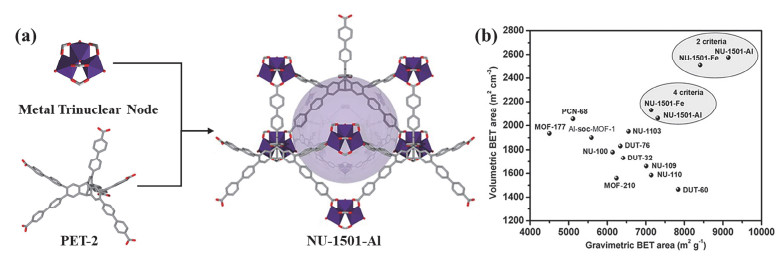
图4
"
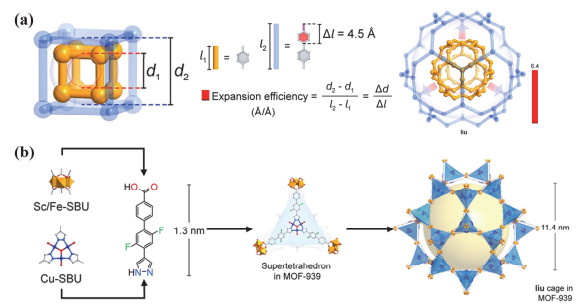
图5
"
图6
"
图7
"
图8
"
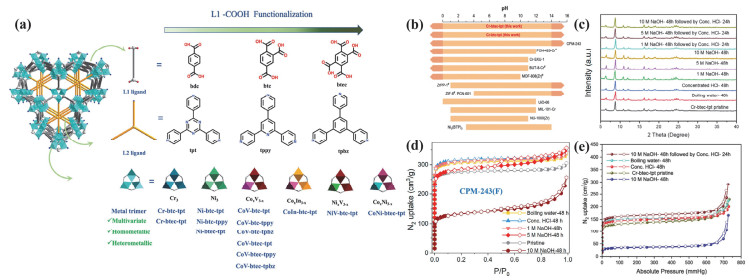
图9
"
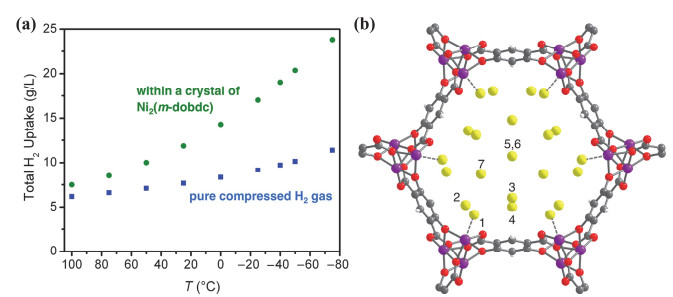
图10
"
图11
"
图12
"
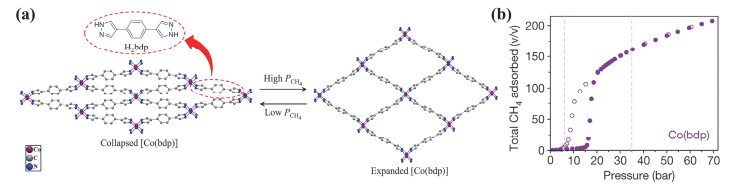
图13
"
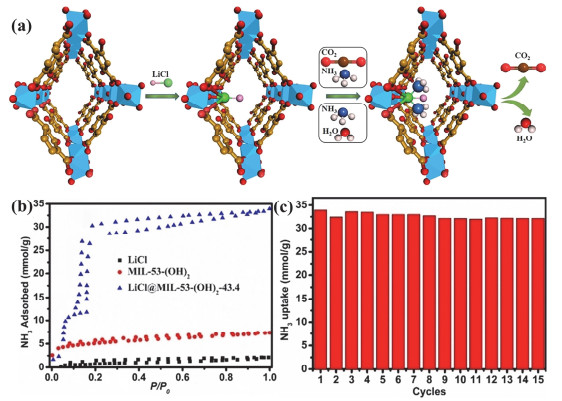
图14
"
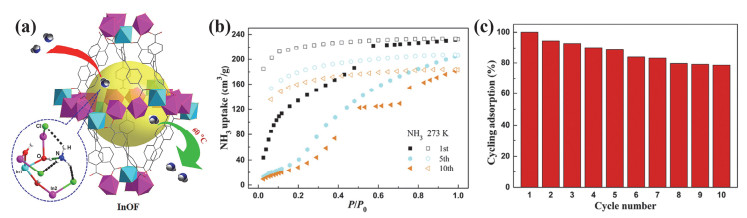
图15
"
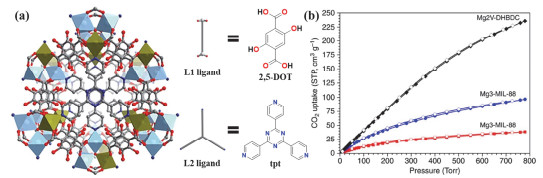
图16
"
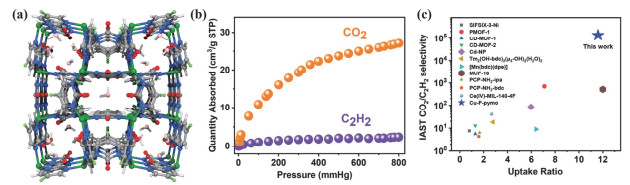
图17
"
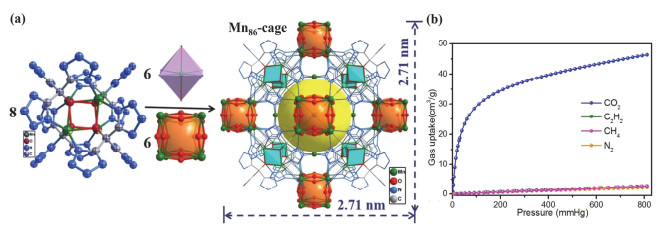
图18
"
图19
"
图20
"
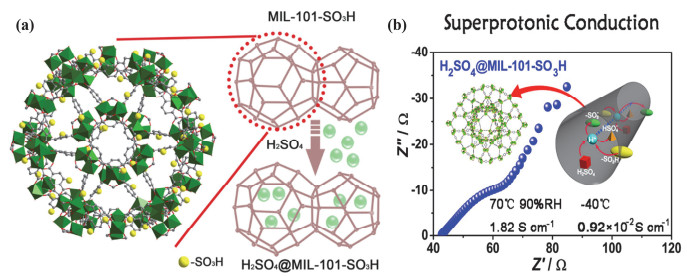
图21
"
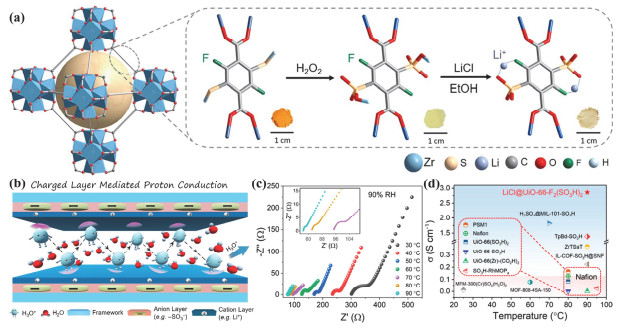
图22
"
图23
"
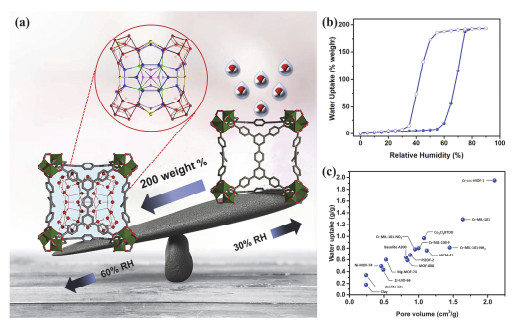
图24
"
图25
"
图26
"
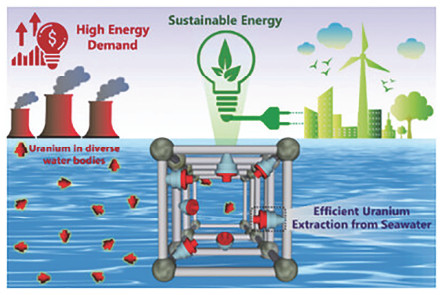
图27
"
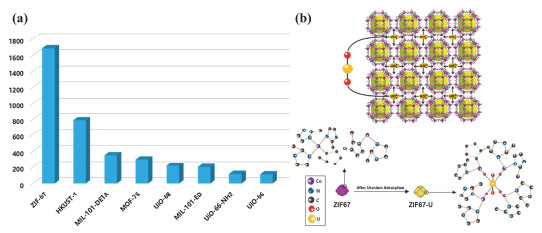
图28
"
图29
"
图30
"
图31
"
| 1 |
O. M. Yaghi, G. Li, H. Li. Nature 1995, 378, 703.
doi: 10.1038/378703a0 |
| 2 |
H. Li, M. Eddaoudi, M. O'Keeffe, O. M. Yaghi. Nature 1999, 402, 276.
doi: 10.1038/46248 |
| 3 |
B. F. Hoskins, R. Robson. J. Am. Chem. Soc. 1989, 111, 5962.
doi: 10.1021/ja00197a079 |
| 4 |
M. Kondo, T. Yoshitomi, K. Seki, H. Matsuzaka, S. Kitagawa. Angew. Chem. Int. Ed. Engl. 1997, 36, 1725.
doi: 10.1002/anie.199717251 |
| 5 |
H. Furukawa, K. E. Cordova, M. O'Keeffe, O. M. Yaghi. Science 2013, 341, 1230444.
doi: 10.1126/science.1230444 |
| 6 |
B. Li, H.-M. Wen, Y. J. Cui, W. Zhou, G. D. Qian, B. L. Chen. Adv. Mater. 2016, 28, 8819.
doi: 10.1002/adma.201601133 |
| 7 |
M. Yang, Y. Xie, D. Zhu. Prog. Chem. 2023, 35, 683.
doi: 10.7536/PC221112 |
| 8 |
J. Wang, Y. Zhang, Y. Su, X. Liu, P. Zhang, R.-B. Lin, S. Chen, Q. Deng, Z. Zeng, S. Deng, et al.. Nat. Commun. 2022, 13, 200.
|
| 9 |
S. Zhang, Y. Xie, R. J. Somerville, F. F. Tirani, R. Scopelliti, Z. Fei, D. Zhu, P. J. Dyson. Small 2023, 19, 2206999.
doi: 10.1002/smll.202206999 |
| 10 |
J. D. Pang, Z. Q. Zhang, S. T. Zhang, X. Y. Guo, Q. Chen, X.-W. Zhang, H.-L. Zhou, W. Gong, S. S. A. Shah, C. L. Zhong, et al.. Sci. China Chem. 2025, 68, 1230.
doi: 10.1007/s11426-024-2457-y |
| 11 |
J. D. Pang, W. T. Jiang, X.-W. Zhang, H.-L. Zhou, Y. X. Sun, W. Gong, B. Wang, F. Y. Ma, L. W. He, L. Chen, et al.. Sci. China Chem. 2025, 68, 1642.
doi: 10.1007/s11426-024-2458-3 |
| 12 |
Z. J. Chen, P. H. Li, R. Anderson, X. J. Wang, X. Zhang, L. Robison, L. R. Redfern, S. Moribe, T. Islamoglu, D. A. Gómez-Gualdrón, et al.. Science 2020, 368, 297.
doi: 10.1126/science.aaz8881 |
| 13 |
G. Hu, Q. Liu, Y. Zhou, W. Yan, Y. Sun, S. Peng, C. Zhao, X. Zhou, H. Deng. J. Am. Chem. Soc. 2023, 145, 13181.
doi: 10.1021/jacs.3c02128 |
| 14 |
P. Li, N. A. Vermeulen, C. D. Malliakas, D. A. Gómez-Gualdrón, A. J. Howarth, B. L. Mehdi, A. Dohnalkova, N. D. Browning, M. O'Keeffe, O. K. Farha. Science 2017, 356, 624.
doi: 10.1126/science.aam7851 |
| 15 |
J. Yuan, M. Yang, B. Yang, S. Chen, Z. Liu, Q. Pang, M. Wan, A. Zheng, B. Tu. Nat. Chem. 2025, 17, 421.
doi: 10.1038/s41557-024-01717-4 |
| 16 |
Z.-S. Wang, M. Li, Y.-L. Peng, Z. Zhang, W. Chen, X.-C. Huang. Angew. Chem. Int. Ed. 2019, 58, 16071.
doi: 10.1002/anie.201909046 |
| 17 |
P. Ajayan, W. Wang, Y. Chen, X. Bu, P. Feng. Adv. Mater. 2024, 36, 2408042.
doi: 10.1002/adma.202408042 |
| 18 |
M. T. Kapelewski, T. Runcěvski, J. D. Tarver, H. Z. H. Jiang, K. E. Hurst, P. A. Parilla, A. Ayala, T. Gennett, S. A. FitzGerald, C. M. Brown, et al.. Chem. Mater. 2018, 30, 8179.
doi: 10.1021/acs.chemmater.8b03276 |
| 19 |
J. A. Mason, J. Oktawiec, M. K. Taylor, M. R. Hudson, J. Rodriguez, J. E. Bachman, M. I. Gonzalez, A. Cervellino, A. Guagliardi, C. M. Brown, et al.. Nature 2015, 527, 357.
doi: 10.1038/nature15732 |
| 20 |
Y. Shi, Z. Wang, Z. Li, H. Wang, D. Xiong, J. Qiu, X. Tian, G. Feng, J. Wang. Angew. Chem. Int. Ed. 2022, 61, e202212032.
doi: 10.1002/anie.202212032 |
| 21 |
Q.-G. Zhai, X. Bu, C. Mao, X. Zhao, L. Daemen, Y. Cheng, A. J. Ramirez-Cuesta, P. Feng. Nat. Commun. 2016, 7, 13645.
doi: 10.1038/ncomms13645 |
| 22 |
X.-M. Li, L.-Z. Dong, S.-L. Li, G. Xu, J. Liu, F.-M. Zhang, L.-S. Lu, Y.-Q. Lan. ACS Energy Lett. 2017, 2, 2313.
doi: 10.1021/acsenergylett.7b00560 |
| 23 |
S.-L. Zheng, C.-M. Wu, L.-H. Chung, H.-Q. Zhou, J. Hu, Z. Liu, Y. Wu, L. Yu, J. He. ACS Energy Lett. 2023, 8, 3095.
doi: 10.1021/acsenergylett.3c00780 |
| 24 |
S. M. T. Abtab, D. Alezi, P. M. Bhatt, A. Shkurenko, Y. Belmabkhout, H. Aggarwal, Ł. J. Weseliński, N. Alsadun, U. Samin, M. N. Hedhili, et al.. Chem 2018, 4, 94.
doi: 10.1016/j.chempr.2017.11.005 |
| 25 |
H. Furukawa, N. Ko, Y. B. Go, N. Aratani, S. B. Choi, E. Choi, A. Ö. Yazaydin, R. Q. Snurr, M. O'Keeffe, J. Kim, et al.. Science 2010, 329, 424.
doi: 10.1126/science.1192160 |
| 26 |
H.-L. Jiang, T. A. Makal, H.-C. Zhou. Coord. Chem. Rev. 2013, 257, 2232.
doi: 10.1016/j.ccr.2013.03.017 |
| 27 |
J. J. Yang, Y.-B. Zhang, Q. Liu, C. A. Trickett, E. Gutierrez-Puebla, M. Á. Monge, H. J. Cong, A. Aldossary, H. X. Deng, O. M. Yaghi. J. Am. Chem. Soc. 2017, 139, 6448.
doi: 10.1021/jacs.7b02272 |
| 28 |
Q. Liu, Y. Song, Y. Ma, Y. Zhou, H. Cong, C. Wang, J. Wu, G. Hu, M. O'Keeffe, H. Deng. J. Am. Chem. Soc. 2019, 141, 488.
doi: 10.1021/jacs.8b11230 |
| 29 |
X. Gong, Y. Shu, Z. Jiang, L. Lu, X. Xu, C. Wang, H. Deng. Angew. Chem. Int. Ed. 2020, 59, 5326.
doi: 10.1002/anie.201915537 |
| 30 |
G. Hu, Q. Liu, H. Deng. Acc. Chem. Res. 2025, 58, 73.
doi: 10.1021/acs.accounts.4c00633 |
| 31 |
D. Feng, Z.-Y. Gu, J.-R. Li, H.-L. Jiang, Z. Wei, H.-C. Zhou. Angew. Chem. Int. Ed. 2012, 51, 10307.
doi: 10.1002/anie.201204475 |
| 32 |
K. Wang, X.-L. Lv, D. Feng, J. Li, S. Chen, J. Sun, L. Song, Y. Xie, J.-R. Li, H.-C. Zhou. J. Am. Chem. Soc. 2016, 138, 914.
doi: 10.1021/jacs.5b10881 |
| 33 |
H. Yang, F. Peng, A. N. Hong, Y. Wang, X. Bu, P. Feng. J. Am. Chem. Soc. 2021, 143, 14470.
doi: 10.1021/jacs.1c07277 |
| 34 |
W. Fan, X. Zhang, Z. Kang, X. Liu, D. Sun. Coord. Chem. Rev. 2021, 440, 213968.
doi: 10.1016/j.ccr.2021.213968 |
| 35 |
A. Ahmed, Y. Liu, J. Purewal, L. D. Tran, A. G. Wong-Foy, M. Veenstra, A. J. Matzger, D. J. Siegel. Energy Environ. Sci. 2017, 10, 2459.
doi: 10.1039/c7ee02477k |
| 36 |
Z. J. Chen, K. O. Kirlikovali, K. B. Idrees, M. C. Wasson, O. K. Farha. Chem 2022, 8, 693.
doi: 10.1016/j.chempr.2022.01.012 |
| 37 |
X. Zhang, R.-B. Lin, J. Wang, B. Wang, B. Liang, T. Yildirim, J. Zhang, W. Zhou, B. Chen. Adv. Mater. 2020, 32, 1907995.
doi: 10.1002/adma.201907995 |
| 38 |
X. Zhang, X. Zhang, J. A. Johnson, Y.-S. Chen, J. Zhang. J. Am. Chem. Soc. 2016, 138, 8380.
doi: 10.1021/jacs.6b04608 |
| 39 |
A. Schoedel, Z. Ji, O. M. Yaghi. Nat. Energy 2016, 1, 16034.
doi: 10.1038/nenergy.2016.34 |
| 40 |
S. S.-Y. Chui, S. M.-F. Lo, J. P. H. Charmant, A. G. Orpen, I. D. Williams. Science 1999, 283, 1148.
doi: 10.1126/science.283.5405.1148 |
| 41 |
Y. Peng, V. Krungleviciute, I. Eryazici, J. T. Hupp, O. K. Farha, T. Yildirim. J. Am. Chem. Soc. 2013, 135, 11887.
doi: 10.1021/ja4045289 |
| 42 |
F. Gándara, H. Furukawa, S. Lee, O. M. Yaghi. J. Am. Chem. Soc. 2014, 136, 5271.
doi: 10.1021/ja501606h |
| 43 |
X. He, S. Gao, R. Peng, D. Zhu, F. Yu. J. Mater. Chem. A 2024, 12, 14501.
doi: 10.1039/d4ta02447h |
| 44 |
D. W. Kim, D. W. Kang, M. Kang, J.-H. Lee, J. H. Choe, Y. S. Chae, D. S. Choi, H. Yun, C. S. Hong. Angew. Chem. Int. Ed. 2020, 59, 22531.
doi: 10.1002/anie.202012552 |
| 45 |
B. E. R. Snyder, A. B. Turkiewicz, H. Furukawa, M. V. Paley, E. O. Velasquez, M. N. Dods, J. R. Long. Nature 2023, 613, 287.
doi: 10.1038/s41586-022-05409-2 |
| 46 |
Y. Chen, F. Zhang, Y. Wang, C. Yang, J. Yang, J. Li. Micropor. Mesopor. Mat. 2018, 258, 170.
doi: 10.1016/j.micromeso.2017.09.013 |
| 47 |
D. W. Kim, D. W. Kang, M. Kang, D. S. Choi, H. Yun, S. Y. Kim, S. M. Lee, J. H. Lee, C. S. Hong. J. Am. Chem. Soc. 2022, 144, 9672.
doi: 10.1021/jacs.2c01117 |
| 48 |
Y.-L. Xu, Q. Gao, M. Zhao, H.-J. Zhang, Y.-H. Zhang, Z. Chang. Chin. Chem. Lett. 2017, 28, 55.
doi: 10.1016/j.cclet.2016.06.006 |
| 49 |
P. Nugent, Y. Belmabkhout, S. D. Burd, A. J. Cairns, R. Luebke, K. Forrest, T. Pham, S. Ma, B. Space, L. Wojtas, et al.. Nature 2013, 495, 80.
doi: 10.1038/nature11893 |
| 50 |
F. Xiang, L. Li, Z. Yuan, W. Wei, X. Zheng, S. Chen, Y. Yang, L. Chen, Z. Yao, J. Fu, et al.. Chin. Chem. Lett. 2025, 36, 109672.
doi: 10.1016/j.cclet.2024.109672 |
| 51 |
Y. Shi, Y. Xie, H. Cui, Y. Ye, H. Wu, W. Zhou, H. Arman, R.-B. Lin, B. Chen. Adv. Mater. 2021, 33, 2105880.
doi: 10.1002/adma.202105880 |
| 52 |
S. Geng, H. Xu, C.-S. Cao, T. Pham, B. Zhao, Z. Zhang. Angew. Chem. Int. Ed. 2023, 62, e202305390.
doi: 10.1002/anie.202305390 |
| 53 |
Z. Sharifzadeh, A. Morsali. Coord. Chem. Rev. 2022, 459, 214445.
doi: 10.1016/j.ccr.2022.214445 |
| 54 |
J. A. Mason, K. Sumida, Z. R. Herm, R. Krishna, J. R. Long. Energy Environ. Sci. 2011, 4, 3030.
doi: 10.1039/c1ee01720a |
| 55 |
A. Lee, G. Xiao, P. Xiao, K. Joshi, R. Singh, P. A. Webley. Energy Procedia 2011, 4, 1199.
doi: 10.1016/j.egypro.2011.01.174 |
| 56 |
R. C. Rohde, K. M. Carsch, M. N. Dods, H. Z. H. Jiang, A. R. McIsaac, R. A. Klein, H. Kwon, S. L. Karstens, Y. Wang, A. J. Huang, et al.. Science 2024, 386, 814.
doi: 10.1126/science.adk5697 |
| 57 |
H. Fang, J. Jiang, D. Wang, X. Liu, D. Zhu, Y. Li. Acta Phys.-Chim. Sin. 2023, 39, 2305030.
doi: 10.3866/PKU.WHXB202305030 |
| 58 |
K.-J. Chen, H. S. Scott, D. G. Madden, T. Pham, A. Kumar, A. Bajpai, M. Lusi, K. A. Forrest, B. Space, J. J. Perry IV, et al.. Chem 2016, 1, 753.
doi: 10.1016/j.chempr.2016.10.009 |
| 59 |
X. Cui, K. Chen, H. Xing, Q. Yang, R. Krishna, Z. Bao, H. Wu, W. Zhou, X. Dong, Y. Han, et al.. Science 2016, 353, 141.
doi: 10.1126/science.aaf2458 |
| 60 |
B. Li, X. Cui, D. O'Nolan, H.-M. Wen, M. Jiang, R. Krishna, H. Wu, R.-B. Lin, Y.-S. Chen, D. Yuan, et al.. Adv. Mater. 2017, 29, 1704210.
doi: 10.1002/adma.201704210 |
| 61 |
X.-W. Gu, E. Wu, J.-X. Wang, H.-M. Wen, B. Chen, B. Li, G. Qian. Sci. Adv. 2023, 9, eadh0135.
doi: 10.1126/sciadv.adh0135 |
| 62 |
K. Jiao, J. Xuan, Q. Du, Z. Bao, B. Xie, B. Wang, Y. Zhao, L. Fan, H. Wang, Z. Hou, et al.. Nature 2021, 595, 361.
doi: 10.1038/s41586-021-03482-7 |
| 63 |
X. Wang, T. Qin, S.-S. Bao, Y.-C. Zhang, X. Shen, L.-M. Zheng, D. Zhu. J. Mater. Chem. A 2016, 4, 16484.
doi: 10.1039/c6ta06792a |
| 64 |
X.-X. Xie, Y.-C. Yang, B.-H. Dou, Z.-F. Li, G. Li. Coord. Chem. Rev. 2020, 403, 213100.
doi: 10.1016/j.ccr.2019.213100 |
| 65 |
S. C. Pal, M. C. Das. Adv. Funct. Mater. 2021, 31, 2101584.
doi: 10.1002/adfm.202101584 |
| 66 |
J. Yang, S. Zhang, Z. Feng, Y. Cao, D.-R. Zhu. Dalton Trans. 2021, 50, 11975.
doi: 10.1039/d1dt02116h |
| 67 |
S. Zhang, Y. Xie, M. Yang, D. Zhu. Inorg. Chem. Front. 2022, 9, 1134.
doi: 10.1039/d1qi01610e |
| 68 |
Y.-P. Qu, Q. Zou, S.-S. Bao, L.-M. Zheng. Chin. Chem. Lett. 2024, 35, 108320.
doi: 10.1016/j.cclet.2023.108320 |
| 69 |
H. Furukawa, F. Gándara, Y.-B. Zhang, J. Jiang, W. L. Queen, M. R. Hudson, O. M. Yaghi. J. Am. Chem. Soc. 2014, 136, 4369.
doi: 10.1021/ja500330a |
| 70 |
H. Kim, S. Yang, S. R. Rao, S. Narayanan, E. A. Kapustin, H. Furukawa, A. S. Umans, O. M. Yaghi, E. N. Wang. Science 2017, 356, 430.
doi: 10.1126/science.aam8743 |
| 71 |
H. Kim, S. R. Rao, E. A. Kapustin, L. Zhao, S. Yang, O. M. Yaghi, E. N. Wang. Nat. Commun. 2018, 9, 1191.
doi: 10.1038/s41467-018-03162-7 |
| 72 |
M. J. Kalmutzki, C. S. Diercks, O. M. Yaghi. Adv. Mater. 2018, 30, 1704304.
doi: 10.1002/adma.201704304 |
| 73 |
F. Fathieh, M. J. Kalmutzki, E. A. Kapustin, P. J. Waller, J. J. Yang, O. M. Yaghi. Sci. Adv. 2018, 4, eaat3198.
doi: 10.1126/sciadv.aat3198 |
| 74 |
N. Hanikel, M. S. Prévot, F. Fathieh, E. A. Kapustin, H. Lyu, H. Wang, N. J. Diercks, T. G. Glover, O. M. Yaghi. ACS Cent. Sci. 2019, 5, 1699.
doi: 10.1021/acscentsci.9b00745 |
| 75 |
N. Hanikel, M. S. Prévot, O. M. Yaghi. Nat. Nanotechnol. 2020, 15, 348.
doi: 10.1038/s41565-020-0673-x |
| 76 |
Y. Tao, Q. Wu, C. Huang, W. Su, Y. Ying, D. Zhu, H. Li. ACS Appl. Mater. Interfaces 2022, 14, 10966.
doi: 10.1021/acsami.1c23644 |
| 77 |
Y. Tao, Q. Wu, C. Huang, D. Zhu, H. Li. Chem. Eng. J. 2023, 451, 138547.
doi: 10.1016/j.cej.2022.138547 |
| 78 |
Y. Tao, J. Sun, Q. Wu, D. Zhu, H. Li. Chem. Eng. J. 2023, 461, 141864.
doi: 10.1016/j.cej.2023.141864 |
| 79 |
H. Y. Lin, Y. H. Yang, Y.-C. Hsu, J. Q. Zhang, C. Welton, I. Afolabi, M. Loo, H.-C. Zhou. Adv. Mater. 2024, 36, e2209073.
doi: 10.1002/adma.202209073 |
| 80 |
H.-Y. Li, X.-J. Kong, S.-D. Han, J. Pang, T. He, G.-M. Wang, X.-H. Bu. Chem. Soc. Rev. 2024, 53, 5626.
doi: 10.1039/d3cs00873h |
| 81 |
Y. Wang, Y. Hu, Q. He, J. Yan, H. Xiong, N. Wen, S. Cai, D. Peng, Y. Liu, Z. Liu. Biosens. Bioelectron. 2020, 169, 112604.
doi: 10.1016/j.bios.2020.112604 |
| 82 |
K. Chattopadhyay, M. Mandal, D. K. Maiti. ACS Appl. Bio Mater. 2021, 4, 8159.
doi: 10.1021/acsabm.1c00982 |
| 83 |
J. Huang, W. Q. Li, X. K. Bai, F. B. Xiao, H. Y. Xu. Coord. Chem. Rev. 2023, 488, 215160.
doi: 10.1016/j.ccr.2023.215160 |
| 84 |
Q. Yang, J. Deng, D. Zhu, F. Yu, Y.-X. Li, J. Chauvin, X.-J. Zhang, S. Cosnier, D. Shan. Adv. Funct. Mater. 2025, 35, e25510.
doi: 10.1002/adfm.202525510 |
| 85 |
F. Yin, E. Yang, X. Ge, Q. Sun, F. Mo, G. Wu, Y. Shen. Chin. Chem. Lett. 2024, 35, 108753.
doi: 10.1016/j.cclet.2023.108753 |
| 86 |
C. Huang, Y. Wang, X. Li, L. Ren, J. Zhao, Y. Hu, L. Zhang, G. Fan, J. Xu, X. Gu, et al.. Lancet 2020, 395, 497.
doi: 10.1016/S0140-6736(20)30183-5 |
| 87 |
L. J. Carter, L. V. Garner, J. W. Smoot, Y. Li, Q. Zhou, C. J. Saveson, J. M. Sasso, A. C. Gregg, D. J. Soares, T. R. Beskid, et al.. ACS Cent. Sci. 2020, 6, 591.
doi: 10.1021/acscentsci.0c00501 |
| 88 |
C. Ma, Y. Cao, X. Gou, J.-J. Zhu, Anal.. Chem. 2020, 92, 431.
doi: 10.1021/acs.analchem.9b04947 |
| 89 |
Y.-X. Li, J. Li, D. Zhu, J.-Z. Wang, G.-F. Shu, J. Li, S.-L. Zhang, X.-J. Zhang, S. Cosnier, H.-B. Zeng, et al.. Adv. Funct. Mater. 2022, 32, 2209743.
doi: 10.1002/adfm.202209743 |
| 90 |
Z. Fan, B. Yao, Y. Ding, D. Xu, J. Zhao, K. Zhang. Chem. Eng. J. 2022, 427, 131686.
doi: 10.1016/j.cej.2021.131686 |
| 91 |
N. Kaltsoyannis, S. T. Liddle. Chem 2016, 1, 659.
doi: 10.1016/j.chempr.2016.10.003 |
| 92 |
D. S. Sholl, R. P. Lively. Nature 2016, 532, 435.
doi: 10.1038/532435a |
| 93 |
A. Ye, Y. Liu, L. Gong, X. Xie, F. Luo. Chem. Sci. 2025, 16, 13749.
doi: 10.1039/d5sc02966j |
| 94 |
J. Luo, X. Luo, M. Xie, J.-T. Lin, J. Pang, N. Yin, Y.-Y. Li, G.-H. Ning, D. Li. Sci. China Chem. 2025, 68, 1906.
doi: 10.1007/s11426-024-2424-0 |
| 95 |
M. Carboni, C. W. Abney, S. Liu, W. Lin. Chem. Sci. 2013, 4, 2396.
doi: 10.1039/c3sc50230a |
| 96 |
C. M. Abney, R. T. Mayes, T. Saito, S. Dai. Chem. Rev. 2017, 117, 13935.
doi: 10.1021/acs.chemrev.7b00355 |
| 97 |
S. Su, R. Che, Q. Liu, J. Liu, H. Zhang, R. Li, X. Jing, J. Wang. Colloid Surf. A 2018, 547, 73.
doi: 10.1016/j.colsurfa.2018.03.042 |
| 98 |
S. Mollick, S. Saurabh, Y. D. More, S. Fajal, M. M. Shirolkar, W. Mandala, S. K. Ghosh. Energy Environ. Sci. 2022, 15, 3462.
doi: 10.1039/d2ee01199a |
| 99 |
L. Feng, H. Wang, T. Feng, B. Yan, Q. Yu, J. Zhang, Z. Guo, Y. Yuan, C. Ma, T. Liu, et al.. Angew. Chem. Int. Ed. 2022, 61, 82.
doi: 10.1002/anie.202101015 |
| 100 |
Y. Xie, Z. Liu, Y. Geng, H. Li, N. Wang, Y. Song, X. Wang, J. Chen, J. Wang, S. Ma, et al.. Chem. Soc. Rev. 2023, 52, 97.
doi: 10.1039/d2cs00595f |
| 101 |
Y. Wu, Y. Xie, X. Liu, Y. Li, J. Wang, Z. Chen, H. Yang, B. Hu, C. Shen, Z. Tang, et al.. Coord. Chem. Rev. 2023, 483, 215097.
doi: 10.1016/j.ccr.2023.215097 |
| 102 |
Y. D. More, S. Mollick, S. Saurabh, S. Fajal, M. Tricarico, S. Dutta, M. M. Shirolkar, W. Mandal, J.-C. Tan, S. K. Ghosh. Small 2024, 20, 230214.
doi: 10.1002/smll.202302014 |
| 103 |
S. Wei, X. Li, C. Huang, D. Chen, S. Zhang, B. Zhu. Chin. Chem. Lett. 2025, 36, 111858.
doi: 10.1016/j.cclet.2025.111858 |
| 104 |
L. Gagliardi, O. M. Yaghi. Chem. Mater. 2023, 35, 5711.
doi: 10.1021/acs.chemmater.3c01706 |
| 105 |
H. Deng, C. J. Doonan, H. Furukawa, R. B. Ferreira, J. Towne, C. B. Knobler, B. Wang, O. M. Yaghi. Science 2010, 327, 846.
doi: 10.1126/science.1181761 |
| 106 |
J. Li, Y. Wang, Y. Yu, Q. Li. Chin. Chem. Lett. 2018, 29, 837.
doi: 10.1016/j.cclet.2017.12.026 |
| 107 |
S. Yuan, J.-S. Qin, L. Zou, Y.-P. Chen, X. Wang, Q. Zhang, H.-C. Zhou. J. Am. Chem. Soc. 2016, 138, 6636.
doi: 10.1021/jacs.6b03263 |
| 108 |
Z. Dong, Y. Sun, J. Chu, X. Zhang, H. Deng. J. Am. Chem. Soc. 2017, 139, 14209.
doi: 10.1021/jacs.7b07392 |
| 109 |
Q. Xia, Z. Li, C. Tan, Y. Liu, W. Gong, Y. Cui. J. Am. Chem. Soc. 2017, 139, 8259.
doi: 10.1021/jacs.7b03113 |
| 110 |
B. Tu, Q. Pang, H. Xu, X. Li, Y. Wang, Z. Ma, L. Weng, Q. Li. J. Am. Chem. Soc. 2017, 139, 7998.
doi: 10.1021/jacs.7b03578 |
| 111 |
A. Helal, Z. H. Yamani, K. E. Cordova, O. M. Yaghi. Natl. Sci. Rev. 2017, 4, 296.
doi: 10.1093/nsr/nwx013 |
| 112 |
J.-S. Qin, S. Yuan, Q. Wang, A. Alsalme, H.-C. Zhou. J. Mater. Chem. A. 2017, 5, 4280.
doi: 10.1039/c6ta10281f |
| 113 |
J. Pang, S. Yuan, J. Qin, M. Wu, C. T. Lollar, J. Li, N. Huang, B. Li, P. Zhang, H.-C. Zhou. J. Am. Chem. Soc. 2018, 140, 12328.
doi: 10.1021/jacs.8b07411 |
| 114 |
C. Castillo-Blas, F. Gándara. Isr. J. Chem. 2018, 58, 1036.
doi: 10.1002/ijch.201800085 |
| 115 |
C. Tan, X. Han, Z. Li, Y. Liu, Y. Cui. J. Am. Chem. Soc. 2018, 140, 16229.
doi: 10.1021/jacs.8b09606 |
| 116 |
L. Feng, K.-Y. Wang, G. S. Day, H.-C. Zhou. Chem. Soc. Rev. 2019, 48, 4823.
doi: 10.1039/c9cs00250b |
| 117 |
M. Y. Masoomi, A. Morsali, A. Dhakshinamoorthy, H. Garcia. Angew. Chem. Int. Ed. 2019, 58, 1518.
doi: 10.1002/anie.201902229 |
| 118 |
Q. Pang, B. Tu, Q. Li. Coord. Chem. Rev. 2019, 388, 107.
doi: 10.1016/j.ccr.2019.02.022 |
| 119 |
M. Kalaj, J. M. Palomba, K. C. Bentz, S. M. Cohen. Chem. Commun. 2019, 55, 5367.
doi: 10.1039/c9cc02252j |
| 120 |
L. Feng, K.-Y. Wang, X.-L. Lv, J. A. Powell, T.-H. Yan, J. Willman, H.-C. Zhou. J. Am. Chem. Soc. 2019, 141, 14524.
doi: 10.1021/jacs.9b06917 |
| 121 |
S. Abednatanzi, P. G. Derakhshandeh, H. Depauw, F.-X. Coudert, H. Vrielinck, P. Van Der Voort, K. Leus. Chem. Soc. Rev. 2019, 48, 2535.
doi: 10.1039/c8cs00337h |
| 122 |
Z. Ji, T. Li, O. M. Yaghi. Science 2020, 369, 674.
doi: 10.1126/science.aaz4304 |
| 123 |
N. M. Padial, B. Lerma-Berlanga, N. Almora-Barrios, J. Castells-Gil, I. da Silva, M. de la Mata, S. I. Molina, J. Hernández-Saz, A. E. Platero-Prats, S. Tatay, et al.. J. Am. Chem. Soc. 2020, 142, 6638.
doi: 10.1021/jacs.0c00117 |
| 124 |
R. Rajak, R. Kumar, S. N. Ansari, M. Saraf, S. M. Mobin. Dalton Trans. 2020, 49, 11792.
doi: 10.1039/d0dt01676d |
| 125 |
M. Viciano-Chumillas, X. Liu, A. Leyva-Pérez, D. Armentano, J. Ferrando-Soria, E. Pardo. Coord. Chem. Rev. 2022, 451, 214273.
doi: 10.1016/j.ccr.2021.214273 |
| 126 |
S. J. Lee, S. G. Telfer. Angew. Chem. Int. Ed. 2023, 62, e202306341.
doi: 10.1002/anie.202306341 |
| 127 |
Y. K. Sun, K. J. Quan, J. He, J. Chen, Z. G. Li, H. D. Qiu. Chem. Eng. J. 2024, 495, 153621.
doi: 10.1016/j.cej.2024.153621 |
| 128 |
W. Zhen, Z. Xu, Y. Mao, C. McCleary, X. Jiang, R. R. Weichselbaum, W. Lin. J. Am. Chem. Soc. 2024, 146, 33149.
doi: 10.1021/jacs.4c12140 |
| 129 |
M. B. Nguyen, L. H. T. Nguyen, H. T. Lai, H. V. Doan, N. Q. Tran, N. X. D. Mai, L. D. Tran, P. A. Krisbiantoro, K. C.-W. Wu, T. L. H. Doan. Chem. Eng. J. 2024, 497, 154479.
doi: 10.1016/j.cej.2024.154479 |
| 130 |
W. T. Jiang, C.-C. Liang, Y.-B. Zhang. Adv. Funct. Mater. 2024, 34, 2308946.
doi: 10.1002/adfm.202308946 |
| 131 |
X. Chen, J.-Y. Song, J. Zheng, Y.-M. Wang, J. Luo, P. Weng, B.-C. Cai, X.-C. Lin, G.-H. Ning, D. Li. J. Am. Chem. Soc. 2024, 146, 19271.
doi: 10.1021/jacs.4c04556 |
| 132 |
H. Li, H. Yang, X. Pu, Y. Xu, K. Zhu, C. Xue, H. Huang, L. Gan, H. Yang. Adv. Mater. 2025, 37, 2414151.
doi: 10.1002/adma.202414151 |
| 133 |
M. Bonneau, C. Lavenn, J.-J. Zheng, A. Legrand, T. Ogawa, K. Sugimoto, F.-X. Coudert, R. Reau, S. Sakaki, K.-i. Otake, et al.. Nat. Chem. 2022, 14, 816.
doi: 10.1038/s41557-022-00928-x |
| 134 |
C.-K. Chang, T.-R. Ko, T.-Y. Lin, Y.-C. Lin, H. J. Yu, J. S. Lee, Y.-P. Li, H.-L. Wu, D.-Y. Kang. Commun. Chem. 2023, 6, 118.
doi: 10.1038/s42004-023-00917-2 |
| 135 |
N. Hanikel, X. Pei, S. Chheda, H. Lyu, W. Jeong, J. Sauer, L. Gagliardi, O. M. Yaghi. Science 2021, 374, 454.
doi: 10.1126/science.abj0890 |
| 136 |
Z. Zheng, N. Hanikel, H. Lyu, O. M. Yaghi. J. Am. Chem. Soc. 2022, 144, 22669.
doi: 10.1021/jacs.2c09756 |
| 137 |
T.-Y. Zhou, B. Auer, S. J. Lee, S. G. Telfer. J. Am. Chem. Soc. 2019, 141, 1577.
doi: 10.1021/jacs.8b11221 |
| 138 |
Y. Pi, X. Feng, Y. Song, Z. Xu, Z. Li, W. Lin. J. Am. Chem. Soc. 2020, 142, 10302.
doi: 10.1021/jacs.0c03906 |
| 139 |
B. Gui, Y. Meng, Y. Xie, J. Tian, G. Yu, W. Zeng, G. Zhang, S. Gong, C. Yang, D. Zhang, et al.. Adv. Mater. 2018, 30, 1802329.
doi: 10.1002/adma.201802329 |
| 140 |
W. J. Newsome, S. Ayad, J. Cordova, E. W. Reinheimer, A. D. Campiglia, J. K. Harper, K. Hanson, F. J. Uribe-Romo. J. Am. Chem. Soc. 2019, 141, 11298.
doi: 10.1021/jacs.9b05191 |
| 141 |
R. Moi, A. Ghorai, S. Banerjee, K. Biradha. Cryst. Growth Des. 2020, 20, 5557.
doi: 10.1021/acs.cgd.0c00732 |
| 142 |
S. Nandi, S. Wang, M. Wahiduzzaman, V. Yadav, K. Taksande, G. Maurin, C. Serre, S. Devautour-Vinot. ACS Appl. Mater. Interfaces 2021, 13, 20194.
doi: 10.1021/acsami.1c03644 |
| 143 |
Y. G. Chung, E. Haldoupis, B. J. Bucior, M. Haranczyk, S. Lee, H. Zhang, K. D. Vogiatzis, M. Milisavljevic, S. Ling, J. S. Camp, et al.. J. Chem. Eng. Data 2019, 64, 5985.
doi: 10.1021/acs.jced.9b00835 |
| 144 |
P. Z. Moghadam, S. M. J. Rogge, A. Li, C.-M. Chow, J. Wieme, N. Moharrami, M. Aragones-Anglada, G. Conduit, D. A. Gomez-Gualdron, V. V. Speybroeck, et al.. Matter 2019, 1, 219.
doi: 10.1016/j.matt.2019.03.002 |
| 145 |
A. Nandy, C. Duan, H. J. Kulik. J. Am. Chem. Soc. 2021, 143, 17535.
doi: 10.1021/jacs.1c07217 |
| 146 |
A. S. Rosen, S. M. Iyer, D. Ray, Z. Yao, A. Aspuru-Guzik, L. Gagliardi, J. M. Notestein, R. Q. Snurr. Matter 2021, 4, 1578.
doi: 10.1016/j.matt.2021.02.015 |
| 147 |
A. Nandy, G. Terrones, N. Arunachalam, C. R. Duan, D. W. Kastner, H. J. Kulik. Sci. Data 2022, 9, 74.
doi: 10.1038/s41597-022-01181-0 |
| 148 |
Z. Zheng, O. Zhang, C. Borgs, J. T. Chayes, O. M. Yaghi. J. Am. Chem. Soc. 2023, 145, 18048.
doi: 10.1021/jacs.3c05819 |
| 149 |
Z. Zheng, Z. Rong, N. Rampal, C. Borgs, J. T. Chayes, O. M. Yaghi. Angew. Chem. Int. Ed. 2023, 62, e202311983.
doi: 10.1002/anie.202311983 |
| 150 |
Z. Zheng, A. H. Alawadhi, S. Chheda, S. E. Neumann, N. Rampal, S. Liu, H. L. Nguyen, Y.-h. Lin, Z. Rong, J. I. Siepmann, et al.. J. Am. Chem. Soc. 2023, 145, 28284.
doi: 10.1021/jacs.3c12086 |
| 151 |
Z. Zheng, O. Zhang, H. L. Nguyen, N. Rampal, A. H. Alawadhi, Z. Rong, T. Head-Gordon, C. Borgs, J. T. Chayes, O. M. Yaghi. ACS Cent. Sci. 2023, 9, 2161.
doi: 10.1021/acscentsci.3c01087 |
| 152 |
N. S. Bobbitt, K. Shi, B. J. Bucior, H. Chen, N. Tracy-Amoroso, Z. Li, Y. Sun, J. H. Merlin, J. I. Siepmann, D. W. Siderius, et al.. J. Chem. Eng. Data 2023, 68, 483.
doi: 10.1021/acs.jced.2c00583 |
| 153 |
L. T. Glasby, K. Gubsch, R. Bence, R. Oktavian, K. Isoko, S. M. Moosavi, J. L. Cordiner, J. C. Cole, P. Z. Moghadam. Chem. Mater. 2023, 35, 4510.
doi: 10.1021/acs.chemmater.3c00788 |
| 154 |
Y. Kang, J. Kim. Nat. Commun. 2024, 15, 4705.
doi: 10.1038/s41467-024-48998-4 |
| 155 |
Y. Ruan, C. Lu, N. Xu, Y. He, Y. Chen, J. Zhang, J. Xuan, J. Pan, Q. Fang, H. Gao, et al.. Nat. Commun. 2024, 15, 10160.
doi: 10.1038/s41467-024-54457-x |
| 156 |
L. M. Antunes, K. T. Butler, R. Grau-Crespo. Nat. Commun. 2024, 15, 10570.
doi: 10.1038/s41467-024-54639-7 |
| 157 |
W. Zhang, Q. Wang, X. Kong, J. Xiong, S. Ni, D. Cao, B. Niu, M. Chen, Y. Li, R. Zhang, et al.. Chem. Sci. 2024, 15, 10600.
doi: 10.1039/d4sc00924j |
| 158 |
G. G. Terrones, S.-P. Huang, M. P. Rivera, S. Yue, A. Hernandez, H. J. Kulik. J. Am. Chem. Soc. 2024, 146, 20333.
doi: 10.1021/jacs.4c05879 |
| 159 |
Z. Zheng, N. Rampal, T. J. Inizan, C. Borgs, J. T. Chayes, O. M. Yaghi. Nat. Rev. Mater. 2025, 10, 369.
doi: 10.1038/s41578-025-00772-8 |
| 160 |
Z. Han, Y. Yang, J. Rushlow, J. Huo, Z. Liu, Y.-C, Hsu, R. Yin, M. Wang, R. Liang, K.-Y. Wang, et al.. Chem. Soc. Rev. 2025, 54, 367.
doi: 10.1039/d4cs00432a |
| 161 |
M. Negahdary, S. Mabbott. Coord. Chem. Rev. 2025, 523, 216249.
doi: 10.1016/j.ccr.2024.216249 |
| 162 |
S. Greed, O. M. Yaghi. Nat. Rev. Chem. 2025, 9, 135.
doi: 10.1038/s41570-025-00691-w |
| 163 |
Y. Luo, S. Bag, O. Zaremba, A. Cierpka, J. Andreo, S. Wuttke, P. Friederich, M. Tsotsalas. Angew. Chem. Int. Ed. 2022, 61, e202200242.
doi: 10.1002/anie.202200242 |
| 164 |
X. Zhang, K. Zhang, Y. Lee. ACS Appl. Mater. Interfaces 2020, 12, 734.
doi: 10.1021/acsami.9b17867 |
| 165 |
C. R. Groom, I. J. Bruno, M. P. Lightfoot, S. C. Ward. Acta Cryst. B 2016, 72, 171.
doi: 10.1107/S2052520616003954 |
| 166 |
P. Z. Moghadam, A. Li, S. B. Wiggin, A. Tao, A. G. P. Maloney, P. A. Wood, S. C. Ward, D. Fairen-Jimenez. Chem. Mater. 2017, 29, 2618.
doi: 10.1021/acs.chemmater.7b00441 |
| 167 |
M. O'Shaughnessy, J. Glover, R. Hafizi, M. Barhi, R. Clowes, S. Y. Chong, S. P. Argent, G. M. Day, A. I. Cooper. Nature 2024, 630, 102.
doi: 10.1038/s41586-024-07353-9 |
| 168 |
V. A. Russell, M. C. Etter, M. D. Ward. J. Am. Chem. Soc. 1994, 116, 1941.
doi: 10.1021/ja00084a039 |
| 169 |
Y. Liu, C. Hu, A. Comotti, M. D. Ward. Science 2011, 333, 436.
doi: 10.1126/science.1204369 |
| 170 |
T. Hasell, A. I. Cooper. Nat. Rev. Mater. 2016, 1, 16053.
doi: 10.1038/natrevmats.2016.53 |
| 171 |
S. Bracco, T. Miyano, M. Negroni, I. Bassanetti, L. Marchio´, P. Sozzani, N. Tohnai, A. Comotti. Chem. Commun. 2017, 53, 7776.
doi: 10.1039/c7cc02983g |
| 172 |
G. Xing, T. Yan, S. Das, T. Ben, S. Qiu. Angew. Chem. Int. Ed. 2018, 57, 5345.
doi: 10.1002/anie.201800423 |
| 173 |
S. A. Boer, M. Morshedi, A. Tarzia, C. J. Doonan, N. G. White. Chem. Eur. J. 2019, 25, 10006.
doi: 10.1002/chem.201902117 |
| 174 |
Y. Wang, T. Yan, T. Ben. Chem. Res. Chin. Univ. 2020, 36, 976.
doi: 10.1007/s40242-020-9276-1 |
| 175 |
I. Brekalo, D. E. Deliz, L. J. Barbour, M. D. Ward, T. Friščić, K. T. Holman. Angew. Chem. Int. Ed. 2020, 59, 1997.
doi: 10.1002/anie.201911861 |
| 176 |
S. Yu, G.-L. Xing, L.-H. Chen, T. Ben. B.-L. Su. Adv. Mater. 2020, 32, 2003270.
doi: 10.1002/adma.202003270 |
| 177 |
Y. Zhao, C. Fan, C. Pei, X. Geng, G. Xing, T. Ben, S. Qiu. J. Am. Chem. Soc. 2020, 142, 3593.
doi: 10.1021/jacs.9b13274 |
| 178 |
S. Zhang, J. Fu, S. Das, K. Ye, W. Zhu, T. Ben. Angew. Chem. Int. Ed. 2022, 61, e202208660.
doi: 10.1002/anie.202208660 |
| 179 |
W. Xin, J. Fu, Y. Qian, L. Fu, X.-Y. Kong, T. Ben, L. Jiang, L. Wen. Nat. Commun. 2022, 13, 1701.
doi: 10.1038/s41467-022-29382-6 |
| 180 |
H. Sei, K. Oka, H. Sotome, H. Miyasaka, N. Tohnai. Small 2023, 19, 2301887.
doi: 10.1002/smll.202301887 |
| 181 |
M. O'Shaughnessy, A. C. Padgham, R. Clowes, M. A. Little, M. C. Brand, H. Qu, A. G. Slater, A. I. Cooper. Chem. Eur. J. 2023, 29, e202302420.
doi: 10.1002/chem.202302420 |
| 182 |
G. Xing, S. Zhang, W. Zhu, T. Ben. Angew. Chem. Int. Ed. 2023, 62, e202215074.
doi: 10.1002/anie.202215074 |
| 183 |
I. Hutskalov, A. Linden, I. Čorić. J. Am. Chem. Soc. 2023, 145, 8291.
doi: 10.1021/jacs.3c01030 |
| 184 |
X. Yang, Q. Guo, X. Liu, J.-X. Ma. Adv. Sci. 2024, 11, 2403539.
doi: 10.1002/advs.202403539 |
| 185 |
T. Ami, K. Oka, S. Kitajima, N. Tohnai. Angew. Chem. Int. Ed. 2024, 63, e202407484.
doi: 10.1002/anie.202407484 |
| 186 |
G. Xing, D. Peng, T. Ben. Chem. Soc. Rev. 2024, 53, 1495.
doi: 10.1039/d3cs00855j |
| 187 |
Y. Xie, X. Ding, J. Wang, G. Ye. Angew. Chem. Int. Ed. 2023, 62, e202313951.
doi: 10.1002/anie.202313951 |
| 188 |
D. Sun, G. Xing, J. Lyu, Y. Han, P. Sun, Y. Zhao, K. Iqbal, H. Kong, Y. Zhang, D. Peng, et al.. J. Mater. Chem. A 2024, 12, 31223.
doi: 10.1039/d4ta06066k |
| 189 |
S. A. Kuznetsova, S. M. Yunusov, M. North, V. P. Zhereb, E. A. Khakina, A. Naumkin, N. N. Lobanov, V. N. Khrustalev, D. Chusov, E. S. Kalyuzhnaya, et al.. ChemistrySelect 2024, 9, e202402788.
doi: 10.1002/slct.202402788 |
| 190 |
S. Wang, J. Chen, Y. Chang, S. Wang, C. Meng, Z. Long, G. Chen. J. Mater. Chem. A 2024, 12, 14159.
doi: 10.1039/d4ta01548g |
| 191 |
J. Wang, S. Yang, L. Zhang, X. Xiao, Z. Deng, X. Chen, C. Liu, G. Huang, R. T. K. Kwok, J. W. Y. Lam, et al.. J. Am. Chem. Soc. 2024, 146, 31042.
doi: 10.1021/jacs.4c10713 |
| 192 |
B. Xu, Y. Zhang, Y. Pi, Q. Shao, X. Huang. Acta Phys.-Chim. Sin. 2021, 37, 2009074.
doi: 10.3866/PKU.WHXB202009074 |
| 193 |
Y. Zhao, J. Yuan, L. Zhu, Y. Fang. Chin. Chem. Lett. 2024, 35, 109065.
doi: 10.1016/j.cclet.2023.109065 |
| 194 |
H.-Y. Chen, H.-L. Zhu, P.-Q. Liao, X.-M. Chen. Acta Phys.-Chim. Sin. 2024, 40, 2306046.
doi: 10.3866/PKU.WHXB202306046 |
| 195 |
B. Shao, H. Dong, Y. Gong, J. Mei, F. Cai, J. Liu, D. Zhong, T. Lu. Acta Phys.-Chim. Sin. 2024, 40, 2305026.
doi: 10.3866/PKU.WHXB202305026 |
| 196 |
X. Zhao, H. Qiu, Y. Shao, P. Wang, S. Yu, H. Li, Y. Zhou, Z. Zhou, L. Ma, C. Tan. Acta Phys.-Chim. Sin. 2023, 39, 2211043.
doi: 10.3866/PKU.WHXB202211043 |
| 197 |
B. Xue, X. Geng, H. Cui, H. Chen, Z. Wu, H. Chen, H. Li, Z. Zhou, M. Zhao, C. Tan, et al.. Chin. Chem. Lett. 2023, 34, 108140.
doi: 10.1016/j.cclet.2023.108140 |
| 198 |
S. He, D. Chu, Z. Pang, Y. Du, J. Wang, Y. Chen, Y. Su, J. Qin, X. Pan, Z. Zhou, et al.. Acta Phys.-Chim. Sin. 2025, 41, 100046.
doi: 10.1016/j.actphy.2025.100046 |
| 199 |
M. Wakizaka, R. Ishikawa, H. Tanaka, S. Cupta, S. Takaishi, M. Yamashita. Small 2023, 19, 2301966.
doi: 10.1002/smll.202301966 |
| 200 |
R.-J. Wei, X. Luo, G.-H. Ning, D. Li. Acc. Chem. Res. 2025, 58, 746.
doi: 10.1021/acs.accounts.4c00774 |
| [1] | 俞华, 陈鼎都, 王璇, 杨丽君, 王戈明, 胡朴. MOF封装磷/氮离子液体作为高安全性锂离子电池的多功能阻燃添加剂[J]. 物理化学学报, 2026, 42(7): 100201 - . |
| [2] | 毛双双, 罗驹华, 韩冰洁, 时家欢, 谷俞稼. 共价有机框架衍生的Fe3C/NC/TiO2异质结构用于高性能电磁波吸收[J]. 物理化学学报, 2026, 42(7): 100290 - . |
| [3] | 杨雪琦, 赵俊涛, 叶家伟, 周德森, 狄廷敏, 张军. 调节NNU-55(Fe)的d带中心以增强CO2吸附和光催化活性[J]. 物理化学学报, 2025, 41(7): 100074 - . |
| [4] | 王卓, 白雪, 张可新, 王鸿志, 董家宝, 高源, 赵斌. MOF模板法合成氮掺杂碳材料用于增强电化学钠离子储存和去除[J]. 物理化学学报, 2025, 41(3): 100026 - . |
| [5] | 张泽豪, 王政, 李海波. V2CFx MXene衍生2D V2O3@介孔碳纳米片的制备及其电容脱盐特性[J]. 物理化学学报, 2024, 40(8): 2308020 - . |
| [6] | 邵碧珠, 董慧君, 龚云南, 梅剑华, 蔡锋石, 刘金彪, 钟地长, 鲁统部. 金属有机框架衍生镍纳米颗粒在宽电位窗口内高效电催化二氧化碳还原[J]. 物理化学学报, 2024, 40(4): 2305026 - . |
| [7] | 陈慧滢, 朱浩林, 廖培钦, 陈小明. 一例整合了三联吡啶钌和卟啉锌的金属-有机框架材料用于光催化二氧化碳还原全反应[J]. 物理化学学报, 2024, 40(4): 2306046 - . |
| [8] | 许银洁, 李随勤, 刘力豪, 贺佳辉, 李凯, 王梦欣, 赵舒影, 李纯, 张峥斌, 钟兴, 王建国. NiFe-MOF和氮氧自由基协同增强甾醇电催化氧化[J]. 物理化学学报, 2024, 40(3): 2305012 - . |
| [9] | 项景超, 李静君, 杨雪, 高水英, 曹荣. 阳离子镍基MOF自组装CdS/PFC-8催化剂用于可见光光催化选择性苯甲醇氧化耦合产氢[J]. 物理化学学报, 2023, 39(4): 2205039 -0 . |
| [10] | 焦卓浩, 赵心远, 赵健, 谢瑶, 侯胜利, 赵斌. [Co3]簇基金属有机框架材料实现“一石二鸟”高效催化CO2转化为噁唑烷酮[J]. 物理化学学报, 2023, 39(11): 2301018 - . |
| [11] | 徐冰妍, 张应, 皮业灿, 邵琪, 黄小青. 镍基金属有机框架及其衍生物在电催化析氧反应中的研究进展[J]. 物理化学学报, 2021, 37(7): 2009074 - . |
| [12] | 高增强, 王聪勇, 李俊俊, 朱亚廷, 张志成, 胡文平. 导电金属有机框架材料在电催化中的成就,挑战和机遇[J]. 物理化学学报, 2021, 37(7): 2010025 - . |
| [13] | 王艺蒙, 张申平, 葛宇, 王臣辉, 胡军, 刘洪来. 多孔双金属氧化物/碳复合光催化剂对四环素的高效光催化降解[J]. 物理化学学报, 2020, 36(8): 1905083 - . |
| [14] | 段树华,巫树锋,王磊,佘厚德,黄静伟,王其召. 棒状金属有机框架结构PCN-222(Cu)/TiO2复合材料的制备及其高效光催化CO2还原性能[J]. 物理化学学报, 2020, 36(3): 1905086 - . |
| [15] | 王倩倩, 刘大军, 何兴权. 基于金属有机框架衍生的Fe-N-C纳米复合材料作为高效的氧还原催化剂[J]. 物理化学学报, 2019, 35(7): 740 -748 . |
|
||