Acta Phys. -Chim. Sin. ›› 2024, Vol. 40 ›› Issue (10): 2311030.doi: 10.3866/PKU.WHXB202311030
• REVIEW • Previous Articles Next Articles
Fabricating Micro/Nanostructured Separators and Electrode Materials by Coaxial Electrospinning for Lithium-Ion Batteries: From Fundamentals to Applications
Qi Li1, Pingan Li1, Zetong Liu1, Jiahui Zhang1, Hao Zhang1, Weilai Yu2,*( ), Xianluo Hu1,*()
- 1 State Key Laboratory of Materials Processing and Die & Mould Technology, School of Materials Science and Engineering, Huazhong University of Science and Technology, Wuhan 430074, China
2 Department of Chemical Engineering, Stanford University, Stanford CA 94305, USA
-
Received:2023-11-23Revised:2023-12-12Accepted:2023-12-14Published:2024-03-13 -
Contact:Email: huxl@mail.hust.edu.cn, Tel: +86-27-87558245 (Xianluo Hu)wyyu@stanford.edu (Weilai Yu) -
Supported by:the National Natural Foundation Science of China(52272206); the National Natural Foundation Science of China(51972132)

Cite this article
Qi Li, Pingan Li, Zetong Liu, Jiahui Zhang, Hao Zhang, Weilai Yu, Xianluo Hu. Fabricating Micro/Nanostructured Separators and Electrode Materials by Coaxial Electrospinning for Lithium-Ion Batteries: From Fundamentals to Applications[J]. Acta Phys. -Chim. Sin. 2024, 40(10), 2311030. doi: 10.3866/PKU.WHXB202311030
share this article
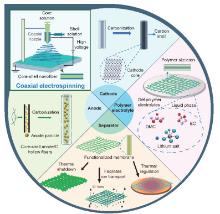
Fig 1
Applications of coaxial electrospinning in different components of LIBs."
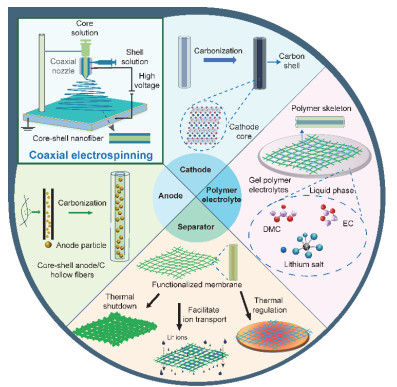
Fig 2
Schematic diagram of (a) conventional electrospinning and (b) coaxial electrospinning devices."
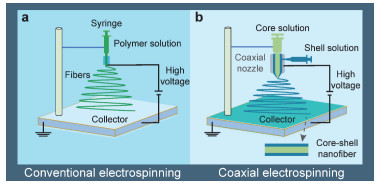
Fig 3
Schematic diagram of three solution ranges, (a) dilute (c < c*); (b) semidilute unentangled (c* < c < ce); (c) semidilute entangled (c > ce) 36; Reproduced with permission. Copyright 2005, Elsevier. Scanning electron microscope (SEM) images of coaxial electrospinning of (d) 7 wt% (mass fraction), (e) 15 wt% and (f) 20 wt% poly(methyl methacrylate) (PMMA) in formic acid solution 37; Reproduced with permission. Copyright 2010, Springer Nature."
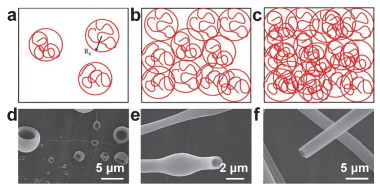
Fig 4
(a) Stable cone-jet mode of electrospinning, Lj is the distance from the starting position of the whipping jet to the nozzle, and Hc is the height of the Taylor cone. (b) The influence of Qc on the spatial size of Taylor cone and jet morphology. (c) Electrospun fibers with different Qc were obtained: 0.3, 0.5, 1.0, and 2.0 mL∙h−1 51; Reproduced with permission. Copyright 2010, American Chemical Society."
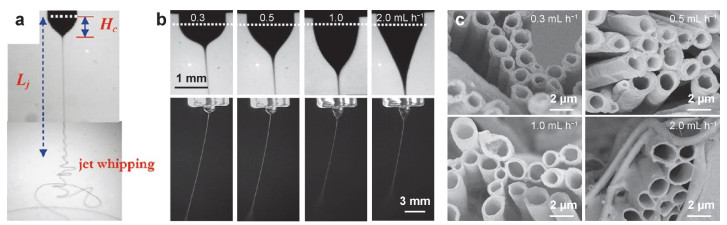
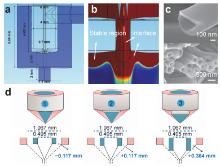
Fig 5
(a) Schematic diagram of the core-cut nozzle; (b) Functional relationship between Richardson number in fluid and Kelvin-Helmholtz (K-H) instability; (c) Field emission scanning electron microscopy (FE-SEM) images of HCNF at different core flow rates with the same shell solution flow rate, prepared through a core-cut nozzle combined with subsequent heat treatment 58; Reproduced with permission. Copyright 2014, Springer Nature. (d) Coaxial nozzles with different inner tube structures 59; Adapted from J. Ind. Text., SAGE Publications."

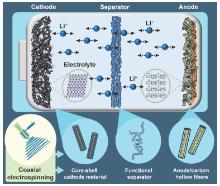
Fig 6
Schematic of the principle of LIBs and coaxial electrospinning used for the core-shell structure design of each component in the LIBs."
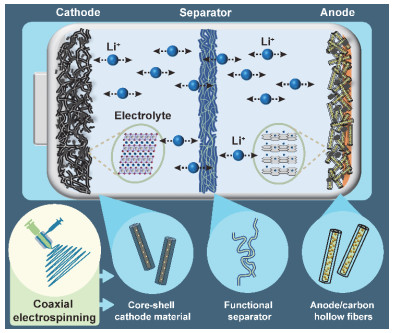
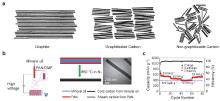
Fig 7
(a) Schematics of morphologies of non-graphitizable carbon (hard carbon), graphitizable carbon (soft carbon) and graphite 66; Reproduced with permission. Copyright 2001, John Wiley and Sons. Characterization of C-CNFW: (b) C-CNFW prepared by combining coaxial electrospinning and heat treatment, (c) rate performance of C-CNFW under different current densities 72; Reproduced with permission. Copyright 2011, Elsevier."

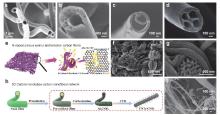
Fig 8
Carbon nanofibers with different structures. (a) FE-SEM image of HCNFs carbonized at 1600 ℃ 78; Reproduced with permission. Copyright 2012, Elsevier. (b)The porous HCNF obtained by coaxial electrospinning and subsequent heat treatment 79; Reproduced with permission. Copyright 2012, American Chemical Society. (c) High-magnification FE-SEM image of double-tubular CNFs 80; Reproduced with permission. Copyright 2014, IOP Publishing. (d) FESEM image of a four-channel HCNF 83; Reproduced with permission. Copyright 2014, RSC Publishing. (e) Schematic representation of the storage mechanism of lithium ions in NCFs-CW; (f, g) SEM images of NCFs-CW 84; Reproduced with permission. Copyright 2021, Elsevier. (h) The preparation procedure of CNTs-CNFs; (i) SEM image of CNTs-CNFs 85; Reproduced with permission. Copyright 2021, Elsevier."
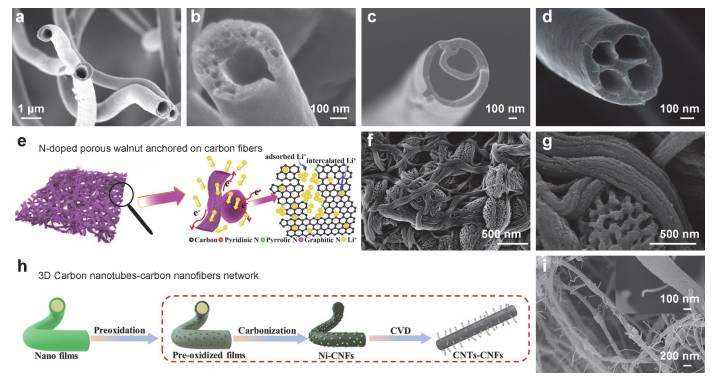
Fig 9
Si NPs composited with carbon nanofibers. (a) SEM morphology of core-shell structure SiNP@C. The carbon shell fully wrapped the Si particles 87; Reproduced with permission. Copyright 2012, American Chemical Society. (b) FE-SEM image of MWNT-Si-core/C-shell nanofibers at high magnifications 93; Reproduced with permission. Copyright 2013, RSC Pub. (c) Structural schematic and (d) FE-SEM image of C/Si/C nanofibers 94; Reproduced with permission. Copyright 2014, RSC Pub. (e) FE-SEM image of Si4cHCNF 83; Reproduced with permission. Copyright 2014, RSC Publishing. (f) Schematic diagram of the structural design and (g) SEM image of Si/po-C@C composite fiber 99; Reproduced with permission. Copyright 2015, Royal Society of Chemistry."
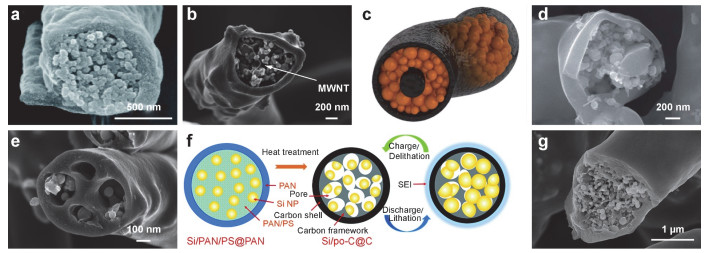
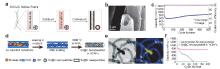
Fig 10
Sn-based materials composited with carbon nanofibers. (a) Schematic representation of the changes in the SnO2/C hollow fiber structure during heat treatment; (b) Hollow core-shell structure of SnO2/C fibers; (c) Cycling performance of composite electrode prepared from core-shell SnO2/C hollow fibers (current density: 600 mA∙g−1) 112; Reproduced with permission. Copyright 2015, American Chemical Society. (d) Preparation process of encapsulating Sn@carbon nanoparticles into HCNFs; (e) TEM micrograph of pyrolyzed nanofibers obtained after heat treatment; (f) Cycling performance of commercial Sn nanopowder (diameter: 100 nm) and Sn/C composite electrode at 0.5C 74; Reproduced with permission. Copyright 2009, John Wiley and Sons."
Table 1
Preparation of anode materials by coaxial electrospinning."
| Materials (core/shell) | Solvents (core/shell) | Fiber structures | Advantages | Electrochemical performance | Ref. |
| Core: mineral oil Shell: PAN | Mineral oil/N, N-dimethylformamide (DMF) | Core: covert to soft carbon Shell: covert to hard carbon | Core-shell carbon nanofibers | 520 mAh∙g−1 at 25 mA∙g−1 | |
| Core: mineral oil Shell: PVP, nickel acetate Middle: PAN | Mineral oil/ DMF/DMF | Core: hollow Middle: amorphous carbon nanotubes Shell: hollow graphitic carbon nano-spheres after Ni removal | A novel architecture prepared by a novel triple-coaxial electrospinning technique | 969 mAh∙g−1 at 50 mA∙g−1 volumetric capacity of ~1.4 Ah∙cm−3 | |
| Core: PAN Shell: PAN, PMMA | DMF/DMF | Core: carbon core Shell: porous carbon shell | Improving the mechanical properties of PCNFs with a dense amorphous carbon core | 445.3 mAh∙g−1 at 100 mA∙g−1 after 100 cycles 388.9 mAh∙g−1 at 1 A∙g−1 after 1000 cycles | |
| Core: Si NPs, PMMA Shell: PAN | Acetone, DMF/DMF | Core: Si NPs Shell: carbon shell | The carbon shell as a restriction boundary | 1384 mAh∙g−1 at 0.1C 721 mAh∙g−1 at 12C | |
| Core: SAN Shell: PAN | DMF/DMF | Core: hollow Shell: carbon shell | Investigating the effect of carbonization temperature on electrochemical performance | 390, 334, 273, and 243 mAh∙g−1 at 50 mA∙g−1 (800, 1000, 1200, 1600 ℃) | |
| Core: SAN Shell: SAN, PAN | DMF/DMF | Core: hollow Shell: porous carbon shell | Investigating the effect of pores on electrochemical performance | 620 (pore) vs. 352 (no pore) mAh∙g−1 at 50 mA∙g−1 77% after 10 cycles | |
| Core: SAN, Si NPs Shell: PAN | DMF/DMF | Core: Si NPs Shell: carbon shell | In situ observation of contact-lithiation | 596 mAh∙g−1 at 50 mA∙g−1 92% after 50 cycles at 50 mA∙g−1 | |
| Core: PMMA, Si NPs Shell: PVP | DMF/DMF | Core: Si NPs Shell: carbon shell | Excellent mechanical flexibility without compromising electrochemical performance | Initial reversible capacity of 1162.8 mAh∙g−1 at 0.1 A∙g−1 762.0 mAh∙g−1 after 100 cycles | |
| Core: SAN, Si NPs, MWNT Shell: PAN | DMF/DMF | Core: Si NPs, MWNT Shell: carbon shell | MWNT as additional conductive paths between the Si NPs (excellent electrical conductivity) | 911 mAh∙g−1 at 50 mA∙g−1 | |
| Core: PMMA, Si NPs, MXene Shell: PAN | DMF/DMF | Core: Si NPs, MXene Shell: carbon shell | MXene as a conductive substrate bridge the Si particles and carbon shell to form the conductive network | Initial reversible capacity of 1083 mAh∙g−1 at 0.1 A∙g−1 301 mAh∙g−1 at 2 A∙g−1 | |
| Core: Si NPs, P(AN-co-MHI), PMMA Shell: P(AN-co-MHI), PMMA | DMF/DMF | Core: Si NPs, porous carbon Shell: porous carbon shell | Porous carbon in the core enables fast charge transfer, porous carbon shell shortens Li+ diffusion distance and facilitate ion transport | 842.1 mAh∙g−1 after 500 cycles at 0.5 A∙g−1 1366.6 mAh∙g−1 at 0.5 A∙g−1 | |
| Core: PAN-co-IA, thiourea, PMMA, porous Si NPs Shell: PAN-co-IA, thiourea, PMMA | DMF/DMF | Core: porous Si NPs Shell: sulfur-doped porous carbon shell | The porous structure of Si and carbon shell provides abundant diffusion channels for ion transport | excellent reversible capacity of 1112.7 mAh∙g−1 after 1000 cycles at 2.0 A∙g−1 | |
| Core: PAN Middle: SAN, Si NPs Shell: PAN | DMF/DMF/DMF | Core: carbon shell Middle: Si NPs Shell: carbon shell | The wire-in-tube-structured trilayered nanofibers | 1211 mAh∙g−1 at 50 mA∙g−1 75% after 100 cycles at 50 mA∙g−1 | |
| Core: PMMA, zinc acetate Shell: PAN, graphene oxide (GO) | DMF/DMF | Core: ZnO NPs Shell: reduced GO incorporated glassy carbon | Enhancing battery performance by the incorporation of the reduced GO network into the shell | 815 mAh∙g−1 at 50 mA∙g−1 76% after 100 cycles | |
| Core: PAN, PVP, Iron phytate NPs Shell: PAN, PVP, TiO2 | DMF/DMF | Core: Fe2P NPs Shell: TiO2/carbon shell | Carbon shell facilitates electron transport. TiO2 shell inhibits the volume expansion and pulverization of the Fe2P core. | Initial reversible capacity of 1175.7 mAh∙g−1 716.8 mAh∙g−1 after 100 cycles | |
| Core: PMMA, carboxyethyl germanium hemioxide Shell: PAN | DMF/DMF | Core: P/GeP NPs Shell: carbon shell | N-doped hollow carbon fibers that restrict the crystal growth and solve the volume expansion of P/GeP | Initial reversible capacity of 1340.9 mAh∙g−1 382.9 mAh∙g−1 after 500 cycles at 1 A∙g−1 | |
| Core: mineral oil Shell: phosphomolybdic acid, PAN | Mineral oil/DMF | Core: hollow Shell: Mo2C@C NPs incorporated carbon shell | Manufacturing metal carbide/carbon composites by coaxial electrospinning | 1176 mAh∙g−1 at 100 mA∙g−1 674 mAh∙g−1 after 300 cycles | |
| Core: TEOS/PS Shell: PAN | HCl, DMF/ DMF | Core: SiO2 shell Shell: N-doped carbon shell | Formation of hollow double-shelled PMo12-SiO2@N-C nanofibers | 1641 mAh∙g−1 after 1000 cycles at 2 A∙g−1 | |
| Core: SAN, liquid metal nanoparticles (LMNPs), MWCNTs, GO Shell: PAN+SAN | DMF/DMF | Core: MWCNTs, rGO, self-healing LMNPs Shell: porous carbon shell | The LMNPs with a self-healing property and high theoretical capacity; MWCNTs and rGO as a conductive network | 604 mAh∙g−1 at 1000 mA∙g−1 552 mAh∙g−1 after 1500 cycles 499 mAh∙g−1 at 2000 mA∙g−1 | |
| Core: SAN, Si NPs Shell: polyamic acid (PAA) | DMF/DMF | Core: Si NPs Shell: polyimide (PI)-based carbon shell | Investigating the relationship between electrochemical properties and different Si contents | 621 mAh∙g−1 at 100 mA∙g−1 77.8% after 200 cycles | |
| Core: PAN, Mo(acac)2 Shell: PMMA, TBT | DMF, acetic acid/DMF | MoO3 encapsulated by TiO2 layer incorporated porous carbon matrices | Enhancing the electrode conductivity by the CNFs matrices and the TiO2 layers together | 561 mAh∙g−1 after 300 cycles at 1000 mA∙g−1 | |
| Core: PEO Shell: PAN, PVP | DMF/DMF | N-enriched porous walnut anchored on carbon fibers | Synthesis of new structural N-rich carbon porous materials by coaxial electrospinning | 965 mAh∙g−1 at 200 mA∙g−1 in the first cycle 99% after 30 cycles | |
| Core: cellulose Shell: chitosan | EmimAc/ EmimAc | Bio-N-doped composite carbon nanofibrous mats | Investigating the effects of different electrospinning way | 327 mAh∙g−1 after 300 cycles at 100 mA∙g−1 (single nozzle) | |
| Core: PAN Shell: PVP, Ni(NO3)2 | DMF/DMF | Core: carbon core Shell: Ni NPs | Improving the uniformity of catalyst and the controllability of catalyst content | 546 mAh∙g−1 after 100 cycles at 100 mA∙g−1 307 mAh∙g−1 at 1 A∙g−1 | |
| Core: PS Shell: copper acetate, PAN | DMF/DMF | Core: hollow Shell: conductive copper/carbon shell | Provides a cross-network for rapid electron diffusion and alleviates volume expansion | Initial capacity of 424 mAh∙g−1 at 5 A∙g−1 378 mAh∙g−1 after 1000 cycles | |
| Core: PMMA, carboxyethyl germanium hemioxides Shell: PAN | DMF/DMF | Core: GeP NPs Shell: N-doped carbon shell | Overcoming difficulty in structural design and severe volume expansion of GeP | 612 mAh∙g−1 at the 600th cycle at 1 A∙g−1 |
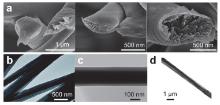
Fig 11
(a) SEM images of the cross-sections of the nanofibers: the electrospun PVDF-HFP nanofibers; the electrospun PI nanofibers; the coaxially electrospun PI@PVDF-HFP core/sheath nanofibers 137; Reproduced with permission. Copyright 2012, John Wiley and Sons. (b) TEM image of PAN@PVDF-HFP 143; Reproduced with permission. Copyright 2018, RSC Publishing. (c) TEM image of PMIA@PVDF-HFP coaxial electrospun composite 146; Reproduced with permission. Copyright 2020, Elsevier. (d) TEM photograph of single PPESK/PVDF fiber 147; Reproduced with permission. Copyright 2019, Elsevier."
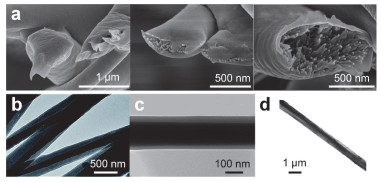
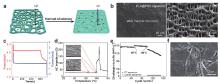
Fig 12
(a) Schematic diagram of membrane thermal shutdown; (b) SEM image of the poly(lactic acid)@poly (butylene succinate) (PLA@PBS) and Celgard 2325 separators after high temperature heating (130 ℃ for 30 s) 150; Reproduced with permission. Copyright 2017, Royal Society of Chemistry. (c) Details of the voltage change of LiCoO2||Li half-cell after heat treatment at 180 ℃ for 2 h, the battery was assembled with PMIA@PVDF 144; Reproduced with permission. Copyright 2019, Elsevier. (d) Results of the shutdown characteristics of the nonwoven separator (SFNS) with thermal shutdown functionality. AC impedance was measured at a frequency of 1 kHz, as temperature increased at a rate of 2 ℃∙min−1. The inset displays SEM images of SFNS after 110 ℃ and 140 ℃ treatment for 1 h 129; Reproduced with permission. Copyright 2016, Elsevier. (e) The cycling performance of cells based on commercial PP and thermal shutdown functionalized PP separators at different temperatures 157; Reproduced with permission. Copyright 2017, John Wiley and Sons. (f) High-temperature deformation characteristics of PVDF/PMIA/PVDF nanofiber membranes with sandwich structure (1 h at 180 ℃) 158; Reproduced with permission. Copyright 2014, Royal Society of Chemistry."
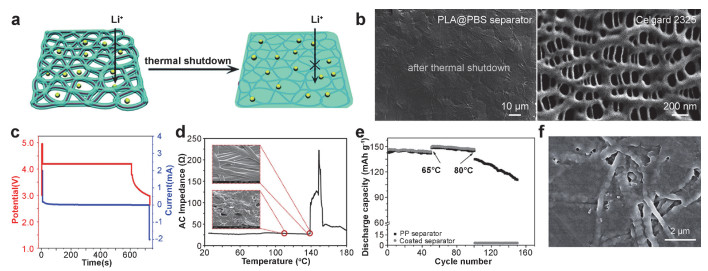
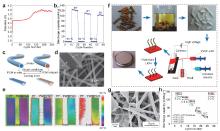
Fig 13
(a) Charge curve of the cell assembled with PVP@TiO2 separator at 60 ℃; (b) On/off functional characteristics exhibited by PVP@TiO2 separator 159; Reproduced with permission. Copyright 2018, Elsevier. (c) Schematic illustration of the fiber structure of the thermoregulating separator; (d) Morphology and structure of PW@PAN nanofibers; (e) Surface thermal infrared imaging of Celgard PP and PW@PAN separators heated at 130 ℃ 160; Reproduced with permission. Copyright 2021, John Wiley and Sons. (f) Schematic diagram of the preparation process of cellulose-based coaxial nanofiber membranes 61; Reproduced with permission. Copyright 2015, American Chemical Society. (g) Micromorphology structure of cellulose/PVDF‐HFP nanofibers containing 8% Li0.33La0.557TiO3 (LLTO); (h) Rate performance of cells using a composite nanofibrous membrane 166."
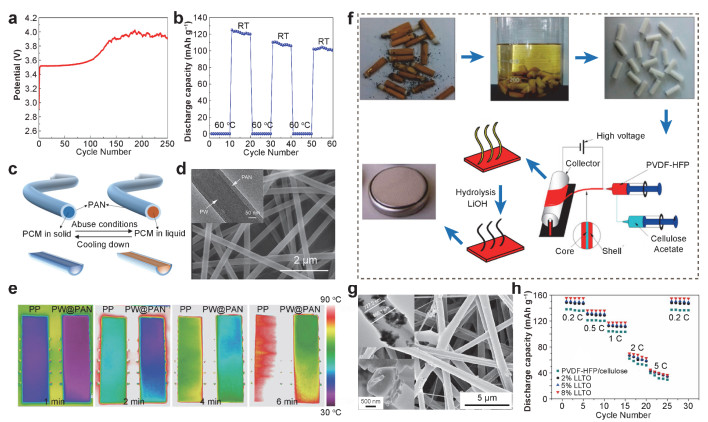
Table 2
Preparation of separators by coaxial electrospinning."
| Materials (core/shell) | Solvents (core/shell) | Advantages | Thermal stability (shrinkage) | Ionic conductivity (mS·cm−1) | Ref. |
| PDA, ODA/ | Dimethylacetamide | PI: excellent thermal stability | 0% at 150 ℃ for 1 h | 1.68 (25 ℃) | |
| PVDF-HFP | (DMAc)/DMF | PVDF-HFP: superior affinity with electrolyte | 2.33 (40 ℃) | ||
| 3.44 (90 ℃) | |||||
| Polyamic acid (PAA)/PVDF-HFP | DMAc/DMF | PI: outstanding thermal stability and self-extinguished properties PVDF-HFP: good affinity with liquid electrolyte | 0% at 200 ℃ for 0.5 h | 1.24 | |
| PSA/PVDF-HFP | DMAc/DMAc | PSA: excellent mechanical properties, thermal resistance PVDF-HFP: better anodic stability, good affinity with liquid electrolyte | 0% at 200 ℃ for 0.5 h | 1.97 | |
| Cellulose acetate/ PVDF-HFP | DMAc, acetone/DMAc, acetone | Cellulose core: high thermal stability PVDF-HFP shell: flame retardant | 0% at 200 ℃ for 1 h | 6.16 | |
| Cellulose acetate/PVDF-HFP, superfine LLTO NPs | DMAc, acetone/DMAc, acetone | LLTO NPs: retard the thermal degradation of cellulose | 13.90 (20 ℃) | ||
| PLA/PBS | HFIP, CF, o-chlorobenzaldehyde/HFIP, CF, o-chlorobenzaldehyde | PLA: excellent thermo-dimensional stability, mechanical strength PBS: strong affinity, appropriate shut-down temperature | 0% at 170 ℃ for 15 min | 1.65 | |
| Mineral oil/ PVP, titanium tetraisopropanolate | -/Ethanol, acetic acid | Mineral oil: sacrifice material to form hollow fibers | Slight shrinkage at 500 ℃ for 3 h | 1.41 (25 ℃) | |
| PAN/PVDF-HFP | DMF/DMF | PAN: excellent flame-retardant property and high resistance to the effect of heat PVDF-HFP: an excellent polymer electrolyte material, inert; insoluble, and stable | 0% at 150 ℃ for 30 min | 1.74 | |
| PAN/PVDF-HFP | DMF/DMF | PAN: thermally stable, high mechanical strength PVDF-HFP: excellent electrolyte wettability | almost 0% at 250 ℃ for 10 min | ||
| PPESK/PVDF | N-methyl-2-pyrrolidone (NMP), tetrahydrofuran (THF)/DMAc, acetone | PPESK: novel soluble engineering plastics with a high glass transition temperature of 263–305 ℃ PVDF-HFP: as the thermal shutdown component | 0% at 200 ℃ for 1 h | 1.69 | |
| PMIA/PVDF | DMAc/DMAc, acetone | PMIA: high mechanical strength, excellent thermal stability PVDF: excellent anodic stability, polarity of electrolyte (high polarity C-F chemical bonds) | 0% at 180 ℃ for 2 h | 1.70 | |
| TPP/PVDF | DMF, acetone/acetone | TPP: flame retardant PVDF: encapsulation material, and melts at high temperature to release TPP | 3.90 | ||
| TPP/PVDF | DMF, acetone/acetone | TPP: flame retardant PVDF: encapsulation material, and melts at high temperature to release TPP, thermal shutdown | 0.15–0.44 | ||
| TPP/PVDF, SiO2, GO | DMF, acetone/acetone | TPP: flame retardant PVDF: encapsulation material, and melts at high temperature to release TPP SiO2 and GO: enhance thermal stability | 3.79% at 150 ℃ for 1 h | 0.88 | |
| PMIA/PVDF-HFP | DMAc, LiCl/DMF | PMIA: hard material, higher thermal stability, mechanical strength PVDF-HFP: soft material, higher electrochemical performance | 0% at 180 ℃ for 1 h | 0.68 | |
| PAN/PBS | DMF/HFIP, chloroform | PAN: good mechanical and thermal stability, fast Li+ transportation PBS: lower melting point than PE | 0% at 200 ℃ for 15 min | 2.10 | |
| PAN, HCNFs/ PVDF, UiO-66 | DMAc, acetone/ DMAc, acetone | HCNFs: prevent membranes from serious shrinkage in the direction perpendicular UiO-66 NPs: increase the Li+ transport | 0% at 200 ℃ for 1 h | 1.59 | |
| PW/PAN | Kerosene/DMF | PW: remarkable latent heat (~240 J∙g−1) and suitable phase transition temperature (~45 ℃) PAN: superior thermal stability and high electrolyte wettability | 0% at 200 ℃ | 1.40 | |
| PW/PAN, BNNs | Kerosene/DMF | PW: absorb heat in situ PAN: superior thermal stability and high electrolyte wettability BNNs: promote heat conduction | 0% at 200 ℃ | 0.84 | |
| PI/fluorinated PMIA | DMF/DMAc | PI: high wetting breaking strength suppress lithium dendrite F-PMIA: remarkable gelation degree | 0% at 300 ℃ | 1.30 | |
| CNTs, PAN/ Uio-66-NH2, PVDF-HFP | DMF/DMF, acetone | CNTs: hinder the displacement of PAN polymer chains and strengthen mechanical strength Uio-66-NH2: improve the interfacial compatibility | 15% at 150 ℃ | 3.43 | |
| PAN/PVDF | DMF/DMAc | PAN: excellent mechanical properties PVDF: promote the rapid migration of Li+, high electrode compatibility. | 0% at 170 ℃ for 1 h | 1.62 | |
| PMIA/PAN, PVDF-HFP, TiO2 | DMAc/DMF | PMIA and PAN: high thermal stability PVDF-HFP: high electrolyte affinity TiO2: reinforce mechanical strength | 0% at 220 ℃ for 1 h | 1.36 |
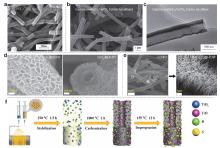
Fig 14
(a) SEM image of LiFePO4/C/Ag hollow nanofibers 179; Reproduced with permission. Copyright 2013, Springer Nature. (b) SEM and (c) TEM images of the carbon-coated LiFePO4 hollow nanofibers 180; Reproduced with permission. Copyright 2016, Springer Nature. (d) SEM images of synthesized SnS2@HCNF 185; Reproduced with permission. Copyright 2021, Elsevier. (e) SEM images of HCNFs and NiCo2S4@HCNF 186; Reproduced with permission. Copyright 2022, Elsevier. (f) Overall preparation process of TiO@B-HMCFs/S 188; Reproduced with permission. Copyright 2022, Elsevier."
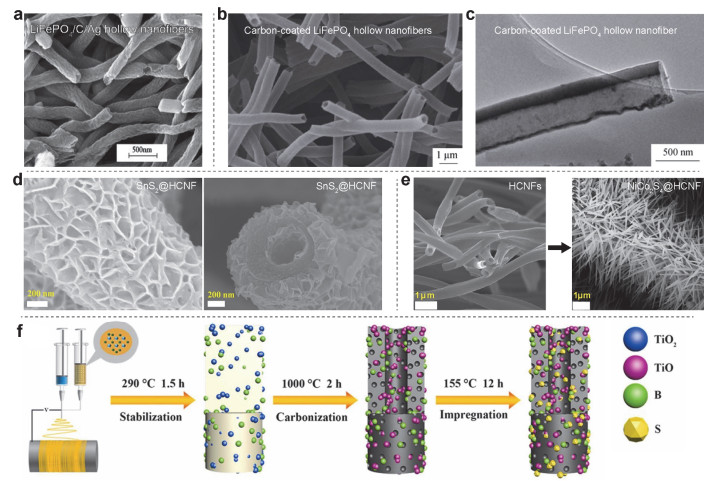
Table 3
Preparation of cathode materials (including interlayer material) by coaxial electrospinning."
| Materials (core/shell) | Solvents (core/shell) | Fiber structures | Advantages | Electrochemical performance | Ref. |
| Core: LiCoO2 sol Shell: MgO sol | Distilled water | Core: partially oriented LiCoO2 NPs Shell: poor crystallinity | Optimizing the influence of passivating surface film formed by MgO | The initial capacity of 192 mAh∙g−1 90% after 40 cycles | |
| Core: LiNi0.8Co0.1Mn0.1O2 sol, PVP Shell: MgO sol | Distilled water | Core: LiNi0.8Co0.1Mn0.1O2 core Shell: MgO shell | A tubular structure composed of core-shell fibers with the addition of PVP | The initial capacity of 195 mAh∙g−1 89.2% after 50 cycles | |
| Core: machine oil Shell: LiNiO2 precursor | Distilled water | Core: hollow Shell: well-crystallized LiNiO2 | Preparing hollow nanofibers of continuous LiNiO2 phase | ||
| Core: PVP Shell: LiFePO4 precursor, AgNO3, PVP | DMF/DMF | Core: hollow Shell: LiFePO4/C/Ag | Contributes to the formation of conductive coating (PVP) and LiFePO4 simultaneously | 138.7 mAh∙g−1 at 0.2C | |
| Core: PMMA, LiFePO4 precursor Shell: PAN | DMF/DMF | Core: hollow Shell: carbon fiber with integrated carbon-coated LiFePO4 NPs. | High specific surface area hollow nanofibers with multiple active sites | 153.2 mAh∙g−1 at 0.2C 135.7 mAh∙g−1 at 2C | |
| Core: PMMA Shell: PAN | DMF/DMF | Core: hollow structure partially filled with S; Shell: microporous carbon fiber with integrated sulfur. | Alleviating the dissolution of soluble polysulfides, facilitating ion transport | Maximum capacity of 815 mAh∙g−1 88% after 70 cycles | |
| Core: PMMA Shell: PAN | DMF/DMF | Core: hollow Shell: SnS2 | Restraining the shuttling effect of lithium polysulfides, facilitating the transport of ions and electrons | The initial capacity of 1138 mAh∙g−1 at 0.2C, 675 mAh∙g−1 after 500 cycles at 1C | |
| Core: PMMA Shell: PAN | DMF/DMF | Core: hollow Shell: NiCo2S4 | Restraining the shuttling effect of lithium polysulfides, facilitating ion/electron transport | The initial capacity of 1213 mAh∙g−1 at 0.2C, 0.06% decay per cycle in 500 cycles at 1C | |
| Core: PEO Shell: PAN | DMF/DMF | Core: hollow Shell: sulfurized PAN | Provides a 3D transmission path for ions and electrons; suppressing the shuttle effect | 1250 mAh∙gsulfur−1 or 515 mAh∙gelectrode−1 at 0.1C | |
| Core: PMMA Shell: P(AN-co-MHI), PMMA, boric acid, TiO2 | DMF/DMF | Core: hollow Shell: TiO, boron-doped hollow multichannel carbon shell | Abundant void to alleviate the volume change of S and promote electrolyte infiltration, alleviating shuttle effect and improving electronic conductivity | 1070 mAh∙g−1 at 0.1 A∙g−1, capacity decay rate of 0.096% per cycle over 300 cycles | |
| Core: PMMA Shell: PAN, methyl methacrylate, PMMA, boric acid, SiO2 | DMF/DMF | Lotus-root-structure porous multichannel carbon nanotubes | Capturing sulfur and restricting its loss, facilitating the diffusion of lithium ions | 778 mAh∙g−1 after 100 cycles at 0.1C |
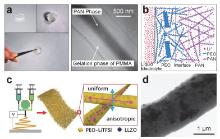
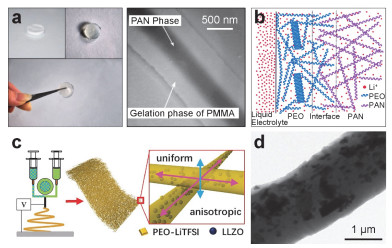
Fig 15
(a) Stacked nanofiber membranes and saturated GPEs 201; Reproduced with permission. Copyright 2014, Elsevier. (b) Schematic diagram of the lithium-ion transportation pathway in gel polymer electrolytes 202; Reproduced with permission. Copyright 2015, Elsevier. (c) Illustrative representation of the design principle of electrospun composite solid electrolyte; (d) TEM image of ES-CSE 213; Reproduced with permission. Copyright 2021, John Wiley and Sons."
| 1 |
doi: 10.1016/j.nanoen.2019.06.023 |
| 2 |
doi: 10.1016/j.jechem.2020.09.043 |
| 3 |
doi: 10.1016/j.jpowsour.2020.228649 |
| 4 |
doi: 10.1002/anie.200702505 |
| 5 |
doi: 10.3866/PKU.WHXB202211057 |
|
鲁航语; 侯瑞林; 褚世勇; 周豪慎; 郭少华. 物理化学学报, 2023, 39(7), 2211057.
doi: 10.3866/PKU.WHXB202211057 |
|
| 6 |
doi: 10.3866/PKU.WHXB202107030 |
|
莫英; 肖逵逵; 吴剑芳; 刘辉; 胡爱平; 高鹏; 刘继磊. 物理化学学报, 2021, 38(6), 2107030.
doi: 10.3866/PKU.WHXB202107030 |
|
| 7 |
doi: 10.1002/inf2.12189 |
| 8 |
doi: 10.1002/inf2.12305 |
| 9 |
doi: 10.3866/PKU.WHXB202210014 |
|
吕浩亮; 王雪杰; 杨宇; 刘涛; 张留洋. 物理化学学报, 2022, 39(3), 2210014.
doi: 10.3866/PKU.WHXB202210014 |
|
| 10 |
doi: 10.1002/adma.202207752 |
| 11 |
doi: 10.1021/am505829v |
| 12 |
doi: 10.1016/j.jpowsour.2015.01.156 |
| 13 |
doi: 10.1149/2.0441803jes |
| 14 |
doi: 10.1016/j.jpowsour.2015.08.012 |
| 15 |
doi: 10.1016/j.jallcom.2021.162550 |
| 16 |
doi: 10.1016/j.cej.2017.07.106 |
| 17 |
doi: 10.1039/b618508h |
| 18 |
doi: 10.1080/15583720802022257 |
| 19 |
doi: 10.1039/c3ta12390a |
| 20 |
doi: 10.1002/adma.201704765 |
| 21 |
doi: 10.1002/cplu.201900281 |
| 22 |
doi: 10.1007/s41918-021-00103-9 |
| 23 |
doi: 10.1016/j.ensm.2021.12.022 |
| 24 |
doi: 10.1016/s0266-3538(03)00178-7 |
| 25 |
doi: 10.1177/155892501200702S10 |
| 26 |
doi: 10.1016/j.xinn.2023.100381 |
| 27 |
doi: 10.1007/s40820-022-00986-3 |
| 28 |
doi: 10.1016/j.biotechadv.2010.01.004 |
| 29 |
doi: 10.1126/science.1067595 |
| 30 |
doi: 10.1002/adma.200305136 |
| 31 |
doi: 10.1021/jp808468x |
| 32 |
doi: 10.1002/adma.200400606 |
| 33 |
doi: 10.1021/nl049590f |
| 34 |
doi: 10.3389/fmats.2019.00114 |
| 35 |
doi: 10.1016/j.polymer.2005.03.011 |
| 36 |
doi: 10.1016/j.polymer.2005.04.021 |
| 37 |
doi: 10.1007/s13233-010-0607-9 |
| 38 |
doi: 10.1002/polb.20222 |
| 39 |
doi: 10.1021/cm049580f |
| 40 |
doi: 10.1002/polb.20253 |
| 41 |
doi: 10.1038/pj.2017.8 |
| 42 |
doi: 10.1002/wnan.1391 |
| 43 |
doi: 10.1039/c7nj02805a |
| 44 |
doi: 10.1021/jp107871v |
| 45 |
doi: 10.3390/pharmaceutics11070305 |
| 46 |
doi: 10.1002/adma.200306644 |
| 47 |
doi: 10.1039/c0cc03521a |
| 48 |
doi: 10.1021/la100748g |
| 49 |
doi: 10.1002/smll.200400056 |
| 50 |
doi: 10.3390/polym12010103 |
| 51 |
doi: 10.1021/ma100423x |
| 52 |
doi: 10.1016/j.electacta.2014.01.004 |
| 53 |
doi: 10.1002/app.28994 |
| 54 |
doi: 10.1016/S1369-7021(06)71389-X |
| 55 |
doi: 10.1016/j.progpolymsci.2013.02.001 |
| 56 |
doi: 10.1039/c0jm00484g |
| 57 |
doi: 10.1177/1528083715627165 |
| 58 |
doi: 10.1038/srep06758 |
| 59 |
doi: 10.1177/1528083716676816 |
| 60 |
doi: 10.1186/s11671-016-1416-7 |
| 61 |
doi: 10.1021/acssuschemeng.5b00032 |
| 62 |
doi: 10.1038/s41560-023-01208-9 |
| 63 |
doi: 10.1002/aenm.202203841 |
| 64 |
doi: 10.3390/molecules28052108 |
| 65 |
doi: 10.1002/adma.202210734 |
| 66 |
doi: 10.1002/tcr.1024 |
| 67 |
doi: 10.3866/PKU.WHXB202103052 |
|
朱思颖; 李辉阳; 胡忠利; 张桥保; 赵金保; 张力. 物理化学学报, 2022, 38(6), 2103052.
doi: 10.3866/PKU.WHXB202103052 |
|
| 68 |
doi: 10.34133/energymatadv.0010 |
| 69 |
doi: 10.1016/j.est.2023.106716 |
| 70 |
doi: 10.1016/j.ceramint.2022.04.340 |
| 71 |
doi: 10.1016/j.jmrt.2021.01.009 |
| 72 |
doi: 10.1016/j.elecom.2011.03.009 |
| 73 |
doi: 10.1016/j.jpowsour.2012.01.120 |
| 74 |
doi: 10.1002/anie.200901723 |
| 75 |
doi: 10.1039/c3ta14646d |
| 76 |
doi: 10.1039/c3nr01128c |
| 77 |
doi: 10.26599/nre.2022.9120037 |
| 78 |
doi: 10.1016/j.jpowsour.2011.10.030 |
| 79 |
doi: 10.1021/am301873d |
| 80 |
doi: 10.1088/0957-4484/25/46/465602 |
| 81 |
doi: 10.1039/c2ee22085g |
| 82 |
doi: 10.1007/s12598-023-02372-3 |
| 83 |
doi: 10.1039/c4ra10031j |
| 84 |
doi: 10.1016/j.jcis.2020.10.100 |
| 85 |
doi: 10.1016/j.jallcom.2020.158481 |
| 86 |
doi: 10.1007/s10853-021-06532-7 |
| 87 |
doi: 10.1021/nl203817r |
| 88 |
doi: 10.1039/c3nr00322a |
| 89 |
doi: 10.1016/j.eurpolymj.2015.07.041 |
| 90 |
doi: 10.3390/nano11123454 |
| 91 |
doi: 10.1016/j.carbon.2015.11.048 |
| 92 |
doi: 10.1515/epoly-2020-0023 |
| 93 |
doi: 10.1039/c3nr00982c |
| 94 |
doi: 10.1039/c4nr00318g |
| 95 |
doi: 10.1039/d1qm00823d |
| 96 |
doi: 10.1016/j.colsurfa.2022.129721 |
| 97 |
doi: 10.1021/acsaem.2c01898 |
| 98 |
doi: 10.1016/j.ssi.2014.02.003 |
| 99 |
doi: 10.1039/c4ta06044j |
| 100 |
doi: 10.1039/c5nr00224a |
| 101 |
doi: 10.1016/j.materresbull.2018.09.023 |
| 102 |
doi: 10.1016/j.elecom.2012.05.034 |
| 103 |
doi: 10.1002/slct.202000288 |
| 104 |
doi: 10.1039/c5ta05400a |
| 105 |
doi: 10.1016/j.electacta.2015.09.120 |
| 106 |
doi: 10.1039/c4ta07220k |
| 107 |
doi: 10.1016/j.apsusc.2018.12.098 |
| 108 |
doi: 10.1016/j.colsurfa.2022.129953 |
| 109 |
doi: 10.1016/j.jallcom.2023.170851 |
| 110 |
doi: 10.1021/acsami.1c07387 |
| 111 |
doi: 10.1002/chem.202101638 |
| 112 |
doi: 10.1021/acsami.5b06512 |
| 113 |
doi: 10.1038/nmat1368 |
| 114 |
doi: 10.1039/c0ee00170h |
| 115 |
doi: 10.1039/c1jm11483b |
| 116 |
doi: 10.1007/s41918-022-00131-z |
| 117 |
doi: 10.1002/cssc.202201464 |
| 118 |
doi: 10.1039/d2ta09266b |
| 119 |
doi: 10.1016/j.jpowsour.2023.232853 |
| 120 |
doi: 10.1038/s41560-018-0295-9 |
| 121 |
doi: 10.1021/cr020738u |
| 122 |
doi: 10.1016/j.mtphys.2023.101256 |
| 123 |
doi: 10.1039/d3qm00709j |
| 124 |
doi: 10.1016/j.ensm.2022.02.020 |
| 125 |
doi: 10.1149/2.003309jes |
| 126 |
doi: 10.1016/j.jpowsour.2012.10.027 |
| 127 |
doi: 10.1016/j.memsci.2019.04.005 |
| 128 |
doi: 10.1002/ente.201801072 |
| 129 |
doi: 10.1016/j.jpowsour.2015.11.106 |
| 130 |
doi: 10.1016/j.electacta.2017.03.205 |
| 131 |
doi: 10.1016/j.memsci.2017.12.015 |
| 132 |
doi: 10.1016/j.cej.2019.123312 |
| 133 |
doi: 10.1016/j.cej.2020.124571 |
| 134 |
doi: 10.1016/j.jpowsour.2020.227759 |
| 135 |
doi: 10.1016/j.electacta.2004.07.014 |
| 136 |
doi: 10.1002/adma.200304617 |
| 137 |
doi: 10.1002/mame.201200158 |
| 138 |
doi: 10.1016/j.cej.2020.124258 |
| 139 |
doi: 10.1126/sciadv.1601978 |
| 140 |
doi: 10.1016/j.apmt.2020.100675 |
| 141 |
doi: 10.1016/j.matchemphys.2022.125975 |
| 142 |
doi: 10.3390/en12173391 |
| 143 |
doi: 10.1039/c8ra02035c |
| 144 |
doi: 10.1016/j.electacta.2019.01.115 |
| 145 |
doi: 10.1016/j.jcis.2023.01.033 |
| 146 |
doi: 10.1016/j.ssi.2020.115253 |
| 147 |
doi: 10.1016/j.matlet.2019.02.009 |
| 148 |
doi: 10.1016/j.cej.2020.126542 |
| 149 |
doi: 10.1016/j.cclet.2023.108350 |
| 150 |
doi: 10.1039/c7ta08063h |
| 151 |
doi: 10.1021/acsapm.0c00164 |
| 152 |
Shao, F.; Kang, G.; Chen, H.; Wang, X.; Shao, Z.; Li, W.; Zheng, G. Preparation of Flame-retardant Lithium-ion Battery Separator by Coaxial Electrospinning. In IEEE 16th International Conference on Nano/Micro Engineered and Molecular Systems (NEMS), Xiamen, China; 2021. doi: 10.1109/nems51815.2021.9451445
|
| 153 |
doi: 10.1016/j.matchemphys.2023.127647 |
| 154 |
doi: 10.1021/acsami.3c08757 |
| 155 |
doi: 10.1002/eem2.12129 |
| 156 |
doi: 10.1177/0954008318814154 |
| 157 |
doi: 10.1002/mame.201700241 |
| 158 |
doi: 10.1039/c4ta02151g |
| 159 |
doi: 10.1016/j.memsci.2018.08.008 |
| 160 |
doi: 10.1002/adma.202008088 |
| 161 |
doi: 10.1007/s12274-023-6179-8 |
| 162 |
doi: 10.20964/2017.06.69 |
| 163 |
doi: 10.1016/j.memsci.2019.02.003 |
| 164 |
doi: 10.1021/acsami.8b17521 |
| 165 |
doi: 10.1016/j.cej.2020.128075 |
| 166 |
doi: 10.3390/ma9020075 |
| 167 |
doi: 10.1002/tcr.202200142 |
| 168 |
doi: 10.1002/smll.202207547 |
| 169 |
doi: 10.1016/j.micromeso.2020.110724 |
| 170 |
doi: 10.1002/adma.201808338 |
| 171 |
doi: 10.1016/j.mtchem.2023.101552 |
| 172 |
doi: 10.1002/ente.202201200 |
| 173 |
doi: 10.3390/electronics12051152 |
| 174 |
doi: 10.1007/s10008-023-05387-z |
| 175 |
doi: 10.1039/c3ra45414b |
| 176 |
doi: 10.1039/c3cc43874k |
| 177 |
doi: 10.1080/01932690701781469 |
| 178 |
doi: 10.1039/b614205b |
| 179 |
doi: 10.1007/s10854-013-1465-y |
| 180 |
doi: 10.1007/s12613-016-1258-4 |
| 181 |
doi: 10.3866/PKU.WHXB202301019 |
|
屈卓研; 张笑银; 肖茹; 孙振华; 李峰. 物理化学学报, 2023, 39(8), 2301019.
doi: 10.3866/PKU.WHXB202301019 |
|
| 182 |
doi: 10.3866/PKU.WHXB202212005 |
|
王晶晶; 曹贵强; 段瑞贤; 李向阳; 李喜飞. 物理化学学报, 2023, 39(5), 2212005.
doi: 10.3866/PKU.WHXB202212005 |
|
| 183 |
doi: 10.1039/d1ta10444f |
| 184 |
doi: 10.1016/j.mtcomm.2021.102666 |
| 185 |
doi: 10.1016/j.carbon.2021.08.004 |
| 186 |
doi: 10.1016/j.colsurfa.2022.129179 |
| 187 |
doi: 10.1016/j.electacta.2019.135493 |
| 188 |
doi: 10.1016/j.jallcom.2022.167056 |
| 189 |
doi: 10.1016/j.jelechem.2020.114564 |
| 190 |
doi: 10.1016/j.jallcom.2014.04.073 |
| 191 |
doi: 10.1016/j.jechem.2020.02.033 |
| 192 |
doi: 10.1021/acsami.0c02291 |
| 193 |
doi: 10.1016/j.mtener.2021.100694 |
| 194 |
doi: 10.1002/advs.202201718 |
| 195 |
doi: 10.1002/cjoc.202200588 |
| 196 |
doi: 10.1002/anie.202302586 |
| 197 |
doi: 10.1016/j.jechem.2018.12.013 |
| 198 |
doi: 10.1016/j.ensm.2020.10.018 |
| 199 |
doi: 10.1016/j.jpowsour.2014.03.140 |
| 200 |
doi: 10.1016/j.ensm.2019.11.005 |
| 201 |
doi: 10.1016/j.jpowsour.2014.05.030 |
| 202 |
doi: 10.1016/j.memsci.2015.05.040 |
| 203 |
doi: 10.1016/j.jcis.2020.08.046 |
| 204 |
doi: 10.1016/j.ssi.2020.115266 |
| 205 |
doi: 10.3389/fchem.2019.00421 |
| 206 |
doi: 10.1016/j.electacta.2016.09.147 |
| 207 |
doi: 10.1016/j.jpowsour.2018.07.039 |
| 208 |
doi: 10.1016/j.electacta.2018.12.168 |
| 209 |
doi: 10.1021/acsami.0c20854 |
| 210 |
doi: 10.1038/s41565-019-0465-3 |
| 211 |
doi: 10.1021/acsaem.9b00295 |
| 212 |
doi: 10.1002/adem.201900055 |
| 213 |
doi: 10.1002/advs.202100899 |
| 214 |
doi: 10.1002/jbm.a.32543 |
| 215 |
doi: 10.3390/pharmaceutics11010005 |
| 216 |
doi: 10.1016/j.jddst.2018.09.005 |
| 217 |
doi: 10.1002/pat.3794 |
| 218 |
doi: 10.1016/j.electacta.2016.11.083 |
| 219 |
doi: 10.1016/j.jpowsour.2017.07.004 |
| 220 |
doi: 10.1016/j.est.2020.102079 |
| 221 |
doi: 10.1016/j.jcis.2021.08.171 |
| 222 |
doi: 10.1002/chem.201200378 |
| 223 |
doi: 10.1021/acsanm.0c01120 |
| 224 |
doi: 10.1016/j.xcrp.2020.100078 |
| 225 |
doi: 10.1002/mame.201700002 |
| [1] | Pengcheng Yan, Peng Wang, Jing Huang, Zhao Mo, Li Xu, Yun Chen, Yu Zhang, Zhichong Qi, Hui Xu, Henan Li. Engineering Multiple Optimization Strategy on Bismuth Oxyhalide Photoactive Materials for Efficient Photoelectrochemical Applications [J]. Acta Phys. -Chim. Sin., 2025, 41(2): 100014-. |
| [2] | Shuai Chen, Chuang Yu, Qiyue Luo, Chaochao Wei, Liping Li, Guangshe Li, Shijie Cheng, Jia Xie. Research Progress of Lithium Metal Halide Solid Electrolytes [J]. Acta Phys. -Chim. Sin., 2023, 39(8): 2210032-0. |
| [3] | Linfeng Peng, Chuang Yu, Chaochao Wei, Cong Liao, Shuai Chen, Long Zhang, Shijie Cheng, Jia Xie. Recent Progress on Lithium Argyrodite Solid-State Electrolytes [J]. Acta Phys. -Chim. Sin., 2023, 39(7): 2211034-0. |
| [4] | Yae Qi, Yongyao Xia. Electrolyte Regulation Strategies for Improving the Electrochemical Performance of Aqueous Zinc-Ion Battery Cathodes [J]. Acta Phys. -Chim. Sin., 2023, 39(2): 2205045-0. |
| [5] | Ying Mo, Kuikui Xiao, Jianfang Wu, Hui Liu, Aiping Hu, Peng Gao, Jilei Liu. Lithium-Ion Battery Separator: Functional Modification and Characterization [J]. Acta Phys. -Chim. Sin., 2022, 38(6): 2107030-. |
| [6] | Zheng Bo, Jing Kong, Huachao Yang, Zhouwei Zheng, Pengpeng Chen, Jianhua Yan, Kefa Cen. Ultra-Low-Temperature Supercapacitor Based on Holey Graphene and Mixed-Solvent Organic Electrolyte [J]. Acta Phys. -Chim. Sin., 2022, 38(4): 2005054-. |
| [7] | Hui Li, Shuangyu Liu, Tianci Yuan, Bo Wang, Peng Sheng, Li Xu, Guangyao Zhao, Huitao Bai, Xin Chen, Zhongxue Chen, Yuliang Cao. Influence of NaOH Concentration on Sodium Storage Performance of Na0.44MnO2 [J]. Acta Phys. -Chim. Sin., 2021, 37(3): 1907049-. |
| [8] | Yongli Tong, Meizhen Dai, Lei Xing, Hengqi Liu, Wanting Sun, Xiang Wu. Asymmetric Hybrid Capacitor Based on NiCo2O4 Nanosheets Electrode [J]. Acta Physico-Chimica Sinica, 2020, 36(7): 1903046-. |
| [9] | Xinxin Cao,Jiang Zhou,Anqiang Pan,Shuquan Liang. Recent Advances in Phosphate Cathode Materials for Sodium-ion Batteries [J]. Acta Physico-Chimica Sinica, 2020, 36(5): 1905018-. |
| [10] | Nannan Guo,Su Zhang,Luxiang Wang,Dianzeng Jia. Application of Plant-Based Porous Carbon for Supercapacitors [J]. Acta Physico-Chimica Sinica, 2020, 36(2): 1903055-. |
| [11] | Kang YANG,Xiaorui SHUAI,Huachao YANG,Jianhua YAN,Kefa CEN. Electrochemical Performance of Activated Graphene Powder Supercapacitors Using a Room Temperature Ionic Liquid Electrolyte [J]. Acta Phys. -Chim. Sin., 2019, 35(7): 755-765. |
| [12] | Shah Rahim,Alam Naveed,A. Razzaq Amir,Cheng YANG,Yujie CHEN,Jiapeng HU,Xiaohui ZHAO,Yang PENG,Zhao DENG. Effect of Binder Conformity on the Electrochemical Behavior of Graphite Anodes with Different Particle Shapes [J]. Acta Physico-Chimica Sinica, 2019, 35(12): 1382-1390. |
| [13] | Hao ZHANG,Xin-Gang LI,Jin-Meng CAI,Ya-Ting WANG,Mo-Qing WU,Tong DING,Ming MENG,Ye TIAN. Effect of the Amount of Hydrofluoric Acid on the Structural Evolution and Photocatalytic Performance of Titanium Based Semiconductors [J]. Acta Phys. -Chim. Sin., 2017, 33(10): 2072-2081. |
| [14] | Cui-Ping YU,Yan WANG,Jie-Wu CUI,Jia-Qin LIU,Yu-Cheng WU. Recent Advances in the Multi-Modification of TiO2 Nanotube Arrays and Their Application in Supercapacitors [J]. Acta Phys. -Chim. Sin., 2017, 33(10): 1944-1959. |
| [15] | Yong LU,Qing ZHAO,Jing LIANG,Zhan-Liang TAO,Jun CHEN. Quinones as Electrode Materials for Rechargeable Lithium Batteries [J]. Acta Phys. -Chim. Sin., 2016, 32(7): 1593-1603. |
|
||