Acta Phys. -Chim. Sin. ›› 2026, Vol. 42 ›› Issue (7): 100225.doi: 10.1016/j.actphy.2025.100225
• REVIEW • Previous Articles Next Articles
Metal-Organic Frameworks (2014–2024): A decade pursuit for top performance
Ri Peng1, Yuxin Xie1, Shuai Yuan2, Ruwei Shen1, Dunru Zhu1,2,*( )
)
- 1 State Key Laboratory of Materials-Oriented Chemical Engineering, College of Chemical Engineering, Nanjing Tech University, Nanjing 211816, Jiangsu Province, China
2 State Key Laboratory of Coordination Chemistry, Nanjing University, Nanjing 210023, Jiangsu Province, China
-
Received:2025-09-22Revised:2025-11-23Accepted:2025-11-26Published:2026-05-22 -
Contact:Email: zhudr@njtech.edu.cn (Dunru Zhu)

Cite this article
Ri Peng, Yuxin Xie, Shuai Yuan, Ruwei Shen, Dunru Zhu. Metal-Organic Frameworks (2014–2024): A decade pursuit for top performance[J]. Acta Phys. -Chim. Sin. 2026, 42(7), 100225. doi: 10.1016/j.actphy.2025.100225
share this article
Fig 1
Two "milestone" complexes: (a) [Co(HBTC)(Py)2]·2/3Py and (b) MOF-5 in the development of MOFs [1, 2]. Adapted with permission from Ref. [1] and [2], Copyright 1995 and 1999 Springer Nature publisher."
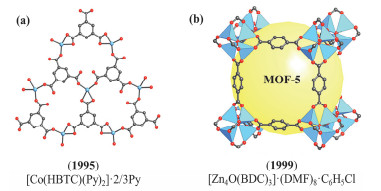
Fig 2
The number of MOF publications each year from 2014 to 2024. Web of Science data by searching the topic of "metal-organic framework" on August 31, 2025."
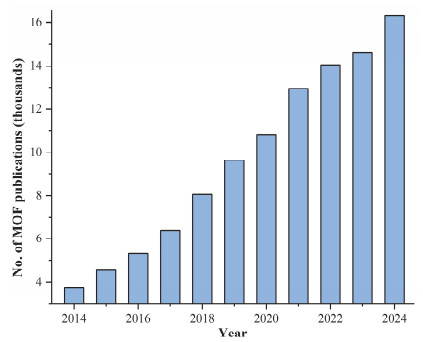
Table 1
MOFs with the best values for the indicated properties."
| Property or application | MOF | Achieved value | Refs. |
| Highest reported value | |||
| BET surface area a | NU-1501-Al b | 7310 m2 g−1 | [ |
| Cage size | MOF-939 | 11.4 nm | [ |
| Unit cell volume | NU-1301 | 5201294 Å3 | [ |
| Unit cell length | SC-MOF-6 c | 266.21 Å | [ |
| Thermal stability | MAF-stu-1 d | 680 ℃ | [ |
| Chemical stability | Cr-btec-tpt e | pH: −1.1~15 | [ |
| Volumetric H2 uptake (298 K/100 bar) | [Ni2(4,6-m-DOT)] | 11.9 g L−1 | [ |
| Usable H2 capacity (298 K/100 bar) | [Ni2(4,6-m-DOT)] | 11.0 g L−1 | [ |
| Gravimetric H2 uptake (296 K/100 bar) | NU-1501-Al | 2.9 wt% | [ |
| Usable CH4 capacity (298 K/65 bar) | [Co(bdp)] f | 197 cm3 cm−3 | [ |
| Gravimetric CH4 uptake (296 K/100 bar) | NU-1501-Al | 0.54 g g−1 | [ |
| Gravimetric NH3 uptake (298 K/1 bar) | LiCl@MIL-53-(OH)2 g | 0.58 g g−1 | [ |
| Volumetric NH3 uptake (298 K/1 bar) | LiCl@MIL-53-(OH)2 | 0.80 g cm−3 | [ |
| Gravimetric CO2 uptake (273 K/1 bar) | CPM-231 h | 0.46 g g−1 | [ |
| Proton conductivity (−40 ℃) | H2SO4@MIL-101-SO3H | 9.2 × 10⁻³ S cm−1 | [ |
| Proton conductivity (90 ℃/90% RH) i | LiCl@UiO-66-F2-(SO3H)2 j | 2.86 S cm−1 | [ |
| Gravimetric water uptake (RT/70% RH) k | Cr-soc-MOF-1 | 1.95 g g−1 | [ |
| Lowest reported value | |||
| Density | NU-1301 | 0.124 g cm−3 | [ |
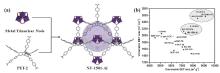
Fig 3
(a) Synthetic strategy of NU-1501-Al. (b) Some porous MOFs with both ultrahigh volumetric and gravimetric BET areas [12]. Adapted with permission from Ref. [12], Copyright 2020 The American Association for the Advancement of Science publisher."
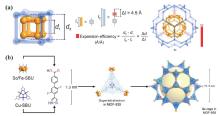
Fig 4
(a) Definition of expansion efficiency. (b) Construction principle of 3D MOF-939 with the largest cage [13]. Adapted with permission from Ref. [13], Copyright 2023 American Chemical Society publisher."
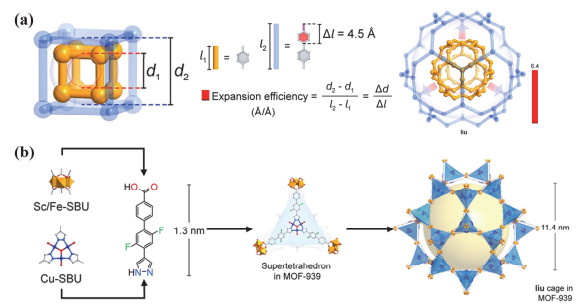
Fig 5
(a) Single cuboctahedron consisting of 8 [UO2(CO2)3]− SBUs and 12 L3− linkers. (b) A triangular face links two cuboctahedron cages. (c) The pentagonal prism consisting of 5 cuboctahedra and the hexagonal prism consisting of 6 cuboctahedra. (d) The large cages along different directions [14]. Adapted with permission from Ref. [14], Copyright 2017 The American Association for the Advancement of Science publisher."
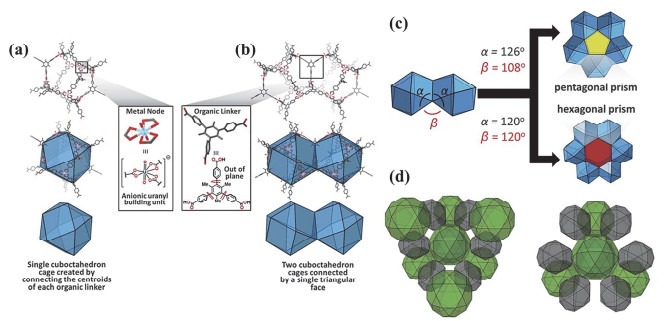
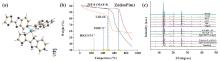
Fig 6
(a) Coordination environment of Zn2+. (b) Thermal stability of [Zn(imPim)]. (c) Chemical stability of [Zn(imPim)] [16]. Adapted with permission from Ref. [16], Copyright 2019 John Wiley and Sons publisher."
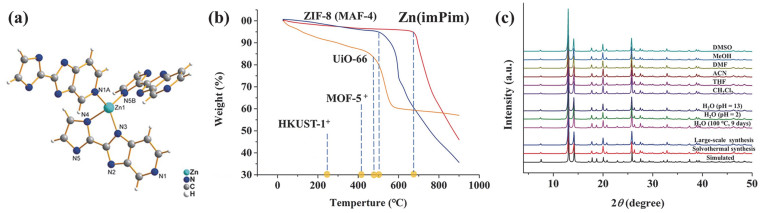
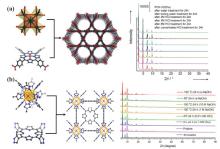
Fig 7
Construction strategy and chemical stability of (a) PCN-222(Fe) and (b) PCN-601 [31, 32]. Adapted with permission from Ref. [31], Copyright 2012 John Wiley and Sons publisher. Adapted with permission from Ref. [32], Copyright 2016 American Chemical Society publisher."
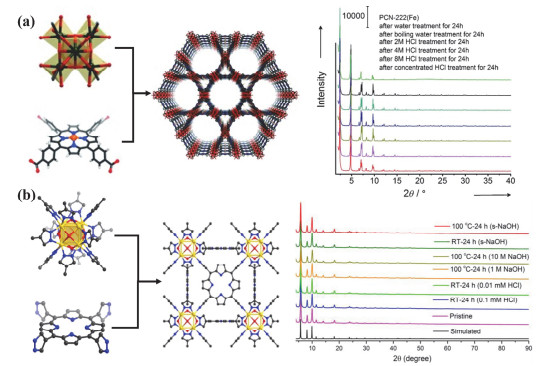
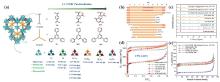
Fig 8
(a) A series of ultrastable pacs-MOFs built by a three-module synthesis strategy. (b) Comparison of ultrastable MOFs based on stable pH range. (c) Chemical stability of Cr-btec-tpt determined from PXRD. Chemical stability of (d) CPM-243(F) and (e) Cr-btec-tpt based on N2 isotherms at 77 K [17, 33]. Adapted with permission from Ref. [33], Copyright 2021 American Chemical Society publisher. Adapted with permission from Ref. [17], Copyright 2024 John Wiley and Sons publisher."
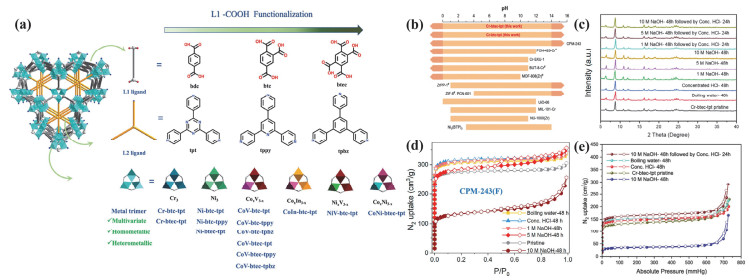
Fig 9
(a) Comparison of total H2 uptake between pure compressed H2 and [Ni2(4,6-m-DOT)] at 100 bar. (b) A pore of [Co2(4,6-m-DOT)] with seven different D2 binding sites [18]. Adapted with permission from Ref. [18], Copyright 2018 American Chemical Society publisher."
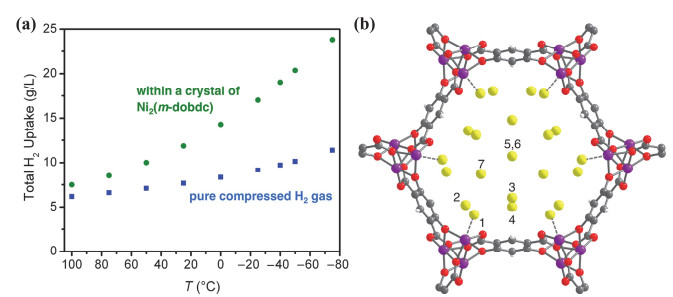
Fig 10
(a) Some top-performing MOFs with both gravimetric and volumetric H2 working capacities. (b) Three main cages in NPF-200 [37]. Adapted with permission from Ref. [37], Copyright 2020 John Wiley and Sons publisher."
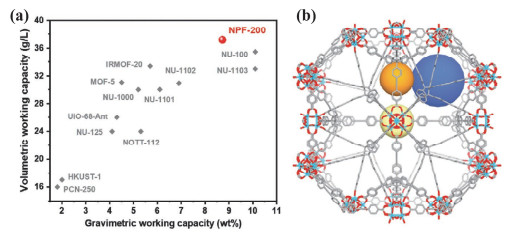
Fig 11
(a) Composition of MOF-519. (b) The volumetric CH4 storage in MOF-519. (c) Some top performing MOFs with CH4 working capacity [42]. Adapted with permission from Ref. [42], Copyright 2014 American Chemical Society publisher."
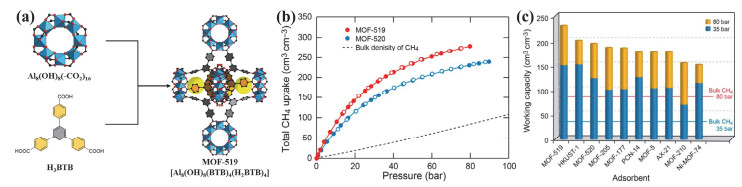
Fig 12
(a) A non-porous structure (0 bar) and a porous network (30 bar) of [Co(bdp)]. (b) Total CH4 adsorption isotherms of [Co(bdp)] [19]. Adapted with permission from Ref. [19], Copyright 2015 Springer Nature publisher."
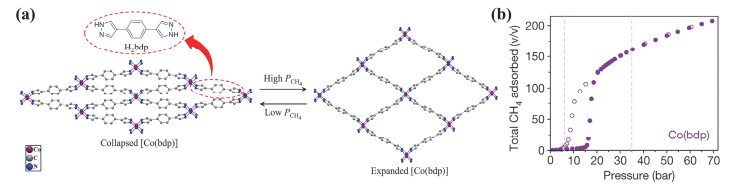
Fig 13
(a) A schematic of preparing LiCl@MIL-53-(OH)2 and the selectively capturing ammonia. (b) NH3 uptake isotherms under 1 bar and RT. (c) 15 cycles of adsorption-desorption [20]. Adapted with permission from Ref. [20], Copyright 2022 John Wiley and Sons publisher."
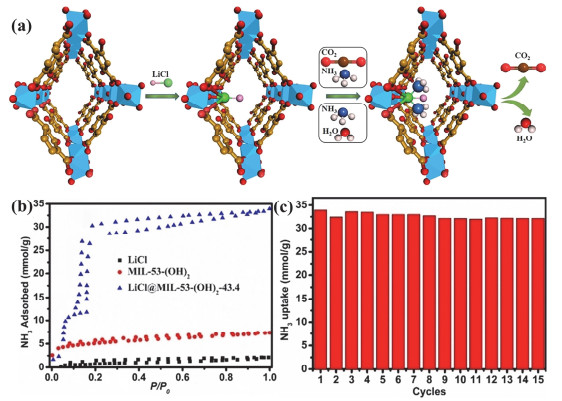
Fig 14
(a) The schematic of novel In-MOF for caption of NH3. (b) NH3 adsorption isotherms of In-MOF under 1 bar and 0 ℃. (c) 10 cycles of NH3 adsorption-desorption [43]. Adapted with permission from Ref. [43], Copyright 2024 Royal Society of Chemistry publisher."
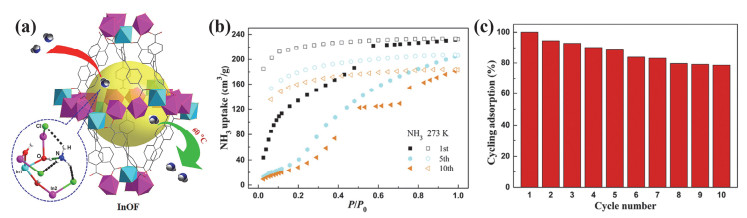
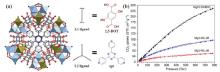
Fig 15
(a) Construction of CPM-231. (b) CO2 sorption of CPM-231 at 1 bar and 0 ℃ [21]. Adapted with permission from Ref. [21], Copyright 2016 Springer Nature publisher."
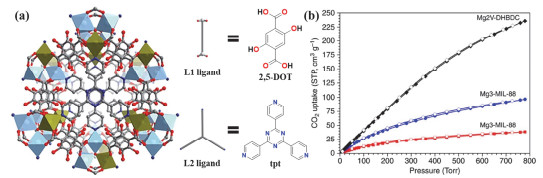
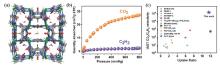
Fig 16
(a) The residual H2O shown as pink within micropore of Cu-F-pymo. (b) The CO2 and C2H2 sorption isotherms of Cu-F-pymo-a at 1 bar and RT. (c) Selectivity of CO2/C2H2 and uptake ratio in some MOF materials [51]. Adapted with permission from Ref. [51], Copyright 2021 John Wiley and Sons publisher."
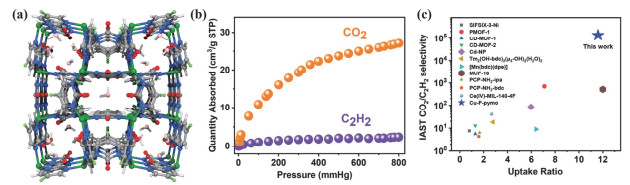
Fig 17
(a) Cage A [Mn86] consisting of 6 [Mn8O12], 8 [Mn4O4] clusters and 6 discrete Mn2+ cations. (b) The gas uptake isotherm at RT and 1 bar [52]. Adapted with permission from Ref. [52], Copyright 2023 John Wiley and Sons publisher."
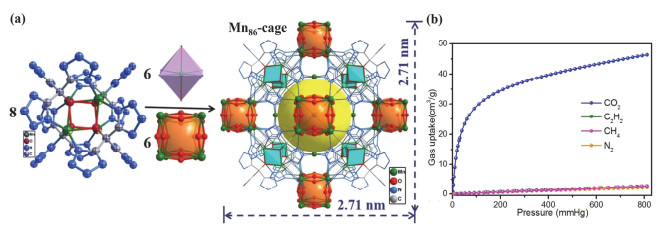
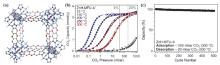
Fig 18
(a) A pore in ZnH-MFU-4l. (b) Varying-temperature CO2 adsorption (●) and desorption (○) isotherms. (c) The adsorption-desorption cycles of 508 [56]. Adapted with permission from Ref. [56], Copyright 2024 The American Association for the Advancement of Science publisher."
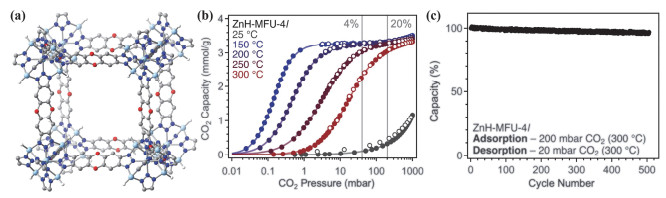
Fig 19
(a) The fsc framework of ZJU-300. (b) The C2H2 binding sites in the cavity of ZJU-300a. (c) Plot of C2H2/C2H4 selectivity versus 0.01-bar acetylene uptake for the top-performing materials [61]. Adapted with permission from Ref. [61], Copyright 2023 The American Association for the Advancement of Science publisher."
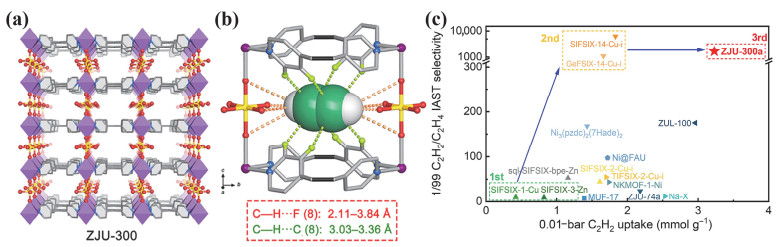
Fig 20
(a) 3D net in MIL-101-SO3H (SO3H group as yellow ball; Cr3+ cations as green polyhedra) and schematic of preparing H2SO4@MIL-101-SO3H. (b) Nyquist plot of H2SO4@MIL-101-SO3H (3 mol L−1) and the superprotonic conductivity [22]. Adapted with permission from Ref. [22], Copyright 2017 American Chemical Society publisher."
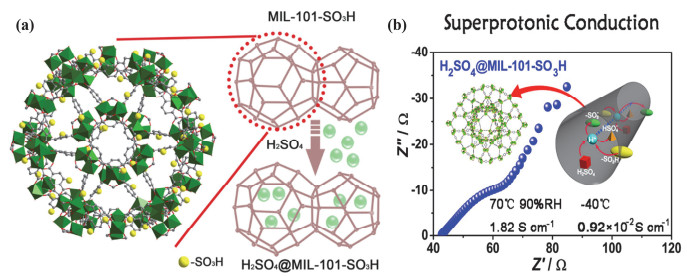
Fig 21
(a) Preparative route for LiCl@UiO-66-F2(SO3H)2. (b) CLMPC mechanism. (c) Nyquist plots of LiCl@UiO-66-F2(SO3H)2 under variable-temperature and 90% RH. (d) Some top performing materials with proton conductivities at 90% RH [23]. Adapted with permission from Ref. [23], Copyright 2023 American Chemical Society publisher."
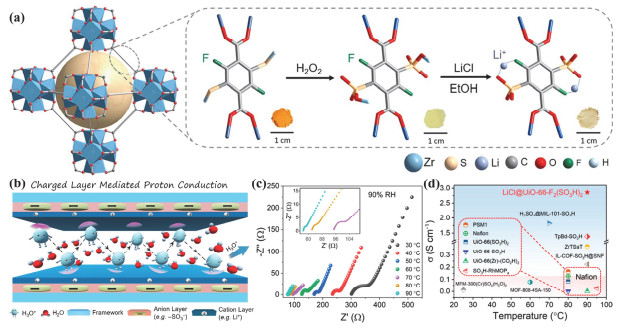
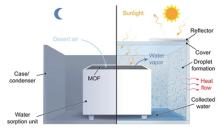
Fig 22
Schematic of the MOF-based monocyclic AWH device containing a water adsorptive unit in a case [73]. Adapted with permission from Ref. [73], Copyright 2018 The American Association for the Advancement of Science publisher."
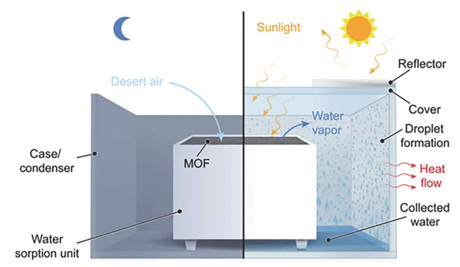
Fig 23
(a) Schematic for Cr-soc-MOF-1 capturing H2O double its weight. (b) H2O adsorption (●)/desorption (○) isotherm for activated Cr-soc-MOF-1 under RT. (c) Plot of H2O absorption vs. pore volume for some top-performing materials [24]. Adapted with permission from Ref. [24], Copyright 2018 Elsevier publisher."
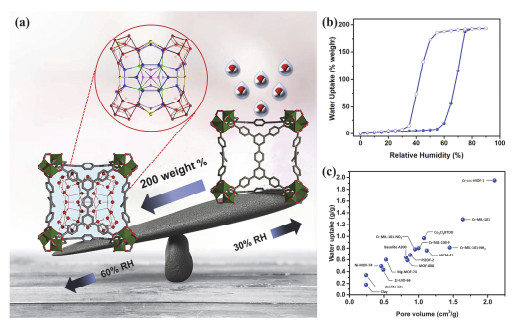
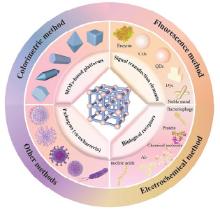
Fig 24
MOF-based biosensing methods for pathogen detection [83]. Adapted with permission from Ref. [83], Copyright 2023 Elsevier publisher."
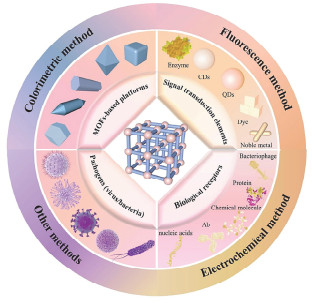
Fig 25
Schematic of 2D porphyrin-based heterobimetallic MOF, [(ZnTCPP)Co2(MeIm)], and its ECL biosensing to detect SARS-CoV-2 RdRp gene [89]. Adapted with permission from Ref. [89], Copyright 2022 John Wiley and Sons publisher."
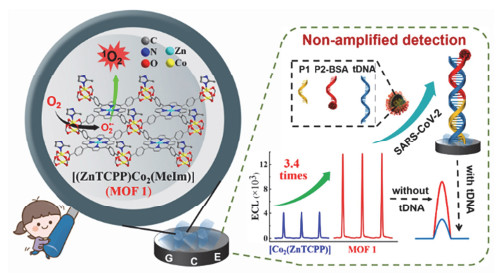
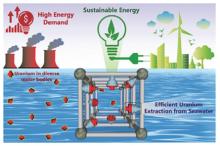
Fig 26
Schematic of MOFs used for UES for the substantial nuclear energy [102]. Adapted with permission from Ref. [102], Copyright 2023 John Wiley and Sons publisher."
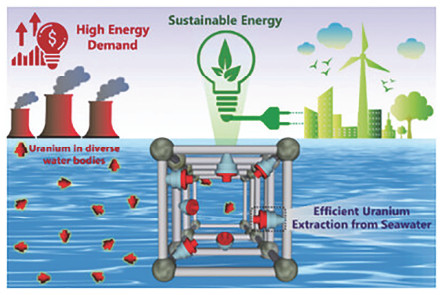
Fig 27
(a) Comparison of the U adsorption capacity of ZIF-67 with other MOFs sorbents. (b) Proposed adsorption mechanism of UO22+ by the ZIF-67 microcrystals [97]. Adapted with permission from Ref. [97], Copyright 2018 Elsevier publisher."
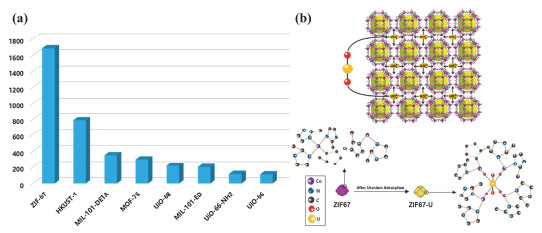
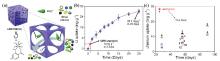
Fig 28
(a) Schematic of selective capturing UO22+ from the other cations by i-MZIF-90(50). (b) The UO22+ uptake in seawater during 25 days. (c) Plot of UO22+ uptake capacity vs. time for some top-performing sorbents in natural seawater [98]. Adapted with permission from Ref. [98], Copyright 2022 Royal Society of Chemistry publisher."
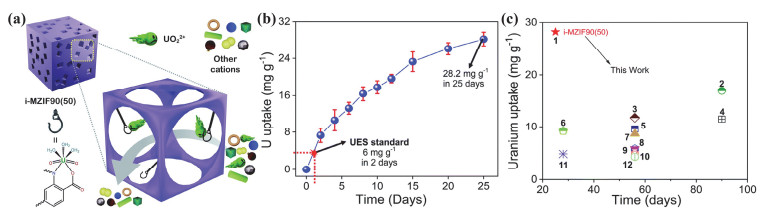
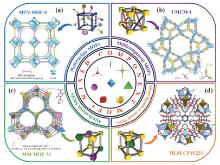
Fig 29
Schematic for four kinds of mixed-component MOFs and their typical examples. (a) Multivariate MOFs (MTV-MOF-5). (b) Multicomponent MOFs (UMCM-1). (c) Mixed-metals MOFs (MM-MOF-74). (d) Mixed-ligands and metals MOFs (MLM-CPM-231) [125]. Adapted with permission from Ref. [125], Copyright 2022 Elsevier publisher."
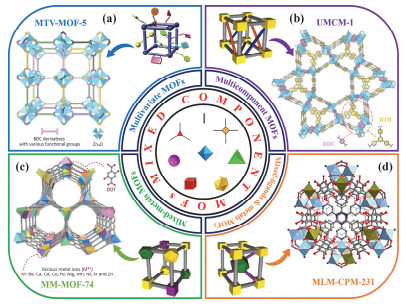
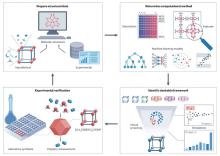
Fig 30
The roles LLMs can take in a data-driven selection process for synthesis of MOFs [159]. Adapted with permission from Ref. [159], Copyright 2025 Springer Nature publisher."
Fig 31
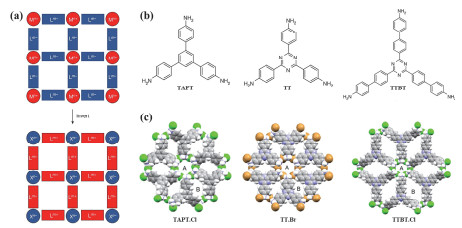
(a) Inverse reticular design strategy for non-MOFs. (b) Structures of organic bases used as linkers. (c) Space-filling structures of three non-MOFs TAPT.Cl, TT.Br, TTBT.Cl [167]. Adapted with permission from Ref. [167], Copyright 2024 Springer Nature publisher."
| 1 |
O. M. Yaghi, G. Li, H. Li. Nature 1995, 378, 703.
doi: 10.1038/378703a0 |
| 2 |
H. Li, M. Eddaoudi, M. O'Keeffe, O. M. Yaghi. Nature 1999, 402, 276.
doi: 10.1038/46248 |
| 3 |
B. F. Hoskins, R. Robson. J. Am. Chem. Soc. 1989, 111, 5962.
doi: 10.1021/ja00197a079 |
| 4 |
M. Kondo, T. Yoshitomi, K. Seki, H. Matsuzaka, S. Kitagawa. Angew. Chem. Int. Ed. Engl. 1997, 36, 1725.
doi: 10.1002/anie.199717251 |
| 5 |
H. Furukawa, K. E. Cordova, M. O'Keeffe, O. M. Yaghi. Science 2013, 341, 1230444.
doi: 10.1126/science.1230444 |
| 6 |
B. Li, H.-M. Wen, Y. J. Cui, W. Zhou, G. D. Qian, B. L. Chen. Adv. Mater. 2016, 28, 8819.
doi: 10.1002/adma.201601133 |
| 7 |
M. Yang, Y. Xie, D. Zhu. Prog. Chem. 2023, 35, 683.
doi: 10.7536/PC221112 |
| 8 |
J. Wang, Y. Zhang, Y. Su, X. Liu, P. Zhang, R.-B. Lin, S. Chen, Q. Deng, Z. Zeng, S. Deng, et al.. Nat. Commun. 2022, 13, 200.
|
| 9 |
S. Zhang, Y. Xie, R. J. Somerville, F. F. Tirani, R. Scopelliti, Z. Fei, D. Zhu, P. J. Dyson. Small 2023, 19, 2206999.
doi: 10.1002/smll.202206999 |
| 10 |
J. D. Pang, Z. Q. Zhang, S. T. Zhang, X. Y. Guo, Q. Chen, X.-W. Zhang, H.-L. Zhou, W. Gong, S. S. A. Shah, C. L. Zhong, et al.. Sci. China Chem. 2025, 68, 1230.
doi: 10.1007/s11426-024-2457-y |
| 11 |
J. D. Pang, W. T. Jiang, X.-W. Zhang, H.-L. Zhou, Y. X. Sun, W. Gong, B. Wang, F. Y. Ma, L. W. He, L. Chen, et al.. Sci. China Chem. 2025, 68, 1642.
doi: 10.1007/s11426-024-2458-3 |
| 12 |
Z. J. Chen, P. H. Li, R. Anderson, X. J. Wang, X. Zhang, L. Robison, L. R. Redfern, S. Moribe, T. Islamoglu, D. A. Gómez-Gualdrón, et al.. Science 2020, 368, 297.
doi: 10.1126/science.aaz8881 |
| 13 |
G. Hu, Q. Liu, Y. Zhou, W. Yan, Y. Sun, S. Peng, C. Zhao, X. Zhou, H. Deng. J. Am. Chem. Soc. 2023, 145, 13181.
doi: 10.1021/jacs.3c02128 |
| 14 |
P. Li, N. A. Vermeulen, C. D. Malliakas, D. A. Gómez-Gualdrón, A. J. Howarth, B. L. Mehdi, A. Dohnalkova, N. D. Browning, M. O'Keeffe, O. K. Farha. Science 2017, 356, 624.
doi: 10.1126/science.aam7851 |
| 15 |
J. Yuan, M. Yang, B. Yang, S. Chen, Z. Liu, Q. Pang, M. Wan, A. Zheng, B. Tu. Nat. Chem. 2025, 17, 421.
doi: 10.1038/s41557-024-01717-4 |
| 16 |
Z.-S. Wang, M. Li, Y.-L. Peng, Z. Zhang, W. Chen, X.-C. Huang. Angew. Chem. Int. Ed. 2019, 58, 16071.
doi: 10.1002/anie.201909046 |
| 17 |
P. Ajayan, W. Wang, Y. Chen, X. Bu, P. Feng. Adv. Mater. 2024, 36, 2408042.
doi: 10.1002/adma.202408042 |
| 18 |
M. T. Kapelewski, T. Runcěvski, J. D. Tarver, H. Z. H. Jiang, K. E. Hurst, P. A. Parilla, A. Ayala, T. Gennett, S. A. FitzGerald, C. M. Brown, et al.. Chem. Mater. 2018, 30, 8179.
doi: 10.1021/acs.chemmater.8b03276 |
| 19 |
J. A. Mason, J. Oktawiec, M. K. Taylor, M. R. Hudson, J. Rodriguez, J. E. Bachman, M. I. Gonzalez, A. Cervellino, A. Guagliardi, C. M. Brown, et al.. Nature 2015, 527, 357.
doi: 10.1038/nature15732 |
| 20 |
Y. Shi, Z. Wang, Z. Li, H. Wang, D. Xiong, J. Qiu, X. Tian, G. Feng, J. Wang. Angew. Chem. Int. Ed. 2022, 61, e202212032.
doi: 10.1002/anie.202212032 |
| 21 |
Q.-G. Zhai, X. Bu, C. Mao, X. Zhao, L. Daemen, Y. Cheng, A. J. Ramirez-Cuesta, P. Feng. Nat. Commun. 2016, 7, 13645.
doi: 10.1038/ncomms13645 |
| 22 |
X.-M. Li, L.-Z. Dong, S.-L. Li, G. Xu, J. Liu, F.-M. Zhang, L.-S. Lu, Y.-Q. Lan. ACS Energy Lett. 2017, 2, 2313.
doi: 10.1021/acsenergylett.7b00560 |
| 23 |
S.-L. Zheng, C.-M. Wu, L.-H. Chung, H.-Q. Zhou, J. Hu, Z. Liu, Y. Wu, L. Yu, J. He. ACS Energy Lett. 2023, 8, 3095.
doi: 10.1021/acsenergylett.3c00780 |
| 24 |
S. M. T. Abtab, D. Alezi, P. M. Bhatt, A. Shkurenko, Y. Belmabkhout, H. Aggarwal, Ł. J. Weseliński, N. Alsadun, U. Samin, M. N. Hedhili, et al.. Chem 2018, 4, 94.
doi: 10.1016/j.chempr.2017.11.005 |
| 25 |
H. Furukawa, N. Ko, Y. B. Go, N. Aratani, S. B. Choi, E. Choi, A. Ö. Yazaydin, R. Q. Snurr, M. O'Keeffe, J. Kim, et al.. Science 2010, 329, 424.
doi: 10.1126/science.1192160 |
| 26 |
H.-L. Jiang, T. A. Makal, H.-C. Zhou. Coord. Chem. Rev. 2013, 257, 2232.
doi: 10.1016/j.ccr.2013.03.017 |
| 27 |
J. J. Yang, Y.-B. Zhang, Q. Liu, C. A. Trickett, E. Gutierrez-Puebla, M. Á. Monge, H. J. Cong, A. Aldossary, H. X. Deng, O. M. Yaghi. J. Am. Chem. Soc. 2017, 139, 6448.
doi: 10.1021/jacs.7b02272 |
| 28 |
Q. Liu, Y. Song, Y. Ma, Y. Zhou, H. Cong, C. Wang, J. Wu, G. Hu, M. O'Keeffe, H. Deng. J. Am. Chem. Soc. 2019, 141, 488.
doi: 10.1021/jacs.8b11230 |
| 29 |
X. Gong, Y. Shu, Z. Jiang, L. Lu, X. Xu, C. Wang, H. Deng. Angew. Chem. Int. Ed. 2020, 59, 5326.
doi: 10.1002/anie.201915537 |
| 30 |
G. Hu, Q. Liu, H. Deng. Acc. Chem. Res. 2025, 58, 73.
doi: 10.1021/acs.accounts.4c00633 |
| 31 |
D. Feng, Z.-Y. Gu, J.-R. Li, H.-L. Jiang, Z. Wei, H.-C. Zhou. Angew. Chem. Int. Ed. 2012, 51, 10307.
doi: 10.1002/anie.201204475 |
| 32 |
K. Wang, X.-L. Lv, D. Feng, J. Li, S. Chen, J. Sun, L. Song, Y. Xie, J.-R. Li, H.-C. Zhou. J. Am. Chem. Soc. 2016, 138, 914.
doi: 10.1021/jacs.5b10881 |
| 33 |
H. Yang, F. Peng, A. N. Hong, Y. Wang, X. Bu, P. Feng. J. Am. Chem. Soc. 2021, 143, 14470.
doi: 10.1021/jacs.1c07277 |
| 34 |
W. Fan, X. Zhang, Z. Kang, X. Liu, D. Sun. Coord. Chem. Rev. 2021, 440, 213968.
doi: 10.1016/j.ccr.2021.213968 |
| 35 |
A. Ahmed, Y. Liu, J. Purewal, L. D. Tran, A. G. Wong-Foy, M. Veenstra, A. J. Matzger, D. J. Siegel. Energy Environ. Sci. 2017, 10, 2459.
doi: 10.1039/c7ee02477k |
| 36 |
Z. J. Chen, K. O. Kirlikovali, K. B. Idrees, M. C. Wasson, O. K. Farha. Chem 2022, 8, 693.
doi: 10.1016/j.chempr.2022.01.012 |
| 37 |
X. Zhang, R.-B. Lin, J. Wang, B. Wang, B. Liang, T. Yildirim, J. Zhang, W. Zhou, B. Chen. Adv. Mater. 2020, 32, 1907995.
doi: 10.1002/adma.201907995 |
| 38 |
X. Zhang, X. Zhang, J. A. Johnson, Y.-S. Chen, J. Zhang. J. Am. Chem. Soc. 2016, 138, 8380.
doi: 10.1021/jacs.6b04608 |
| 39 |
A. Schoedel, Z. Ji, O. M. Yaghi. Nat. Energy 2016, 1, 16034.
doi: 10.1038/nenergy.2016.34 |
| 40 |
S. S.-Y. Chui, S. M.-F. Lo, J. P. H. Charmant, A. G. Orpen, I. D. Williams. Science 1999, 283, 1148.
doi: 10.1126/science.283.5405.1148 |
| 41 |
Y. Peng, V. Krungleviciute, I. Eryazici, J. T. Hupp, O. K. Farha, T. Yildirim. J. Am. Chem. Soc. 2013, 135, 11887.
doi: 10.1021/ja4045289 |
| 42 |
F. Gándara, H. Furukawa, S. Lee, O. M. Yaghi. J. Am. Chem. Soc. 2014, 136, 5271.
doi: 10.1021/ja501606h |
| 43 |
X. He, S. Gao, R. Peng, D. Zhu, F. Yu. J. Mater. Chem. A 2024, 12, 14501.
doi: 10.1039/d4ta02447h |
| 44 |
D. W. Kim, D. W. Kang, M. Kang, J.-H. Lee, J. H. Choe, Y. S. Chae, D. S. Choi, H. Yun, C. S. Hong. Angew. Chem. Int. Ed. 2020, 59, 22531.
doi: 10.1002/anie.202012552 |
| 45 |
B. E. R. Snyder, A. B. Turkiewicz, H. Furukawa, M. V. Paley, E. O. Velasquez, M. N. Dods, J. R. Long. Nature 2023, 613, 287.
doi: 10.1038/s41586-022-05409-2 |
| 46 |
Y. Chen, F. Zhang, Y. Wang, C. Yang, J. Yang, J. Li. Micropor. Mesopor. Mat. 2018, 258, 170.
doi: 10.1016/j.micromeso.2017.09.013 |
| 47 |
D. W. Kim, D. W. Kang, M. Kang, D. S. Choi, H. Yun, S. Y. Kim, S. M. Lee, J. H. Lee, C. S. Hong. J. Am. Chem. Soc. 2022, 144, 9672.
doi: 10.1021/jacs.2c01117 |
| 48 |
Y.-L. Xu, Q. Gao, M. Zhao, H.-J. Zhang, Y.-H. Zhang, Z. Chang. Chin. Chem. Lett. 2017, 28, 55.
doi: 10.1016/j.cclet.2016.06.006 |
| 49 |
P. Nugent, Y. Belmabkhout, S. D. Burd, A. J. Cairns, R. Luebke, K. Forrest, T. Pham, S. Ma, B. Space, L. Wojtas, et al.. Nature 2013, 495, 80.
doi: 10.1038/nature11893 |
| 50 |
F. Xiang, L. Li, Z. Yuan, W. Wei, X. Zheng, S. Chen, Y. Yang, L. Chen, Z. Yao, J. Fu, et al.. Chin. Chem. Lett. 2025, 36, 109672.
doi: 10.1016/j.cclet.2024.109672 |
| 51 |
Y. Shi, Y. Xie, H. Cui, Y. Ye, H. Wu, W. Zhou, H. Arman, R.-B. Lin, B. Chen. Adv. Mater. 2021, 33, 2105880.
doi: 10.1002/adma.202105880 |
| 52 |
S. Geng, H. Xu, C.-S. Cao, T. Pham, B. Zhao, Z. Zhang. Angew. Chem. Int. Ed. 2023, 62, e202305390.
doi: 10.1002/anie.202305390 |
| 53 |
Z. Sharifzadeh, A. Morsali. Coord. Chem. Rev. 2022, 459, 214445.
doi: 10.1016/j.ccr.2022.214445 |
| 54 |
J. A. Mason, K. Sumida, Z. R. Herm, R. Krishna, J. R. Long. Energy Environ. Sci. 2011, 4, 3030.
doi: 10.1039/c1ee01720a |
| 55 |
A. Lee, G. Xiao, P. Xiao, K. Joshi, R. Singh, P. A. Webley. Energy Procedia 2011, 4, 1199.
doi: 10.1016/j.egypro.2011.01.174 |
| 56 |
R. C. Rohde, K. M. Carsch, M. N. Dods, H. Z. H. Jiang, A. R. McIsaac, R. A. Klein, H. Kwon, S. L. Karstens, Y. Wang, A. J. Huang, et al.. Science 2024, 386, 814.
doi: 10.1126/science.adk5697 |
| 57 |
H. Fang, J. Jiang, D. Wang, X. Liu, D. Zhu, Y. Li. Acta Phys.-Chim. Sin. 2023, 39, 2305030.
doi: 10.3866/PKU.WHXB202305030 |
| 58 |
K.-J. Chen, H. S. Scott, D. G. Madden, T. Pham, A. Kumar, A. Bajpai, M. Lusi, K. A. Forrest, B. Space, J. J. Perry IV, et al.. Chem 2016, 1, 753.
doi: 10.1016/j.chempr.2016.10.009 |
| 59 |
X. Cui, K. Chen, H. Xing, Q. Yang, R. Krishna, Z. Bao, H. Wu, W. Zhou, X. Dong, Y. Han, et al.. Science 2016, 353, 141.
doi: 10.1126/science.aaf2458 |
| 60 |
B. Li, X. Cui, D. O'Nolan, H.-M. Wen, M. Jiang, R. Krishna, H. Wu, R.-B. Lin, Y.-S. Chen, D. Yuan, et al.. Adv. Mater. 2017, 29, 1704210.
doi: 10.1002/adma.201704210 |
| 61 |
X.-W. Gu, E. Wu, J.-X. Wang, H.-M. Wen, B. Chen, B. Li, G. Qian. Sci. Adv. 2023, 9, eadh0135.
doi: 10.1126/sciadv.adh0135 |
| 62 |
K. Jiao, J. Xuan, Q. Du, Z. Bao, B. Xie, B. Wang, Y. Zhao, L. Fan, H. Wang, Z. Hou, et al.. Nature 2021, 595, 361.
doi: 10.1038/s41586-021-03482-7 |
| 63 |
X. Wang, T. Qin, S.-S. Bao, Y.-C. Zhang, X. Shen, L.-M. Zheng, D. Zhu. J. Mater. Chem. A 2016, 4, 16484.
doi: 10.1039/c6ta06792a |
| 64 |
X.-X. Xie, Y.-C. Yang, B.-H. Dou, Z.-F. Li, G. Li. Coord. Chem. Rev. 2020, 403, 213100.
doi: 10.1016/j.ccr.2019.213100 |
| 65 |
S. C. Pal, M. C. Das. Adv. Funct. Mater. 2021, 31, 2101584.
doi: 10.1002/adfm.202101584 |
| 66 |
J. Yang, S. Zhang, Z. Feng, Y. Cao, D.-R. Zhu. Dalton Trans. 2021, 50, 11975.
doi: 10.1039/d1dt02116h |
| 67 |
S. Zhang, Y. Xie, M. Yang, D. Zhu. Inorg. Chem. Front. 2022, 9, 1134.
doi: 10.1039/d1qi01610e |
| 68 |
Y.-P. Qu, Q. Zou, S.-S. Bao, L.-M. Zheng. Chin. Chem. Lett. 2024, 35, 108320.
doi: 10.1016/j.cclet.2023.108320 |
| 69 |
H. Furukawa, F. Gándara, Y.-B. Zhang, J. Jiang, W. L. Queen, M. R. Hudson, O. M. Yaghi. J. Am. Chem. Soc. 2014, 136, 4369.
doi: 10.1021/ja500330a |
| 70 |
H. Kim, S. Yang, S. R. Rao, S. Narayanan, E. A. Kapustin, H. Furukawa, A. S. Umans, O. M. Yaghi, E. N. Wang. Science 2017, 356, 430.
doi: 10.1126/science.aam8743 |
| 71 |
H. Kim, S. R. Rao, E. A. Kapustin, L. Zhao, S. Yang, O. M. Yaghi, E. N. Wang. Nat. Commun. 2018, 9, 1191.
doi: 10.1038/s41467-018-03162-7 |
| 72 |
M. J. Kalmutzki, C. S. Diercks, O. M. Yaghi. Adv. Mater. 2018, 30, 1704304.
doi: 10.1002/adma.201704304 |
| 73 |
F. Fathieh, M. J. Kalmutzki, E. A. Kapustin, P. J. Waller, J. J. Yang, O. M. Yaghi. Sci. Adv. 2018, 4, eaat3198.
doi: 10.1126/sciadv.aat3198 |
| 74 |
N. Hanikel, M. S. Prévot, F. Fathieh, E. A. Kapustin, H. Lyu, H. Wang, N. J. Diercks, T. G. Glover, O. M. Yaghi. ACS Cent. Sci. 2019, 5, 1699.
doi: 10.1021/acscentsci.9b00745 |
| 75 |
N. Hanikel, M. S. Prévot, O. M. Yaghi. Nat. Nanotechnol. 2020, 15, 348.
doi: 10.1038/s41565-020-0673-x |
| 76 |
Y. Tao, Q. Wu, C. Huang, W. Su, Y. Ying, D. Zhu, H. Li. ACS Appl. Mater. Interfaces 2022, 14, 10966.
doi: 10.1021/acsami.1c23644 |
| 77 |
Y. Tao, Q. Wu, C. Huang, D. Zhu, H. Li. Chem. Eng. J. 2023, 451, 138547.
doi: 10.1016/j.cej.2022.138547 |
| 78 |
Y. Tao, J. Sun, Q. Wu, D. Zhu, H. Li. Chem. Eng. J. 2023, 461, 141864.
doi: 10.1016/j.cej.2023.141864 |
| 79 |
H. Y. Lin, Y. H. Yang, Y.-C. Hsu, J. Q. Zhang, C. Welton, I. Afolabi, M. Loo, H.-C. Zhou. Adv. Mater. 2024, 36, e2209073.
doi: 10.1002/adma.202209073 |
| 80 |
H.-Y. Li, X.-J. Kong, S.-D. Han, J. Pang, T. He, G.-M. Wang, X.-H. Bu. Chem. Soc. Rev. 2024, 53, 5626.
doi: 10.1039/d3cs00873h |
| 81 |
Y. Wang, Y. Hu, Q. He, J. Yan, H. Xiong, N. Wen, S. Cai, D. Peng, Y. Liu, Z. Liu. Biosens. Bioelectron. 2020, 169, 112604.
doi: 10.1016/j.bios.2020.112604 |
| 82 |
K. Chattopadhyay, M. Mandal, D. K. Maiti. ACS Appl. Bio Mater. 2021, 4, 8159.
doi: 10.1021/acsabm.1c00982 |
| 83 |
J. Huang, W. Q. Li, X. K. Bai, F. B. Xiao, H. Y. Xu. Coord. Chem. Rev. 2023, 488, 215160.
doi: 10.1016/j.ccr.2023.215160 |
| 84 |
Q. Yang, J. Deng, D. Zhu, F. Yu, Y.-X. Li, J. Chauvin, X.-J. Zhang, S. Cosnier, D. Shan. Adv. Funct. Mater. 2025, 35, e25510.
doi: 10.1002/adfm.202525510 |
| 85 |
F. Yin, E. Yang, X. Ge, Q. Sun, F. Mo, G. Wu, Y. Shen. Chin. Chem. Lett. 2024, 35, 108753.
doi: 10.1016/j.cclet.2023.108753 |
| 86 |
C. Huang, Y. Wang, X. Li, L. Ren, J. Zhao, Y. Hu, L. Zhang, G. Fan, J. Xu, X. Gu, et al.. Lancet 2020, 395, 497.
doi: 10.1016/S0140-6736(20)30183-5 |
| 87 |
L. J. Carter, L. V. Garner, J. W. Smoot, Y. Li, Q. Zhou, C. J. Saveson, J. M. Sasso, A. C. Gregg, D. J. Soares, T. R. Beskid, et al.. ACS Cent. Sci. 2020, 6, 591.
doi: 10.1021/acscentsci.0c00501 |
| 88 |
C. Ma, Y. Cao, X. Gou, J.-J. Zhu, Anal.. Chem. 2020, 92, 431.
doi: 10.1021/acs.analchem.9b04947 |
| 89 |
Y.-X. Li, J. Li, D. Zhu, J.-Z. Wang, G.-F. Shu, J. Li, S.-L. Zhang, X.-J. Zhang, S. Cosnier, H.-B. Zeng, et al.. Adv. Funct. Mater. 2022, 32, 2209743.
doi: 10.1002/adfm.202209743 |
| 90 |
Z. Fan, B. Yao, Y. Ding, D. Xu, J. Zhao, K. Zhang. Chem. Eng. J. 2022, 427, 131686.
doi: 10.1016/j.cej.2021.131686 |
| 91 |
N. Kaltsoyannis, S. T. Liddle. Chem 2016, 1, 659.
doi: 10.1016/j.chempr.2016.10.003 |
| 92 |
D. S. Sholl, R. P. Lively. Nature 2016, 532, 435.
doi: 10.1038/532435a |
| 93 |
A. Ye, Y. Liu, L. Gong, X. Xie, F. Luo. Chem. Sci. 2025, 16, 13749.
doi: 10.1039/d5sc02966j |
| 94 |
J. Luo, X. Luo, M. Xie, J.-T. Lin, J. Pang, N. Yin, Y.-Y. Li, G.-H. Ning, D. Li. Sci. China Chem. 2025, 68, 1906.
doi: 10.1007/s11426-024-2424-0 |
| 95 |
M. Carboni, C. W. Abney, S. Liu, W. Lin. Chem. Sci. 2013, 4, 2396.
doi: 10.1039/c3sc50230a |
| 96 |
C. M. Abney, R. T. Mayes, T. Saito, S. Dai. Chem. Rev. 2017, 117, 13935.
doi: 10.1021/acs.chemrev.7b00355 |
| 97 |
S. Su, R. Che, Q. Liu, J. Liu, H. Zhang, R. Li, X. Jing, J. Wang. Colloid Surf. A 2018, 547, 73.
doi: 10.1016/j.colsurfa.2018.03.042 |
| 98 |
S. Mollick, S. Saurabh, Y. D. More, S. Fajal, M. M. Shirolkar, W. Mandala, S. K. Ghosh. Energy Environ. Sci. 2022, 15, 3462.
doi: 10.1039/d2ee01199a |
| 99 |
L. Feng, H. Wang, T. Feng, B. Yan, Q. Yu, J. Zhang, Z. Guo, Y. Yuan, C. Ma, T. Liu, et al.. Angew. Chem. Int. Ed. 2022, 61, 82.
doi: 10.1002/anie.202101015 |
| 100 |
Y. Xie, Z. Liu, Y. Geng, H. Li, N. Wang, Y. Song, X. Wang, J. Chen, J. Wang, S. Ma, et al.. Chem. Soc. Rev. 2023, 52, 97.
doi: 10.1039/d2cs00595f |
| 101 |
Y. Wu, Y. Xie, X. Liu, Y. Li, J. Wang, Z. Chen, H. Yang, B. Hu, C. Shen, Z. Tang, et al.. Coord. Chem. Rev. 2023, 483, 215097.
doi: 10.1016/j.ccr.2023.215097 |
| 102 |
Y. D. More, S. Mollick, S. Saurabh, S. Fajal, M. Tricarico, S. Dutta, M. M. Shirolkar, W. Mandal, J.-C. Tan, S. K. Ghosh. Small 2024, 20, 230214.
doi: 10.1002/smll.202302014 |
| 103 |
S. Wei, X. Li, C. Huang, D. Chen, S. Zhang, B. Zhu. Chin. Chem. Lett. 2025, 36, 111858.
doi: 10.1016/j.cclet.2025.111858 |
| 104 |
L. Gagliardi, O. M. Yaghi. Chem. Mater. 2023, 35, 5711.
doi: 10.1021/acs.chemmater.3c01706 |
| 105 |
H. Deng, C. J. Doonan, H. Furukawa, R. B. Ferreira, J. Towne, C. B. Knobler, B. Wang, O. M. Yaghi. Science 2010, 327, 846.
doi: 10.1126/science.1181761 |
| 106 |
J. Li, Y. Wang, Y. Yu, Q. Li. Chin. Chem. Lett. 2018, 29, 837.
doi: 10.1016/j.cclet.2017.12.026 |
| 107 |
S. Yuan, J.-S. Qin, L. Zou, Y.-P. Chen, X. Wang, Q. Zhang, H.-C. Zhou. J. Am. Chem. Soc. 2016, 138, 6636.
doi: 10.1021/jacs.6b03263 |
| 108 |
Z. Dong, Y. Sun, J. Chu, X. Zhang, H. Deng. J. Am. Chem. Soc. 2017, 139, 14209.
doi: 10.1021/jacs.7b07392 |
| 109 |
Q. Xia, Z. Li, C. Tan, Y. Liu, W. Gong, Y. Cui. J. Am. Chem. Soc. 2017, 139, 8259.
doi: 10.1021/jacs.7b03113 |
| 110 |
B. Tu, Q. Pang, H. Xu, X. Li, Y. Wang, Z. Ma, L. Weng, Q. Li. J. Am. Chem. Soc. 2017, 139, 7998.
doi: 10.1021/jacs.7b03578 |
| 111 |
A. Helal, Z. H. Yamani, K. E. Cordova, O. M. Yaghi. Natl. Sci. Rev. 2017, 4, 296.
doi: 10.1093/nsr/nwx013 |
| 112 |
J.-S. Qin, S. Yuan, Q. Wang, A. Alsalme, H.-C. Zhou. J. Mater. Chem. A. 2017, 5, 4280.
doi: 10.1039/c6ta10281f |
| 113 |
J. Pang, S. Yuan, J. Qin, M. Wu, C. T. Lollar, J. Li, N. Huang, B. Li, P. Zhang, H.-C. Zhou. J. Am. Chem. Soc. 2018, 140, 12328.
doi: 10.1021/jacs.8b07411 |
| 114 |
C. Castillo-Blas, F. Gándara. Isr. J. Chem. 2018, 58, 1036.
doi: 10.1002/ijch.201800085 |
| 115 |
C. Tan, X. Han, Z. Li, Y. Liu, Y. Cui. J. Am. Chem. Soc. 2018, 140, 16229.
doi: 10.1021/jacs.8b09606 |
| 116 |
L. Feng, K.-Y. Wang, G. S. Day, H.-C. Zhou. Chem. Soc. Rev. 2019, 48, 4823.
doi: 10.1039/c9cs00250b |
| 117 |
M. Y. Masoomi, A. Morsali, A. Dhakshinamoorthy, H. Garcia. Angew. Chem. Int. Ed. 2019, 58, 1518.
doi: 10.1002/anie.201902229 |
| 118 |
Q. Pang, B. Tu, Q. Li. Coord. Chem. Rev. 2019, 388, 107.
doi: 10.1016/j.ccr.2019.02.022 |
| 119 |
M. Kalaj, J. M. Palomba, K. C. Bentz, S. M. Cohen. Chem. Commun. 2019, 55, 5367.
doi: 10.1039/c9cc02252j |
| 120 |
L. Feng, K.-Y. Wang, X.-L. Lv, J. A. Powell, T.-H. Yan, J. Willman, H.-C. Zhou. J. Am. Chem. Soc. 2019, 141, 14524.
doi: 10.1021/jacs.9b06917 |
| 121 |
S. Abednatanzi, P. G. Derakhshandeh, H. Depauw, F.-X. Coudert, H. Vrielinck, P. Van Der Voort, K. Leus. Chem. Soc. Rev. 2019, 48, 2535.
doi: 10.1039/c8cs00337h |
| 122 |
Z. Ji, T. Li, O. M. Yaghi. Science 2020, 369, 674.
doi: 10.1126/science.aaz4304 |
| 123 |
N. M. Padial, B. Lerma-Berlanga, N. Almora-Barrios, J. Castells-Gil, I. da Silva, M. de la Mata, S. I. Molina, J. Hernández-Saz, A. E. Platero-Prats, S. Tatay, et al.. J. Am. Chem. Soc. 2020, 142, 6638.
doi: 10.1021/jacs.0c00117 |
| 124 |
R. Rajak, R. Kumar, S. N. Ansari, M. Saraf, S. M. Mobin. Dalton Trans. 2020, 49, 11792.
doi: 10.1039/d0dt01676d |
| 125 |
M. Viciano-Chumillas, X. Liu, A. Leyva-Pérez, D. Armentano, J. Ferrando-Soria, E. Pardo. Coord. Chem. Rev. 2022, 451, 214273.
doi: 10.1016/j.ccr.2021.214273 |
| 126 |
S. J. Lee, S. G. Telfer. Angew. Chem. Int. Ed. 2023, 62, e202306341.
doi: 10.1002/anie.202306341 |
| 127 |
Y. K. Sun, K. J. Quan, J. He, J. Chen, Z. G. Li, H. D. Qiu. Chem. Eng. J. 2024, 495, 153621.
doi: 10.1016/j.cej.2024.153621 |
| 128 |
W. Zhen, Z. Xu, Y. Mao, C. McCleary, X. Jiang, R. R. Weichselbaum, W. Lin. J. Am. Chem. Soc. 2024, 146, 33149.
doi: 10.1021/jacs.4c12140 |
| 129 |
M. B. Nguyen, L. H. T. Nguyen, H. T. Lai, H. V. Doan, N. Q. Tran, N. X. D. Mai, L. D. Tran, P. A. Krisbiantoro, K. C.-W. Wu, T. L. H. Doan. Chem. Eng. J. 2024, 497, 154479.
doi: 10.1016/j.cej.2024.154479 |
| 130 |
W. T. Jiang, C.-C. Liang, Y.-B. Zhang. Adv. Funct. Mater. 2024, 34, 2308946.
doi: 10.1002/adfm.202308946 |
| 131 |
X. Chen, J.-Y. Song, J. Zheng, Y.-M. Wang, J. Luo, P. Weng, B.-C. Cai, X.-C. Lin, G.-H. Ning, D. Li. J. Am. Chem. Soc. 2024, 146, 19271.
doi: 10.1021/jacs.4c04556 |
| 132 |
H. Li, H. Yang, X. Pu, Y. Xu, K. Zhu, C. Xue, H. Huang, L. Gan, H. Yang. Adv. Mater. 2025, 37, 2414151.
doi: 10.1002/adma.202414151 |
| 133 |
M. Bonneau, C. Lavenn, J.-J. Zheng, A. Legrand, T. Ogawa, K. Sugimoto, F.-X. Coudert, R. Reau, S. Sakaki, K.-i. Otake, et al.. Nat. Chem. 2022, 14, 816.
doi: 10.1038/s41557-022-00928-x |
| 134 |
C.-K. Chang, T.-R. Ko, T.-Y. Lin, Y.-C. Lin, H. J. Yu, J. S. Lee, Y.-P. Li, H.-L. Wu, D.-Y. Kang. Commun. Chem. 2023, 6, 118.
doi: 10.1038/s42004-023-00917-2 |
| 135 |
N. Hanikel, X. Pei, S. Chheda, H. Lyu, W. Jeong, J. Sauer, L. Gagliardi, O. M. Yaghi. Science 2021, 374, 454.
doi: 10.1126/science.abj0890 |
| 136 |
Z. Zheng, N. Hanikel, H. Lyu, O. M. Yaghi. J. Am. Chem. Soc. 2022, 144, 22669.
doi: 10.1021/jacs.2c09756 |
| 137 |
T.-Y. Zhou, B. Auer, S. J. Lee, S. G. Telfer. J. Am. Chem. Soc. 2019, 141, 1577.
doi: 10.1021/jacs.8b11221 |
| 138 |
Y. Pi, X. Feng, Y. Song, Z. Xu, Z. Li, W. Lin. J. Am. Chem. Soc. 2020, 142, 10302.
doi: 10.1021/jacs.0c03906 |
| 139 |
B. Gui, Y. Meng, Y. Xie, J. Tian, G. Yu, W. Zeng, G. Zhang, S. Gong, C. Yang, D. Zhang, et al.. Adv. Mater. 2018, 30, 1802329.
doi: 10.1002/adma.201802329 |
| 140 |
W. J. Newsome, S. Ayad, J. Cordova, E. W. Reinheimer, A. D. Campiglia, J. K. Harper, K. Hanson, F. J. Uribe-Romo. J. Am. Chem. Soc. 2019, 141, 11298.
doi: 10.1021/jacs.9b05191 |
| 141 |
R. Moi, A. Ghorai, S. Banerjee, K. Biradha. Cryst. Growth Des. 2020, 20, 5557.
doi: 10.1021/acs.cgd.0c00732 |
| 142 |
S. Nandi, S. Wang, M. Wahiduzzaman, V. Yadav, K. Taksande, G. Maurin, C. Serre, S. Devautour-Vinot. ACS Appl. Mater. Interfaces 2021, 13, 20194.
doi: 10.1021/acsami.1c03644 |
| 143 |
Y. G. Chung, E. Haldoupis, B. J. Bucior, M. Haranczyk, S. Lee, H. Zhang, K. D. Vogiatzis, M. Milisavljevic, S. Ling, J. S. Camp, et al.. J. Chem. Eng. Data 2019, 64, 5985.
doi: 10.1021/acs.jced.9b00835 |
| 144 |
P. Z. Moghadam, S. M. J. Rogge, A. Li, C.-M. Chow, J. Wieme, N. Moharrami, M. Aragones-Anglada, G. Conduit, D. A. Gomez-Gualdron, V. V. Speybroeck, et al.. Matter 2019, 1, 219.
doi: 10.1016/j.matt.2019.03.002 |
| 145 |
A. Nandy, C. Duan, H. J. Kulik. J. Am. Chem. Soc. 2021, 143, 17535.
doi: 10.1021/jacs.1c07217 |
| 146 |
A. S. Rosen, S. M. Iyer, D. Ray, Z. Yao, A. Aspuru-Guzik, L. Gagliardi, J. M. Notestein, R. Q. Snurr. Matter 2021, 4, 1578.
doi: 10.1016/j.matt.2021.02.015 |
| 147 |
A. Nandy, G. Terrones, N. Arunachalam, C. R. Duan, D. W. Kastner, H. J. Kulik. Sci. Data 2022, 9, 74.
doi: 10.1038/s41597-022-01181-0 |
| 148 |
Z. Zheng, O. Zhang, C. Borgs, J. T. Chayes, O. M. Yaghi. J. Am. Chem. Soc. 2023, 145, 18048.
doi: 10.1021/jacs.3c05819 |
| 149 |
Z. Zheng, Z. Rong, N. Rampal, C. Borgs, J. T. Chayes, O. M. Yaghi. Angew. Chem. Int. Ed. 2023, 62, e202311983.
doi: 10.1002/anie.202311983 |
| 150 |
Z. Zheng, A. H. Alawadhi, S. Chheda, S. E. Neumann, N. Rampal, S. Liu, H. L. Nguyen, Y.-h. Lin, Z. Rong, J. I. Siepmann, et al.. J. Am. Chem. Soc. 2023, 145, 28284.
doi: 10.1021/jacs.3c12086 |
| 151 |
Z. Zheng, O. Zhang, H. L. Nguyen, N. Rampal, A. H. Alawadhi, Z. Rong, T. Head-Gordon, C. Borgs, J. T. Chayes, O. M. Yaghi. ACS Cent. Sci. 2023, 9, 2161.
doi: 10.1021/acscentsci.3c01087 |
| 152 |
N. S. Bobbitt, K. Shi, B. J. Bucior, H. Chen, N. Tracy-Amoroso, Z. Li, Y. Sun, J. H. Merlin, J. I. Siepmann, D. W. Siderius, et al.. J. Chem. Eng. Data 2023, 68, 483.
doi: 10.1021/acs.jced.2c00583 |
| 153 |
L. T. Glasby, K. Gubsch, R. Bence, R. Oktavian, K. Isoko, S. M. Moosavi, J. L. Cordiner, J. C. Cole, P. Z. Moghadam. Chem. Mater. 2023, 35, 4510.
doi: 10.1021/acs.chemmater.3c00788 |
| 154 |
Y. Kang, J. Kim. Nat. Commun. 2024, 15, 4705.
doi: 10.1038/s41467-024-48998-4 |
| 155 |
Y. Ruan, C. Lu, N. Xu, Y. He, Y. Chen, J. Zhang, J. Xuan, J. Pan, Q. Fang, H. Gao, et al.. Nat. Commun. 2024, 15, 10160.
doi: 10.1038/s41467-024-54457-x |
| 156 |
L. M. Antunes, K. T. Butler, R. Grau-Crespo. Nat. Commun. 2024, 15, 10570.
doi: 10.1038/s41467-024-54639-7 |
| 157 |
W. Zhang, Q. Wang, X. Kong, J. Xiong, S. Ni, D. Cao, B. Niu, M. Chen, Y. Li, R. Zhang, et al.. Chem. Sci. 2024, 15, 10600.
doi: 10.1039/d4sc00924j |
| 158 |
G. G. Terrones, S.-P. Huang, M. P. Rivera, S. Yue, A. Hernandez, H. J. Kulik. J. Am. Chem. Soc. 2024, 146, 20333.
doi: 10.1021/jacs.4c05879 |
| 159 |
Z. Zheng, N. Rampal, T. J. Inizan, C. Borgs, J. T. Chayes, O. M. Yaghi. Nat. Rev. Mater. 2025, 10, 369.
doi: 10.1038/s41578-025-00772-8 |
| 160 |
Z. Han, Y. Yang, J. Rushlow, J. Huo, Z. Liu, Y.-C, Hsu, R. Yin, M. Wang, R. Liang, K.-Y. Wang, et al.. Chem. Soc. Rev. 2025, 54, 367.
doi: 10.1039/d4cs00432a |
| 161 |
M. Negahdary, S. Mabbott. Coord. Chem. Rev. 2025, 523, 216249.
doi: 10.1016/j.ccr.2024.216249 |
| 162 |
S. Greed, O. M. Yaghi. Nat. Rev. Chem. 2025, 9, 135.
doi: 10.1038/s41570-025-00691-w |
| 163 |
Y. Luo, S. Bag, O. Zaremba, A. Cierpka, J. Andreo, S. Wuttke, P. Friederich, M. Tsotsalas. Angew. Chem. Int. Ed. 2022, 61, e202200242.
doi: 10.1002/anie.202200242 |
| 164 |
X. Zhang, K. Zhang, Y. Lee. ACS Appl. Mater. Interfaces 2020, 12, 734.
doi: 10.1021/acsami.9b17867 |
| 165 |
C. R. Groom, I. J. Bruno, M. P. Lightfoot, S. C. Ward. Acta Cryst. B 2016, 72, 171.
doi: 10.1107/S2052520616003954 |
| 166 |
P. Z. Moghadam, A. Li, S. B. Wiggin, A. Tao, A. G. P. Maloney, P. A. Wood, S. C. Ward, D. Fairen-Jimenez. Chem. Mater. 2017, 29, 2618.
doi: 10.1021/acs.chemmater.7b00441 |
| 167 |
M. O'Shaughnessy, J. Glover, R. Hafizi, M. Barhi, R. Clowes, S. Y. Chong, S. P. Argent, G. M. Day, A. I. Cooper. Nature 2024, 630, 102.
doi: 10.1038/s41586-024-07353-9 |
| 168 |
V. A. Russell, M. C. Etter, M. D. Ward. J. Am. Chem. Soc. 1994, 116, 1941.
doi: 10.1021/ja00084a039 |
| 169 |
Y. Liu, C. Hu, A. Comotti, M. D. Ward. Science 2011, 333, 436.
doi: 10.1126/science.1204369 |
| 170 |
T. Hasell, A. I. Cooper. Nat. Rev. Mater. 2016, 1, 16053.
doi: 10.1038/natrevmats.2016.53 |
| 171 |
S. Bracco, T. Miyano, M. Negroni, I. Bassanetti, L. Marchio´, P. Sozzani, N. Tohnai, A. Comotti. Chem. Commun. 2017, 53, 7776.
doi: 10.1039/c7cc02983g |
| 172 |
G. Xing, T. Yan, S. Das, T. Ben, S. Qiu. Angew. Chem. Int. Ed. 2018, 57, 5345.
doi: 10.1002/anie.201800423 |
| 173 |
S. A. Boer, M. Morshedi, A. Tarzia, C. J. Doonan, N. G. White. Chem. Eur. J. 2019, 25, 10006.
doi: 10.1002/chem.201902117 |
| 174 |
Y. Wang, T. Yan, T. Ben. Chem. Res. Chin. Univ. 2020, 36, 976.
doi: 10.1007/s40242-020-9276-1 |
| 175 |
I. Brekalo, D. E. Deliz, L. J. Barbour, M. D. Ward, T. Friščić, K. T. Holman. Angew. Chem. Int. Ed. 2020, 59, 1997.
doi: 10.1002/anie.201911861 |
| 176 |
S. Yu, G.-L. Xing, L.-H. Chen, T. Ben. B.-L. Su. Adv. Mater. 2020, 32, 2003270.
doi: 10.1002/adma.202003270 |
| 177 |
Y. Zhao, C. Fan, C. Pei, X. Geng, G. Xing, T. Ben, S. Qiu. J. Am. Chem. Soc. 2020, 142, 3593.
doi: 10.1021/jacs.9b13274 |
| 178 |
S. Zhang, J. Fu, S. Das, K. Ye, W. Zhu, T. Ben. Angew. Chem. Int. Ed. 2022, 61, e202208660.
doi: 10.1002/anie.202208660 |
| 179 |
W. Xin, J. Fu, Y. Qian, L. Fu, X.-Y. Kong, T. Ben, L. Jiang, L. Wen. Nat. Commun. 2022, 13, 1701.
doi: 10.1038/s41467-022-29382-6 |
| 180 |
H. Sei, K. Oka, H. Sotome, H. Miyasaka, N. Tohnai. Small 2023, 19, 2301887.
doi: 10.1002/smll.202301887 |
| 181 |
M. O'Shaughnessy, A. C. Padgham, R. Clowes, M. A. Little, M. C. Brand, H. Qu, A. G. Slater, A. I. Cooper. Chem. Eur. J. 2023, 29, e202302420.
doi: 10.1002/chem.202302420 |
| 182 |
G. Xing, S. Zhang, W. Zhu, T. Ben. Angew. Chem. Int. Ed. 2023, 62, e202215074.
doi: 10.1002/anie.202215074 |
| 183 |
I. Hutskalov, A. Linden, I. Čorić. J. Am. Chem. Soc. 2023, 145, 8291.
doi: 10.1021/jacs.3c01030 |
| 184 |
X. Yang, Q. Guo, X. Liu, J.-X. Ma. Adv. Sci. 2024, 11, 2403539.
doi: 10.1002/advs.202403539 |
| 185 |
T. Ami, K. Oka, S. Kitajima, N. Tohnai. Angew. Chem. Int. Ed. 2024, 63, e202407484.
doi: 10.1002/anie.202407484 |
| 186 |
G. Xing, D. Peng, T. Ben. Chem. Soc. Rev. 2024, 53, 1495.
doi: 10.1039/d3cs00855j |
| 187 |
Y. Xie, X. Ding, J. Wang, G. Ye. Angew. Chem. Int. Ed. 2023, 62, e202313951.
doi: 10.1002/anie.202313951 |
| 188 |
D. Sun, G. Xing, J. Lyu, Y. Han, P. Sun, Y. Zhao, K. Iqbal, H. Kong, Y. Zhang, D. Peng, et al.. J. Mater. Chem. A 2024, 12, 31223.
doi: 10.1039/d4ta06066k |
| 189 |
S. A. Kuznetsova, S. M. Yunusov, M. North, V. P. Zhereb, E. A. Khakina, A. Naumkin, N. N. Lobanov, V. N. Khrustalev, D. Chusov, E. S. Kalyuzhnaya, et al.. ChemistrySelect 2024, 9, e202402788.
doi: 10.1002/slct.202402788 |
| 190 |
S. Wang, J. Chen, Y. Chang, S. Wang, C. Meng, Z. Long, G. Chen. J. Mater. Chem. A 2024, 12, 14159.
doi: 10.1039/d4ta01548g |
| 191 |
J. Wang, S. Yang, L. Zhang, X. Xiao, Z. Deng, X. Chen, C. Liu, G. Huang, R. T. K. Kwok, J. W. Y. Lam, et al.. J. Am. Chem. Soc. 2024, 146, 31042.
doi: 10.1021/jacs.4c10713 |
| 192 |
B. Xu, Y. Zhang, Y. Pi, Q. Shao, X. Huang. Acta Phys.-Chim. Sin. 2021, 37, 2009074.
doi: 10.3866/PKU.WHXB202009074 |
| 193 |
Y. Zhao, J. Yuan, L. Zhu, Y. Fang. Chin. Chem. Lett. 2024, 35, 109065.
doi: 10.1016/j.cclet.2023.109065 |
| 194 |
H.-Y. Chen, H.-L. Zhu, P.-Q. Liao, X.-M. Chen. Acta Phys.-Chim. Sin. 2024, 40, 2306046.
doi: 10.3866/PKU.WHXB202306046 |
| 195 |
B. Shao, H. Dong, Y. Gong, J. Mei, F. Cai, J. Liu, D. Zhong, T. Lu. Acta Phys.-Chim. Sin. 2024, 40, 2305026.
doi: 10.3866/PKU.WHXB202305026 |
| 196 |
X. Zhao, H. Qiu, Y. Shao, P. Wang, S. Yu, H. Li, Y. Zhou, Z. Zhou, L. Ma, C. Tan. Acta Phys.-Chim. Sin. 2023, 39, 2211043.
doi: 10.3866/PKU.WHXB202211043 |
| 197 |
B. Xue, X. Geng, H. Cui, H. Chen, Z. Wu, H. Chen, H. Li, Z. Zhou, M. Zhao, C. Tan, et al.. Chin. Chem. Lett. 2023, 34, 108140.
doi: 10.1016/j.cclet.2023.108140 |
| 198 |
S. He, D. Chu, Z. Pang, Y. Du, J. Wang, Y. Chen, Y. Su, J. Qin, X. Pan, Z. Zhou, et al.. Acta Phys.-Chim. Sin. 2025, 41, 100046.
doi: 10.1016/j.actphy.2025.100046 |
| 199 |
M. Wakizaka, R. Ishikawa, H. Tanaka, S. Cupta, S. Takaishi, M. Yamashita. Small 2023, 19, 2301966.
doi: 10.1002/smll.202301966 |
| 200 |
R.-J. Wei, X. Luo, G.-H. Ning, D. Li. Acc. Chem. Res. 2025, 58, 746.
doi: 10.1021/acs.accounts.4c00774 |
| [1] | Hua Yu, Dingdu Chen, Xuan Wang, Lijun Yang, Geming Wang, Pu Hu. MOF-encapsulated phosphorus/nitrogen ionic liquid as a multifunctional flame-retardant additive for high-safety lithium-ion batteries [J]. Acta Phys. -Chim. Sin., 2026, 42(7): 100201-. |
| [2] | Zhuo Wang, Xue Bai, Kexin Zhang, Hongzhi Wang, Jiabao Dong, Yuan Gao, Bin Zhao. MOF-Templated Synthesis of Nitrogen-Doped Carbon for Enhanced Electrochemical Sodium Ion Storage and Removal [J]. Acta Phys. -Chim. Sin., 2025, 41(3): 100026-. |
| [3] | Bizhu Shao, Huijun Dong, Yunnan Gong, Jianhua Mei, Fengshi Cai, Jinbiao Liu, Dichang Zhong, Tongbu Lu. Metal-Organic Framework-Derived Nickel Nanoparticles for Efficient CO2 Electroreduction in Wide Potential Windows [J]. Acta Phys. -Chim. Sin., 2024, 40(4): 2305026-. |
| [4] | Hui-Ying Chen, Hao-Lin Zhu, Pei-Qin Liao, Xiao-Ming Chen. Integration of Ru(Ⅱ)-Bipyridyl and Zinc(Ⅱ)-Porphyrin Moieties in a Metal-Organic Framework for Efficient Overall CO2 Photoreduction [J]. Acta Phys. -Chim. Sin., 2024, 40(4): 2306046-. |
| [5] | Yinjie Xu, Suiqin Li, Lihao Liu, Jiahui He, Kai Li, Mengxin Wang, Shuying Zhao, Chun Li, Zhengbin Zhang, Xing Zhong, Jianguo Wang. Enhanced Electrocatalytic Oxidation of Sterols using the Synergistic Effect of NiFe-MOF and Aminoxyl Radicals [J]. Acta Phys. -Chim. Sin., 2024, 40(3): 2305012-. |
| [6] | Jingchao Xiang, Jingjun Li, Xue Yang, Shuiying Gao, Rong Cao. Cationic Ni-MOF-Assembled CdS/PFC-8 Catalyst for Photocatalytic Hydrogen Production with Selective Benzyl Alcohol Oxidation under Visible Light [J]. Acta Phys. -Chim. Sin., 2023, 39(4): 2205039-0. |
| [7] | Zhuohao Jiao, Xinyuan Zhao, Jian Zhao, Yao Xie, Shengli Hou, Bin Zhao. [Co3]-Cluster Based Metal-Organic Framework Enables "Two Birds with One Stone" in Efficient Transformation of CO2 to Oxazolidinones [J]. Acta Phys. -Chim. Sin., 2023, 39(11): 2301018-. |
| [8] | Bingyan Xu, Ying Zhang, Yecan Pi, Qi Shao, Xiaoqing Huang. Research Progress of Nickel-Based Metal-Organic Frameworks and Their Derivatives for Oxygen Evolution Catalysis [J]. Acta Phys. -Chim. Sin., 2021, 37(7): 2009074-. |
| [9] | Zengqiang Gao, Congyong Wang, Junjun Li, Yating Zhu, Zhicheng Zhang, Wenping Hu. Conductive Metal-Organic Frameworks for Electrocatalysis:Achievements, Challenges, and Opportunities [J]. Acta Phys. -Chim. Sin., 2021, 37(7): 2010025-. |
| [10] | Chengfang Qiao,Lei Lü,Wenfeng Xu,Zhengqiang Xia,Chunsheng Zhou,Sanping Chen,Shengli Gao. Synthesis, Thermal Decomposition Kinetics and Detonation Performance of a Three-Dimensional Solvent-Free Energetic Ag(I)-MOF [J]. Acta Physico-Chimica Sinica, 2020, 36(6): 1905085-. |
| [11] | Shuhua Duan,Shufeng Wu,Lei Wang,Houde She,Jingwei Huang,Qizhao Wang. Rod-Shaped Metal Organic Framework Structured PCN-222(Cu)/TiO2 Composites for Efficient Photocatalytic CO2 Reduction [J]. Acta Physico-Chimica Sinica, 2020, 36(3): 1905086-. |
| [12] | Qianqian WANG, Dajun LIU, Xingquan HE. Metal-Organic Framework-Derived Fe-N-C Nanohybrids as Highly-Efficient Oxygen Reduction Catalysts [J]. Acta Physico-Chimica Sinica, 2019, 35(7): 740-748. |
| [13] | Xueting LIN,Mingli FU,Hui HE,Junliang WU,Limin CHEN,Daiqi YE,Yun HU,Yifan WANG,William WEN. Synthesis of MnOx-CeO2 Using Metal-Organic Framework as Sacrificial Template and Its Performance in the Toluene Catalytic Oxidation Reaction [J]. Acta Phys. -Chim. Sin., 2018, 34(6): 719-730. |
| [14] | Xiao-Lei LI,Shuo TAO,Ke-Da LI,Ya-Song WANG,Ping WANG,Zhi-Jian TIAN. In situ Synthesis of ZIF-8 Membranes with Gas Separation Performance in a Deep Eutectic Solvent [J]. Acta Phys. -Chim. Sin., 2016, 32(6): 1495-1500. |
| [15] | Zhen-Zhen. LIU,Yong. SHI,Chun-Yan. LI,Qi-Dong. ZHAO,Xin-Yong. LI. Electrochemical Synthesis of Cu3(BTC)2-MOF for Selective Catalytic Reduction of NO with NH3 [J]. Acta Phys. -Chim. Sin., 2015, 31(12): 2366-2374. |
|
||