物理化学学报 >> 2025, Vol. 41 >> Issue (12): 100160.doi: 10.1016/j.actphy.2025.100160
利用飞秒瞬态吸收光谱研究pH值对质子化COF光催化H2O2生成的影响
周欣1,2,3, 霍怡廷2, 杨松瑀3, 何博文3, 王晓晶1,*( ), 吴珍2,*(), 张建军3,*()
- 1 内蒙古大学化学化工学院, 内蒙古 呼和浩特 010021
2 鄂尔多斯应用技术学院化学工程学院, 内蒙古 鄂尔多斯 017000
3 中国地质大学(武汉)材料与化学学院太阳能燃料实验室, 湖北 武汉 430078
-
收稿日期:2025-07-25修回日期:2025-08-12录用日期:2025-08-14发布日期:2025-10-23 -
通讯作者:Email: wang_xiao_jing@hotmail.com (王晓晶)wuzhen@oit.edu.cn (吴珍)zhangjianjun@cug.edu.cn (张建军) -
基金资助:国家自然科学基金(52202375); 国家自然科学基金(22469001); 国家自然科学基金(22409181); 湖北省自然科学基金(2022CFA001); 湖北省自然科学基金(2025AFB631); 鄂尔多斯应用技术学院科研项目(KYQN25Z012); 鄂尔多斯应用技术学院科研项目(KYYB2023014); 中国地质大学(武汉)中央高校基本科研业务费专项资金(2025034); 内蒙古自治区自然科学基金(2025QN05107); 内蒙古自治区自然科学基金(2025ZDLH002)
Understanding the effect of pH on protonated COF during photocatalytic H2O2 production by femtosecond transient absorption spectroscopy
Xin Zhou1,2,3, Yiting Huo2, Songyu Yang3, Bowen He3, Xiaojing Wang1,*(), Zhen Wu2,*(), Jianjun Zhang3,*()
- 1 College of Chemistry and Chemical Engineering, Inner Mongolia University, Hohhot, 010021, Inner Mongolia Autonomous Region, China
2 Department of Chemical Engineering, Ordos Institute of Technology, Ordos, 017000, Inner Mongolia Autonomous Region, China
3 Laboratory of Solar Fuel, Faculty of Materials Science and Chemistry, China University of Geosciences, Wuhan 430078, Hubei Provicne, China
-
Received:2025-07-25Revised:2025-08-12Accepted:2025-08-14Published:2025-10-23 -
Contact:Email: wang_xiao_jing@hotmail.com (Xiaojing Wang)wuzhen@oit.edu.cn (Zhen Wu)zhangjianjun@cug.edu.cn (Jianjun Zhang) -
Supported by:National Natural Science Foundation of China(52202375); National Natural Science Foundation of China(22469001); National Natural Science Foundation of China(22409181); the Natural Science Foundation of Hubei Province of China(2022CFA001); the Natural Science Foundation of Hubei Province of China(2025AFB631); Ordos Institute of Technology Research Programs(KYQN25Z012); Ordos Institute of Technology Research Programs(KYYB2023014); the Scientific Research Funds at China University of Geosciences (Wuhan)(2025034); Natural Science Foundation of Inner Mongolia Autonomous Region of China(2025QN05107); Natural Science Foundation of Inner Mongolia Autonomous Region of China(2025ZDLH002)

摘要:
共价有机框架材料(COFs)因其结构可精确调控且具有高比表面积,被认为是极具前景的过氧化氢(H2O2)光催化合成材料。然而,pH值对COFs在光催化合成H2O2过程中稳定性的关键影响尚不明确。本研究通过简单质子化策略显著提升了亚胺连接型COF的光催化H2O2合成性能。值得注意的是,质子化COF在弱酸性条件(pH ≥ 3)下表现出优异的稳定性,但在强酸性条件(pH < 3)下会发生不可逆水解。质子化过程发生在亚胺单元的氮原子上,具有双重功能:抑制超快电荷复合(由飞秒瞬态吸收光谱证实)以及直接为H2O2生成提供质子源。此外,在光催化体系中引入氟离子(F−)可进一步提高H2O2产率,F−的强电负性促进了电子从COF向F−转移,从而实现光生载流子的空间分离。机理研究证实H2O2通过双电子氧还原反应路径生成。这些发现阐明了质子化COFs的pH依赖性稳定性与活性,为载流子转移动力学提供了思路,并为开发高效稳定的COF基光催化剂用于太阳能驱动H2O2合成确立了设计原则。
引用本文
周欣, 霍怡廷, 杨松瑀, 何博文, 王晓晶, 吴珍, 张建军. 利用飞秒瞬态吸收光谱研究pH值对质子化COF光催化H2O2生成的影响[J]. 物理化学学报, 2025, 41(12), 100160. doi: 10.1016/j.actphy.2025.100160
Xin Zhou, Yiting Huo, Songyu Yang, Bowen He, Xiaojing Wang, Zhen Wu, Jianjun Zhang. Understanding the effect of pH on protonated COF during photocatalytic H2O2 production by femtosecond transient absorption spectroscopy[J]. Acta Phys. -Chim. Sin. 2025, 41(12), 100160. doi: 10.1016/j.actphy.2025.100160
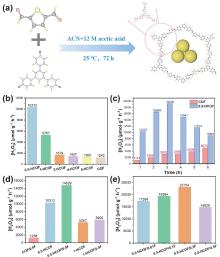
图1
"
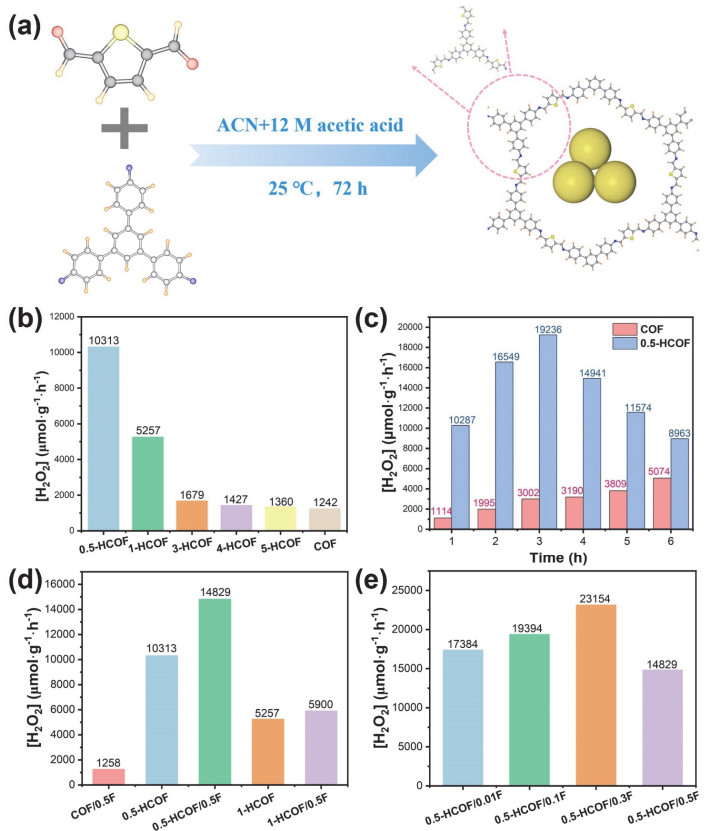
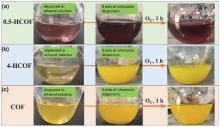
图2
"
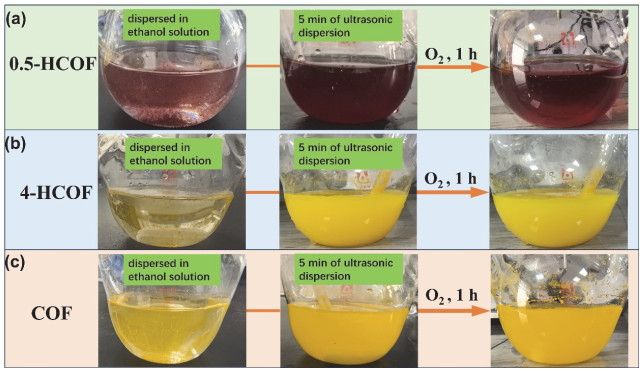
图3
"
图4
"
图5
"
图6
"
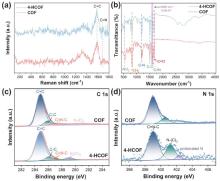
图7
"
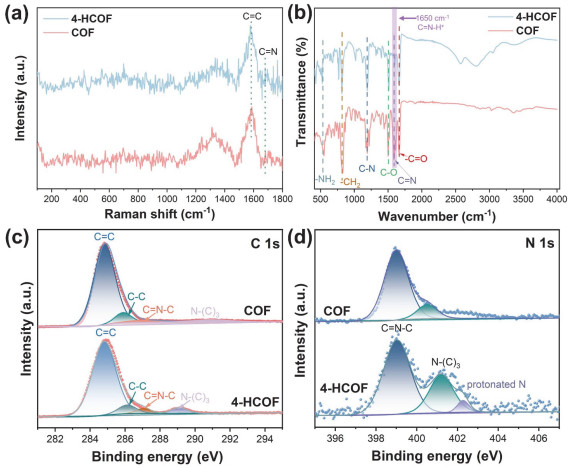
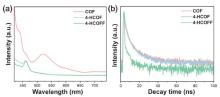
图8
"
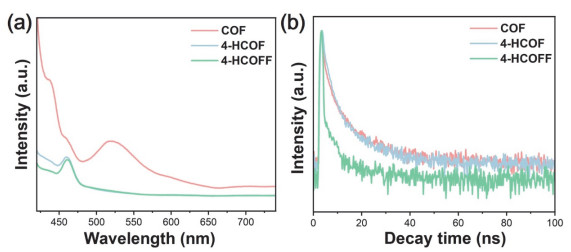
图9
"
图10
"
| 1 |
T. He, Y. Zhao. Angew. Chem. Int. Ed. 2023, 62, e202303086.
doi: 10.1002/anie.202303086 |
| 2 |
Z. Yu, J. Hua. ACS Appl. Energy Mater. 2025, 8, 8830- 8849.
doi: 10.1021/acsaem.5c01191 |
| 3 |
Y. Zhang, Y. Wang, Y. Liu, S. Zhang, Y. Zhao, J. Zhang. J. Materiomics 2025, 11, 100985.
doi: 10.1016/j.jmat.2024.100985 |
| 4 |
Y. Zhang, J. Qiu, B. Zhu, G. Sun, B. Cheng, L. Wang. Chin. J. Catal. 2024, 57, 143.
doi: 10.1016/S1872-2067(23)64580-2 |
| 5 |
J. Zhang, C. Yuan, Y. Zhang, C. Sun, J. Yu, L. Zhang. J. Colloid Interface Sci. 2025, 692, 137544.
doi: 10.1016/j.jcis.2025.137544 |
| 6 |
Y. Kuai, Y. Wang. Carbon Neutrality 2024, 3, 36.
doi: 10.1007/s43979-024-00110-x |
| 7 |
C.-Y. Lin, D. Zhang, Z. Zhao, Z. Xia. Adv. Mater. 2018, 30, 1703646.
doi: 10.1002/adma.201703646 |
| 8 |
L. Zhu, Y. Cao, T. Xu, H. Yang, L. Wang, L. Dai, F. Pan, C. Chen, C. Si. Energy Environ. Sci. 2025, 18, 5675- 5739.
doi: 10.1039/D5EE00494B |
| 9 |
W. Huang, W. Zhang, S. Yang, L. Wang, G. Yu. Small 2024, 20, 2308019.
doi: 10.1002/smll.202308019 |
| 10 |
M. Gordo-Lozano, M. Martínez-Fernández, R. P. Paitandi, J. I. Martínez, J. L. Segura, S. Seki. Small 2025, 21, 2406211.
doi: 10.1002/smll.202406211 |
| 11 |
H.-C. Ma, M.-Y. Gu, M.-Z. Li, C.-Y. Gu, D.-F. Zhu, G.-J. Chen, Y.-B. Dong. Angew. Chem. Int. Ed. 2025, 64, e202506509.
doi: 10.1002/anie.202506509 |
| 12 |
H. Dong, C. Qu, C. Li, B. Hu, X. Li, G. Liang, J. Jiang. Chin. J. Catal. 2025, 70, 142- 206.
doi: 10.1016/S1872-2067(24)60184-1 |
| 13 |
L. Yuan, Y. Peng, Z.-J. Guan, Y. Fang. Acta Phys. Chim. Sin. 2025, 41, 100086.
doi: 10.1016/j.actphy.2025.100086 |
| 14 |
G. Liu, R. Chen, B. Xia, Z. Wu, S. Liu, A. Talebian-Kiakalaieh, J. Ran. Chin. J. Catal. 2024, 61, 97- 110.
doi: 10.1016/S1872-2067(24)60014-8 |
| 15 |
X. Wang, H. Li, S. Zhou, J. Ning, H. Wei, X. Li, S. Wang, L. Hao, D. Cao. Adv. Funct. Mater. 2025, 2424035.
doi: 10.1002/adfm.202424035 |
| 16 |
H. Zhang, J. Liu, Y. Zhang, B. Cheng, B. Zhu, L. Wang. J. Mater. Sci. Technol. 2023, 166, 241.
doi: 10.1016/j.jmst.2023.05.030 |
| 17 |
S.-S. Zhu, Z. Zhang, Z. Li, H. Yue, X. Liu. Chem Catal. 2024, 4, 100963.
doi: 10.1016/j.checat.2024.100963 |
| 18 |
X. Wang, K. Qi, K. Xu. Chin. J. Catal. 2025, 70, 1.
doi: 10.1016/S1872-2067(24)60246-9 |
| 19 |
J. Chen, Y. Wang, Y. Yu, J. Wang, J. Liu, H. Ihara, H. Qiu. Exploration 2023, 3, 20220144.
doi: 10.1002/EXP.20220144 |
| 20 |
Y. Yang, J. Liu, M. Gu, B. Cheng, L. Wang, J. Yu. Appl. Catal. B 2023, 333, 122780.
doi: 10.1016/j.apcatb.2023.122780 |
| 21 |
L. Dai, A. Dong, X. Meng, H. Liu, Y. Li, P. Li, B. Wang. Angew. Chem. Int. Ed. 2023, 62, e202300224.
doi: 10.1002/anie.202300224 |
| 22 |
K. Paliušytė, L. Leão Nascimento, H. Illner, M. Wiedmaier, R. Guntermann, M. Döblinger, T. Bein, A. O. T. Patrocinio, J. Schneider. Small 2025, 21, 2500870.
doi: 10.1002/smll.202500870 |
| 23 |
X. Zhang, C. Gao, Y. Zhou, R. Chen, X. Guan, Z. Shen, B. Hu, Q.-H. Xu. Sci. China Chem 2025, 68, 3277.
doi: 10.1007/s11426-024-2446-7 |
| 24 |
H. He, R. Shen, Y. Yan, D. Chen, Z. Liu, L. Hao, X. Zhang, P. Zhang, X. Li. Chem. Sci. 2024, 15, 20002.
doi: 10.1039/D4SC07028C |
| 25 |
J. Yang, A. Acharjya, M.-Y. Ye, J. Rabeah, S. Li, Z. Kochovski, S. Youk, J. Roeser, J. Grüneberg, C. Penschke, M. Schwarze, T. Wang, Y. Lu, R. van de Krol, M. Oschatz, R. Schomäcker, P. Saalfrank, A. Thomas. Angew. Chem. Int. Ed. 2021, 60, 19797.
doi: 10.1002/anie.202104870 |
| 26 |
F. Ma, Y. Wang, Q. Wang, C. Li, Z. Jiang, R. Xu, J. Li, X. Mu, W. Liu, L. Ye. Surf. Interf 2025, 66, 106503.
doi: 10.1016/j.surfin.2025.106503 |
| 27 |
P. Dong, X. Xu, T. Wu, R. Luo, W. Kong, Z. Xu, S. Yuan, J. Zhou, J. Lei. Angew. Chem. Int. Ed. 2024, 63, e202405313.
doi: 10.1002/anie.202405313 |
| 28 |
X. Li, Z. Wang. Acta Phys. Chim. Sin. 2025, 41, 100080.
doi: 10.1016/j.actphy.2025.100080 |
| 29 |
L. Wang, J. Zhao. J. Mater. Sci. Technol. 2026, 241, 18.
doi: 10.1016/j.jmst.2025.04.009 |
| 30 |
K. Meng, J. Zhang, B. Cheng, X. Ren, Z. Xia, F. Xu, L. Zhang, J. Yu. Adv. Mater. 2024, 36, 2406460.
doi: 10.1002/adma.202406460 |
| 31 |
B. Zhu, J. Liu, J. Sun, F. Xie, H. Tan, B. Cheng, J. Zhang. J. Mater. Sci. Technol. 2023, 162, 90.
doi: 10.1016/j.jmst.2023.03.054 |
| 32 |
X. Zhou, C. Ai, X. Wang, Z. Wu, J. Zhang. J. Materiomics 2025, 11, 100974.
doi: 10.1016/j.jmat.2024.100974 |
| 33 |
S. Xu, K. Chen, Y. Cai, S. Ren, W. Chu, M. Song, Y. Xu, C. Tan. Water Res. 2025, 285, 124139.
doi: 10.1016/j.watres.2025.124139 |
| 34 |
W. Zhong, A. Meng, Y. Su, H. Yu, P. Han, J. Yu. Angew. Chem. Int. Ed. 2025, 64, e202425038.
doi: 10.1002/anie.202425038 |
| 35 |
X. Zhou, S. Yang, X. Wang, Z. Wu, Y. Huo, J. Zhang. J. Mater. Sci. Technol. 2025, 234, 60.
doi: 10.1016/j.jmst.2025.02.027 |
| 36 |
X. Huang, C. Sun, X. Feng. Sci. Chin. Chem 2020, 63, 1367.
doi: 10.1007/s11426-020-9836-x |
| 37 |
Y.-P. Zhang, W. Han, Y. Yang, H.-Y. Zhang, Y. Wang, L. Wang, X.-J. Sun, F.-M. Zhang. Chem. Eng. J. 2022, 446, 137213.
doi: 10.1016/j.cej.2022.137213 |
| 38 |
T. Cao, Q. Xu, J. Zhang, S. Wang, T. Di, Q. Deng. Chin. J. Catal. 2025, 72, 118.
doi: 10.1016/S1872-2067(24)60277-9 |
| 39 |
B. Liu, J. Zhang, H. Li, B. Cheng, C. Bie. Acta Phys. Chim. Sin. 2025, 41, 100121.
doi: 10.1016/j.actphy.2025.100121 |
| 40 |
J. Ning, B. Zhang, L. Siqin, G. Liu, Q. Wu, S. Xue, T. Shao, F. Zhang, W. Zhang, X. Liu. Exploration 2023, 3, 20230050.
doi: 10.1002/EXP.20230050 |
| 41 |
Z. Lu, C. Yang, L. He, J. Hong, C. Huang, T. Wu, X. Wang, Z. Wu, X. Liu, Z. Miao, B. Zeng, Y. Xu, C. Yuan, L. Dai. J. Am. Chem. Soc. 2022, 144, 9624.
doi: 10.1021/jacs.2c00429 |
| 42 |
Y. Wu, C. Cheng, K. Qi, B. Cheng, J. Zhang, J. Yu, L. Zhang. Acta Phys. Chim. Sin. 2024, 40, 2406027.
doi: 10.3866/PKU.WHXB202406027 |
| 43 |
Y. Liu, M. Li, T. Liu, Z. Wu, L. Zhang. J. Mater. Sci. Technol. 2025, 233, 201.
doi: 10.1016/j.jmst.2025.03.005 |
| 44 |
T. Yang, H. Hu, Y. Wang, X. Chen, J. Fan, D. Li, S. Liu, J. Li, T. He, S. Lu, L. Qiu. Adv. Mater. 2025, 37, 2419547.
doi: 10.1002/adma.202419547 |
| 45 |
M. Sayed, F. Xu, P. Kuang, J. Low, S. Wang, L. Zhang, J. Yu. Nat. Commun. 2021, 12, 4936.
doi: 10.1038/s41467-021-25007-6 |
| 46 |
Y. Fan, X. Hao, N. Yi, Z. Jin. Appl. Catal. B 2024, 357, 124313.
doi: 10.1016/j.apcatb.2024.124313 |
| 47 |
Q. Che, C. Li, Z. Chen, S. Yang, W. Zhang, G. Yu. Angew. Chem. Int. Ed. 2024, 63, e202409926.
doi: 10.1002/anie.202409926 |
| 48 |
Q. Zhang, H. Miao, J. Wang, T. Sun, E. Liu. Chin. J. Catal. 2024, 63, 176.
doi: 10.1016/S1872-2067(24)60077-X |
| 49 |
K. Meng, J. Zhang, B. Zhu, C. Jiang, H. García, J. Yu. Adv. Mater. 2025, 37, 2505088.
doi: 10.1002/adma.202505088 |
| 50 |
Y. Ma, S. Wang, Y. Zhang, B. Cheng, L. Zhang. J. Materiomics 2025, 11, 100978.
doi: 10.1016/j.jmat.2024.100978 |
| 51 |
J. Yang, X. Hao, J. Jing, Y. Hao, Z. Jin. Acta Phys. Chim. Sin. 2025, 41, 100131.
doi: 10.1016/j.actphy.2025.100131 |
| 52 |
J. Qiu, K. Meng, Y. Zhang, B. Cheng, J. Zhang, L. Wang, J. Yu. Adv. Mater. 2024, 36, 2400288.
doi: 10.1002/adma.202400288 |
| 53 |
C. Jiang, C. Yuan, K. Xu, X. Zhou, C. Bie. J. Mater. Sci. Technol. 2025, 231, 36.
doi: 10.1016/j.jmst.2024.12.071 |
| 54 |
W. Deng, X. Hao, J. Yang, Z. Jin. Appl. Catal. B 2025, 360, 124551.
doi: 10.1016/j.apcatb.2024.124551 |
| 55 |
M. Gu, Y. Yang, B. Cheng, L. Zhang, P. Xiao, T. Chen. Chin. J. Catal. 2024, 59, 185.
doi: 10.1016/S1872-2067(23)64610-8 |
| 56 |
M. Gu, Y. Yang, L. Zhang, B. Zhu, G. Liang, J. Yu. Appl. Catal. B 2023, 324, 122227.
doi: 10.1016/j.apcatb.2022.122227 |
| 57 |
J. Hu, M. Zhu, Z. A. Ghazi, Y. Cao. Chin. J. Catal. 2025, 71, 319.
doi: 10.1016/S1872-2067(24)60240-8 |
| 58 |
J. Zhang, B. Zhu, L. Zhang, J. Yu. Chem. Commun. 2023, 59, 688.
doi: 10.1039/D2CC06300J |
| 59 |
Z. Yu, D. Zhang, C. Ai, J. Zhang, Q. Xiang. Chin. J. Catal. 2024, 67, 71.
doi: 10.1016/S1872-2067(24)60159-2 |
| 60 |
J. Zhang, J. Liu, Z. Meng, S. Jana, L. Wang, B. Zhu. J. Mater. Sci. Technol. 2023, 159, 1.
doi: 10.1016/j.jmst.2023.02.044 |
| 61 |
X. Deng, J. Zhang, K. Qi, G. Liang, F. Xu, J. Yu. Nat. Commun. 2024, 15, 4807.
doi: 10.1038/s41467-024-49004-7 |
| 62 |
C. Cheng, J. Yu, D. Xu, L. Wang, G. Liang, L. Zhang, M. Jaroniec. Nat. Commun. 2024, 15, 1313.
doi: 10.1038/s41467-024-45604-5 |
| 63 |
X. Zhang, D. Gao, B. Zhu, B. Cheng, J. Yu, H. Yu. Nat. Commun. 2024, 15, 3212.
doi: 10.1038/s41467-024-47624-7 |
| 64 |
Z. Jiang, J. Zhang, B. Cheng, Y. Zhang, J. Yu, L. Zhang. Small 2025, 21, 2409079.
doi: 10.1002/smll.202409079 |
| 65 |
L. Li, X. Lv, Y. Xue, H. Shao, G. Zheng, Q. Han. Angew. Chem. Int. Ed. 2024, 63, e202320218.
doi: 10.1002/anie.202320218 |
| 66 |
Y. Zhao, Y. Zhang, H. Tan, C. Ai, J. Zhang. J. Materiomics 2025, 11, 100970.
doi: 10.1016/j.jmat.2024.100970 |
| 67 |
W. Yu. Chin. J. Catal. 2025, 73, 8.
doi: 10.1016/S1872-2067(25)60706-1 |
| 68 |
Q. Zhu, L. Shi, Z. Li, G. Li, X. Xu. Angew. Chem. Int. Ed. 2024, 63, e202408041.
doi: 10.1002/anie.202408041 |
| 69 |
M. Sayed, H. Li, C. Bie. Acta Phys. Chim. Sin. 2025, 41, 100117.
doi: 10.1016/j.actphy.2025.100117 |
| 70 |
Y. Yang, X. Zhou, M. Gu, B. Cheng, Z. Wu, J. Zhang. Acta Phys. Chim. Sin. 2025, 41, 100064.
doi: 10.1016/j.actphy.2025.100064 |
| 71 |
Y. Xu, Z. Sun, S. Fan, X. Han, L. Li, Z. Gao, C. Wang. J. Mater. Chem. A 2024, 12, 27180.
doi: 10.1039/D4TA05404K |
| [1] | 赵呈孝, 李昭霖, 吴东方, 杨小飞. SBA-15模板化共价三嗪框架增强光催化产氢[J]. 物理化学学报, 2026, 42(1): 100149 - . |
| [2] | 蔡家杰, 程畅, 刘博文, 张建军, 姜传佳, 程蓓. CdS/DBTSO-BDTO S型异质结光催化制氢及其电荷转移动力学[J]. 物理化学学报, 2025, 41(8): 100084 - . |
| [3] | 袁乐汪, 彭垚垚, 管宗杰, 方煜. 二维共价有机框架作为光催化剂在有机合成中的研究进展[J]. 物理化学学报, 2025, 41(8): 100086 - . |
| [4] | 赵鑫婉, 曹越, 雷敏军, 靳治良, TsubakiNoritatsu. 构建S型异质结:通过将共价有机框架与过渡金属硫化物结合实现高效无贵金属光催化制氢[J]. 物理化学学报, 2025, 41(12): 100152 - . |
| [5] | 邵毅宏, 沈荣晨, 王松, 李世杰, 张鹏, 李鑫. 共价有机框架中的组分工程用于定制光催化[J]. 物理化学学报, 2025, 41(12): 100176 - . |
| [6] | 魏勉, 程畅, 何博文, 程蓓, 戚克振, 别传彪. 无机-有机CdS/YBTPy S型光催化剂高效产氢及其机理[J]. 物理化学学报, 2025, 41(12): 100158 - . |
| [7] | 张淑敏, 王亚琪, 王泽林, 王立博, 安长胜, 许第发. ZIS1−x/UCN S型异质结界面的超快电子转移实现高效H2O2光合成耦合四环素降解[J]. 物理化学学报, 2025, 41(11): 100136 - . |
| [8] | 刘纪舟, 艾陈斌, 胡晨睿, 程蓓, 张建军. 六氯锡酸铵促进钙钛矿太阳能电池界面电子转移及其飞秒瞬态吸收光谱研究[J]. 物理化学学报, 2024, 40(11): 2402006 - . |
| [9] | 谢斐, 袁成成, 谭海燕, MoshfeghAlireza Z., 朱必成, 余家国. d带中心调控过渡金属单原子负载COF吸附O2的理论计算研究[J]. 物理化学学报, 2024, 40(11): 2407013 - . |
| [10] | 杨文秀, 张金锋, 徐全龙, 杨云, 张礼杰. AuCu双金属合金修饰共价有机框架用于高效光催化析氢[J]. 物理化学学报, 2024, 40(10): 2312014 - . |
| [11] | 夏伟锋, 季成宇, 王锐, 裘式纶, 方千荣. 基于四硫富瓦烯的无金属共价有机框架材料用于高效电催化析氧反应[J]. 物理化学学报, 2023, 39(9): 2212057 -0 . |
| [12] | 单春晖,白若鹏,蓝宇. 过渡金属参与C―H键切断模式的理论研究进展[J]. 物理化学学报, 2019, 35(9): 940 -953 . |
| [13] | 李路路,姚路,段力. 基于共价有机框架复合材料的锂硒电池应用[J]. 物理化学学报, 2019, 35(7): 734 -739 . |
| [14] | 鄢慧君,李彪,蒋宁,夏定国. 阴离子硫氧化还原与Li1-xNiO2-ySy的结构稳定性:第一性原理研究[J]. 物理化学学报, 2017, 33(9): 1781 -1788 . |
| [15] | 陈晓宇,王经东,于安池. 金纳米颗粒在不同包裹介质中的超快等离子体动力学[J]. 物理化学学报, 2017, 33(11): 2184 -2190 . |
|
||