物理化学学报 >> 2026, Vol. 42 >> Issue (10): 100221.doi: 10.1016/j.actphy.2025.100221
微小改变,显著差异:改良KSCN熔盐法一锅制备富Cd空位MoS2/CdS并实现光催化产氢性能提升
范育歌, 付先亮*( ), 朱丽, 徐慢*()
- 武汉工程大学材料科学与工程学院, 湖北省环境材料与膜技术工程技术研究中心, 湖北 武汉 430073
-
收稿日期:2025-10-14修回日期:2025-11-14录用日期:2025-11-16发布日期:2026-09-03 -
通讯作者:Email: fuxl@wit.edu.cn (付先亮)xuman@wit.edu.cn (徐慢)
Small changes, big differences: modified KSCN molten salt method for one-pot synthesis of Cd vacancy-enriched MoS2/CdS and the enhanced photocatalytic H2 evolution performance
Yuge Fan, Xianliang Fu*(), Li Zhu, Man Xu*()
- Engineering Research Center of Environmental Materials and Membrane Technology of Hubei Province, School of Materials Science and Engineering, Wuhan Institute of Technology, Wuhan 430073, Hubei Province, China
-
Received:2025-10-14Revised:2025-11-14Accepted:2025-11-16Published:2026-09-03 -
Contact:Email: fuxl@wit.edu.cn (Xianliang Fu)xuman@wit.edu.cn (Man Xu)

摘要:
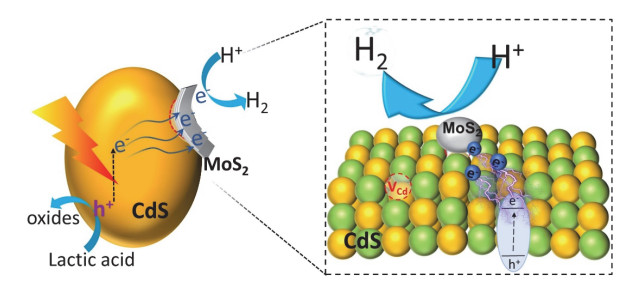
低温KSCN熔盐法已被用于一锅制备修饰型硫化物基光催化剂。然而,由于S2-的供给依赖于相对稳定的KSCN热分解,该反应体系实际存在S前体不足的问题,这可能不利于高性能催化剂的制备。为此,我们开发了一种添加外部硫源的改良KSCN熔盐法,并以1% MoS2/CdS为原型进行了一锅制备。结果表明,与传统KSCN熔盐法制备的样品(MC)相比,在富S2-环境中可轻松制备出富罕见Cd空位(ⅤCd,MC-S)的高效样品。此外,由于熔盐中能引入更多晶核,CdS与MoS2的尺寸均可从微米级显著减小至纳米级,从而获得少层MoS2均匀紧密锚定于平均尺寸仅为~33 nm的CdS上的复合结构。最终所得MC-S样品展现出15.01 mmol h-1 g-1的卓越产氢活性,较传统KSCN熔盐法制备的对照样品(MC)提升达6.5倍。这种高活性主要归因于ⅤCd的引入以及小尺寸CdS与少层MoS2之间的强耦合界面,二者均有利于电子-空穴分离。我们通过对比晶体成核与生长过程的差异,初步探讨了样品的形成机制。相信这种改进的制备方法也将有助于其他高性能硫化物基光催化剂的合成。
引用本文
范育歌, 付先亮, 朱丽, 徐慢. 微小改变,显著差异:改良KSCN熔盐法一锅制备富Cd空位MoS2/CdS并实现光催化产氢性能提升[J]. 物理化学学报, 2026, 42(10), 100221. doi: 10.1016/j.actphy.2025.100221
Yuge Fan, Xianliang Fu, Li Zhu, Man Xu. Small changes, big differences: modified KSCN molten salt method for one-pot synthesis of Cd vacancy-enriched MoS2/CdS and the enhanced photocatalytic H2 evolution performance[J]. Acta Phys. -Chim. Sin. 2026, 42(10), 100221. doi: 10.1016/j.actphy.2025.100221
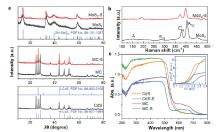
图1
"
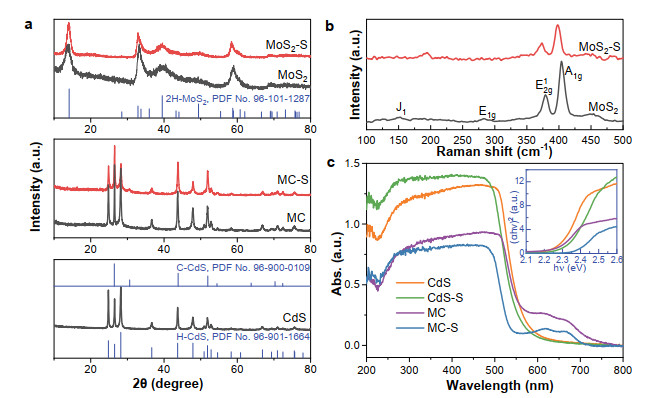
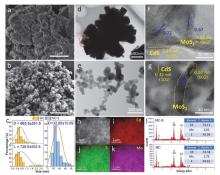
图2
"
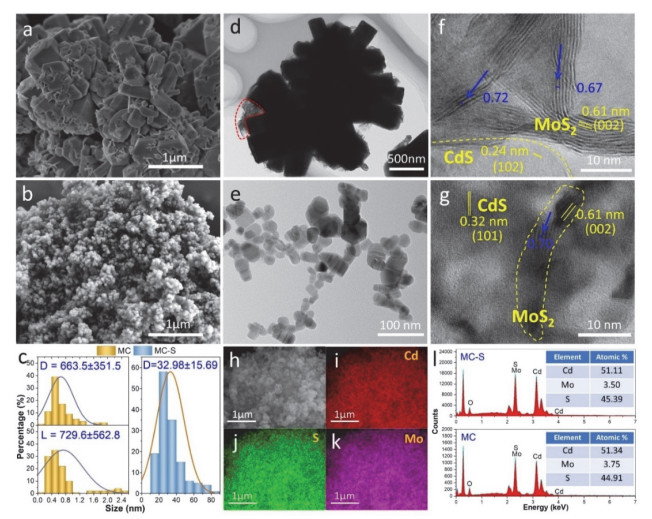
图3
"
图4
"
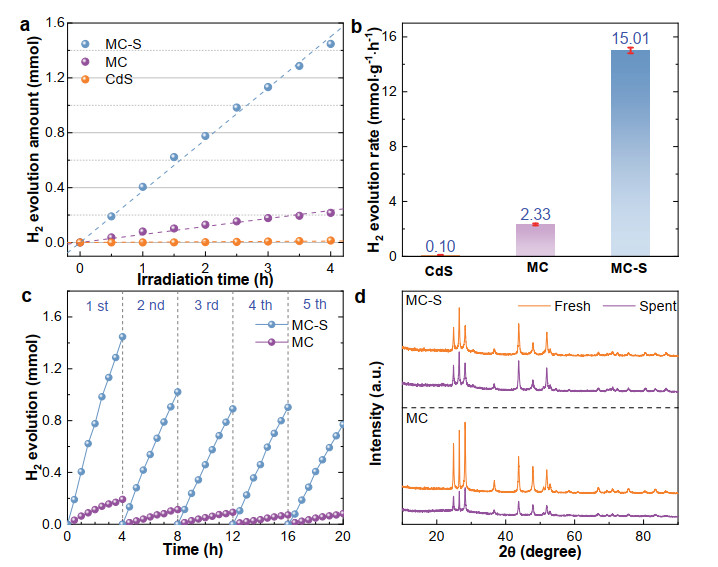
图5
"
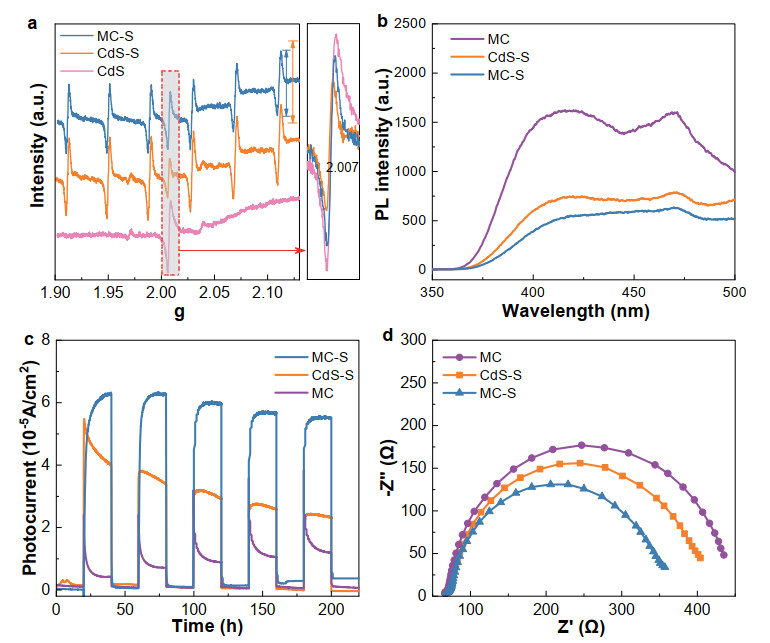
图6
"
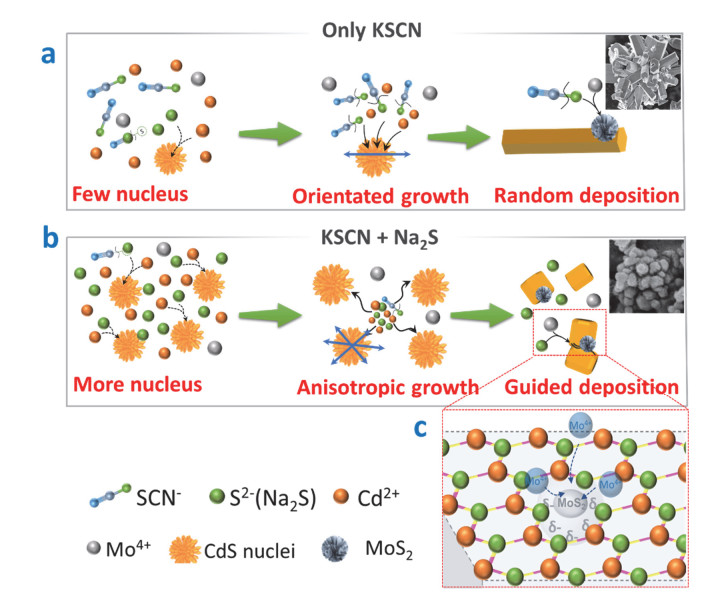
图7
"
| 1 |
Y. Kageshima, S. Kato, S. Shiga, F. Takagi, H. Minamisawa, M. Horita, T. Yamakami, K. Teshima, K. Domen, H. Nishikiori. ACS Appl. Mater. Interfaces 2022, 15, 13108.
doi: 10.1021/acsami.2c23103 |
| 2 |
H. Liu, D.-g. Cheng, F. Chen, X. Zhan. ACS Sustain. Chem. Eng. 2020, 8, 16897.
doi: 10.1021/acssuschemeng.0c06004 |
| 3 |
Y. Zou, K. Yang, Q. Chen, H. Wang, X. Meng. RSC Adv. 2018, 8, 36819.
doi: 10.1039/c8ra07543c |
| 4 |
J. Liu, N. Uezono, K. Tajima, S. A. Pawar, M. M. Islam, S. Ikeda, T. Sakurai. ACS Appl. Energy Mater. 2021, 5, 4191.
doi: 10.1021/acsaem.1c03626 |
| 5 |
Y. Hu, Q. Meng, C. Li, Y. Zhou, Z. Han, W. Xing, S. Hao, G. Chen. J. Mater. Chem. C 2019, 7, 2936.
doi: 10.1039/c8tc06340k |
| 6 |
J. Bai, Y. Sun, M. Li, L. Yang, J. Li, S. Hu. New J. Chem. 2018, 42, 13529.
doi: 10.1039/c8nj02565g |
| 7 |
J. Yingsu, Y. Liu, H. Huang, L. Yang, Y. Qian, X. Fu, H. Liu. J. Phys. Chem. C 2023, 127, 8687.
doi: 10.1021/acs.jpcc.3c01631 |
| 8 |
L. An, M. Kitta, A. Iwase, A. Kudo, N. Ichikuni, H. Onishi. ACS Catal. 2018, 8, 9334.
doi: 10.1021/acscatal.8b02437 |
| 9 |
Y. Tian, Y. Huang, X. Huang, Z. Su, F. Wang. New J. Chem. 2021, 45, 14626.
doi: 10.1039/d1nj02608a |
| 10 |
G. Zhang, Z. Guan, J. Yang, Q. Li, Y. Zhou, Z. Zou. Sol. RRL 2022, 6, 2200587.
doi: 10.1002/solr.202200587 |
| 11 |
S. Zhang, X. Ou, Q. Xiang, S. A. C. Carabineiro, J. Fan, K. Lv. Chemosphere 2022, 303, 135085.
doi: 10.1016/j.chemosphere.2022.135085 |
| 12 |
L. Sun, X. Yu, L. Tang, W. Wang, Q. Liu. Chin. J. Catal. 2023, 52, 164.
doi: 10.1016/s1872-2067(23)64507-3 |
| 13 |
D. Xiang, Y. Zhu, C. Cai, Z. He, Z. Liu, D. Yin, J. Luo. Phys. E 2011, 44, 733.
doi: 10.1016/j.physe.2011.11.023 |
| 14 |
N. Li, J. Zhou, Z. Sheng, W. Xiao. Appl. Surf. Sci. 2017, 430, 218.
doi: 10.1016/j.apsusc.2017.08.086 |
| 15 |
X. Xiang, H. Liu, K. Lv, D. Tang, Q. Li. New J. Chem. 2024, 48, 15633.
doi: 10.1039/d4nj02285h |
| 16 |
M. Benchikhi, R. E. Ouatib, S. Guillemet-Fritsch, J. Y. Chane-Ching, J. J. Demai, L. Er-Rakho, B. Durand. Mater. Lett. 2014, 136, 431.
doi: 10.1016/j.matlet.2014.08.101 |
| 17 |
W. Hao, J. Zhang, C. Yuan, Z. Lu, B. Ma, W. Ruan, Z. Liu, F. Teng. J. Alloy. Compd. 2022, 891, 161987.
doi: 10.1016/j.jallcom.2021.161987 |
| 18 |
Z. Li, J. Zhang, Y. Teng, H. Zhang, X. Guo, X. Zhang, Z. Li, G. Cheng, A. O. Ibhadon, F. Teng. Inorg. Chem. Commun. 2023, 155, 111060.
doi: 10.1016/j.inoche.2023.111060 |
| 19 |
D. Liu, L. Yang, J. Wu, B. Li. Sci. Total Environ. 2022, 824, 153934.
doi: 10.1016/j.scitotenv.2022.153934 |
| 20 |
J. Xu, W. Zhong, F. Chen, X. Wang, H. Yu. Appl. Catal. B Environ. 2023, 328, 122493.
doi: 10.1016/j.apcatb.2023.122493 |
| 21 |
S. He, H. Du, K. Wang, Q. Liu, J. Sun, Y. Liu, Z. Du, L. Xie, W. Ai, W. Huang. Chem. Commun. 2020, 56, 5548.
doi: 10.1039/d0cc01726d |
| 22 |
X. Wang, D. Xu, M. Lu, D. Yuan, G. Zhang, S. Xu, S. Guo, X. Jiang, J. Liu, C. Song, et al.. Mater. Res. Bull. 2003, 38, 1269.
doi: 10.1016/s0025-5408(03)00111-9 |
| 23 |
P. Keller, G. W. Harrington. Anal. Chem. 1969, 41, 523.
doi: 10.1021/ac60272a007 |
| 24 |
F. Wang, M. Zhou, W. Huang, K. Lu, S. Ouyang, W. Xiang, C. Zhou, C. Yu, K. Yang. Inorg. Chem. Front. 2024, 11, 4297.
doi: 10.1039/d4qi00925h |
| 25 |
P. Bohac, V. Tanner, A. Gaeumann. Cryst. Res. Technol. 2006, 17, 717.
doi: 10.1002/crat.2170170605 |
| 26 |
Y. Fan, A. You, X. Fu, J. Shen, X. Zhao, L. Yang, L. Zhu, M. Xu. J. Colloid Interface Sci. 2025, 689, 137204.
doi: 10.1016/j.jcis.2025.02.212 |
| 27 |
Y. Qin, L. Zhang, B. Yang, R. Hou, G. Fu, T. Huang, R. Deng, S. Zhang, X. Meng. J. Colloid Interface Sci. 2024, 660, 617.
doi: 10.1016/j.jcis.2024.01.107 |
| 28 |
Y. Wang, X. Xu, W. Lu, Y. Huo, L. Bian. Dalton Trans. 2018, 47, 4219.
doi: 10.1039/c7dt04912a |
| 29 |
T. Tian, X. Jin, N. Guo, H. Li, Y. Han, Y. Yuan. Appl. Catal. B Environ. 2022, 308, 121227.
doi: 10.1016/j.apcatb.2022.121227 |
| 30 |
M. Li, H. Yao, S. Yao, G. Chen, J. Sun. J. Colloid Interface Sci. 2023, 630, 224.
doi: 10.1016/j.jcis.2022.10.056 |
| 31 |
W. Wang, X. Qin, X. Wang, K. Ma, Z. Wu, H. Si, J. Zhang. Environ. Pollut. 2024, 345, 123428.
doi: 10.1016/j.envpol.2024.123428 |
| 32 |
H. Nagakawa, T. Tatsuma. ACS Appl. Energy Mater. 2022, 5, 14652.
doi: 10.1021/acsaem.2c03083 |
| 33 |
W. Li, E. Wang, H. Wang, Y. Yang, S. Hu, H. Liu. Nano Energy 2025, 142, 111235.
doi: 10.1016/j.nanoen.2025.111235 |
| 34 |
K. Yang, Y. Huang, T. Wang, Y. Li, Y. Du, J. Ling, Z. Fan, C. Zhang, C. Ma. Adv. Mater. 2024, 36, 2409832.
doi: 10.1002/adma.202409832 |
| 35 |
L. Cheng, B. Li, H. Yin, J. Fan, Q. Xiang. J. Mater. Sci. Technol. 2022, 118, 54.
doi: 10.1016/j.jmst.2021.11.055 |
| 36 |
B. Sambandam, T. Muthukumar, S. Arumugam, P. L. Paulose, P. T. Manoharan. RSC Adv. 2014, 4, 22141.
doi: 10.1039/c4ra01899k |
| 37 |
Z. Xu, X. Liu, K. Yao, Y. Ren, J. Li, X. Shen, Z. Li. Nanotechnology 2021, 33, 025602.
doi: 10.1088/1361-6528/ac2d09 |
| 38 |
H. Li, X. Han, S. Jiang, L. Zhang, W. Ma, R. Ma, Z. Zhou. Green Energy Environ. 2022, 7, 314.
doi: 10.1016/j.gee.2020.09.003 |
| 39 |
A. Li, H. Pang, P. Li, N. Zhang, G. Chen, X. Meng, M. Liu, X. Liu, R. Ma, J. Ye. Appl. Catal. B Environ. 2021, 288, 119976.
doi: 10.1016/j.apcatb.2021.119976 |
| 40 |
K. J. Zhang, H. Xu, L. Sun, W. T. Luo, S. W. Gu, H. Wang, C. Ye, S. Han, T. Shen. ChemistrySelect 2019, 4, 13615.
doi: 10.1002/slct.201903127 |
| 41 |
S. Zhang, H. Yang, H. Gao, R. Cao, J. Huang, X. Xu. ACS Appl. Mater. Interfaces 2017, 9, 23635.
doi: 10.1021/acsami.7b03673 |
| 42 |
M. Xiong, J. Yan, B. Chai, G. Fan, G. Song. J. Mater. Sci. Technol. 2020, 56, 179.
doi: 10.1016/j.jmst.2020.03.037 |
| 43 |
A. J. Ramya, N. Shobanadevi, S. P. Mangaiyarkarasi, R. Sankar. J. Mater. Sci. Mater. Electron. 2023, 34, 1350.
doi: 10.1007/s10854-023-10765-4 |
| 44 |
W. Ma, C. Zhang, S. Hao, Y. Xing, G. Zhao, S. Qiu, C. Zhang, X. Wang. New J. Chem. 2022, 46, 11934.
doi: 10.1039/d2nj01043g |
| 45 |
F. Ma, Y. Wu, Y. Shao, Y. Zhong, J. Lv, X. Hao. Nano Energy 2016, 27, 466.
doi: 10.1016/j.nanoen.2016.07.014 |
| 46 |
P. Du, Y. Zhu, J. Zhang, D. Xu, W. Peng, G. Zhang, F. Zhang, X. Fan. RSC Adv. 2016, 6, 74394.
doi: 10.1039/c6ra10170d |
| 47 |
K. Chang, M. Li, T. Wang, S. Ouyang, P. Li, L. Liu, J. Ye. Adv. Energy Mater. 2015, 5, 1402279.
doi: 10.1002/aenm.201402279 |
| 48 |
J. Xu, X. Cao. Chem. Eng. J. 2015, 260, 642.
doi: 10.1016/j.cej.2014.07.046 |
| 49 |
Z. Wei, W. Mao, J. Liu, Y. Xiao, M. Zhu, Y. Tian. J. Mater. Sci. Mater. Electron. 2020, 31, 4574.
doi: 10.1007/s10854-020-03008-3 |
| 50 |
C. Patriarchea, I. Vamvasakis, E. D. Koutsouroubi, G. S. Armatas. Inorg. Chem. Front. 2022, 9, 625.
doi: 10.1039/d1qi01278a |
| 51 |
S. Ma, J. Xie, J. Q. Wen, K. L. He, X. Li, W. Liu, X. C. Zhang. Appl. Surf. Sci. 2017, 391, 580.
doi: 10.1016/j.apsusc.2016.07.067 |
| 52 |
B. Han, S. Liu, N. Zhang, Y. J. Xu, Z. R. Tang. Appl. Catal. B Environ. 2017, 202, 298.
doi: 10.1016/j.apcatb.2016.09.023 |
| 53 |
B. Chai, M. Xu, J. Yan, Z. Ren. Appl. Surf. Sci. 2017, 430, 523.
doi: 10.1016/j.apsusc.2017.07.292 |
| 54 |
X. Li, C. Hu, X. Wang, Y. Xi. Appl. Surf. Sci. 2012, 258, 4370.
doi: 10.1016/j.apsusc.2011.12.116 |
| 55 |
M. Bai, W. Li, H. Yang, W. Dong, Q. Wang, Q. Chang. RSC Adv. 2022, 12, 28463.
doi: 10.1039/d2ra05351a |
| 56 |
P.-R. Wu, Z. Liu, Z.-L. Cheng. ACS Omega 2019, 4, 9823.
doi: 10.1021/acsomega.9b01129 |
| 57 |
X. Lu, W. Chen, Y. Yao, X. Wen, J. N. Hart, C. Tsounis, C. Ying Toe, J. Scott, Y. H. Ng. Chem. Eng. J. 2020, 420, 127709.
doi: 10.1016/j.cej.2020.127709 |
| 58 |
H. Zhang, Q. Feng, F. Yu, Y. Wang, C. Liu, Q. Liu, L. Yin, J. Huang, X. Kong. J. Phys. Chem. C 2022, 126, 9027.
doi: 10.1021/acs.jpcc.2c00146 |
| 59 |
X. L. Yin, L. L. Li, D. C. Li, Z. J. Li, Y. X. Wang, X. J. Kong, J. S. Zhao, J. H. Jiang, J. C. Qian, D. H. Pang, et al.. Int. J. Hydrog. Energy 2019, 44, 16657.
|
| 60 |
L. L. Li, X. L. Yin, D. H. Pang, X. X. Du, H. Xue, H. W. Zhou, Q. X. Yao, H. W. Wang, J. C. Qian, J. Yang, et al.. Int. J. Hydrog. Energy 2019, 44, 31930.
doi: 10.1016/j.ijhydene.2019.10.056 |
| 61 |
X. Jin, G. Li. J. Mater. Sci. Mater. Electron. 2020, 31, 9377.
doi: 10.1007/s10854-020-03477-6 |
| 62 |
M. Du, Y. Zhang, S. Kang, X. Guo, Y. Ma, M. Xing, Y. Zhu, Y. Chai, B. Qiu. ACS Catal. 2022, 12, 12823.
doi: 10.1021/acscatal.2c03605 |
| 63 |
S. Iqbal, Z. Pan, K. Zhou. Nanoscale 2017, 9, 6638.
doi: 10.1039/c7nr01705g |
| 64 |
Z. Guo, W. Li, Y. He, G. Li, K. Zheng, C. Xu. Appl. Surf. Sci. 2020, 512, 145750.
doi: 10.1016/j.apsusc.2020.145750 |
| 65 |
J. Shi, L. Yang, J. Zhang, Z. Wang, W. Zhu, Y. Wang, Z. Zou. Chem. Eur. J. 2022, 28, e202202019.
doi: 10.1002/chem.202202019 |
| 66 |
P. A. Jadhav, R. P. Panmand, D. R. Patil, H. Fouad, S. W. Gosavi, B. B. Kale. J. Nanopart. Res. 2017, 19, 218.
doi: 10.1007/s11051-017-3903-x |
| 67 |
W. Zhao, J. Liu, Z. Ding, J. Zhang, X. Wang. J. Alloy. Compd. 2020, 813, 152234.
doi: 10.1016/j.jallcom.2019.152234 |
| 68 |
H. Zhao, H. Fu, X. Yang, S. Xiong, D. Han, X. An. Int. J. Hydrog. Energy 2022, 47, 8247.
doi: 10.1016/j.ijhydene.2021.12.171 |
| 69 |
X. L. Yin, L. L. Li, Y. L. Wang. New J. Chem. 2022, 46, 21078.
doi: 10.1039/d2nj03833a |
| 70 |
L. Zhao, J. Jia, Z. Yang, J. Yu, A. Wang, Y. Sang, W. Zhou, H. Liu. Appl. Catal. B Environ. 2017, 210, 290.
doi: 10.1016/j.apcatb.2017.04.003 |
| 71 |
K. L. Wang, Z. H. Su, Y. H. Lou, Q. Lv, J. Chen, Y. R. Shi, C. H. Chen, Y. H. Zhou, X. Y. Gao, Z. K. Wang, L. S. Liao. Adv. Energy Mater. 2022, 12, 2201274.
doi: 10.1002/aenm.202201274 |
| 72 |
S. Mozaffari, W. Li, C. Thompson, S. Ivanov, S. Seifert, B. Lee, L. Kovarik, A. M. Karim. Nanoscale 2017, 9, 13772.
doi: 10.1039/c7nr04101b |
| 73 |
Y. Cao, L. Guo, M. Dan, D. E. Doronkin, C. Han, Z. Rao, Y. Liu, J. Meng, Z. Huang, K. Zheng, et al.. Nat. Commun. 2021, 12, 21925.
doi: 10.1038/s41467-021-21925-7 |
| 74 |
S. S. Gupta, M. A. van Huis. J. Phys. Chem. C 2017, 121, 9815.
doi: 10.1021/acs.jpcc.6b13010 |
| [1] | 薛媛, 张艳军, 杜军, 徐祖顺, 廖光福, 李庆. 在氮化碳上引入双功能位点:调控载流子迁移与O2活化以促进光催化合成H2O2[J]. 物理化学学报, 2026, 42(9): 100311 - . |
| [2] | 伍昊, 李凤麒, 石欣伟, 卞海峰, 周庆, 贾顺顺, 马玉洁, 顾坚, 张靖梓, 何水剑, 孟祥康. 机器学习指导筛选多主元合金作为析氢反应电催化剂[J]. 物理化学学报, 2026, 42(8): 100227 - . |
| [3] | 许凯强, 于佳, 夏伟, 张建军, 韩生. 范德华S型异质结赋予快速电荷转移助力光催化活性提升[J]. 物理化学学报, 2026, 42(7): 100211 - . |
| [4] | 王颖, 杨明成, 尹铸, 王英齐, 成佳佳. 无过渡金属聚庚嗪酰亚胺促进的光催化Katritzky盐C–X键构建反应研究[J]. 物理化学学报, 2026, 42(7): 100212 - . |
| [5] | 崔依琳, 李中付, 张维坤, 高禹, 董志超, 刘从华. 硫空位提升2D/2D In2.77S4/CuInS2 S型异质结光催化还原CO2为C2H4选择性[J]. 物理化学学报, 2026, 42(7): 100274 - . |
| [6] | 邓玉金, 陈怡爽, 张礼杰, 金辉乐, 杨云, 徐全龙, 王舜. 等离子体金纳米双锥强局域电场促进共价有机框架光催化析氢研究[J]. 物理化学学报, 2026, 42(6): 100193 - . |
| [7] | 张小菲, 徐山浩, 王志远, 何龙, 黄天成, 徐永明, 卞玉翠, 李一珂, 陈海军, 李中军. BiOCl表面掺杂石墨烯用于可见光下高效光催化胺偶联[J]. 物理化学学报, 2026, 42(5): 100202 - . |
| [8] | 孟奥运, 李振华, 熊国远, 李真, 张金锋. S型异质结Al6Si2O13/BiOBr通过增强电荷转移效应实现高效稳定光催化降解三唑磷和敌敌畏农药[J]. 物理化学学报, 2026, 42(5): 100186 - . |
| [9] | 肖子翼, 马心怡, 王林平, 胡浩斌, 刘恩周. Na2S/Na2SO3溶液促进NiS2/Mn0.5Cd0.5S肖特基/S型孪晶同质结光催化转化H2S[J]. 物理化学学报, 2026, 42(4): 100171 - . |
| [10] | 邱艳平, 张佳桐, 李林萍, 高旸钦, 李宁, 戈磊. MOF衍生的g-C3N4/ZnIn2S4 S型异质结:界面工程增强光催化NO转化[J]. 物理化学学报, 2026, 42(4): 100175 - . |
| [11] | 郭杰, 薛丽君, 宋发辉, 李程鹏, 陈卓, 温丽丽. 双内建电场驱动的D-A COFs/ZnIn2S4 S型异质结加速电荷分离实现纯水中高效光合成H2O2[J]. 物理化学学报, 2026, 42(4): 100177 - . |
| [12] | 朱文君, 艾陈斌, 许凯强, 周亚太, 张锡东, 张勇. WO3@TP无机@有机S型光催化剂用于促进产H2O2[J]. 物理化学学报, 2026, 42(3): 100184 - . |
| [13] | 骆泽, 朱玉坤, 罗雅丹, 任广敏, 王永红, 唐华. S型异质结In2O3/ZnIn2S4光催化5-羟甲基糠醛选择性氧化耦合产氢[J]. 物理化学学报, 2026, 42(3): 100166 - . |
| [14] | 张宇航, 李意, 曹玥晗, 帅英杰, 周宇, 周莹. Ir调控中间体生成类型抑制光催化甲烷转化中产物过氧化[J]. 物理化学学报, 2026, 42(2): 100173 - . |
| [15] | 刘宇, 李鹏飞, 刘翼泽, 孙再成. 碳点作为单一光催化剂的最新进展[J]. 物理化学学报, 2026, 42(2): 100167 - . |
|
||