

物理化学学报 >> 2023, Vol. 39 >> Issue (11): 2302021.doi: 10.3866/PKU.WHXB202302021
所属专题: 二氧化碳资源化
卢俊文1,2, 张书南3,*( ), 周浩志3, 黄超杰1,2, 夏林1, 刘晓放1, 罗虎1, 王慧1,3,*()
收稿日期:2023-02-14
录用日期:2023-03-21
发布日期:2023-03-24
通讯作者:
张书南,王慧
E-mail:zhangshn2@shanghaitech.edu.cn;wanghh@sari.ac.cn
基金资助:
Junwen Lu1,2, Shunan Zhang3,*(), Haozhi Zhou3, Chaojie Huang1,2, Lin Xia1, Xiaofang Liu1, Hu Luo1, Hui Wang1,3,*()
Received:2023-02-14
Accepted:2023-03-21
Published:2023-03-24
Contact:
Shunan Zhang, Hui Wang
E-mail:zhangshn2@shanghaitech.edu.cn;wanghh@sari.ac.cn
Supported by:摘要:
在高温逆水气变换(RWGS)反应中,开发高活性和高稳定性的金属负载型催化剂还存在巨大挑战。针对此问题,本研究采用溶液蒸发自组装法构建了Ir物种负载于α-MoC的协同催化剂,结果表明,Ir与α-MoC的协同效应使其在较宽的温度范围内均有较好的RWGS反应性能。特别是在500 ℃、0.1 MPa、300000 mL·g−1·h−1的反应条件下,0.5%Ir/MoC催化剂的CO2转化率高达48.4%,接近CO2平衡转化率(49.9%),同时,CO选择性和CO时空收率分别高达94.0%和423.1 μmol·g−1·s−1,且在100 h之内反应性能几乎没有衰减,具有优异的高温稳定性,此催化性能也超过了大多数文献报道。系列结构表征表明,Ir物种均匀地分散在α-MoC载体上,其电子较利于转移至α-MoC而形成金属载体强相互作用,极大地提高了催化稳定性;同时,当Ir负载量高于0.2% (质量分数)时,Ir团簇(Irn)和Ir单原子(Ir1)同时存在,与α-MoC形成了Irn-Ir1-C-Mo协同位点。其中,0.5%Ir/MoC催化剂拥有较小尺寸的Irn和较多的Ir1,显著地促进了CO2和H2的吸附和活化,并促进了甲酸盐中间体的生成和解离,从而获得了优异的RWGS性能。这项工作为设计和制备高效稳定的CO2利用催化剂提供了一定的参考和指导。
卢俊文, 张书南, 周浩志, 黄超杰, 夏林, 刘晓放, 罗虎, 王慧. 负载Ir单原子和团簇的α-MoC催化剂用于高效催化CO2加氢制CO[J]. 物理化学学报, 2023, 39(11), 2302021. doi: 10.3866/PKU.WHXB202302021
Junwen Lu, Shunan Zhang, Haozhi Zhou, Chaojie Huang, Lin Xia, Xiaofang Liu, Hu Luo, Hui Wang. Ir Single Atoms and Clusters Supported on α-MoC as Catalysts for Efficient Hydrogenation of CO2 to CO[J]. Acta Phys. -Chim. Sin. 2023, 39(11), 2302021. doi: 10.3866/PKU.WHXB202302021
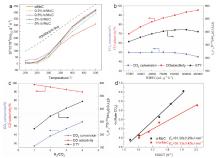
Fig 1
Catalytic performance of the Ir/MoC catalysts for RWGS reaction at different (a) temperature, (b) space velocity, (c) feed H2/CO2 ratio. (d) Arrhenius plots for CO2 conversion over Ir/MoC. (a–d) Parameters = 0.1 MPa; (a, c, d) WHSV = 300000 mL·g−1·h−1; (b, c) T = 500 ℃; (a, b, d) H2/CO2 = 3."
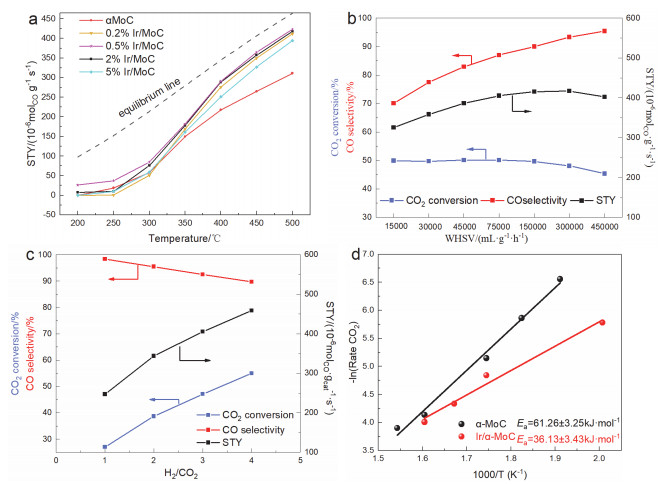
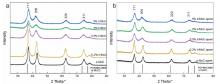
Fig 2
XRD patterns of the Ir/MoC catalysts: (a) fresh catalysts, (b) spent catalysts."
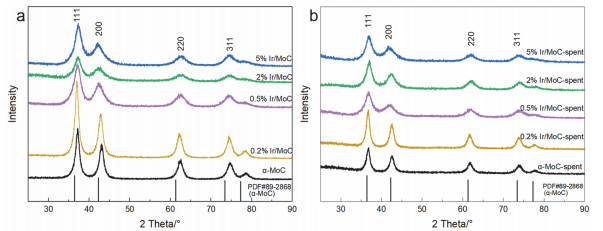
Table 1
Textural properties of the Ir/MoC catalysts."
| Catalyst | Ir loading (wt) a | Surface area b/(m2∙g−1) | Pore volume c/(cm3∙g−1) | Pore size d/nm |
| α-MoC | N/A | 127 | 0.13 | 3.05 |
| 0.2%Ir/MoC | 0.28% | 107 | 0.11 | 1.75 |
| 0.5%Ir/MoC | 0.42% | 99 | 0.08 | 2.13 |
| 2%Ir/MoC | 2.23% | 85 | 0.06 | 2.92 |
| 5%Ir/MoC | 6.60% | 50 | 0.09 | 3.81 |
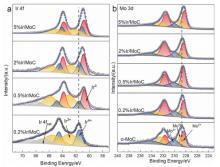
Fig 3
XPS of the Ir/MoC spent catalysts: (a) Ir 4f, (b) Mo 3d."
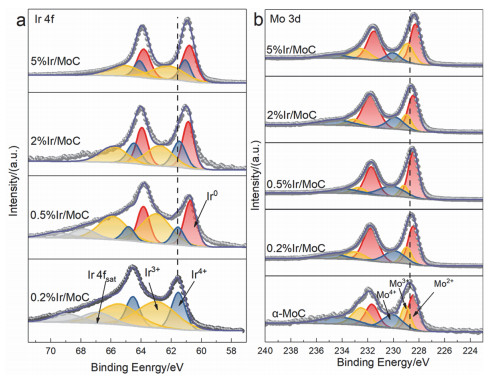
Table 2
Compositions and positions of Mo 3d5/2, Ir 4f7/2 for all samples."
| Catalyst | Mo 3d5/2 binding energy/eV | Ir 4f7/2 binding energy/eV | |||||
| Mo2+ | Mo3+ | Mo4+ | Ir0 | Ir4+ | Ir3+ | ||
| α-MoC | 228.43 | 229.05 | 230.08 | – | – | – | |
| (39.48%) | (30.57%) | (29.95%) | – | – | – | ||
| 0.2%Ir/MoC | 228.45 | 228.96 | 229.92 | – | 61.53 | 62.97 | |
| (56.57%) | (19.88%) | (23.55%) | – | (33.18%) | (66.82%) | ||
| 0.5%Ir/MoC | 228.45 | 229.18 | 230.16 | 60.74 | 61.56 | 62.99 | |
| (59.62%) | (13.36%) | (27.02%) | (34.13%) | (12.98%) | (52.90%) | ||
| 2%Ir/MoC | 228.46 | 228.98 | 229.87 | 60.87 | 61.46 | 62.76 | |
| (58.65%) | (16.71%) | (24.64%) | (37.54%) | (24.28%) | (38.18%) | ||
| 5%Ir/MoC | 228.30 | 228.98 | 230.08 | 60.80 | 61.07 | 62.21 | |
| (58.19%) | (26.91%) | (14.90%) | (42.23%) | (19.74%) | (38.02%) | ||
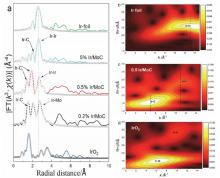
Fig 4
(a) Fourier transforms of the Ir L3-edge EXAFS spectra of Ir/MoC, Ir foil, and IrO2. (b–d) Wavelet transform of the Ir L3-edge EXAFS spectra of 0.5% Ir/MoC, Ir foil, and IrO2. 1 Å = 0.1 nm"
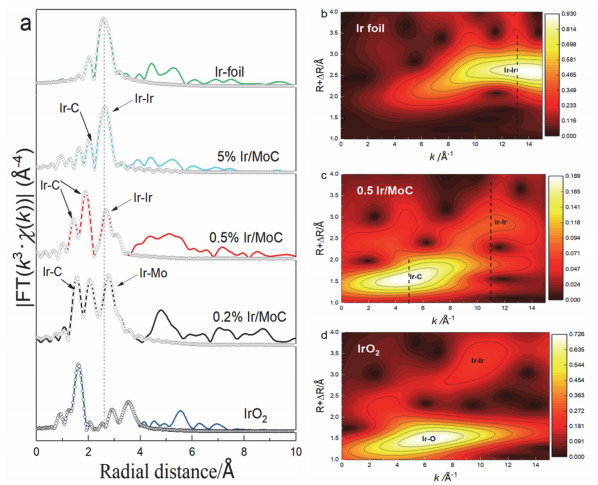
Fig 5
(a) TEM images, (b) AC-HAADF-STEM images (the Ir atoms were highlighted by the red circles, and Ir clusters were highlighted by the white circles), (c) EDS mapping images of Ir/MoC. Color online."
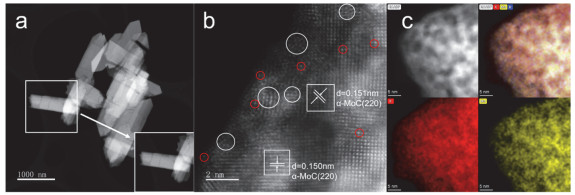
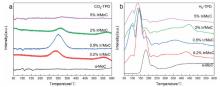
Fig 6
TPD profiles of the Ir/MoC catalysts: (a) CO2-TPD, (b) H2-TPD."
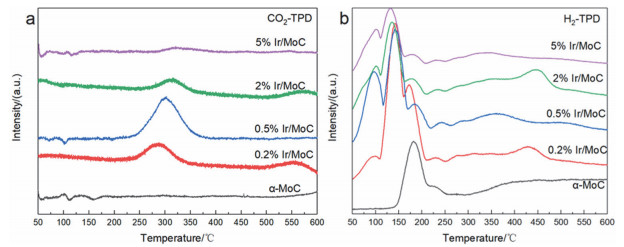
Fig 7
(a) The CO2 dissociation experiment of 0.5%Ir/MoC, (b) TPSR results of the 0.5%Ir/MoC."
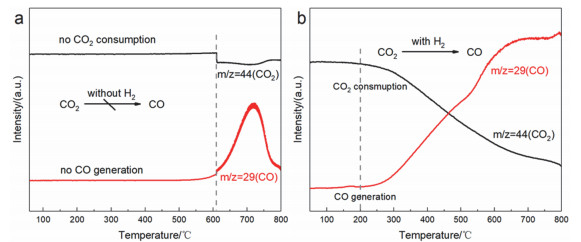
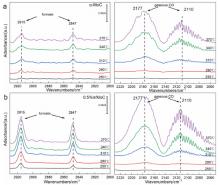
Fig 8
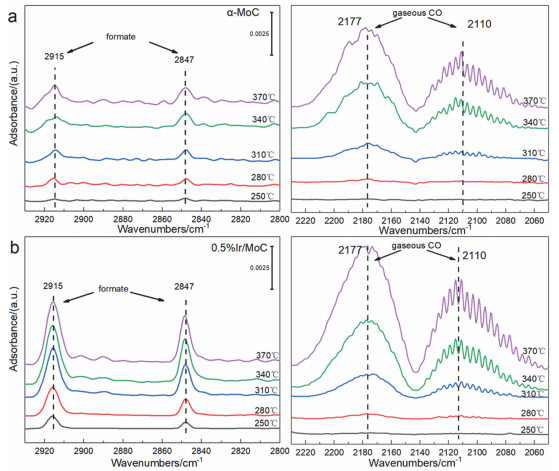
DRIFTS spectra of (a) α-MoC and (b) Ir/MoC catalysts in RWGS at 250–370 ℃. Reaction condition: H2, 30 mL·min−1, CO2, 10 mL·min−1."
| 1 |
SuX.;YangX.;ZhaoB.;HuangY.J. Energy Chem.2017,26(5),854.
doi: 10.1016/j.jechem.2017.07.006 |
| 2 |
ChuW.;WangL.-N.;ChernavskiiP. A.;KhodakovA. Y.Angew. Chem. Int. Ed.2008,47(27),5052.
doi: 10.1002/anie.200800657 |
| 3 |
ZhangD.;LuoJ.;WangJ.;XiaoX.;LiuY.;QiW.;SuD. S.;ChuW.Chin. J. Catal.2018,39(1),157.
doi: 10.1016/S1872-2067(17)62967-X |
| 4 |
VarvoutisG.;LykakiM.;PapistaE.;CarabineiroS. A. C.;PsarrasA. C.;MarnellosG. E.;KonsolakisM.J. CO2 Util.2021,44,101408.
doi: 10.1016/j.jcou.2020.101408 |
| 5 |
LoilandJ. A.;WulfersM. J.;MarinkovicN. S.;LoboR. F.Catal. Sci. Technol.2016,6(14),5267.
doi: 10.1039/C5CY02111A |
| 6 |
LuB.;KawamotoK.J. Environ. Chem. Eng.2013,1(3),300.
doi: 10.1016/j.jece.2013.05.008 |
| 7 |
VovchokD.;ZhangC.;HwangS.;JiaoL.;ZhangF.;LiuZ.;SenanayakeS. D.;RodriguezJ. A.ACS Catal.2020,10(17),10216.
doi: 10.1021/acscatal.0c01584 |
| 8 |
JungH.S.;ZafarF.;WangX.;NguyenT. X.;HongC. H.;HurY. G.;ChoungJ. W.;ParkM.-J.;BaeJ. W.ACS Catal.2021,11(22),14210.
doi: 10.1021/acscatal.1c04451 |
| 9 |
LiuH.-X.;LiS.-Q.;WangW.-W.;YuW.-Z.;ZhangW.-J.;MaC.;JiaC. J.Nat. Commun.2022,13(1),867.
doi: 10.1038/s41467-022-28476-5 |
| 10 |
MorseJ. R.;JuneauM.;BaldwinJ. W.;PorosoffM. D.;WillauerH. D.J. CO2 Util.2020,35,38.
doi: 10.1016/j.jcou.2019.08.024 |
| 11 |
RodriguezJ. A.;EvansJ.;FeriaL.;VidalA. B.;LiuP.;NakamuraK.;IllasF.J. Catal.2013,307,162.
doi: 10.1016/j.jcat.2013.07.023 |
| 12 |
PorosoffM. D.;YanB.;ChenJ. G.Energ Environ. Sci.2016,9(1),62.
doi: 10.1039/C5EE02657A |
| 13 |
LiJ.;LiuL.;LiuY.;LiM.;ZhuY.;LiuH.;KouY.;ZhangJ.;HanY.;MaD.Energ Environ. Sci.2014,7(1),393.
doi: 10.1039/C3EE41945B |
| 14 |
MaY.;GuoZ.;JiangQ.;WuK.-H.;GongH.;LiuY.J. Energy Chem.2020,50,37.
doi: 10.1016/j.jechem.2020.03.012 |
| 15 |
ZhangX.;ZhuX.;LinL.;YaoS.;ZhangM.;LiuX.;WangX.;LiY.-W.;ShiC.;MaD.ACS Catal.2016,7(1),912.
doi: 10.1021/acscatal.6b02991 |
| 16 |
LiS.;CaoR.;XuM.;DengY.;LinL.;YaoS.;LiangX.;PengM.;GaoZ.;GeY.Nat. Sci. Rev.2021,9(1),2095.
doi: 10.1093/nsr/nwab026 |
| 17 |
LinL.;ZhouW.;GaoR.;YaoS.;ZhangX.;XuW.;ZhengS.;JiangZ.;YuQ.;LiY.-W.Nature2017,544(7648),80.
doi: 10.1038/nature21672 |
| 18 |
GeY.;QinX.;LiA.;DengY.;LinL.;ZhangM.;YuQ.;LiS.;PengM.;XuY.J. Am. Chem. Soc.2021,143(2),628.
doi: 10.1021/jacs.0c11285 |
| 19 |
FanX.;LiuC.;WuM.;GaoB.;ZhengL.;ZhangY.;ZhangH.;GaoQ.;CaoX.;TangY.Appl. Catal. B2022,318,121867.
doi: 10.1016/j.apcatb.2022.121867 |
| 20 |
ReddyK. P.;DamaS.;MhamaneN. B.;GhosalyaM. K.;RajaT.;SatyanarayanaC. V.;GopinathC. S.Dalton Trans.2019,48(32),12199.
doi: 10.1039/C9DT01774G |
| 21 |
GaoJ.;WuY.;JiaC.;ZhongZ.;GaoF.;YangY.;LiuB.Catal. Commun.2016,84,147.
doi: 10.1016/j.catcom.2016.06.026 |
| 22 | MaD.Acta Phys. -Chim. Sin.2019,35(8),794. |
|
马丁;物理化学学报,2019,35(8),794.
doi: 10.3866/PKU.WHXB201810033 |
|
| 23 |
DengY.;GeY.;XuM.;YuQ.;XiaoD.;YaoS.;MaD.Acc. Chem. Res.2019,52(12),3372.
doi: 10.1021/acs.accounts.9b00182 |
| 24 |
YaoS.;ZhangX.;ZhouW.;GaoR.;XuW.;YeY.;LinL.;WenX.;LiuP.;ChenB.Science2017,357(6349),389.
doi: 10.1126/science.aah4321 |
| 25 |
LinL.;YaoS.;GaoR.;LiangX.;YuQ.;DengY.;LiuJ.;PengM.;JiangZ.;LiS.Nat. Nanotechnol.2019,14(4),354.
doi: 10.1038/s41565-019-0366-5 |
| 26 | WuK.Acta Phys. -Chim. Sin.2017,33(6),1073. |
|
吴凯;物理化学学报,2017,33(6),1073.
doi: 10.3866/PKU.WHXB201704122 |
|
| 27 |
JinC.;WangB.;ZhouY.;YangF.;GuoP.;LiuZ.;ShenW.Chem. Commun.2022,58(52),7313.
doi: 10.1039/D2CC02478K |
| 28 |
GuoY.;WangM.;ZhuQ.;XiaoD.;MaD.Nat. Catal.2022,5(9),766.
doi: 10.1038/s41929-022-00839-7 |
| 29 |
ChenX.;SuX.;SuH.-Y.;LiuX.;MiaoS.;ZhaoY.;SunK.;HuangY.;ZhangT.ACS Catal.2017,7(7),4613.
doi: 10.1021/acscatal.7b00903 |
| 30 |
PerumalS.;LimT.;SeenivasanS.;SeoJ.Appl. Surf. Sci.2022,604,154553.
doi: 10.1016/j.apsusc.2022.154553 |
| 31 |
ZhangY.;ZhangZ.;YangX.;WangR.;DuanH.;ShenZ.;LiL.;SuY.;YangR.;ZhangY.Green Chem.2020,22(20),6855.
doi: 10.1039/D0GC02302G |
| 32 |
LiS.;XuY.;ChenY.;LiW.;LinL.;LiM.;DengY.;WangX.;GeB.;YangC.Angew. Chem. Int. Ed.2017,56(36),10761.
doi: 10.1002/anie.201705002 |
| 33 |
LinL.;YuQ.;PengM.;LiA.;YaoS.;TianS.;LiuX.;LiA.;JiangZ.;GaoR.J. Am. Chem. Soc.2021,143(1),309.
doi: 10.1021/jacs.0c10776 |
| 34 |
ZuoJ.;NaW.;ZhangP.;YangX.;WenJ.;ZhengM.;WangH.Mol. Catal.2022,526,112357.
doi: 10.1016/j.mcat.2022.112357 |
| 35 |
PahijaE.;PanaritisC.;GusarovS.;ShadbahrJ.;BensebaaF.;PatienceG.;BoffitoD. C.ACS Catal.2022,12(12),6887.
doi: 10.1021/acscatal.2c01099 |
| 36 |
ZhangQ.;Pastor-PérezL.;JinW.;GuS.;ReinaT. R.Appl. Catal. B.2019,244,889.
doi: 10.1016/j.apcatb.2018.12.023 |
| 37 |
WangL.-X.;GuanE.;WangZ.;WangL.;GongZ.;CuiY.;YangZ.;WangC.;ZhangJ.;MengX.ACS Catal.2020,10(16),9261.
doi: 10.1021/acscatal.0c00907 |
| 38 |
XuJ.;GongX.;HuR.;LiuZ.-W.;LiuZ.-T.Mol. Catal.2021,516,111954.
doi: 10.1016/j.mcat.2021.111954 |
| 39 |
MaY.;RenY.;ZhouY.;LiuW.;BaazizW.;ErsenO.;CuongP.;GreinerM.;ChuW.;WangA.Angew. Chem. Int. Ed.2020,59(48),21613.
doi: 10.1002/anie.202007707 |
| 40 |
GuF.;ZhengL.;WeiH.;MiW.;ZhangC.;SuQ.;ZhuW.;LinW.Appl. Surf. Sci.2022,606,155008.
doi: 10.1016/j.apsusc.2022.155008 |
| 41 |
TangY.;YangZ.;GuoC.;HanH.;JiangY.;WangZ.;LiuJ.;WuL.;WangF.J. Mater. Chem. A2022,10(22),12157.
doi: 10.1039/D2TA00933A |
| 42 |
YangQ.;SunK.;XuY.;DingZ.;HouR.Appl. Catal. A-Gen.2022,630,118455.
doi: 10.1016/j.apcata.2021.118455 |
| 43 |
ChenJ. G.Chem. Rev.1996,96(4),1477.
doi: 10.1021/cr950232u |
| 44 |
XiaZ.;ZhangH.;ShenK.;QuY.;JiangZ.Phys. B Condens. Matter.2018,542,12.
doi: 10.1016/j.physb.2018.04.039 |
| 45 |
RavelB.;NewvilleM.J. Synchrot. Radiat.2005,12(4),537.
doi: 10.1107/S0909049505012719 |
| 46 |
WangS.-G.;LiaoX.-Y.;CaoD.-B.;HuoC.-F.;LiY.-W.;WangJ.;JiaoH.J. Phys. Chem.2007,111(45),16934.
doi: 10.1021/jp074570y |
| 47 |
LiuH.-X.;LiJ.-Y.;QinX.;MaC.;WangW.-W.;XuK.;YanH.;XiaoD.;JiaC.-J.;FuQ.Nat. Commun.2022,13(1),5800.
doi: 10.1038/s41467-022-33308-7 |
| 48 |
Alvarez-GalvanC.;LustembergP. G.;OropezaF. E.;Bachiller-BaezaB.;Dapena OspinaM.;HerranzM.;CebolladaJ.;ColladoL.;Campos-MartinJ. M.;de la Peña-O'SheaV. A.ACS Appl. Mater. Interfaces2022,14(45),50739.
doi: 10.1021/acsami.2c11248 |
| 49 |
ZhangY.;LiangL.;ChenZ.;WenJ.;ZhongW.;ZouS.;FuM.;ChenL.;YeD.Appl. Surf. Sci.2020,516,146035.
doi: 10.1016/j.apsusc.2020.146035 |
| 50 |
ZhangX.;LiuY.;ZhangM.;YuT.;ChenB.;XuY.;CrockerM.;ZhuX.;ZhuY.;WangR.Chem2020,6(12),3312.
doi: 10.1016/j.chempr.2020.09.016 |
| 51 |
XuD.;DingM.;HongX.;LiuG.ACS Catal.2020,10(24),14516.
doi: 10.1021/acscatal.0c03575 |
| 52 |
ZhengH.;LiaoW.;DingJ.;XuF.;JiaA.;HuangW.;ZhangZ.ACS Catal.2022,12(24),15451.
doi: 10.1021/acscatal.2c04437 |
| 53 |
BobadillaL. F.;SantosJ. L.;IvanovaS.;OdriozolaJ. A.;UrakawaA.ACS Catal.2018,8(8),7455.
doi: 10.1021/acscatal.8b02121 |
| [1] | 雷明杰, 胡文婷, 林可心, 孙秀娟, 张澔珅, 钱烨, 康彤玥, 吴秀琳, 廖海龙, 潘园, 张玉微, 魏笛野, 高平. Co/Mn/Mo掺杂加速NiSe2重构以提高其电催化尿素氧化性能[J]. 物理化学学报, 2025, 41(8): 100083 - . |
| [2] | 徐勇庆, 杨玉瑶, 武孟娜, 杨潇潇, 别璇, 张时语, 李清海, 张衍国, 张宸伟, PrzekopRobert E., SztorchBogna, BrzakalskiDariusz, 周会. 基于碳化钼材料CO2加氢制备高附加值化学品的热催化研究进展[J]. 物理化学学报, 2024, 40(4): 2304003 - . |
| [3] | 王佳, 秦清, 王哲, 赵旭浩, 陈云菲, 候利强, 刘尚果, 刘希恩. 磷掺杂碳负载ZnxPyOz常温常压下高效电催化合成氨[J]. 物理化学学报, 2024, 40(3): 2304044 - . |
| [4] | 李世杰, 戎珂, 王晓琴, 申楚琦, 杨方, 张青红. 一种新型Carbon Quantum Dots/CdS/Ta3N5 S型异质结纤维光催化材料用于高效降解抗生素[J]. 物理化学学报, 2024, 40(12): 2403005 - . |
| [5] | 董珂欣, 申楚琦, 阎如玉, 刘艳萍, 庄春强, 李世杰. 一种新型等离子体共振效应调控的Ag/Ag3PO4/C3N5 S型异质结光催化材料高效降解左氧氟沙星抗生素[J]. 物理化学学报, 2024, 40(10): 2310013 - . |
| [6] | 王中辽, 汪静, 张金锋, 代凯. 光激发电荷在光催化氧化还原反应中的全利用[J]. 物理化学学报, 2023, 39(6): 2209037 - . |
| [7] | 吕浩亮, 王雪杰, 杨宇, 刘涛, 张留洋. 还原氧化石墨烯包覆MOF衍生In2Se3用于钠离子电池负极[J]. 物理化学学报, 2023, 39(3): 2210014 -0 . |
| [8] | 曹美芳, 陈博, 阮涛, 欧阳新平, 邱学青. Pt/NbPWO双功能催化剂的制备及氢解碱木质素制备芳香单体[J]. 物理化学学报, 2022, 38(10): 2204037 - . |
| [9] | 李聪明, 陈阔, 王晓月, 薛楠, 杨恒权. 探究Cu/ZnO相互作用对CO2加氢制甲醇反应性能的影响[J]. 物理化学学报, 2021, 37(5): 2009101 - . |
| [10] | 凌云云, 夏云生. 金纳米复合材料:制备、性质及其癌症诊疗应用[J]. 物理化学学报, 2020, 36(9): 1912006 - . |
| [11] | 吕翰林, 胡兵, 刘国亮, 洪昕林, 庄林. ZnO逆修饰小尺寸Cu/SiO2催化剂及其在CO2加氢制甲醇中的应用[J]. 物理化学学报, 2020, 36(11): 1911008 - . |
| [12] | 王倩倩, 刘大军, 何兴权. 基于金属有机框架衍生的Fe-N-C纳米复合材料作为高效的氧还原催化剂[J]. 物理化学学报, 2019, 35(7): 740 -748 . |
| [13] | 林舟,申琳璠,瞿希铭,张俊明,姜艳霞,孙世刚. 盐封后碳化钼电催化剂的制备及其氢析出性能[J]. 物理化学学报, 2019, 35(5): 523 -530 . |
| [14] | 莫周胜,秦玉才,张晓彤,段林海,宋丽娟. 环己烯对噻吩在CuY分子筛上吸附的影响机制[J]. 物理化学学报, 2017, 33(6): 1236 -1241 . |
| [15] | 唐伟,王兢. 金属氧化物异质结气体传感器气敏增强机理[J]. 物理化学学报, 2016, 32(5): 1087 -1104 . |
|
||
