物理化学学报 >> 2025, Vol. 41 >> Issue (3): 100020.doi: 10.3866/PKU.WHXB202310004
所属专题: 新型光电功能材料
基于低维材料的自供电光电探测器研究进展
张宇航1, 赵伟玮1,*( ), 刘宏微1,*(), 吕俊鹏2
- 1 南京师范大学物理科学与技术学院, 江苏省光电技术重点实验室, 南京 210023
2 东南大学物理学院, 量子材料与信息器件教育部重点实验室, 南京 211189
-
收稿日期:2023-10-09修回日期:2023-11-01录用日期:2023-11-03发布日期:2023-12-20 -
通讯作者:Email: 06301@njnu.edu.cn (赵伟玮)phylhw@njnu.edu.cn (刘宏微) -
基金资助:国家自然科学基金(T2222011c); 国家自然科学基金(62174026); 国家自然科学基金(12274234); 国家重点研发计划(2023YFB3611400); 国家重点研发计划(2019YFA0308000); 中央高校基本科研业务费专项资金(242023k30027)
Progress on Self-Powered Photodetectors Based on Low-Dimensional Materials
Yuhang Zhang1, Weiwei Zhao1,*(), Hongwei Liu1,*(), Junpeng Lü2
- 1 Jiangsu Key Lab on Optoelectronic Technology, School of Physics and Technology, Nanjing Normal University, Nanjing 210023, China
2 Key Laboratory of Quantum Materials and Devices of Ministry of Education, School of Physics, Southeast University, Nanjing 211189, China
-
Received:2023-10-09Revised:2023-11-01Accepted:2023-11-03Published:2023-12-20 -
Contact:Email: 06301@njnu.edu.cn (Weiwei Zhao)phylhw@njnu.edu.cn (Hongwei Liu) -
Supported by:the National Natural Science Foundation of China(T2222011c); the National Natural Science Foundation of China(62174026); the National Natural Science Foundation of China(12274234); the National Key Research and Development Program of China(2023YFB3611400); the National Key Research and Development Program of China(2019YFA0308000); the Fundamental Research Funds for the Central Universities(242023k30027)

摘要:
自供电光电探测器可在无外部供能时将入射光信号转换为电信号,实现光探测功能。结合低维材料可将自供电光电探测器尺寸缩小至微纳量级,从而进一步实现器件的微型化和集成化。本文介绍了基于自供电技术的低维材料光电探测器的架构及工作原理,总结了当前自供电光电探测器应用进展,讨论了自供电光电探测器未来的发展方向与存在的问题,希望能为新型自供电光电探测器的材料选择和开发提供参考。
引用本文
张宇航, 赵伟玮, 刘宏微, 吕俊鹏. 基于低维材料的自供电光电探测器研究进展[J]. 物理化学学报, 2025, 41(3), 100020. doi: 10.3866/PKU.WHXB202310004
Yuhang Zhang, Weiwei Zhao, Hongwei Liu, Junpeng Lü. Progress on Self-Powered Photodetectors Based on Low-Dimensional Materials[J]. Acta Phys. -Chim. Sin. 2025, 41(3), 100020. doi: 10.3866/PKU.WHXB202310004
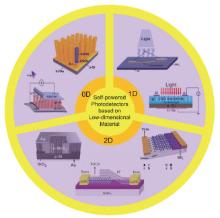
图1
"
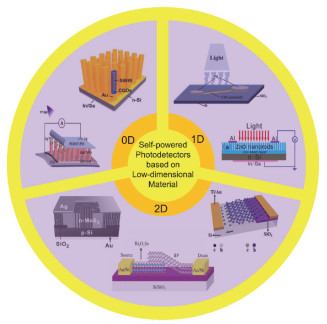
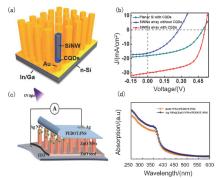
图2
(a, b) Self-powered photodetectors based on CQDs/Si NWs, Influence of Si NWs and CQDs on the device performance. (c, d) Self-powered photodetectors based on Ag QDs/ZnO NWs and Influence of Ag QDs modification on the device performance."
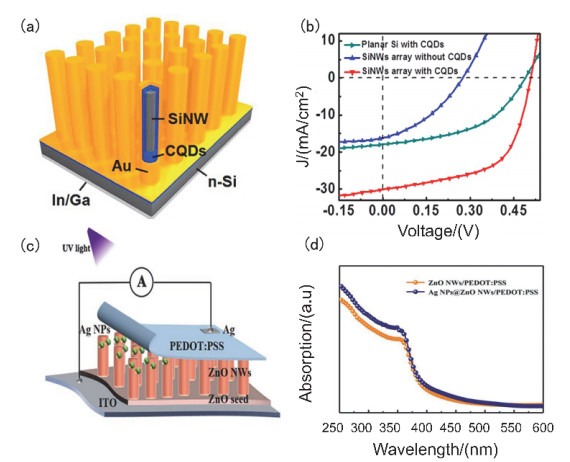
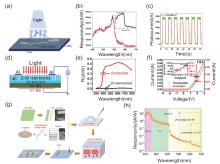
图3
"
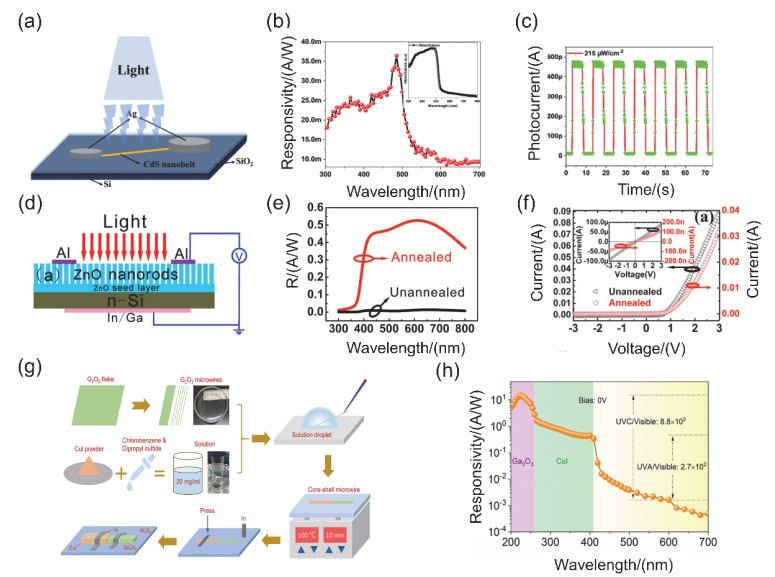
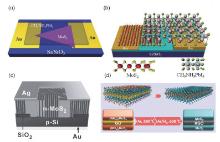
图4
"
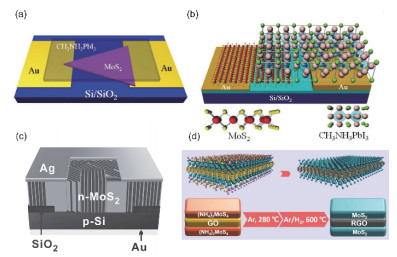
图5
"
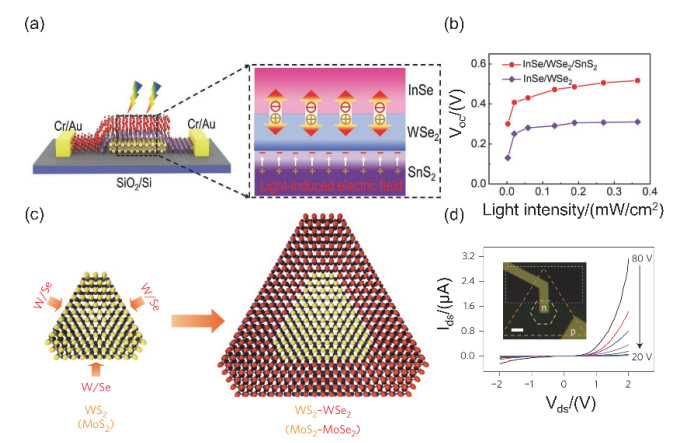
图6
"
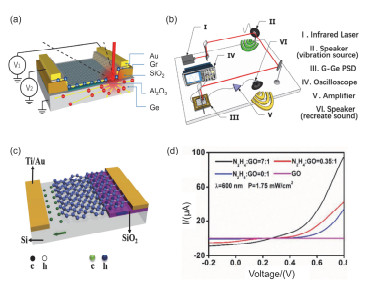
图7
"
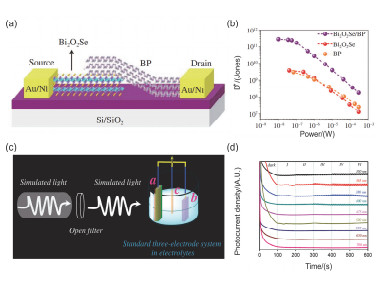
表1
"
| Type | Devices | Wavelength (nm) | R (mA∙W−1) | D (Jones) | Response Time (µs) | Ref. | |
| 0D | C QDs-ZnO/Si | 468 | 2.082 × 10³ | – | 9.5 | ||
| CsPbBr3 QDs/TiO2 | 530 | 1.01 × 10⁴ | 9.35 × 10¹³ | – | |||
| C QDs/Si | 600 | 353 | – | 20/40 | |||
| Ag QDs-ZnO/PEDOT: PSS | 325 | 25.4 | 6.73 × 10¹⁰ | 100 | |||
| 1D | Sb2Se3 NRA/B-ZnO | 625 | 172.8 | 2.25 × 10¹¹ | – | ||
| ZnO NRA/Si | 430 | 500 | – | – | |||
| CuI NW/Ga2O3 NW | 350 | 8.46 | 7.75 × 10¹¹ | 2.89 × 10⁴ | |||
| CdS NW/Si | 484 | 36 | 2.3 × 10¹² | 3×10⁴ | |||
| ZnO NRA /Si | 1064 | 0.43 | – | 210/260 | |||
| 2D | MAPbBr3/MoS2 | 532 | 368 | 3.74 × 10¹² | – | ||
| MoS2/Si | 808 | – | – | 1.6× 10⁻² | |||
| RGO-MoS2/Si | 808 | 2.18 × 10⁴ | 3.8 × 10¹⁵ | 2.8/46.6 | |||
| InSe/WSe2/SnS2 | 400 | 410 | – | 110/120 | |||
| PtSe2/GaAs | 808 | 262 | 1 × 10¹² | 5.5/6.5 | |||
| PtSe2/Si | 780 | 300.2 | 1 × 10¹³ | 38/44 | |||
| MoO3-Gr/Si | 750 | 400 | 5.4 × 10¹² | – | |||
| RGO/Si | 600 | 1.52 × 10³ | – | 2×10³ | |||
| RGO/Ge | 1400 | 51.8 | 1.38 × 10¹⁰ | 23 | |||
| Gr/Pentacene | 658 | 1×10⁸ | > 1011 | 6/9 | |||
| BP/Bi2O2Se | 700 | – | 2.8×10¹¹ | 9×10³ | |||
| PtSe2/Si | 808 | 520 | 3.26 × 10¹³ | 55.3/170 | |||
| Gr/Si | 532 | 510 | – | 130 | |||
| 1 |
doi: 10.1002/advs.201700256 |
| 2 |
doi: 10.1360/tb-2023-0438 |
| 3 |
doi: 10.1002/adom.202200786 |
| 4 |
doi: 10.1038/s41560-018-0324-8 |
| 5 |
doi: 10.1002/adma.201703694 |
| 6 |
doi: 10.1002/adma.201503534 |
| 7 |
doi: 10.1016/j.mattod.2021.11.027 |
| 8 |
doi: 10.1021/acsami.0c15816 |
| 9 |
doi: 10.1021/acsaelm.2c00411 |
| 10 |
doi: 10.1021/acsami.0c18028 |
| 11 |
doi: 10.1016/j.nanoen.2023.108172 |
| 12 |
doi: 10.1002/smll.201903469 |
| 13 |
doi: 10.1002/admi.201701189 |
| 14 |
doi: 10.1016/j.nanoen.2022.107657 |
| 15 |
doi: 10.1039/c5nr06167a |
| 16 |
doi: 10.1016/j.mattod.2016.12.001 |
| 17 |
doi: 10.1021/acs.jpclett.8b00266 |
| 18 |
doi: 10.1038/ncomms7142 |
| 19 |
doi: 10.1039/c5ee03522h |
| 20 |
doi: 10.1038/nmat4703 |
| 21 |
doi: 10.1002/admi.202101443 |
| 22 |
doi: 10.1021/cr900137k |
| 23 |
doi: 10.1021/ja068351m |
| 24 |
doi: 10.1002/adfm.202103106 |
| 25 |
doi: 10.1002/sstr.202000136 |
| 26 |
doi: 10.1038/s41578-023-00583-9 |
| 27 |
doi: 10.1126/sciadv.aau3241 |
| 28 |
doi: 10.1007/s10853-023-08379-6 |
| 29 |
doi: 10.1021/nn501001j |
| 30 |
doi: 10.1002/adfm.202202184 |
| 31 |
doi: 10.1039/d1ma00580d |
| 32 |
doi: 10.1063/1.3082096 |
| 33 |
doi: 10.1002/adfm.201500216 |
| 34 |
doi: 10.1002/smll.201600835 |
| 35 |
doi: 10.1007/s11432-020-3101-1 |
| 36 |
doi: 10.1038/nnano.2010.46 |
| 37 |
doi: 10.1002/adma.200902153 |
| 38 |
doi: 10.1038/nnano.2014.215 |
| 39 |
doi: 10.37188/co.2020-0139 |
| 40 |
doi: 10.3866/PKU.WHXB201804041 |
|
贺平; 袁方龙; 王子飞; 谭占鳌; 范楼珍; 等. 物理化学学报, 2018, 34, 1250- 11.
doi: 10.3866/PKU.WHXB201804041 |
|
| 41 |
doi: 10.1126/science.aac5523 |
| 42 |
doi: 10.1038/nnano.2012.60 |
| 43 |
doi: 10.1038/nnano.2008.313 |
| 44 |
doi: 10.1002/adma.201202220 |
| 45 |
doi: 10.1002/adma.201402471 |
| 46 |
doi: 10.1002/adom.201900019 |
| 47 |
doi: 10.1038/nmat3539 |
| 48 |
doi: 10.1021/nl502491d |
| 49 |
doi: 10.1038/nphoton.2007.147 |
| 50 |
doi: 10.1002/adma.202000004 |
| 51 |
doi: 10.1038/nmat1299 |
| 52 |
doi: 10.1007/s13204-018-0842-5 |
| 53 |
doi: 10.1002/adma.201705893 |
| 54 |
doi: 10.1016/j.nanoen.2018.06.058 |
| 55 |
doi: 10.1016/j.jallcom.2017.11.376 |
| 56 |
doi: 10.1021/acs.jpclett.0c03382 |
| 57 |
doi: 10.1021/acsnano.7b03560 |
| 58 |
doi: 10.1002/adom.202200816 |
| 59 |
doi: 10.1002/adma.201204488 |
| 60 |
doi: 10.1126/science.1102896 |
| 61 |
doi: 10.3866/PKU.WHXB202108017 |
|
常诚; 陈伟; 陈也11; 陈永华11; 陈雨11; 丁峰11; 樊春海11; 范红金11; 范战西11; 龚成11; 等. 物理化学学报, 2021, 37 (2108017)
doi: 10.3866/PKU.WHXB202108017 |
|
| 62 |
doi: 10.3866/PKU.WHXB201812020 |
|
李家意; 丁一; 张卫; 周鹏; 等. 物理化学学报, 2019, 35 (1058)
doi: 10.3866/PKU.WHXB201812020 |
|
| 63 |
doi: 10.1038/s41467-018-07643-7 |
| 64 |
doi: 10.1016/j.scib.2019.09.021 |
| 65 |
doi: 10.1002/adma.201500889 |
| 66 |
doi: 10.1038/ncomms2830 |
| 67 |
doi: 10.1038/s41598-017-05176-5 |
| 68 |
doi: 10.1016/j.apmt.2020.100765 |
| 69 |
doi: 10.1021/acsnano.6b03722 |
| 70 |
doi: 10.1002/adfm.201701611 |
| 71 |
doi: 10.1088/0957-4484/27/22/225501 |
| 72 |
doi: 10.1038/s41467-022-32062-0 |
| 73 |
doi: 10.1002/smll.201501298 |
| 74 |
doi: 10.1021/acsnano.1c02007 |
| 75 |
doi: 10.1039/c9nr04348a |
| 76 |
doi: 10.1021/acsnano.6b01839 |
| 77 |
doi: 10.1021/acsaelm.3c00156 |
| 78 |
doi: 10.1002/adom.201900765 |
| 79 |
doi: 10.1002/admi.201701275 |
| 80 |
doi: 10.1002/admi.202200912 |
| 81 |
doi: 10.1002/adma.201801729 |
| 82 |
doi: 10.1002/advs.201700502 |
| 83 |
doi: 10.1021/acsami.5b10001 |
| 84 |
doi: 10.1021/nl301164v |
| 85 |
doi: 10.3866/PKU.WHXB201909013 |
|
刘忠范. 物理化学学报, 2019, 35 (1309)
doi: 10.3866/PKU.WHXB201909013 |
|
| 86 |
doi: 10.1038/nnano.2014.150 |
| 87 |
doi: 10.1021/nl502075n |
| 88 |
doi: 10.1016/j.optcom.2017.07.033 |
| 89 |
doi: 10.1039/c8nr04004d |
| 90 |
doi: 10.1002/smtd.202200966 |
| 91 |
doi: 10.1038/nnano.2014.222 |
| 92 |
doi: 10.1016/j.nanoen.2018.06.049 |
| 93 |
doi: 10.1002/adfm.201806878 |
| 94 |
doi: 10.1002/adfm.201705970 |
| 95 |
doi: 10.1016/j.mssp.2019.104804 |
| 96 |
doi: 10.1016/j.ssc.2008.02.024 |
| 97 |
doi: 10.1109/led.2013.2275169 |
| 98 |
doi: 10.1038/srep12014 |
| 99 |
doi: 10.1002/adma.201506140 |
| 100 |
doi: 10.1039/c8tc02786b |
| 101 |
doi: 10.1002/smll.201701848 |
| 102 |
doi: 10.1021/acs.nanolett.9b03368 |
| 103 |
doi: 10.1021/am4026505 |
| 104 |
doi: 10.1021/acsami.6b09943 |
| 105 |
doi: 10.1002/advs.202204332 |
| 106 |
doi: 10.1038/s41427-020-00260-1 |
| 107 |
doi: 10.1126/science.aac9439 |
| 108 |
doi: 10.1126/sciadv.abj2521 |
| 109 |
doi: 10.1038/s41566-018-0239-8 |
| 110 |
doi: 10.1002/adfm.201705833 |
| 111 |
doi: 10.1002/adfm.201606834 |
| 112 |
doi: 10.1088/1361-6528/aab6ee |
| [1] | 樊凡, 修浩, 王宇婷, 崔永朋, 王雅君. NH2-MIL-125/Na掺杂g-C3N4复合S型异质结的构建及其光催化产过氧化氢性能[J]. 物理化学学报, 2026, 42(2): 100143 - . |
| [2] | 葛成艳, 胡佳伟, 刘星雨, 宋玉玺, 刘超, 邹志刚. 自集成黑色NiO团簇与ZnIn2S4微球实现S型电子转移机制下光热辅助制氢[J]. 物理化学学报, 2026, 42(1): 100154 - . |
| [3] | 陈轼逸, 付家龙, 裘建平, 常国菊, 郝仕油. 废弃医用口罩衍生的碳量子点增强BiOBr/g-C3N4 S型异质结光催化降解聚对苯二甲酸乙二醇酯(PET)[J]. 物理化学学报, 2026, 42(1): 100135 - . |
| [4] | 王文龙, 郝文韬, 何浪, 乔佳, 李宁, 陈朝秋, 覃勇. 碳量子点/TiO2 S型异质结的能带和吸附工程促进光催化CO2甲烷化[J]. 物理化学学报, 2025, 41(9): 100116 - . |
| [5] | 韦梦兰, 欧晓霞, 王艺濛, 张梦圆, 滕飞, 王凯旋. S型异质结g-C3N4/Bi2WO6高效降解左氧氟沙星:性能、机理及降解路径[J]. 物理化学学报, 2025, 41(9): 100105 - . |
| [6] | 李静萍, 严素定, 吴佳曦, 程强, 王楷. LiFePO4改善无机/有机S型光催化剂的过氧化氢光合作用[J]. 物理化学学报, 2025, 41(9): 100104 - . |
| [7] | 吴琦, 王长华, 李莹莹, 张昕彤. 增强g-C3N4@BN范德华异质结界面上的三重态电子转移增强光催化合成H2O2[J]. 物理化学学报, 2025, 41(9): 100107 - . |
| [8] | 蔡家杰, 程畅, 刘博文, 张建军, 姜传佳, 程蓓. CdS/DBTSO-BDTO S型异质结光催化制氢及其电荷转移动力学[J]. 物理化学学报, 2025, 41(8): 100084 - . |
| [9] | 孟凡鹏, 赵飞, 林靖恺, 赵金生, 张华阳, 王少彬. 优化氮化碳纳米片/球形共轭聚合物S型异质结界面电场以促进析氢反应[J]. 物理化学学报, 2025, 41(8): 100095 - . |
| [10] | 王伟康, 吴亚栋, 张建军, 孟凯, 李金河, 王乐乐, 刘芹芹. 三聚氰胺泡沫支撑的S型硫铟锌镉/硫掺杂氮化碳异质结的绿色H2O2合成:协同界面电荷转移调控与局域光热效应[J]. 物理化学学报, 2025, 41(8): 100093 - . |
| [11] | 刘方璇, 刘子妍, 周国伟, 高婷婷, 刘文宇, 孙彬. 中空结构光催化剂[J]. 物理化学学报, 2025, 41(7): 100071 - . |
| [12] | 刘超, 余欢, 李佳明, 余茜, 郁壮志, 宋玉玺, 张峰, 张勤芳, 邹志刚. 具有光热效应的多级Ti3C2/Bi12O17Br2肖特基异质结简单合成及其太阳能驱动抗生素光降解的研究[J]. 物理化学学报, 2025, 41(7): 100075 - . |
| [13] | 诸海渝, 文卓群, 熊稳, 魏兴战, 王峙. 二维半金属/硅异质结中肖特基势垒高度的准确高效预测[J]. 物理化学学报, 2025, 41(7): 100078 - . |
| [14] | 苗鑫宇, 杨浩, 何杰, 王晶, 靳治良. 调整Keggin型多金属氧酸盐电子结构构建S型异质结用于光催化析氢[J]. 物理化学学报, 2025, 41(6): 100051 - . |
| [15] | 荣坤, 温翠莲, 闻健森, 李雄, 廖秋刚, 鄢思情, 许超, 张晓亮, 萨百晟, 孙志梅. 层状MoS2/Ti3C2Tx异质结光热转换材料用于太阳能驱动水蒸发[J]. 物理化学学报, 2025, 41(6): 100053 - . |
|
||