物理化学学报 >> 2025, Vol. 41 >> Issue (3): 100026.doi: 10.3866/PKU.WHXB202405002
MOF模板法合成氮掺杂碳材料用于增强电化学钠离子储存和去除
王卓, 白雪, 张可新, 王鸿志, 董家宝, 高源, 赵斌*( )
)
- 上海理工大学材料与化学学院, 上海 200093
-
收稿日期:2024-05-01修回日期:2024-05-24录用日期:2024-05-31发布日期:2024-12-14 -
通讯作者:Email: zhaobin@usst.edu.cn (赵斌) -
基金资助:国家自然科学基金(22209114); 上海市教育委员会和上海市教育发展基金会晨光计划(21CGA56); 上海市自然科学基金(21ZR1445700); 上海市青年科技英才扬帆计划(21YF1430800)
MOF-Templated Synthesis of Nitrogen-Doped Carbon for Enhanced Electrochemical Sodium Ion Storage and Removal
Zhuo Wang, Xue Bai, Kexin Zhang, Hongzhi Wang, Jiabao Dong, Yuan Gao, Bin Zhao*()
- School of Materials and Chemistry, University of Shanghai for Science and Technology, Shanghai 200093, China
-
Received:2024-05-01Revised:2024-05-24Accepted:2024-05-31Published:2024-12-14 -
Contact:Email: zhaobin@usst.edu.cn (Bin Zhao) -
Supported by:the National Natural Science Foundation of China(22209114); the Chenguang Program of Shanghai Education Development Foundation and Shanghai Municipal Education(21CGA56); the Natural Science Foundation of Shanghai(21ZR1445700); the Shanghai Sailing Program(21YF1430800)

摘要:
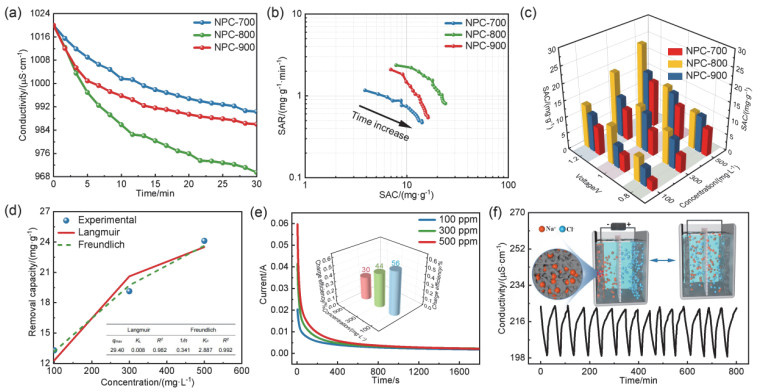
电极材料在电容去离子技术中起到决定性作用,影响着盐离子的去除和电荷储存能力。本文通过碳化MOF-5和三聚氰胺的混合物,成功制备了氮掺杂的分级多孔碳,其中三聚氰胺起着氮源和造孔剂的双重作用。通过优化碳化温度,得到的MOF-5衍生纳米多孔碳(NPC-800),其不但保持着MOF-5原始的立方体形貌、还具有大的比表面积、高氮含量和良好的润湿性。NPC-800电极在0.2 A·g-1电流密度下具有91.8 mAh·g-1的高比容量。在5 A·g-1的电流密度下循环50000次,容量保持率为100%,展现出超长的循环稳定性。在500 mg·L-1的NaCl溶液,施加恒压1.2 V,NPC-800电极具有高的脱盐容量24.17 mg·g-1,快的脱盐速度2.8 mg·g-1·min-1和较稳定的再生循环能力。因此,以金属有机框架为模板合成氮掺杂的碳材料,能够有效增强钠离子的电化学储存和去除能力,有望成为电容去离子电极材料的最佳选择。
引用本文
王卓, 白雪, 张可新, 王鸿志, 董家宝, 高源, 赵斌. MOF模板法合成氮掺杂碳材料用于增强电化学钠离子储存和去除[J]. 物理化学学报, 2025, 41(3), 100026. doi: 10.3866/PKU.WHXB202405002
Zhuo Wang, Xue Bai, Kexin Zhang, Hongzhi Wang, Jiabao Dong, Yuan Gao, Bin Zhao. MOF-Templated Synthesis of Nitrogen-Doped Carbon for Enhanced Electrochemical Sodium Ion Storage and Removal[J]. Acta Phys. -Chim. Sin. 2025, 41(3), 100026. doi: 10.3866/PKU.WHXB202405002
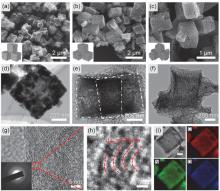
图1
SEM images of (a) NPC-700, (b) NPC-800, (c) NPC-900, TEM images of (d) NPC-700, (e) NPC-800, (f) NPC-900, (g, h) HRTEM images of NPC-800 (inset: selected area electron diffraction pattern), and (i) the corresponding elemental mappings of NPC-800."
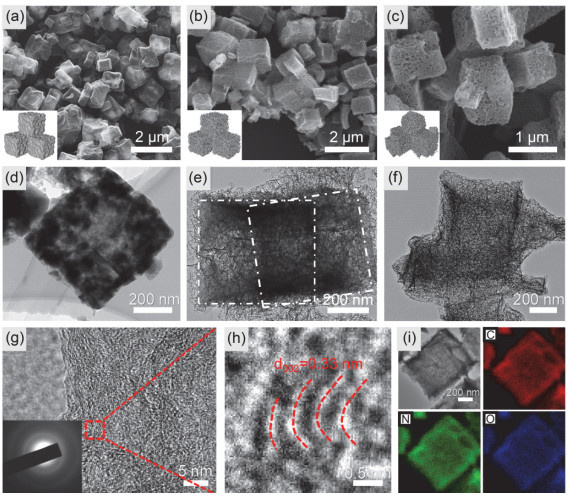
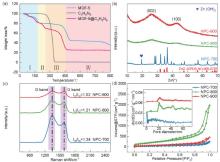
图2
(a) TG curves of MOF-5, C3H6N6, and MOF-5@C3H6N6 at N2 atmosphere, (b) XRD patterns, (c) Raman spectra, and (d) N2 adsorption-desorption isothermal curves (inset: the corresponding pore-size distributions) of NPCs."
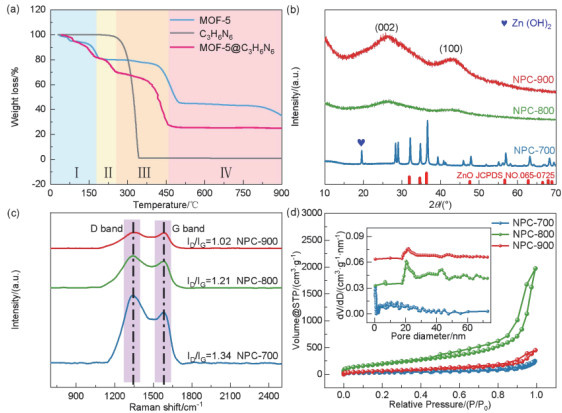
图3
(a) High-resolution XPS N 1s spectra of NPC, and (b) optical micrographs of the water contact angles on the surface of NPC-700, NPC-800, and NPC-900."
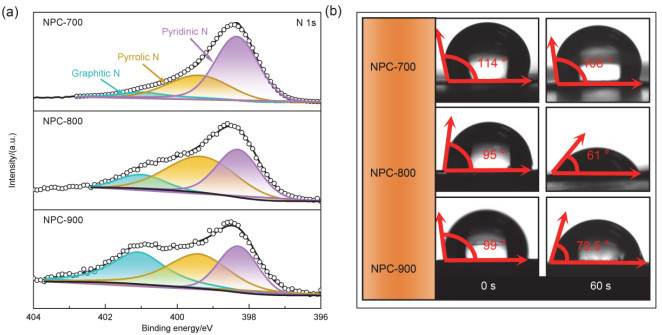
图4
(a) CV curves at a scan rate of 1 mV∙s−1, (b) GCD curves at the current density of 0.2 A∙g−1, and (c) rate performance of NPCs, (d) cyclic stability of NPC-800 at a charge-discharge current density of 5 A ∙ g−1 for 50000 cycles (inset: the galvanostatic charge-discharge curves), all measurements were conducted in 1.0 mol∙L−1 NaCl by using a three-electrode system."
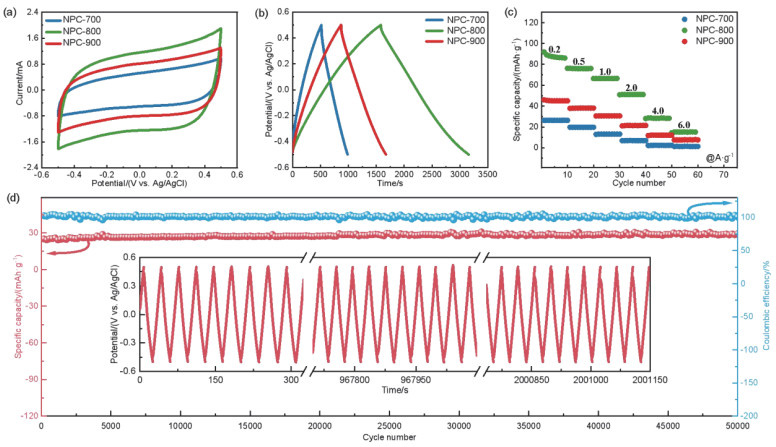
图5
(a) Plots of solution conductivity vs. deionization time, (b) Ragone plots of the samples in 500 mg∙L−1 NaCl solution at 1.2 V, (c) SAC of NPCs under different applied voltages and NaCl solution concentrations, (d)the simulations of Langmuir and Freundlich isotherms for the adsorption isotherm data of NPC-800, (e) corresponding current response versus CDI time at different initial NaCl concentrations (inset: charge efficiencies of NPCs at various NaCl solution concentrations), (f) the cycle stability of NPC-800 in a 100 mg∙L−1 NaCl solution at 1.2 V (inset: Schematic CDI process for the NPC//NPC system)."
| 1 |
doi: 10.1038/517006a |
| 2 |
doi: 10.1038/nature06599 |
| 3 |
doi: 10.1038/d41586-023-00793-9 |
| 4 |
doi: 10.1016/j.desal.2019.01.019 |
| 5 |
doi: 10.1016/j.est.2022.105025 |
| 6 |
doi: 10.1016/s0011-9164(00)00043-6 |
| 7 |
doi: 10.1016/j.est.2019.04.029 |
| 8 |
doi: 10.1016/j.est.2022.104862 |
| 9 |
doi: 10.1016/j.desal.2023.116701 |
| 10 |
熊岳城.; 于飞.; 马杰.. 物理化学学报, 2022, 38, 2006037.
doi: 10.3866/PKU.WHXB202006037 |
|
doi: 10.3866/PKU.WHXB202006037 |
|
| 11 |
doi: 10.1002/adfm.202401332 |
| 12 |
doi: 10.1002/anie.202401972 |
| 13 |
doi: 10.1002/smll.202107913 |
| 14 |
doi: 10.1016/j.jelechem.2020.114416 |
| 15 |
doi: 10.1002/anie.202302180 |
| 16 |
doi: 10.1016/0013-4686(67)80079-3 |
| 17 |
doi: 10.1016/j.mtchem.2021.100603 |
| 18 |
doi: 10.1016/j.seppur.2009.10.023 |
| 19 |
doi: 10.1016/j.electacta.2015.12.028 |
| 20 |
doi: 10.1039/c7cc03424e |
| 21 |
王雷.; 于飞.; 马杰.. 物理化学学报, 2017, 33, 1338.
doi: 10.3866/PKU.WHXB201704113 |
|
doi: 10.3866/PKU.WHXB201704113 |
|
| 22 |
doi: 10.1016/j.ccr.2024.215835 |
| 23 |
doi: 10.1016/j.seppur.2023.123628 |
| 24 |
doi: 10.1002/advs.202204041 |
| 25 |
doi: 10.1007/s10311-021-01355-z |
| 26 |
陈清.; 赵健.; 程虎虎.; 曲良体.. 物理化学学报, 2022, 38, 2101020.
doi: 10.3866/PKU.WHXB202101020 |
|
doi: 10.3866/PKU.WHXB202101020 |
|
| 27 |
张泽豪.; 王政.; 李海波.. 物理化学学报, 2024, 40, 2308020.
doi: 10.3866/PKU.WHXB202308020 |
|
doi: 10.3866/PKU.WHXB202308020 |
|
| 28 |
孙宇恒.; 高铭达.; 李慧.; 徐丽.; 薛晴.; 王欣然.; 白莹.; 吴川.. 物理化学学报, 2021, 37, 2007048.
doi: 10.3866/PKU.WHXB202007048 |
|
doi: 10.3866/PKU.WHXB202007048 |
|
| 29 |
doi: 10.1016/j.cej.2020.126960 |
| 30 |
doi: 10.1016/j.cis.2024.103092 |
| 31 |
doi: 10.1016/j.est.2022.105420 |
| 32 |
doi: 10.1016/j.est.2022.104071 |
| 33 |
doi: 10.1039/d2ee03530h |
| 34 |
doi: 10.1021/acsami.7b02712 |
| 35 |
doi: 10.1039/c6ta02420c |
| 36 |
doi: 10.1021/acsami.3c10043 |
| 37 |
doi: 10.1016/j.carbon.2016.07.047 |
| 38 |
doi: 10.1039/c9en01216h |
| 39 |
doi: 10.1016/j.jtice.2016.01.022 |
| 40 |
doi: 10.1016/j.electacta.2015.07.130 |
| 41 |
doi: 10.1016/j.cej.2022.139764 |
| 42 |
doi: 10.1021/acssuschemeng.3c08359 |
| 43 |
doi: 10.1039/b922528e |
| 44 |
doi: 10.1002/celc.201600051 |
| 45 |
doi: 10.1039/c9en01233h |
| 46 |
doi: 10.1016/j.jece.2023.109684 |
| 47 |
doi: 10.1007/s12274-020-3097-x |
| 48 |
doi: 10.1002/smll.201703548 |
| 49 |
doi: 10.1016/j.matlet.2023.134434 |
| 50 |
doi: 10.1002/aenm.201800569 |
| 51 |
doi: 10.1002/advs.202300283 |
| 52 |
doi: 10.1016/j.est.2023.107397 |
| 53 |
doi: 10.1016/j.nanoen.2020.105304 |
| 54 |
doi: 10.1016/j.est.2023.108152 |
| 55 |
doi: 10.1016/j.est.2021.102331 |
| 56 |
doi: 10.1039/d2en01103d |
| 57 |
doi: 10.1016/j.seppur.2022.122918 |
| 58 |
doi: 10.1016/j.jece.2023.109914 |
| 59 |
doi: 10.1016/j.jelechem.2017.12.078 |
| 60 |
doi: 10.1016/j.desal.2023.116766 |
| [1] | 项书宏, 杨旅, 徐应生, 曹国新, 周宏建. 利用碳纳米管分散的亚铁氰化锌钾电极选择性电吸附高盐放射性废水中的铯(Ⅰ)[J]. 物理化学学报, 2025, 41(9): 100097 - . |
| [2] | 陈泽秋, 蔡黎淼, 关杰, 李瞻洋, 王昊, 郭耀广, 徐兴涛, 潘丽坤. 电容去离子提锂技术中电极材料的研究进展[J]. 物理化学学报, 2025, 41(8): 100089 - . |
| [3] | 黄鋆, 聂鹏飞, 鲁勇朝, 李佳洋, 王怡文, 刘建允. 丝光沸石负载自支撑氮掺杂多孔碳纳米纤维电容器及高效选择性去除硬度离子[J]. 物理化学学报, 2025, 41(7): 100066 - . |
| [4] | 杨雪琦, 赵俊涛, 叶家伟, 周德森, 狄廷敏, 张军. 调节NNU-55(Fe)的d带中心以增强CO2吸附和光催化活性[J]. 物理化学学报, 2025, 41(7): 100074 - . |
| [5] | 严国泽, 左彬, 刘少卿, 王桃, 王若愚, 包锦洋, 赵忠舟, 储菲菲, 李政通, YusukeYamauchi, SaadMelhi, 徐兴涛. 电容去离子海水提铀的机遇与挑战[J]. 物理化学学报, 2025, 41(4): 100032 - . |
| [6] | 王禹尧, 曹志涛, 杜泽宇, 曹鑫鑫, 梁叔全. 钠离子电池铁基聚阴离子正极材料研究进展[J]. 物理化学学报, 2025, 41(4): 100035 - . |
| [7] | 叶萍, 覃玲霜, 贺萌瑶, 巫方方, 陈增烨, 梁明星, 邓立波. 荷叶衍生多孔碳的零电荷电位调节实现废水中电化学捕集镉离子[J]. 物理化学学报, 2025, 41(3): 100023 - . |
| [8] | 严鹏程, 王鹏, 黄婧, 莫曌, 徐丽, 陈芸, 张瑜, 齐志冲, 许晖, 李赫楠. 多策略提升卤化氧铋活性材料的光电性能及其在光电化学领域的应用进展[J]. 物理化学学报, 2025, 41(2): 100014 - . |
| [9] | 张泽豪, 王政, 李海波. V2CFx MXene衍生2D V2O3@介孔碳纳米片的制备及其电容脱盐特性[J]. 物理化学学报, 2024, 40(8): 2308020 - . |
| [10] | 邵碧珠, 董慧君, 龚云南, 梅剑华, 蔡锋石, 刘金彪, 钟地长, 鲁统部. 金属有机框架衍生镍纳米颗粒在宽电位窗口内高效电催化二氧化碳还原[J]. 物理化学学报, 2024, 40(4): 2305026 - . |
| [11] | 陈慧滢, 朱浩林, 廖培钦, 陈小明. 一例整合了三联吡啶钌和卟啉锌的金属-有机框架材料用于光催化二氧化碳还原全反应[J]. 物理化学学报, 2024, 40(4): 2306046 - . |
| [12] | 许银洁, 李随勤, 刘力豪, 贺佳辉, 李凯, 王梦欣, 赵舒影, 李纯, 张峥斌, 钟兴, 王建国. NiFe-MOF和氮氧自由基协同增强甾醇电催化氧化[J]. 物理化学学报, 2024, 40(3): 2305012 - . |
| [13] | 张笑晨, 于飞, 马杰. 多角度数理模拟在电容去离子中的前沿应用[J]. 物理化学学报, 2024, 40(11): 2311026 - . |
| [14] | 李琪, 黎平安, 刘泽通, 张佳辉, 张浩, 余维来, 胡先罗. 同轴静电纺丝构筑微/纳米结构隔膜与电极材料用于锂离子电池:从原理到应用[J]. 物理化学学报, 2024, 40(10): 2311030 - . |
| [15] | 陈帅, 余创, 罗启悦, 魏超超, 李莉萍, 李广社, 程时杰, 谢佳. 卤化物固态电解质研究进展[J]. 物理化学学报, 2023, 39(8): 2210032 -0 . |
|
||