物理化学学报 >> 2026, Vol. 42 >> Issue (10): 100248.doi: 10.1016/j.actphy.2026.100248
具有“钢筋混凝土”结构和优异电磁波吸收性能的Fe3O4/Ti3C2Tx MXene/CF@PANI复合材料
翟钰琦1, 刘梦竹1,*( ), 胡峻豪1, 王永鹏2
- 1 吉林化工大学材料科学与工程学院, 吉林 吉林 132022
2 吉林化工大学碳纤维研究所, 吉林 吉林 132022
-
收稿日期:2025-11-17修回日期:2026-01-09录用日期:2026-01-24发布日期:2026-09-03 -
通讯作者:Email: liumingzhu125@163.com (刘梦竹)
Strengthening of Fe3O4/Ti3C2Tx MXene/CF@PANI composites with 'reinforced concrete' structure and high electromagnetic wave absorption performance
Yuqi Zhai1, Mengzhu Liu1,*(), Junhao Hu1, Yongpeng Wang2
- 1 College of Materials Science and Engineering, Jilin University of Chemical Technology, Jilin 132022, Jilin Province, China
2 Carbon Fiber Research Institute, Jilin University of Chemical Technology, Jilin 132022, Jilin Province, China
-
Received:2025-11-17Revised:2026-01-09Accepted:2026-01-24Published:2026-09-03 -
Contact:Email: liumingzhu125@163.com (Mengzhu Liu)

摘要:
Ti3C2Tx MXene作为高效电磁波吸波剂(EWA)的应用受到其高反射率、低吸收率和较差的机械强度的阻碍。受结构工程的启发,我们提出一种异质组装策略,构建了一种新型的“钢筋混凝土”结构Fe3O4/Ti3C2Tx MXene/CF@PANI复合材料(CPFT)。通过多尺度结构设计与界面调控,实现了力学增强与电磁功能的集成。原位聚合CF@PANI的芯-壳结构既作为增强骨架又充当导电桥梁,提升了机械稳定性和传导损耗能力。与此同时,在聚多巴胺的作用下,Fe3O4在Ti3C2Tx MXene层间及表面原位生长,形成类似混凝土基体结构。各组分通过静电与氢键相互作用自组装,形成具有优异界面相容性的异质结构。这一结构显著促进了界面电荷积累与多重极化效应,优化了阻抗匹配特性,延长了电磁波在材料内的传播与耗散路径,实现了介电损耗与磁损耗的高效协同作用。因此,在厚度仅为1.5 mm时,CPFT-0.75在13.76 GHz处取得最小反射损耗-37.34 dB,并获得3.28 GHz的有效吸收带宽。此外,CPFT-1.0具有良好的机械性能,测得杨氏模量为20.8 MPa,拉伸强度3.63 MPa,断裂伸长率10.98%。本研究通过将磁性材料、导电材料与二维纳米材料整合于分级结构中,提出了一种新型MXene基功能材料,实现了电磁波吸收性能和力学性能上的双重提升。
引用本文
翟钰琦, 刘梦竹, 胡峻豪, 王永鹏. 具有“钢筋混凝土”结构和优异电磁波吸收性能的Fe3O4/Ti3C2Tx MXene/CF@PANI复合材料[J]. 物理化学学报, 2026, 42(10), 100248. doi: 10.1016/j.actphy.2026.100248
Yuqi Zhai, Mengzhu Liu, Junhao Hu, Yongpeng Wang. Strengthening of Fe3O4/Ti3C2Tx MXene/CF@PANI composites with 'reinforced concrete' structure and high electromagnetic wave absorption performance[J]. Acta Phys. -Chim. Sin. 2026, 42(10), 100248. doi: 10.1016/j.actphy.2026.100248
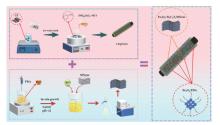
图1
"
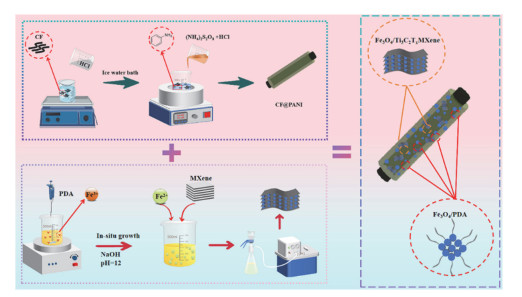
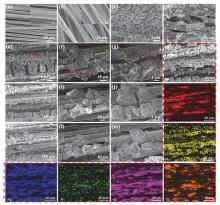
图2
"
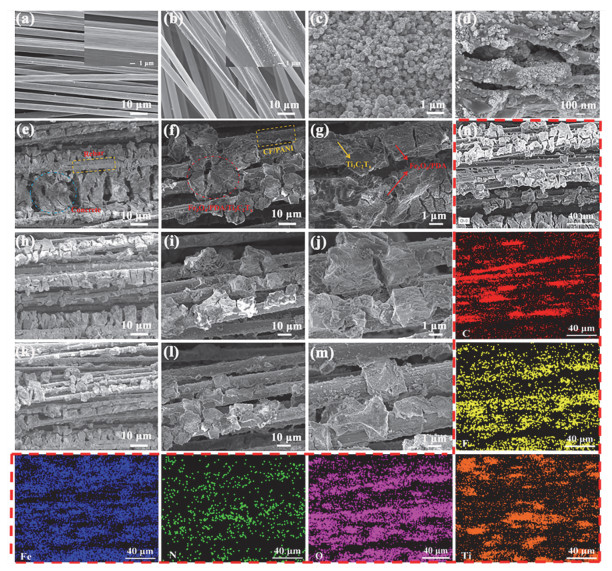
图3
"
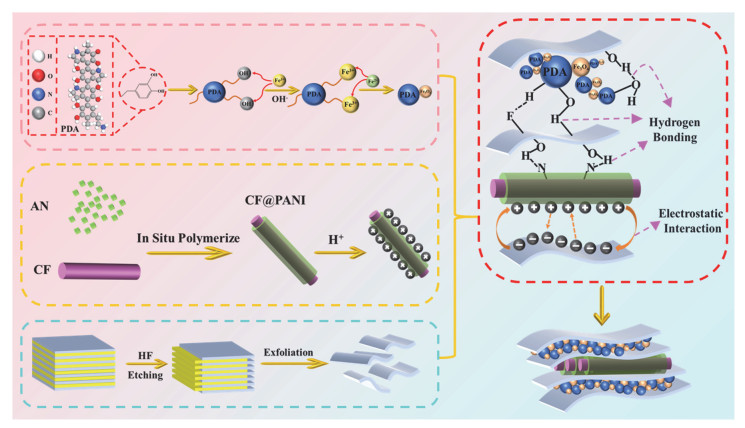
图4
"
图5
"
图6
"
图7
"
图8
"
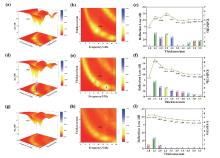
图9
"
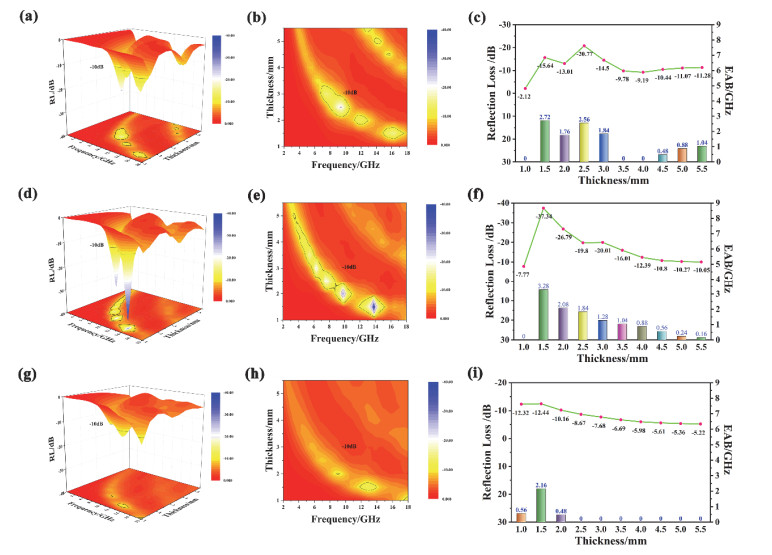
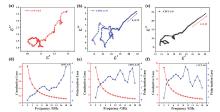
图10
"
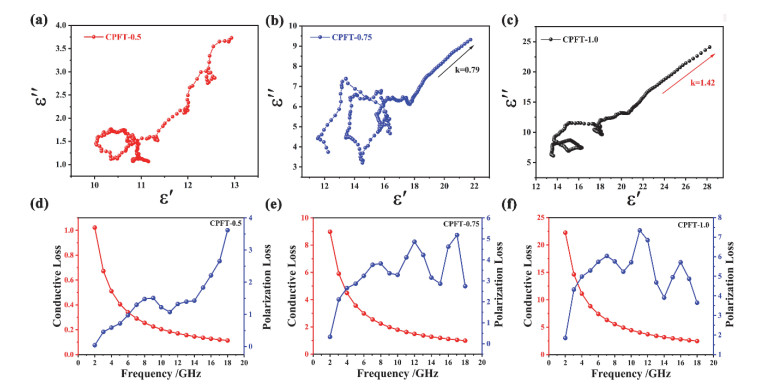
图11
"
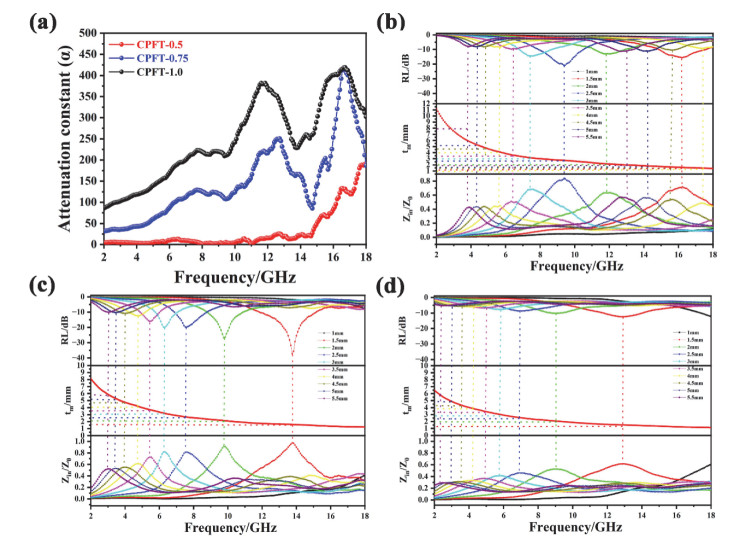
图12
"
图13
"
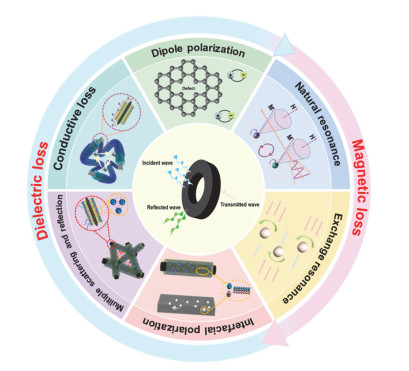
表1
"
| Sample | Young modulus (MPa) | Yield Strength (MPa) | Tensile Strength (MPa) | Elongation at Break (%) |
| Ti3C2Tx | – | – | – | – |
| Fe3O4/PDA/Ti3C2Tx | – | – | – | – |
| CPFT-0.5 | 6.4 | 2.71 | 2.43 | 11.78 |
| CPFT-0.75 | 15.8 | 2.93 | 2.76 | 11.48 |
| CPFT-1.0 | 20.8 | 4.76 | 3.63 | 10.98 |
| 1 |
X. Luo, H. Xie, Y. Ma, D. Lan, G. Wu, Z. Jia. Int. J. Miner. Metall. Mater. 2026, 33, 768.
doi: 10.1007/s12613-025-3252-1 |
| 2 |
C. Xu, P. Liu, Z. Wu, H. Zhang, R. Zhang, C. Zhang, L. Wang, L. Wang, B. Yang, Z. Yang, W. You, R. Che, et al.. Adv. Sci. 2022, 9, 2200804.
doi: 10.1002/advs.202200804 |
| 3 |
J. Wang, S. Zhong, M. Liu, R. Zhang, X. Liu, Y. Huang, X. Liu, X. Wang, D. Lv, L. Xia. Carbon 2024, 229, 119508.
doi: 10.1016/j.carbon.2024.119508 |
| 4 |
T. Hou, Z. Jia, Y. Dong, X. Liu, G. Wu. Chem. Eng. J. 2022, 431, 133919.
doi: 10.1016/j.cej.2021.133919 |
| 5 |
R. Yan, Q. Lin, K. You, L. Zhang, Y. Chen, Z. Huang, X. Sheng. Soft Sci. 2025, 5, 8.
doi: 10.20517/ss.2024.66 |
| 6 |
P. Yi, H. Zou, Y. Yu, X. Li, Z. Li, G. Deng, C. Chen, M. Fang, J. He, X. Sun, X. Liu, J. Shui, R. Yu, et al.. ACS Nano 2022, 16, 14490.
doi: 10.1021/acsnano.2c04863 |
| 7 |
B. Deng, L. Wang, Z. Xiang, Z. Liu, F. Pan, W. Lu. Mater. Lett. 2021, 284, 129029.
doi: 10.1016/j.matlet.2020.129029 |
| 8 |
Y. Qing, W. Zhou, F. Luo, D. Zhu. Ceram. Int. 2016, 42, 16412.
doi: 10.1016/j.ceramint.2016.07.150 |
| 9 |
M. Han, X. Yin, H. Wu, Z. Hou, C. Song, X. Li, L. Zhang, L. Cheng. ACS Appl. Mater. Interfaces 2016, 8, 21011.
doi: 10.1021/acsami.6b06455 |
| 10 |
Z. Zhang, Y. He, Y. Lv, L. Zhang, X. Chen, Z. Wu, Y. Zou. J. Phys. Chem. C 2020, 124, 19666.
doi: 10.1021/acs.jpcc.0c06115 |
| 11 |
Z. Zhang, Z. Cai, Y. Zhang, Y. Peng, Z. Wang, L. Xia, S. Ma, Z. Yin, R. Wang, Y. Cao, Z. Li, Y. Huang. Carbon 2021, 174, 484.
doi: 10.1016/j.carbon.2020.12.060 |
| 12 |
X. Hu, Y. Zhang, H. Guo, M. He, H. Qiu, X. Shi, L. Wang, J. Gu. Adv. Funct. Mater. 2025, 36, e17665.
doi: 10.1002/adfm.202517665 |
| 13 |
Y. Zhang, X. Liu, Z. Guo, C. Jia, F. Lu, Z. Jia, G. Wu. J. Mater. Sci. Technol. 2024, 176, 167.
doi: 10.1016/j.jmst.2023.07.061 |
| 14 |
D. Jin, H. Chen, Y. Du, X. Yang, X. Ren. Mater. Sci. Eng. B-Adv. Funct. Solid-State Mater. 2022, 286, 116026.
doi: 10.1016/j.mseb.2022.116026 |
| 15 |
Y. Wang, H. Zhang, Q. Wu, S. Li, H. Gao, B. Wan, D. Wen, G. Zeng. J. Mater. Chem. C 2023, 11, 4171.
doi: 10.1039/D2TC05150H |
| 16 |
M. Zhang, J. Qiu, Z. Xin, X. Sun. Materials 2021, 14, 4610.
doi: 10.3390/ma14164610 |
| 17 |
X. Li, X. Yin, C. Song, M. Han, H. Xu, W. Duan, L. Cheng, L. Zhang. Adv. Funct. Mater. 2018, 28, 1803938.
doi: 10.1002/adfm.201803938 |
| 18 |
X. Du, F. Yan, M. Cheng, H. Li, C. Peng, Y. Liu, D. Liu, D. Lan, G. Wu, Z. Jia. Int. J. Miner. Metall. Mater. 2026, 33, 1320.
doi: 10.1007/s12613-025-3317-1 |
| 19 |
W. Jiang, S. Xu, C. Lv, D. Lan, S. Zhang, Z. Gao, Z. Jia, G. Wu. Carbon 2025, 245, 120784.
doi: 10.1016/j.carbon.2025.120784 |
| 20 |
Y. Pan, K. Yu, D. Lan, Z. Zhang, Z. Chen. Carbon 2025, 245, 120824.
doi: 10.1016/j.carbon.2025.120824 |
| 21 |
J. Wang, X. Guo, D. Lan, Y. Wang, H. Huang, C. Zhang, G. Wu, S. Zhang, Z. Jia. Carbon 2025, 245, 120818.
doi: 10.1016/j.carbon.2025.120818 |
| 22 |
C. Jia, F. Zhang, Z. Wang, C. Lv, D. Lan, S. Zhang, Z. Jia, Z. Gao, G. Wu. Compos. Commun. 2025, 59, 102569.
doi: 10.1016/j.coco.2025.102569 |
| 23 |
L. Wang, H. Liu, X. Lv, G. Cui, G. Gu. J. Alloy. Compd. 2020, 828, 154251.
doi: 10.1016/j.jallcom.2020.154251 |
| 24 |
A. Liu, X. Xu, H. Qiu, H. Guo, M. He, Z. Yu, Y. Zhang, J. Gu. InfoMat 2025, 7, e70060.
doi: 10.1002/inf2.70060 |
| 25 |
X. Ren, Z. Jia, Z. Gao, S. Zhang, Y. Zhang, D. Lan, G. Wu. Adv. Funct. Mater. 2026, 36, e24264.
doi: 10.1002/adfm.202524264 |
| 26 |
A. Liu, H. Qiu, X. Lu, H. Guo, J. Hu, C. Liang, M. He, Z. Yu, Y. Zhang, J. Kong, J. Gu. Adv. Mater. 2025, 37, 2414085.
doi: 10.1002/adma.202414085 |
| 27 |
P. Song, H. Qiu, L. Wang, X. Liu, Y. Zhang, J. Zhang, J. Kong, J. Gu. Sustain. Mater. Techno. 2020, 24, e00153.
doi: 10.1016/j.susmat.2020.e00153 |
| 28 |
W.-T. Cao, F.-F. Chen, Y.-J. Zhu, Y.-G. Zhang, Y.-Y. Jiang, M.-G. Ma, F. Chen. ACS Nano 2018, 12, 4583.
doi: 10.1021/acsnano.8b00997 |
| 29 |
G. Yin, Y. Wang, W. Wang, D. Yu. Colloid Surf. A-Physicochem. Eng. Asp. 2020, 601, 125047.
doi: 10.1016/j.colsurfa.2020.125047 |
| 30 |
H. Xu, Y. Wang, M. Liu, Y. Zhai. ACS Appl. Mater. Interfaces 2025, 17, 47679.
doi: 10.1021/acsami.5c09658 |
| 31 |
J. M. Ang, Y. Du, B. Y. Tay, C. Zhao, J. Kong, L. P. Stubbs, X. Lu. Langmuir 2016, 32, 9265.
doi: 10.1021/acs.langmuir.6b02331 |
| 32 |
J. Fu, L. Li, D. Lee, J. M. Yun, B. K. Ryu, K. H. Kim. Appl. Surf. Sci. 2020, 504, 144250.
doi: 10.1016/j.apsusc.2019.144250 |
| 33 |
S.-S. Chang, C.-G. Wu. J. Phys. Chem. B 2005, 109, 18275.
doi: 10.1021/jp0531210 |
| 34 |
Y. Han, Y. Ding, W. Zhang, H. Zhuang, Z. Wang, Z. Li, Z. Zhu. Sens. Actuator B-Chem. 2023, 381, 133360.
doi: 10.1016/j.snb.2023.133360 |
| 35 |
Y. Zhang, Y. Zhang, Y. Li, X. Miao, Y. Shao, C. Liu, F. Xu. J. Alloy. Compd. 2024, 973, 172843.
doi: 10.1016/j.jallcom.2023.172843 |
| 36 |
T. Wang, A. Hassanpouryouzband, M. Fan, C. Mebrahtu, L. Zhang, Y. Song. Nat. Commun. 2025, 16, 3702.
doi: 10.1038/s41467-025-58734-1 |
| 37 |
F. Wu, K. Yang, Q. Li, T. Shah, M. Ahmad, Q. Zhang, B. Zhang. Carbon 2021, 173, 918.
doi: 10.1016/j.carbon.2020.11.088 |
| 38 |
X. Zuo, K. Chang, J. Zhao, Z. Xie, H. Tang, B. Li, Z. Chang. J. Mater. Chem. A 2016, 4, 51.
doi: 10.1039/C5TA06869J |
| 39 |
W. Yang, X. Yang, J. Hu, D. Liu, Y. Dong, Y. Zhu, Y. Fu. Appl. Surf. Sci. 2021, 564, 150437.
doi: 10.1016/j.apsusc.2021.150437 |
| 40 |
P. Slobodian, P. Riha, R. Olejnik, M. Sedlacik. Polymers 2020, 12, 1316.
doi: 10.3390/polym12061316 |
| 41 |
X. Wang, D. Jiang, C. Jing, X. Liu, K. Li, M. Yu, S. Qi, Y. Zhang. J. Energy Storage 2020, 30, 101554.
doi: 10.1016/j.est.2020.101554 |
| 42 |
M. Beygisangchin, S. Abdul Rashid, S. Shafie, A. R. Sadrolhosseini, H. N. Lim, Preparations. Polymers 2021, 13, 2003.
doi: 10.3390/polym13122003 |
| 43 |
H. Zhang, Z. Jia, A. Feng, Z. Zhou, C. Zhang, K. Wang, N. Liu, G. Wu. Compos. Commun. 2020, 19, 42.
doi: 10.1016/j.coco.2020.02.010 |
| 44 |
M. Zhang, H. Ling, S. Ding, Y. Xie, T. Cheng, L. Zhao, T. Wang, H. Bian, H. Lin, Z. Li, A. Meng. Carbon 2021, 174, 248.
doi: 10.1016/j.carbon.2020.12.005 |
| 45 |
J. Liu, H. Zhang, R. Sun, Y. Liu, Z. Liu, A. Zhou, Z. Yu, Hydrophobic. Adv. Mater. 2017, 29, 1702367.
doi: 10.1002/adma.201702367 |
| 46 |
L. Han, H. Yang, Y. Lin, H. Zhou, Z. Cai, Y. Qiu. Ceram. Int. 2024, 50, 1341.
doi: 10.1016/j.ceramint.2023.10.222 |
| 47 |
H. Liu, S. Wu, C. You, N. Tian, Y. Li, N. Chopra. Ceram. Int. 2022, 48, 19452.
doi: 10.1016/j.ceramint.2022.03.246 |
| 48 |
H. Du, Q. Zhang, B. Zhao, F. Marken, Q. Gao, H. Lu, L. Guan, H. Wang, G. Shao, H. Xu, R. Zhang, B. Fan, et al.. J. Adv. Ceram. 2021, 10, 1042.
doi: 10.1007/s40145-021-0487-9 |
| 49 |
Z. Jiao, W. Huyan, F. Yang, J. Yao, R. Tan, P. Chen, X. Tao, Z. Yao, J. Zhou, P. Liu. Nano-Micro Lett. 2022, 14, 173.
doi: 10.1007/s40820-022-00904-7 |
| 50 |
H. Wang, P. Shi, M. Rui, A. Zhu, R. Liu, C. Zhang. Prog. Org. Coat. 2020, 139, 105476.
doi: 10.1016/j.porgcoat.2019.105476 |
| 51 |
M.-J. B. Boyetey, P. Sukyai, N. Kamonsutthipaijit, S. Nijpanich, N. Chanlek. ACS Omega 2023, 8, 43295.
doi: 10.1021/acsomega.3c07266 |
| 52 |
W. Zhang, H. Xu, Y. Li, Y. Wang, X. Yang, Y. Wang, H. Jia, Y. Shen, W. Zhang, T. Wejrzanowski. Mater. Chem. Phys. 2025, 336, 130507.
doi: 10.1016/j.matchemphys.2025.130507 |
| 53 |
M. Tian, Y.-G. Liu, J. Hou, B. Jing, Y. Zhang, Y. Mu, X. Sun, H.-Y. Jiang. Appl. Catal. B-Environ. Energy 2023, 334, 122866.
doi: 10.1016/j.apcatb.2023.122866 |
| 54 |
X. Yan, C. Yang, C. Ma, H. Tao, S. Cheng, L. Chen, G. Wang, X. Lin, C. Yao. Chemosphere 2022, 307, 136114.
doi: 10.1016/j.chemosphere.2022.136114 |
| 55 |
C. Cui, C. Xiang, L. Geng, X. Lai, R. Guo, Y. Zhang, H. Xiao, J. Lan, S. Lin, S. Jiang. J. Alloy. Compd. 2019, 788, 1246.
doi: 10.1016/j.jallcom.2019.02.294 |
| 56 |
Z. Zhang, Y. Zhao, Z. Li, L. Zhang, Z. Liu, Z. Long, Y. Li, Y. Liu, R. Fan, K. Sun, Z. Zhang. Adv. Compos. Hybrid Mater. 2022, 5, 513.
doi: 10.1007/s42114-021-00350-w |
| 57 |
D. Wang, T. Ping, Z. Du, Y. Liao, H. Gao, X. Gong, J. Rao, B. Wang, S. Wei, X. Liu, Y. Zhang. Nano Res. 2025, 18, 94907226.
doi: 10.26599/NR.2025.94907226 |
| 58 |
R. Tan, J. Zhou, Z. Yao, B. Wei, Z. Li. Ceram. Int. 2021, 47, 2077.
doi: 10.1016/j.ceramint.2020.09.040 |
| 59 |
J. Tao, J. Zhou, Z. Yao, Z. Jiao, B. Wei, R. Tan, Z. Li. Carbon 2021, 172, 542.
doi: 10.1016/j.carbon.2020.10.062 |
| 60 |
D. Wang, X. Zhang, Z. Du, X. Gong, Y. Zhang. J. Mater. Sci. Technol. 2026, 257, 307.
doi: 10.1016/j.jmst.2025.08.051 |
| 61 |
D. Wang, T. Ping, Z. Du, X. Liu, Y. Zhang. Nano-Micro Lett. 2025, 17, 100.
doi: 10.1007/s40820-024-01591-2 |
| 62 |
Q. Wu, J. Wu, G.-S. Wang, H.-Z. Zhang, H.-J. Gao, W.-J. Shui. Sci. Rep. 2019, 9, 10488.
doi: 10.1038/s41598-019-47037-3 |
| 63 |
G. Wang, Z. Gao, S. Tang, C. Chen, F. Duan, S. Zhao, S. Lin, Y. Feng, L. Zhou, Y. Qin. ACS Nano 2012, 6, 11009.
doi: 10.1021/nn304630h |
| 64 |
D. Wang, Y. Hu, Z. Cui, P. Yang, Z. Du, Y. Hou, P. Yang, J. Rao, C. Wang, Y. Zhang. J. Colloid Interface Sci. 2023, 646, 991.
doi: 10.1016/j.jcis.2023.05.112 |
| 65 |
H. Veisi, T. Tamoradi, A. Rashtiani, S. Hemmati, B. Karmakar. J. Ind. Eng. Chem. 2020, 90, 379.
doi: 10.1016/j.jiec.2020.06.030 |
| 66 |
Z. Xiang, Y. Shi, X. Zhu, L. Cai, W. Lu. Nano-Micro Lett. 2021, 13, 150.
doi: 10.1007/s40820-021-00673-9 |
| 67 |
X. Ren, M. Zhen, F. Meng, X. Meng, M. Zhu. Nanomaterials 2025, 15, 553.
doi: 10.3390/nano15070553 |
| 68 |
Q. Liu, X. Liu, H. Feng, H. Shui, R. Yu. Chem. Eng. J. 2017, 314, 320.
doi: 10.1016/j.cej.2016.11.089 |
| 69 |
D. Zhang, W. He, G. Quan, Y. Wang, Y. Su, L. Lei, Y. Du, Y. Hong, S. Wang, Y. Tang, W. Zhang, Y. Chen, et al.. Appl. Surf. Sci. 2023, 607, 155027.
doi: 10.1016/j.apsusc.2022.155027 |
| 70 |
Y. Zhao, H. Zhang, X. Yang, H. Huang, G. Zhao, T. Cong, X. Zuo, Z. Fan, S. Yang, L. Pan. Carbon 2021, 171, 395.
doi: 10.1016/j.carbon.2020.09.036 |
| 71 |
T. Xu, H. Cheng, H. Pei, J. Wang, Y. Shi, X. Zhang, D. Huang. Adv. Sci. 2025, 12, 2409979.
doi: 10.1002/advs.202409979 |
| 72 |
Y. Liu, X. Wei, X. He, J. Yao, R. Tan, P. Chen, B. Yao, J. Zhou, Z. Yao. Adv. Funct. Mater. 2023, 33, 2211352.
doi: 10.1002/adfm.202211352 |
| 73 |
B. Wen, M.-S. Cao, Z.-L. Hou, W.-L. Song, L. Zhang, M.-M. Lu, H.-B. Jin, X.-Y. Fang, W.-Z. Wang, J. Yuan. Carbon 2013, 65, 124.
doi: 10.1016/j.carbon.2013.07.110 |
| 74 |
H. Wang, F. Meng, F. Huang, C. Jing, Y. Li, W. Wei, Z. Zhou. ACS Appl. Mater. Interfaces 2019, 11, 12142.
doi: 10.1021/acsami.9b01122 |
| 75 |
J. Wang, M. Zhou, Z. Xie, X. Hao, S. Tang, J. Wang, Z. Zou, G. Ji. J. Colloid Interface Sci. 2022, 612, 146.
doi: 10.1016/j.jcis.2021.12.162 |
| 76 |
J. Shu, W. Cao, M. Cao. Adv. Funct. Mater. 2021, 31, 2100470.
doi: 10.1002/adfm.202100470 |
| 77 |
H. Lee, S. M. Dellatore, W. M. Miller, P. B. Messersmith. Science 2007, 318, 426.
doi: 10.1126/science.1147241 |
| [1] | 魏祺, 仇亚茹, 杨腾飞, 蒋艺玲, 朱韶涵, 周杰, 刘聪聪, 侯文杰, 王越, 刘冬. 金属@碳纳米片异质界面的协同工程用于双功能电磁波吸收与电化学储能[J]. 物理化学学报, 2026, 42(9): 100320 - . |
| [2] | 闫婧, 张泽楠, 马东威, 张昕怡, 叶卓栋, 陈雪芳. 三聚氰胺辅助MOFs拓扑定向转化为针状α-MoC/β-Mo2C用于高性能电磁波吸收与耐腐蚀性研究[J]. 物理化学学报, 2026, 42(9): 100328 - . |
| [3] | 王骏, 王奕博, 吴吉然, 王大双, 刘成, 黄海铭, 王友勇, 张传坤. 在多相核壳异质结中协同磁交换共振与多级介电弛豫以实现高效微波耗散[J]. 物理化学学报, 2026, 42(9): 100336 - . |
| [4] | 杨世豪, 郭志强, 贾梓睿, 刘翌, 王丁硕, 李增超, 李海丰, 邱华, 吴广磊. 双金属MOFs中精确设计的异质界面实现多尺度极化协同效应用于高效电磁衰减[J]. 物理化学学报, 2026, 42(9): 100348 - . |
| [5] | 冯仁威, 范聪敏, 兰笛, 刘澜翔, 何秦川, 王益群. 锚定策略诱导Ni-MOF@膨胀石墨复合材料的导电损耗以实现宽带微波吸收[J]. 物理化学学报, 2026, 42(8): 100301 - . |
| [6] | 戴鑫鑫, 兰笛, 陈星亮, 王行伟, 姬广斌. 二氧化锰@氮掺杂碳@镍铁氧体杂化材料的一锅法绿色合成及吸波性能研究[J]. 物理化学学报, 2026, 42(8): 100302 - . |
| [7] | 张帅, 李海丰, 张世杰, 王顺, 杜苏轩, 赵志伟, 赵小苗, 梁笑微. 微波辅助构筑Ta2CTx MXene/CuInS2异质结构增强介电损耗和宽频电磁波吸收性能[J]. 物理化学学报, 2026, 42(8): 100305 - . |
| [8] | 贾志卿, 宫新菊, 兰笛, 孙环环, 刘雨, 高玉萍, 郭思瑶. 静电诱导缺陷极化增强型PBA/MXene异质结构的双耦合界面以提升电磁波吸收性能[J]. 物理化学学报, 2026, 42(8): 100312 - . |
| [9] | 贾梓睿, 周泽华, 徐爽, 王远, 石梦佳, 何梦婷, 张传坤, 兰笛. 一石二鸟:磷掺杂以增强导电损耗和偶极极化用于电磁波吸收[J]. 物理化学学报, 2026, 42(8): 100310 - . |
| [10] | 刘伟恒, 罗驹华, 时家欢, 兰笛, 毛双双, 谢宇. 双金属有机框架衍生蜂窝状BiCo@NC用于高效电磁波吸收[J]. 物理化学学报, 2026, 42(8): 100313 - . |
| [11] | 吴广荣, 朱佳慧, 郭小萌, 张昌淼, 何梦婷, 邱华, 马冬威. 构建肖特基势垒并增强C@ZnO/Sn@GaN界面极化效应以实现高性能电磁波吸收[J]. 物理化学学报, 2026, 42(8): 100324 - . |
| [12] | 毛双双, 罗驹华, 韩冰洁, 时家欢, 谷俞稼. 共价有机框架衍生的Fe3C/NC/TiO2异质结构用于高性能电磁波吸收[J]. 物理化学学报, 2026, 42(7): 100290 - . |
| [13] | 胡波, 陈言轶, 陈永政, 王璇, 韩喜江, 杜耘辰. 基于理论计算指导的FeCo合金泡沫设计合成及其在2.0–8.0 GHz范围内的吸波性能研究[J]. 物理化学学报, 2026, 42(6): 100269 - . |
| [14] | 于冉, 胡晨, 郭锐利, 刘若男, 夏力行, 杨岑玉, 水江澜. 杂多酸H3PW12O40高效催化MgH2储氢[J]. 物理化学学报, 2025, 41(1): 100001 - . |
| [15] | 柏雨婷, 严岑琪, 李祯, 秦家强, 程沛. 采用原位成孔法制备热闭孔特性的高强度聚酰亚胺多孔薄膜[J]. 物理化学学报, 2024, 40(9): 2306010 - . |
|
||