物理化学学报 >> 2025, Vol. 41 >> Issue (8): 100089.doi: 10.1016/j.actphy.2025.100089
所属专题: 电化学分离与资源化
电容去离子提锂技术中电极材料的研究进展
陈泽秋1,†, 蔡黎淼1,†, 关杰1, 李瞻洋1, 王昊2, 郭耀广1,*( ), 徐兴涛3,*(), 潘丽坤2,4,*()
- 1 上海第二工业大学资源与环境工程学院, 上海电子废弃物回收协同创新中心, 上海 201209
2 华东师范大学物理与电子科学学院, 上海磁共振重点实验室, 上海 200241
3 浙江海洋大学海洋科技学院, 浙江 舟山 316022
4 华东师范大学医学磁共振与分子影像技术研究院, 上海 200241
-
收稿日期:2025-01-17修回日期:2025-04-03录用日期:2025-04-07发布日期:2025-06-07 -
通讯作者:Email: ygguo@sspu.edu.cn (郭耀广)lkpan@phy.ecnu.edu.cn (潘丽坤)xingtao.xu@zjou.edu.cn (徐兴涛) -
作者简介:†These authors contributed equally to this work.
-
基金资助:国家自然科学基金(52400174); 国家自然科学基金(52270129); 国家自然科学基金(52370142); 上海扬帆计划(24YF2714000); 东方英才青年计划及上海曙光计划(23SG52)
Advanced electrode materials in capacitive deionization for efficient lithium extraction
Zeqiu Chen1, Limiao Cai1, Jie Guan1, Zhanyang Li1, Hao Wang2, Yaoguang Guo1,*(), Xingtao Xu3,*(), Likun Pan2,4,*()
- 1 Shanghai Collaborative Innovation Centre for WEEE Recycling, School of Resources and Environmental Engineering, Shanghai Polytechnic University, Shanghai 201209, China
2 Shanghai Key Laboratory of Magnetic Resonance, School of Physics and Electronic Science, East China Normal University, Shanghai 200241, China
3 Marine Science and Technology College, Zhejiang Ocean University, Zhoushan 316022, Zhejiang Province, China
4 Institute of Magnetic Resonance and Molecular Imaging in Medicine, East China Normal University, Shanghai 200241, China
-
Received:2025-01-17Revised:2025-04-03Accepted:2025-04-07Published:2025-06-07 -
Contact:Email: ygguo@sspu.edu.cn (Yaoguang Guo)lkpan@phy.ecnu.edu.cn (Likun Pan)xingtao.xu@zjou.edu.cn (Xingtao Xu) -
Supported by:the National Natural Science Foundation of China(52400174); the National Natural Science Foundation of China(52270129); the National Natural Science Foundation of China(52370142); Shanghai Sailing Program(24YF2714000); Oriental Talent Youth Program, and Shanghai Shuguang Program(23SG52)

摘要:
随着新能源领域对锂资源需求的持续增长,开发高效的锂提取技术变得及其重要。然而,由于其高能耗和可能引发的二次污染问题,传统的锂提取和回收技术具有实际应用和发展的局限性。电容去离子(CDI)技术作为一种新兴的锂提取技术,在效率、成本效益和能源消耗方面展现出巨大的潜力。本综述从文献计量入手,剖析了CDI提锂的关键研究主题,进而全面总结了在CDI提锂技术中电极材料的最新进展,并探讨了使用这些材料构建的各种CDI系统类型。本研究详细阐明了CDI系统中用于锂资源回收的主要电极材料——水系锂离子电极材料(包括LiFePO4、LiMn2O4、LiNi1/3Co1/3Mn1/3O2等)及其修饰材料(包括碳纳米管、石墨烯、MOF等)。此外,本文讨论了通过不同的电容去离子(CDI)系统提高锂提取效率,并评估了各种先进电极材料在这些系统中的性能。文末强调了机器学习在CDI提锂领域的应用潜力,并期望本研究将为未来开发基于CDI的高效锂提取系统提供坚实的理论基础和实践指导。
引用本文
陈泽秋, 蔡黎淼, 关杰, 李瞻洋, 王昊, 郭耀广, 徐兴涛, 潘丽坤. 电容去离子提锂技术中电极材料的研究进展[J]. 物理化学学报, 2025, 41(8), 100089. doi: 10.1016/j.actphy.2025.100089
Zeqiu Chen, Limiao Cai, Jie Guan, Zhanyang Li, Hao Wang, Yaoguang Guo, Xingtao Xu, Likun Pan. Advanced electrode materials in capacitive deionization for efficient lithium extraction[J]. Acta Phys. -Chim. Sin. 2025, 41(8), 100089. doi: 10.1016/j.actphy.2025.100089
表1
"
| Indicator | Range of values |
| TOP N | No concrete limitations |
| Q | Q ranges from 0 to 1 Q > 0.3 indicates a distinct and cohesive network community structure |
| S | S ranges from 0 to 1 S > 0.5 suggests reasonable clustering validity S > 0.7 demonstrates high reliability |
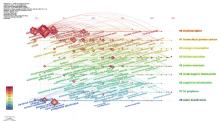
图1
"
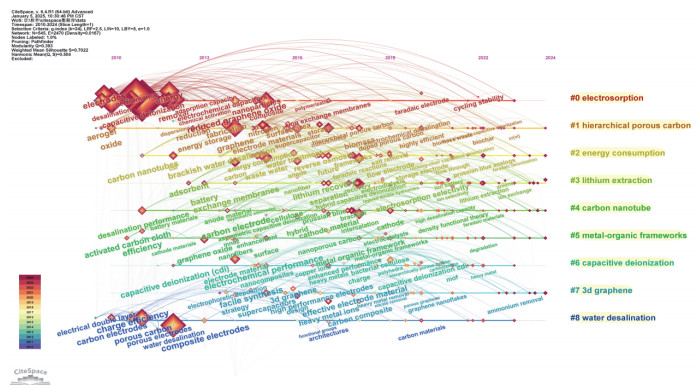
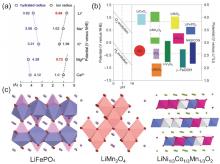
图2
"
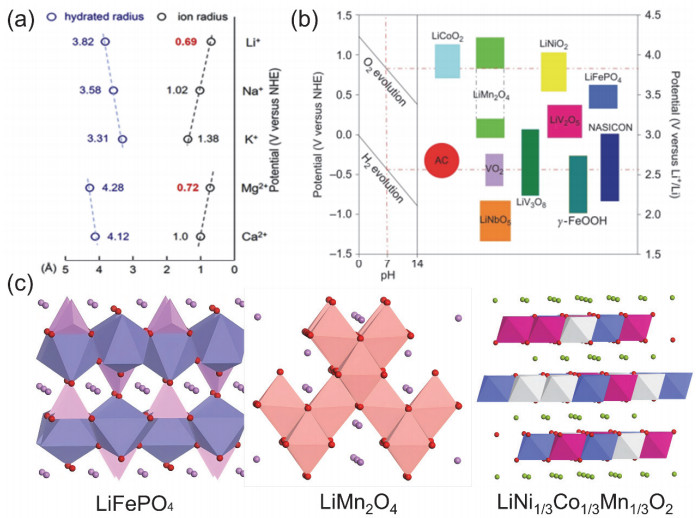
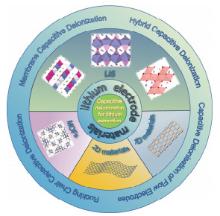
图3
"
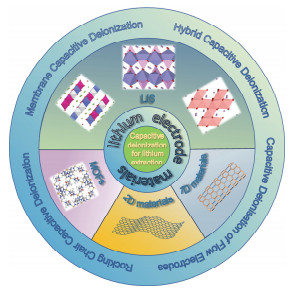
表2
"
| Methods | Cathode | Anode | Adsorption capacity | Separation factor | Selectivity factor | Energy consumption | Ref. |
| MCDI | LMO/LAO | Active carbon | 900 μmol·g−1 | 0.67 kWh∙m−3 | [ | ||
| LMO | Active carbon | 0.35 μmol·g−1 | 23.3 Wh∙g−1 | [ | |||
| Active carbon | Active carbon | SLi/Mg = 2.95 | 0.0018 kWh∙mol−1 | [ | |||
| HCDI | LMO/GO | Active carbon | 720.2 μmol·g−1 | [ | |||
| GO/La-LMO | Active carbon | 1.33 mmol·g−1 | [ | ||||
| CNTs-LMO | Active carbon | 11.11 mg·g−1 | 3.6 Wh∙mol−1 | [ | |||
| λ-MnO2 | Active carbon | 18.1 mg·g−1 | 0.99 Wh∙mol−1 | [ | |||
| rGO/LMO | Active carbon | 4.34 mmol·g−1 | [ | ||||
| LMTO | Active carbon (AEM) | 28.6 mg·g−1 | 1.54–12.10 Wh∙mol−1 | [ | |||
| FCDI | Nanoporous Active carbon (CEM) | Nanoporous Active carbon (AEM) | [ | ||||
| (CEM) | (AEM) | SLi/Na = 141 ± 5.85 SLi/K = 46 ± 1.46 | 16.70 ± 1.63 kWh∙kg−1 | [ | |||
| RCDI | Li1-xMn2O4 | LiMn2O4 | 18 mg·g−1 | FMg/Li from 147.8 to 0.37 | SLi/Na = 5.94 SLi/K = 9.16 SLi/Mg = 42.95 SLi/Al = 73.93 | [ | |
| LiMn2O4 | Li1-xMn2O4 | 34.69 mg·g−1 | 6.76 Wh∙mol−1 | [ | |||
| FePO4 | LiFePO4 | 32 mg·g−1 | FMg/Li from 48.4 to 0.5 | [ | |||
| NaFePO4 | FePO4 | SLi/Na = 18000 | [ |
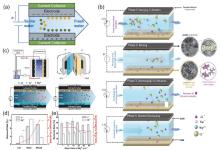
图4
"
图5
"
图6
"
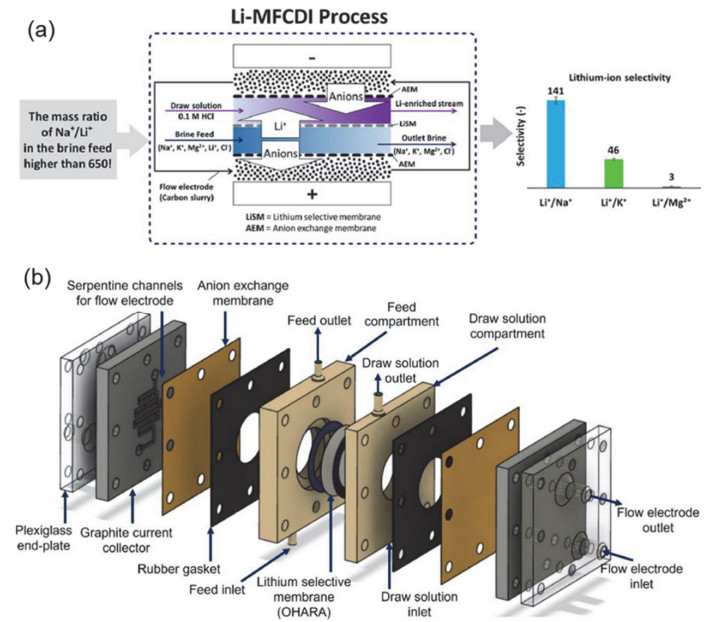
图7
"
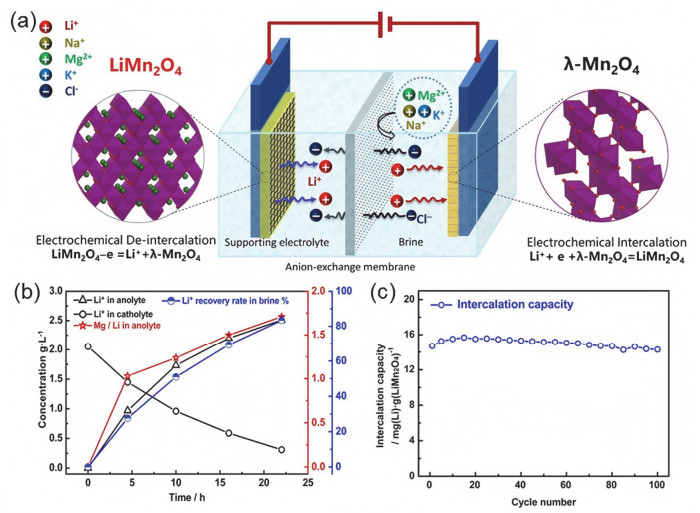
图8
"
| 1 |
doi: 10.1038/s41467-020-18402-y |
| 2 |
doi: 10.1080/08827508.2022.2117172 |
| 3 |
doi: 10.1038/s41598-021-99912-7 |
| 4 |
doi: 10.1007/s11837-013-0666-4 |
| 5 |
doi: 10.31035/cg2022088 |
| 6 |
doi: 10.1016/j.seppur.2020.117807 |
| 7 |
doi: 10.31035/cg2023061 |
| 8 |
doi: 10.1016/j.desal.2022.115611 |
| 9 |
doi: 10.1039/c7ew00020k |
| 10 |
doi: 10.1016/j.watres.2022.118822 |
| 11 |
doi: 10.1016/j.mineng.2019.105868 |
| 12 |
doi: 10.1021/ie502749n |
| 13 |
doi: 10.1016/j.hydromet.2018.01.005 |
| 14 |
doi: 10.1016/j.hydromet.2017.04.007 |
| 15 |
doi: 10.1016/j.desal.2022.116225 |
| 16 |
doi: 10.1016/j.watres.2003.11.008 |
| 17 |
doi: 10.1016/j.desal.2013.03.009 |
| 18 |
doi: 10.1016/j.desal.2019.114081 |
| 19 |
doi: 10.1595/205651317x696676 |
| 20 |
doi: 10.1016/j.desal.2022.115951 |
| 21 |
doi: 10.1002/adma.201905440 |
| 22 |
doi: 10.1016/j.rser.2021.111813 |
| 23 |
doi: 10.1021/acs.iecr.3c03744 |
| 24 |
doi: 10.1016/j.pnsc.2020.01.017 |
| 25 |
doi: 10.1016/j.ccr.2024.215835 |
| 26 |
doi: 10.1016/j.watres.2018.11.064 |
| 27 |
doi: 10.1016/j.desal.2021.114930 |
| 28 |
doi: 10.1016/j.desal.2024.118035 |
| 29 |
doi: 10.1002/smll.202401214 |
| 30 |
doi: 10.1016/j.seppur.2024.129423 |
| 31 |
doi: 10.1016/j.ensm.2024.103710 |
| 32 |
doi: 10.1039/d3qi01705b |
| 33 |
doi: 10.1016/j.carbon.2018.01.035 |
| 34 |
doi: 10.1016/j.desal.2024.118450 |
| 35 |
doi: 10.1016/j.desal.2020.114883 |
| 36 |
doi: 10.3390/su142114429 |
| 37 |
doi: 10.1016/j.efmat.2023.11.001 |
| 38 |
doi: 10.1002/wics.89 |
| 39 |
doi: 10.1016/j.desal.2022.115562 |
| 40 |
doi: 10.1016/j.desal.2023.117107 |
| 41 |
doi: 10.1016/j.hydromet.2018.05.001 |
| 42 |
doi: 10.1007/s12665-017-6885-1 |
| 43 |
doi: 10.1080/08827508.2022.2047041 |
| 44 |
doi: 10.1016/j.desal.2007.05.016 |
| 45 |
doi: 10.16/jdesal.2015.020 |
| 46 |
doi: 10.4028/www.scientific.net/AMM.378.318 |
| 47 |
doi: 10.1016/j.desal.2014.10.043 |
| 48 |
doi: 10.1016/j.memsci.2005.12.001 |
| 49 |
doi: 10.21/ba-1960-0027.ch020 |
| 50 |
doi: 10.1149/1.2408094 |
| 51 |
doi: 10.1038/s41578-020-0193-1 |
| 52 |
doi: 10.1016/j.hydromet.2017.09.005 |
| 53 |
doi: 10.1039/c2ee22977c |
| 54 |
doi: 10.1016/j.jwpe.2022.102786 |
| 55 |
doi: 10.1016/j.cej.2024.153808 |
| 56 |
doi: 10.1039/d4mh00773e |
| 57 |
doi: 10.1016/j.seppur.2022.121510 |
| 58 |
doi: 10.1016/j.seppur.2023.125084 |
| 59 |
doi: 10.1038/s41578-021-00314-y |
| 60 |
doi: 10.3390/membranes12050459 |
| 61 |
doi: 10.1016/j.cej.2021.131680 |
| 62 |
doi: 10.3390/en16031136 |
| 63 |
doi: 10.1016/j.cej.2023.147986 |
| 64 |
doi: 10.1016/j.jwpe.2023.104379 |
| 65 |
doi: 10.1016/j.desal.2023.116652 |
| 66 |
doi: 10.1016/j.seppur.2024.129285 |
| 67 |
doi: 10.1002/adfm.202414805 |
| 68 |
doi: 10.1016/j.cej.2024.148923 |
| 69 |
doi: 10.1016/j.desal.2023.116569 |
| 70 |
doi: 10.1021/acs.est.9b07646 |
| 71 |
doi: 10.1016/j.matt.2022.04.034 |
| 72 |
doi: 10.1038/nchem.763 |
| 73 |
doi: 10.1038/35104644 |
| 74 |
doi: 10.1016/j.hydromet.2012.11.013 |
| 75 |
doi: 10.1016/0025-5408(84)90088-6 |
| 76 |
doi: 10.1007/s12274-023-6121-0 |
| 77 |
doi: 10.1080/01496399308019512 |
| 78 |
doi: 10.1016/j.desal.2021.115112 |
| 79 |
doi: 10.1016/j.seppur.2020.118009 |
| 80 |
doi: 10.1016/j.jallcom.2008.06.123 |
| 81 |
doi: 10.3390/batteries8110225 |
| 82 |
doi: 10.1016/j.cej.2018.05.030 |
| 83 |
doi: 10.1002/adma.201800863 |
| 84 |
doi: 10.1002/adma.201505918 |
| 85 |
doi: 10.1007/s40843-023-2526-8 |
| 86 |
doi: 10.1002/eem2.12586 |
| 87 |
doi: 10.1016/j.jpowsour.2015.05.027 |
| 88 |
doi: 10.1016/j.electacta.2016.10.137 |
| 89 |
doi: 10.1016/j.electacta.2017.02.161 |
| 90 |
doi: 10.1016/j.electacta.2019.135314 |
| 91 |
doi: 10.1038/s41598-019-53195-1 |
| 92 |
doi: 10.1016/j.ceramint.2019.02.180 |
| 93 |
doi: 10.1016/j.jpcs.2019.109303 |
| 94 |
doi: 10.1002/advs.201700786 |
| 95 |
doi: 10.1002/smtd.202200508 |
| 96 |
doi: 10.1016/j.desal.2023.117154 |
| 97 |
doi: 10.1016/j.desal.2020.114360 |
| 98 |
doi: 10.1016/j.jcis.2021.12.181 |
| 99 |
doi: 10.1002/anie.202106259 |
| 100 |
doi: 10.1038/s41467-019-13648-7 |
| 101 |
doi: 10.1039/c6cs00426a |
| 102 |
doi: 10.1039/c9sc03916c |
| 103 |
doi: 10.1016/j.rser.2024.114520 |
| 104 |
doi: 10.1002/aenm.201801257 |
| 105 |
doi: 10.1039/c7ta08268a |
| 106 |
doi: 10.1016/j.desal.2022.116201 |
| 107 |
doi: 10.1016/j.desal.2024.117403 |
| 108 |
doi: 10.1016/j.watres.2019.114904 |
| 109 |
doi: 10.1016/j.desal.2024.118195 |
| 110 |
doi: 10.1016/j.seppur.2018.09.006 |
| 111 |
doi: 10.1007/s10008-023-05461-6 |
| 112 |
doi: 10.1016/j.seppur.2024.127693 |
| 113 |
doi: 10.1021/acsaem.1c02654 |
| 114 |
doi: 10.1016/j.cej.2024.148802 |
| 115 |
doi: 10.1016/j.desal.2022.115569 |
| 116 |
doi: 10.3390/en12152913 |
| 117 |
doi: 10.1016/j.memlet.2023.100059 |
| 118 |
doi: 10.1016/j.desal.2021.114935 |
| 119 |
doi: 10.1016/j.desal.2022.115767 |
| 120 |
doi: 10.1002/gch2.201700079 |
| 121 |
doi: 10.1016/j.joule.2020.05.017 |
| 122 |
doi: 10.1039/c3ee42209g |
| 123 |
doi: 10.1016/j.watres.2015.08.012 |
| 124 |
doi: 10.1016/j.desal.2016.09.016 |
| 125 |
doi: 10.1016/j.desal.2006.01.011 |
| 126 |
doi: 10.5004/dwt.2017.20431 |
| 127 |
doi: 10.1039/c4ee02378a |
| 128 |
doi: 10.1016/j.ccr.2024.215923 |
| 129 |
doi: 10.1016/j.seppur.2017.11.045 |
| 130 |
doi: 10.1016/j.seppur.2019.116234 |
| 131 |
doi: 10.1016/j.seppur.2020.116660 |
| 132 |
doi: 10.1039/c3ee24443a |
| 133 |
doi: 10.1149/2.0761603jes |
| 134 |
doi: 10.1016/j.desal.2015.08.013 |
| 135 |
doi: 10.1016/j.desal.2024.117850 |
| 136 |
doi: 10.1039/d0ta09531a |
| 137 |
doi: 10.1016/j.cej.2023.146676 |
| 138 |
doi: 10.1016/j.watres.2024.122374 |
| 139 |
doi: 10.1016/j.desal.2023.116715 |
| 140 |
doi: 10.1039/d3ta07069g |
| 141 |
doi: 10.1021/acsami.7b02712 |
| 142 |
doi: 10.1039/c8ta04813d |
| 143 |
doi: 10.1016/j.desal.2021.115197 |
| 144 |
doi: 10.1016/j.watres.2022.119349 |
| 145 |
doi: 10.1016/j.desal.2022.115992 |
| 146 |
doi: 10.1021/acsestengg.4c00142 |
| 147 |
doi: 10.1016/j.scitotenv.2022.159158 |
| [1] | 张慧, 赵子健, 王雅静, 倪凯, 王彦飞, 朱亮, 刘建允, 赵晓昱. 通过热压法构建具有高效离子传输路径的无溶剂LiFePO4卤水提锂电极[J]. 物理化学学报, 2026, 42(2): 100130 - . |
| [2] | 陈芸, 邓代洁, 徐丽, 朱兴旺, 李赫楠, 孙成明. 共价键调控电荷转移以实现自供能电化学传感平台对重金属离子的灵敏分析[J]. 物理化学学报, 2026, 42(1): 100144 - . |
| [3] | 王雷, 张盼盼, 郭志远, 汪婧, 马杰, 纪志永. 电化学提锂中的法拉第材料:进展、挑战与性能强化方法[J]. 物理化学学报, 2026, 42(1): 100127 - . |
| [4] | 项书宏, 杨旅, 徐应生, 曹国新, 周宏建. 利用碳纳米管分散的亚铁氰化锌钾电极选择性电吸附高盐放射性废水中的铯(Ⅰ)[J]. 物理化学学报, 2025, 41(9): 100097 - . |
| [5] | 孙明磊, 袁忠勇. 电化学降解污水中含氮废弃物的升值策略[J]. 物理化学学报, 2025, 41(9): 100108 - . |
| [6] | 黄鋆, 聂鹏飞, 鲁勇朝, 李佳洋, 王怡文, 刘建允. 丝光沸石负载自支撑氮掺杂多孔碳纳米纤维电容器及高效选择性去除硬度离子[J]. 物理化学学报, 2025, 41(7): 100066 - . |
| [7] | 邱领邦, 蒋江民, 王李波, 白浪, 周飞, 周羔宇, 庄全超, 崔艳华. 原位电化学阻抗谱监测长寿命热电池Nb12WO33正极材料的高温双放电机制[J]. 物理化学学报, 2025, 41(5): 100040 - . |
| [8] | 王禹尧, 曹志涛, 杜泽宇, 曹鑫鑫, 梁叔全. 钠离子电池铁基聚阴离子正极材料研究进展[J]. 物理化学学报, 2025, 41(4): 100035 - . |
| [9] | 严国泽, 左彬, 刘少卿, 王桃, 王若愚, 包锦洋, 赵忠舟, 储菲菲, 李政通, YusukeYamauchi, SaadMelhi, 徐兴涛. 电容去离子海水提铀的机遇与挑战[J]. 物理化学学报, 2025, 41(4): 100032 - . |
| [10] | 王卓, 白雪, 张可新, 王鸿志, 董家宝, 高源, 赵斌. MOF模板法合成氮掺杂碳材料用于增强电化学钠离子储存和去除[J]. 物理化学学报, 2025, 41(3): 100026 - . |
| [11] | 叶萍, 覃玲霜, 贺萌瑶, 巫方方, 陈增烨, 梁明星, 邓立波. 荷叶衍生多孔碳的零电荷电位调节实现废水中电化学捕集镉离子[J]. 物理化学学报, 2025, 41(3): 100023 - . |
| [12] | 杨美清, 王路, 卢浩滋, 杨耀成, 刘松. 用于丝网印刷光电化学生物传感器的功能纳米材料的最新进展[J]. 物理化学学报, 2025, 41(2): 100018 - . |
| [13] | 严鹏程, 王鹏, 黄婧, 莫曌, 徐丽, 陈芸, 张瑜, 齐志冲, 许晖, 李赫楠. 多策略提升卤化氧铋活性材料的光电性能及其在光电化学领域的应用进展[J]. 物理化学学报, 2025, 41(2): 100014 - . |
| [14] | 程康娟, 刘春晓, 王友鹏, 江秋, 郑婷婷, 李旭, 夏川. 用于电合成过氧化氢的贵金属催化剂和反应器设计[J]. 物理化学学报, 2025, 41(10): 100112 - . |
| [15] | 秦露冰, 孙芳, 李美银, 范浩, 王立开, 唐青, 王春栋, 唐正华. 原子精确的(AgPd)27团簇用于硝酸盐电还原制氨:一种配体诱导策略来调控金属核[J]. 物理化学学报, 2025, 41(1): 100008 - . |
|
||