Acta Phys. -Chim. Sin. ›› 2024, Vol. 40 ›› Issue (12): 2405016.doi: 10.3866/PKU.WHXB202405016
Special Issue: Solar fuel preparation
• REVIEW • Previous Articles Next Articles
Rational Design of Bismuth Based Photocatalysts for Solar Energy Conversion
Yuanyin Cui1,2, Jinfeng Zhang2, Hailiang Chu1,*( ), Lixian Sun1,*(), Kai Dai2,*()
- 1 Guangxi Key Laboratory of Information Materials, Guangxi Collaborative Innovation Centre of Structure and Property for New Energy Materials, School of Materials Science and Engineering, Guilin University of Electronic Technology, Guilin 541004, Guangxi Zhuang Autonomous Region, China
2 Laboratory of Green and Precise Synthetic Chemistry and Applications, Ministry of Education, College of Physics and Electronic Information, Huaibei Normal University, Huaibei 235000, Anhui Province, China
-
Received:2024-05-20Revised:2024-07-07Accepted:2024-07-08Published:2024-11-09 -
Contact:Email: daikai940@chnu.edu.cn (Kai Dai)sunlx@guet.edu.cn (Lixian Sun)chuhailiang@guet.edu.cn (Hailiang Chu) -
Supported by:This work was supported by the National Natural Science Foundation of China (22278169, 51973078, 22179026), the Excellent Scientific Research and Innovation Team of Education Department of Anhui Province (2022AH010028), the Major Projects of Education Department of Anhui Province (2022AH040068), and Anhui Provincial Quality Engineering Project (2022sx134), the Innovation Platform and Talent Program Project of Guilin (20210102-4), the Guilin Lijiang Scholar Foundation and the Guangxi Bagui Scholar Foundation

Cite this article
Yuanyin Cui, Jinfeng Zhang, Hailiang Chu, Lixian Sun, Kai Dai. Rational Design of Bismuth Based Photocatalysts for Solar Energy Conversion[J]. Acta Phys. -Chim. Sin. 2024, 40(12), 2405016. doi: 10.3866/PKU.WHXB202405016
share this article
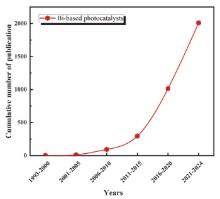
Fig 1
Trends in the publication of Bi-based photocatalysts from 1993 to 2024. Data on publications and citations with abstracts highlighting "Bi photocatalysts" obtained from a Web of Science search performed on April 17, 2024."
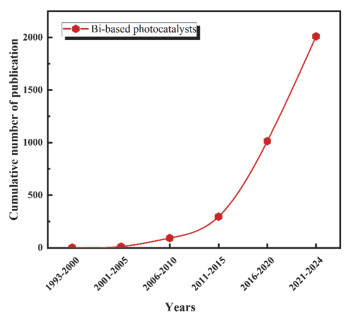
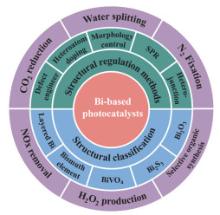
Fig 2
Schematic illustration of the structural classification, structural regulation methods and application of Bi-based photocatalysts."
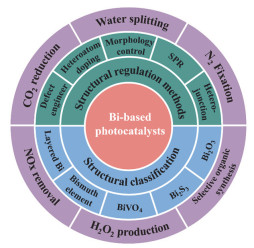
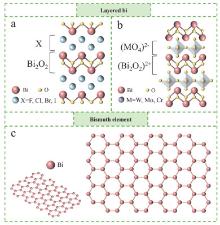
Fig 3
The Crystal structural diagram of (a) BiOX (X = F, Cl, Br, I), (b) Bi2MO6 (M = W, Mo, Cr), (c) Bismuthene."
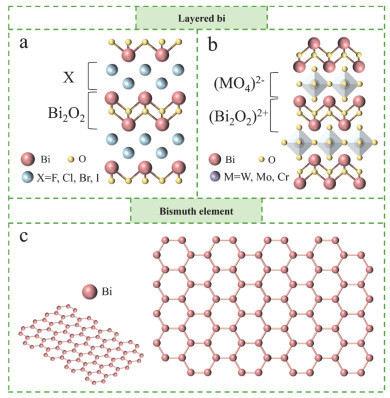
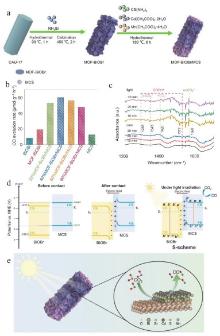
Fig 4
(a) Schematic diagram of MOF-BiOBr/MCS fabrication process. (b) The yields of CO2 photoreduction. (c) In situ DRIFT of 40%MOF-BiOBr/MCS. (d) Photocatalytic mechanism of BiOBr/MCS. (e) Photocatalytic reduction of CO2 54. Copyright 2023, Elsevier."
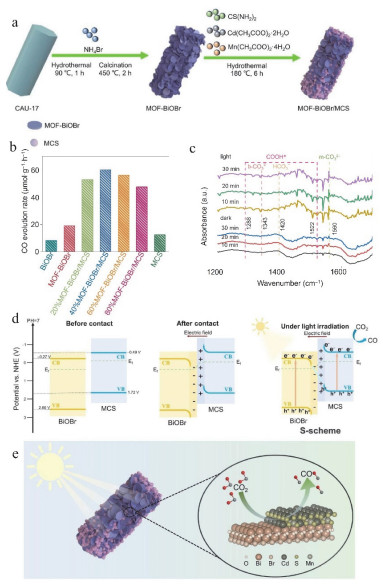
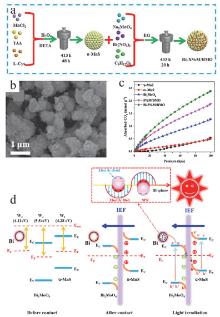
Fig 5
(a) Diagram illustrating of the synthetic route of α-MnS/Bi2MoO6 photocatalyst. (b) SEM images of Bi-5 %M/BMO. (c) CO2 absorption isotherms detected on various photocatalysts. (d) An overview of the S-scheme mechanism 62. Copyright 2021, Elsevier."
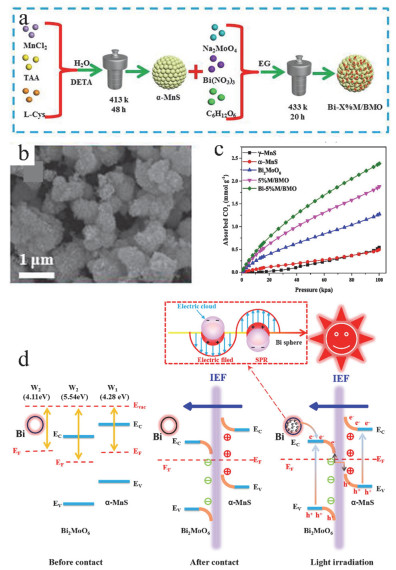
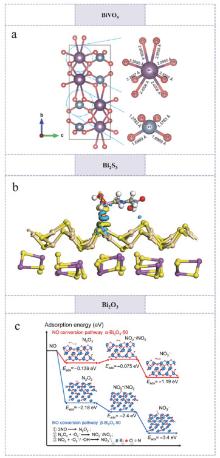
Fig 6
(a) The crystal structural diagram of BiVO4 67. Copyright 2022, John Wiley and Sons. (b) Charge distribution difference of Bi2S3/CdS adsorbing Gly 68. Copyright 2024, Elsevier. (c) Bi2O3 69. Copyright 2020, Elsevier."
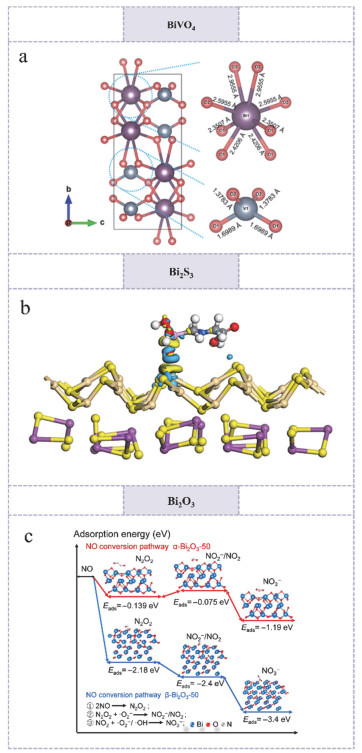
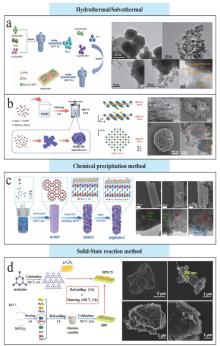
Fig 7
Synthesis diagram of Bi-based photocatalysts. (a) BS/BVO/MCS 75. Copyright 2022, Elsevier. (b) Bi/BiOBr nanoflowers 76. Copyright 2023, Elsevier. (c) Bi@BiOBr/C 77. Copyright 2024, Elsevier. (d) Bi4NbO8Cl/g-C3N4 78. Copyright 2020, Elsevier."
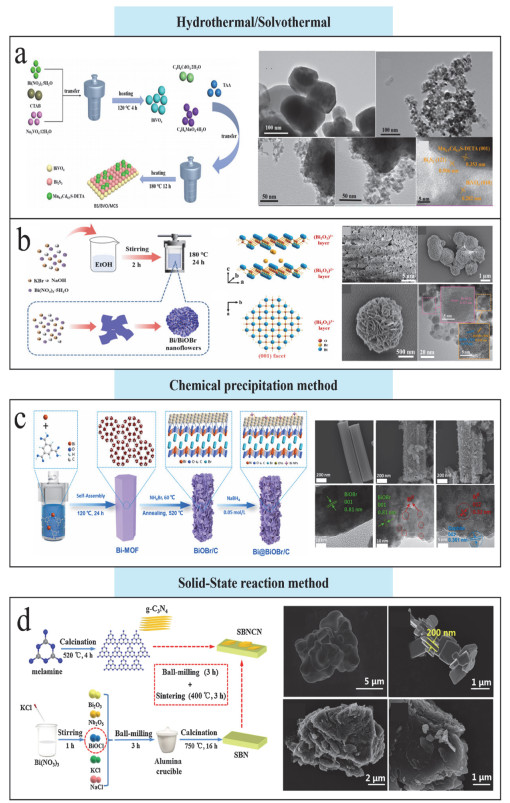
Fig 8
The schematic diagram of the defect engineering methods to structural regulation. (a) Ta3N5/BiOCl 81. Copyright 2022, Elsevier. (b) BiOBr-(0 0 1)/Bi2SiO5/Bi 82. Copyright 2023, Elsevier. (c) Bi2S3/SnS2/Bi2W2O9 83. Copyright 2023, Elsevier."
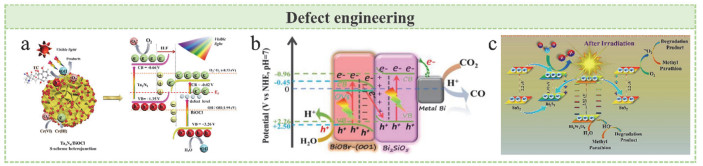
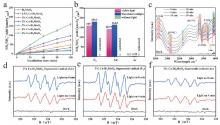
Fig 9
The schematic diagram of the impact of heteroatom doping on performance. (a) Photocatalytic N2 fixation properties of Bi2MoO6 and Co-Bi2MoO6. (b) 3% Co-Bi2MoO6 under visible light and simulated sunlight. (c) In situ FTIR spectra of 3% Co-Bi2MoO6. (d–f) ESR spectra of 3% Co-Bi2MoO6 for (d) Air, (e) N2 and (f) Ar 86. Copyright 2023, Elsevier."
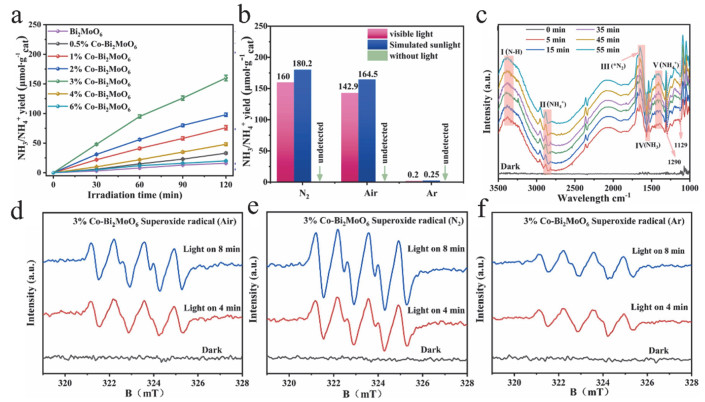
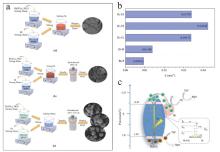
Fig 10
The schematic diagram of morphological control. (a) The method for preparing BiOI, Bi4O5I2 and Bi/Bi4O5I2. (b) Kinetics of HgO oxidation reaction. (c) Photocatalytic mechanism of Bi/Bi4O5I2 87. Copyright 2021, Elsevier."
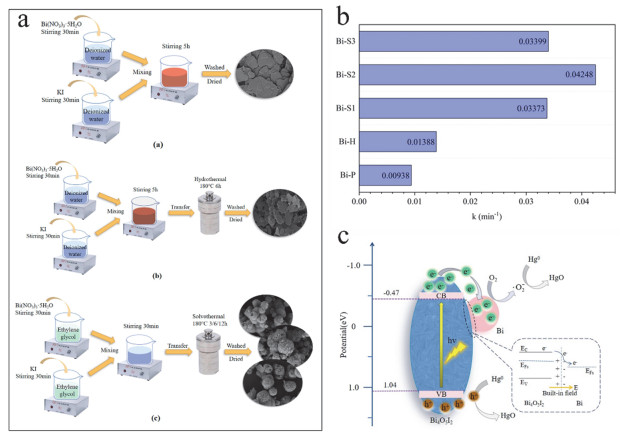
Fig 11
The schematic illustration of (a) Bi/BiVO4/g-C3N4 91.Copyright 2020, Elsevier. (b) Bi/Bi2WO6 92. Copyright 2019, Elsevier."
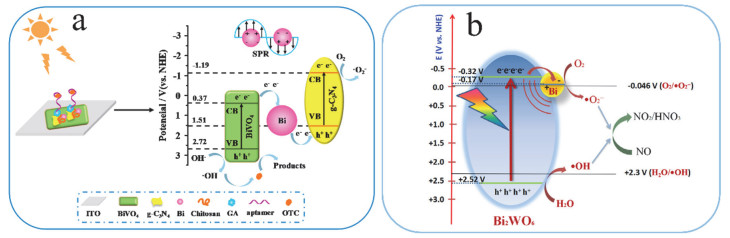
Fig 12
The schematic diagram of heterojunction of (a) Type-Ⅰ, (b) Type-Ⅱ, (c) Type-Ⅲ, (d) Z-scheme, and (e) S-scheme."
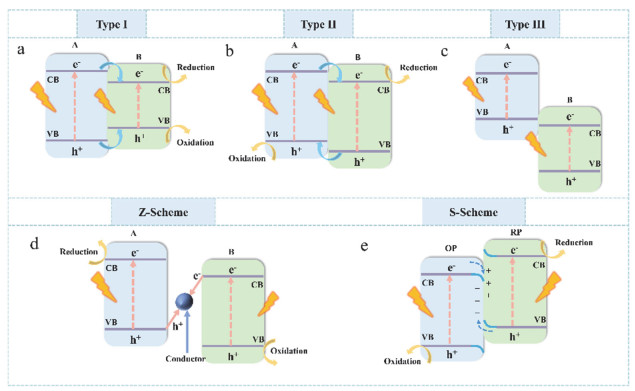
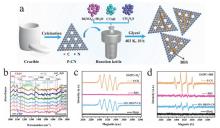
Fig 13
(a) Schematic illustration of the synthesis of the BBS/P-CN. (b) In situ DRIFTS spectra of 10%BBS/P-CN. (c) DMPO •O2− in methanol and (d) DMPO •OH in aqueous dispersion of P-CN, BBS, and 10%BBS/P-CN under 2 min light irradiation 120. Copyright 2022, John Wiley and Sons."
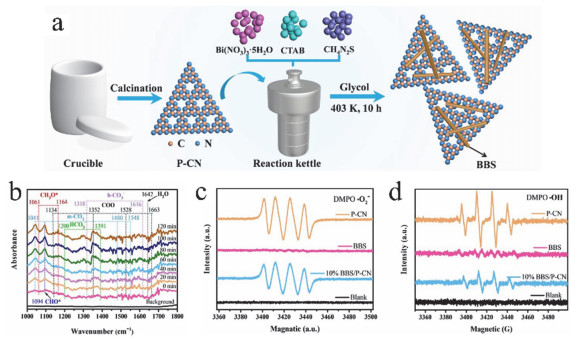
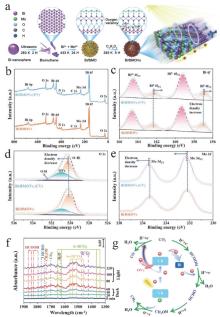
Fig 14
(a) Synthesis process of Bi/BMOVs. (b) In situ XPS spectra for Bi/BMOVs. High-resolution Bi 4f (c), O 1s (d), and Mo 3d (e). (f) In situ DRIFTS spectra of Bi/BMOVs. (g) Photocatalytic CO2 reduction of Bi/BMOVs 63. Copyright 2023, John Wiley and Sons."
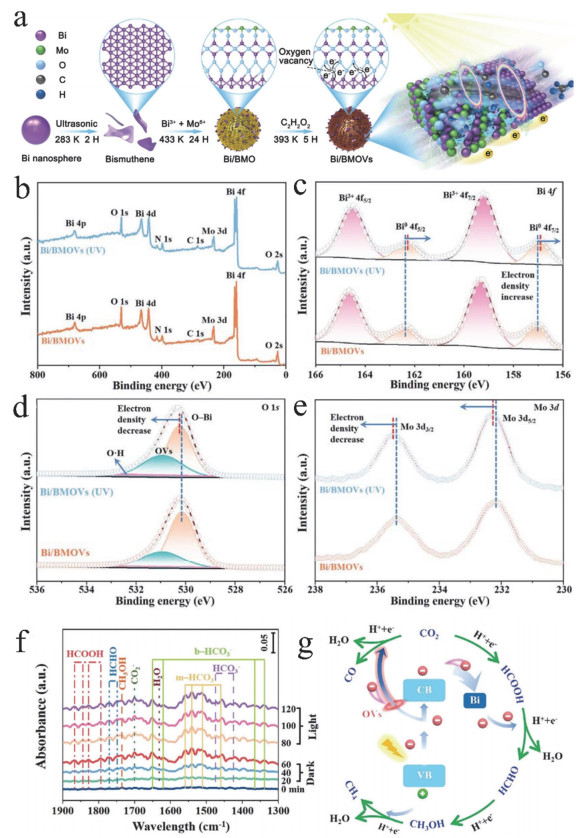
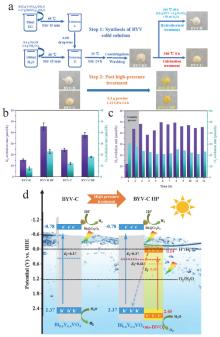
Fig 15
(a) Synthetic process of BiVO4/Bi0.6Y0.4VO4 S-scheme heterostructure. (b) Catalytic activity of different materials. (c) Photocatalytic OWS stability of BYV-H HP. (d) Photocatalytic mechanism of BiVO4/Bi0.6Y0.4VO4 131. Copyright 2022, Elsevier."
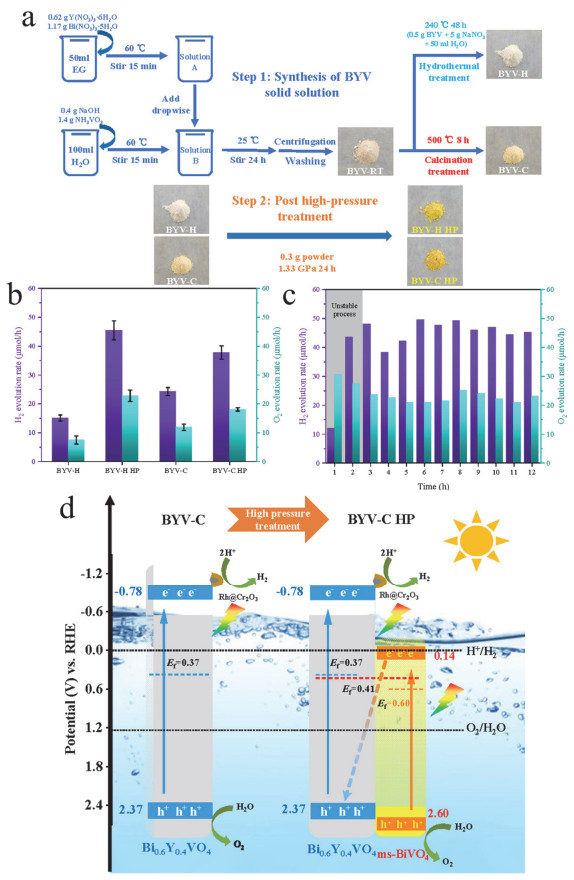
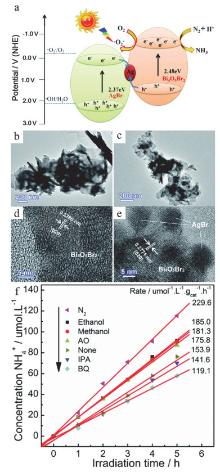
Fig 16
(a) Photocatalytic mechanism of the AgBr/Bi4O5Br2 heterojunction. (b, d) TEM images of Bi4O5Br2. (c, e) TEM images of AgBr/Bi4O5Br2. (f) Photocatalytic N2 fixation efficiency of the 5.0 wt% AgBr/Bi4O5Br2 photocatalyst 132. Copyright 2019, The Royal Society of Chemistry."
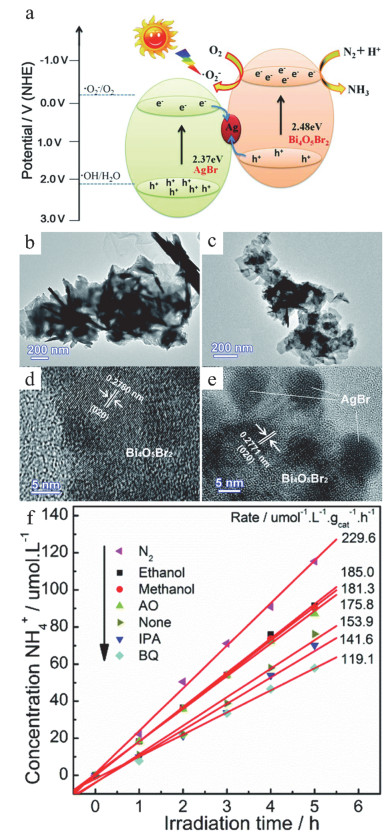
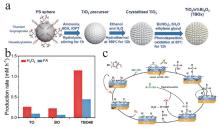
Fig 17
(a) The creation processes for TBOx through hydrothermal and photodeposition methods. (b) Production formation rates of H2O2 and FA over TO, BO, and TBO40 in 12 h. (c) The suggested process for photocatalytic FFA oxidation involves coupling with the generation of H2O2, coinciding with the presence of O2 on TBO40 surface 107. Copyright 2022, John Wiley and Sons."
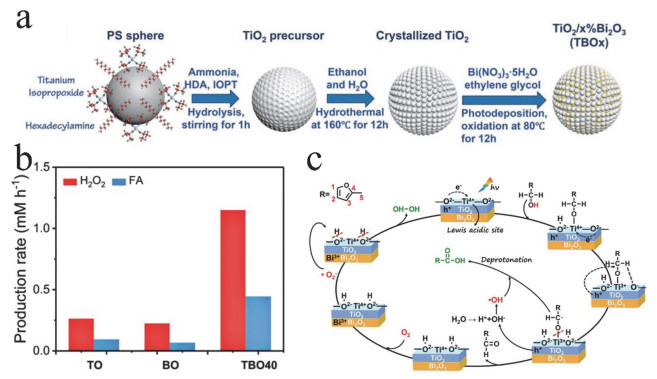
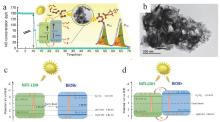
Fig 18
(a) NO removal rate of NiTi-LDH/BiOBr. (b) HRTEM images of the NiTi/BiOBr-1.2 samples. (c, d) Heterogeneous structure of NiTi-LDH and BiOBr 137. Copyright 2023, Elsevier."
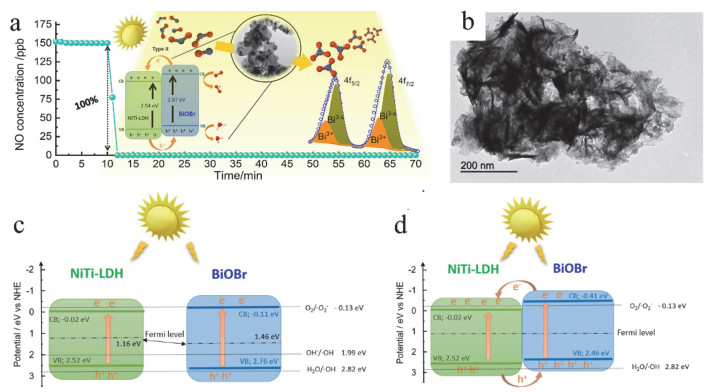
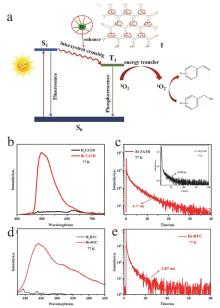
Fig 19
(a) Coordinated with Bi facilitates the singlet → triplet intersystem crossing of the ligand. (b) Phosphorescence spectra of H3TATB and Bi-TATB. (c) Time-resolved phosphorescence spectra of H3TATB and Bi-TATB. (d) Phosphorescence spectra of H3BTC and Bi-BTC. (e) Time-resolved phosphorescence spectra of Bi-BTC 138. Copyright 2019, Elsevier."
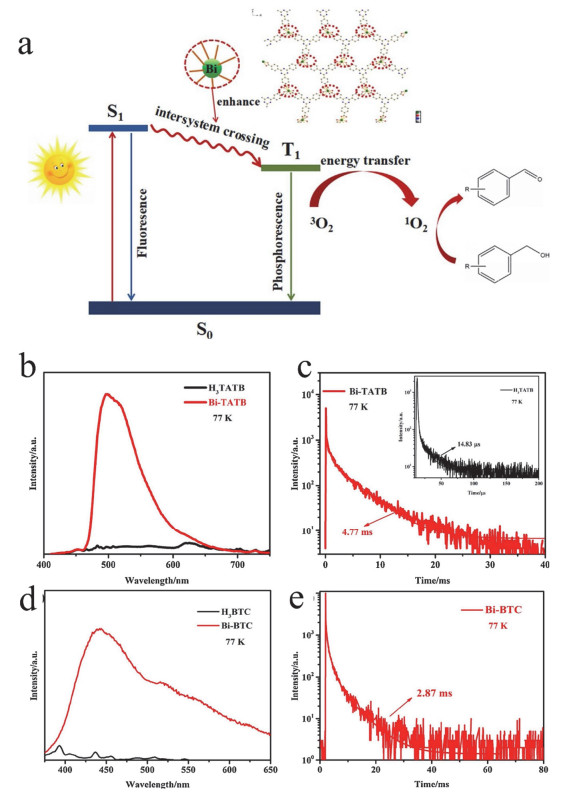
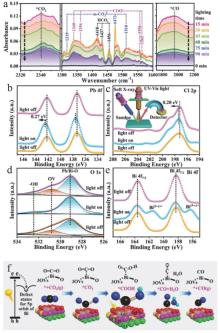
Fig 20
(a) In situ FTIR spectra during CO2 reduction with increasing light duration of DUC PBOC-1. (b–e) SI-XPS high-resolution spectra of Pb 4f (b), Cl 2p (c), O 1s (d), and Bi 4f (e). (f) Schematic diagram of the CO2 conversion process 139. Copyright 2022, John Wiley and Sons."
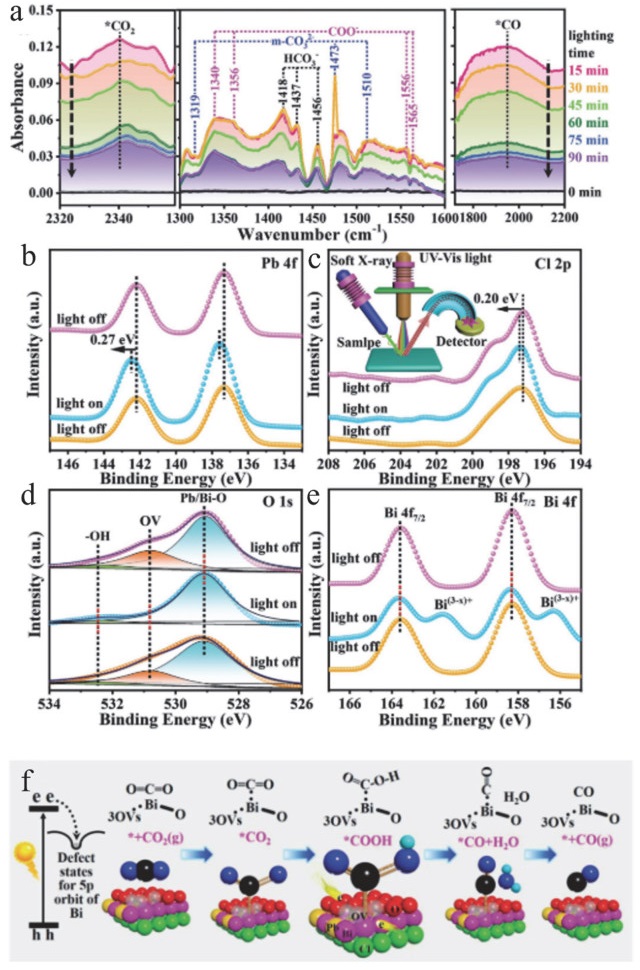
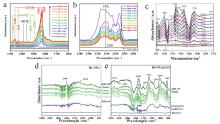
Fig 21
In situ FTIR spectra of (a, b) CO2 production of BiOBr-1 141. Copyright 2023, Springer Nature. (c) Photocatalytic NO oxidation reaction over Bi/BiOCl-200 142. Copyright 2018, Elsevier. (d, e) Photocatalytic reaction of NO on Bi-NPs and Bi-NPs@GO under UV light irradiation 144. Copyright 2018, Elsevier."
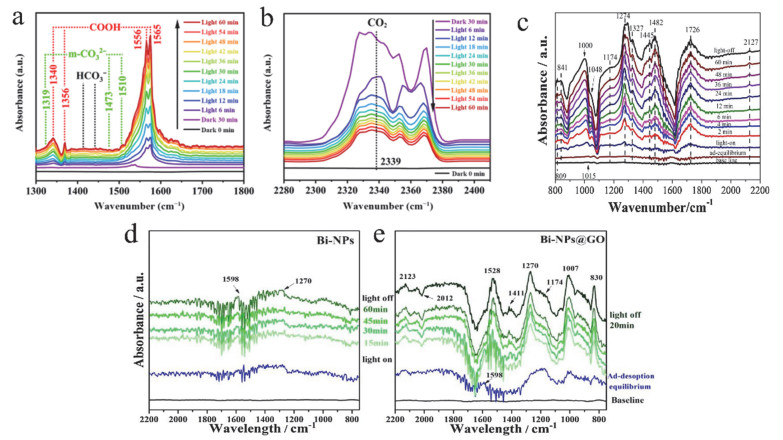
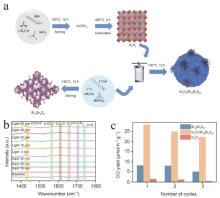
Fig 22
(a) Schematic diagram of the synthesized In2O3/Bi19Br3S27. (b) DRIFTS of In2O3/Bi19Br3S27 in darkness and under light. (c) Recyclability tests of Bi19Br3S27, In2O3, and In2O3/Bi19Br3S27 composites 145. Copyright 2024, Springer Nature."
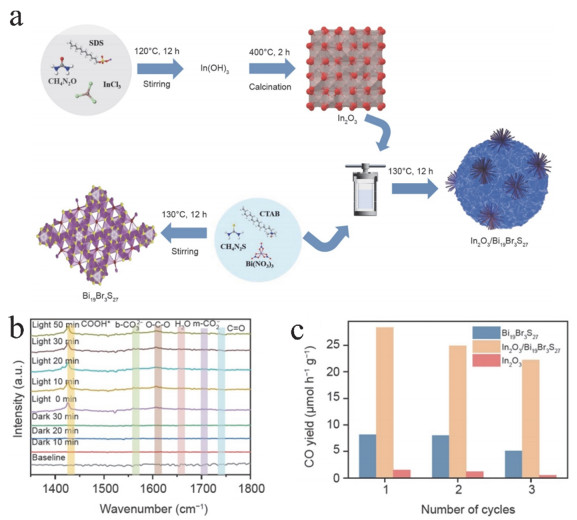
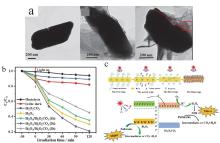
Fig 23
In situ TEM spectra of (a) Bi2O4 morphology obtained under LED light irradiation (0, 1, 2 h). (b) Photocatalytic performance of different photocatalysts for the degradation of CIP. (c) Diagram of the heterogeneous structure of Bi2O4/Bi2O2CO3 146. Copyright 2019, Elsevier."
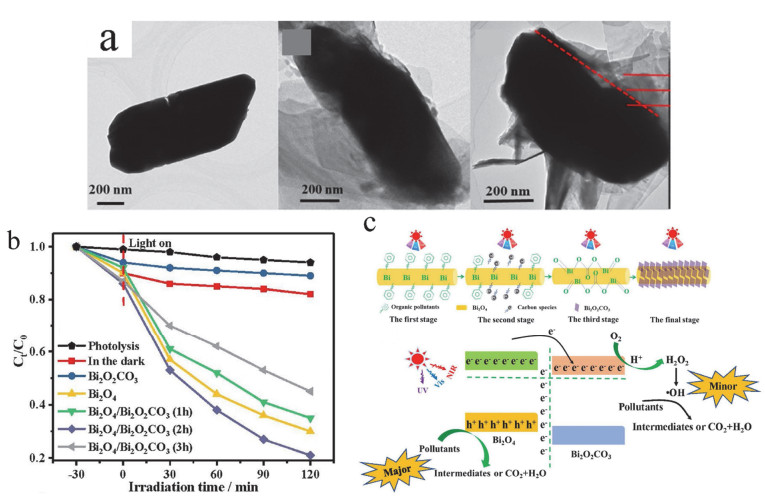
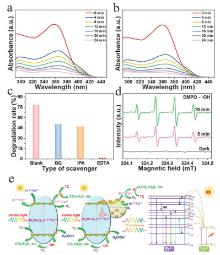
Fig 24
In situ UV-Vis curves of TC removal through (a) Bi2MoO6: Er3+/0.03Yb3+@Bi0.05 and (b) Bi2MoO6: Er3+/0.03Yb3+@Bi0.10. (c) TC removal efficiencies using Bi2MoO6: Er3+/0.03Yb3+@Bi0.10 in the presence of different scavengers under light irradiation. (d) ESR spectra of Bi2MoO6: Er3+/Yb3+@Bi0.10 using different capture agents of DMPO-•OH. (e) Photocatalytic mechanism diagram 149. Copyright 2023, Elsevier."
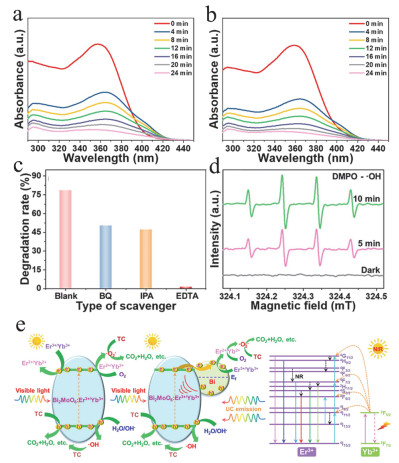
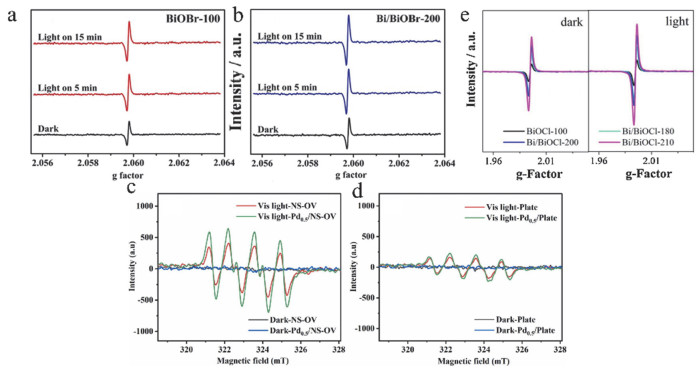
Fig 25
In situ EPR spectra of (a) BiOBr-100 and on (b) Bi/BiOBr-200 150. Copyright 2018, Elsevier. (c) NS-OV and Pd0.5/NS-OV, (d) Plate and Pd0.5/Plate 151. Copyright 2022, Elsevier. (e) BiOCl and Bi/BiOCl 142. Copyright 2018, Elsevier."
| 1 |
doi: 10.1038/238037a0 |
| 2 |
doi: 10.1016/S1872-2067(22)64096-8 |
| 3 |
doi: 10.3866/PKU.WHXB202209037 |
| 4 |
doi: 10.1016/S1872-2067(23)64438-9 |
| 5 |
doi: 10.1002/solr.202100788 |
| 6 |
doi: 10.1016/S1872-2067(21)63866-4 |
| 7 |
doi: 10.3866/PKU.WHXB202211051 |
| 8 |
doi: 10.1016/j.apcatb.2020.119789 |
| 9 |
doi: 10.1002/adfm.202400065 |
| 10 |
doi: 10.14102/j.cnki.0254-5861.2022-0042 |
| 11 |
doi: 10.3866/PKU.WHXB202307016 |
| 12 |
doi: 10.1016/S1872-2067(21)63832-9 |
| 13 |
doi: 10.3866/PKU.WHXB202212010 |
| 14 |
doi: 10.1021/acssuschemeng.8b02064 |
| 15 |
doi: 10.1016/S1872-2067(21)63830-5 |
| 16 |
doi: 10.1002/adma.201807660 |
| 17 |
doi: 10.1016/S1872-2067(23)64502-4 |
| 18 |
doi: 10.1038/s41467-021-25007-6 |
| 19 |
doi: 10.1038/s41467-024-49004-7 |
| 20 |
doi: 10.1002/aenm.202301158 |
| 21 |
doi: 10.1016/S1872-2067(23)64491-2 |
| 22 |
doi: 10.1016/j.mtphys.2023.101315 |
| 23 |
doi: 10.14102/j.cnki.0254-5861.2022-0068 |
| 24 |
doi: 10.1016/S1872-2067(21)63872-X |
| 25 |
doi: 10.1007/s40843-023-2770-8 |
| 26 |
doi: 10.1016/S1872-2067(23)64466-3 |
| 27 |
doi: 10.1016/j.jmst.2023.02.044 |
| 28 |
doi: 10.1016/S1872-2067(21)63883-4 |
| 29 |
doi: 10.1002/adfm.202214470 |
| 30 |
doi: 10.1016/j.apcatb.2020.118844 |
| 31 |
doi: 10.1016/S1872-2067(21)64024-X |
| 32 |
doi: 10.14102/j.cnki.0254-5861.2022-0096 |
| 33 |
doi: 10.1016/j.jcis.2021.10.034 |
| 34 |
doi: 10.1002/anie.202304559 |
| 35 |
doi: 10.1016/j.jhazmat.2020.122050 |
| 36 |
doi: 10.1002/aenm.201903802 |
| 37 |
doi: 10.1002/adma.202207752 |
| 38 |
doi: 10.1016/j.apcatb.2022.121788 |
| 39 |
doi: 10.1039/D0CS01487G |
| 40 |
doi: 10.1016/S1872-2067(20)63784-6 |
| 41 |
doi: 10.1016/S1872-2067(21)63910-4 |
| 42 |
doi: 10.1016/j.jmst.2022.02.014 |
| 43 |
doi: 10.1016/j.apcatb.2020.119832 |
| 44 |
doi: 10.1016/j.cej.2020.124402 |
| 45 |
doi: 10.1016/S1872-2067(19)63481-9 |
| 46 |
doi: 10.1016/j.ccr.2023.215246 |
| 47 |
doi: 10.1002/anie.202407736 |
| 48 |
doi: 10.1016/j.ccr.2022.214515 |
| 49 |
doi: 10.1016/j.cej.2023.144658 |
| 50 |
doi: 10.1016/j.ccr.2021.214033 |
| 51 |
doi: 10.1016/j.ccr.2022.214541 |
| 52 |
doi: 10.3866/PKU.WHXB202209016 |
| 53 |
doi: 10.3866/PKU.WHXB202212026 |
| 54 |
doi: 10.1016/j.jmst.2023.03.003 |
| 55 |
doi: 10.1016/j.jhazmat.2021.126207 |
| 56 |
doi: 10.1016/j.apsusc.2021.151921 |
| 57 |
doi: 10.1016/s1872-2067(20)63612-9 |
| 58 |
doi: 10.1016/j.jmst.2023.07.076 |
| 59 |
doi: 10.1016/j.ccr.2022.215010 |
| 60 |
doi: 10.7536/PC220934 |
| 61 |
doi: 10.3866/PKU.WHXB202309031 |
| 62 |
doi: 10.1016/j.jcis.2021.07.064 |
| 63 |
doi: 10.1002/adma.202300643 |
| 64 |
doi: 10.1016/j.apcatb.2021.120957 |
| 65 |
doi: 10.1021/acsami.1c01470 |
| 66 |
doi: 10.1016/j.apcatb.2024.124209 |
| 67 |
doi: 10.1002/adfm.202206811 |
| 68 |
doi: 10.1016/j.cej.2024.150209 |
| 69 |
doi: 10.1016/j.scib.2020.01.007 |
| 70 |
doi: 10.1016/j.jmst.2023.05.037 |
| 71 |
doi: 10.1016/j.jhazmat.2020.124394 |
| 72 |
doi: 10.1016/j.apcatb.2017.05.009 |
| 73 |
doi: 10.1016/j.matlet.2019.126740 |
| 74 |
doi: 10.1016/j.apcatb.2018.05.069 |
| 75 |
doi: 10.1016/j.jmst.2021.11.046 |
| 76 |
doi: 10.1016/j.apcatb.2022.122238 |
| 77 |
doi: 10.1016/j.apcatb.2023.123238 |
| 78 |
doi: 10.1016/j.jhazmat.2019.121159 |
| 79 |
doi: 10.1016/j.cej.2023.145473 |
| 80 |
doi: 10.1016/j.cej.2023.145282 |
| 81 |
doi: 10.1016/j.jmst.2022.02.012 |
| 82 |
doi: 10.1016/j.jcis.2023.04.097 |
| 83 |
doi: 10.1016/j.seppur.2023.124509 |
| 84 |
doi: 10.1016/S1872-2067(22)64104-4 |
| 85 |
doi: 10.1016/j.jcis.2022.09.031 |
| 86 |
doi: 10.1016/j.apcatb.2023.123057 |
| 87 |
doi: 10.1016/j.cej.2021.131599 |
| 88 |
doi: 10.1002/adma.202301307 |
| 89 |
doi: 10.1021/acs.chemrev.1c00473 |
| 90 |
doi: 10.1021/acssuschemeng.7b03032 |
| 91 |
doi: 10.1016/j.bios.2020.112453 |
| 92 |
doi: 10.1016/S1872-2067(19)63320-6 |
| 93 |
doi: 10.1016/j.jcis.2022.02.026 |
| 94 |
doi: 10.1007/s40843-024-2779-5 |
| 95 |
doi: 10.1016/S1872-2067(23)64444-4 |
| 96 |
doi: 10.14102/j.cnki.0254-5861.2022-0150 |
| 97 |
doi: 10.1016/j.jmst.2023.08.038 |
| 98 |
doi: 10.1039/d2nr05341a |
| 99 |
doi: 10.3866/PKU.WHXB202311016 |
| 100 |
doi: 10.1016/j.jmst.2023.03.067 |
| 101 |
doi: 10.3866/PKU.WHXB202307022 |
| 102 |
doi: 10.1016/j.ccr.2022.214596 |
| 103 |
doi: 10.1016/j.trechm.2022.08.008 |
| 104 |
doi: 10.1016/S1872-2067(21)63911-6 |
| 105 |
doi: 10.3866/PKU.WHXB202209012 |
| 106 |
doi: 10.1002/aenm.202201449 |
| 107 |
doi: 10.1002/adma.202203225 |
| 108 |
doi: 10.1002/adma.202400288 |
| 109 |
doi: 10.1002/adma.202107668 |
| 110 |
doi: 10.1002/adma.202310600 |
| 111 |
doi: 10.1002/anie.202218688 |
| 112 |
doi: 10.1002/anie.202313172 |
| 113 |
doi: 10.1002/adfm.202315426 |
| 114 |
doi: 10.1016/S1872-2067(20)63560-4 |
| 115 |
doi: 10.1016/j.apcatb.2022.121893 |
| 116 |
doi: 10.1016/j.cej.2021.132519 |
| 117 |
doi: 10.1016/j.apcatb.2020.119251 |
| 118 |
doi: 10.1016/j.cej.2021.129530 |
| 119 |
doi: 10.1016/j.jmst.2023.03.037 |
| 120 |
doi: 10.1002/chem.202202669 |
| 121 |
doi: 10.1002/adma.202303902 |
| 122 |
doi: 10.1021/acs.chemrev.8b00400 |
| 123 |
doi: 10.1016/S1872-2067(23)64477-8 |
| 124 |
doi: 10.1002/adma.202303030 |
| 125 |
doi: 10.1002/anie.202209703 |
| 126 |
doi: 10.1016/j.apcatb.2022.121503 |
| 127 |
doi: 10.1002/adma.202108475 |
| 128 |
doi: 10.1016/j.jmst.2023.02.020 |
| 129 |
doi: 10.1002/adma.202309199 |
| 130 |
doi: 10.1016/j.chempr.2022.04.013 |
| 131 |
doi: 10.1016/s1872-2067(21)63846-9 |
| 132 |
doi: 10.1039/C9QI00782B |
| 133 |
doi: 10.1016/j.cjsc.2023.100202 |
| 134 |
doi: 10.1002/anie.202208438 |
| 135 |
doi: 10.1002/anie.202406310 |
| 136 |
doi: 10.1016/j.enchem.2023.100116 |
| 137 |
doi: 10.1016/j.cej.2023.144088 |
| 138 |
doi: 10.1016/j.apcatb.2019.05.024 |
| 139 |
doi: 10.1002/adfm.202202885 |
| 140 |
doi: 10.1016/j.apcatb.2020.119351 |
| 141 |
doi: 10.1007/s12274-023-5828-2 |
| 142 |
doi: 10.1016/j.apcatb.2017.11.079 |
| 143 |
doi: 10.1021/acsami.7b04026 |
| 144 |
doi: 10.1016/j.apcatb.2017.09.046 |
| 145 |
doi: 10.1007/s40843-023-2725-y |
| 146 |
doi: 10.1016/j.apcatb.2018.10.067 |
| 147 |
doi: 10.1016/j.apcatb.2016.08.049 |
| 148 |
doi: 10.3866/PKU.WHXB202011022 |
| 149 |
doi: 10.1016/j.cej.2023.146192 |
| 150 |
doi: 10.1016/j.jcat.2017.10.004 |
| 151 |
doi: 10.1016/j.apcatb.2021.121032 |
| 152 |
doi: 10.34133/research.0244 |
| [1] | Renyi Shao, Khurram Abbas, Vladimir Yu. Osipov, Haimei Zhu, Yuan Li, Usama, Hong Bi. Red-emitting carbon dots prepared from Epipremnum Aureum leaves extract for biological imaging [J]. Acta Phys. -Chim. Sin., 2026, 42(2): 100134-. |
| [2] | Xian-Wei Lv, Xinyuan Ding, Jiaxing Gong, Xuhuan Yan, Dayong Huang, Jianxin Geng, Zhong-Yong Yuan. Research progress on orbital hybridization in photocatalysis and electrocatalysis [J]. Acta Phys. -Chim. Sin., 2026, 42(2): 100151-. |
| [3] | Fan Fan, Hao Xiu, Yuting Wang, Yongpeng Cui, Yajun Wang. Construction of NH2-MIL-125/Na-doped g-C3N4 composite S-scheme heterojunction and its performance in photocatalytic hydrogen peroxide production [J]. Acta Phys. -Chim. Sin., 2026, 42(2): 100143-. |
| [4] | Yu Liu, Pengfei Li, Yize Liu, Zaicheng Sun. Recent advances in carbon dots as a single photocatalyst [J]. Acta Phys. -Chim. Sin., 2026, 42(2): 100167-. |
| [5] | Yuhang Zhang, Yi Li, Yuehan Cao, Yingjie Shuai, Yu Zhou, Ying Zhou. Regulating the formation type by Ir of intermediates to suppress product overoxidation in photocatalytic methane conversion [J]. Acta Phys. -Chim. Sin., 2026, 42(2): 100173-. |
| [6] | Débora Ferreira dos Santos Morais, José Luis Tirado, Carlos Pérez-Vicente, Fabiana Villela da Motta, Pedro Lavela, Mauricio Bomio, Sergio Lavela. Unlocking the performance of sodium-ion batteries by coating Na3V2(PO4)3 with Nb2O5 [J]. Acta Phys. -Chim. Sin., 2026, 42(2): 100180-. |
| [7] | Chengxiao Zhao, Zhaolin Li, Dongfang Wu, Xiaofei Yang. SBA-15 templated covalent triazine frameworks for boosted photocatalytic hydrogen production [J]. Acta Phys. -Chim. Sin., 2026, 42(1): 100149-. |
| [8] | Chengyan Ge, Jiawei Hu, Xingyu Liu, Yuxi Song, Chao Liu, Zhigang Zou. Self-integrated black NiO clusters with ZnIn2S4 microspheres for photothermal-assisted hydrogen evolution by S-scheme electron transfer mechanism [J]. Acta Phys. -Chim. Sin., 2026, 42(1): 100154-. |
| [9] | Shiyi Chen, Jialong Fu, Jianping Qiu, Guoju Chang, Shiyou Hao. Waste medical mask-derived carbon quantum dots enhance the photocatalytic degradation of polyethylene terephthalate (PET) over BiOBr/g-C3N4 S-scheme heterojunction [J]. Acta Phys. -Chim. Sin., 2026, 42(1): 100135-. |
| [10] | Shan Zhao, Xu Liu, Haotian Guo, Zonglin Liu, Pengfei Wang, Jie Shu, Tingfeng Yi. Synergistic design of high-entropy P2/O3 biphasic cathodes for high-performance sodium-ion batteries [J]. Acta Phys. -Chim. Sin., 2026, 42(1): 100129-. |
| [11] | Fengying Zhang, Yanglin Mei, Yuman Jiang, Shenshen Zheng, Kaibo Zheng, Ying Zhou. Research progress of transient absorption spectroscopy in solar energy conversion and utilization [J]. Acta Phys. -Chim. Sin., 2025, 41(9): 100118-. |
| [12] | Wenlong Wang, Wentao Hao, Lang He, Jia Qiao, Ning Li, Chaoqiu Chen, Yong Qin. Bandgap and adsorption engineering of carbon dots/TiO2 S-scheme heterojunctions for enhanced photocatalytic CO2 methanation [J]. Acta Phys. -Chim. Sin., 2025, 41(9): 100116-. |
| [13] | Menglan Wei, Xiaoxia Ou, Yimeng Wang, Mengyuan Zhang, Fei Teng, Kaixuan Wang. S-scheme heterojunction g-C3N4/Bi2WO6 highly efficient degradation of levofloxacin: performance, mechanism and degradation pathway [J]. Acta Phys. -Chim. Sin., 2025, 41(9): 100105-. |
| [14] | Jingping Li, Suding Yan, Jiaxi Wu, Qiang Cheng, Kai Wang. Improving hydrogen peroxide photosynthesis over inorganic/organic S-scheme photocatalyst with LiFePO4 [J]. Acta Phys. -Chim. Sin., 2025, 41(9): 100104-. |
| [15] | Qi Wu, Changhua Wang, Yingying Li, Xintong Zhang. Enhanced photocatalytic synthesis of H2O2 by triplet electron transfer at g-C3N4@BN van der Waals heterojunction interface [J]. Acta Phys. -Chim. Sin., 2025, 41(9): 100107-. |
|
||