Acta Phys. -Chim. Sin. ›› 2024, Vol. 40 ›› Issue (11): 2407002.doi: 10.3866/PKU.WHXB202407002
Special Issue: Solar fuel preparation
• ARTICLE • Previous Articles Next Articles
Highly Efficient InOOH/ZnIn2S4 Hollow Sphere S-Scheme Heterojunction with 0D/2D Interface for Enhancing Photocatalytic CO2 Conversion
Jiaxing Cai1, Wendi Xu3, Haoqiang Chi4, Qian Liu1, Wa Gao1,*( ), Li Shi3,*(), Jingxiang Low1,5,*(), Zhigang Zou4, Yong Zhou2,4,*()
- 1 School of Physical Science and Technology, Tiangong University, Tianjin 300387, China
2 School of Chemical and Environmental Engineering, Anhui Polytechnic University, Wuhu 241000, Anhui Province, China
3 State Key Laboratory of Organic Electronics and Information Displays & Institute of Advanced Materials (IAM), Nanjing University of Posts and Telecommunications, Nanjing 210023, China
4 School of Physics, Jiangsu Key Laboratory of Nanotechnology, Eco-materials and Renewable Energy Research Center (ERERC), National Laboratory of Solid State Microstructures, Collaborative Innovation Center of Advanced Microstructures, Nanjing University, Nanjing 210093, China
5 Multidisciplinary Platform of Advanced Engineering, Chemical Engineering Discipline, School of Engineering, Monash University Malaysia, Bandar Sunway 47500, Selangor, Malaysia
-
Received:2024-07-02Revised:2024-08-05Accepted:2024-08-05Published:2024-10-14 -
Contact:Email: gaowa@tiangong.edu.cn (Wa Gao)iamlshi@njupt.edu.cn (Li Shi)jxlow@tiangong.edu.cn (Jingxiang Low)zhouyong1999@nju.edu.cn (Yong Zhou) -
Supported by:the National Key R & D Program of China(2022YFE0126500); the National Key R & D Program of China(2018YFE0208500); the National Natural Science Foundation of China(21972065); the National Natural Science Foundation of China(22203046); the National Natural Science Foundation of China(22202152); the Natural Science Foundation of Jiangsu Province(BK20220006); the Hefei National Laboratory for Physical Sciences at the Microscale(KF2020006); the Program for Guangdong Introducing Innovative and Entrepreneurial Team(2019ZL08L101); the Chinese University Development Fund(UDF01001159); the Project of State Key Laboratory of Organic Electronics and Information Displays, Nanjing University of Posts and Telecommunications(GZR2023010003); Natural Science Research Start-up Foundation of Recruiting Talents of Nanjing University of Posts and Telecommunications(NY221128)

Cite this article
Jiaxing Cai, Wendi Xu, Haoqiang Chi, Qian Liu, Wa Gao, Li Shi, Jingxiang Low, Zhigang Zou, Yong Zhou. Highly Efficient InOOH/ZnIn2S4 Hollow Sphere S-Scheme Heterojunction with 0D/2D Interface for Enhancing Photocatalytic CO2 Conversion[J]. Acta Phys. -Chim. Sin. 2024, 40(11), 2407002. doi: 10.3866/PKU.WHXB202407002
share this article
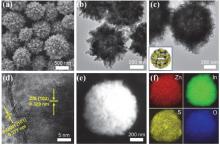
Fig 1
(a) SEM image of the hollow InOOH. (b) TEM image of InOOH. (c) TEM image and (inset) schematic illustration of InOOH/ZIS-10. (d) HRTEM image of InOOH/ZIS-10. (e, f) FESEM image (e) and EDX elemental mappings (f) of InOOH/ZIS-10."
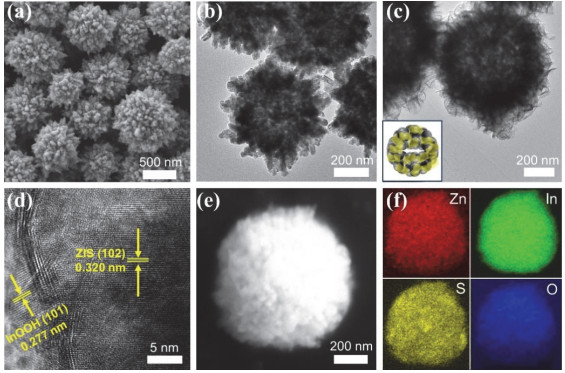
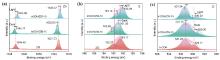
Fig 2
High-resolution XPS spectra of (a) Zn 2p, (b) S 2p (c) O 1s of InOOH/ZIS-10, ZIS and InOOH. In situ XPS measurement was performed under light irradiation."
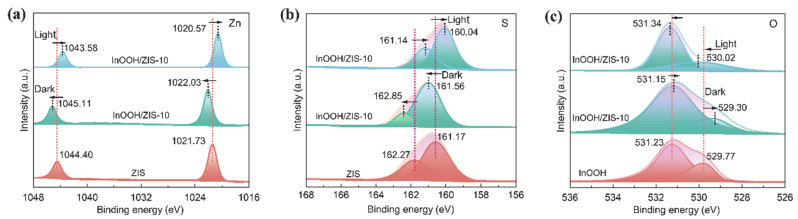
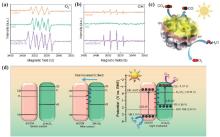
Fig 3
(a, b) ESR signals of DMPO-•O2− (a) and DMPO-•OH (b) for InOOH/ZIS-10, ZIS, and InOOH under light irradiation. (c) Schematic illustration of the photocatalytic CO2 reduction over InOOH/ZIS. (d) Proposed schematic diagram of the S-scheme photocatalytic mechanism of photocatalytic CO2 reduction over InOOH/ZIS-10."
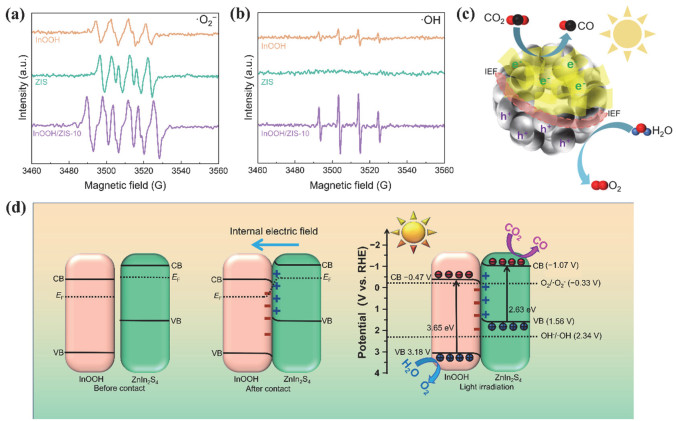
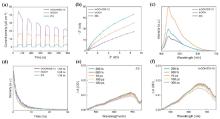
Fig 4
(a) Transient photocurrent responses, (b) Nyquist plots, (c) PL emission spectra, and (d) PL decay traces of ZIS, InOOH, and InOOH/ZIS-10. (e, f) fs-TAS spectra of ZIS (e) and InOOH/ZIS-10 (f) under 350 nm laser pulse excitation."
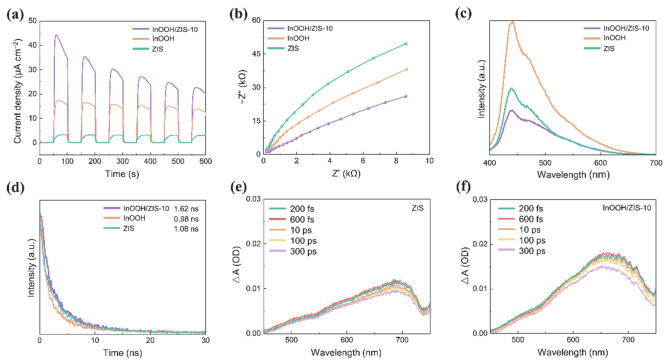
Fig 5
(a) Photocatalytic CO output changes with light irradiation times. (b) Comparison of photocatalytic activity over different samples. (c) Cyclic stability test. (d) Comparison of photocatalytic activity under different conditions."
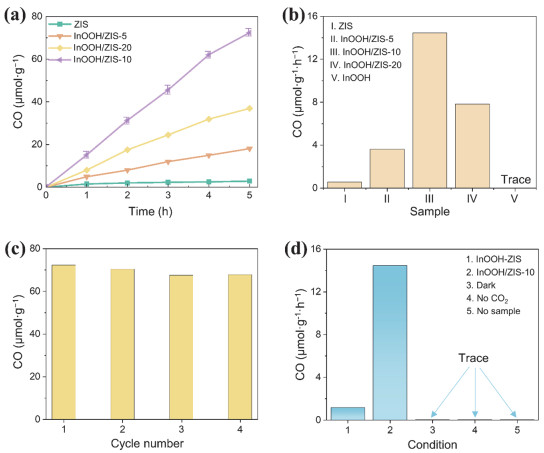
Fig 6
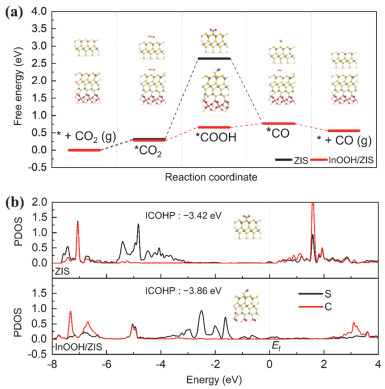
(a) Gibbs free energy profiles for the CO2 reduction reaction on ZIS and InOOH/ZIS. The insets represent reaction intermediates of element steps. The yellow, red, white, gray, brown, and blue represent S, O, H, C, In, and Zn atoms, respectively. (b) Projected density of states of adsorbed *COOH on the C atom and S atom sites."
| 1 |
doi: 10.1002/anie.202308523 |
| 2 |
doi: 10.3866/PKU.WHXB202212026 |
| 3 |
doi: 10.1016/j.jmst.2023.02.044 |
| 4 |
doi: 10.3866/PKU.WHXB202307045 |
| 5 |
doi: 10.3866/PKU.WHXB202308036 |
| 6 |
doi: 10.1016/j.apcatb.2018.11.011 |
| 7 |
doi: 10.3866/PKU.WHXB202212016 |
| 8 |
doi: 10.1002/adma.202310600 |
| 9 |
doi: 10.1039/d2en00781a |
| 10 |
doi: 10.1038/s41467-024-49004-7 |
| 11 |
doi: 10.3866/PKU.WHXB202211051 |
| 12 |
doi: 10.1016/S1872-2067(23)64551-6 |
| 13 |
doi: 10.1007/s40843-023-2725-y |
| 14 |
doi: 10.3866/PKU.WHXB202210003 |
| 15 |
doi: 10.1016/S1872-2067(23)64607-8 |
| 16 |
doi: 10.1016/j.cej.2023.145256 |
| 17 |
doi: 10.1002/adfm.202214470 |
| 18 |
doi: 10.3866/PKU.WHXB202209016 |
| 19 |
doi: 10.1016/S1872-2067(23)64480-8 |
| 20 |
doi: 10.1016/j.cjsc.2023.100202 |
| 21 |
doi: 10.1002/admi.202100695 |
| 22 |
doi: 10.3866/PKU.WHXB202307022 |
| 23 |
doi: 10.1002/anie.202218688 |
| 24 |
doi: 10.1002/smll.202103447 |
| 25 |
doi: 10.1016/S1872-2067(23)64466-3 |
| 26 |
doi: 10.3866/PKU.WHXB202302051 |
| 27 |
doi: 10.1002/smll.202204774 |
| 28 |
doi: 10.3866/PKU.WHXB202312024 |
| 29 |
doi: 10.1016/j.jmst.2024.02.048 |
| 30 |
doi: 10.1016/j.chempr.2020.06.010 |
| 31 |
doi: 10.1088/0953-8984/21/39/395502 |
| 32 |
doi: 10.1103/PhysRevLett.77.3865 |
| 33 |
doi: 10.1002/jcc.21759 |
| 34 |
doi: 10.1016/j.cej.2020.127389 |
| 35 |
doi: 10.1016/j.apsusc.2023.158492 |
| 36 |
doi: 10.1016/j.apsusc.2021.150225 |
| 37 |
doi: 10.1039/c9en01325c |
| 38 |
doi: 10.1016/j.cej.2019.122770 |
| 39 |
doi: 10.1021/acsami.0c21266 |
| 40 |
doi: 10.3866/PKU.WHXB202212010 |
| 41 |
doi: 10.1016/j.jcis.2021.05.132 |
| 42 |
doi: 10.3866/PKU.WHXB202209037 |
| 43 |
doi: 10.1007/s10971-021-05532-y |
| 44 |
doi: 10.1021/acs.accounts.1c00705 |
| 45 |
doi: 10.1021/acsanm.3c06076 |
| 46 |
doi: 10.1016/j.jcat.2021.05.007 |
| 47 |
doi: 10.1021/acsaem.0c00750 |
| 48 |
doi: 10.1002/smll.202305410 |
| 49 |
doi: 10.1016/j.jcis.2019.12.091 |
| 50 |
doi: 10.1016/j.scib.2020.03.032 |
| 51 |
doi: 10.1016/j.jcis.2022.08.008 |
| 52 |
doi: 10.1021/acsami.3c00955 |
| 53 |
doi: 10.1021/jacs.2c13464 |
| 54 |
doi: 10.1021/acs.inorgchem.3c02126 |
| 55 |
doi: 10.1016/j.isci.2023.108435 |
| 56 |
doi: 10.1002/solr.202200294 |
| 57 |
doi: 10.3866/PKU.WHXB202211009 |
| 58 |
doi: 10.1016/j.apcatb.2022.122227 |
| 59 |
doi: 10.1016/S1872-2067(23)64438-9 |
|
||