Acta Phys. -Chim. Sin. ›› 2024, Vol. 40 ›› Issue (4): 2305048.doi: 10.3866/PKU.WHXB202305048
• REVIEW • Previous Articles Next Articles
Advances in Metal or Nonmetal Modification of Bismuth-Based Photocatalysts
Huiwei Ding, Bo Peng, Zhihao Wang, Qiaofeng Han*( )
)
- Key Laboratory for Soft Chemistry and Functional Materials, Ministry of Education, Nanjing University of Science and Technology, Nanjing 210094, China
-
Received:2023-05-26Revised:2023-07-12Accepted:2023-07-12Published:2023-07-19 -
Contact:Email: hanqiaofeng@njust.edu.cn (Qiaofeng Han) -
Supported by:the National Natural Science Foundation of China(51772155)

Cite this article
Huiwei Ding, Bo Peng, Zhihao Wang, Qiaofeng Han. Advances in Metal or Nonmetal Modification of Bismuth-Based Photocatalysts[J]. Acta Phys. -Chim. Sin. 2024, 40(4), 2305048. doi: 10.3866/PKU.WHXB202305048
share this article
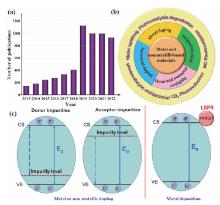
Fig 1
The number of publications on Bi-based photocatalysts from 2013 to 2022 (data acquired from Web of Science on 2023 March 31 for "Bismuth" and "photocatalysis" topics) (a); illustration for the metal and nonmetal modifications of Bi-based photocatalysts and applications (b); schematic illustration of the metal or nonmetal modified Bi-based photocatalysts (c)."
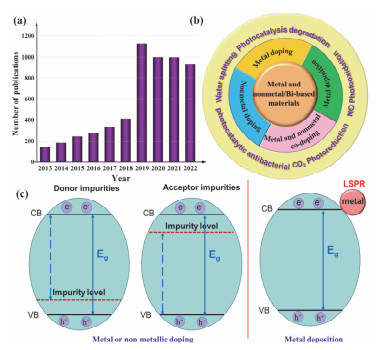
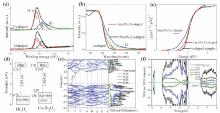
Fig 2
High-resolution XPS spectrum of O 2p for Cs-doped or undoped α-Bi2O3 (a); UV-Vis optical absorption spectra (b) and the plot of (ahν)1/2 vs. hν of undoped, 1 mol% and 5 mol% Cs-doped α-Bi2O3 (c); the schematic illustration of energy band structures of pristine and Cs doping α-Bi2O3 (d); the calculated electronic structure, projected density of states (PDOS) and total density of states (TDOS) of pristine α-Bi2O3 based on Heyd, Scuseria, and Ernzerhof 06 calculations (e); TDOS and PDOS of Cs doping α-Bi2O3 with oxygen vacancies (Fermi energy is set to zero) (f). (a–d) Adapted with permission from Ref. 31, Copyright 2019 Elsevier. (e–f) Adapted with permission from Ref. 34, Copyright 2020 Elsevier."
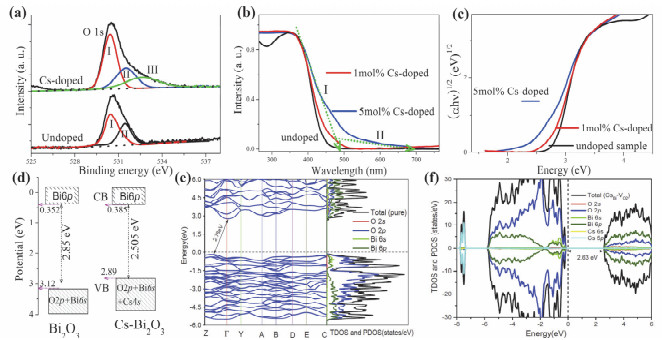
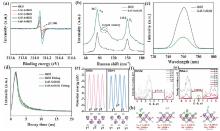
Fig 3
EPR spectra of Sr-doped or undoped BiOI photocatalysts (a); Raman spectra (b), Photoluminescence spectra (c) and Fluorescence decay spectra (d) of BiOI and 0.45 g of Sr doping BiOI; Electrostatic potential distribution of pure BiOBr and Ba-doped BiOBr (light-green, purple, and red spheres stand for Br, Bi and O, respectively) (e); Projected density of state of pure BiOBr (f) and Ba-doped BiOBr (g); Optimized oxygen and water adsorption capacity and charge density difference of BiOBr and Ba-doped BiOBr (green sphere stands for Ba) (h). Color online. (a–d) Adapted with permission from Ref. 36, Copyright 2021 Elsevier. (e–h) Adapted with permission from Ref. 39, Copyright 2021 American Chemical Society."
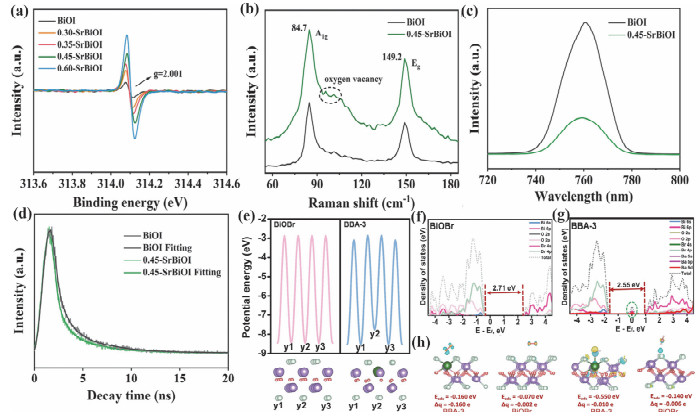
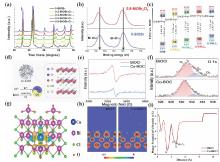
Fig 4
XRD patterns of Co2+-doped BiOBrxCl1−x photocatalysts (a); high-resolution XPS spectrum of Bi 4f for Co-doped or undoped BiOBr (b); band structures of the pure and doped samples (c); schematic of Co2+-doped BOCl and synergistic effect of Co doping and OVs (d); ESR spectra (e) and high-resolution O 1s XPS spectra (f) of Co-doped BiOCl and pristine BiOCl; Charge difference distribution of Cu2+ ions doped BiOCl (g), yellow and cyan stand for depletion and charge accumulation, respectively; electronic location function analysis (h) and electrostatic potential (i) of pristine BiOCl and Cu-doped BiOCl. Color online. (a–c) Adapted with permission from Ref. 52, Copyright 2021 Elsevier. (d–f) Adapted with permission from Ref. 54, Copyright 2022 Elsevier. (g–i) Adapted with permission from Ref. 22, Copyright 2022 Elsevier."
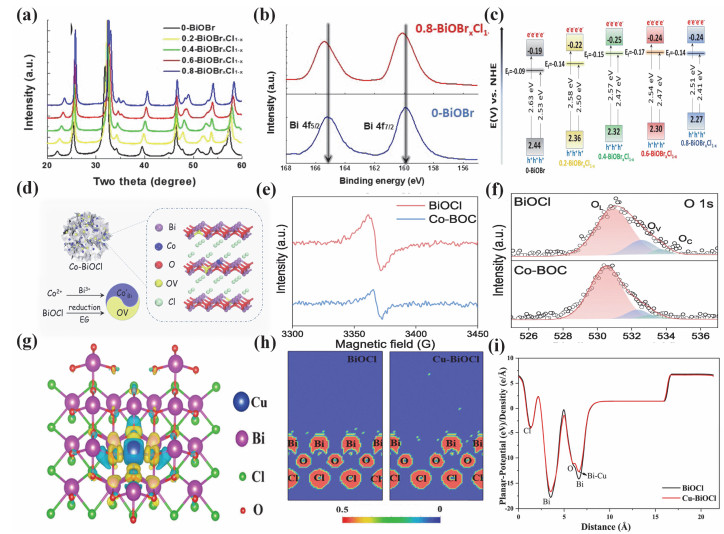
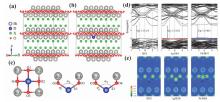
Fig 5
Pristine (a) and D-doped (D = Ag, Pd) (b) BiOX (X = F, Cl, Br, I) model; the structure diagram around impurity atom D (a1 and a2 represent the bond angle for O1―Ag―O3 and O2―Ag―O4, respectively; d1, d2, d3, and d4 stand for the bond length for O1―Ag, O3―Ag, O2―Ag and O4―Ag, respectively) (c); the band structures (d) and the charge density (e) of pure and D-modified BiOI. (a–e) Adapted with permission from Ref.71, Copyright 2019 Elsevier."
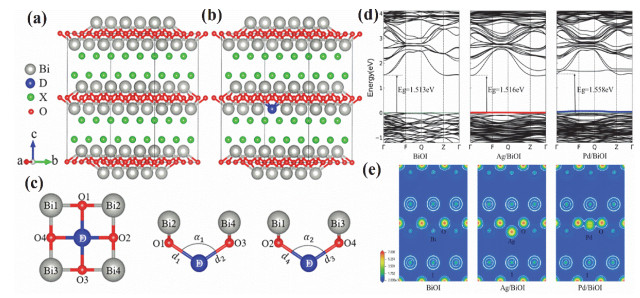
Fig 6
Theoretical electronic band structure models of pristine and lanthanide ions (Sm, Nd, Pr, Yb and Tb)-doped Bi2MoO6 (a); The DFT-simulated band structure and the density of states of pristine BiOBr and Er-doped BiOBr crystals (b); UV-Vis diffuse reflection spectra and Tauc plots of pristine BiVO4 and different amount of europium doping BiVO4 (c); PL spectra (d) and Raman spectra (e) of BiVO4 and different amount of europium doping BiVO4; UV-Vis diffuse reflection spectra and relevant Kubelka-Munk plot (inset) of Er/Yb-doped Bi2MoO6 (f); Upconversion emission spectra of Er/Yb-doped Bi2MoO6 photocatalysts (g). (a) Adapted with permission from Ref. 77, Copyright 2015 Elsevier. (b) Adapted with permission from Ref. 79, Copyright 2020 Elsevier. (c–e) Adapted with permission from Ref. 85, Copyright 2022 Elsevier. (f–g) Adapted with permission from Ref. 95, Copyright 2014 Elsevier."
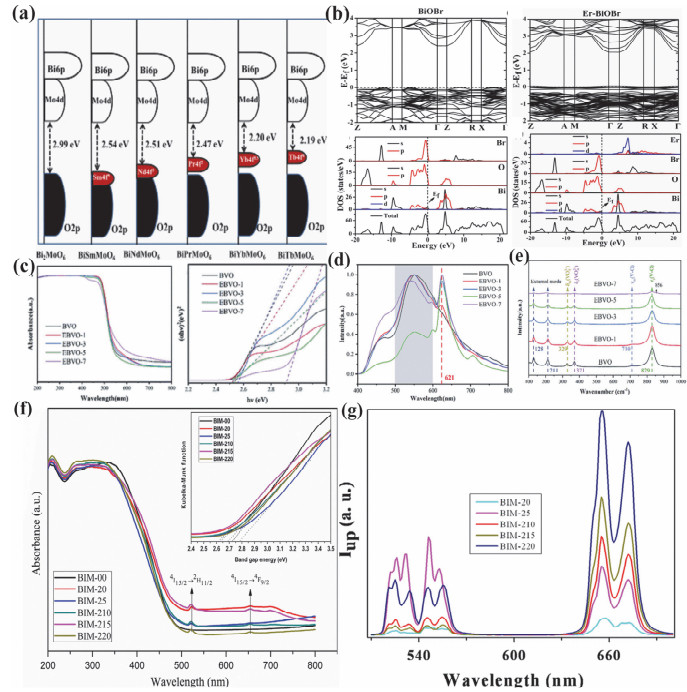
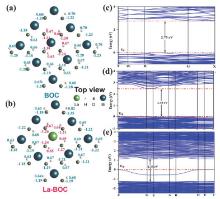
Fig 7
Charge distribution of La, O, H and Bi atoms for pristine Bi2O2CO3 (a) and La-doped Bi2O2CO3 (b); Band structures of pristine Bi5O7I (c), La-doped Bi5O7I (d) and La-doped Bi5O7I with oxygen vacancies (e). (a, b) Adapted with permission from Ref. 104, Copyright 2020 Elsevier. (c–e) Adapted with permission from Ref. 105, Copyright 2019 Elsevier."
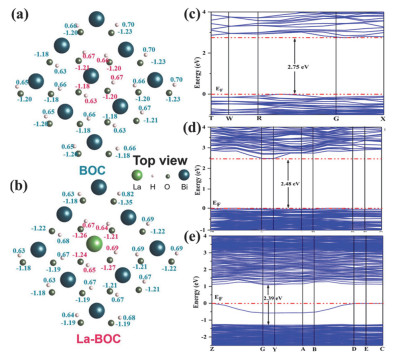
Table 1
Metal doping and their photocatalytic performance."
| Types of metal doping | Dopants | Ionic radius Bi (1.03 Å) | Pristine materials | Light source | Application | Enhanced photocatalytic Activity/pristine | Ref. |
| Alkali metals | Na | 1.02 Å | α-Bi2O3 | λ > 420 nm | RhB degradation | 0.0245 min−1/0.0081 min−1 | |
| Cs | 1.74 Å | α-Bi2O3 | λ > 420 nm | MB degradation | 0.0765 min−1/0.0125 min−1 | ||
| Sr | 1.12 Å | BiOI | λ > 420 nm | Indomethacin degradation | 0.0574 min−1/0.0053 min−1 | ||
| Ba | 1.35 Å | BiOBr | λ ≥ 420 nm | NO oxidation | 53%/10% (5 min) | ||
| Ba | BiFeO3 | Natural sunlight | RhB degradation | 86%/57% (6 h) | |||
| Transition metals | Ti | 0.6 Å | β-Bi2O3 | λ > 420 nm | Pentachlorophenol reduction | 99.6% within 60 min | |
| Ti | BiOI | λ ≥ 400 nm | Diclofenac sodium salt degradation | 0.0483 min−1/0.004 min−1 | |||
| Mn | 0.83 Å | BiOCl | Visible light | Nile blue degradation | 0.36 min−1/0.02 min−1 | ||
| Fe | 0.64 Å | Bi2MoO6 | λ > 420 nm | RhB degradation | 92.4%/66.3% (90 min) | ||
| Fe | δ-Bi2O3 | UV light | Paracetamol degradation | − | |||
| Fe | BiOCl | λ ≥ 400 nm | Cr reduction RhB degradation | 0.061 min−1/0.012 min−1 0.077 min−1/0.019 min−1 | |||
| Co | 0.65 Å | BiOBr | λ > 400 nm | RhB degradation MB degradation | 99.5%/34% (120 min) 98.9%/50.6% (150 min) | ||
| Co | BiOBrxCl1−x | Visible light | RhB degradation E. coli bacteria inactivation | 0.024 min−1/0.0096 min−1; – | |||
| Co | BiOCl | λ > 420 nm | RhB degradation Norfloxacin (NOR) degradation Cr reduction | 98.9%/69.3% (5 min) 82.3%/48.1% (7 min) 81.5%/62.7% (7 min) | |||
| Co | BiOCl | λ > 420 nm | Bisphenol A (BPA) degradation | 95%/20% (120 min) | |||
| Cu | 0.73 Å | BiOCl | 400 nm ≤ λ ≤ 800 nm | RhB degradation | 99.1%/68.6% (120 min) | ||
| Cu | Bi2Se3 | Sunlight | MB degradation malachite green (MG) degradation | 0.123 min−1/0.043 min−1 0.151 min−1/0.041 min−1 | |||
| Cu | BiOBr | λ > 420 nm | NOR degradation | 0.64 min−1/0.28 min−1 | |||
| Zn | 0.74 Å | BiOCl | λ > 420 nm | RhB degradation | 0.46019 min−1/0.17055 min−1 | ||
| Mo | 0.62 Å | BiVO4 | Sunlight | Water splitting | – | ||
| Ag | 1 Å | Bi2WO6 | Visible light | RhB degradation | 94%/50% (120 min) | ||
| Ag | BiOI | Daylight | MB degradation | 96.8%/81.89% (100 min) | |||
| Au | 0.84 Å | Bi2MoO6 | Visible light | RhB degradation | 0.0107 min−1/0.00193 min−1 | ||
| Pd | 0.64 Å | Bi2MoO6 | Visible light | RhB degradation | 97.12%/38.36% (240 min) | ||
| Rare earth metals | La | 1.03 Å | Bi2O3CO3 | λ > 420 nm | NO oxidation | 49.8%/15.2% (30 min) | |
| La | BiOCl | Visible light | RhB degradation Cr reduction | 94.7%/45.2% (18 min) 94.3%/7.1% (120 min) | |||
| La Sm | 1.03 Å 0.96 Å | Bi5O7I | λ ≥ 420 nm | Tetracycline (TC) degradation RhB degradation | 100%/50% (40 min) 93%/0 (40 min) | ||
| Ce | 1.20 Å | BiPO4 | UV light | MB degradation | 90%/− (120 min) | ||
| Ce | BiOBr | 380 nm ≤ λ ≤ 780 nm | RhB degradation | 99.22%/71.04% (40 min) | |||
| Pr | 0.99 Å | α-Bi2O3 | λ > 420 nm | RhB degradation 2, 4-dichlorophenol degradation | 70.8%/48.7% (120 min) 81.8%/42.8% (120 min) | ||
| Sm | 0.96 Å | BiFeO3 | λ ≥ 420 nm | Methyl orange (MO) degradation | 86.9%/58.8% (120 min) | ||
| Eu | 0.95 Å | BiVO4 | Visible light | MB degradation RhB degradation | 90.1%/60.8% (90 min) 60.1%/40.5% (90 min) | ||
| Eu | Bi2O3 | λ > 420 nm | RhB degradation | − | |||
| Gd | 0.94 Å | Bi2Fe4O9 | Visible light | MB degradation | 77%/50% (80 min) | ||
| Gd | β-Bi2O3 | λ > 400 nm | MO degradation RhB degradation Phenol degradation | 993.%/70.1% (28 min) 98.2%/29.8% (120 min) 97.2%/72.3% (195 min) | |||
| Rare earth metals | Er | 0.89 Å | BiOBr | Visible light | RhB degradation | 92.7%/59.3% (100 min) | |
| Er | BiOI0.5Cl0.5 | λ > 420 nm | Acid Red1 degradation | 0.0909 min−1/0.0513 min−1 | |||
| Er Yb | 0.89 Å 0.98 Å | Bi2MoO6 | Solar light | RhB degradation | – | ||
| Gd Er Lu | 0.94 Å 0.89 Å 0.86 Å | Bi2MoO6 | λ > 420 nm | TC degradation RhB degradation 4-Chlorophenol degradation | − | ||
| Self-doping | Bi vacancies | Bi2WO6 | λ > 420 nm | Water splitting | 100.13 μmol∙g −1∙h−1/ 38.01 μmol∙g −1∙h−1 | ||
| Bi vacancies | BiOBr | Solar light | CO2 reduction | 20.1 μmol∙g −1∙h−1/5.3 μmol∙g −1∙h−1 |
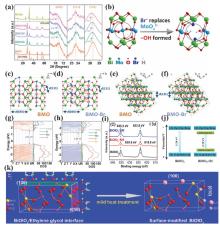
Fig 8
XRD patterns of Br doped or undoped Bi2MoO6 (a); the microstructure of Br-doped Bi2MoO6 (denoted as BMO-Br) (b); the optimized crystal structures of Br-doped Bi2MoO6 (d, f) and pristine Bi2MoO6 (c, e); Energy bands and total density of states for pristine Bi2MoO6 (g) and BMO-Br (h); high resolution XPS spectra of I 3d for BiOIO3 and samples calcined at 0, 125 and 300 ℃ (denoted as BiOIO3, BiOIO3-125 and BiOIO3-300) (i); band structure of BiOIO3 and BiOIO3-125 (j); schematic illustration of I-doped BiOIO3 with oxygen vacancies (k). (a–h) Adapted with permission from Ref. 23, Copyright 2022 Elsevier. (i–k) Adapted with permission from Ref. 122, Copyright 2019 Elsevier."
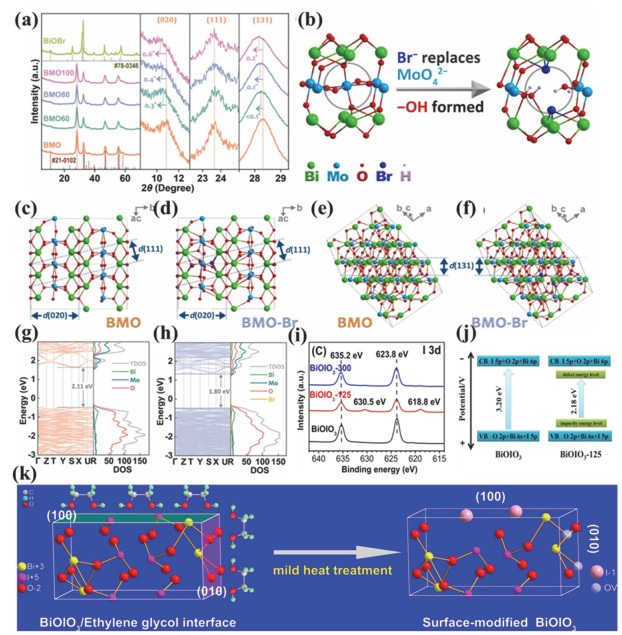
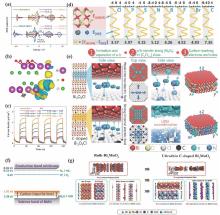
Fig 9
Total and partial density of states for pristine BiOCl and P-doped BiOCl photoctalysts (a); Charge distribution of Bi, O and Cl atoms for P-doped BiOCl (blue and yellow represent charge accumulation and depletion, respectively) (b); transient photocurrent density during on-off cycling of pure BiOCl and P-doped BiOCl samples (c); Electrostatic potential spectra of nonmetal (Cl, P, S, N, B, F, Br, C) doped Bi3O4Cl (d); Schematic diagram of photo-generated carrier separation and migration in pristine Bi3O4Cl and C doped Bi3O4Cl (e); Band structure of C-doped Bi2MoO6 (f); Charge transfer schemes for pristine Bi2MoO6 and C-doped Bi2MoO6 (g). (a–c) Adapted with permission from Ref. 126, Copyright 2022 Elsevier. (d, e) Adapted with permission from Ref. 134, Copyright 2016 Wiley. (f, g) Adapted with permission from Ref. 135, Copyright 2017 Wiley."
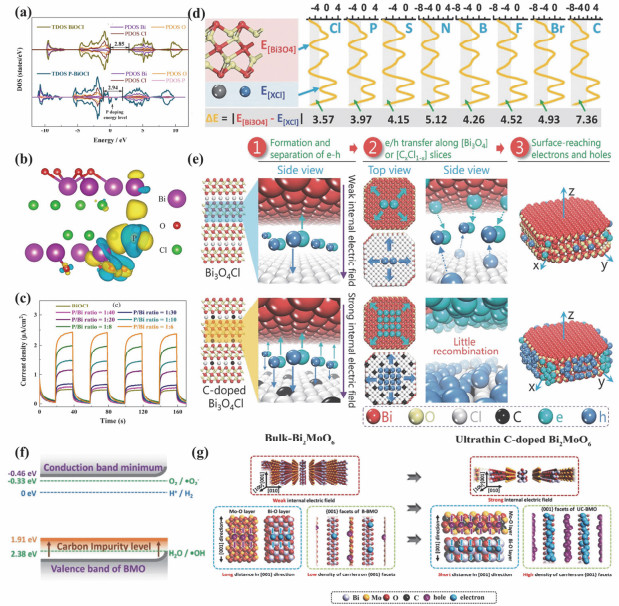
Table 2
Nonmetal doping and their photocatalytic performance."
| Types of nonmetal doping | Dopants | Ionic radius | Pristine materials | Light source | Application | Enhanced photocatalytic Activity/pristine | Ref. |
| Halogen | Cl | 1.8 Å (Cl)/ 1.4 Å (O) | BiOI | λ > 420 nm | MB degradation | 0.01203 min−1/0.00148 min−1 | |
| Cl | Bi2O2CO3 | Sunlight | RhB degradation | 0.1679 min−1/0.0708 min−1 | |||
| Br | 1.9 Å | BiOCOOH | λ > 420 nm | NO oxidation | 37.8%/almost no activity | ||
| Br | Bi2MoO6 | λ ≥ 420 nm | N2 reduction | 1.60 μmol∙h−1/0.68 μmol∙h−1 | |||
| I | 2.20 Å | Bi12O17Cl2 | λ > 420 nm | MO degradation | 96.1%/33.7% (60 min) | ||
| I | BiOIO3 | λ > 420 nm | Bisphenol AF degradation Bisphenol A (BPA) degradation | 0.02787 min−1/0.00002 min−1 0.06764 min−1/0.00004 min−1 | |||
| I | Bi2O2CO3 | λ > 400 nm | MO degradation | About 20%/13.0% (35 min) | |||
| I | BiOIO3 | λ > 420 nm | Propylparaben degradation | 97.2%/barely change (60 min) | |||
| I | Bi2GdO4Cl | λ ≥ 420 nm | Water splitting | 14.8 μmol∙h−1/3.4 μmol∙h−1 | |||
| Cl, Br, I | Bi2O2(OH)(NO3) | Solar irradiation | CO2 reduction | 8.12 µmol∙g−1∙h−1 (Br)/ 0.11 µmol∙g−1∙h−1 | |||
| I | Bi4Ti3O12 | Solar irradiation | CO2 reduction | 10.8 µmol∙g−1∙h−1 (Br)/ 1.7 µmol∙g−1∙h−1 | |||
| Cl, Br, I | Bi2MoO6 | Solar irradiation | N2 reduction | 10.56 µmol∙g−1∙h−1 (I)/ 3.00 µmol∙g−1∙h−1 | |||
| Non halogen | B | 0.27 Å | Bi3O4Cl | 420 nm ≤ λ ≤ 800 nm | Ciprofloxacin degradation | 91.2 %/barely change (12 h) | |
| C | 0.16 Å | BiOCl | λ > 420 nm | NO oxidation | 40.6%/5.4% (5 min) | ||
| C | Bi3O4Cl | λ ≥ 420 nm | Water splitting | 80%/0.6% | |||
| C | Bi2MoO6 | Visible light | NO oxidation | 60.0%/29.9% (230 min) | |||
| C | BiOI | Sunlight Visible light | N2 reduction MO degraddation | 311 µmol∙L−1∙g−1∙h−1/83.6 µmol∙L−1∙g−1∙h−1 0.136 min−1/0.025 min−1 | |||
| N | 1.71 Å (N3−) | Bi2WO6 | λ > 290 nm | RhB degradation | 90%/30%–45% (60 min) | ||
| Si | 0.42 Å | Bi2O2CO3 | Visible light | RhB degradation MO degradation MB degradation | 50%/− 10%/− 80%/− | ||
| P | 0.34 Å | BiOx | Visible light | Cr degradation RhB degradation | 84%/67% (180 min) 96%/81% (120 min) | ||
| P | BiOCl | λ > 420 nm | TC degradation | 81.0%/29.1% (30 min) |
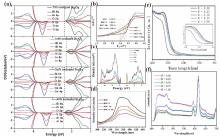
Fig 10
TDOS for Ti-N, In-N, Ga-N and Al-N co-doped β-Bi2O3 (a). UV-Vis diffuse reflectance spectra (DRS) (b) and photoluminescence spectra (d) of pristine BiOCl and S-Mo co-doped BiOCl samples; DOS for S-Mo co-doped BiOCl photocatalysts (c); DRS (e) and PL spectra (f) of Eu-F co-doped BiVO4 with different amounts. (a) Adapted with permission from Ref. 137, Copyright 2014 Elsevier. (b–d) Adapted with permission from Ref. 140, Copyright 2023 Elsevier. (e, f) Adapted with permission from Ref. 147, Copyright 2022 Elsevier."
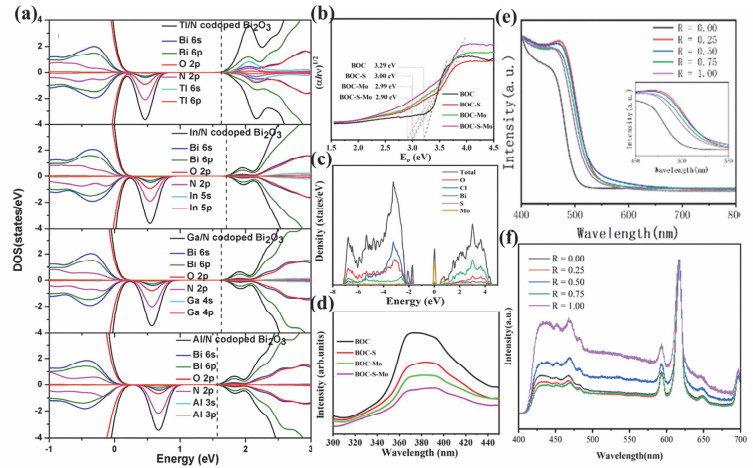
Table 3
Metal and nonmetal co-doping and their photocatalytic performance."
| Dopants | Pristine materials | Light source | Application | Enhanced photocatalytic Activity/pristine | Ref. |
| Ni and F | α-Bi2O3 | λ > 420 nm | RhB degradation | 0.0215 min−1/0.0071 min−1 | |
| In and S | BiOCl | λ > 420 nm | TC degradation | 81%/53.2% (120 min) | |
| La and B | BiVO4 | λ > 420 nm | MO degradation | 0.030 min−1/0.004 min−1 | |
| Mo and S | BiOCl | λ ≥ 420 nm | RhB degradation TC-HCl degradation | 97.24%/20.4% (60 min) 0.0059 min−1/0.0005 min−1 | |
| Ti and N | TiO2/Bi2WO6 | UV light | MB degradation | 98%/65% (50 min) | |
| Te and V | δ-Bi2O3 | λ > 420 nm | RhB degradation | 0.0212 min−1/0.0097 min−1 | |
| Te and Ti | Bi3Nb17O47 | λ > 420 nm | RhB degradation | 95%/Greater than 35% (240 min) | |
| Sn and C | bismuth titanate | Sunlight | MG degradation | 90%/− | |
| Eu and F | BiVO4 | Visible light | MB degradation | 0.025 min−1/0.01594 min−1 | |
| Ag and C | Bi2WO6 | λ > 420 nm | MB degradation | 95.1%/56.2% (3 h) |
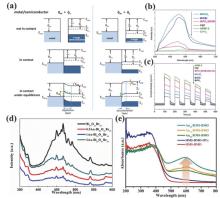
Fig 11
Mechanism diagram of Schottky barrier formed between metal (light blue) and n-type semiconductor (dark blue), Evac, Ec and Ev stand for the energy of vacuum, conduction band minimum and valence band maximum, respectively; ϕm and ϕs are work function of metal and semiconductor, respectively (a); The photoluminescence spectra (b) and transient photocurrent density during on-off cycling (c) of different samples; PL spectra (d) of the obtained samples; UV-Vis DRS (e) of Bi2MoO6 with OVs (denoted as HMS-BMO), Bi2MoO6 with abundant OVs (named HMS-BMO-OVs) and Au/HMS-BMO samples. (a) Adapted with permission from Ref. 151, Copyright 2012 American Chemical Society. (b, c) Adapted with permission from Ref. 152, Copyright 2022 Elsevier. (d) Adapted with permission from Ref. 154, Copyright 2019 Elsevier. (e) Adapted with permission from Ref. 160, Copyright 2022 Elsevier."
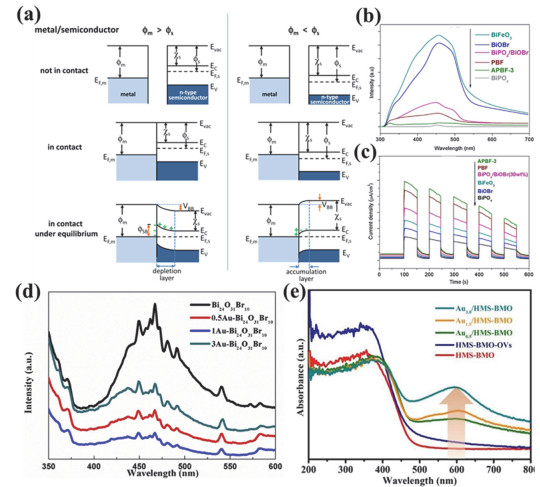
Table 4
Metal deposition and their photocatalytic performance."
| Deposition | Pristine materials | Light source | Application | Enhanced photocatalytic Activity/pristine | Ref. |
| Au Pd | BiVO4 | λ > 420 nm | O2 reduction | 1.37 mmol∙L−1/9.88 μmol∙L−1 | |
| Au | BiOX (X = Cl, Br) | λ > 420 nm | RhB degradation | 92%/85% (60 min) | |
| Au | Bi2MoO6 | λ > 420 nm | CO2 reduction | 37.6 μmol∙g−1∙L−1/1.3 μmol∙g−1∙L−1 | |
| Au | BiOI | Visible light | Oxytetracycline degradation | Almost no change | |
| Ag | BiPO4/BiOBr/BiFeO3 | UV light Visible light NIR light | Norfloxacin degradation | 99.1%/85.6% (45 min) 98.3%/− (90 min) 30.2%/− (120 min) | |
| Ag | BiVO4 | λ = 470 nm | 2, 4-Dichlorophenoxyacetic degradation | 90%/40% (240 min) | |
| Ag | Bi2O2CO3 | λ > 420 nm | NO oxidation | 54%/22% (35 min) | |
| Au | Bi24O31Br10 | Sunlight | MO degradation | 91%/55% (120 min) | |
| Pt or Pd or Ag | BiVO4 | Visible light | BPA degradation | 0.028 min−1 or 0.013 min−1 or 0.005 min−1 | |
| Pt | Bi2MoO6 | λ > 420 nm | 2, 4-dibromophenol degradation | 3.86%/1.32% (quantum efficiency) | |
| Ag | RGO/Bi2MoO6 | 310 nm < λ < 800 nm | Phenol degradation | 97.5%/26.5% (300 min) |
| 1 |
doi: 10.1016/j.cej.2020.127877 |
| 2 |
doi: 10.1016/j.cej.2022.137757 |
| 3 |
doi: 10.1039/D1NR05797A |
| 4 |
doi: 10.1016/j.apcatb.2021.121039 |
| 5 |
doi: 10.1016/j.jhazmat.2021.125217 |
| 6 |
doi: 10.1002/adma.202005256 |
| 7 |
doi: 10.1016/j.cclet.2022.05.037 |
| 8 |
doi: 10.1002/sstr.202200188 |
| 9 |
胡程; 黄洪伟. 物理化学学报, 2023, 39, 2212048.
doi: 10.3866/PKU.WHXB202212048 |
|
|
|
| 10 |
doi: 10.1016/j.chemosphere.2023.138599 |
| 11 |
doi: 10.1016/j.cej.2021.134104 |
| 12 |
doi: 10.1016/j.apsusc.2021.149970 |
| 13 |
doi: 10.1039/D1NR03187B |
| 14 |
doi: 10.1080/01614940.2022.2057044 |
| 15 |
doi: 10.1016/j.envres.2021.111843 |
| 16 |
doi: 10.1016/j.cej.2023.142694 |
| 17 |
doi: 10.1016/j.cej.2023.141271 |
| 18 |
doi: 10.1016/j.cej.2022.140157 |
| 19 |
doi: 10.1016/j.cej.2022.139456 |
| 20 |
doi: 10.1016/j.cej.2022.139819 |
| 21 |
doi: 10.1039/D2TA08812F |
| 22 |
doi: 10.1016/j.jhazmat.2021.127554 |
| 23 |
doi: 10.1016/j.apcatb.2022.121319 |
| 24 |
doi: 10.1002/smll.201901008 |
| 25 |
doi: 10.1016/j.jenvman.2017.04.099 |
| 26 |
doi: 10.1016/j.apcatb.2017.06.003 |
| 27 |
doi: 10.1016/j.jallcom.2021.160391 |
| 28 |
doi: 10.1002/aenm.201800980 |
| 29 |
doi: 10.1039/C7TA00315C |
| 30 |
doi: 10.1002/cctc.201000314 |
| 31 |
doi: 10.1016/j.apsusc.2018.12.165 |
| 32 |
doi: 10.1007/s12274-018-2404-x |
| 33 |
doi: 10.1016/j.apcatb.2022.121879 |
| 34 |
doi: 10.1016/j.jpcs.2020.109581 |
| 35 |
doi: 10.1016/j.jtice.2018.11.029 |
| 36 |
doi: 10.1016/j.jhazmat.2021.125147 |
| 37 |
doi: 10.1007/s12274-021-3431-y |
| 38 |
doi: 10.1021/jacs.8b02200 |
| 39 |
doi: 10.1021/acs.jpcc.1c00772 |
| 40 |
doi: 10.1016/j.apcatb.2014.07.053 |
| 41 |
doi: 10.3390/ma15030961 |
| 42 |
doi: 10.1080/02726351.2019.1570991 |
| 43 |
doi: 10.1016/j.electacta.2019.135171 |
| 44 |
doi: 10.1016/j.catcom.2008.11.041 |
| 45 |
doi: 10.1016/j.molcata.2004.08.043 |
| 46 |
doi: 10.1016/S1010-6030[98]00452-3 |
| 47 |
doi: 10.1016/j.jhazmat.2018.12.070 |
| 48 |
doi: 10.1016/j.cplett.2020.137729 |
| 49 |
doi: 10.1021/es101006s |
| 50 |
doi: 10.1016/j.molliq.2018.11.119 |
| 51 |
doi: 10.1007/s10854-019-01869-x |
| 52 |
doi: 10.1016/j.jhazmat.2020.123457 |
| 53 |
doi: 10.1016/j.apcatb.2017.09.036 |
| 54 |
doi: 10.1016/j.seppur.2022.121953 |
| 55 |
doi: 10.1016/j.jallcom.2015.03.103 |
| 56 |
doi: 10.1016/S1872-2067[18]63056-6 |
| 57 |
doi: 10.1016/j.apcatb.2021.119911 |
| 58 |
doi: 10.1016/j.cej.2020.126012 |
| 59 |
doi: 10.1016/j.cplett.2018.05.053 |
| 60 |
doi: 10.1002/anie.201705628 |
| 61 |
doi: 10.1016/j.ceramint.2022.07.203 |
| 62 |
doi: 10.1016/j.chemosphere.2020.127616 |
| 63 |
doi: 10.1021/acsanm.0c03042 |
| 64 |
doi: 10.1016/j.ceramint.2020.10.165 |
| 65 |
doi: 10.1016/j.apt.2019.02.012 |
| 66 |
doi: 10.1007/s10853-017-1865-0 |
| 67 |
doi: 10.18178/ijmmm.2018.6.3.383 |
| 68 |
doi: 10.1007/s41779-021-00665-3 |
| 69 |
doi: 10.1007/s41779-022-00765-8 |
| 70 |
doi: 10.1016/j.jallcom.2020.153914 |
| 71 |
doi: 10.3390/catal9020198 |
| 72 |
doi: 10.1016/j.apcatb.2023.122462 |
| 73 |
doi: 10.1039/D1NA00223F |
| 74 |
doi: 10.1016/j.apsusc.2018.11.098 |
| 75 |
doi: 10.1039/C9TC00215D |
| 76 |
doi: 10.1016/j.jcis.2021.12.197 |
| 77 |
doi: 10.1016/j.materresbull.2015.04.025 |
| 78 |
doi: 10.1016/0925-8388[96]02293-1 |
| 79 |
doi: 10.1007/s10853-020-04802-4 |
| 80 |
doi: 10.1007/s12274-022-4344-0 |
| 81 |
doi: 10.1002/adfm.201802685 |
| 82 |
doi: 10.1039/D1NR05691C |
| 83 |
doi: 10.1039/D0TA09729B |
| 84 |
doi: 10.1021/acscatal.3c00444 |
| 85 |
doi: 10.1039/D1QI01623G |
| 86 |
doi: 10.1016/j.jallcom.2016.10.146 |
| 87 |
doi: 10.1016/j.solener.2019.02.046 |
| 88 |
doi: 10.1016/j.apsusc.2015.05.137 |
| 89 |
doi: 10.1016/j.matlet.2021.129960 |
| 90 |
doi: 10.1016/j.jlumin.2019.116970 |
| 91 |
doi: 10.1111/ijac.13600 |
| 92 |
doi: 10.1016/j.materresbull.2019.04.019 |
| 93 |
doi: 10.1016/j.mseb.2017.03.005 |
| 94 |
doi: 10.1002/jctb.4034 |
| 95 |
doi: 10.1016/j.jssc.2013.10.028 |
| 96 |
doi: 10.1016/j.apcatb.2017.06.015 |
| 97 |
doi: 10.1016/j.molcata.2014.05.029 |
| 98 |
doi: 10.1016/j.apsusc.2018.08.254 |
| 99 |
doi: 10.1016/j.chemosphere.2022.137540 |
| 100 |
doi: 10.1016/j.apsusc.2018.07.051 |
| 101 |
doi: 10.1016/j.jallcom.2016.03.124 |
| 102 |
doi: 10.1007/s12666-016-0897-5 |
| 103 |
doi: 10.1016/j.apcatb.2018.09.078 |
| 104 |
doi: 10.1016/j.jhazmat.2020.123174 |
| 105 |
doi: 10.1021/acsami.9b14300 |
| 106 |
doi: 10.1039/C7CC02890C |
| 107 |
doi: 10.1016/j.apcatb.2018.06.066 |
| 108 |
doi: 10.1021/acsami.9b08109 |
| 109 |
doi: 10.1016/S1872-2067[15]61054-3 |
| 110 |
doi: 10.1016/j.rser.2005.01.009 |
| 111 |
doi: 10.1002/adma.201900546 |
| 112 |
doi: 10.3390/molecules201019189 |
| 113 |
doi: 10.1016/j.materresbull.2018.12.023 |
| 114 |
doi: 10.1016/j.apsusc.2017.04.101 |
| 115 |
doi: 10.1016/j.jiec.2019.06.022 |
| 116 |
doi: 10.1002/chem.202202004 |
| 117 |
doi: 10.1016/j.cej.2020.126543 |
| 118 |
doi: 10.1002/anie.202106310 |
| 119 |
doi: 10.1021/acs.iecr.6b00847 |
| 120 |
doi: 10.1039/D0QI00673D |
| 121 |
doi: 10.1016/j.jpowsour.2022.231990 |
| 122 |
doi: 10.1016/j.cej.2019.05.057 |
| 123 |
doi: 10.1039/C3NR03597B |
| 124 |
doi: 10.1021/jp0756350 |
| 125 |
doi: 10.1016/j.solener.2020.07.068 |
| 126 |
doi: 10.1016/j.cej.2022.134683 |
| 127 |
doi: 10.1016/j.apcatb.2019.118309 |
| 128 |
doi: 10.1016/j.jhazmat.2022.130364 |
| 129 |
doi: 10.1007/s40195-013-0009-z |
| 130 |
doi: 10.1142/s1793292014500945 |
| 131 |
doi: 10.1016/j.desal.2009.10.011 |
| 132 |
doi: 10.1016/j.jcis.2018.12.101 |
| 133 |
doi: 10.1016/S1872-2067[20]63612-9 |
| 134 |
doi: 10.1002/adma.201600301 |
| 135 |
doi: 10.1002/adfm.201703923 |
| 136 |
doi: 10.1007/s11467-016-0577-2 |
| 137 |
doi: 10.1016/j.cplett.2014.03.091 |
| 138 |
doi: 10.1088/1361-6463/aae633 |
| 139 |
doi: 10.1016/j.matdes.2019.108066 |
| 140 |
doi: 10.1016/j.mtchem.2022.101279 |
| 141 |
doi: 10.1016/j.chemosphere.2023.137742 |
| 142 |
doi: 10.1016/j.ceramint.2019.11.205 |
| 143 |
doi: 10.1016/j.enmm.2019.100228 |
| 144 |
doi: 10.1016/S1002-0721[12]60373-1 |
| 145 |
doi: 10.1016/j.jallcom.2019.153172 |
| 146 |
doi: 10.1016/j.apsusc.2015.01.122 |
| 147 |
doi: 10.1039/d2nj03655j |
| 148 |
doi: 10.1016/j.chemosphere.2018.01.042 |
| 149 |
doi: 10.1016/j.apcatb.2018.06.067 |
| 150 |
doi: 10.1016/j.cej.2022.136429 |
| 151 |
doi: 10.1021/cr3000626 |
| 152 |
doi: 10.1016/j.jhazmat.2018.10.060 |
| 153 |
doi: 10.1016/j.colsurfa.2020.124778 |
| 154 |
doi: 10.1016/j.solidstatesciences.2019.06.010 |
| 155 |
doi: 10.1002/ppsc.201600300 |
| 156 |
doi: 10.1016/j.apcatb.2018.06.016 |
| 157 |
doi: 10.1016/j.apcata.2020.117625 |
| 158 |
doi: 10.1016/j.apcatb.2015.10.024 |
| 159 |
doi: 10.1038/s41467-019-12853-8 |
| 160 |
doi: 10.1016/j.cej.2021.133540 |
| 161 |
doi: 10.1016/j.jphotochem.2019.112163 |
| 162 |
doi: 10.1016/j.jcat.2016.10.006 |
| 163 |
doi: 10.1039/c4dt00427b |
| 164 |
doi: 10.1016/j.optmat.2023.113888 |
| 165 |
doi: 10.1016/j.colsurfa.2020.124946 |
| 166 |
doi: 10.1016/j.cej.2019.123686 |
| 167 |
doi: 10.1016/j.cej.2019.122810 |
| 168 |
doi: 10.1016/j.jece.2022.108693 |
| [1] | Linfeng Xiao, Wanlu Ren, Shishi Shen, Mengshan Chen, Runhua Liao, Yingtang Zhou, Xibao Li. Enhancing Photocatalytic Hydrogen Evolution through Electronic Structure and Wettability Adjustment of ZnIn2S4/Bi2O3 S-Scheme Heterojunction [J]. Acta Phys. -Chim. Sin., 2024, 40(8): 2308036-. |
| [2] | Muhammad Faizan, Guoqi Zhao, Tianxu Zhang, Xiaoyu Wang, Xin He, Lijun Zhang. Elastic and Thermoelectric Properties of Vacancy Ordered Double Perovskites A2BX6: A DFT Study [J]. Acta Phys. -Chim. Sin., 2024, 40(1): 2303004-. |
| [3] | Yaowu Luo, Dingsheng Wang. Enhancing Heterogeneous Catalysis by Electronic Property Regulation of Single Atom Catalysts [J]. Acta Phys. -Chim. Sin., 2023, 39(9): 2212020-0. |
| [4] | Tianmi Tang, Zhenlu Wang, Jingqi Guan. Electronic Structure Regulation of Single-Site M-N-C Electrocatalysts for Carbon Dioxide Reduction [J]. Acta Phys. -Chim. Sin., 2023, 39(4): 2208033-0. |
| [5] | Shuyi Zheng, Jia Wu, Ke Wang, Mengchen Hu, Huan Wen, Shibin Yin. Electronic Modulation of Ni-Mo-O Porous Nanorods by Co Doping for Selective Oxidation of 5-Hydroxymethylfurfural Coupled with Hydrogen Evolution [J]. Acta Phys. -Chim. Sin., 2023, 39(12): 2301032-. |
| [6] | Peng Chen, Ying Zhou, Fan Dong. Advances in Regulation Strategies for Electronic Structure and Performance of Two-Dimensional Photocatalytic Materials [J]. Acta Phys. -Chim. Sin., 2021, 37(8): 2010010-. |
| [7] | Yawen Li, Guangren Na, Shulin Luo, Xin He, Lijun Zhang. Structural, Thermodynamical and Electronic Properties of All-Inorganic Lead Halide Perovskites [J]. Acta Phys. -Chim. Sin., 2021, 37(4): 2007015-. |
| [8] | Tangfei Zheng, Jinxia Jiang, Jian Wang, Sufang Hu, Wei Ding, Zidong Wei. Regulation of Electrocatalysts Based on Confinement-Induced Properties [J]. Acta Phys. -Chim. Sin., 2021, 37(11): 2011027-. |
| [9] | Junjie Shi, Ziqi Hu, Yihao Yang, Yuxiang Bu, Zujin Shi. Stability and Formation Mechanism of Endohedral Metal Carbonitride Clusterfullerenes [J]. Acta Phys. -Chim. Sin., 2021, 37(10): 1907077-. |
| [10] | Yiqing Wang,Shaohua Shen. Progress and Prospects of Non-Metal Doped Graphitic Carbon Nitride for Improved Photocatalytic Performances [J]. Acta Physico-Chimica Sinica, 2020, 36(3): 1905080-. |
| [11] | Fuzhen BI,Xiao ZHENG,Chiyung YAM. First-Principles Study of Mixed Cation Methylammonium-Formamidinium Hybrid Perovskite [J]. Acta Phys. -Chim. Sin., 2019, 35(1): 69-75. |
| [12] | Jinyang XI,Yuma NAKAMURA,Tianqi ZHAO,Dong WANG,Zhigang SHUAI. Theoretical Studies on the Deformation Potential, Electron-Phonon Coupling, and Carrier Transports of Layered Systems [J]. Acta Phys. -Chim. Sin., 2018, 34(9): 961-976. |
| [13] | Yueqi YIN,Mengxu JIANG,Chunguang LIU. DFT Study of POM-Supported Single Atom Catalyst (M1/POM, M = Ni, Pd, Pt, Cu, Ag, Au, POM = [PW12O40]3-) for Activation of Nitrogen Molecules [J]. Acta Phys. -Chim. Sin., 2018, 34(3): 270-277. |
| [14] | Tao JING,Ying DAI. Development of Solid Solution Photocatalytic Materials [J]. Acta Phys. -Chim. Sin., 2017, 33(2): 295-304. |
| [15] | Rui-Fen WANG,Fu-Ming WANG,Jin-Ling SONG,Sheng-Li AN,Xin WANG. Synthesis and Photocatalytic Activities of Rare Earth-Boron Co-Doped Slice Layer TiO2 [J]. Acta Phys. -Chim. Sin., 2016, 32(2): 536-542. |
|
||