

物理化学学报 >> 2023, Vol. 39 >> Issue (11): 2212042.doi: 10.3866/PKU.WHXB202212042
所属专题: 多物理场能源催化转化
万宇彤, 方帆( ), 孙瑞雪, 张杰, 常焜()
收稿日期:2022-12-27
录用日期:2023-02-16
发布日期:2023-03-02
通讯作者:
方帆,常焜
E-mail:fangfan1990@nuaa.edu.cn;changkun@nuaa.edu.cn
基金资助:
Yutong Wan, Fan Fang(), Ruixue Sun, Jie Zhang, Kun Chang()
Received:2022-12-27
Accepted:2023-02-16
Published:2023-03-02
Contact:
Fan Fang, Kun Chang
E-mail:fangfan1990@nuaa.edu.cn;changkun@nuaa.edu.cn
Supported by:摘要:
由于人类经济社会的快速发展,大气中二氧化碳的浓度逐年增加造成了严重的生态环境问题。为了应对气候变化带来的挑战,中国作出了“到2030年达到碳排放峰值,到2060年实现碳中和”的重大承诺。理想情况下,将二氧化碳转化为增值产品或太阳能燃料(如CH4、CO)是一种两全其美的策略,可以同时缓解温室效应和解决能源供需不足的问题。在为上述策略提出的设想中,利用可再生的绿H2生产化学品来减少CO2的方案是首选,它除了实现CO2减排,还可以激发清洁能源的潜力。为了研究这一还原过程,人们设计了许多催化反应,其中光催化是最理想的方案,因为太阳能是清洁和可持续的。在光催化中,光热催化二氧化碳加氢技术因其较高的催化效率和太阳能的广泛利用而成为一种很有前途的CO2转化方案。对光热催化加氢原理目前主要有两种解释:(1)仅以太阳光为能量源,驱动催化剂自身产热从而实现二氧化碳的转化。在这种情况下,反应仍以热催化方式进行。(2)光能与热能相互耦合协同催化反应的发生。因此,根据催化方式的不同,光热催化剂的合理设计和成功合成非常重要。值得关注的是,金属氧化物半导体由于其独特的能带结构和化学性质,高稳定性,环境友好等优点,被广泛应用于光热催化加氢反应的研究。在本文中,我们主要从负载催化剂、微观结构工程、缺陷工程三种不同的催化剂调控策略综述了金属氧化物材料用于光热催化CO2加氢反应的研究进展,特别是近五年的重要研究成果。同时,对这些调制策略的机理进行了总结和介绍,以供进一步理解。本文还介绍了不同类型的光热加氢反应器,以及一些重要参数对催化反应的影响。最后,对金属氧化物催化剂的设计策略提出建议,并对光热减排技术的发展提出展望。
万宇彤, 方帆, 孙瑞雪, 张杰, 常焜. 金属氧化物半导体用于光热催化CO2加氢反应:最新进展和展望[J]. 物理化学学报, 2023, 39(11), 2212042. doi: 10.3866/PKU.WHXB202212042
Yutong Wan, Fan Fang, Ruixue Sun, Jie Zhang, Kun Chang. Metal Oxide Semiconductors for Photothermal Catalytic CO2 Hydrogenation Reactions: Recent Progress and Perspectives[J]. Acta Phys. -Chim. Sin. 2023, 39(11), 2212042. doi: 10.3866/PKU.WHXB202212042
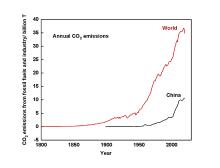
Fig 1
Fossil fuel and industrial carbon dioxide (CO2) emissions; Data from https://ourworldindata.org."
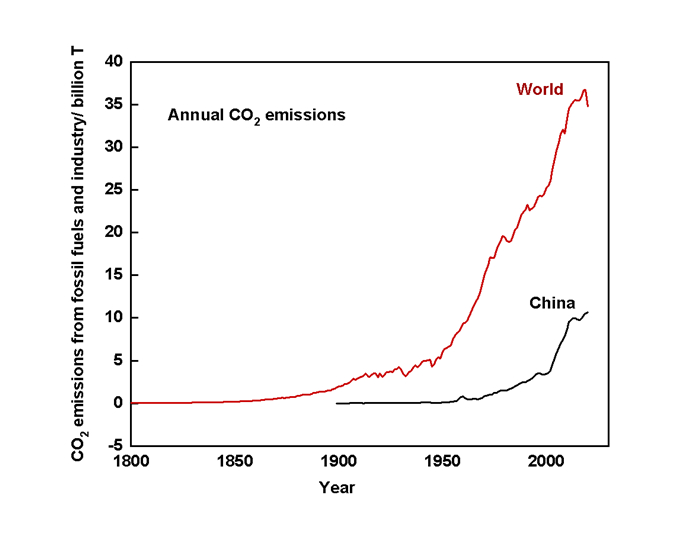
Table 1
The reaction free energy and heat of CO2 hydrogenation reactions."
| Equation | Reaction | ∆G298 KӨ/(kJ∙mol−1) | ∆H298 KӨ/(kJ∙mol−1) |
| 1 | CO2(g) + H2(g) ↔ CO(g) + H2O(g) | 28.6 | 41.2 |
| 2 | CO2(g) + 3H2(g) ↔ CH3OH(g) + H2O(g) | 3.5 | −49.1 |
| 3 | CO2(g) + 4H2(g) ↔ CH4(g) + 2H2O(g) | −113.6 | 165 |
| 4 | CO2(g) + xH2(g) ↔ C2Hx(g) + xH2O(g) | – | – |
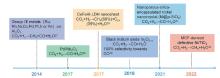
Fig 2
Timeline of significant reported works for photothermal CO2 hydrogenation."
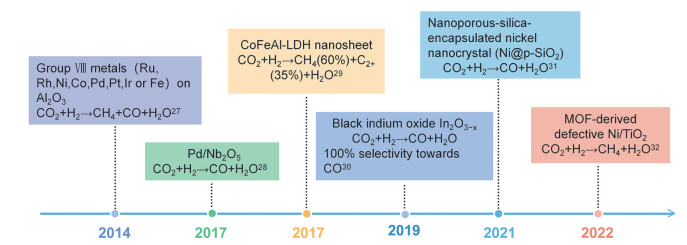
Fig 3
(a) Material of CE-5 sample compared with Apollo-12 sample (No. 12041)13; (b) diagram of extraterrestrial photosynthesis on the moon 34. Copyright 2022, Elsevier."
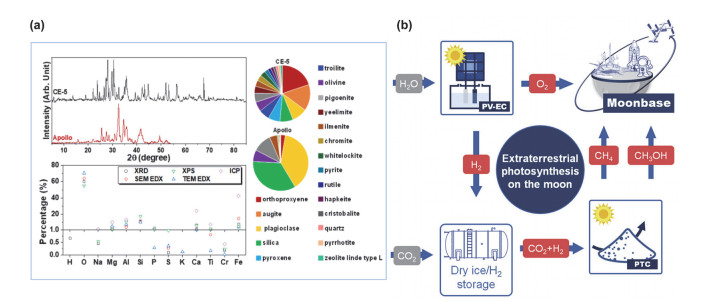
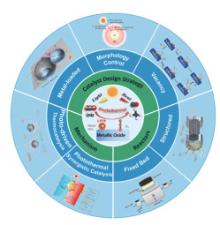
Fig 4
Research advance of metal oxide materials for photothermal catalytic CO2 hydrogenation."
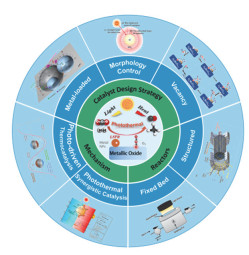
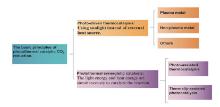
Fig 5
Classification of photothermal catalysis principles."
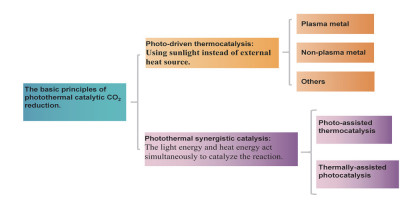
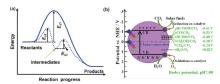
Fig 6
(a) Energy diagram of thermocatalytic reaction process 16; Adapted from Angew. Chem. Int. Ed., Wiley-VCH. (b) Schematic diagram of photocatalytic CO2 conversion mechanism on semiconductor photocatalyst 41; Adapted from Int. J. Hydrog. Energy, American Chemical Society."
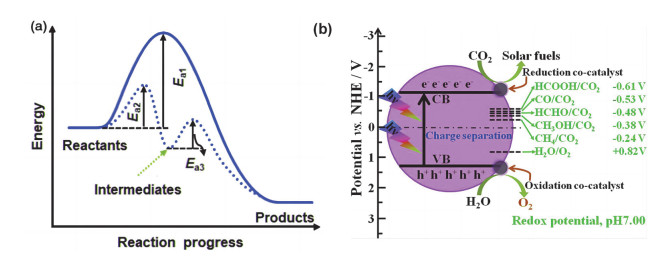
Fig 7
(a) Schematic illustration of the dynamics of an excited plasmonic nanoparticle 42; Adapted from Chem. Soc. Rev., The Royal Society of Chemistry. (b) Non-radiative transitions excited within or between bands produce a large number of high-energy carriers (hot electrons and holes) 16; Adapted from Angew. Chem., Int. Ed., Wiley-VCH. (c) The mechanisms of the photocatalytic reactions with nonplasmonic metal NP photocatalysts 45; Adapted from Chem. Eng. J., Wiley-VCH. (d) Monitoring the temperature of the catalyst bed of the Fe5C2 catalyst being exposed to light 47; Adapted from Angew. Chem, Elsevier."
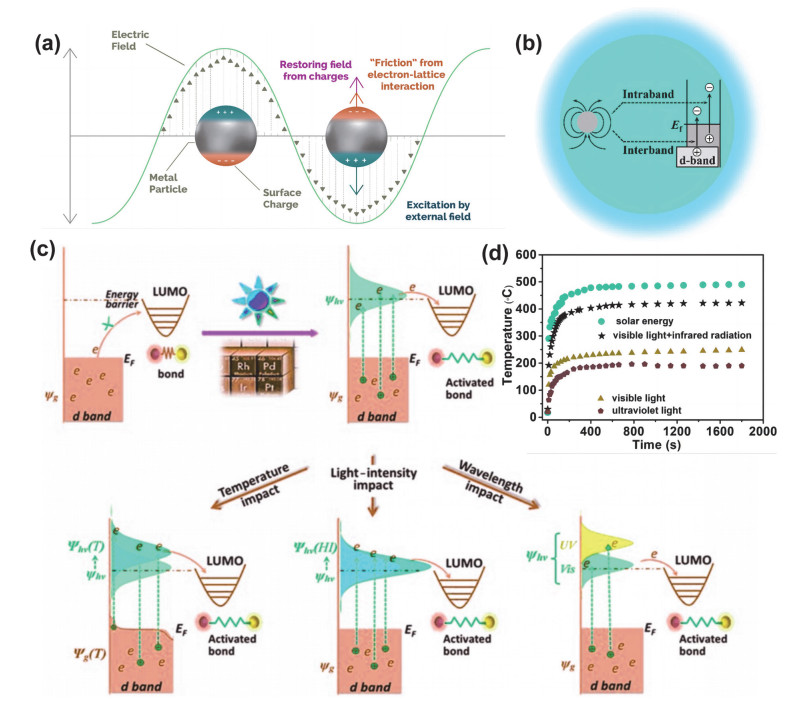
Fig 8
(a) Catalytic performance on Au/CeO2 during different situations; (b) the CO2 conversion and CO selectivity under different conditions; (c) illustration of enhanced the catalytic performance of CO2 hydrogenation in photothermal method on Au/CeO2 51; Adapted from Catal. Commun., Elsevier. (d) Schematic illustration of Ov-TiO2 of the thermally coupled photoconductivity, (RT is room temperature) 55; Adapted from Chin. J. Catal., Elsevier. (e) Effect of different factors during CO2 hydrogenation 52; Adapted from Chin. J. Catal., Elsevier."
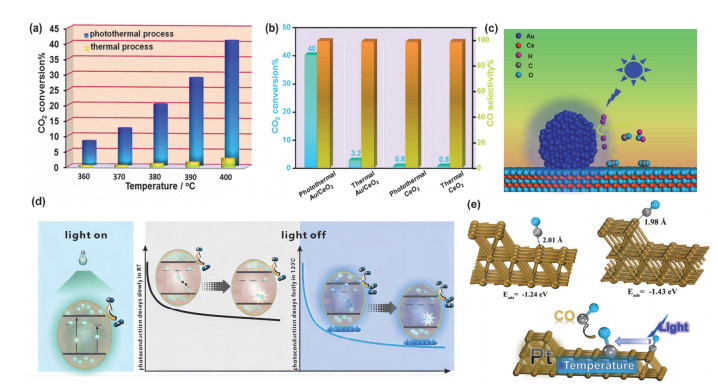
Fig 9
(a) The excellent sunlight-harvesting ability of the Ru/Al2O3 61; Copyright 2019, American Chemical Society. (b) reaction mechanism on a Rh nanocube; (c) Production rates of CH4 and CO on Rh/Al2O3 and Al2O3 at 623 K, (d) production rates of CH4 and CO on Au/Al2O3 at 623 K 64. Copyright 2017, Springer Nature. (e) Pictures of pure Nb2O5 and Pd@Nb2O5; (f) CO production rate and (g) CH4 selectivity on Pd@Nb2O5 under 300 W xenon lamp irradiation 28; Copyright 2017, Wiley-VCH."
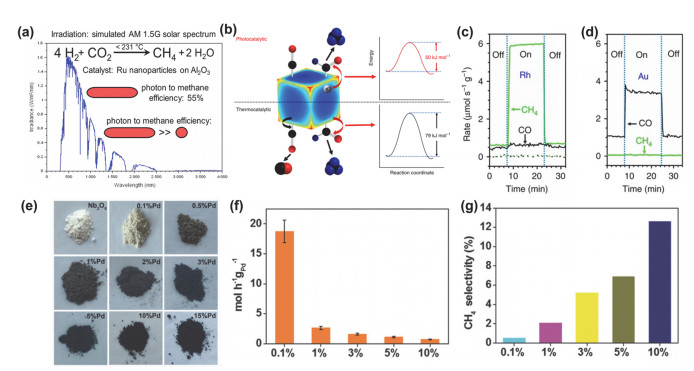
Fig 10
(a) The catalytic activity of CO2 methanation under different light irradiation at different temperatures; (b) relative increase of Ni/CeO2 catalyst at different light intensities 72; Copyright 2021, Elsevier. (c) The mechanism of CO2 methanation in the presence of sunlight 73; Copyright 2018, Elsevier. (d) A speculation on possible events in the photothermal methanation process over Ni/CexTiyO2 catalyst 25; Copyright 2022, Elsevier. (e) Proposed light-assisted CO2 hydrogenation mechanism; (f) the space-time yield (STY) and selectivity of MeOH under different conditions 76. Copyright 2020, Springer Nature."
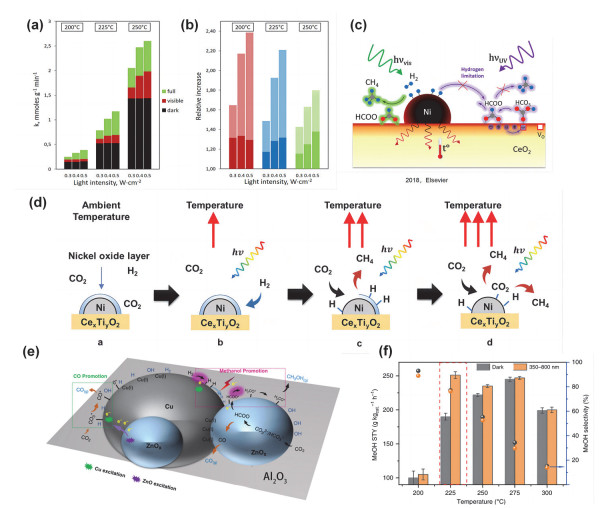
Fig 11
(a) Deposition method of Cu1 on Pd/WO3 and the corresponding photos; (b) in a flow reactor and batch reactor, the production of CO on Pd/WO3 in dark (brown) and light (orange) with different Cu loadings 82; Copyright 2019, American Chemical Society. (c) Reaction paths on the surfaces of Fe2O3 (110), Fe3O4 (110) and Co3O4 (100); (d) the possible C-C coupling paths; (e) the different CoFe-x catalysts formed at different temperatures and the CO2 hydrogenation selectivity of each CoFe-x catalyst are illustrated 29. Adapted from Adv. Mater., Wiley-VCH."
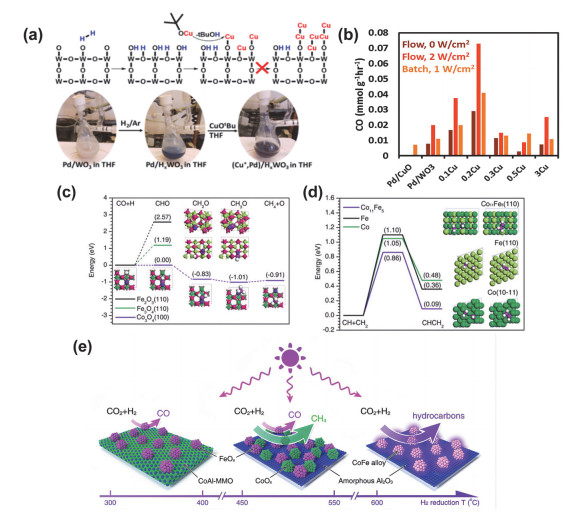
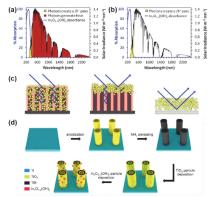
Fig 12
Absorption spectra of In2O3−x(OH)y nanoparticles compared with photon utilization in solar irradiance of (a) In2O3−x(OH)y/SiNW materials and (b) In2O3−x(OH)y/glass films, (c) diagram of the effect of nanostructure 86; Copyright 2016, American Chemical Society. (d) Formation of ntTiN@ncTiO2@ncIn2O3−x (OH)y 87; Copyright 2021, American Chemical Society."
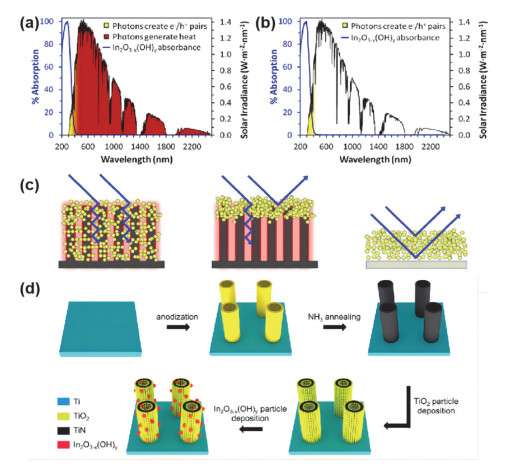
Fig 13
(a) Illustration of the Earth's greenhouse effect, (b) illustration of the nanoscale greenhouse effect in Ni@p-SiO2-30, (c) evaluation of Tlocal of different catalysts under different intensity of light, (d) schematic illustration of the preparation process for Ni@p-SiO2, (e) CO2 conversion rate for photothermal CO2 hydrogenation of different Ni catalysts under different illuminations 31; Adapted from Nat. Energy., Springer Nature. (f) SEM image and TEM image of the superstructure of In2O3−x(OH)y nanocrystals, (g) the methanol rate of NR-14h in Photothermal catalytic CO2 hydrogenation at atmospheric pressure 91; Copyright 2018, Elsevier."
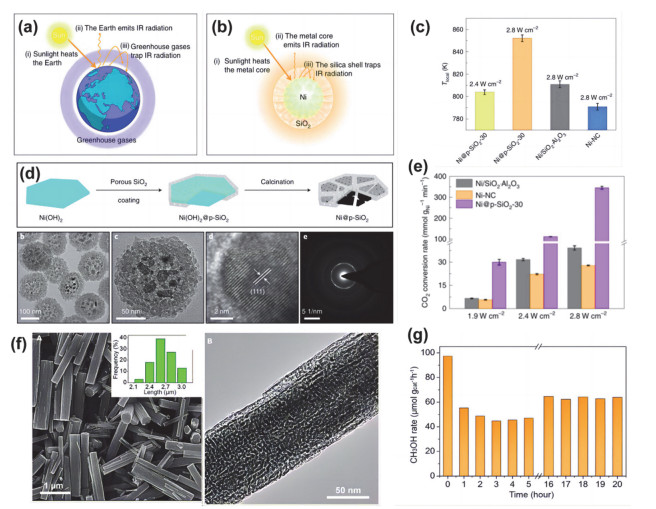
Fig 14
(a) Proposed mechanism over CuGa/CeO2 for photothermal RWGS reaction, (b) catalysts surface temperature at different light intensities, (c) solar-driven CO yields over CuGaCe catalysts under different light intensities 95; Adapted from Appl. Catal., B, Elsevier. (d) TEM images of TiO2, 5Ni/TiO2, 8Ni/TiO2 and 10Ni/TiO2; HRTEM images of 5Ni/TiO2, 8Ni/TiO2, 10 Ni/TiO2 and 8Ni/P25; element mapping images of 8Ni/TiO2 and 8Ni/P25; Yield in the first 3 h (e) and stability test (f) 32; Adapted from Appl. Catal., B, Elsevier."
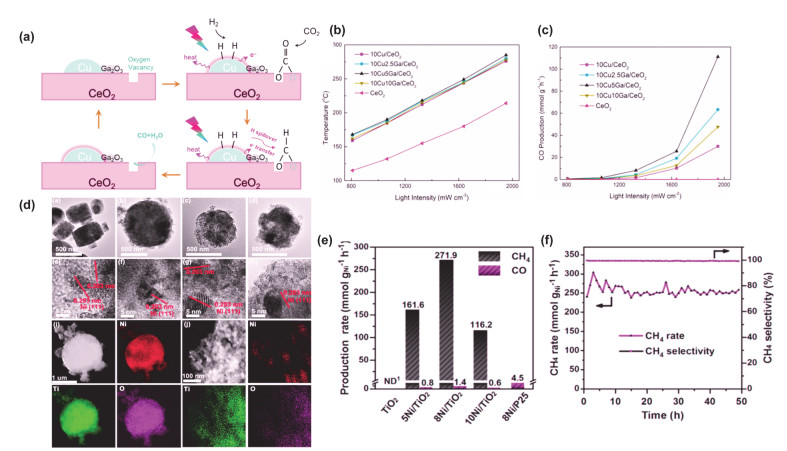
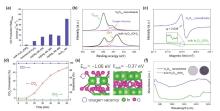
Fig 15
(a) CO yields of bulk In2O3−x(OH)y, commercial In2O3, In(OH)3 nanosheets and 2D black In2O3−x nanosheets; (b) XPS spectra of O 1s peak regions and (c) electron spin resonance spectra of In2O3−x nanosheets and bulk In2O3−x(OH)y; (d) CO2 selectivity and conversion of In(OH)3 nanosheets; (e) oxygen vacancy generation energies for the In2O3 surface and bottom surface; (f) UV-Vis–NIR absorption spectra 30; Adapted from Adv. Mate., Wiley-VCH."
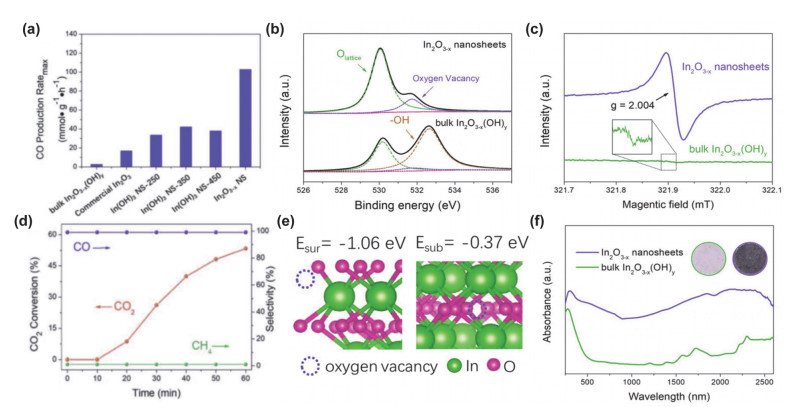
Table 2
Reported metal oxide semiconductors for photothermal catalytic CO2 hydrogenation."
| Type | Photothermal catalysts and materials | Reaction conditions | Catalytic performance | Ref. |
| Supported catalysts | Ru/Al2O3 | 300 W Xe lamp | CH4: 18.16 mol∙h−1∙g−1 | |
| Rod-shaped Ru/Al2O3 | 1 sunsolar intensity, 250 ℃ | CH4: 135 mmol∙gRu−1 | ||
| Ru/TiO2 | 1 sun solar intensity, 150 ℃ | CH4: 1.72 mmol∙gcat−1∙h−1 | ||
| Small Pd/Nb2O5 nanorods | 300 W Xe lamp (4.2 W∙cm−2) | CO: 18.8 mol∙h−1∙gPd−1 | ||
| Pd/ZnO | Two high-pressure mercury lamps, 12 bar | CH3OH: 4.0 mmol∙g−1∙h−1 CO: 8.3 mmol∙g−1∙h−1 | ||
| Au/TiO2 | Green light irradiation, 200 ℃ | CO: 0.70 μmol∙gcat−1∙ s−1 | ||
| Ni/Al2O3 | 300 W Xe lamp | CH4: 2.30 mol∙h−1∙g−1 | ||
| Ni-Al2O3/SiO2 | LED lamp | CH4: 35 mmol g−1 h−1 | ||
| Cu/ZnO | Visible light, 1 bar | CH3OH: 2.13 μmol∙g−1∙min−1 | ||
| (Cu+, Pd)/HyWO3−x | 2 W∙cm2 illumination | CO: 0.073 mmol∙g−1∙h−1 | ||
| CoFeAl layered-double-hydroxide (LDH) | UV-Vis irradiation | C2+: 36.3% | ||
| Co7Cu1Mn1Ox | 300 W Xe lamp, 200 ℃ + | C2+: 7.5 mmol∙g−1∙h−1 | ||
| Micro-structure modulation | Ru/SiNW | Xe lamp with 3.2 suns intensity | CH4: 0.99 mmol∙g−1∙h−1 | |
| Nanostructured RuO2 on Si Photonic Crystal | High-intensity solar simulated irradiation | CH4: 4.4 mmol∙gcat−1∙h−1 | ||
| In2O3−x(OH)y/SiNW | 300 W Xe lamp, 150 ℃ | CO: 22.0 μmol∙gcat−1∙h−1 | ||
| Core-shell structured Ni12P5@SiO2 | 300 W Xe lamp | 100% CO: 135mmol∙g−1∙h−1 | ||
| Core-satellite structured Co@SiO2 | 300 W Xe lamp (1.7 W∙cm−2) | CO: 80 mmol∙gCo−1∙h−1 | ||
| Nanoporous-silica-encapsulated nickel nanocrystal (Ni@p-SiO2) | 300 W Xe lamp (2.8 W∙cm−2) | CO: 0.344 mol∙gNi−1 min−1 | ||
| Rod-like nanocrystal superstructure In2O3−x(OH)y | 130 W Xe lamp, 1 bar | 50%CH3OH: 0.06mmol∙g−1∙h−1 | ||
| ZIF-67 derived Co/Al2O3 | PLS-SXE300UV, PerfectLight | 97.7%CH4: 6036 μmol∙g−1 ∙h−1 | ||
| Metal-organic framework-derived Ga-Cu/CeO2 | 300 W Xe lamp | 100%CO: 112 mmol∙g−1∙h−1 | ||
| MIL-125(Ti)-derived defective Ni/TiO2 | Infrared (IR) light | 100%CH4: 271.9 mmol∙g Ni−1∙h−1 | ||
| Defect modulation | In2O3−x/In2O3 | Light intensity = ~20 suns | 100%CO: 1874.62 μmol∙m−2∙h−1 | |
| 2D Black In2O3−x nanosheets | 300 W Xe lamp | 100% CO: 103.21 mmol∙g−1∙h−1 | ||
| HzIn2O3−x(OH)y | Light intensity of 6 suns, 1 bar | CH3OH : 33.24%−49.23% | ||
| Ru/HxMoO3−y | Vis-NIR light irradiation, 140 ℃ | CH4: 20.8 mmol∙g−1∙h−1 | ||
| Bi2O3−x | Infrared (IR) light | 100%CO: 4.6 μmol∙g−1∙h−1 |
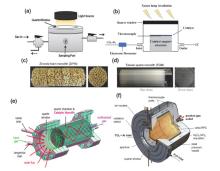
Fig 16
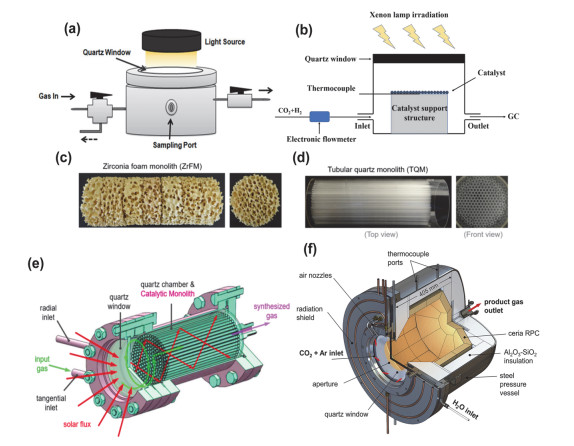
Scheme of (a) batch fixed bed photoreactor 80 and (b) continuous flow fixed bed photoreactor 108; Copyright 2020, American Chemical Society. Copyright 2020, Springer Nature. Pictures of (c) Zirconia foam monolith and (d) Tubular quartz monolith; (e) Schematic of reactor model with design components and describing its operation 109; Adapted from Solar Energy, Elsevier. (f) Schematic of the solar reactor for splitting H2O and CO2 through a thermochemical redox cycle based on CeO2 111. Copyright 2022, Elsevier."
| 1 |
Liu, Y.; Wang, Y.; Shi, C.; Zhang, W.; Luo, W.; Wang, J.; Li, K.; Yeung, N.; Kite, S. Renew. Sustain. Energy Rev. 2022, 154, 111811.
doi: 10.1016/j.rser.2021.111811 |
| 2 |
Marc Perez, R. P. Solar Energy Adv. 2022, 2, 10014.
doi: 10.1016/j.seja.2022.100014 |
| 3 |
Bekun, F. V.; Alola, A. A.; Sarkodie, S. A. Sci. Total Environ. 2019, 657, 1023.
doi: 10.1016/j.scitotenv.2018.12.104 |
| 4 |
Amjith, L. R.; Bavanish, B. Chemosphere 2022, 293, 133579.
doi: 10.1016/j.chemosphere.2022.133579 |
| 5 |
Gao, W.; Liang, S.; Wang, R.; Jiang, Q.; Zhang, Y.; Zheng, Q.; Xie, B.; Toe, C. Y.; Zhu, X.; Wang, J.; et al. Chem. Soc. Rev. 2020, 49, 8584.
doi: 10.1039/d0cs00025f |
| 6 |
Wang, J.; Li, G.; Li, Z.; Tang, C.; Feng, Z.; An, H.; Liu, H.; Liu, T.; Li, C. Sci. Adv. 2017, 3, 1701290.
doi: 10.1126/sciadv.1701290 |
| 7 |
Chen, Z.; Zhang, G.; Chen, H.; Prakash, J.; Zheng, Y.; Sun, S. Renew. Sustain. Energy Rev. 2022, 155, 111922.
doi: 10.1016/j.rser.2021.111922 |
| 8 |
Wang, S.; Teramura, K.; Hisatomi, T.; Domen, K.; Asakura, H.; Hosokawa, S.; Tanaka, T. ACS Appl. Energy Mater. 2020, 3, 1468.
doi: 10.1021/acsaem.9b01927 |
| 9 |
Wang, Z.; Yang, Z.; Kadirova, Z. C.; Guo, M.; Fang, R.; He, J.; Yan, Y.; Ran, J. Coord. Chem. Rev. 2022, 473, 214794.
doi: 10.1016/j.ccr.2022.214794 |
| 10 |
Liu, G.; Tran Phu, T.; Chen, H.; Tricoli, A. Adv. Sustain. Syst. 2018, 2, 1800028.
doi: 10.1002/adsu.201800028 |
| 11 |
Torrente-Murciano, L.; Mattia, D.; Jones, M. D.; Plucinski, P. K. J. CO2 Util. 2014, 6, 34.
doi: 10.1016/j.jcou.2014.03.002 |
| 12 |
Gong, L.; Zhang, D.; Lin, C. Y.; Zhu, Y.; Shen, Y.; Zhang, J.; Han, X.; Zhang, L.; Xia, Z. Adv. Energy Mater. 2019, 9, 1902625.
doi: 10.1002/aenm.201902625 |
| 13 |
Shinde, G. Y.; Mote, A. S.; Gawande, M. B. Catalysts 2022, 12, 94.
doi: 10.3390/catal12010094 |
| 14 |
Hakami, O. Int. J. Energy Res. 2022, 46, 19929.
doi: 10.1002/er.8702 |
| 15 |
Liu, X.; Chen, T.; Xue, Y.; Fan, J.; Shen, S.; Hossain, M. S. A.; Amin, M. A.; Pan, L.; Xu, X.; Yamauchi, Y. Coord. Chem. Rev. 2022, 459, 214440.
doi: 10.1016/j.ccr.2022.214440 |
| 16 |
Wang, Z.; Song, H.; Liu, H.; Ye, J. Angew. Chem. Int. Ed. 2019, 59, 8016.
doi: 10.1002/anie.201907443 |
| 17 |
Zhang, F.; Li, Y.; Qi, M.; Yamada, Y. M. A.; Xu, Y. Chem. Catal. 2021, 1, 272.
doi: 10.1016/j.checat.2021.01.003 |
| 18 |
Wang, Z.; Yang, Z.; Fang, R.; Yan, Y.; Ran, J.; Zhang, L. Chem. Eng. J. 2022, 429, 132322.
doi: 10.1016/j.cej.2021.132322 |
| 19 |
Diego, M.; Jose L. C.; Sara, D.; Jorge, G. Chem. Soc. Rev. 2021, 50, 2173.
doi: 10.1039/d0cs00357c |
| 20 |
Kim, S. S.; Lee, H. H.; Hong, S. C. Appl. Catal. B Environ. 2012, 119, 100.
doi: 10.1016/j.apcatb.2012.02.023 |
| 21 |
Albero, J.; Garcia, H.; Corma, A. Top Catal. 2016, 59, 787.
doi: 10.1007/s11244-016-0550-x |
| 22 |
Zhang, Z.; Mao, C.; Meira, D. M.; Duchesne, P. N.; Tountas, A. A.; Li, Z.; Qiu, C.; Tang, S.; Song, R.; Ding, X.; et al. Nat. Commun. 2022, 13, 1512.
doi: 10.1038/s41467-022-29222-7 |
| 23 |
Ye, R.; Liao, L.; Reina, T. R.; Liu, J.; Chevella, D.; Jin, Y.; Fan, M.; Liu, J. Fuel 2021, 285, 119151.
doi: 10.1016/j.fuel.2020.119151 |
| 24 |
Vogt, C.; Monai, M.; Kramer, G. J.; Weckhuysen, B. M. Nat. Catal. 2019, 2, 188.
doi: 10.1038/s41929-019-0244-4 |
| 25 |
Li, Z.; Shi, R.; Ma, Y.; Zhao, J.; Zhang, T. J. Phys. Chem. Lett. 2022, 13, 5291.
doi: 10.1021/acs.jpclett.2c01159 |
| 26 |
Puga, A. V. Top Catal. 2016, 59, 1268.
doi: 10.1007/s11244-016-0658-z |
| 27 |
Meng, X.; Wang, T.; Liu, L.; Ouyang, S.; Li, P.; Hu, H.; Kako, T.; Iwai, H.; Tanaka, A.; Ye, J. Angew. Chem. Int. Ed. 2014, 53, 11478.
doi: 10.1002/anie.201404953 |
| 28 |
Jia, J.; Wang, H.; Lu, Z.; O'Brien, P. G.; Ghoussoub, M.; Duchesne, P.; Zheng, Z.; Li, P.; Qiao, Q.; Wang, L.; et al. Adv. Sci. 2017, 4, 1700252.
doi: 10.1002/advs.201700252 |
| 29 |
Chen, G.; Gao, R.; Zhao, Y.; Li, Z.; Waterhouse, G. I. N.; Shi, R.; Zhao, J.; Zhang, M.; Shang, L.; Sheng, G.; et al. Adv. Mater. 2018, 30, 1704663.
doi: 10.1002/adma.201704663 |
| 30 |
Qi, Y.; Song, L.; Ouyang, S.; Liang, X.; Ning, S.; Zhang, Q.; Ye, J. Adv. Mater. 2019, 32, 1903915.
doi: 10.1002/adma.201903915 |
| 31 |
Cai, M.; Wu, Z.; Li, Z.; Wang, L.; Sun, W.; Tountas, A. A.; Li, C.; Wang, S.; Feng, K.; Xu, A.; et al. Nat. Energy 2021, 6, 807.
doi: 10.1038/s41560-021-00867-w |
| 32 |
Li, Q.; Gao, Y.; Zhang, M.; Gao, H.; Chen, J.; Jia, H. Appl. Catal. B Environ. 2022, 303, 120905.
doi: 10.1016/j.apcatb.2021.120905 |
| 33 |
Cai, T.; Sun, H.; Qiao, J.; Zhu, L.; Zhang, F.; Zhang, J.; Tang, Z.; Wei, X.; Yang, J. Science 2021, 373, 1523.
doi: 10.1126/science.abh4049 |
| 34 |
Yao, Y.; Wang, L.; Zhu, X.; Tu, W.; Zhou, Y.; Liu, R.; Tao, B.; Wang, C.; Yu, X.; Gao, L. Joule 2022, 6, 1008.
doi: 10.1016/j.joule.2022.04.011 |
| 35 |
Védrine, J. C. ChemSusChem 2019, 12, 577.
doi: 10.1002/cssc.201802248 |
| 36 |
Xin, Y.; Yu, K.; Zhang, L.; Yang, Y.; Yuan, H.; Li, H.; Wang, L.; Zeng, J. Adv. Mater. 2021, 33, 2008145.
doi: 10.1002/adma.202008145 |
| 37 |
Ghoussoub, M.; Xia, M.; Duchesne, P. N.; Segal, D.; Ozin, G. Energy Environ. Sci. 2019, 12, 1122.
doi: 10.1039/C8EE02790K |
| 38 |
Vogt, C.; Groeneveld, E.; Kamsma, G.; Nachtegaal, M.; Lu, L.; Kiely, C. J.; Berben, P. H.; Meirer, F.; Weckhuysen, B. M. Nat. Catal. 2018, 1, 127.
doi: 10.1038/s41929-017-0016-y |
| 39 |
Wang, L.; Cheng, W.; Zhang, D.; Du, Y.; Amal, R.; Qiao, S.; Wu, J.; Yin, Z. Chem. Soc. Rev. 2019, 48, 5310.
doi: 10.1039/C9CS00163H |
| 40 |
Li, K.; Peng, B.; Peng, T. ACS Catal. 2016, 6, 7485.
doi: 10.1021/acscatal.6b02089 |
| 41 |
Ma, R.; Sun, J.; Li, D. H.; Wei, J. J. Int. J. Hydrog. Energy 2020, 45, 30288.
doi: 10.1016/j.ijhydene.2020.08.127 |
| 42 |
Hu, S.; Fang, Y. Chem. Soc. Rev. 2022, 51, 3609.
doi: 10.1039/d1cs00782c |
| 43 |
Liu, H.; Meng, X.; Dao, T. D.; Zhang, H.; Li, P.; Chang, K.; Wang, T.; Li, M.; Nagao, T.; Ye, J. Angew. Chem. 2015, 127, 11707.
doi: 10.1002/ange.201504933 |
| 44 |
Meng, X.; Liu, L.; Ouyang, S.; Xu, H.; Wang, D.; Zhao, N.; Ye, J. Adv. Mater. 2016, 28, 6781.
doi: 10.1002/adma.201600305 |
| 45 |
Fan, W. K.; Tahir, M. Chem. Eng. J. 2022, 427, 131617.
doi: 10.1016/j.cej.2021.131617 |
| 46 |
Sarina, S.; Zhu, H.; Xiao, Q.; Jaatinen, E.; Jia, J.; Huang, Y.; Zheng, Z.; Wu, H. Angew. Chem. 2014, 126, 2979.
doi: 10.1002/ange.201308145 |
| 47 |
Liu, G.; Meng, X.; Zhang, H.; Zhao, G.; Pang, H.; Wang, T.; Li, P.; Kako, T.; Ye, J. Angew. Chem. 2017, 129, 5662.
doi: 10.1002/ange.201701370 |
| 48 |
Gao, W.; Gao, R.; Zhao, Y.; Peng, M.; Song, C.; Li, M.; Li, S.; Liu, J.; Li, W.; Deng, Y.; et al. Chem 2018, 4, 2917.
doi: 10.1016/j.chempr.2018.09.017 |
| 49 |
Aslam, U.; Rao, V. G.; Chavez, S.; Linic, S. Nat. Catal. 2018, 1, 656.
doi: 10.1038/s41929-018-0138-x |
| 50 |
Liu, H.; Meng, X.; Dao, T. D.; Zhang, H.; Li, P.; Chang, K.; Wang, T.; Li, M.; Nagao, T.; Ye, J. Angew. Chem. Int. Ed. 2015, 54, 11545.
doi: 10.1002/anie.201504933 |
| 51 |
Lu, B.; Quan, F.; Sun, Z.; Jia, F.; Zhang, L. Catal. Commun. 2019, 29, 105724.
doi: 10.1016/j.catcom.2019.105724 |
| 52 |
Zhao, Z.; Doronkin, D. E.; Ye, Y.; Grunwaldt, J.; Huang, Z.; Zhou, Y. Chin. J. Catal. 2020, 41, 286.
doi: 10.1016/S1872-2067(19)63445-5 |
| 53 |
Upadhye, A. A.; Ro, I.; Zeng, X.; Kim, H. J.; Tejedor, I.; Anderson, M. A.; Dumesic, J. A.; Huber, G. W. Catal. Sci. Technol. 2015, 5, 2590.
doi: 10.1039/C4CY01183J |
| 54 |
Sun, M.; Zhao, B.; Chen, F.; Liu, C.; Lu, S.; Yu, Y.; Zhang, B. Chem. Eng. J. 2021, 408, 127280.
doi: 10.1016/j.cej.2020.127280 |
| 55 |
Li, D.; Huang, Y.; Li, S.; Wang, C.; Li, Y.; Zhang, X.; Liu, Y. Chin. J. Catal. 2020, 41, 154.
doi: 10.1016/S1872-2067(19)63475-3 |
| 56 |
Zhou, S.; Shang, L.; Zhao, Y.; Huang, Y.; Zheng, L.; Zhang, T. Adv. Mater. 2019, 31, 1900509.
doi: 10.1002/adma.201900509 |
| 57 |
Liu, H.; Gao, X.; Shi, D.; He, D.; Meng, Q.; Qi, P.; Zhang, Q. Energy Technol. 2022, 10, 2100804.
doi: 10.1002/ente.202100804 |
| 58 |
Wang, L.; Dong, Y.; Yan, T.; Hu, Z.; Jelle, A. A.; Meira, D. M.; Duchesne, P. N.; Loh, J. Y. Y.; Qiu, C.; Storey, E. E.; et al. Nat. Commun. 2020, 11, 2432.
doi: 10.1038/s41467-020-16336-z |
| 59 |
Bi, Q.; Hu, K.; Chen, J.; Zhang, Y.; Riaz, M. S.; Xu, J.; Han, Y.; Huang, F. Appl. Catal. B Environ. 2021, 295, 120211.
doi: 10.1016/j.apcatb.2021.120211 |
| 60 |
Zhang, X.; Zhang, Z.; Li, J.; Zhao, X.; Wu, D.; Zhou, Z. J. Mater. Chem. A 2017, 1, 2899-2903.
doi: 10.1039/c7ta03557h |
| 61 |
Sastre, F.; Versluis, C.; Meulendijks, N.; Rodríguez-Fernández, J.; Sweelssen, J.; Elen, K.; Van Bael, M. K.; den Hartog, T.; Verheijen, M. A.; Buskens, P. ACS Omega 2019, 4, 7369.
doi: 10.1021/acsomega.9b00581 |
| 62 |
Wang, C.; Fang, S.; Xie, S.; Zheng, Y.; Hu, Y. H. J. Mater. Chem. A 2020, 15, 7390.
doi: 10.1039/C9TA13275A |
| 63 |
Kim, C.; Hyeon, S.; Lee, J.; Kim, W. D.; Lee, D. C.; Kim, J.; Lee, H. Nat. Commun. 2018, 9, 3027.
doi: 10.1038/s41467-018-05542-5 |
| 64 |
Zhang, X.; Li, X.; Zhang, D.; Su, N. Q.; Yang, W.; Everitt, H. O.; Liu, J. Nat. Commun. 2017, 8, 14542.
doi: 10.1038/ncomms14542 |
| 65 |
Li, X.; Everitt, H. O.; Liu, J. Nano Res. 2019, 12, 1906.
doi: 10.1007/s12274-019-2457-x |
| 66 |
Ge, H.; Kuwahara, Y.; Kusu, K.; Yamashita, H. J. Mater. Chem. A 2021, 24, 13898.
doi: 10.1039/D1TA02277F |
| 67 |
Wu, D.; Deng, K.; Hu, B.; Lu, Q.; Liu, G.; Hong, X. ChemCatChem 2019, 11, 1598.
doi: 10.1016/S0740-5472(96)90021-5 |
| 68 |
Li, N.; Liu, M.; Yang, B.; Shu, W.; Shen, Q.; Liu, M.; Zhou, J. J. Phys. Chem. C 2017, 121, 2923.
doi: 10.1021/acs.jpcc.6b12683 |
| 69 |
Zhao, J.; Bai, Y.; Liang, X.; Wang, T.; Wang, C. J. CO2 Util. 2021, 49, 101562.
doi: 10.1016/j.jcou.2021.10156 |
| 70 |
Wang, K.; Cao, M.; Lu, J.; Lu, Y.; Lau, C. H.; Zheng, Y.; Fan, X. Appl. Catal. B Environ. 2021, 296, 120341.
doi: 10.1016/j.apcatb.2021.120341 |
| 71 |
Bueno-Alejo, C. J.; Arca-Ramos, A.; Hueso, J. L.; Santamaria, J. Catal. Today 2020, 355, 678.
doi: 10.1016/j.cattod.2019.06.022 |
| 72 |
Golovanova, V.; Spadaro, M. C.; Arbiol, J.; Golovanov, V.; Rantala, T. T.; Andreu, T.; Morante, J. R. Appl. Catal. B Environ. 2021, 291, 120038.
doi: 10.1016/j.apcatb.2021.120038 |
| 73 |
Jantarang, S.; Lovell, E. C.; Tan, T. H.; Scott, J.; Amal, R. Prog. Nat. Sci. Mater. 2018, 28, 168.
doi: 10.1016/j.pnsc.2018.02.004 |
| 74 |
Zhang, H.; Itoi, T.; Konishi, T.; Izumi, Y. Angew. Chem. 2021, 133, 9127.
doi: 10.1002/ange.202016346 |
| 75 |
Wang, Z.; Song, H.; Pang, H.; Ning, Y.; Dao, T. D.; Wang, Z.; Chen, H.; Weng, Y.; Fu, Q.; Nagao, T.; et al. Appl. Catal. B Environ. 2019, 250, 10.
doi: 10.1016/j.apcatb.2019.03.003 |
| 76 |
Xie, B.; Wong, R. J.; Tan, T. H.; Higham, M.; Gibson, E. K.; Decarolis, D.; Callison, J.; Aguey-Zinsou, K.; Bowker, M.; Catlow, C. R. A.; et al. Nat. Commun. 2020, 11, 1615.
doi: 10.1038/s41467-020-15445-z |
| 77 |
Ullah, S.; Lovell, E. C.; Tan, T. H.; Xie, B.; Kumar, P. V.; Amal, R.; Scott, J. Appl. Catal. B Environ. 2021, 294, 120248.
doi: 10.1016/j.apcatb.2021.120248 |
| 78 |
Zhao, B.; Sun, M.; Chen, F.; Wang, W.; Lu, S.; Zhang, B. ACS Catal. 2021, 11, 10316.
doi: 10.1021/acscatal.1c02644 |
| 79 |
Li, Z.; Liu, J.; Shi, R.; Waterhouse, G. I. N.; Wen, X.; Zhang, A. T. Adv. Energy Mater. 2021, 11, 2002783.
doi: 10.1002/aenm.202002783 |
| 80 |
Song, C.; Liu, X.; Xu, M.; Masi, D.; Wang, Y.; Deng, Y.; Zhang, M.; Qin, X.; Feng, K.; Yan, J.; et al. ACS Catal. 2020, 10, 10364.
doi: 10.1021/acscatal.0c02244 |
| 81 |
Stanley, J. N. G.; García-García, I.; Perfrement, T.; Lovell, E. C.; Schmidt, T. W.; Scott, J.; Amal, R. Chem. Eng. Sci. 2019, 194, 94.
doi: 10.1016/j.ces.2018.04.003 |
| 82 |
Li, Y. F.; Lu, W.; Chen, K.; Duchesne, P.; Jelle, A.; Xia, M.; Wood, T. E.; Ulmer, U.; Ozin, G. A. J. Am. Chem. Soc. 2019, 141, 14991.
doi: 10.1021/jacs.9b08030 |
| 83 |
He, Z.; Li, Z.; Wang, Z.; Wang, K.; Sun, Y.; Wang, S.; Wang, W.; Yang, Y.; Liu, Z. Green Chem. 2021, 23, 5775.
doi: 10.1039/d1gc01152a |
| 84 |
Raut, H. K.; Ganesh, V. A.; Nair, A. S.; Ramakrishna, S. Energy Environ. 2011, 4, 3779.
doi: 10.1039/c1ee01297e |
| 85 |
O'Brien, P. G.; Sandhel, A.; Wood, T. E.; Jelle, A. A.; Hoch, L. B.; Perovic, D. D.; Mims, C. A.; Ozin, G. A. Adv. Sci. 2014, 1, 1400001.
doi: 10.1002/advs.201400001 |
| 86 |
Hoch, L. B.; O'Brien, P. G.; Jelle, A.; Sandhel, A.; Perovic, D. D.; Mims, C. A.; Ozin, G. A. ACS Nano 2016, 10, 9017.
doi: 10.1021/acsnano.6b05416 |
| 87 |
Nguyen, N. T.; Xia, M.; Duchesne, P. N.; Wang, L.; Mao, C.; Jelle, A. A.; Yan, T.; Li, P.; Lu, Z.; Ozin, G. A. Nano Lett. 2021, 21, 1311.
doi: 10.1021/acs.nanolett.0c04008 |
| 88 |
Jelle, A. A.; Ghuman, K. K.; O'Brien, P. G.; Hmadeh, M.; Sandhel, A.; Perovic, D. D.; Singh, C. V.; Mims, C. A.; Ozin, G. A. Adv. Energy Mater. 2018, 8, 1702277.
doi: 10.1002/aenm.201702277 |
| 89 |
Lou, D.; Zhu, Z.; Xu, Y.; Li, C.; Feng, K.; Zhang, D.; Lv, K.; Wu, Z.; Zhang, C.; Ozin, G. A.; et al. Sci. China Mater. 2021, 64, 2212.
doi: 10.1007/s40843-020-1630-2 |
| 90 |
Shen, J.; Tang, R.; Wu, Z.; Wang, X.; Chu, M.; Cai, M.; Zhang, C.; Zhang, L.; Yin, K.; He, L.; et al. Trans. Tianjin Univ. 2022, 28, 236.
doi: 10.1007/s12209-022-00333-y |
| 91 |
Wang, L.; Ghoussoub, M.; Wang, H.; Shao, Y.; Sun, W.; Tountas, A. A.; Wood, T. E.; Li, H.; Loh, J. Y. Y.; Dong, Y.; et al. Joule 2018, 2, 1369.
doi: 10.1016/j.joule.2018.03.007 |
| 92 |
Hurtado, L.; Mohan, A.; Ulmer, U.; Natividad, R.; Tountas, A. A.; Sun, W.; Wang, L.; Kim, B.; Sain, M. M.; Ozin, G. A. Chem. Eng. J. 2022, 435, 134864.
doi: 10.1016/j.cej.2022.134864 |
| 93 |
Fan, W. K.; Tahir, M. Ind. Eng. Chem. Res. 2021, 60, 13149.
doi: 10.1021/acs.iecr.1c02058 |
| 94 |
Chen, X.; Li, Q.; Zhang, M.; Li, J.; Cai, S.; Chen, J.; Jia, H. ACS Appl. Mater. Interfaces 2020, 12, 39304.
doi: 10.1021/acsami.0c11576 |
| 95 |
Deng, B.; Song, H.; Peng, K.; Li, Q.; Ye, J. Appl. Catal. B Environ. 2021, 298, 120519.
doi: 10.1016/j.apcatb.2021.120519 |
| 96 |
Ye, J.; Liu, C.; Mei, D.; Ge, Q. ACS Catal. 2013, 3, 1296.
doi: 10.1021/cs400132a |
| 97 |
Li, J.; Ye, Y.; Ye, L.; Su, F.; Ma, Z.; Huang, J.; Xie, H.; Doronkin, D. E.; Zimina, A.; Grunwaldt, J.; Zhou, Y. J. Mater. Chem. A 2019, 6, 2821.
doi: 10.1039/C8TA10922B |
| 98 |
Ge, H.; Kuwahara, Y.; Kusu, K.; Bian, Z.; Yamashita, H. Appl. Catal. B Environ. 2022, 317, 121734.
doi: 10.1016/j.apcatb.2022.121734 |
| 99 |
Yin, H.; Kuwahara, Y.; Mori, K.; Louis, C.; Yamashita, H. Catal. Sci. Technol. 2020, 10, 4141.
doi: 10.1039/c9cy02511a |
| 100 |
Li, Y. F.; Soheilnia, N.; Greiner, M.; Ulmer, U.; Wood, T.; Jelle, A. A.; Dong, Y.; Yin Wong, A. P.; Jia, J.; Ozin, G. A. ACS Appl. Mater. Interfaces 2019, 11, 5610.
doi: 10.1021/acsami.8b04982 |
| 101 |
Li, Y.; Wen, M.; Wang, Y.; Tian, G.; Wang, C.; Zhao, J. Angew. Chem. Int. Ed. 2021, 133, 923.
doi: 10.1002/ange.202010156 |
| 102 |
Ali, S.; Razzaq, A.; Kim, H.; In, S. Chem. Eng. J. 2022, 429, 131579.
doi: 10.1016/j.cej.2021.131579 |
| 103 |
Ii, C. O. W. M.; Wang, W.; Deng, C.; Xie, S.; Li, Y.; Zhang, W.; Sheng, H.; Chen, C.; Zhao, J. J. Am. Chem. Soc. 2021, 143, 2984.
doi: 10.1021/jacs.1c00206 |
| 104 |
Lv, C.; Bai, X.; Ning, S.; Song, C.; Guan, Q.; Liu, B.; Li, Y.; Ye, J. ACS Nano 2023, 17, 1725.
doi: 10.1021/acsnano.2c09025 |
| 105 |
Tahir, B.; Tahir, M.; Amin, N. S. Energy Convers. Manag. 2015, 90, 272.
doi: 10.1016/j.enconman.2014.11.018 |
| 106 |
Zhang, M.; Wang, C.; Wang, Y.; Li, S.; Zhang, X.; Liu, Y. Nano Res. 2023, 2, 2142.
doi: 10.1007/s12274-022-4949-3 |
| 107 |
Nam, H.; Kim, J. H.; Kim, H.; Kim, M. J.; Jeon, S.; Jin, G.; Won, Y.; Hwang, B. W.; Lee, S.; Baek, J.; et al. Energy 2021, 214, 118895.
doi: 10.1016/j.energy.2020.118895 |
| 108 |
Zhao, J.; Yang, Q.; Shi, R.; Waterhouse, G. I. N.; Zhang, X.; Wu, L.; Tung, C.; Zhang, T. NPG Asia Mater. 2020, 12, 5.
doi: 10.1038/s41427-019-0171-5 |
| 109 |
Bhatta, S.; Nagassou, D.; Mohsenian, S.; Trelles, J. P. Solar Energy 2019, 178, 201.
doi: 10.1016/j.solener.2018.12.019 |
| 110 |
Usubharatana, P.; Mcmartin, D.; Veawab, A.; Tontiwachwuthikul, P. Ind. Eng. Chem. Res. 2006, 45, 2558.
doi: 10.1021/ie0505763 |
| 111 |
Zoller, S.; Koepf, E.; Nizamian, D.; Stephan, M.; Patane, A.; Haueter, P.; Romero, M.; Lez-Aguilar, J. G.; Lieftink, D.; de Wit, E.; et al. Joule 2022, 6, 1606.
doi: 10.1016/j.joule.2022.06.012 |
| 112 |
Khan, A. A.; Tahir, M. J. CO2 Util. 2019, 29, 205.
doi: 10.1016/j.jcou.2018.12.008 |
| 113 |
Zhang, X.; Li, X.; Reish, M. E.; Zhang, D.; Su, N. Q.; Gutiérrez, Y.; Moreno, F.; Yang, W.; Everitt, H. O.; Liu, J. Nano Lett. 2018, 8, 1714.
doi: 10.1021/acs.nanolett.7b04776 |
| 114 |
Wang, A.; Zhu, Q.; Xing, Z. Chem. Eng. J. 2020, 393, 124781.
doi: 10.1016/j.cej.2020.124781 |
| [1] | 宋相海, 刘晓颖, 任智祥, 刘想, 汪梅, 吴元锋, 周伟强, 朱志, 霍鹏伟. 氮掺杂显著提升BiOBr光催化还原CO2性能研究[J]. 物理化学学报, 2025, 41(6): 100055 - . |
| [2] | 董雪, 孙晓甫, 贾帅强, 韩世涛, 周达伟, 姚婷, 王敏, 方明慧, 吴海虹, 韩布兴. 碳修饰的铜催化剂实现安培级电流电化学还原CO2制C2+产物[J]. 物理化学学报, 2025, 41(3): 100024 - . |
| [3] | 霍怡廷, 周欣, 赵非凡, 艾陈斌, 吴珍, 常志东, 朱必成. TiO2/CdS S型异质结促进光催化CO2甲烷化及其飞秒瞬态吸收光谱机理研究[J]. 物理化学学报, 2025, 41(11): 100148 - . |
| [4] | 孔燕, 危伟, 徐乐凯, 陈晨. 电催化氮集成二氧化碳还原反应合成有机氮化合物[J]. 物理化学学报, 2024, 40(8): 2307049 - . |
| [5] | 孙浩宇, 李敦, 闵媛媛, 王莹莹, 马艳芸, 郑逸群, 黄宏文. 多级钯-铜-银多孔纳米花作为高效电催化剂催化CO2还原为C2+产物[J]. 物理化学学报, 2024, 40(6): 2307007 - . |
| [6] | 陈慧滢, 朱浩林, 廖培钦, 陈小明. 一例整合了三联吡啶钌和卟啉锌的金属-有机框架材料用于光催化二氧化碳还原全反应[J]. 物理化学学报, 2024, 40(4): 2306046 - . |
| [7] | 张志全, RhimiBaker, 刘喆旸, 周敏, 邓国伟, 魏巍, 毛梁, 李华明, 姜志锋. 铜基光催化剂二氧化碳转化研究进展[J]. 物理化学学报, 2024, 40(12): 2406029 - . |
| [8] | 王雪娇, 董隋颖, 戚克振, PopkovVadim, 项祥林. 利用改性g-C3N4光催化还原CO2[J]. 物理化学学报, 2024, 40(12): 2408005 - . |
| [9] | 朱锐杰, 康磊磊, 李林, 潘晓丽, 王华, 苏杨, 李广亿, 程鸿魁, 李仁贵, 刘晓艳, 王爱琴. WO3-TiO2负载的Pt单原子催化剂光热协同催化丙烷和丙烯氧化[J]. 物理化学学报, 2024, 40(1): 2303003 - . |
| [10] | 徐涵煜, 宋雪旦, 张青, 于畅, 邱介山. 理论研究Cu@C2N催化剂表面上水分子对电催化CO2还原反应机理的影响[J]. 物理化学学报, 2024, 40(1): 2303040 - . |
| [11] | 王吉超, 乔秀, 史维娜, 贺景, 陈军, 张万庆. 多面体状Cu2O修饰片状BiOI的S型异质结构筑及光催化水蒸气中CO2转化性能研究[J]. 物理化学学报, 2023, 39(6): 2210003 - . |
| [12] | 张怡宁, 高明, 陈松涛, 王会琴, 霍鹏伟. Ag/CN/ZnIn2S4 S型异质结等离子体光催化剂的制备及其增强光还原CO2研究[J]. 物理化学学报, 2023, 39(6): 2211051 - . |
| [13] | 罗铖, 龙庆, 程蓓, 朱必成, 王临曦. Pt-C3N4/BiOCl S型异质结应用于光催化CO2还原的理论计算研究[J]. 物理化学学报, 2023, 39(6): 2212026 - . |
| [14] | 刘真, 孟祥福, 古万苗, 查珺, 闫楠, 尤青, 夏楠, 王辉, 伍志鲲. 组合掺杂引入新型、多种镉配位方式增强金纳米团簇的电催化性能[J]. 物理化学学报, 2023, 39(12): 2212064 - . |
| [15] | 刘弘禹, 孟钢, 邓赞红, 李蒙, 常鋆青, 代甜甜, 方晓东. VOCs分子的半导体型传感器识别检测研究进展[J]. 物理化学学报, 2022, 38(5): 2008018 - . |
|
||
