Acta Phys. -Chim. Sin. ›› 2024, Vol. 40 ›› Issue (11): 2406024.doi: 10.3866/PKU.WHXB202406024
Special Issue: Solar fuel preparation
• ARTICLE • Previous Articles Next Articles
Construction of Electron Bridge and Activation of MoS2 Inert Basal Planes by Ni Doping for Enhancing Photocatalytic Hydrogen Evolution
Qin Hu1, Liuyun Chen1, Xinling Xie1, Zuzeng Qin1, Hongbing Ji1,2, Tongming Su1,*( )
)
- 1 Guangxi Key Laboratory of Petrochemical Resource Processing and Process Intensification Technology, School of Chemistry and Chemical Engineering, Guangxi University, Nanning 530004, China
2 Institute of Green Petroleum Processing and Light Hydrocarbon Conversion, College of Chemical Engineering, Zhejiang University of Technology, Hangzhou 310014, China
-
Received:2024-06-20Revised:2024-07-20Accepted:2024-07-22Published:2024-10-14 -
Contact:Email: sutm@gxu.edu.cn (Tongming Su) -
Supported by:the National Natural Science Foundation of China(22208065); Guangxi Natural Science Foundation(2022GXNSFBA035483); Opening Project of Guangxi Key Laboratory of Petrochemical Resource Processing and Process Intensification Technology(2023K012); Special Funding for 'Guangxi Bagui Scholars'

Cite this article
Qin Hu, Liuyun Chen, Xinling Xie, Zuzeng Qin, Hongbing Ji, Tongming Su. Construction of Electron Bridge and Activation of MoS2 Inert Basal Planes by Ni Doping for Enhancing Photocatalytic Hydrogen Evolution[J]. Acta Phys. -Chim. Sin. 2024, 40(11), 2406024. doi: 10.3866/PKU.WHXB202406024
share this article
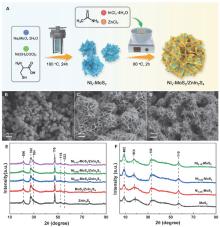
Fig 1
Schematic illustration of the synthesis of the Nix-MoS2/ZnIn2S4 composite (A). SEM images of Ni0.08-MoS2 (B), ZnIn2S4 (C), and Ni0.08-MoS2/ZnIn2S4 (D). XRD patterns of ZnIn2S4, MoS2/ZnIn2S4, Nix-MoS2/ZnIn2S4 (E), MoS2 and Nix-MoS2 (F)."
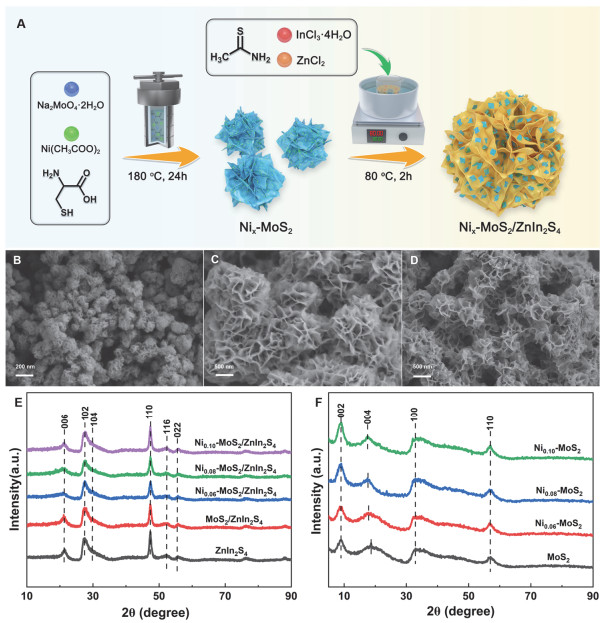
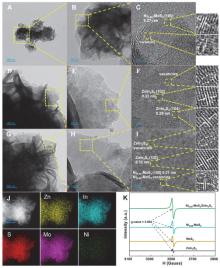
Fig 2
TEM images and HRTEM images of Ni0.08-MoS2 (A, B, C), ZnIn2S4 (D, E, F), and Ni0.08-MoS2/ZnIn2S4 (G, H, I). HAADF-STEM image and corresponding EDS element (Zn, In, S, Mo, and Ni) mapping of Ni0.08-MoS2/ZnIn2S4 (J). EPR spectra of ZnIn2S4, MoS2, Ni0.08-MoS2, and Ni0.08-MoS2/ZnIn2S4 (K)."
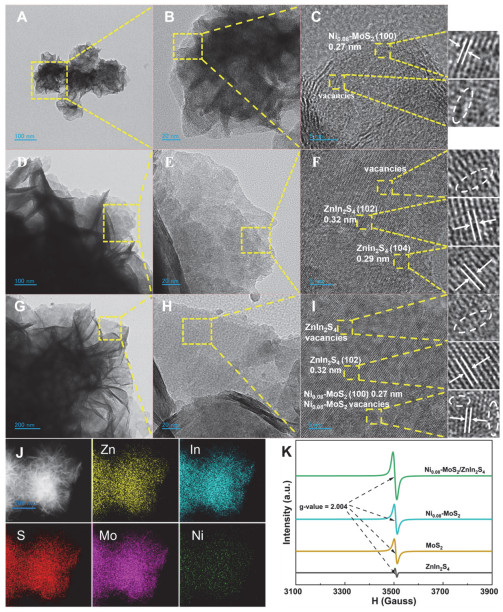
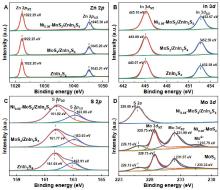
Fig 3
High-resolution XPS spectra of Zn 2p (A), In 3d (B), S 2p (C), and Mo 3d (D) in ZnIn2S4, MoS2/ZnIn2S4, and Ni0.08-MoS2/ZnIn2S4."
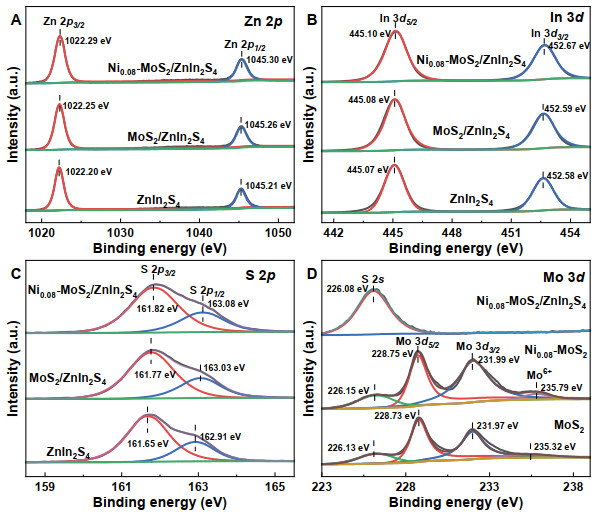
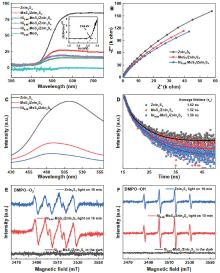
Fig 4
UV-Vis diffuse reflectance spectra of ZnIn2S4, MoS2/ZnIn2S4, and Nix-MoS2/ZnIn2S4 (the inset shows the band gap values of ZnIn2S4 calculated by the Kubelka–Munk equation) (A). EIS Nyquist plots (B), PL spectra (C), and TRPL decay spectra (D) of ZnIn2S4, MoS2/ZnIn2S4, and Ni0.08-MoS2/ZnIn2S4. EPR spectra of radical adduct signals labeled by DMPO for ·O2− (E) and ·OH (F) of ZnIn2S4 and Ni0.08-MoS2/ZnIn2S4."
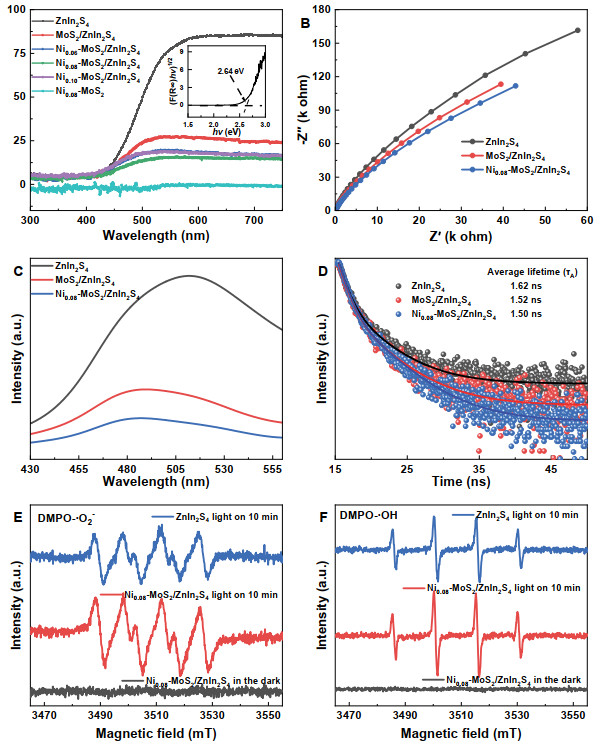
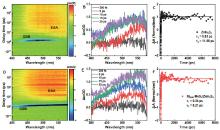
Fig 5
2D mapping fs-TA spectra of ZnIn2S4 (A) and Ni0.08-MoS2/ZnIn2S4 (D). fs-TAS spectra at different delay times for ZnIn2S4 (B) and Ni0.08-MoS2/ZnIn2S4 (E). Kinetic delay curves fitted at500 nm for ZnIn2S4 (C) and Ni0.08-MoS2/ZnIn2S4 (F)."
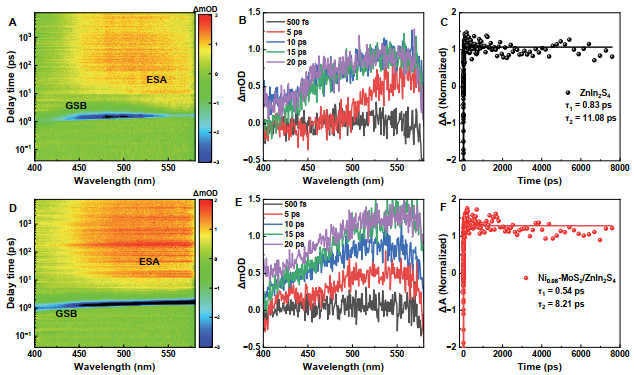
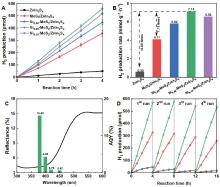
Fig 6
Time course of photocatalytic H2 production performance (A) and the photocatalytic H2 production rate (B) of ZnIn2S4, MoS2/ZnIn2S4, and Nix-MoS2/ZnIn2S4. Dependence of apparent quantum yield (AQY) as a function of incident irradiation wavelength and diffuse reflectance spectra of Ni0.08-MoS2/ZnIn2S4 (C). Cyclic experiments of photocatalytic H2 production over ZnIn2S4, MoS2/ZnIn2S4, and Ni0.08-MoS2/ZnIn2S4 (D)."
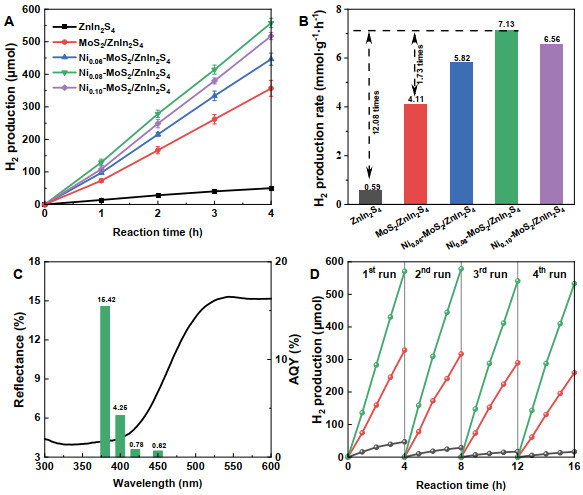
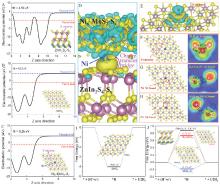
Fig 7
Electrostatic potentials of ZnIn2S4-Sv (A), MoS2 (B), and Ni-MoS2-Sv (C). Electron density differences between the Ni-MoS2-Sv/ZnIn2S4-Sv interface (D) and the Ni-MoS2-Sv surface (E); the yellow and blue areas in (D) and (E) represent the accumulation and loss of electrons, respectively. The optimized model and corresponding electron localization function (ELF) maps of H2O adsorption at different sites of S vacancies (F), Ni―S1 bonds (G), and Ni―S2 bonds (H) on the Ni-MoS2-Sv surface. Hydrogen adsorption free energy of MoS2 (I) and ZnIn2S4-Sv, Nix-MoS2, and MoS2-Sv (J)."
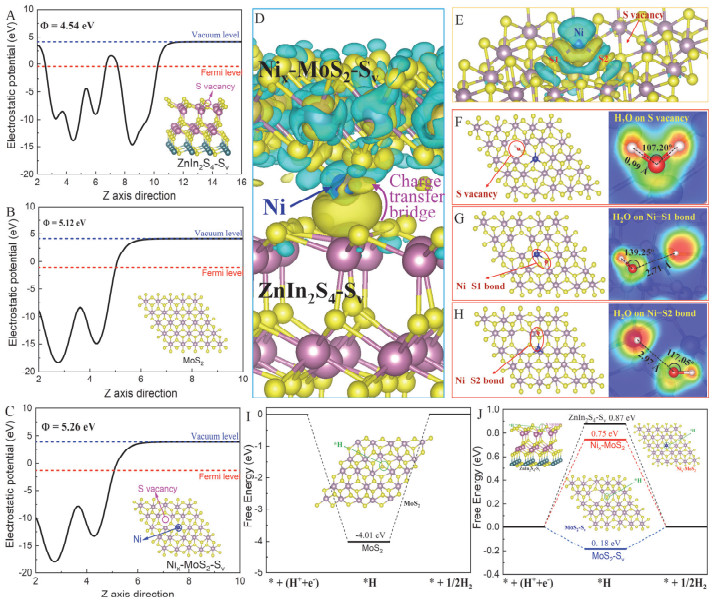
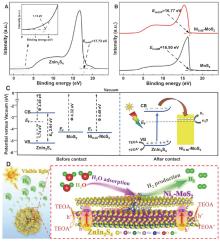
Fig 8
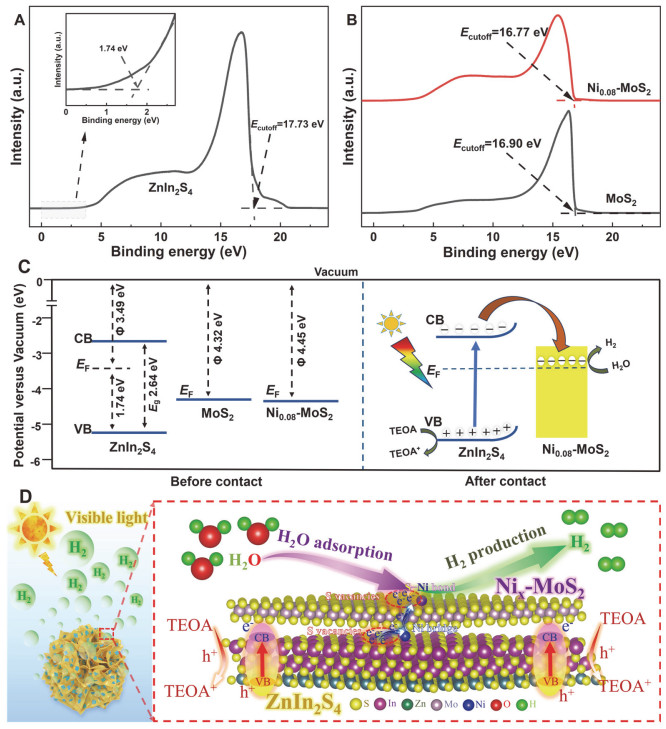
The valence band and secondary electron cutoff of ZnIn2S4 (A), MoS2 and Ni0.08-MoS2 (B) with respect to the Fermi level (EF), which were measured by UPS spectra. Energy scheme before and after contact with ZnIn2S4 and Ni0.08-MoS2 (C). Schematic illustration of the photocatalytic hydrogen production mechanism over Ni0.08-MoS2/ZnIn2S4 (D)."
| 1 |
doi: 10.1038/s41560-019-0456-5 |
| 2 |
doi: 10.3866/pku.Whxb202211010 |
| 3 |
doi: 10.1016/s1872-2067(21)64033-0 |
| 4 |
doi: 10.3390/molecules29020465 |
| 5 |
doi: 10.1021/acsomega.3c02229 |
| 6 |
doi: 10.1021/acs.chemrev.9b00201 |
| 7 |
doi: 10.1016/j.gee.2020.12.015 |
| 8 |
doi: 10.1016/s1872-2067(23)64444-4 |
| 9 |
doi: 10.1038/238037a0 |
| 10 |
doi: 10.3866/pku.Whxb202212009 |
| 11 |
doi: 10.1016/j.apcatb.2022.121255 |
| 12 |
doi: 10.1016/j.jcis.2023.01.052 |
| 13 |
doi: 10.1016/j.apsusc.2020.147682 |
| 14 |
doi: 10.1002/adfm.202209994 |
| 15 |
doi: 10.1002/anie.202304559 |
| 16 |
doi: 10.1016/j.apsusc.2019.144407 |
| 17 |
doi: 10.1002/admi.201802004 |
| 18 |
doi: 10.1039/c8qi01359d |
| 19 |
doi: 10.1016/j.jcis.2021.04.027 |
| 20 |
doi: 10.1016/j.mssp.2020.105453 |
| 21 |
doi: 10.1016/j.jmst.2023.11.081 |
| 22 |
doi: 10.1002/adfm.202111740 |
| 23 |
doi: 10.1039/d3ee01522j |
| 24 |
doi: 10.1002/advs.202103715 |
| 25 |
doi: 10.1016/j.apcatb.2019.02.027 |
| 26 |
doi: 10.1016/j.cej.2023.145173 |
| 27 |
doi: 10.1016/j.seppur.2023.123170 |
| 28 |
doi: 10.1016/j.apcatb.2022.121337 |
| 29 |
doi: 10.1021/acs.inorgchem.3c0410 |
| 30 |
doi: 10.1016/j.apcatb.2024.123697 |
| 31 |
doi: 10.1002/aenm.202100757 |
| 32 |
doi: 10.1002/aenm.201802566 |
| 33 |
doi: 10.1016/j.apcatb.2013.07.064 |
| 34 |
doi: 10.1016/j.jcis.2023.10.147 |
| 35 |
doi: 10.1002/smll.202107238 |
| 36 |
doi: 10.1007/s00339-014-8436-X |
| 37 |
doi: 10.1007/s40843-023-2456-6 |
| 38 |
doi: 10.1016/j.jcis.2023.11.016 |
| 39 |
doi: 10.1021/acs.energyfuels.2c03942 |
| 40 |
doi: 10.1002/eem2.12644 |
| 41 |
doi: 10.1007/s12274-016-1115-9 |
| 42 |
doi: 10.1016/j.electacta.2020.135885 |
| 43 |
doi: 10.1021/acsestwater.1c00097 |
| 44 |
doi: 10.1016/j.jcis.2021.07.111 |
| 45 |
doi: 10.1016/j.jechem.2022.06.027 |
| 46 |
doi: 10.1021/acsaem.2c00767 |
| 47 |
doi: 10.1002/sstr.202300091 |
| 48 |
doi: 10.1016/j.cej.2021.132770 |
| 49 |
doi: 10.3390/nano9091266 |
| 50 |
doi: 10.1016/j.mtsust.2023.100444 |
| 51 |
doi: 10.1016/j.cej.2020.126791 |
| 52 |
doi: 10.1016/j.apcatb.2020.119254 |
| 53 |
doi: 10.1016/j.apsusc.2023.157461 |
| 54 |
doi: 10.1002/adfm.202205119 |
| 55 |
doi: 10.1016/j.jcis.2024.02.124 |
| 56 |
doi: 10.1007/s12598-023-02419-5 |
| 57 |
doi: 10.1016/j.jcis.2024.02.082 |
| 58 |
doi: 10.1016/j.jcis.2024.02.119 |
| 59 |
doi: 10.1016/j.apsusc.2023.158572 |
| 60 |
doi: 10.1016/j.cej.2023.144240 |
| 61 |
doi: 10.1016/j.cej.2020.125344 |
| 62 |
doi: 10.1016/j.jcis.2023.12.161 |
| 63 |
doi: 10.1016/j.cej.2023.148242 |
| 64 |
doi: 10.1021/acsami.3c02895 |
| 65 |
doi: 10.3866/PKU.WHXB202302017 |
| 66 |
doi: 10.1016/j.apsusc.2023.157451 |
| 67 |
doi: 10.1007/s40843-023-2725-y |
| 68 |
doi: 10.1016/j.jcis.2023.07.032 |
| 69 |
doi: 10.1016/j.jssc.2023.124419 |
| 70 |
doi: 10.3866/PKU.WHXB202211051 |
| 71 |
doi: 10.3866/PKU.WHXB202309031 |
| 72 |
doi: 10.1016/j.jallcom.2022.163709 |
| 73 |
doi: 10.3866/PKU.WHXB202302051 |
| 74 |
doi: 10.1016/j.matlet.2023.135458 |
| 75 |
doi: 10.1016/s1872-2067(23)64607-8 |
| 76 |
doi: 10.1016/j.jmst.2023.12.054 |
| 77 |
doi: 10.1016/s1872-2067(22)64108-1 |
| 78 |
doi: 10.1039/d2cc06300j |
| 79 |
doi: 10.1021/jacsau.3c00482 |
| 80 |
doi: 10.1038/s41467-024-47624-7 |
| 81 |
doi: 10.1039/c9tc05456a |
| 82 |
doi: 10.1021/acscatal.9b00838 |
| 83 |
doi: 10.1021/acscatal.7b02732 |
| 84 |
doi: 10.1002/smll.201804903 |
| 85 |
doi: 10.1016/j.jmst.2022.02.014 |
| 86 |
doi: 10.1002/smll.202300717 |
| 87 |
doi: 10.1016/j.cej.2021.133670 |
| 88 |
doi: 10.1016/j.cej.2023.141549 |
| [1] | Fan Fan, Hao Xiu, Yuting Wang, Yongpeng Cui, Yajun Wang. Construction of NH2-MIL-125/Na-doped g-C3N4 composite S-scheme heterojunction and its performance in photocatalytic hydrogen peroxide production [J]. Acta Phys. -Chim. Sin., 2026, 42(2): 100143-. |
| [2] | Guoqiang Peng, Xiuyan Li, Min Li, Zhibo Su, Falu Hu, Guowei Zhou. Engineering efficient metal-organic frameworks for photocatalytic CO2 reduction [J]. Acta Phys. -Chim. Sin., 2026, 42(2): 100164-. |
| [3] | Yun Chen, Daijie Deng, Li Xu, Xingwang Zhu, Henan Li, Chengming Sun. Covalent bond modulation of charge transfer for sensitive heavy metal ion analysis in a self-powered electrochemical sensing platform [J]. Acta Phys. -Chim. Sin., 2026, 42(1): 100144-. |
| [4] | Huoshuai Huang, Zhidong Wei, Jiawei Yan, Jiasheng Chi, Qianxiang Su, Mingxia Chen, Zhi Jiang, Yangzhou Sun, Wenfeng Shangguan. Unveiling the mechanism of direct-to-indirect bandgap transition in the photocatalytic hydrogen evolution of ZnxCd1−xS solid solution [J]. Acta Phys. -Chim. Sin., 2026, 42(1): 100141-. |
| [5] | Chengxiao Zhao, Zhaolin Li, Dongfang Wu, Xiaofei Yang. SBA-15 templated covalent triazine frameworks for boosted photocatalytic hydrogen production [J]. Acta Phys. -Chim. Sin., 2026, 42(1): 100149-. |
| [6] | Chengyan Ge, Jiawei Hu, Xingyu Liu, Yuxi Song, Chao Liu, Zhigang Zou. Self-integrated black NiO clusters with ZnIn2S4 microspheres for photothermal-assisted hydrogen evolution by S-scheme electron transfer mechanism [J]. Acta Phys. -Chim. Sin., 2026, 42(1): 100154-. |
| [7] | Lele Feng, Xueying Bai, Jifeng Pang, Hongchen Cao, Xiaoyan Liu, Wenhao Luo, Xiaofeng Yang, Pengfei Wu, Mingyuan Zheng. Single-atom Pd boosted Cu catalysts for ethanol dehydrogenation [J]. Acta Phys. -Chim. Sin., 2025, 41(9): 100100-. |
| [8] | Jianan Hong, Chenyu Xu, Yan Liu, Changqi Li, Menglin Wang, Yanwei Zhang. Decoding the interfacial competition between hydrogen evolution and CO2 reduction via edge-active-site modulation in photothermal catalysis [J]. Acta Phys. -Chim. Sin., 2025, 41(9): 100099-. |
| [9] | Xue Wu, Yupeng Liu, Bingzhe Wang, Lingyun Li, Zhenjian Li, Qingcheng Wang, Quansheng Cheng, Guichuan Xing, Songnan Qu. Rationally assembling different surface functionalized carbon dots for enhanced near-infrared tumor photothermal therapy [J]. Acta Phys. -Chim. Sin., 2025, 41(9): 100109-. |
| [10] | Qi Wu, Changhua Wang, Yingying Li, Xintong Zhang. Enhanced photocatalytic synthesis of H2O2 by triplet electron transfer at g-C3N4@BN van der Waals heterojunction interface [J]. Acta Phys. -Chim. Sin., 2025, 41(9): 100107-. |
| [11] | Wenlong Wang, Wentao Hao, Lang He, Jia Qiao, Ning Li, Chaoqiu Chen, Yong Qin. Bandgap and adsorption engineering of carbon dots/TiO2 S-scheme heterojunctions for enhanced photocatalytic CO2 methanation [J]. Acta Phys. -Chim. Sin., 2025, 41(9): 100116-. |
| [12] | Mahmoud Sayed, Han Li, Chuanbiao Bie. Challenges and prospects of photocatalytic H2O2 production [J]. Acta Phys. -Chim. Sin., 2025, 41(9): 100117-. |
| [13] | Mingjie Lei, Wenting Hu, Kexin Lin, Xiujuan Sun, Haoshen Zhang, Ye Qian, Tongyue Kang, Xiulin Wu, Hailong Liao, Yuan Pan, Yuwei Zhang, Diye Wei, Ping Gao. Accelerating the reconstruction of NiSe2 by Co/Mn/Mo doping for enhanced urea electrolysis [J]. Acta Phys. -Chim. Sin., 2025, 41(8): 100083-. |
| [14] | Sumiya Akter Dristy, Md Ahasan Habib, Shusen Lin, Mehedi Hasan Joni, Rutuja Mandavkar, Young-Uk Chung, Md Najibullah, Jihoon Lee. Exploring Zn doped NiBP microspheres as efficient and stable electrocatalyst for industrial-scale water splitting [J]. Acta Phys. -Chim. Sin., 2025, 41(7): 100079-. |
| [15] | Liuyun Chen, Wenju Wang, Tairong Lu, Xuan Luo, Xinling Xie, Kelin Huang, Shanli Qin, Tongming Su, Zuzeng Qin, Hongbing Ji. Soft template-induced deep pore structure of Cu/Al2O3 for promoting plasma-catalyzed CO2 hydrogenation to DME [J]. Acta Phys. -Chim. Sin., 2025, 41(6): 100054-. |
|
||