Acta Phys. -Chim. Sin. ›› 2024, Vol. 40 ›› Issue (12): 2407005.doi: 10.3866/PKU.WHXB202407005
Special Issue: Solar fuel preparation
• REVIEW • Previous Articles Next Articles
Transition Metal Oxides/Chalcogenides for Electrochemical Oxygen Reduction into Hydrogen Peroxides
Xiaofeng Zhu1,2,*( ), Bingbing Xiao1,2, Jiaxin Su1,2, Shuai Wang3, Qingran Zhang3,*(), Jun Wang1,2,*()
- 1 State Key Laboratory of Environment-Friendly Energy Materials, School of Materials and Chemistry, Southwest University of Science and Technology, Mianyang 621010, Sichuan Province, China
2 Tianfu Institute of Research and Innovation, Southwest University of Science and Technology, Chengdu 610299, China
3 State Key Laboratory of Pollution Control and Resources Reuse, Shanghai Institute of Pollution Control and Ecological Security, School of Environmental Science and Engineering, Tongji University, Shanghai 200092, China
-
Received:2024-07-07Revised:2024-08-03Accepted:2024-08-03Published:2024-11-09 -
Contact:Email: junwang091@163.com (Jun Wang)xfzhu@swust.edu.cn (Xiaofeng Zhu)qingran_zhang@tongji.edu.cn (Qingran Zhang) -
Supported by:the National Natural Science Foundation of China(52202305); the National Natural Science Foundation of China(22176155); National Natural Science Foundation of Sichuan Province, China(2023NSFSC0095); Outstanding Youth Talents of Sichuan Science and Technology Program(22JCQN0061); Long Shan Talents Plan of SWUST(22zx7103); Scientific Research Foundation for the Returned Overseas Chinese Scholars, Department of Human Resource and Social Security of Sichuan Province(22zd3148)

Cite this article
Xiaofeng Zhu, Bingbing Xiao, Jiaxin Su, Shuai Wang, Qingran Zhang, Jun Wang. Transition Metal Oxides/Chalcogenides for Electrochemical Oxygen Reduction into Hydrogen Peroxides[J]. Acta Phys. -Chim. Sin. 2024, 40(12), 2407005. doi: 10.3866/PKU.WHXB202407005
share this article
Table 1
The reaction equations involved in ORR."
| ORR pathway | Reaction equations and standard potentials | |
| Alkaline electrolytes | Acidic electrolytes | |
| 4e-ORR | O2 + 2H2O + 4e- → 4OH- (E0 = 1.23 V) | O2 + 4H+ + 4e- → 2H2O (E0 = 1.23 V) |
| 2e-ORR | O2 + H2O + 2e- → HO2- + OH- (E0 = 0.76 V) | O2 + 2H+ + 2e- → H2O2 (E0 = 0.70 V) |
| (2e + 2e)-ORR | HO2- + H2O + 2e- → 3OH- (E0 = 0.86 V) | H2O2 + 2H+ + 2e- → 2H2O (E0 = 1.76 V) |
Table 2
Elementary reaction steps in 2e-ORR."
| In alkaline electrolytes | In acidic electrolytes |
| O2 + H2O + e− + * → *OOH + OH− | O2 + H+ + e− + * → *OOH |
| *OOH + e−→ HO2− + * | *OOH + H+ + e− → * + H2O2 |
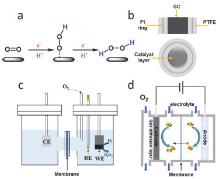
Fig 1
(a) The reaction pathway of 2e-ORR. (b) Structure of rotating ring disc electrode (RRDE). (c) Diagrammatic sketch of a H-cell. (d) Schematic diagram of a flow-cell."
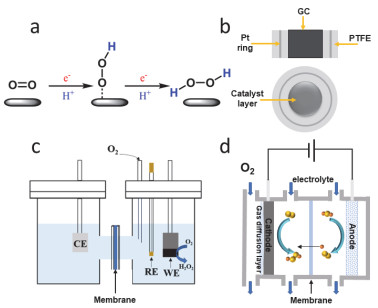
Table 3
Summary of TMOs and TMCs for H2O2 performance (M: mol∙L−1)."
| Type | Catalyst | Electrolytes | 2e-ORR Performance | Ref. |
| Metal oxides | NiOx-C | 0.1 M KOH | Onset: 0.76 VRHE | |
| Selectivity: 91% | ||||
| Co3O4 | 0.5 M H2SO4 | Selectivity: 60% | ||
| Yield: 1.6 mol∙gcat−1∙h−1 at 0.0 VRHE | ||||
| Stability: 5 h at 0.1 VRHE | ||||
| In2O3/CDs | 0.1 M KOH | Selectivity: nearly 100% | ||
| Yield: 4.5 mol∙gcat−1∙h−1 | ||||
| Stability: 5, 000 ADT cycles at 0.5 VRHE | ||||
| MnO2/C | H2SO4 0.1 M + K2SO4 0.1 M | Yield: 391 mg∙L−1 | ||
| ZnO/rGO | 0.5 M NaCl | Selectivity: 80% | ||
| ZnCo2O4/g-C3N4 | 0.1 M KOH | Selectivity: 86.74% | ||
| ZnO/ZnS@C | 0.1 M KOH | Selectivity: 90% | ||
| Yield: 16 mmol∙gcat−1∙h−1 | ||||
| Stability: 30 h at 0 VRHE | ||||
| V2O5-Ov | 0.1 M KOH | Selectivity: 92.32% | ||
| Yield: 1.96 mol∙gcat−1∙h−1 | ||||
| FE: 84% | ||||
| Nd-doped Bi4Ti3O12 | 0.1 M KOH | Selectivity: 95% | ||
| Yield: 208 mmol∙gcat−1∙h−1 at 0.36 VRHE | ||||
| FE: 97.6% | ||||
| Metal oxides | NiNb2O6 | 0.1 M KOH | Selectivity: 96% | |
| Yield: 996 mmol∙gcat−1∙h−1 | ||||
| FE: 92% | ||||
| Stability: 24 h at 0.3 VRHE | ||||
| Pr2Ni0.8Mo0.2O4+δ | 0.1 M KOH | Selectivity: 79% | ||
| Stability: 24 h at 10 mA∙cm−2 | ||||
| Pb-(NiWMnNbZrTi)1/6O3 | 0.1 M KOH | Selectivity: 91% | ||
| Stability: 12 h at 0.1 VRHE | ||||
| CoAl2O4/CoO | 0.1 M KOH | Selectivity: 85% | ||
| Yield: 1.446 mol∙gcat−1∙h−1 | ||||
| Stability: 7 h at 0.2 VRHE | ||||
| ZrO2/PL6C | 0.1 M K2SO4 | Selectivity: 88.8% | ||
| α-Fe2O3 | 0.1 M KOH 0.1 M Na2SO4 | Selectivity: 90%, 88%, and 95% in acidic, neutral, and alkaline electrolytes | ||
| 5 mM H2SO4 | Yield: 454 mmol∙gcat−1∙h−1 at 0.1 VRHE in alkaline | |||
| FE: 80.5% in AEM-flow cell | ||||
| Stability: 48 h at 0.5 VRHE | ||||
| c-WO3 | 0.1 M KOH | Selectivity: 90% | ||
| Yield: 179 mmol∙gcat−1∙h−1 | ||||
| Stability: 24 h at 0.1 VRHE | ||||
| Fe-CeO2 | 0.1 M KOH | Selectivity: 97.7% at 0.38 VRHE | ||
| Yield: 1.80 mol∙gcat−1∙h−1 at 0.1 VRHE | ||||
| FE: 94% at 0.1 VRHE | ||||
| Stability: 10 h at 0.5 VRHE | ||||
| Mn-TiO2 | 0.1 M KOH | Onset: 0.78 VRHE | ||
| Selectivity: 92.7% | ||||
| Yield: 205 mg∙L−1 h−1 at 0 VRHE | ||||
| FE: 98% at 0.3 VRHE | ||||
| Stability: 12 h at 0.40 VRHE | ||||
| Metal chalcogenides | L-PdS-Vs metallene | 0.1 M KOH | Selectivity: 90% | |
| Yield: 1.12 mol∙gcat−1∙h−1 at 0.3 VRHE | ||||
| FE: 90% | ||||
| Stability: 5, 000 CV cycles | ||||
| Pd-S NCs | 0.05 M H2SO4 | Selectivity: 90% | ||
| Yield: 12.5 mM at 0.2 VRHE | ||||
| CuNW@CoS4 | 0.1 M Na2SO4 pH = 5 | Selectivity: 93% | ||
| FE: 91% at 0.1 VRHE | ||||
| Stability: 5 h at 0.1 VRHE | ||||
| CoSe2 polymorph | 0.05 M H2SO4 | Yield: 547 mg∙L−1 | ||
| NiS2 nanosheets | 0.05 M H2SO4 | Selectivity: 99%, onset ~130 mV | ||
| Yield: 109 mg∙L−1∙h−1 0.156 VRHE | ||||
| FE: 98% at 0.456 VRHE | ||||
| Mn-CuS-2 | 0.1 M KOH | Selectivity: 92% | ||
| Yield: 90 mmol∙gcat−1∙h−1 | ||||
| Stability: 25 h at 0.6 VRHE | ||||
| Cu-defective Au@Cu2-xS-CNTs | 0.1 M KOH | Selectivity: 94% | ||
| Stability: 10 h at 0.5 VRHE | ||||
| Metal chalcogenides | Ti-ZnCoS HSS | 0.1 M KOH | Selectivity: 98% | |
| Yield: 675 mmol∙gcat−1∙h−1 | ||||
| Stability: 12 h at 0.55 VRHE | ||||
| Ni2Mo6S8 | 0.1 M KOH | Selectivity: 90% | ||
| Yield: 90 mmol∙gcat−1∙h−1 | ||||
| Stability: 10 h at 0.5 VRHE | ||||
| Metal chalcogenides | CuCo0.8Ni1.2S4 | 0.05 M H2SO4 | Selectivity: 60% | |
| Pd-Se-B NC | 0.1 M KPi buffer | Selectivity: 85% | ||
| PtSe2/C | 0.1 M HClO4 | Selectivity: 91% | ||
| Pd4Se NPs | 0.1 M HClO4 0.1 M KCl | Selectivity: 93.5%, 89.7%, and 86.7% in acidic, neutral, and alkaline electrolytes | ||
| 0.1 M KOH | ||||
| a-PdSe2 NPs | 0.1 M KOH | Selectivity: 90% in different electrolytes−1∙h−1 | ||
| 0.1 M HClO4 0.1 M Na2SO4 | Yield: 3245.7, 1725.5, and 2242.1 mmol∙gPd in alkaline, acidic, and neutral electrolytes | |||
| Cu7.2Se4 | 0.1 M KOH | Selectivity: 90% | ||
| Fe-CoSe-HT | 0.1 M KOH 0.1 M Na2SO4 | Selectivity: 99.1%, 83.2% and 93.6% in alkaline, neutral, and acidic electrolytes | ||
| 0.05 M H2SO4 | Stability: 18 h at 0.2 VRHE | |||
| sc-CoSe2 | 0.5 M H2SO4 | FE: 96.7% | ||
| Yield: 30.60 mg∙cm−2∙h−1 | ||||
| Stability: 100 h at 63 mA∙cm−2 | ||||
| CoPSe | 0.1 M HClO4 | Selectivity: 76%-85% in 0–0.5 VRHE | ||
| Stability: 10 h at 0.1 VRHE | ||||
| CoSe2@NCNTs | 0.1 M HClO4 | Selectivity: 93.2% | ||
| Yield: 172 mg∙L−1∙h−1 | ||||
| Stability: 24 h at 0.1 VRHE | ||||
| CoSe2 NS/CC | 0.1 M KOH | Selectivity: 92% | ||
| Stability: 10 h at 0.5 VRHE | ||||
| NiSe2-VSe | 0.1 M KOH | Selectivity: 96% | ||
| Stability: 40, 000 s at 0.4 VRHE | ||||
| NiSe2/CP | 0.05 M H2SO4 | Selectivity: 92% | ||
| Yield: 988 mg∙L−1 | ||||
| Stability: 12 h at 0 VRHE | ||||
| Pd-Te | 0.1 M H2SO4 | Selectivity: 75% | ||
| CoTe@NC | 0.1 M HClO4 | Selectivity: 92.6% | ||
| Yield: 297.9 mg∙L−1∙h−1 | ||||
| Stability: 12 h at 0.4 VRHE | ||||
| 2H-MoTe2 nanoflakes | 0.5 M H2SO4 | Onset: 140 mV | ||
| Selectivity: 93% |
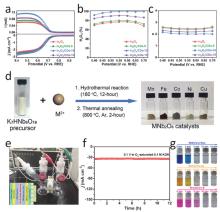
Fig 2
(a–c) Activity of 2e-ORR generated H2O2 by In2O3/CDs 55. (d) A series of columbites were obtained through hydrothermal and thermal annealing 63. (e) Digital image of H-cell, (f) i–t curve of the H2O2 production in the H-cell, and (g) images for the decolorization of MB, MO, and RB against the degradation time 66."
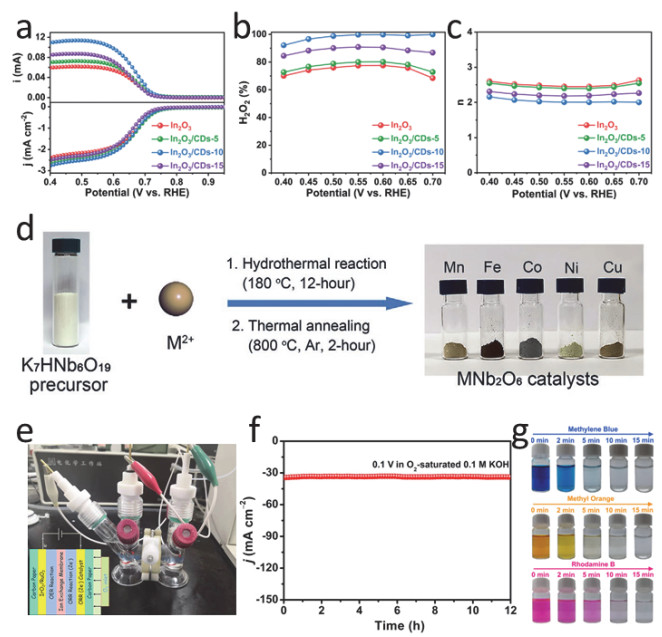
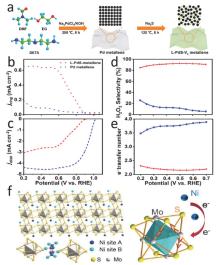
Fig 3
The synthesis process of L-PdS-Vs metallene via a solvothermal method (a), and current density (b, c) and activity (d, e) of L-PdS-Vs metallene for 2e-ORR to H2O2 70. (f) The Ni2Mo6S8 catalyst crystal structure and electronic interactions between Ni and Mo6S8 79."
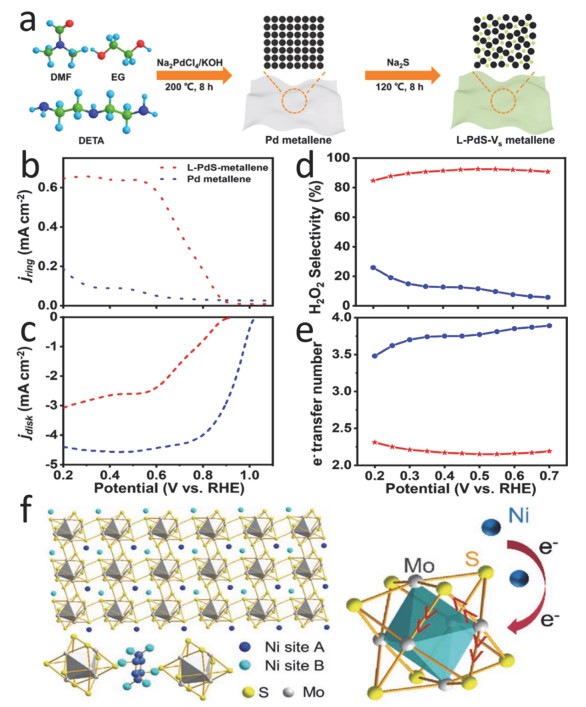
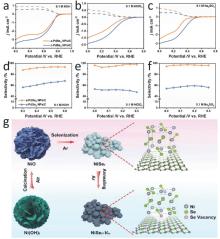
Fig 4
(a–f) Electrocatalytic 2-electron ORR performance of a-PdSe2 NPs/C in different electrolyte 84. (g) The synthesis of NiSe2-VSe via selenization and annealing 97."
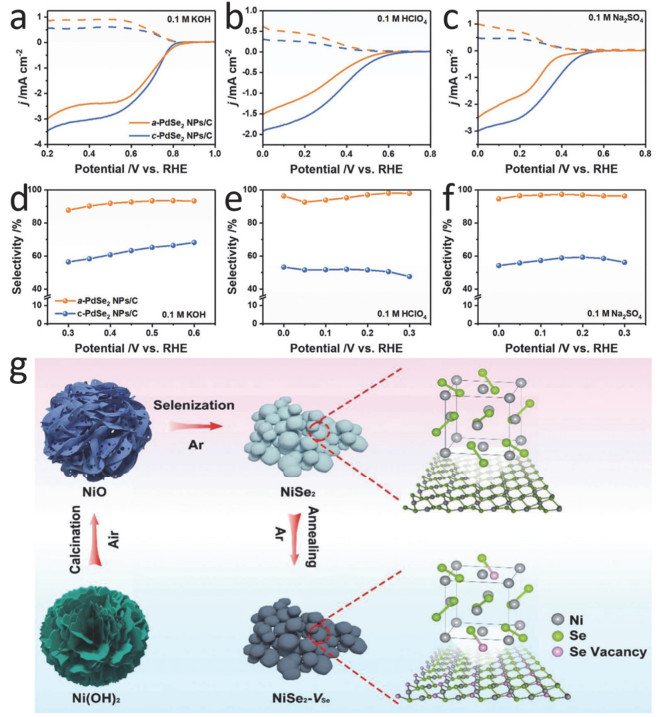
Fig 5
(a, b) Current density and selectivity of 2e-ORR and (c) Long-term stability for CoTe@NC working in an H-cell for 12 h 103. (d, e) The 2H-phase molybdenum telluride (MoTe2) nanoflakes were synthesized from bulk powder via ultrasonication-assisted liquid phase exfoliation 104."
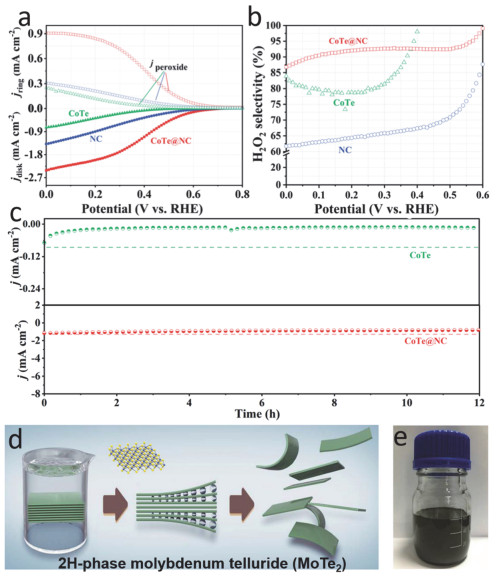
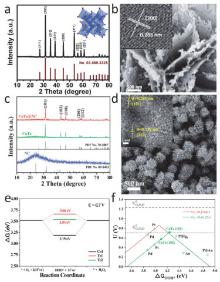
Fig 6
(a, b) NiS2 nanosheets with exposed (200) crystal face 75. (c, d) CoTe nanoparticles with exposed (101) crystal face. (e) Free energy diagrams of O2 reduction to H2O2 on the CoTe (101) at U = 0.7 V, and (f) O2 reduction volcano plots for the 2e− (green) and 4e− (red) reduction pathways 103."
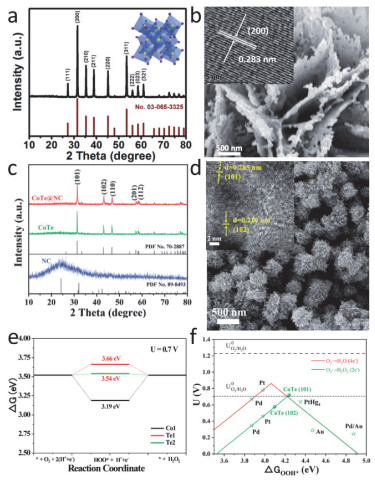
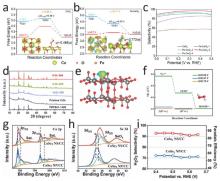
Fig 7
(a, b) Free energy diagrams with theoretical overpotential for 2e-ORR at zero potential for Fe-CeO2 and CeO2, (c) H2O2 selectivity of Fe-CeO2 112. (d) The XRD patterns, (e) O2 adsorption model and (f) 2e-ORR reaction coordinate diagrams of V2O5-VO 61. (g, h) The high-resolution XPS spectra and (i) 2e-ORR activity of CoSe2 NS/CC and CoSe2 NP/CC 96."
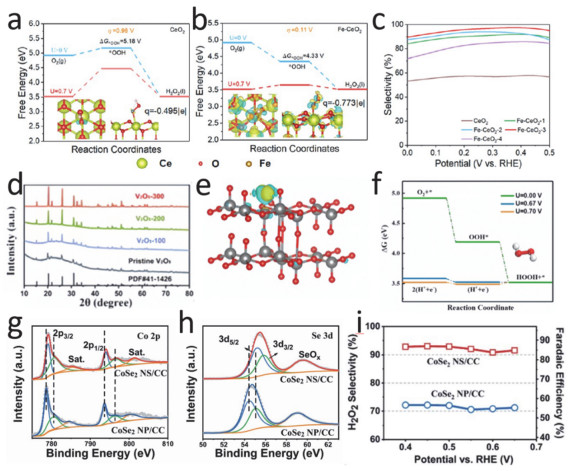
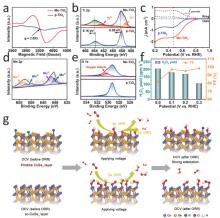
Fig 8
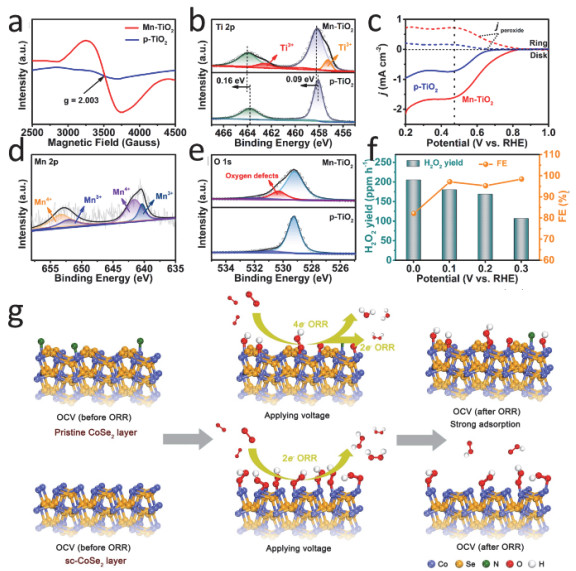
(a) The EPR spectra, (b, d, e) XPS spectra and (c, f) H2O2 performance of Mn-TiO2 113. (g) The ORR process on the sc-CoSe2 88."
| 1 |
doi: 10.1002/aenm.202201466 |
| 2 |
doi: 10.1002/aenm.202300119 |
| 3 |
doi: 10.3866/PKU.WHXB202301001 |
| 4 |
doi: 10.3866/PKU.WHXB202305019 |
| 5 |
Knotter, D. M. The Chemistry of Wet Cleaning. In Handbook of Cleaning in Semiconductor Manufacturing; Reinhardt, K. A., Reidy R. F. Eds.; Scrivener: Beverly, America, 2010; pp. 39–94. doi: 10.1002/9781118071748.ch2
|
| 6 |
doi: 10.3866/PKU.WHXB201711151 |
| 7 |
doi: 10.1039/C7GC03864J |
| 8 |
doi: 10.1016/j.checat.2022.06.002 |
| 9 |
doi: 10.1016/j.jcis.2020.04.030 |
| 10 |
doi: 10.1002/anie.200503779 |
| 11 |
doi: 10.1038/s41929-020-0486-1 |
| 12 |
doi: 10.1021/acscatal.8b00217 |
| 13 |
doi: 10.1016/j.apcata.2008.07.043 |
| 14 |
doi: 10.1039/D1EE02884G |
| 15 |
doi: 10.1038/s41467-022-33757-0 |
| 16 |
doi: 10.3866/PKU.WHXB202212010 |
| 17 |
doi: 10.3866/PKU.WHXB202209016 |
| 18 |
doi: 10.1016/S1872-2067(23)64514-0 |
| 19 |
doi: 10.1038/s41467-024-47624-7 |
| 20 |
doi: 10.1038/s41467-024-45604-5 |
| 21 |
doi: 10.1002/adma.202400288 |
| 22 |
doi: 10.1016/j.apcatb.2021.121036 |
| 23 |
doi: 10.1002/anie.201812435 |
| 24 |
doi: 10.1016/j.apcatb.2023.122491 |
| 25 |
doi: 10.1002/aenm.202102025 |
| 26 |
doi: 10.1002/smll.202302338 |
| 27 |
doi: 10.1016/j.carbon.2020.02.084 |
| 28 |
doi: 10.1021/acssuschemeng.9b07047 |
| 29 |
doi: 10.1038/s41467-023-41947-7 |
| 30 |
doi: 10.1021/jacs.3c00689 |
| 31 |
doi: 10.1016/j.chempr.2020.04.002 |
| 32 |
doi: 10.53941/see.2024.100004 |
| 33 |
doi: 10.3866/PKU.WHXB202008018 |
| 34 |
doi: 10.3866/PKU.WHXB202211025 |
| 35 |
doi: 10.1039/D2TA00075J |
| 36 |
doi: 10.1002/adfm.202003619 |
| 37 |
doi: 10.1039/D4TA01430H |
| 38 |
doi: 10.1016/j.cej.2019.01.156 |
| 39 |
doi: 10.1002/adma.202303030 |
| 40 |
doi: 10.1039/D1CS00859E |
| 41 |
doi: 10.3866/PKU.WHXB202210039 |
| 42 |
doi: 10.1002/advs.202100076 |
| 43 |
doi: 10.1007/s40820-023-01152-z |
| 44 |
Alonso-Vante, N. Transition Metal Chalcogenides for Oxygen Reduction. In Electrocatalysis in Fuel Cells: A Non- and Low-Platinum Approach; Shao, M. Ed.; Springer: London, Britain, 2013; pp. 417–436. doi: 10.1007/978-1-4471-4911-8_14
|
| 45 |
doi: 10.1038/s41929-021-00618-w |
| 46 |
doi: 10.1039/C9CS00869A |
| 47 |
doi: 10.1007/s40820-023-01067-9 |
| 48 |
doi: 10.1021/acs.chemrev.7b00542 |
| 49 |
doi: 10.1021/acscatal.6b01581 |
| 50 |
doi: 10.1016/S1872-2067(21)64028-7 |
| 51 |
doi: 10.1038/s41467-021-23896-1 |
| 52 |
doi: 10.1016/j.apmt.2023.101912 |
| 53 |
doi: 10.1021/acscatal.2c01829 |
| 54 |
doi: 10.1016/j.mtener.2021.100931 |
| 55 |
doi: 10.1002/adfm.202203647 |
| 56 |
doi: 10.1016/j.electacta.2018.02.077 |
| 57 |
doi: 10.1016/j.colsurfa.2023.131446 |
| 58 |
doi: 10.1016/j.electacta.2023.142161 |
| 59 |
doi: 10.1016/j.electacta.2023.142852 |
| 60 |
doi: 10.1039/D2TA09450A |
| 61 |
doi: 10.1021/acs.iecr.3c00262 |
| 62 |
doi: 10.1021/acs.jpcc.1c08140 |
| 63 |
doi: 10.1002/smll.202007249 |
| 64 |
doi: 10.1002/sus2.71 |
| 65 |
doi: 10.1021/acssuschemeng.2c04965 |
| 66 |
doi: 10.1002/anie.202200086 |
| 67 |
doi: 10.1021/acssuschemeng.3c05426 |
| 68 |
doi: 10.1016/j.matchemphys.2021.124575 |
| 69 |
doi: 10.1002/adfm.201910539 |
| 70 |
doi: 10.1021/acsanm.3c04938 |
| 71 |
doi: 10.1007/s12274-021-3786-0 |
| 72 |
doi: 10.1016/j.apcatb.2023.122825 |
| 73 |
doi: 10.1016/j.cej.2023.145581 |
| 74 |
doi: 10.1021/acscatal.9b02546 |
| 75 |
doi: 10.1039/D0TA12008A |
| 76 |
doi: 10.1016/j.apcatb.2023.122721 |
| 77 |
doi: 10.1016/j.cej.2022.140317 |
| 78 |
doi: 10.1002/advs.202104768 |
| 79 |
doi: 10.1002/adfm.202104716 |
| 80 |
doi: 10.1021/acscatal.1c03349 |
| 81 |
doi: 10.1016/j.apcatb.2022.121265 |
| 82 |
doi: 10.1021/acsami.3c02793 |
| 83 |
doi: 10.1016/j.nanoen.2021.106480 |
| 84 |
doi: 10.1002/adma.202208101 |
| 85 |
doi: 10.1021/acs.nanolett.1c04420 |
| 86 |
doi: 10.1016/j.apcatb.2023.123344 |
| 87 |
doi: 10.1039/d0ee01925a |
| 88 |
doi: 10.1002/anie.202111075 |
| 89 |
doi: 10.1016/j.cclet.2023.108472 |
| 90 |
doi: 10.1007/s12274-021-3474-0 |
| 91 |
doi: 10.1007/s40820-020-00456-8 |
| 92 |
doi: 10.1002/adma.202107040 |
| 93 |
doi: 10.1021/jacs.3c14186 |
| 94 |
doi: 10.1002/adma.201800005 |
| 95 |
doi: 10.1016/S1872-2067(16)62456-7 |
| 96 |
doi: 10.1039/d1ta05731f |
| 97 |
doi: 10.1002/advs.202205347 |
| 98 |
doi: 10.1038/s41929-022-00826-y |
| 99 |
doi: 10.1007/s12274-022-5160-2 |
| 100 |
doi: 10.1016/s1872-2067(21)64007-x |
| 101 |
doi: 10.1016/j.apsusc.2023.158976 |
| 102 |
doi: 10.1149/1945-7111/acafa5 |
| 103 |
doi: 10.1039/d1ta06313h |
| 104 |
doi: 10.1093/nsr/nwaa084 |
| 105 |
Liu, M.; Yang, M.; Shu, X.; Zhang, J. 2021, 37 (9), 2007072. doi: 10.3866/PKU.WHXB202007072
|
| 106 |
doi: 10.1016/j.joule.2019.12.014 |
| 107 |
doi: 10.1016/j.pecs.2023.101101 |
| 108 |
doi: 10.1016/j.mattod.2023.02.004 |
| 109 |
doi: 10.1039/D1TA06144E |
| 110 |
doi: 10.1016/j.cej.2022.139449 |
| 111 |
doi: 10.3866/PKU.WHXB202307057 |
| 112 |
doi: 10.1021/acssuschemeng.3c04194 |
| 113 |
doi: 10.1021/acsami.1c13307 |
| 114 |
doi: 10.1016/S1872-2067(21)63961-X |
| 115 |
doi: 10.1002/adma.201804799 |
| 116 |
doi: 10.1002/aenm.202101222 |
| 117 |
doi: 10.1016/j.ccr.2022.214854 |
| [1] | Xue Liu, Lipeng Wang, Luling Li, Kai Wang, Wenju Liu, Biao Hu, Daofan Cao, Fenghao Jiang, Junguo Li, Ke Liu. Research on Cu-Based and Pt-Based Catalysts for Hydrogen Production through Methanol Steam Reforming [J]. Acta Phys. -Chim. Sin., 2025, 41(5): 100049-. |
| [2] | Kangjuan Cheng, Chunxiao Liu, Youpeng Wang, Qiu Jiang, Tingting Zheng, Xu Li, Chuan Xia. Design of noble metal catalysts and reactors for the electrosynthesis of hydrogen peroxide [J]. Acta Phys. -Chim. Sin., 2025, 41(10): 100112-. |
| [3] | Lina Guo, Ruizhe Li, Chuang Sun, Xiaoli Luo, Yiqiu Shi, Hong Yuan, Shuxin Ouyang, Tierui Zhang. Effect of Interlayer Anions in Layered Double Hydroxides on the Photothermocatalytic CO2 Methanation of Derived Ni-Al2O3 Catalysts [J]. Acta Phys. -Chim. Sin., 2025, 41(1): 100002-. |
| [4] | Ye Wang, Ruixiang Ge, Xiang Liu, Jing Li, Haohong Duan. An Anion Leaching Strategy towards Metal Oxyhydroxides Synthesis for Electrocatalytic Oxidation of Glycerol [J]. Acta Phys. -Chim. Sin., 2024, 40(7): 2307019-. |
| [5] | Yixuan Wang, Canhui Zhang, Xingkun Wang, Jiarui Duan, Kecheng Tong, Shuixing Dai, Lei Chu, Minghua Huang. Engineering Carbon-Chainmail-Shell Coated Co9Se8 Nanoparticles as Efficient and Durable Catalysts in Seawater-Based Zn-Air Batteries [J]. Acta Phys. -Chim. Sin., 2024, 40(6): 2305004-. |
| [6] | Zhaoyu Wen, Na Han, Yanguang Li. Recent Progress towards the Production of H2O2 by Electrochemical Two-Electron Oxygen Reduction Reaction [J]. Acta Phys. -Chim. Sin., 2024, 40(2): 2304001-. |
| [7] | Yuehan Cao, Rui Guo, Minzhi Ma, Zeai Huang, Ying Zhou. Effects of Electron Density Variation of Active Sites in CO2 Activation and Photoreduction: A Review [J]. Acta Phys. -Chim. Sin., 2024, 40(1): 2303029-. |
| [8] | Fengyu Gao, Hengheng Liu, Xiaolong Yao, Zaharaddeen Sani, Xiaolong Tang, Ning Luo, Honghong Yi, Shunzheng Zhao, Qingjun Yu, Yuansong Zhou. Spherical MnxCo3−xO4−ƞ Spinel with Mn-Enriched Surface as High-Efficiency Catalysts for Low-Temperature Selective Catalytic Reduction of NOx by NH3 [J]. Acta Phys. -Chim. Sin., 2023, 39(9): 2212003-0. |
| [9] | Yanhui Yu, Peng Rao, Suyang Feng, Min Chen, Peilin Deng, Jing Li, Zhengpei Miao, Zhenye Kang, Yijun Shen, Xinlong Tian. Atomic Co Clusters for Efficient Oxygen Reduction Reaction [J]. Acta Phys. -Chim. Sin., 2023, 39(8): 2210039-0. |
| [10] | Chang Lan, Yuyi Chu, Shuo Wang, Changpeng Liu, Junjie Ge, Wei Xing. Research Progress of Proton-Exchange Membrane Fuel Cell Cathode Nonnoble Metal M-Nx/C-Type Oxygen Reduction Catalysts [J]. Acta Phys. -Chim. Sin., 2023, 39(8): 2210036-0. |
| [11] | Jingxue Li, Yue Yu, Siran Xu, Wenfu Yan, Shichun Mu, Jia-Nan Zhang. Function of Electron Spin Effect in Electrocatalysts [J]. Acta Phys. -Chim. Sin., 2023, 39(12): 2302049-. |
| [12] | Jiashun Liang, Xuan Liu, Qing Li. Principles, Strategies, and Approaches for Designing Highly Durable Platinum-based Catalysts for Proton Exchange Membrane Fuel Cells [J]. Acta Phys. -Chim. Sin., 2021, 37(9): 2010072-. |
| [13] | Zhengrong Li, Tao Shen, Yezhou Hu, Ke Chen, Yun Lu, Deli Wang. Progress on Ordered Intermetallic Electrocatalysts for Fuel Cells Application [J]. Acta Phys. -Chim. Sin., 2021, 37(9): 2010029-. |
| [14] | Miaomiao Liu, Maomao Yang, XinXin Shu, Jintao Zhang. Design Strategies for Carbon-Based Electrocatalysts and Application to Oxygen Reduction in Fuel Cells [J]. Acta Phys. -Chim. Sin., 2021, 37(9): 2007072-. |
| [15] | Hongsa Han, Yanqing Wang, Yunlong Zhang, Yuanyuan Cong, Jiaqi Qin, Rui Gao, Chunxiao Chai, Yujiang Song. Oxygen Reduction Reaction Electrocatalysts Derived from Metalloporphyrin-Modified Meso-/Macroporous Polyaniline [J]. Acta Phys. -Chim. Sin., 2021, 37(9): 2008017-. |
|
||