Acta Phys. -Chim. Sin. ›› 2024, Vol. 40 ›› Issue (2): 2303060.doi: 10.3866/PKU.WHXB202303060
• REVIEW • Previous Articles Next Articles
Research Progress on Modification Strategies of Organic Electrode Materials for Energy Storage Batteries
Yan Xin1,2,*( ), Yunnian Ge2, Zezhong Li2, Qiaobao Zhang3,*(), Huajun Tian1,2,*()
- 1 Key Laboratory of Power Station Energy Transfer Conversion and Systems, Ministry of Education, North China Electric Power University, Beijing 102206, China
2 School of Energy and Power Engineering, North China Electric Power University, Beijing 102206, China
3 State Key Laboratory of Physical Chemistry of Solid Surfaces, College of Materials, Xiamen University, Xiamen 361005, Fujian Province, China
-
Received:2023-03-31Revised:2023-05-10Accepted:2023-05-17Published:2023-05-29 -
Contact:Email: xinyan@ncepu.edu.cn (Yan Xin)zhangqiaobao@xmu.edu.cn (Qiaobao Zhang)huajun.tian@ncepu.edu.cn (Huajun Tian) -
Supported by:the National Natural Science Foundation of China(52122211); the National Natural Science Foundation of China(52072323); the Interdisciplinary Innovation Program of North China Electric Power University(XM2212315); the Fundamental Research Funds for the Central Universities of China(2018MS019)

Cite this article
Yan Xin, Yunnian Ge, Zezhong Li, Qiaobao Zhang, Huajun Tian. Research Progress on Modification Strategies of Organic Electrode Materials for Energy Storage Batteries[J]. Acta Phys. -Chim. Sin. 2024, 40(2), 2303060. doi: 10.3866/PKU.WHXB202303060
share this article
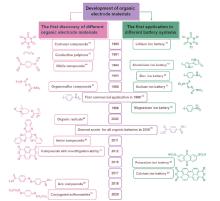
Fig 1
Development history of organic electrode materials."
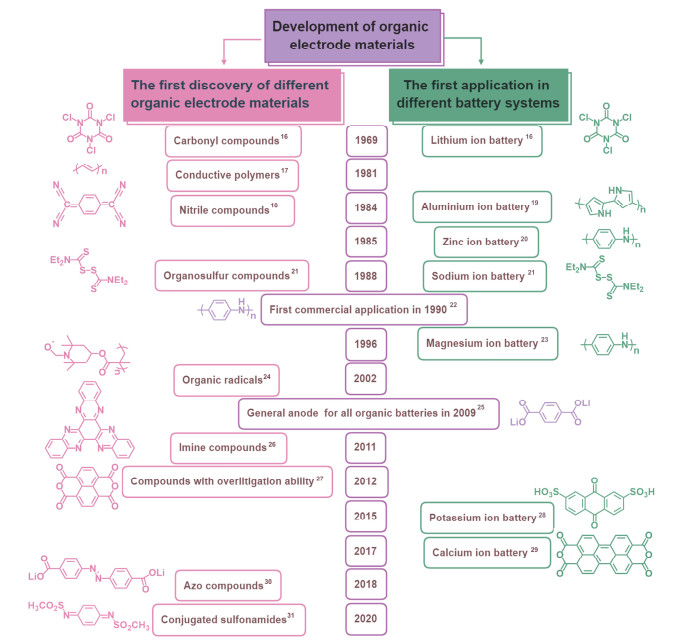
Table 1
Characteristics and applications of organic electrode materials."
| OEMs species | Advantages | Disadvantages | Applications |
| Carbonyl compounds (C=O) | High specific capacity Fast kinetics Flexible structure design | High solubility Poor electrical conductivity | LIB PIB MIB |
| Conductive polymers | High conductivity | Limited doping level Finite energy density | LIB PIB MIB |
| Nitrile compounds (C≡N) | High discharge potential | High solubility | LIB |
| Organosulfur compounds (S―S) | High specific capacity Wide operating temperature range | High solubility Shuttle effect Sluggish kinetics Poor electrical conductivity | LIB MIB |
| Organic free radical compounds (N―O) | High discharge potential Fast kinetics Multiplier performance | Low specific capacity Poor electrical conductivity Self-discharge | LIB ZIB |
| Imine compounds (C=N) | High specific capacity Fast kinetics | High solubility Poor electrical conductivity | LIB ZIB AIB |
| Compounds with superlitigation ability | High specific capacity Fast kinetics | High solubility Poor electrical conductivity | LIB PIB |
| Azo compounds (N=N) | High specific capacity Stable cycle performance | High solubility Poor electrical conductivity | LIB PIB |
| Conjugated sulfonamides (R―S(=O)2−) | High discharge potential Stable cycle performance High energy density | Still uncertain | LIB |
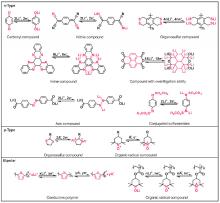
Fig 2
Redox mechanism of organic electrode materials."
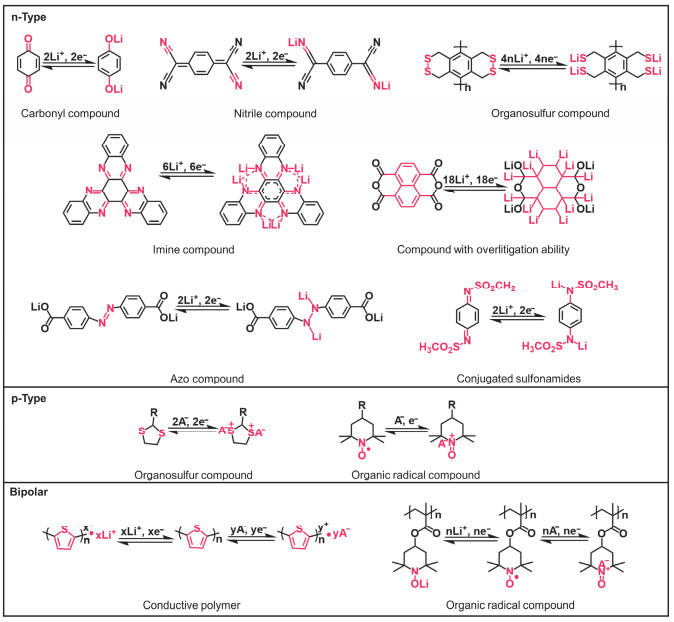
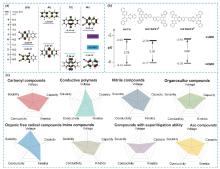
Fig 3
(a) HOMO/LUMO energy levels of DTN, AQ, TTE and NLC92; (b) molecular structure and HOMO/LUMO energy levels of HATN, HATNPF12 and HATNPF2293; (c) summary of basic properties of common organic electrode materials."
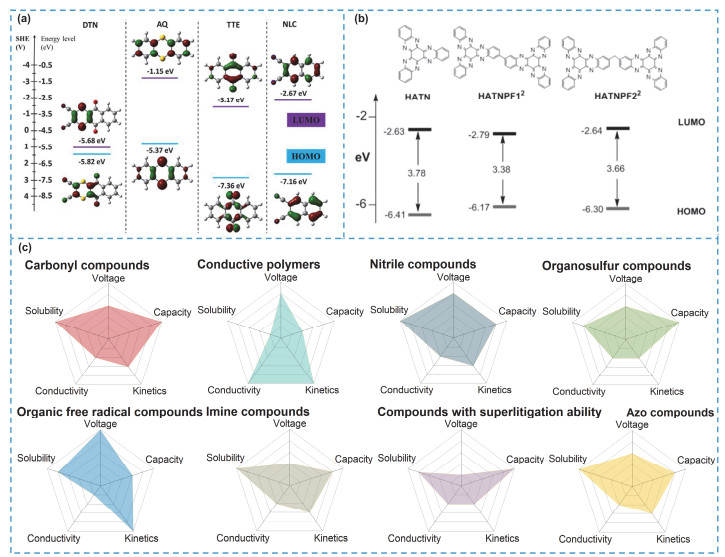
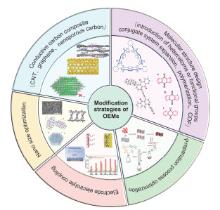
Fig 4
Modification strategies of OEMs."
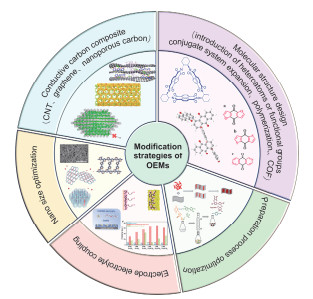
Table 2
Effects of different substituents and representative organic molecular structures."
| Substituents | Functions | Molecular structure illustrations |
| O | Increase the potential | |
| S | Increase the potential Heighten conductivity | |
| N | Increase the potential | |
| ―X (= F, Cl, Br) | Increase the potential | |
| ―OH | Reduce solubility Improve cycle performance Increase the potential | |
| ―C≡N | Higher energy density Increase the potential | |
| ―NH2 | Formation of hydrogen bonds Reduce solubility | |
| XCOO― (X = Li, Na, K) | Reduce solubility Improve cycle performance Reduce the potential | |
| XSO3― (X = Li, Na, K) | Reduce solubility Improve cycle performance Increase the potential |
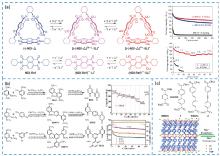
Fig 5
(a) Structural formula, redox process and electrochemical performance of conjugated system extension (−)-NDI-Δ and monomer derivative NDI-Ref. 106; (b) synthetic routes of BBQ, BBQB, TBQB and corresponding electrochemical properties107; (c) the chemical structure of SBDC and three possible extended π-conjugated structures and molecular packing diagram of SSDC108."
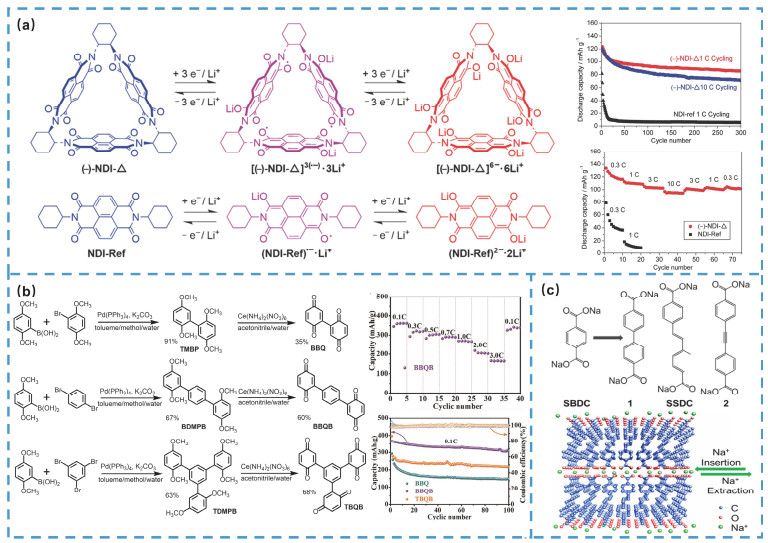
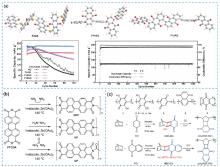
Fig 6
(a) The optimized geometries of the four materials: AQ, PAQS, P14AQ, and P15AQ and cycle profiles at a current density of 0.2C and long cycle profiles of P14AQ at a current density of 1C and 2C112; (b) The synthesis scheme of polymers EDP, HP and UP113; (c) Structures of polymers containing BQ and NQ, synthetic routes of poly(NBE-BQ) and poly(NBE-NQ)114."
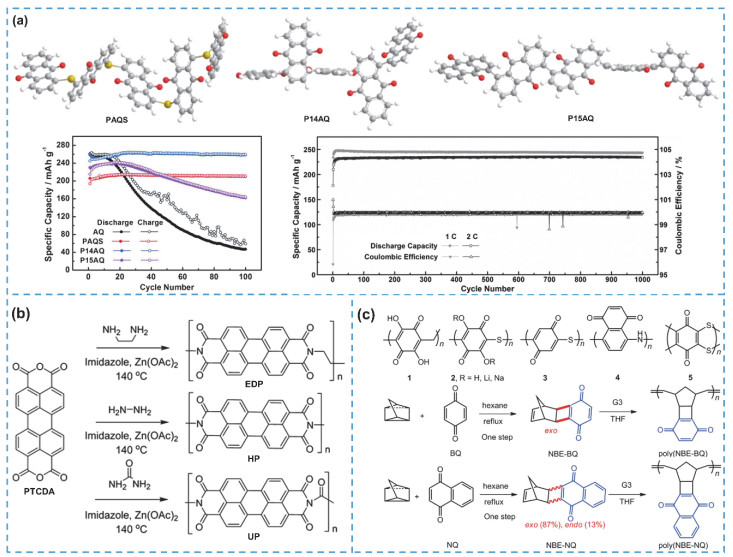
Fig 7
(a) Synthesis, energy storage mechanism and electrochemical performance of 2D-PAI@CNT135; (b) graphical representation of COF@CNTs with few COF layers covered on the exterior surface of CNTs141; (c) the synthesis strategy, morphological characterization and cycle performance of PMTA/SWCNT142."
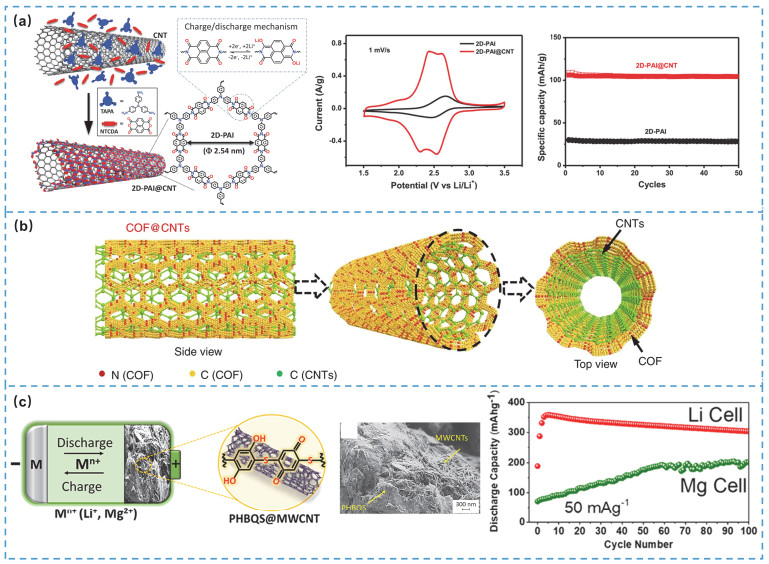
Fig 8
(a) Scheme of the synthesis process of PC/G composites and the corresponding cycle performance151; (b) schematic illustration of the synthesis of VG 8/G composite and the corresponding cycle performance153; (c) schematic illustration of the formation of Na2TP@GE and the corresponding cycle performance154; (d) schematic diagram of in situ braided GDY nanocoatings and the corresponding cycle performance156."
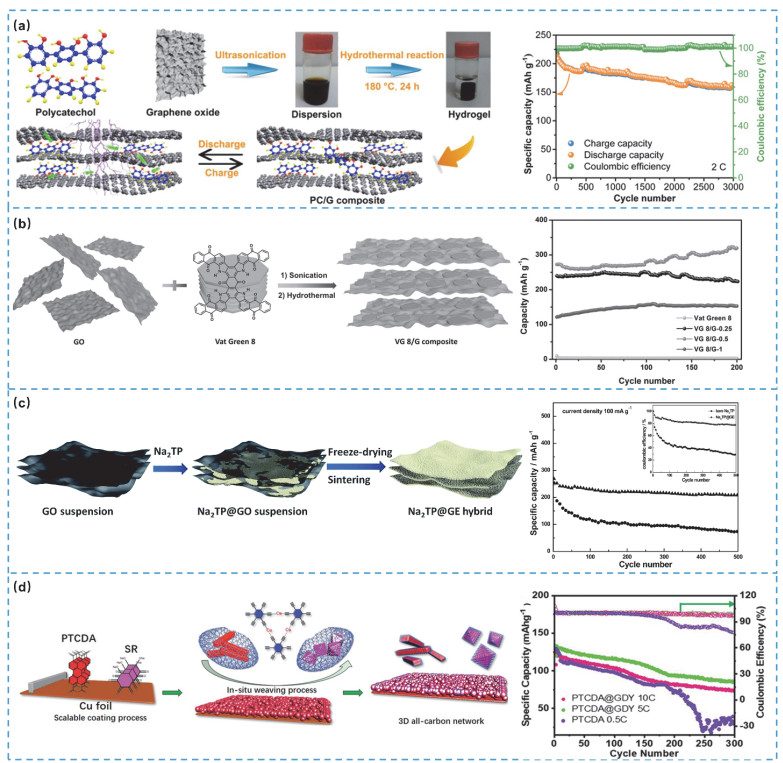
Fig 9
(a) Fabrication process of C6Cl4O2/CMK composite and its electrochemical properties and cycle performance159; (b) preparation of H2bhnq/CMK-3 composites and schematic diagram of electrochemical performance160."
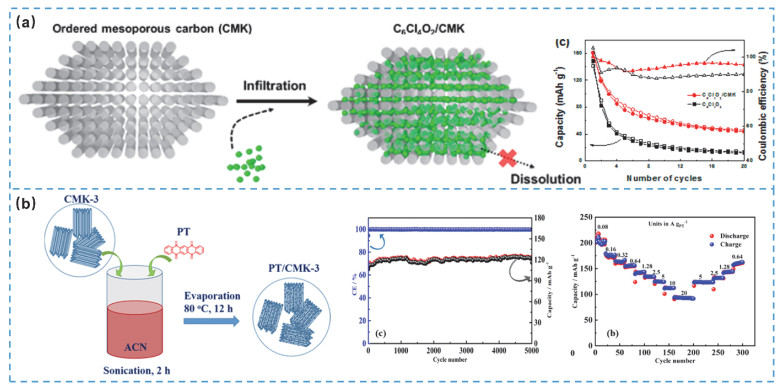
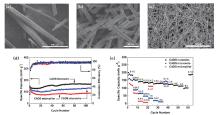
Fig 10
SEM images and electrochemical properties of CADS with different sizes: (a) micropillar; (b) microwire; (c) nanowire; (d) cycle life; (e) rate capability163."
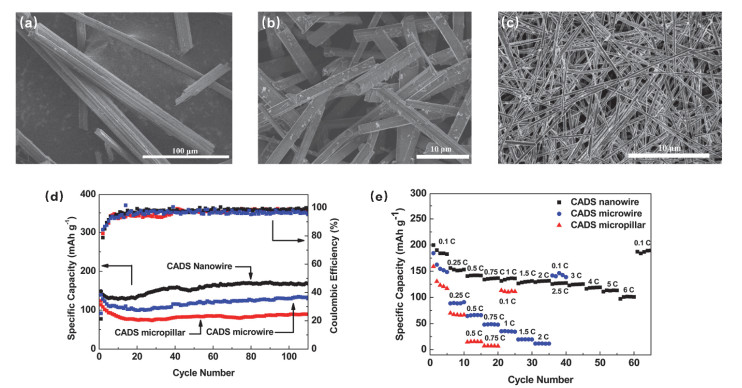
Fig 11
(a) The schematic redox reaction mechanisms of PT and P33DT165; (b) structural diagrams of four conjugated ladder polymers; (c) electrochemical performance of CLP-HAT in potassium ion batteries and morphological characterization169."
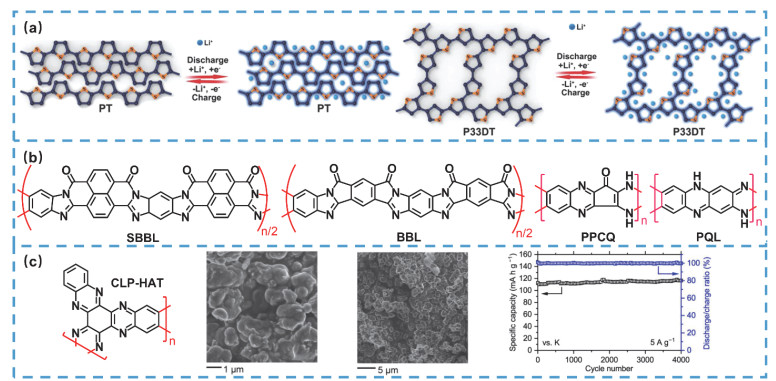
Fig 12
(a) Schematic diagram of layer-by-layer stacking of 2D-COF with different thicknesses and corresponding electrochemical performance170; (b) schematic illustration for the exfoliation of 2D redox-Active COF into exfoliated COF as cathodes for lithium ion battery122; (c) exfoliation of COF-43 yields a suspension of few-layer 2D polymers171."
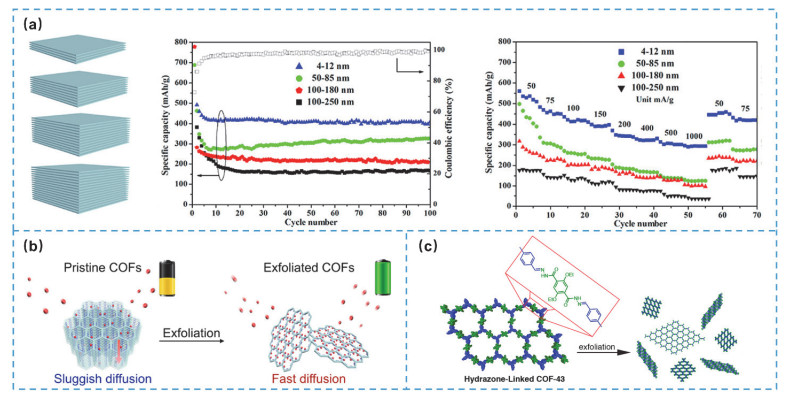
Fig 13
(a) The physical and chemical properties of different electrolytes and the electrochemical performance of PI-1/CNT as electrode materials174; (b) HOMO and LUMO energy levels of different solvents and salts175; (c) interaction and cycle performance of PBALS in liquid and solid electrolytes176."
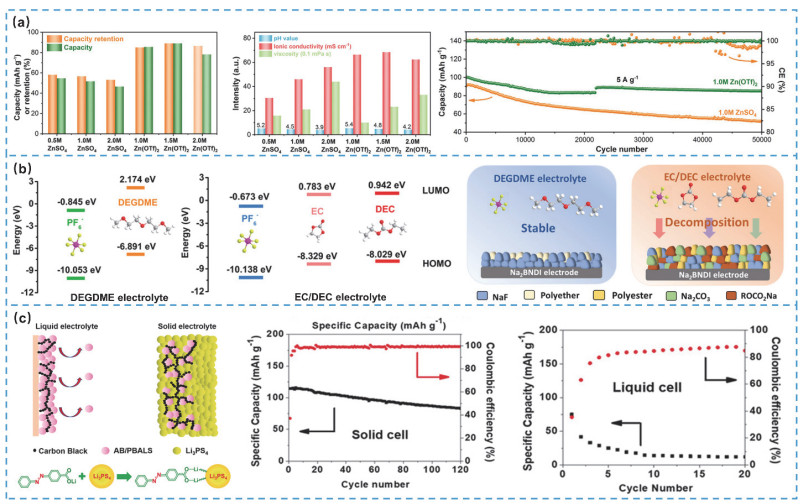
Fig 14
(a) Schematic diagram of PTCDA/rGO synthesis process and electrochemical performance179; (b) schematic diagram of the synthesis process and electrochemical performance of PQANPs180."
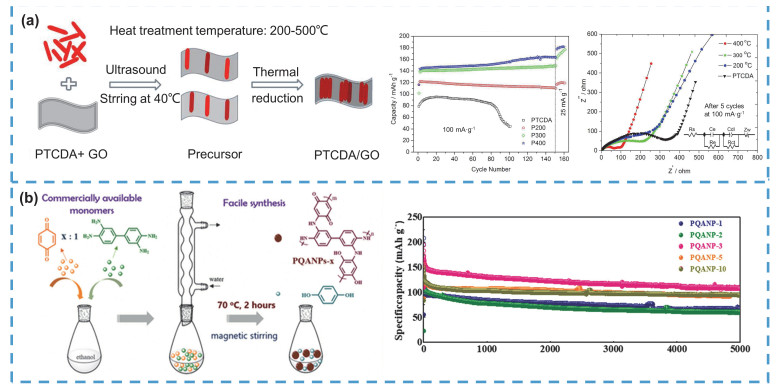
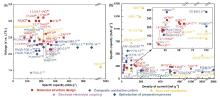
Fig 15
(a) Capacity–voltage and (b) current density–capacity diagrams of partially modified organic electrode materials."
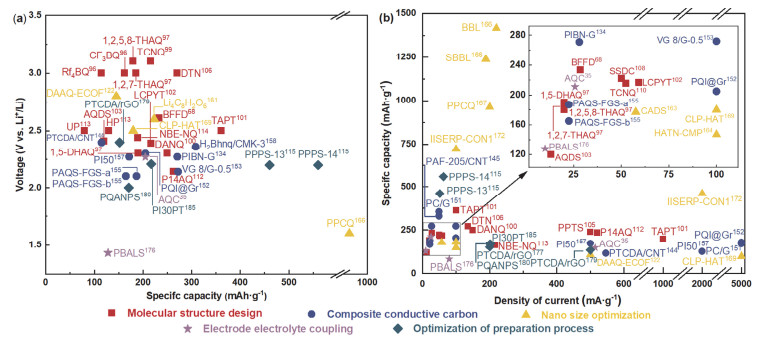
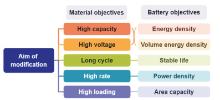
Fig 16
OEM modified target."
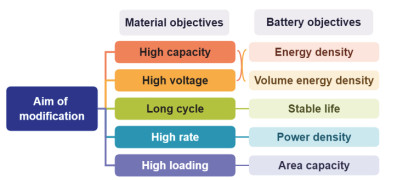
Table 3
Representative OEM with excellent long cycle performance."
| Materials | Electrolyte | Current density/initial specific capacity (mAh∙g−1) | Range of voltage (V) | Cycle number/capacity retention rate (%) | Ref. |
| HATN(3Q)//Li | LiPF6/EC + DEC | 0.5 A∙g−1/152 | 1.5–4.0 | 2000/80 | |
| HATN(3Q)//Li | 1 mol∙L−1 LiTFSI in DME/DOL | 8 A∙g−1/215 | 1.2–3.9 | 6000/80 | |
| 2Q//Li | 1 mol∙L−1 LiTFSI in DME/DOL | 8 A∙g−1/229 | 1.2–3.9 | 6000/81 | |
| BAQIT//Li | 1 mol∙L−1 LiTFSI in DOL/DME = 1 : 1 v/v | 0.5 A∙g−1/155 | 1.5–3.5 | 2200/86 | |
| PBQS//Li | 1 mol∙L−1 LiTFSI in DOL/DME = 1 : 1 v/v | 0.5 A∙g−1/231 | 1.5–4.0 | 1000/86 | |
| P14AQ//Li | 1 mol∙L−1 LiTFSI in DOL/DME = 2 : 1 v/v | 0.52 A∙g−1/235 | 1.5–3.0 | 1000/96 | |
| PI2//Li | 1 mol∙L−1 LiTFSI in DOL/DME = 1 : 1 v/v | 0.37 A∙g−1/170 | 1.5–3.0 | 1000/81.3 | |
| PPTS//Na | 1 mol∙L−1 NaPF6 in DME | 1 A∙g−1/271 | 0.8–3.2 | 2000/84.8 | |
| BQ1-COF//Li | 1 mol∙L−1 LiTFSI in DOL/DME = 1 : 1 v/v | 1.55 A∙g−1/245 | 1.2–3.5 | 1000/81 | |
| HATNPF1//Li | 1 mol∙L−1 LiTFSI in G4 | 0.5 A∙g−1/180 | 1.5–4.0 | 1200/92 | |
| NSHATN//Li | 1 mol∙L−1 LiTFSI in G4 | 0.5 A∙g−1/183 | 1.5–4.0 | 1500/83 | |
| TQBG-COF//Na | 1 mol∙L−1 NaPF6 in DEGDME | 1 A∙g−1/221 | 1.0–3.6 | 1000/96.4 | |
| HATN//Zn | 2 mol∙L−1 ZnSO4 aqueous | 5 A∙g−1/150 | 0.3–1.1 | 5000/93.3 | |
| HFHATN//Zn | 2 mol∙L−1 ZnSO4 aqueous | 5 A∙g−1/196 | 0.1–1.46 | 1000/97.4 | |
| CLPy//Zn | 30 mol∙L−1 ZnCl2 aqueous | 3 A∙g−1/205 | 0.6–1.8 | 38000/96.4 | |
| Tp-PTO-COF//Zn | 2 mol∙L−1 ZnSO4 aqueous | 2 A∙g−1/230 | 0.4–1.5 | 1000/95 |
| 1 |
doi: 10.1038/451652a |
| 2 |
doi: 10.1038/natrevmats.2016.13 |
| 3 |
doi: 10.1038/nchem.2085 |
| 4 |
doi: 10.1038/s41565-019-0371-8 |
| 5 |
doi: 10.1021/acs.chemrev.9b00482 |
| 6 |
|
|
黄俊达; 朱宇辉; 冯煜; 韩叶虎; 谷振一; 刘日鑫; 杨冬月; 陈凯; 张相禹; 孙威; 等. 物理化学学报, 2022, 38, 2208008.
doi: 10.3866/PKU.WHXB202208008 |
|
| 7 |
doi: 10.1016/j.joule.2019.03.028 |
| 8 |
doi: 10.1038/s41467-020-15355-0 |
| 9 |
|
|
朱思颖; 李辉阳; 胡忠利; 张桥保; 赵金保; 张力. 物理化学学报, 2022, 38, 2103052.
doi: 10.3866/PKU.WHXB202103052 |
|
| 10 |
doi: 10.1002/cssc.200700161 |
| 11 |
doi: 10.1021/acsomega.6b00504 |
| 12 |
doi: 10.1021/acsami.9b20384 |
| 13 |
doi: 10.1016/j.chempr.2018.09.005 |
| 14 |
doi: 10.1002/smll.201805061 |
| 15 |
doi: 10.1021/acs.chemmater.9b03109 |
| 16 |
doi: 10.1149/1.2411755 |
| 17 |
doi: 10.1039/C39810000317 |
| 18 |
doi: 10.1149/1.2115542 |
| 19 |
doi: 10.1021/ja00320a014 |
| 20 |
doi: 10.1080/00268948508074857 |
| 21 |
doi: 10.1149/1.2095460 |
| 22 |
doi: 10.1002/pat.1990.220010106 |
| 23 |
doi: 10.1016/0379-6779(96)80214-1 |
| 24 |
doi: 10.1016/S0009-2614(02)00705-4 |
| 25 |
doi: 10.1038/nmat2372 |
| 26 |
doi: 10.1246/cl.2011.750 |
| 27 |
doi: 10.1002/ange.201109187 |
| 28 |
doi: 10.1016/j.nanoen.2015.10.015 |
| 29 |
doi: 10.1021/jacs.7b06313 |
| 30 |
doi: 10.1073/pnas.1717892115 |
| 31 |
doi: 10.1038/s41563-020-00869-1 |
| 32 |
doi: 10.1016/0167-2738(88)90316-5 |
| 33 |
doi: 10.1002/adma.19930050918 |
| 34 |
doi: 10.1039/c5ta10713j |
| 35 |
doi: 10.1002/advs.201500018 |
| 36 |
doi: 10.1016/j.elecom.2015.08.027 |
| 37 |
doi: 10.1039/c9ta00647h |
| 38 |
doi: 10.1002/anie.202116289 |
| 39 |
doi: 10.1002/aenm.201600140 |
| 40 |
doi: 10.1038/s41560-018-0291-0 |
| 41 |
doi: 10.1149/1.2114159 |
| 42 |
doi: 10.1039/c5cc04229a |
| 43 |
doi: 10.1016/j.cej.2021.132704 |
| 44 |
doi: 10.1016/s0378-7753(03)00620-7 |
| 45 |
doi: 10.1016/j.synthmet.2013.06.016 |
| 46 |
doi: 10.1149/1.2056128 |
| 47 |
doi: 10.1149/1945-7111/ab9cc9 |
| 48 |
doi: 10.1002/adfm.201902223 |
| 49 |
doi: 10.1002/advs.201902646 |
| 50 |
doi: 10.1016/j.elecom.2007.05.009 |
| 51 |
doi: 10.1039/d1sc04231a |
| 52 |
doi: 10.1021/cm063052h |
| 53 |
doi: 10.1021/ma1020159 |
| 54 |
doi: 10.1016/j.jpowsour.2020.228796 |
| 55 |
doi: 10.1002/macp.200900257 |
| 56 |
|
|
陈强; 努丽燕娜; 郭维; 杨军; 王久林; 郭玉国. 物理化学学报, 2013, 29, 2295.
doi: 10.3866/PKU.WHXB201309241 |
|
| 57 |
doi: 10.1038/ncomms6335 |
| 58 |
doi: 10.1038/nenergy.2017.74 |
| 59 |
doi: 10.1039/c5ee01832c |
| 60 |
doi: 10.1016/j.cej.2021.134253 |
| 61 |
doi: 10.1002/anie.201910916 |
| 62 |
doi: 10.1002/aenm.201400554 |
| 63 |
doi: 10.1002/adma.201706498 |
| 64 |
doi: 10.1002/anie.201713417 |
| 65 |
doi: 10.1002/aenm.201802986 |
| 66 |
doi: 10.1021/acsenergylett.2c02646 |
| 67 |
|
|
王维坤; 张勇勇; 王安邦; 余仲宝; 韩敏芳; 杨裕生. 物理化学学报, 2010, 26, 47.
doi: 10.3866/PKU.WHXB20100105 |
|
| 68 |
doi: 10.1002/aenm.201200947 |
| 69 |
doi: 10.1002/cssc.201702344 |
| 70 |
doi: 10.1039/c3sc22093a |
| 71 |
doi: 10.1016/0013-4686(79)87057-7 |
| 72 |
doi: 10.1002/adma.200602584 |
| 73 |
doi: 10.1039/c2ra21239k |
| 74 |
doi: 10.1002/pol.1974.170120102 |
| 75 |
doi: 10.1021/cr941181o |
| 76 |
doi: 10.1039/c4ta00523f |
| 77 |
doi: 10.1002/chem.202000878 |
| 78 |
doi: 10.1021/acs.accounts.9b00231 |
| 79 |
doi: 10.1002/advs.202103989 |
| 80 |
|
|
屈卓妍; 张笑银; 肖茹; 孙振华; 李峰. 物理化学学报, 2023, 39, 2301019.
doi: 10.3866/PKU.WHXB202301019 |
|
| 81 |
doi: 10.1016/j.ensm.2017.11.007 |
| 82 |
doi: 10.1039/c9ta10611a |
| 83 |
doi: 10.1039/c7ta07460c |
| 84 |
doi: 10.1038/s41467-021-23521-1 |
| 85 |
doi: 10.1002/adma.201203119 |
| 86 |
doi: 10.1039/c7ee01473b |
| 87 |
doi: 10.1039/c7gc00849j |
| 88 |
doi: 10.1016/j.elecom.2016.09.002 |
| 89 |
doi: 10.1002/anie.201301850 |
| 90 |
doi: 10.1002/adma.201305005 |
| 91 |
doi: 10.1039/c6ta03123d |
| 92 |
doi: 10.1021/acsenergylett.9b02466 |
| 93 |
doi: 10.1021/acssuschemeng.7b03165 |
| 94 |
doi: 10.1002/ente.201300148 |
| 95 |
doi: 10.1002/aenm.201701316 |
| 96 |
doi: 10.1039/c4ta02812k |
| 97 |
doi: 10.1016/j.electacta.2014.09.08 |
| 98 |
doi: 10.1149/2.015401jes |
| 99 |
doi: 10.1038/srep00453 |
| 100 |
doi: 10.1021/acs.chemmater.6b00624 |
| 101 |
doi: 10.1002/anie.202207221 |
| 102 |
doi: 10.1016/j.jpowsour.2014.03.027 |
| 103 |
doi: 10.1039/c4ra01166j |
| 104 |
doi: 10.1016/j.jpowsour.2012.08.040 |
| 105 |
doi: 10.1016/j.chempr.2018.08.014 |
| 106 |
doi: 10.1002/adma.201405416 |
| 107 |
doi: 10.1002/adfm.201909597 |
| 108 |
doi: 10.1021/jacs.5b00336 |
| 109 |
doi: 10.1016/0013-4686(92)85089-4 |
| 110 |
doi: 10.1021/jp960774v |
| 111 |
doi: 10.1149/1.2044178 |
| 112 |
doi: 10.1002/anie.201506673 |
| 113 |
doi: 10.1021/jz4017359 |
| 114 |
doi: 10.1002/cssc.201902966 |
| 115 |
doi: 10.1039/c9cc01495k |
| 116 |
doi: 10.1126/science.1120411 |
| 117 |
doi: 10.1002/aenm.201904199 |
| 118 |
doi: 10.1002/aenm.202100177 |
| 119 |
doi: 10.1002/aenm.202200057 |
| 120 |
doi: 10.1016/j.ccr.2022.214431 |
| 121 |
|
|
孙宇恒; 高铭达; 李慧; 徐丽; 薛晴; 王欣然; 白莹; 吴川. 物理化学学报, 2021, 37, 2007048.
doi: 10.3866/PKU.WHXB202007048 |
|
| 122 |
doi: 10.1021/jacs.7b02648 |
| 123 |
doi: 10.1002/aenm.201902428 |
| 124 |
doi: 10.1021/jacs.9b08147 |
| 125 |
doi: 10.1002/aenm.202003735 |
| 126 |
doi: 10.1021/jacs.2c02196 |
| 127 |
doi: 10.1002/adma.201901640 |
| 128 |
doi: 10.1002/aenm.201801010 |
| 129 |
doi: 10.1021/acsami.0c17692 |
| 130 |
doi: 10.1016/j.nanoen.2020.104498 |
| 131 |
doi: 10.1016/j.ensm.2022.03.033 |
| 132 |
doi: 10.1038/srep08225 |
| 133 |
doi: 10.1021/acs.nanolett.6b00870 |
| 134 |
doi: 10.1002/anie.201805540 |
| 135 |
doi: 10.1002/adma.201901478 |
| 136 |
doi: 10.1039/c9nr00088g |
| 137 |
doi: 10.1021/acsami.7b02336 |
| 138 |
doi: 10.1002/ange.201812685 |
| 139 |
doi: 10.1039/c6ta07606h |
| 140 |
doi: 10.1149/2.0031514jes |
| 141 |
doi: 10.1038/s41467-018-02889-7 |
| 142 |
doi: 10.1021/acs.chemmater.2c00862 |
| 143 |
doi: 10.1039/c5ta07246h |
| 144 |
doi: 10.1039/c3ta10473g |
| 145 |
doi: 10.1016/j.cej.2022.138051 |
| 146 |
doi: 10.1126/science.1102896 |
| 147 |
doi: 10.1002/adma.201201587 |
| 148 |
doi: 10.1021/cr500023c |
| 149 |
doi: 10.1002/adma.201303115 |
| 150 |
doi: 10.1126/science.1246501 |
| 151 |
doi: 10.1002/cssc.201902697 |
| 152 |
doi: 10.1002/eem2.12399 |
| 153 |
doi: 10.1002/adfm.201603603 |
| 154 |
doi: 10.1039/c6ra11809g |
| 155 |
doi: 10.1021/nl2039666 |
| 156 |
doi: 10.1002/adma.202000140 |
| 157 |
doi: 10.1002/cssc.202001389 |
| 158 |
doi: 10.1039/c3qi00076a |
| 159 |
doi: 10.1021/acs.chemmater.5b02569 |
| 160 |
doi: 10.1021/acsaem.0c02511 |
| 161 |
doi: 10.1021/nl402239p |
| 162 |
doi: 10.1021/acs.nanolett.6b00954 |
| 163 |
doi: 10.1021/nl500026j |
| 164 |
doi: 10.1039/c4cc01002g |
| 165 |
doi: 10.1002/adfm.201705432 |
| 166 |
doi: 10.1002/aenm.201402189 |
| 167 |
doi: 10.1021/acsami.6b04277 |
| 168 |
doi: 10.1002/anie.201503072 |
| 169 |
doi: 10.1021/acsaem.1c01970 |
| 170 |
doi: 10.1021/jacs.9b03467 |
| 171 |
doi: 10.1021/ja408243n |
| 172 |
doi: 10.1002/aenm.201702170 |
| 173 |
doi: 10.1016/j.ensm.2022.02.029 |
| 174 |
doi: 10.1002/adma.202200077 |
| 175 |
doi: 10.1002/aenm.202101972 |
| 176 |
doi: 10.1002/anie.201804068 |
| 177 |
|
|
王晗; 安汉文; 单红梅; 赵雷; 王家钧. 物理化学学报, 2021, 37, 2007070.
doi: 10.3866/PKU.WHXB202007070 |
|
| 178 |
|
|
费慧芳; 刘永鹏; 魏传亮; 张煜婵; 冯金奎; 陈传忠; 于慧君. 物理化学学报, 2020, 36, 1905015.
doi: 10.3866/PKU.WHXB201905015 |
|
| 179 |
doi: 10.1039/c6ta02880b |
| 180 |
doi: 10.1002/adfm.202111307 |
| 181 |
doi: 10.1021/acs.chemmater.0c00246 |
| 182 |
doi: 10.1016/j.cej.2021.129043 |
| 183 |
doi: 10.1016/j.nanoen.2015.03.041 |
| 184 |
doi: 10.1039/c7ta07893e |
| 185 |
doi: 10.1016/j.elecom.2012.05.016 |
| 186 |
doi: 10.1039/d0ra01312a |
| 187 |
doi: 10.1021/acsaem.1c02556 |
| 188 |
doi: 10.1021/acsenergylett.6b00300 |
| 189 |
doi: 10.1002/advs.202200187 |
| 190 |
doi: 10.1038/s41570-020-0160-9 |
| 191 |
doi: 10.1002/cssc.201702001 |
| 192 |
doi: 10.1039/D1GC01927A |
| 193 |
doi: 10.1002/adma.202104150 |
| 194 |
doi: 10.1021/jz501557n |
| 195 |
doi: 10.1021/acsami.6b07591 |
| 196 |
doi: 10.1039/c6ta10520c |
| 197 |
doi: 10.3390/en10091314 |
| 198 |
doi: 10.1038/s41560-018-0107-2 |
| 199 |
doi: 10.1002/ese3.47 |
| 200 |
doi: 10.1039/d1ra03068j |
| 201 |
doi: 10.1016/j.nanoen.2022.107554 |
| 202 |
doi: 10.1021/acsenergylett.0c01577 |
| 203 |
doi: 10.1039/c7ta10232a |
| 204 |
doi: 10.1021/acsaem.1c01339 |
| 205 |
doi: 10.1002/advs.201500124 |
| 206 |
doi: 10.1007/s12274-019-2306-y |
| 207 |
doi: 10.1039/c8cc03801e |
| 208 |
doi: 10.1038/s41467-019-13739-5 |
| 209 |
doi: 10.1002/anie.201916529 |
| 210 |
doi: 10.1039/d2se00310d |
| 211 |
doi: 10.1039/d0ee03356a |
| 212 |
doi: 10.1039/d1sc06412f |
| 213 |
doi: 10.1021/jacs.2c01485 |
| 214 |
doi: 10.1016/j.ijhydene.2022.03.100 |
| 215 |
doi: 10.1021/acsenergylett.1c00768 |
| 216 |
doi: 10.1016/j.electacta.2021.139074 |
| 217 |
doi: 10.1016/j.jpowsour.2022.231583 |
| 218 |
doi: 10.1002/anie.201807121 |
| 219 |
doi: 10.1039/c8ta03143f |
| 220 |
doi: 10.1002/adma.201502241 |
| 221 |
doi: 10.1021/acsnano.1c08449 |
| 222 |
doi: 10.1039/D0TA04203J |
| 223 |
doi: 10.1002/anie.201903152 |
| 224 |
doi: 10.1039/C9SC03052B |
| 225 |
doi: 10.1039/D1SC07157B |
| 226 |
doi: 10.1002/celc.201901267 |
| 227 |
doi: 10.1016/j.cej.2021.128509 |
| 228 |
doi: 10.1016/j.ijhydene.2021.08.203 |
| 229 |
doi: 10.1002/anie.202216047 |
| 230 |
doi: 10.1002/adfm.201804629 |
| 231 |
doi: 10.1016/j.electacta.2019.06.153 |
| 232 |
doi: 10.1016/j.jcis.2020.03.047 |
| 233 |
doi: 10.1007/s10118-020-2388-8 |
| 234 |
doi: 10.1021/ja9024897 |
| 235 |
doi: 10.1038/s41467-018-06708-x |
| 236 |
doi: 10.1039/C8TA07097K |
| 237 |
doi: 10.1016/j.ensm.2022.01.039 |
| 238 |
doi: 10.1039/D2EE00566B |
| [1] | Liangliang Song, Haoyan Liang, Shunqing Li, Bao Qiu, Zhaoping Liu. Challenges and strategies on high-manganese Li-rich layered oxide cathodes for ultrahigh-energy-density batteries [J]. Acta Phys. -Chim. Sin., 2025, 41(8): 100085-. |
| [2] | Jiahao Lu, Xin Ming, Yingjun Liu, Yuanyuan Hao, Peijuan Zhang, Songhan Shi, Yi Mao, Yue Yu, Shengying Cai, Zhen Xu, Chao Gao. High-Precision and Reliable Thermal Conductivity Measurement for Graphene Films Based on an Improved Steady-State Electric Heating Method [J]. Acta Phys. -Chim. Sin., 2025, 41(5): 100045-. |
| [3] | Yu Guo, Zhiwei Huang, Yuqing Hu, Junzhe Li, Jie Xu. Recent Advances in Iron-based Heterostructure Anode Materials for Sodium Ion Batteries [J]. Acta Phys. -Chim. Sin., 2025, 41(3): 100022-. |
| [4] | Jing Zhang, Su Zhang, Qiqi Li, Linken Ji, Yutong Li, Yukang Ren, Xiaobei Zang, Ning Cao, Han Hu, Peng Liang, Zhuangjun Fan. Integrating high surface area and electric conductivity in activated carbon by in situ formation of the less-defective carbon network during selective chemical etching [J]. Acta Phys. -Chim. Sin., 2025, 41(10): 100114-. |
| [5] | Chenyue Huang, Hongfei Zheng, Ning Qin, Canpei Wang, Liguang Wang, Jun Lu. Single-Crystal Nickel-Rich Cathode Materials: Challenges and Strategies [J]. Acta Phys. -Chim. Sin., 2024, 40(9): 2308051-. |
| [6] | Meng-Yin Wang, Ruo-Bei Huang, Jian-Feng Xiong, Jing-Hua Tian, Jian-Feng Li, Zhong-Qun Tian. Critical Role and Recent Development of Separator in Zinc-Air Batteries [J]. Acta Phys. -Chim. Sin., 2024, 40(6): 2307017-. |
| [7] | Zhiquan Zhang, Baker Rhimi, Zheyang Liu, Min Zhou, Guowei Deng, Wei Wei, Liang Mao, Huaming Li, Zhifeng Jiang. Insights into the Development of Copper-Based Photocatalysts for CO2 Conversion [J]. Acta Phys. -Chim. Sin., 2024, 40(12): 2406029-. |
| [8] | Hangyu Lu, Ruilin Hou, Shiyong Chu, Haoshen Zhou, Shaohua Guo. Progress on Modification Strategies of Layered Lithium-Rich Cathode Materials for High Energy Lithium-Ion Batteries [J]. Acta Phys. -Chim. Sin., 2023, 39(7): 2211057-0. |
| [9] | Kunjie Wu, Yongyi Zhang, Zhenzhong Yong, Qingwen Li. Continuous Preparation and Performance Enhancement Techniques of Carbon Nanotube Fibers [J]. Acta Phys. -Chim. Sin., 2022, 38(9): 2106034-. |
| [10] | Xinrun Yu, Jun Ma, Chunbo Mou, Guanglei Cui. Percolation Structure Design of Organic-inorganic Composite Electrolyte with High Lithium-Ion Conductivity [J]. Acta Phys. -Chim. Sin., 2022, 38(3): 1912061-. |
| [11] | Houfu Song, Feiyu Kang. Recent Progress on Thermal Conduction of Graphene [J]. Acta Phys. -Chim. Sin., 2022, 38(1): 2101013-. |
| [12] | Runlin Fan, Yuhang Peng, Hao Tian, Junsheng Zheng, Pingwen Ming, Cunman Zhang. Graphite-Filled Composite Bipolar Plates for Fuel Cells: Material, Structure, and Performance [J]. Acta Phys. -Chim. Sin., 2021, 37(9): 2009095-. |
| [13] | Yaokun Ye, Zongxiang Hu, Jiahua Liu, Weicheng Lin, Taowen Chen, Jiaxin Zheng, Feng Pan. Research Progress of Theoretical Studies on Polarons in Cathode Materials of Lithium-Ion Batteries [J]. Acta Phys. -Chim. Sin., 2021, 37(11): 2011003-. |
| [14] | Guanghai Chen,Ying Bai,Yongsheng Gao,Feng Wu,Chuan Wu. Chalcogenide Electrolytes for All-Solid-State Sodium Ion Batteries [J]. Acta Physico-Chimica Sinica, 2020, 36(5): 1905009-. |
| [15] | Laiqiang Xu,Jiayang Li,Cheng Liu,Guoqiang Zou,Hongshuai Hou,Xiaobo Ji. Research Progress in Inorganic Solid-State Electrolytes for Sodium-Ion Batteries [J]. Acta Physico-Chimica Sinica, 2020, 36(5): 1905013-. |
|
||